

 Trade W
Introduction to Whipsaw in Forex: Understanding Risks and Opportunities
A whipsaw is a swift price change that shocks traders. The price moves sharply in one direction, which usually prompts the execution of stop-loss orders, and then the price quickly comes right back in the opposite direction. It's similar to a tennis match where the ball goes back and forth at lightning speed.
If we put it in practical terms, consider this: you are a high school student selling snacks on campus. The prices for the assorted flavors of chips jump up and down based on demand, supply shortages (large game day), or school announcements. At one moment everyone wants your chips at the higher price and the next moment they walk away, due to their friend, selling the same product, at a lower price. That is a shift in market sentiment Willie.
What often complicates a whipsaw even more, is the double-edge sword associated with a whipsaw. There is always the risk of being caught in a whipsaw, generating a loss but on the other hand, an experienced trader could take advantage of induced actions of price behavior.
Newbie or beginning traders often take a hit while experiencing a whipsaw because they lack the experience to read price conditions, or simply realize ones emotions. The beginning trader sees a fast movement and automatically believes it's a top flight trend and by the time they realize it is merely a “whipsaw” their position has been reversed.
Consider the EUR/USD pair, for example, after a high impact economic release such as NFP (Non-Farm Payrolls). Initially, the euro jumps. But in a minute or so, algorithmic trading and institutional repositioning can create the opposite direction as quickly. Often, traders that exploited the initial momentum find themselves on the wrong side of the market.
The takeaway from this section is that whipsaws are part of forex trading. They are not an aberration, or a malfunction of the system. The ability to identify and respond in the correct manner to whipsaws can separate successful traders from traders who experienced an unexpected loss.
Whipsaws and Other Market Patterns: How They Differ
Not all price movements are created equal. By distinguishing a whipsaw from other price formations, you can avoid costly mistakes in your trading.
Trends vs Whipsaws A trend is like walking up a constant slope. There will certainly be some bumps along the way, but as a whole, the movement is unambiguously established and going up. GBP/USD trending up and going up consistently day after day is a perfect example of a trend where price is making higher highs and higher lows in a predictably consistent pattern.
A whipsaw, in contrast, operates like a compressed spring. It is unpredictable, violent, and might snap back in either direction at any moment. The USD/JPY during the overlap of the Tokyo and London sessions could exhibit whipsaw-like movements, especially around significant economic news events.
Range vs Whipsaw Range-bound markets move within an established support and resistance. Consider it like a ball inside a box moving around. Its movements are contained and predictable to an extent.
A whipsaw quickly breaks these leading levels , often creating a false break that traps traders. The price can burst above resistance, lure in buyers, then crash back down to the range it just broke above.
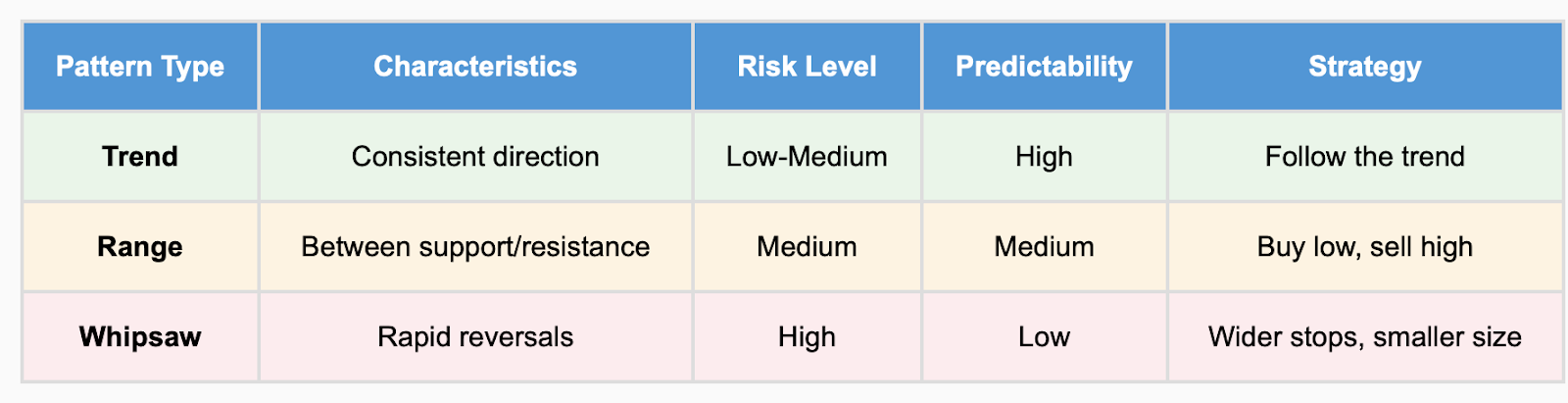
Risk levels, This is where your trading account enters the picture.
- Trends: Low to moderate risk (if you trade with the trend)
- Ranges: Moderate risk (predictable but it can go off, so it is their choice)
- Whipsaws: High risk (unpredictable and could potentially trigger numerous stop losses)
This spring analogy fits right in. When you compress a spring (market tension builds), you would never actually know when it would release or how far it would trigger before going into extreme. It is that uncertainty that we would define a high-risk whipsaw environment.
Experienced traders learn to distinguish between these patterns because the strategies for each are completely different. What works in a trending market can destroy your account during whipsaw conditions.
Reason for Whipsaw Moves in Forex Markets
Knowing exactly why whipsaws happen gives you a huge edge in predicting and managing them. These brief and rapid reversals do not appear out of thin air; they are typically the result of multiple forces converging all-at-once.
Technical Factors: Stop-loss clustering means whipsaws are in perfect alignment to happen. When large numbers of traders place their stops at obvious levels (e.g., round numbers or previous support/resistance), those levels become maddeningly attractive for institutional traders playfully triggering them.
Think about it like school-wide lunch orders, where an increasing number of students jump on the online order system all at the same time; inevitably, the system breaks down, resulting in chaos and waiting. When thousands of stop-loss orders converge at the same time, it creates violent price action that often reverses just as rapidly as it moves.
Lastly, quick breakouts of support and resistance also provide clear avenues for causing whipsaws. A breakout causes momentum, but if the volume does not follow through, price snaps back immediately.
Economic factors are often the push and pull that causes whipsaws in the markets. A central bank's decision on the direction of interest rates can cause a violent whipsaw in USD pairs. The immediate reaction could be in the case of the Federal Reserve, a 100 pip increase in USD/JPY on the announcement before the press conference remarks send the price back down within the hour.
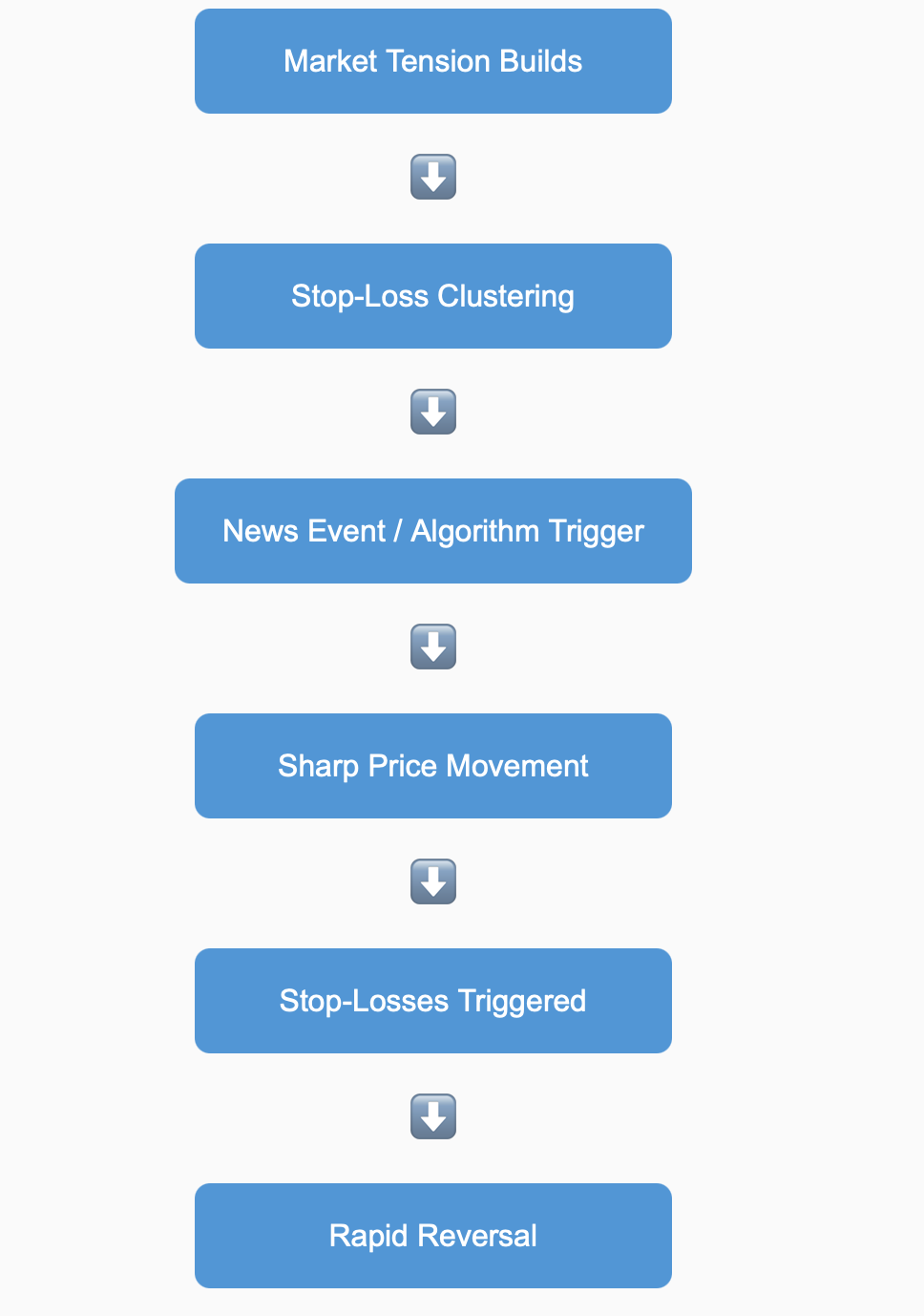
Central bank intervention creates a similar effect as the Bank of Japan announces a plan to weaken their currency by intervening in the JPY pairs. As traders clamour to get into the market, the precise situation for whipsaws is created.
Breaking news is another layer to consider. Geopolitical news, or unexpected economic data can trigger algorithm accounts to run for buy and sell orders that drive prices around aggressively.
Market sentiment is another factor. If the sentiment is too optimistic or too panicked, both can produce whipsaws. If the sentiment is bullish for a currency pair, then any type of negative news can trigger wholesale selling as traders exit their positions.
Consider all of a sudden the school said there was no class due to a snowstorm. The excitement comes that maybe nuts - or apples - may be sold for $2 or $3 respectively. Then the call comes that school is not cancelled, and prices return to normal.
Professional example: The EUR/USD during the 2016 Brexit referendum. Initial polling suggested that "Remain" was winning, and the euro short into rally mode. Then once the results confirmed that "Leave" was gaining traction, the violent reversals created whipsaw conditions straight out of a textbook and trapped many traders.
The critical understanding is that whipsaw conditions take place for reasons other than just the results of polls. They are usually causing when technical levels come into play with a fundamental story, especially when the market is enamored with the story. If you can determine when these events coincide, you can either avoid the chaos or position yourself to make money with it.
Identifying a Whipsaw: Key Indicators for Traders
Identifying a potential whipsaw before it happens can almost be likened to a prediction of when a basketball will begin bouncing irregularly. If you know what to look for, you can indicate when a whipsaw may happen.
Technical Indicators: That Signal Trouble The first clue is moving averages. When price action is truly choppy up and around key moving averages (such as the 20 or 50 period) it is often indicative of forthcoming potential whipsaw conditions. The price keeps bouncing above and below these levels without decisively establishing a market direction.
In this situation, you can rely on the RSI (Relative Strength Index). Watch for rapid fluctuations between overbought and oversold conditions over a very short timeframe. If you see the RSI going from 30 to 70 to 30 within just a few candles, it is very likely that this is a whipsaw setup.
Bollinger Bands have their own indications too. When the bands are squeezing (low volatility) and the price is close to the middle line, it is often indicative of large, violent expansions and can easily become whipsaw conditions. When the bands are super wide and the price is rapidly bouncing between the outer bands, you are in whipsaw conditions.
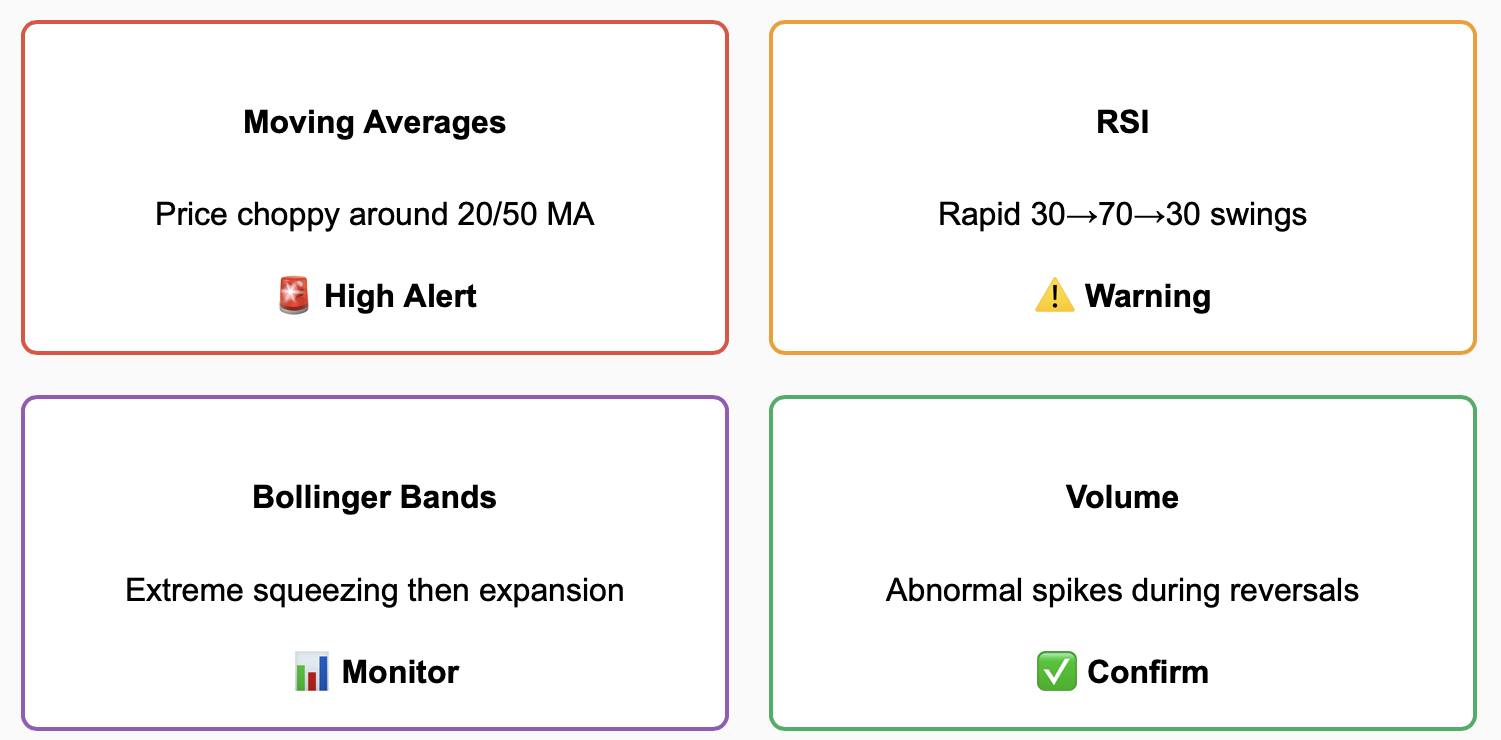
What about chart pattern recognition? Typically, large reversal candles are red flags. A very large bullish candle immediately followed by another very large bearish candle indicates indecision on direction of the market. These back and forth movements often extend for several periods.
Volume spikes to confirm reversals are important confirmations as well. Movement of price to reverse can happen on normal, average volume, but in whipsaws you typically see the action in price with abnormal volume spikes with stop losses getting triggered as institutional players enter or exit positions quickly.
Inside of a short time period, you have experienced several breaches of both short-term support and resistance levels, and these occurrences are an indication of whipsaw. When price breaks above a resistance-level, falls back below the level, then breaks above the level again, all within the span of an hour, this is what you would refer to as whipsaw.
Real-World Example : We can take a look at EUR/USD, for example, during a classic NFP release. On the 1-hour chart, the price has consolidated within a very tight range, leading into the 8:30 AM EST release. Volume is less than average, Bollinger Bands are contracted, and the RSI is hovering around 50.
At 8:30, the NFP number comes in above expectations and EUR/USD suddenly drops 40 pips on a rush of volume, with RSI dropping to 25. But within 15 minutes, comments from Fed Officials about inflation concerns send the EUR/USD pair roaring back up 60 pips, with RSI suddenly pushing to 75.
In the following hour, there were 3 more sharp reversals as algo and institutional traders position themselves in a perfect whipsaw environment. Traders that recognized this setup may have stayed out of the market entirely or simply traded their approach as a means of survival in a chaotic environment.
Key warning signs checklist:
- Price resting just above or below important technical levels just before news
- Contracted volatility (tight Bollinger Bands) in advance of data release
- Multiple time-frame analysis showing contradictory signals
- Unusual volume/movement (expected pattern of movement is not occuring) or very low volume when expected pattern is occurring
- Multiple false breakouts in recent sessions
Remember, identifying whipsaws isn't about predicting exactly when they'll happen. It's about recognizing when conditions favor these rapid reversals so you can adjust your strategy accordingly.
Whipsaw Across Different Time Frames: Understanding Frequency and Impact
Time frame differences make all of the difference when it comes to whipsaws. What looks like violent chaos on a 1-minute chart may only look like a small blip on the daily chart. Being able to understand the difference can save your trading account.
Intraday Whipsaws (1-minute to 1-hour charts): These are the most common and often the biggest risk for retail traders. High-frequency trading algorithms and similar scalping strategies create buy and sell orders that rapidly whip prices around violently and all within short periods of time.
Think about this like exam scores that oscillate very dramatically within a short timeframe. One test brings your average up, the second test brings your average crashing back down to where it was before. As the semester progresses these tests average out over the course of time.
The USD/JPY on the 1-hour chart during the Tokyo - London overlap illustrates this point perfectly. The pair is completely swinging 50 pips one way and then swinging completely back within the next hour as the change of trading session and different algorithm systems colliding.
4 Hour Chart Perspective: Four hour charts smooth out most all of the intraday noise but can still capture meaningful short-term trends and trends as well. Whipsaws on this timeframe are less frequent but typically carry more significant weight when they happen.
Typically, these shifts align with major news events or shifts in market sentiment that develop slowly over a period of hours. If you observe a whipsaw on a four-hour chart, you're likely looking at a legitimate change in the market dynamics rather than simply the noise created by algorithms.
Daily Chart Analysis: The daily chart gives the best insight into actual changes in trend versus whipsaws. A massive reversal candle on lower time frames looks to be a significant price change, but on a daily it might barely register as a small wick.
This is where the basketball analogy works perfectly. If you are standing next to the hoop and watching the ball bounce a few inches from you, every bounce looks strange, violent, and unpredictable. If you instead stood across the court and could view the whole bounces, you would see a bounce pattern develop.
Impacts on Trading Strategies
The timeframe you choose has a large impact on whipsaw frequency and your trading options:
Scalpers and day traders will experience the most whipsaw options because these traders are trading in the noise zone where algorithmic trading is creating the greatest noise. They will depend on very strong risk management and very fast decision making skills.
Swing traders that utilize a 4-hour or daily chart have some built-in protection from many whipsaws due to their longer holding periods, which allow for short-term noise to smooth out. They can usually weather a short whipsaw period that would take out shorter-term traders.
Position traders focused on weekly and monthly charts will be nearly immune to most effects of whipsaw while facing their own challenges such as bigger drawdowns when the trend is changing.
Professional Example During the 2019 Fed rate cut cycle, USD/CHF displayed classic multi-timeframe whipsaw. Day traders witnessed extreme 80-pip reversals occurring only a few hours after Fed announcements. The same sharp movements were also just small shadows in the weekly chart where the overall downtrend remained intact.
Takeaway Your choice of timeframe should fit with your risk tolerance and lifestyle. If you cannot watch a position constantly, the shorter timeframes with more whipsaw probably will not fit your trading style.

Trading Psychology Behind Whipsaws: Avoid Emotional Traps
The whipsaw situations often reveal that your mind is your worst enemy. There is no other event that triggers all the psychological bias and mental traps that destroy trading accounts, and understanding and recognizing these structures will save your trading account.
The Emotion Rollercoaster Whipsaws create a perfect storm to trade emotionally. You enter into a position with confidence, watch it move in your favor, and then you receive the gut punch of a swift reversal. The natural inclination is to panic close the position or double down to "average your losses."
Both of these responses are usually incorrect.
Imagine you are a student and throughout the semester, due to a series of surprise quizzes, your grade fluctuates every week. That anxious feeling leads you to believe you have to study everything, study the wrong material, or even give up completely. This same psychological aspect plays out in forex trading during whipsaw conditions.
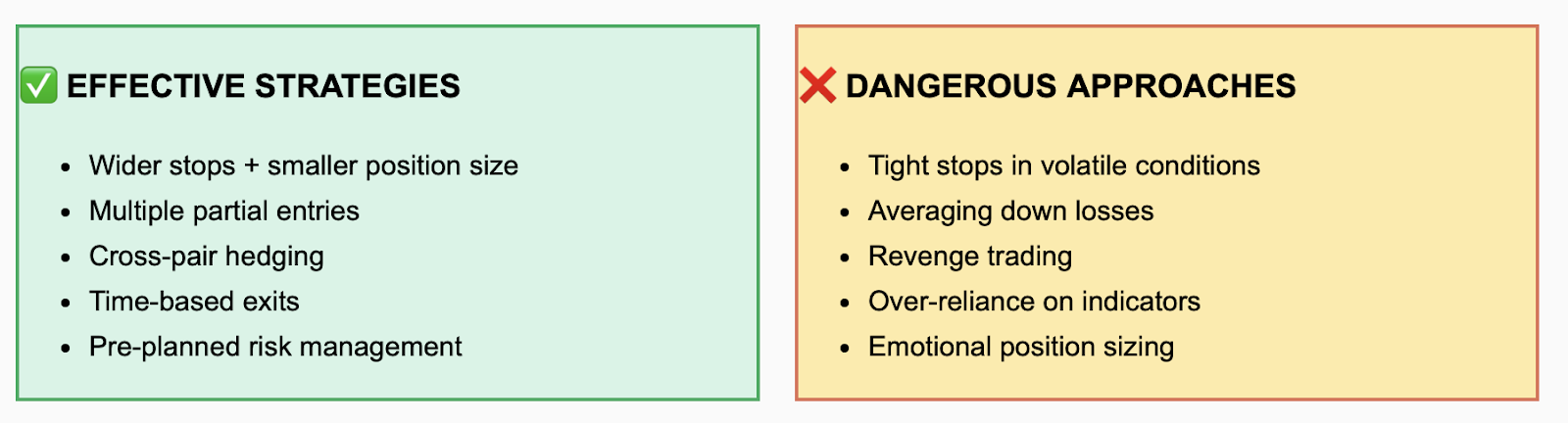
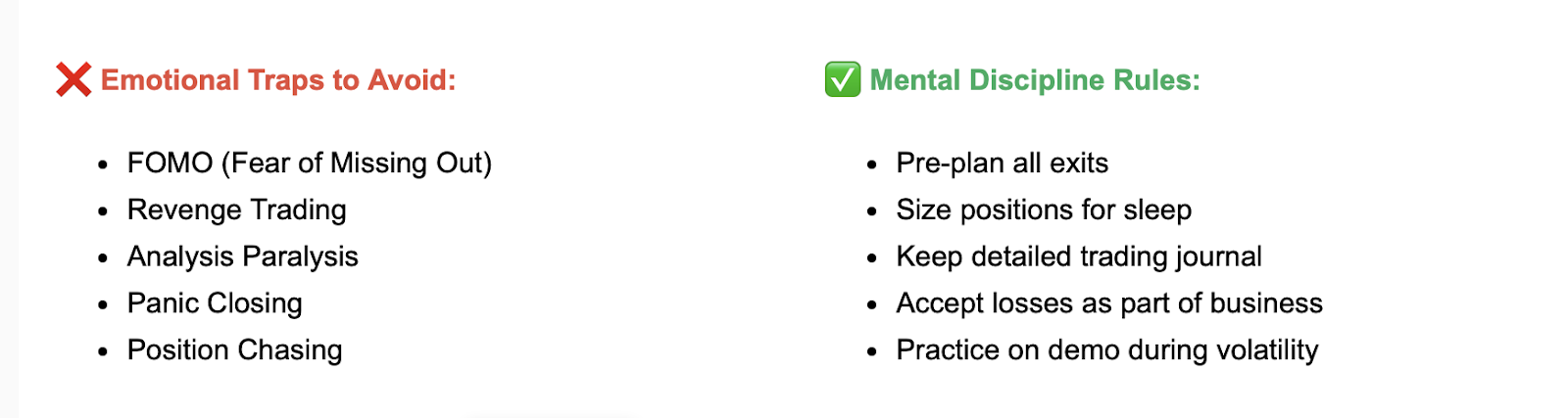
Common Emotional Traps Price chasing is inevitable during whipsaws. You observe a rapid movement, and your brain screams, "Don’t miss out!" So you enter, only to see the price reverse in seconds. This FOMO nature is hard wired and exists in every aspect of human psychology, but it is deadly in whipsaw conditions.
Revenge trading is another serious problem. After being whipped out of a position, it is only natural to "get even" with the market by entering again or increasing position size. This emotional response is rarely productive.
The reverse of that is analysis paralysis. After being whipped out several times, these traders become so afraid of being wrong that they will not pull the trigger on trades, even good opportunities.
Strategies to Control Psychological Distress Pre-planning is everything. Plan exactly where you will exit the trade before taking the trade, particularly in whipsaw conditions. Write it down! When the emotions present themselves, refer back to your trading plan instead of making an emotional decision.
Position sizing becomes very important. Risk only what you can afford to lose without difficulty. If you struggle losing 2% of your account on a single trade, then shorten that to 1% or even 0.5%. The position size should be such that you know you can think clearly when the trade moves against you.
The Non-Farm Payroll or NFP example Non-Farm Payroll releases create college textbook examples of how psychology affects whipsaw trading if you listen to professional traders. There are those who described the exuberance or sadness as the number hits the board, only to adjust their position size in a matter of seconds while the market "digests" the data.
Retail traders who find themselves in these situations often commit the same errors. They notice the initial sharp move, think it is the beginning of a new trend, place large positions, and then gasp in shock as the market turns against them. The emotional toll of losing money quickly causes them to make other poor decisions.
Building Mental Resilience: Accept the fact that there will be whipsaws, they are part of trading, and they do not reflect personal or professional shortcomings. Experienced traders account for whipsaw losses in their trading plan just as a business would account for operating expenses I'm sorry for the intrusions here, but I need to clarify for readers that expecting losses as part of a trading plan is normal.
Detail a trading journal. Document not just what occurred, but how you felt before, during and after each trade. You will probably see patterns in your emotional response to risk that precisely resemble the errors you will make in the future.
Practice with demo accounts during volatile periods that you already expect to be volatile. There is no way to replicate the emotional pressure of real money, but you can practice your mechanical reactions to behavioral whipsaw conditions and learn to create processes within yourself for facing that.
The professionals who survive whipsaw conditions or thrive are not necessarily smarter traders or better traders at determining where price will go. They are people that are superior at controlling themselves emotionally in the moment of chaos.
In the end your biggest edge in whipsaw conditions is absolutely not technical analysis nor even a general or specific knowledge of fundamental factors. Emotional discipline.
Strategies to Handle Whipsaw in Forex Trading
To endure whipsaws, you need to use strategies that are different than "normal" trend-following or range-trading methods. Consider these your survival kit when the market gets crazy.
Strategic Stop-Loss Placement: The conventional stop-loss advice is often irrelevant when a whipsaw event occurs. If you place your stops at obvious technical levels, such as previous support/resistance, it is likely that you will be stopped out right before the market does something you would want to take advantage of.
Wider Stop Strategy: In pre-announced volatile times, such as NFP or Fed announcements, consider deploying a wider stop than normal but reducing your position size by the same ratio. In other words, if you normally risk $1,000 at a 50-tick stop, maybe widen it to a 100-tick stop and risk $500. This gives your trade some room to breathe through the excitement during the first chaos of a trade, while maintaining the same dollar risk.
Time-Based Stops: In some situations, using a time-based stop is more appropriate than a price stop. For example, if your trade has not worked out in a certain time frame during volatile times, exit the position regardless of price.
Multiple Partial Stops: Rather than using just one large stop-loss order on the trade; consider using multiple smaller stop-loss orders. This is beneficial because you can reduce your exposure across your stop orders gradually instead of than a large single hit.
Hedging Strategies Cross-pair hedging can be very effective during whipsaw conditions. For example, if you are long EUR/USD but worried about the strength of the USD, it would be effective to go long EUR/JPY at the same time. Strength in EUR would help you out in both positions, while moves in the USD would only affect one.
You could think of this like when students diversify snacks at school. Instead of buying a single bag of potato chips, they will buy a bag of chips, a candy bar, and a drink. When news comes out that causes potato chips to crash in price, the other snacks should hold their price steady or even go up.
Correlation hedging: If you are trading during uncertain market conditions, trade pairs that are negatively correlated at the same time. For example, being long GBP/USD and short EUR/GBP should help mitigate the negative effects of whipsaw conditions on both positions, while still allowing you to profit overall if your view of the market direction is correct.
Automated Trading Solutions Advantages of algorithms: Automated systems can execute your trades much faster than any human emotion can react. In whipsaw market conditions, when you want to sell some of a position, the speed difference between manual and algorithmic execution can make the difference between profit and loss.
Paradigm-shift: Automated trading systems follow pre-determined criteria regardless of what happens in the market. They don't panic, they don't revenge trade, and they won't hold back when trying to execute profitable trades when they see something.
Risk management: Modern trading platforms allow you to develop complex risk management rules that automatically execute during high volatility market conditions.
Institutional approaches used by professional traders Large institutions take advantage of more sophisticated methods and these same methods can be the basis of retail trader strategies if they wanted to incorporate the concept of whipsaw movements in their thinking:
Layered entries: Rather than enter the full position size initially, institutional traders tend to take multiple smaller entries over time or even at predetermined price levels to lessen the impact of any one whipsaw movement getting caught up in that turbulence.
Dynamic position sizing: Professional traders adjust their position sizing based on the current volatility conditions. Normally a period of high volatility means reduced position sizes; high volatility is capped at a lower position size to shelter capital during whipsaw conditions.
Market Maker Strategy: Some professionals will actually profit from whipsaws by supplying liquidity when everyone else is panicking. This will come with requirements on risk management with significant capital, but keeps in mind that whipsaws can turned into opportunities for traders who planned ahead hoping they would happen.
Practical implementation for example: You want to trade GBP/USD near a Bank of England announcement. Under your trading routine you might:
- Take the full position size before the announcement
- Use your standard 50 pips stop-loss predetermined for the trade
- Then have hope you just get a clean breakout
Try this whipsaw adapted version:
- Enter a 25% position size 30 minutes before the announcement
- Use a 100-pip stop-loss but in which you reduced you normal position size to 1/4 your normal size resulting in the same dollar risk
- Add to the position after the initial volatility settles and market direction is according to plan
- Set profit target at multiple levels to capture any small rapid movement in your favor
The Big Picture Whipsaw doesn't focus on predicting the direction the market will go. It focuses on positioning yourself to get out of the way and profit regardless of the messiness of price action.
This strategy can take time and should fit your trading style and risk threshold. You will want to start small, test on a demo account during volatile times, and as you gain comfort, put your own capital into it.
Whipsaw Triggered by News Events: How to Foresee Volatility
News events tend to create some of the most predictable and also terrifying whipsaw scenarios. While you can't predict the news; you can guess which conditions are conducive to whipsaw development.
High-Impact News Events Central bank policy decisions are on the high-impact news list. Federal Reserve rate decisions typically don't just move USD pairs; it creates a violent cross-currents while traders of various styles try to position for the new interest rate environment.
The initial market reaction often captures the headlining decision but the Fed press conference and guidance is capable of reversing the prior move entirely. For example, EUR/USD may spike higher by 100 pips on a dovish hold but then crash down 150 pips and during the press conference the Fed Chair hints at tightening.
Surprises in economic data will typically have similar impacts. When actual data deviates significantly from expectations and forecasts, algorithm and trading systems as well as institutional repositioning can create perfect whipsaw conditions. High-profile data releases such as Non-Farm Payrolls, inflation data, and GDP releases are the major culprits.
Geopolitical events ground the same unpredictable conditions. Trade war announcements, Brexit developments, or a meteorically unanticipated political shuffle could trigger violent, digitally speeds, currency moves that will quickly reverse upon the next news announcement.

Anticipating Strategies Similar to the equivalent of being surprised by an announcement that all classes are cancelled because of weather, at first there is excitement that causes panic in the hallway, but soon, the excitement wears off, and everything seems to return to normal. The smartest students attempted to position away from the chaos, instead of appearing like livestock scattered to avoid the herd in the hallways.
Awareness to the economic calendar is also critical. Highlight impactful events each quarter at least one week prior and setup your trading framework, as necessary. This does not mean you afe preventing trading, rather you should be sure to adjust your style of trading to manage increased volatility.
Analysis of consensus serves to gauge underlying whipsaw potential. If the economists' forecasts and expectations show a great deal of disagreement regarding any upcoming information, you can bet one way or another the result is likely to startle a big chunk of the market and operating conditions will be ripe for whipsaw.
Market position data offers additional context. If speculative positioning is extremely one-sided before a major announcement, you could also count on that player segment to be unwinding in mass and put you in a position for those types of wild reversals.
Pre-News Positioning: Diminishing your position sizing is probably the smartest way to play. Position yourself with anywhere from 25-50% of your normal position size, allowing you to participate in potential outcomes, but limiting the overall damage from a whipsaw.
Utilizing wider stop losses with proportional size reductions allows you some breathing room surviving initial volatility without materially increasing your dollar risk. A 100-pip stop loss, with half your position size, inherently applies the same risk as that of a 50-pip stop with full position size.
Multiple time frame analysis gives a little more significance to potential whipsaw before informative events. What may look like a clear setup on the 1-hour could be headed for a major resistance level on the daily increasing whipsaw probability.
Post-News Adaptation: The first 15-30 minutes after major news is generally speaking total chaos. Professional traders might even sit on their hands until after this initial time period has paced out before making any positioning.
This paper examines the changing preferences and buying habits of Generation Z (Gen Z) in the context of sustainable fashion. Being the first digital-native generations, Gen Z influence the economy and is highly committed to environmental values. These factors allow them to have a significant impact on the in-store shopping experience and in the retail space overall.
The paper integrates research on their motivations towards sustainability, such as demands for transparency from brands, authenticity, and social responsibility. Additionally, the report will explore behavioral inconsistencies, notably the "value-action gap," which is their beliefs that we should be acting sustainably (taking individual or community-focused action) and behaviors that are often mediated through cost and fast fashion.
Continuously keep your eye on the economic calendars, know the market's positioning before major events, and always plan for a first reaction and a possible reversal. The traders that continue to survive and make money during violence are the ones that understand to plan for chaos, not hope for clean, directional moves.
Dangerous Misconceptions and Tips for Whipsaw Trading
The forex education industry is chalked full of advice that works great in trending markets, but can kill your account in whipsaw conditions. Let's look at some dangerous concepts.
"Always Use A Tight Stop" This suggestion is deadly for accounts during whipsaws. If we think about it logically, it "makes sense" in trending markets where you want to cut your losses quickly if the trend breaks. But in whipsaw conditions or markets, the tight stop almost guarantees you're going to have your account chopped up by quick reversals.
You are getting better: Think about using wider stops with smaller position sizes during accelerated moves. Your dollar risk is the same, but you can still trade while the trades have room to withstand temporary adverse movements.
"Buy Which dips and sell which rallies" This will work in range trading markets, however whipsaws are not regular range trading patterns. Whipsaws will violently and randomly whipsaw and go further than your rational mind needs!
Trying to catch falling knives during whipsaw conditions is like trying to catch a basketball that's bouncing wildly. You would very likely get hurt instead of catch them cleanly.
"Averaging Down" Adding to losing positions during whipsaws is financially reckless. What seems like a good price to add might actually just be halfway through a 200 pip reversal. A professional trader would do the opposite and size down when a trade goes against them in volatile conditions.
"Indicators Are Your 'Friend" Traditional technical indicators often fail spectacularly in whipsaws. The RSI, for example, can remain overbought/oversold for long periods of time during violent price moves. Additionally, moving average cross measures often generate several false signals.
A smart approach: Use indicators as an understanding of volatility and potential reversal zones, NOT as entry or exit points during whipsaw periods.
"Overtrade" Whipsaws provide an illusion of opportunity. Price would indicate fast-moving and near consistent opportunities to trade profitably. This will cause you to overtrade (using marginal setups) and lose money very quickly by commissions and spreads.
"Fact Check" In reality, most of the times you will profit during difficult whipsaw periods will be done out of patience, not activity. (In the market, 'patience' is a virtue, to often get rewarded.) You are better off waiting for a clear setup, instead, rather than trying to catch each swing.
The Fallacy of "Prediction" Many traders assume they should be able to predict which way a whipsaw will go. This presumption can cause frustration and bad decision-making when price does not move as analysts would like.
Truth: Whipsaws cannot be predicted for the most part, simply because the definition is unpredictable. Movement comes from risk management and positioning for multiple possible outcomes, not predicting the exact course price may take.
Position Sizing Mistakes Fear-based sizing: Some traders will size down so much during volatile conditions that even profitable trades have no effect on their account.
Greed-based sizing: Others will size up, thinking they can make more money from being bigger during volatile conditions. This usually goes poorly.
Best practice: Size positions based on your stop-loss distance. When you have to use a wider stop-loss, shrink your position size to maintain a risk amount in dollars that is consistent with previous trades.
Timing Mistakes Too early: Entering into position too soon, before the whipsaw conditions have settled down, often catches traders amidst the whipsaws.
Too late: Waiting for the "perfect" whipsaw market condition can lead to missing the trade altogether.
Balanced: In uncertain conditions, consider entering into partial positions and adding to a winner's position when clearer direction is exhibited.
Risk Management Truth Most traders abandon risk management during the whipsaw state out of fear or greed. Both can be harmful.
Risk management becomes EVEN MORE important during whipsaws, not less. The enhanced uncertainty calls for more rigid discipline, not more lax controls.
Practical Tips for Success Accept higher win percentages and lower profit targets:
In a whipsaw condition, taking smaller profits more often will frequently prove to be a better strategy than trying to hit the home run.
Observe multiple timeframes: What may appear to be chaotic on the 5-minute chart, may provide clarity of direction on the 1-hour chart.
Keep detailed records of spatial consideration. You must track what works for you and what doesn't in an agitated space. Don't do what the market advises do what is statistically relevant to you.
Practice emotional detachment: Whipsaw markets are more about testing discipline on the psychological side than requiring that you exhibit strong technical skill.
The traders who walk away with a profit in this whipsaw condition are not progressively smarter or better at their analysis than anyone watching the price action. They are simply better at avoiding the common mistakes and staying disciplined when everyone else is panicking, and/or being greedy.
Conclusion and Practical Tips: Mastering Whipsaw in Forex
Whipsaw conditions are not market anomalies or hiccups in the system – they are characteristic of the forex market, and an experienced trader understands how to deal with these conditions. The ability to handle reversal conditions often defines the line between a trader's long-term profitablility versus account destruction.
Overview of Key Concepts Whipsaws are instances of rapid price reversals that not only can trigger stop-losses but can also take you by surprise as a trader. Whipsaws represent a level of complexity with underlying technical factors (clustering of traders stop-losses or algorithmic trading), fundamental factors (news, central bank reaction), and extremes of market attitude related to overbought and oversold.
Though often dismissed as "noise", whipsaws are significantly different from a trend, range, or breakout. While more risky, most traders will be able to exploit the unique opportunities available from whipsaws. Whipsaws become apparent through various technical factors (highly volatile RSI, price action around moving averages), volume (or lack thereof), and an understanding of existing market conditions that may be more conducive to rapid reversals, or shifts in price action.
An analysis of timeframes suggests that whipsaws appear regularly on shorter timeframes, but you can also be affected by whipsaws if you are carrying a position (partially or fully) over into a longer-term timeframe. The timeframe should match your ability to gauge risk and your own willingness to monitor risk.
Psychology and Risk-management Your mental approach will matter more during a whipsaw than also during any other market condition. Emotional responses, such as revenge trading, position chasing, or panic closing have destroyed more accounts than bad technical analysis ever has.
Attaining success of a whipsaw, the trader should have a pre-planned strategy- bigger stops with lower (or no) position sizes, multiple partial entries / exits, and emphasized adherence to general risk-management obtaining when emotions may run high.
A Practical Execution Strategy
Begin by demo trading during the most known periods of volatility. This may include executing your strategies during periods of time when NFP, Fed announcements or any high-impact economic events create whipsaw conditions. This practice will allow you to become familiar with managing fast reversals in price actions as it relates to executing your strategy, without risking actual money on your trades.
- Develop your own whipsaw playbook :
- determine what your maximum comfortable stop loss distance is during volatile periods,
- establish what position size is appropriate to use with larger stops,
- establish specific entry rules and exit rules for news volatile price action,
- practice cross-pair hedging strategies,
- test automation trading rules for volatile conditions
Advanced Thoughts Professional traders often profit from whipsaws rather than losing due to them. The disadvantage is that they employ sophisticated risk management, have significant capital, and have extensive experience. Please do not try any advanced advanced whipsaw-dependent strategies until you have completely mastered any basic survival techniques.
Market maker strategies and volatility trading approaches can generate profitability as well. They typically require a different skill set compared to conventional directional trading.
Long-Term Mindset Think of whipsaws as trading costs instead of failing as a trader psychologically. All successful forex traders will experience whipsaw losses at some point in time. Your main objective is to keep the losses to a minimum when compared to your profitable trades.
You edge comes from either surviving the whipsaw period with limited damage while positioning yourself to benefit from direction moves that may come as a result of experiencing high volatility.
The forex market will continue generating whipsaws as long as humans and algorithms trade currencies. Your success depends not on avoiding these conditions but on developing the skills, strategies, and psychological discipline to handle them profitably.
Master whipsaw management with tradewill.com, and you'll have conquered one of the most challenging aspects of forex trading. The confidence and skills you develop handling rapid reversals will improve every other aspect of your trading performance.
I will provide a concise, direct answer by generating an SEO title, meta description, and meta URL for the provided blog post. I will structure the response with clear headings and bold key terms to ensure readability and directness.
Disclaimer: The content of the blog does not represent any position of Trade W, does not serve as any trading-related decision advice, and does not endorse any third-party.