

 Trade W
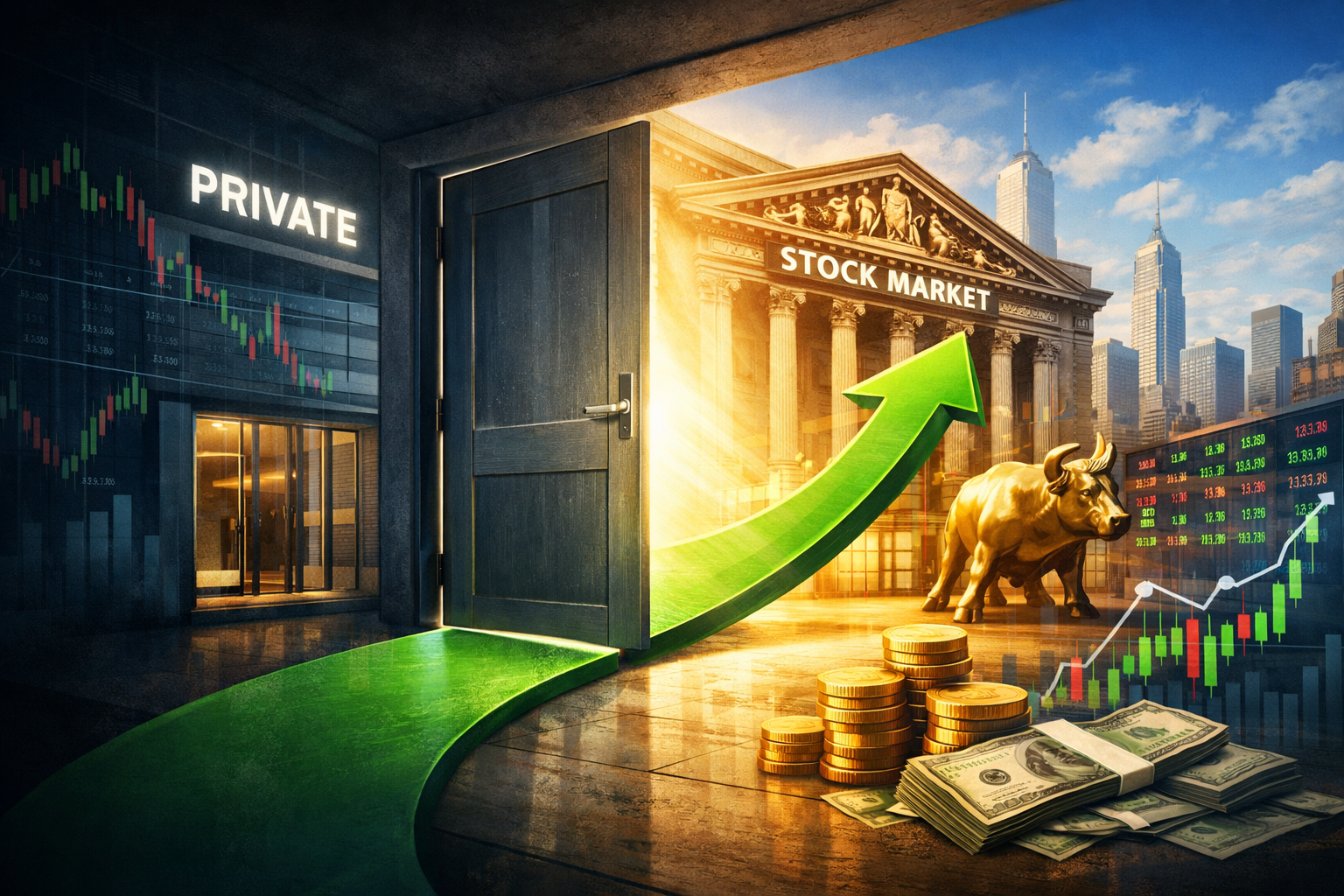
For many businesses today, going public can be seen as an outstanding achievement. Yet, many businesses use methods other than the traditional Initial Public Offering (IPO) to achieve this. Reverse mergers are one such option available to private companies that want to enter the public capital markets without enduring the lengthy and expensive process involved with a traditional IPO.
The simplest way to think of a reverse merger is as an acquisition of a publicly traded "shell" company by a private entity. Shell companies are companies that can be listed on a stock exchange but usually operate without employees, sales/revenue, or other material assets.
By acquiring the "shell" of a publicly listed company, a private entity essentially takes over that entity and is immediately considered a publicly traded company. As such, when done correctly, a reverse merger is not a loophole but a truly legitimate method for entering the capital markets quickly.
An analogy for understanding the difference between a reverse merger and an IPO could include building a house from scratch using the traditional IPO route, or purchasing an existing shell of a home and renovating it before moving in. In either case, once completed, you now have a new address where you can receive mail, and have the electricity, water, and gas connected to the house as soon as you move in.
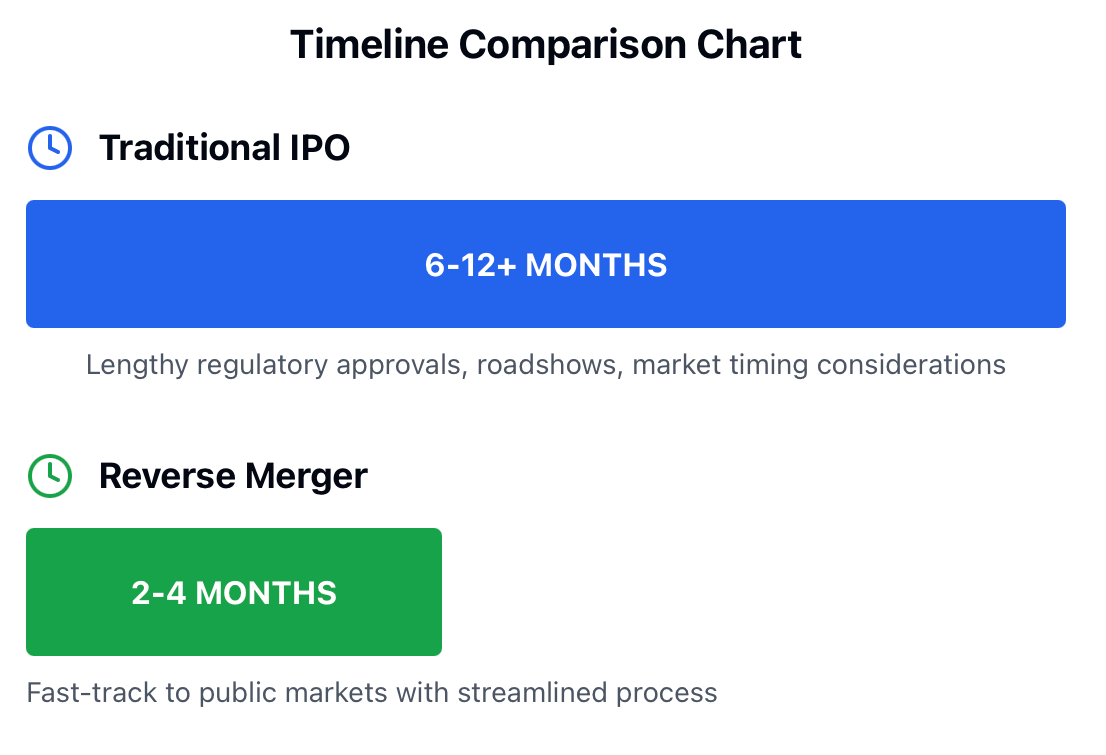
One reason why companies may opt for a reverse merger is the speed of the transaction. An IPO could take anywhere from 6-12 months or longer and can be subject to a number of regulatory approvals and increased market volatility before completing the offering. Conversely, the entire reverse merger process could potentially be completed within a few weeks or months from start to finish.
Examples of a reverse merger include Nikola Motor Company, which made news headlines by reverse merging into the Nasdaq Capital Markets. Alternatively, one could consider a family-run business that has purchased an inactive public shell to jumpstart its operations and begin trading shares earlier than would have been acceptable under standard approval processes.
Some important questions come into play when considering a reverse merger as a financing option for your company, including: Is this financing method a good fit for my business? What risks and opportunities are associated with the reverse merger?
While the "shell" plus a private company equals a publicly listed company may seem straightforward on paper, executing the strategy successfully will require careful consideration and attention to detail.
What Is a Reverse Merger? Understanding the Fast Track to Going Public
If you are unfamiliar with the Reverse Merger process, then it may seem odd. A reverse merger allows a private/closely-held business entity to become listed publicly without having to go through the Initial Public Offering (IPO) process. By reverse merging, you are essentially purchasing an already established ticket to the stock market as opposed to having to apply for a brand new ticket.
The free thinking behind reverse mergers is fairly straightforward. A publicly traded "Shell" entity is merging into a Private company. Upon completion of the merger, the Owners of the Private company are in control of the work and are now running a Publicly Traded entity.
An analogy would be that reverse merging is similar to acquiring a retail location that already has all of the appropriate permits and licenses necessary to operate, as opposed to building a business from scratch and acquiring the appropriate permits and licenses.
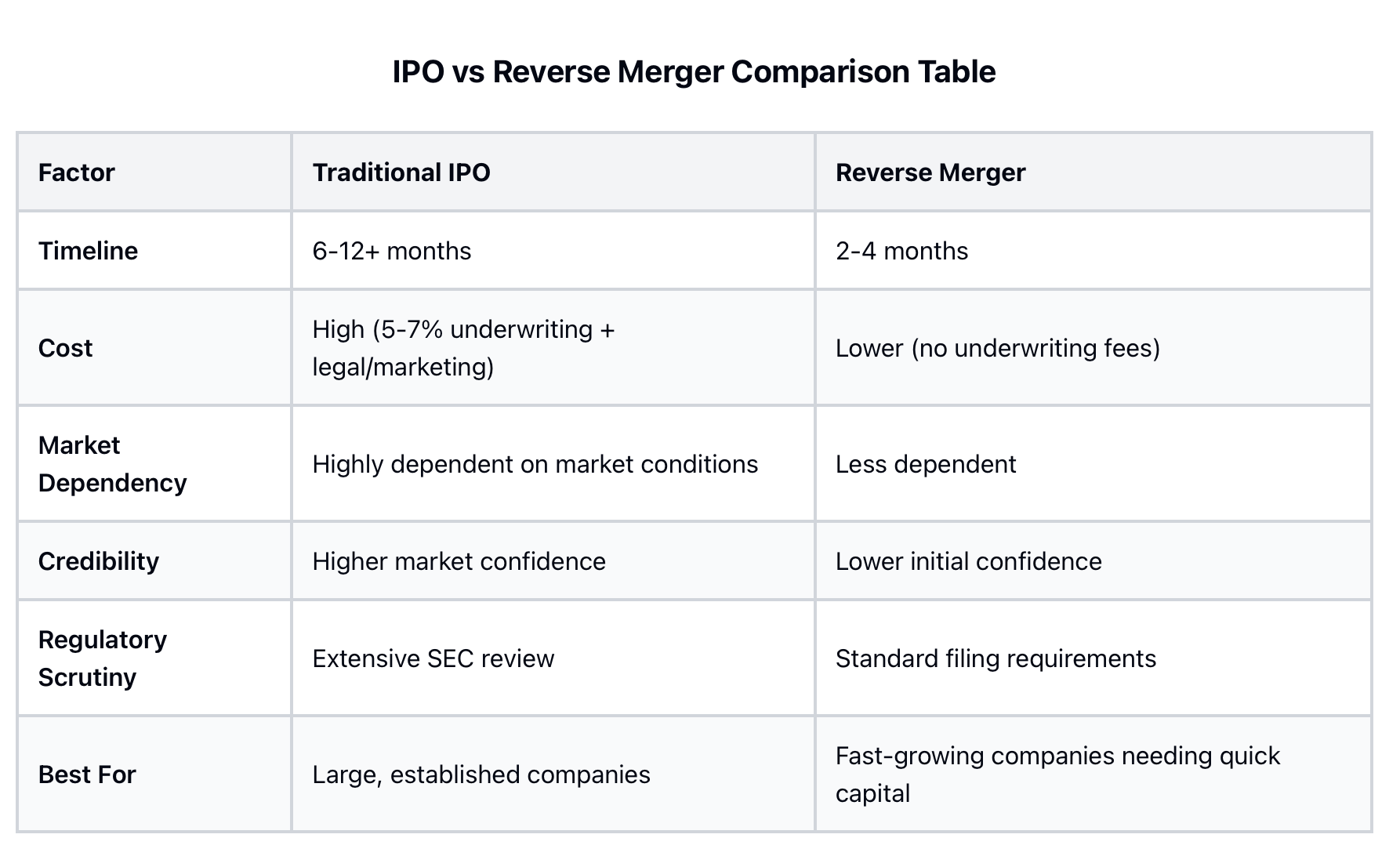
Why would a Company choose a reverse merger and forego the IPO process?
Faster Timing: An IPO typically takes 6 to 12 months or longer to get completed, whereas a reverse merger could be completed in a matter of weeks or a few months! For companies that operate in fast-paced environments or in times of economic downturn, gaining access to capital as quickly as possible is critical.
Lower Cost and Cost of Underwriting: For IPOs, companies incur hundreds of thousands of dollars in legal fees, underwriting costs, marketing expenses, etc. Reverse mergers typically do not have these costs because the companies do not do the road show, book build process, etc.
Less Dependent on Current Market Conditions: The market conditions for IPOs are highly impacted by volatility, whereas Reverse Mergers are not nearly as dependent on current market conditions.
Reverse Mergers are a legitimate financial strategy for serious companies. Reverse Mergers also pose challenges for Companies that can afford to wait for the validation of an IPO. Reverse Mergers are not a loophole but rather are an intelligent decision (can take advantage of time savings and cost savings of the IPO process vs. waiting for IPO validation).
How Reverse Mergers Work: The Step-by-Step Process
Reverse mergers may seem to be some type of financial wizardry, but by knowing how these events work it takes away a bit of the mystery. The steps involved with reverse mergers are relatively straightforward:
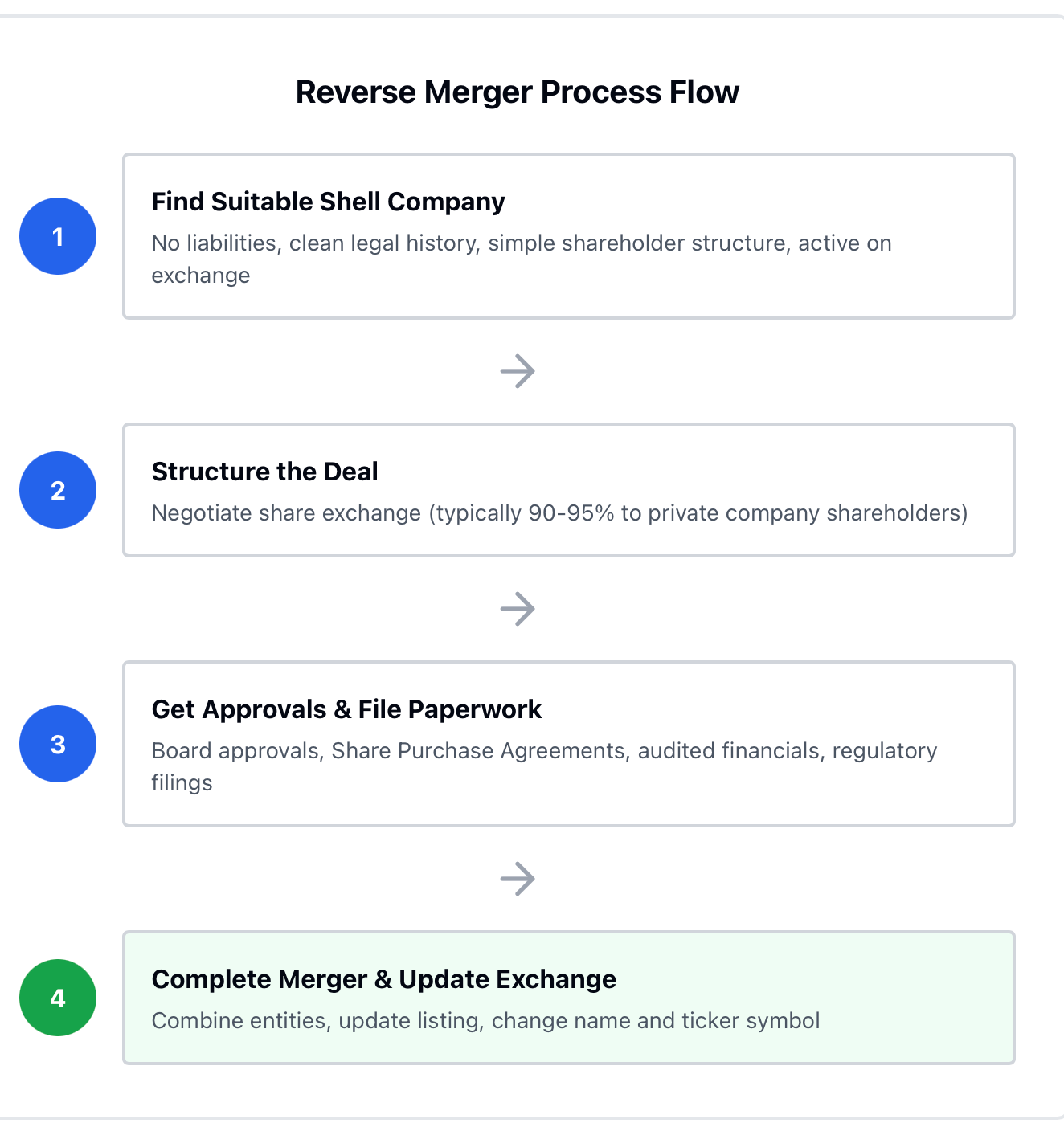
Step 1: Find a suitable shell company: A good shell company should have no liabilities, no legal issues and a simple shareholder structure. Shells must be active on an exchange (exchange) but include little or no management activity.
Step 2: Structure the deal: The private and shell companies negotiate the share exchange between the shells and the private companies' shareholders. Typically, private company shareholders will own between 90% and 95% of the newly consolidated company shares, with a small percentage owned by existing shell company shareholders. This allows for management of the private company to be in control.
Step 3: Get approvals and file paperwork: The boards of each company will need to approve the merger. Then it is time to file the required documentation, such as Share Purchase Agreements, audited financial statements, Due Diligence Reports, and required Federal and State regulatory filings. This process is very paper-intensive and requires a great deal of legal and accounting expertise.
Step 4: Complete the merger and update your exchange: Once all approvals are in place, all documents have been filed and the necessary fees paid, the final step to the merger is when the companies combine to form a new legal entity, which will update its listing on the stock exchange and usually changes its name and ticker symbol, identifying itself with the private company's brand.
For example, in early 2020, DraftKings, a sports betting company, completed a reverse merger with Diamond Eagle Acquisition Corp., a special purpose acquisition corporation (SPAC). DraftKings began trading on the NASDAQ within several months of its reverse merger without going through the extensive process of becoming publicly traded through an initial public offering (IPO).
How does an IPO differ from a reverse merger? In an IPO, new public shares are created for the purpose of selling those new shares to investors through underwriters. In the reverse merger, you are acquiring and leasing an existing public structure and putting your company under that structure.
In summary, critical success factors when arranging a reverse merger include two main points: selecting an appropriate shell company and structuring the equity properly. Selecting a shell company with unknown debt and/or complex shareholder issues can derail the entire reverse merger process. Due diligence is a necessary element of any successful reverse merger transaction.
The Advantages of Reverse Mergers: Why Companies Choose This Route
Why do some businesses look for a reverse merger rather than just consider it a backup to an IPO? Because companies need to be able to go public so they can obtain cash and develop products before they run out, and many times, the timing of the market and the speed of being able to get on are what really matter to the success or failure of those businesses.
A business can complete a reverse merger in two to four months, while the IPO process takes six to twelve months after filing with the SEC. The savings in time may make it possible for a business to take advantage of the opportunities that exist within a market, or it may have lost those opportunities.
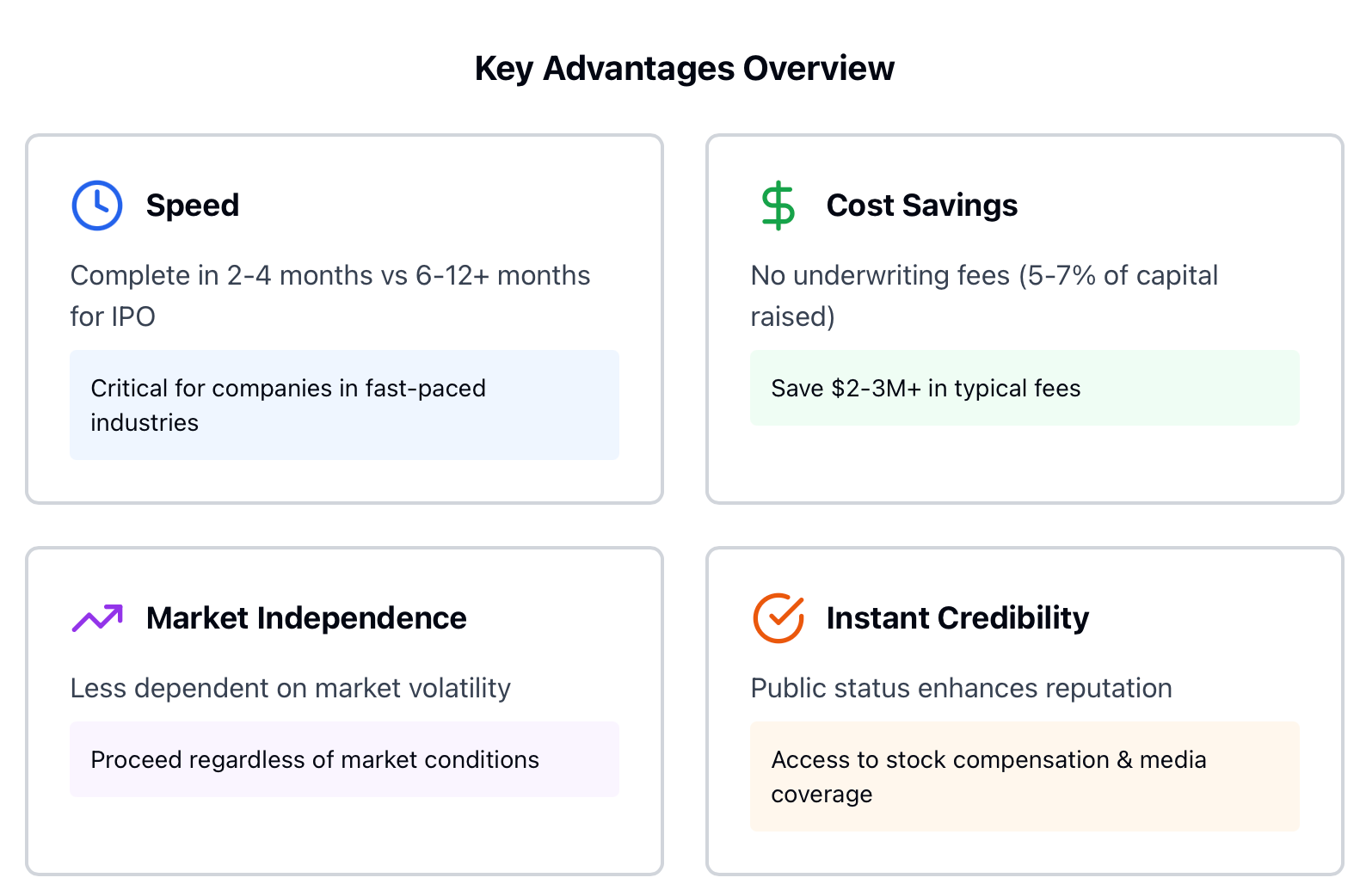
A business will save a considerable amount of money on all associated fees when using a reverse merger. A typical IPO's underwriting fees are charged as five to seven per cent of what the company raises, plus legal fees, auditing fees, and marketing expenses. If a small company saves between two to three million dollars in the fees associated with their IPO, and has an extra three to four million dollars in cash available for product development or expansion efforts in the marketplace.
Once a company goes public, it has been able to obtain credibility in the eyes of its customers, investors, and employees. After the IPO, these companies will have access to stock compensation and the media will be much more attracted to publicly traded companies than they would be attracted to private companies. For emerging industries, having media attention even before the major capital raise may create significant growth.
Capital raises will be more accessible to companies that have gone public as compared to private companies. Companies that have gone public will have an established market value for their shares and have access to a larger number of potential investors.
Certain types of businesses are more likely to benefit from reverse mergers. These businesses typically include tech start-ups where the company has proven that the product is viable and needs additional capital to further develop, and companies that will benefit from being publicly traded companies and will have to rely on fast access to capital.
Think of a student organisation that wants to be involved with the university's larger activities. It would be much easier to just purchase the existing club's charter than to wait an entire semester to complete the necessary paperwork and obtain approval. The same reasoning applies when you look at the strategic value of a reverse merger.
Companies that consider a reverse merger are not companies that are desperate and need to do this to survive or obtain additional funding. They are companies that have made a decision based on a strategic decision to have access to capital quickly and to be able to use that capital to achieve maximum efficiency.
Risks and Challenges: What You're Really Getting Into
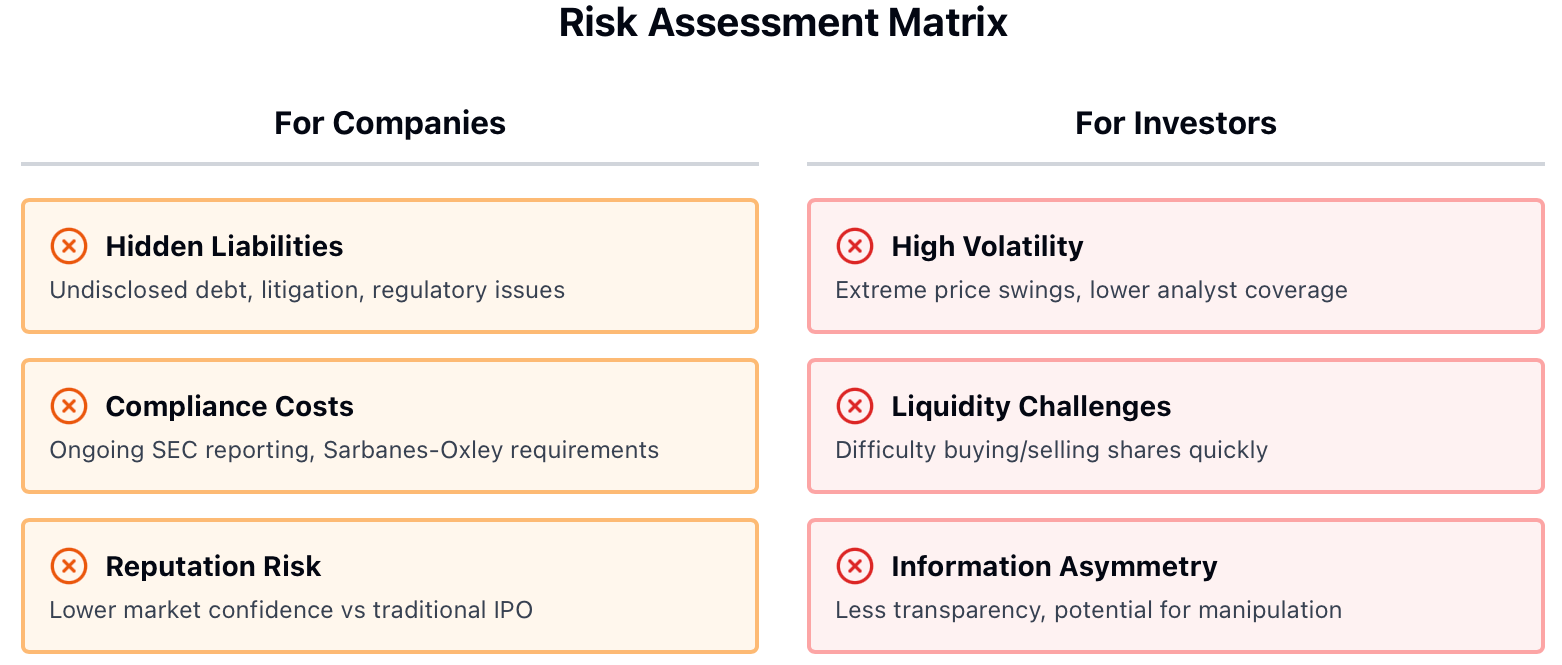
Let’s get real about reverse mergers. There are legitimate risks - both for businesses looking to do a reverse merger and investors who are purchasing reverse-merger shares.
Businesses pursuing reverse mergers:
Hidden liabilities are just hidden. While a shell may appear clean, it can carry undisclosed liabilities. Unpaid debt, pending litigation, and regulatory violations are just a few examples of the skeletons that can exist in a reverse merger business. If adequate due diligence hasn’t been conducted, what appeared to be the “fast track to the public market” will turn into a costly legal challenge.
The costs associated with compliance aren’t going away. Once a business goes public, it must continue to comply with ongoing SEC reporting and Sarbanes-Oxley obligations. Small businesses frequently underestimate these costs that can easily run into the hundreds of thousands of dollars each year.
Investors in Reverse Merger Shares:
When a company becomes public through a reverse merger, there is a general lower level of confidence in the market than if the company had completed an IPO. Investors feel that they were unable to meet the requirements to go public through an IPO.
The volatility of reverse merger shares can be extreme. For example, just take a look at the stock price of Nikola Motor after it completed its reverse merger. The frequent large fluctuations that exist when stock prices move from extreme highs to extreme lows are because reverse merger shares trade with lower liquidity and less analyst coverage than traditional IPO companies.
Investors frequently encounter challenges regarding liquidity. Unlike most stocks traded on larger exchanges, reverse merger stocks often trade on smaller exchanges or through the over-the-counter market; therefore, locating an appropriate restaurant to buy or sell shares can create difficulty when it’s time to move in or move on from a reverse merger investment.
Bottom line: Massive risks accompany massive rewards.
By purchasing a reverse merger stock without researching the history of the shell, an investor is acquiring a used car without checking under the hood. There are two possible outcomes: lucky with a great deal, or unlucky with problems left behind by the previous owner.
Conducting a proper and thorough due diligence investigation is critical. Businesses must carefully vet the shell, and investors must be aware of the shell’s past and the fundamentals of the private company before investing.
Red Flags to Watch: Don't Let Your Investment Turn Into Trash
When it comes to Smart Investing, knowing what not to buy is just as important as knowing what to buy. Here are five key red flags that should cause you to reevaluate a company's stock if it has done a reverse merger:
Red Flag 1: The Shell Company Has a Lot of History. If the shell company has been delisted in the past, has multiple violations with the SEC, or shows consistent signs of financial problems, you should run away from this investment; this will likely be indicative of a bigger problem. To verify this information, check the company's filing history on SEC.gov to see if there have been any audits or legal disputes.
Red Flag 2: The Company's Business Model Is Very Unclear. Many reverse-merger companies have vague descriptions of their actual business activities. If you do not understand how the company makes money after reading their filings, that is a potential red flag, and you should consider rejecting the investment. On the other hand, a legitimate public company will be able to articulate what the company does and how it makes money.
Red Flag 3: The Company's Governance Has a Lot of Issues. Many times, corporations with a history of frequent changes in CEO or the Board of Directors, or the presence of board members with questionable backgrounds and/or a lack of qualified independent directors, can create problems down the road. Look at recent 8-K filings to find out about any management changes, as well as do an online search of the company's executive teams.
Red Flag 4: The Company's Financial Disclosures Are Incomplete or Delayed. All public companies must file quarterly and annual financial disclosures on time. If a company consistently fails to provide timely financial information, or if the information is incomplete, there is a high potential that the company is incompetent or that the company has something to hide.
Red Flag 5: The Stock Has Low Liquidity. If a stock trades very infrequently daily and the bid and ask spread is large, it can likely be easily manipulated. Furthermore, when a company's stock is not liquid, likely, you will not be able to sell your shares when you want to. To get a complete picture of the liquidity of a stock, check the daily trading volume for the last several months or years.
If you were going to buy a vehicle, you wouldn't neglect to verify the maintenance records, check for rust, or take it for a test drive prior to purchasing it. Due diligence is just as important in purchasing reverse merger stocks as it is when buying a vehicle.
For example of what can happen many companies that entered into a reverse merger have suffered catastrophic losses when they learned that the private company's financials had been grossly exaggerated or that the shell company had disclosures pertaining to liabilities. In some cases, the stock price has dropped by 70%-90% within a few weeks after these issues became public knowledge.
Remember that managing your risk is far more important than pursuing speculative returns. Identifying early signs of trouble can help you avoid financial catastrophe.
The Investor's Bottom Line: Evaluating Reverse Merger Opportunities
To determine which approach you will take regarding reverse merger stocks, you will need to change your typical method of evaluating IPOs. When you evaluate a reverse merger stock, you will need to understand that these stocks are often much more volatile than typical IPOs, especially during their first few months following the merger; therefore, if you are not able to handle swings in stock prices of 20 – 30%, reverse merger stocks may not be for you.
You should perform thorough due diligence on both entities involved in a reverse merger; you should research both the shell company's history and the private company's fundamentals, including audited financial statements versus management projections, the identity of the large shareholders, and whether insiders are buying or selling.
You should also place significant emphasis on assessing liquidity; while you should consider the average daily trading volume for reverse merger stocks, you should also take into account the recent spikes in trading volume and determine if there is a reasonable expectation that you will be able to enter and exit a position without having a meaningful negative impact on the stock's price.
You should review the industry environment; are they in an industry currently experiencing growth and demand, or are they simply seeking to ride the current wave of excitement? There is a far greater chance of companies operating in established industries with real growth potential succeeding compared to those simply trying to capitalise on the latest fads.
You should also evaluate the level of transparency offered by any potential companies; companies that are well-run and transparent regularly communicate with investors, maintain an up-to-date website that contains a section dedicated to investor relations, and respond to inquiries received from shareholders. A company that does not communicate with its shareholders promptly often has a significant problem.
The success of companies such as DraftKings in the reverse merger space stands in stark contrast to the many reverse mergers that never resulted in success. The success of these companies is often directly related to the quality of each respective company's financial performance.
You should view your investment in a reverse merger as purchasing a house in a community that is developing. Some communities will continue to develop and prosper, while others will ultimately not produce the results anticipated. The success of your investment will be determined by your ability to identify strong financial performance rather than simply speculating that the results will eventually arrive.
Making Your Decision: Is a Reverse Merger Right for You?
Reverse mergers can be an effective and complicated way to go public for a company or to invest in a new business venture.
For Companies that want to go public via Reverse Merger: In contrast to Traditional Initial Public Offerings (IPOs), Reverse Mergers provide companies with almost instant access to the U.S. Capital Markets, speed, and cost savings.
In addition, Reverse Mergers are particularly useful for companies that need quick access to capital, operate in rapidly evolving industries, or have strong fundamentals and a desire to pursue an alternative to waiting for the IPO markets to open up. Success hinges on finding a suitable shell company, maintaining a strong system of internal controls, and emphasising transparency from day 1 of the business.
For Investors in a Reverse Merger: While reverse merger stocks may offer an opportunity for significant returns, they typically require more research and risk tolerance than regular stock investments. As such, investors should focus their attention on companies that have a clearly defined business model, an experienced management team, a transparent set of financial statements, and a reasonable stock price. Avoid succumbing to the urge to chase after the next DraftKings by only considering companies that exhibit sound fundamentals.
Reverse Merger success is not a black-and-white proposition. Each situation is different; therefore, success will depend on proper professional execution, careful due diligence, and realistic expectations regarding both the potential opportunity as well as potential risks.
Ready to navigate the complexities of public markets and identify real opportunities? Tradewill's platform gives you the research tools and market insights to analyse reverse mergers and other investment opportunities with confidence. Stop guessing and start making informed decisions backed by data.
Disclaimer: The content of the blog does not represent any position of Trade W, does not serve as any trading-related decision advice, and does not endorse any third-party.