

 Trade W

The sector of new materials is experiencing an innovation revolution. At its core is a new "substance" that is one atom thick and has a tremendous amount of strength compared to steel. For people interested in investing outside of typical investment areas, graphene stocks offer a completely new opportunity where high-tech science and business meet. This investment guide provides readers with all the necessary information regarding how to invest in this amazing material.
What Is Graphene? Understanding Graphene's Revolutionary Material Properties
Imagine a thin strip of paper that you can barely see but can stop a bullet at its core; that is, in essence, how scientists define graphene. Essentially a two-dimensional material, graphene consists of a single layer of carbon atoms that is organised into a hexagonal lattice, which is actually what gives it its unique properties. Discovered in late 2004 by researchers Andre Geim and Konstantin Novoselov, their work on the development of graphene would eventually lead both of them to win the Nobel Prize in Physics for their discoveries.
Graphene appears simple in its structure. Essentially, when you take an operational unit of graphite and scrape away all of its layers, leaving just the single atomic layer, you will create a sheet of graphene. However, within that extremely simple type of carbon structure lies an extraordinary variety of properties.
For instance, graphene has an electrical conductivity that is approximately four to five times greater than a copper conductor, and it has thermal conductivities that are significantly higher than those of any other known engineered material. Furthermore, the tensile strength of graphene is nearly 200 times greater than that of steel, all while maintaining a nearly transparent and lightweight characteristic.
These extraordinary qualities are not just a playground for scientists to dream up impressive lab results; they also create opportunities for developing new products and improving existing products throughout all levels of industry.
For instance, electronic devices can build next-generation semiconductors and ultra-fast transistors by utilising the electrical conductivity of graphene. They can create improved heat regulation or cooling in these products by using graphene's thermal conductivity. Recently, many aerospace engineers have noticed that if they use lightweight materials, like graphene, when designing aircraft, these aircraft will be about 30% lighter and require less fuel and will therefore be more fuel-efficient over their life.
Several companies, including Graphenea and First Graphene, are already proving how graphene can be utilized to solve problems. Graphenea, based in Spain, produces high-quality graphene as an ingredient to produce items for both research institutions and industry. Similarly, First Graphene, based in Australia, has developed concrete additives made from graphene to enhance the strength of concrete and decrease the amount of raw materials needed to create the concrete.
The success of these two companies and the wealth of other companies pursuing the development of a series of products and applications that will utilise graphene. There is evidence that the investment into the public trading of graphene is not unrealistic in speculative future technology, but will be a series of commercial success stories of companies delivering products to both individuals and companies around the world today.
What is revolutionary about graphene is its versatility. Unlike other commercially engineered materials designed specifically for one use, the properties of graphene allow it to be used for consideration in the development of products in a diverse range of industry sectors. For example, batteries will charge faster, sensors will be more accurate, and other materials will last longer.
The broad possibilities of modalities in which graphene can be commercialised decrease the risk factor for investors because they will have a variety of products to invest in and will not have all of their investments dependent upon production and supply of a single product market.
Graphene should be thought of as an atomic-level Swiss Army knife. The Survivor Tool, one item in the Swiss Army Knife brand of tools, can be used by the hiker, the mechanic, or the office worker, much the same way graphene material can and will be used in the electronic, energy, healthcare, and construction industries. Corporations and start-ups are racing to unlock the commercial promise of graphene because it is so versatile across so many different levels and industries.
Graphene Value Chain Analysis: From Raw Materials to Commercial Applications
Analysing the value chain of graphite allows investors to identify high-potential opportunity areas within the graphene industry chain. The Graphene value chain all begins very simply with Graphite, the same naturally occurring material used to create pencil leads and batteries.
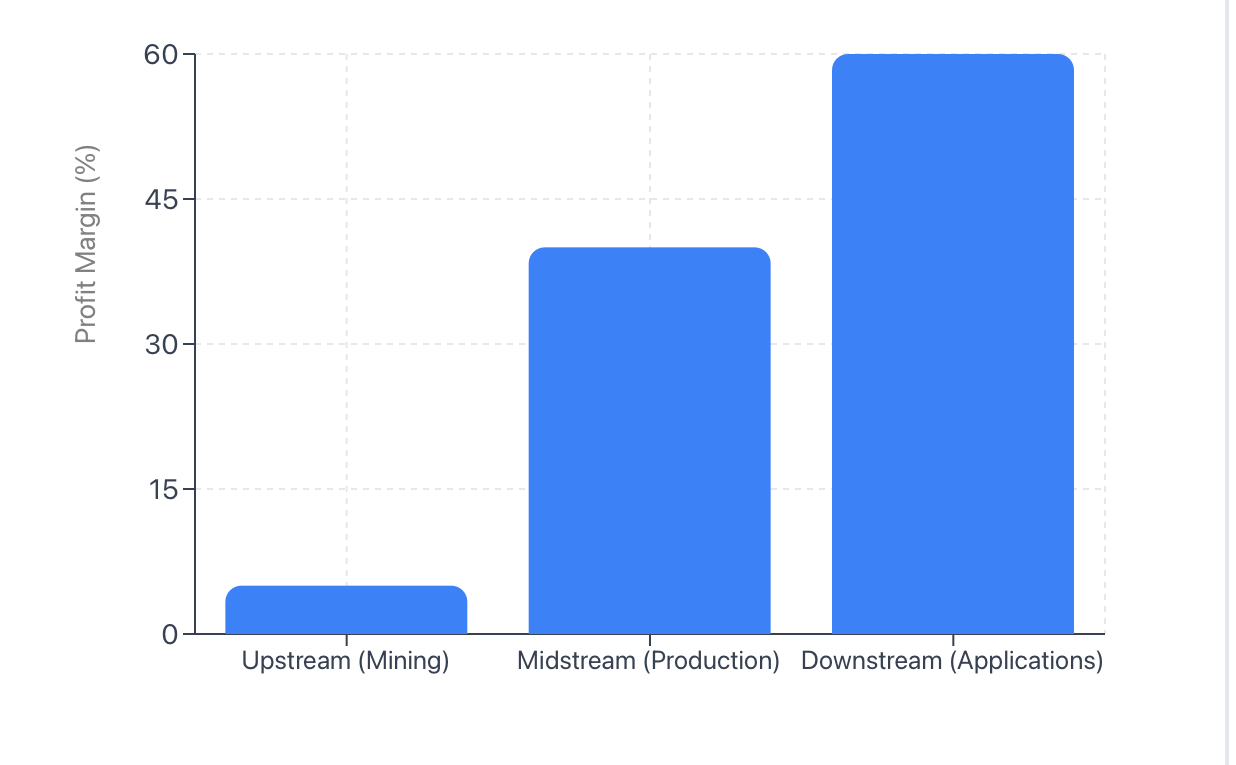
In the upstream section, the activities include the mining or purifying of Graphite. Companies within this section will either have natural Graphite or will manufacture synthetic Graphite, but they will have to refine their Graphite to obtain the purest form possible for use in the production of Graphene. It is important to note that the barriers to entering this section are very low and the profit margins are much narrower than in other segments due to competition and the pricing of commodities. At this phase, think of this as turning raw Graphite into the finished pencil lead.
The midstream section of the Graphene Industry is truly the “magic”. It is here where Graphite is converted into various types of Graphene, such as Powders, Oxide dispersion, Films and Coatings. This section has very high technical barriers to entry. Companies within this segment must have specialised manufacturing equipment, proprietary manufacturing processes, as well as significant Research and Development (R&D) capabilities to produce Graphene products.
The first Graphene in this section produces both Graphene Powders and dispersions for commercial use. In addition, Versarien has gained great experience with the production of Graphene in different types of applications, including multiple Industries.
The method of production is extremely important as well. Using Chemical Vapour Deposition (CVD) can produce high-quality Graphene films, which can be used in Electronic applications, but the expense is very high. Using Liquid Phase Exfoliation will produce Graphene Powders more cost-effectively, however, with a mix of qualities. The best midstream companies have learned how to implement multiple methods of production, providing their customers access to a variety of Graphene Products and a wider range of potential applications.
The downstream applications represent the commercialised use of Graphene's value proposition. Electronic manufacturers incorporate Graphene into their electronic components to improve performance. Energy Companies utilise Graphene to improve the performance of batteries and the speed of charging. Manufacturers of Medical Devices capitalise on the Biocompatibility of Graphene to produce Sensors and Drug Delivery Systems. Manufacturers in the Aerospace Industry are currently undertaking various evaluations of Graphene-reinforced Composites for use in aircraft components.
The profit margins for companies vary across the value chain of the graphene market. Upstream Graphite Companies typically have low single-digit margins as a result of the commoditization of Graphite. Companies within the midstream that possess proprietary processes have the opportunity to achieve margins between 30-50% with reliable customers.
The potential for the greatest returns resides with the downstream applications when they have achieved commercialisation; however, the potential for failure is maximised due to the extremely high level of risk associated with developing the product.
As there is currently a high level of investment flowing into Midstream and Downstream Applications, investment opportunities exist where Technical Expertise creates Sustainable Competitive Advantage for companies to bridge the gap between laboratory trials and commercialisation.
To be successful as an Investor, understanding the value chain allows Investors to differentiate between different types of Graphene Stocks. For example, a Mining Company will experience different opportunities and risks than a Company engaged in materials science, developing Enhanced Aircraft Components. The Mining Company will encounter cycles of Commodities and operational efficiencies, while the materials science company will rely on Technology Development and the extent to which the technology is adopted in the marketplace.
Graphene Technology Trends & Innovations: Emerging Applications and Market Potential
Investments in graphene stocks are often most attractive to investors when they are able to be both technologically advanced and able to produce revenue. Many of these trends have emerged recently due to new technologies, including Graphene's greatest opportunity today with Energy Storage.
Energy storage is one of the primary applications available for Graphene and is likely to be one of the most immediate returns on investment (ROI). Solid State Batteries using Graphene can potentially improve both the driving distance of Electric Vehicles (EV) while decreasing their charging time.
The prospect of having the capability to coat all of the components of a battery with a material that efficiently conducts both electricity and heat means that you will be able to power your EV within minutes instead of hours and potentially drive many hundreds of miles more than previously possible on a single charge. This is not simply science fiction; companies are currently working on testing Graphene-enhanced batteries that will achieve 20-30% greater battery capacity and battery recharge speed than the current lithium-ion battery technologies.
Another application for Graphene in Energy Storage is Supercapacitors. These devices are used as a bridge between batteries and conventional capacitors and allow for fast charging and fast discharging cycles. The applications of Supercapacitors are vast and include regenerative braking in EVs, as well as providing support for grid storage of energy produced by renewable energy sources.
The Electronics industry is also utilising Graphene technologies in many new and exciting ways. Using Graphene-based transparent conductors would allow for the development of Flexible Displays that are capable of bending and/or rolling without damaging the display. Consequently, Samsung and other electronics manufacturers are investing heavily in research with Graphene-based technologies for their next-generation Smartphones as well as their newest Wearable Technology. Companies are also developing new touch-panel technology using Graphene materials that are far superior in terms of sensitivity and durability compared to current-day touch-panel technologies.
Advancements in Medical Applications with Graphene materials are occurring at a rapid pace, including the potential to use Graphene-based biosensors to detect disease markers at extremely low concentrations, thus allowing for earlier diagnosis of various medical conditions. Graphene materials are also of tremendous value in manufacturing Antibacterial medical implants and materials for use in bandaging wounds. Researchers are currently exploring the possibility of utilising Graphene-based systems for the targeted delivery of drugs to patients.
A unique window into the future of Graphene technology comes from one of the largest investments made to date in Graphene research, the Graphene Flagship, which has received over €1 billion of funding through the European Union. Some recent examples of Graphene-enhanced products being developed through this European Union effort include Graphene-Enhanced concrete that has much greater strengths and durability than conventional concrete, Graphene-based water-filtration membranes that are much more efficient at removing contaminants from water, and Reverse Neural Interfaces that could eventually help paralysed patients regain some level of movement.
Although many of these applications are proving to be viable in a laboratory environment, for investors, it's vital to find out if companies will be able to produce these products in a cost-effective way. Most successful companies in the Graphene marketplace will be characterised by having already established partnerships with existing manufacturers, having undertaken successful pilot-scale manufacturing, and targeting specific market needs to which their products are obviously superior to all existing alternative products.
The trends associated with Graphene technology trends suggest that opportunities to access commercialisation of these technologies are accelerating. Patents are now being filed in increasing frequency, major corporate manufacturers are moving from an experimental approach only to one of commercialisation, and many governmental agencies around the world are now investing in manufacturing capacity for Graphene-based products. Consequently, investors will want to clarify which of the emerging technologies are actually beyond the "interesting research" phase and are already commercially available, with actual paying customers.
Graphene Market Size & Investment Potential: Growth Trends and Opportunities
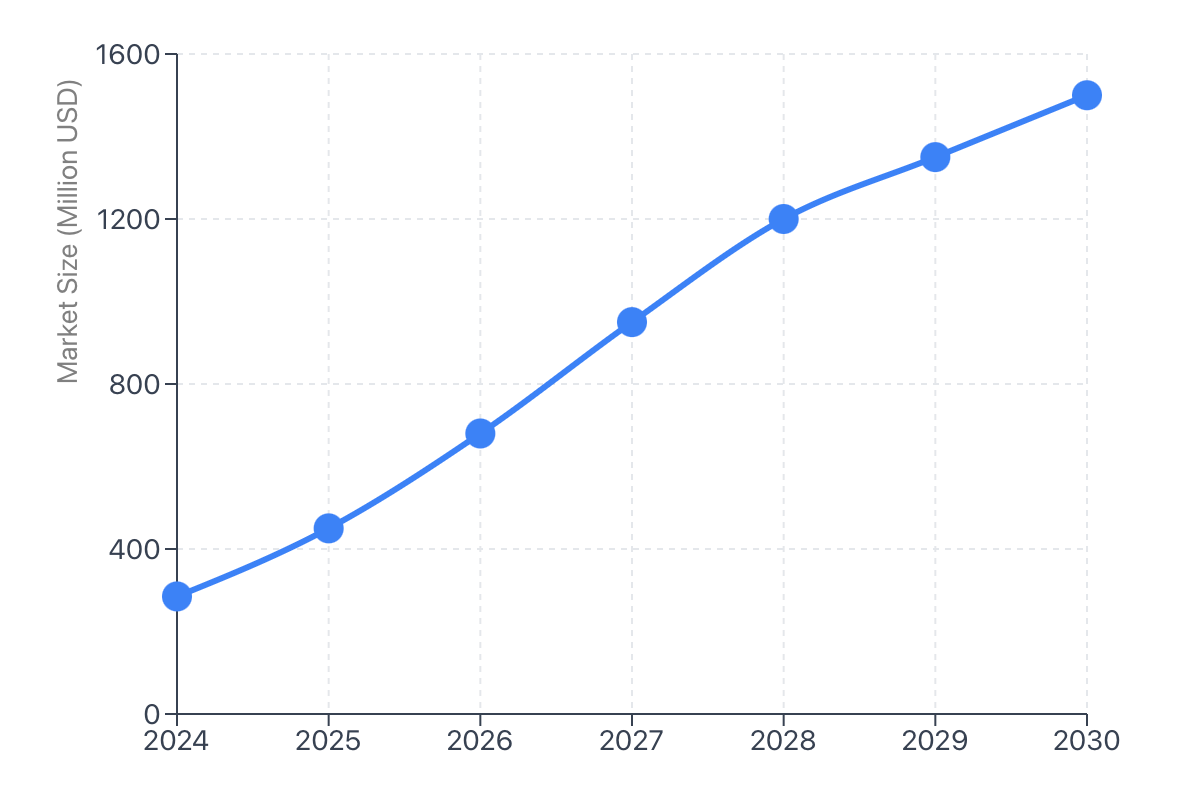
Graphene's global graphene market size is projected to expand from approx 285 million dollars in 2024 to over 1.5 billion dollars by 2030 at a compound annual growth rate (CAGR) of ~30%. The projections are based on actual orders placed for graphene products, production capacity coming on board, and companies that are now using graphene in their product line.
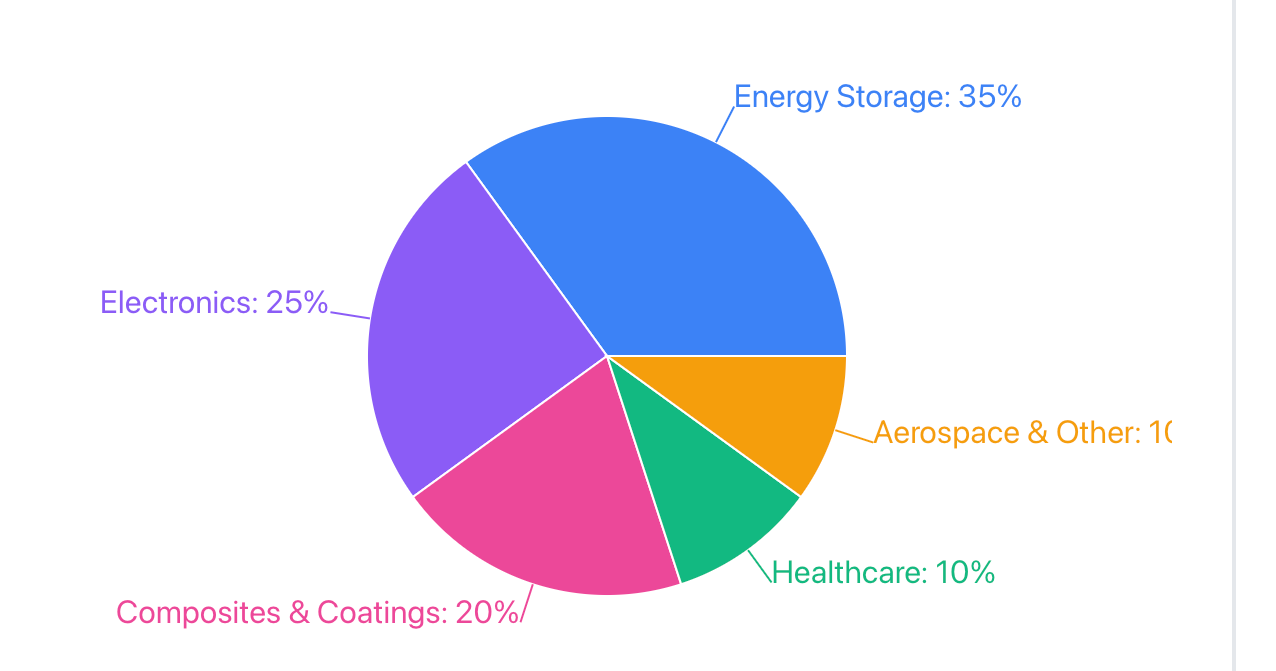
As far as market share per application, we can see that approximately 35% of these applications are related to energy storage; this is driven by the rise of the electric vehicle industry and the need for renewable energy storage. The electronics application category represents approximately 25%, while composite coatings and additives account for about 20%. The remaining portions will fall into the healthcare, aerospace, or some other developing application categories.


By varying the distribution of exposure across these four sectors, we are able to select a level of risk, based upon our investment strategy and projected opportunity, for each investment type. Energy storage applications offer a variety of macro potential opportunities due to the increase in electric vehicles (EVs) and grid modernisation; however, there is also significant competition and price pressure in this category. Electronics applications will offer greater margin potential, yet will require very large amounts of research and development (R&D) funds and extended development cycles.
Several ways exist for investors to invest in graphene stocks. One option is to purchase shares directly from publicly traded companies. This method will allow an investor to select targeted exposure to the graphene market; however, this method requires extensive due diligence.
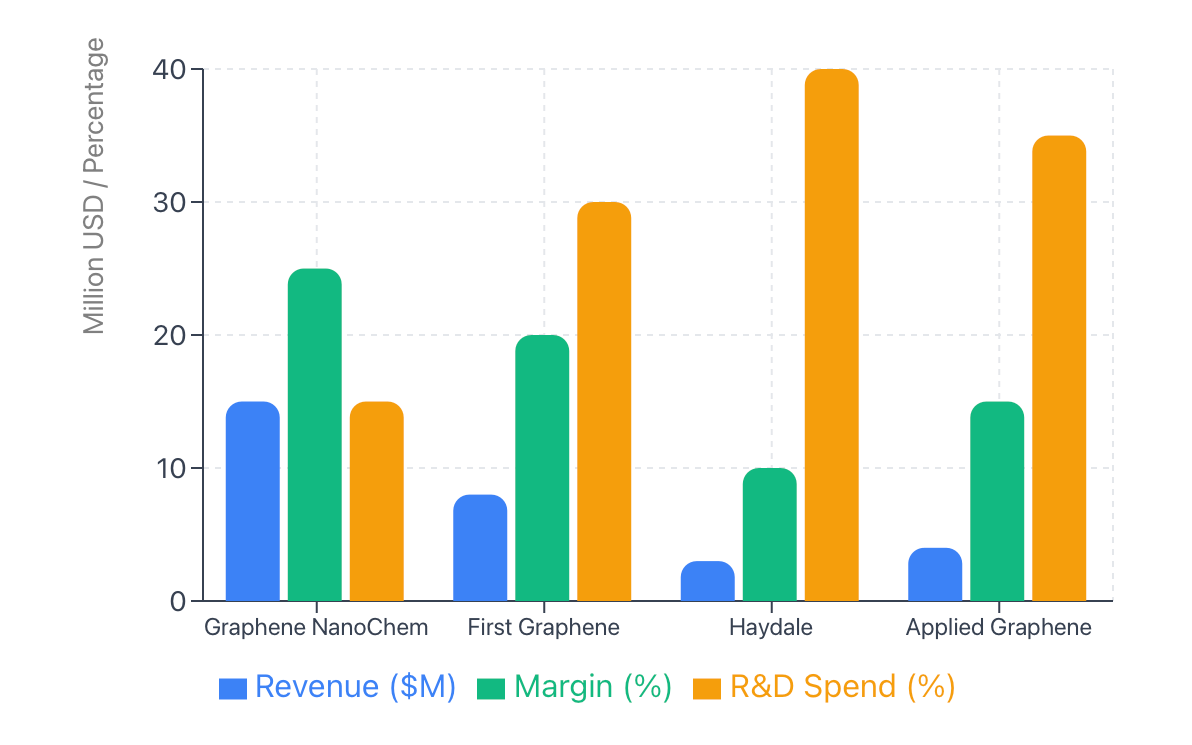
For instance, one example is Graphene NanoChem, which recently filed its IPO and was listed on the Malaysian Stock Exchange. This company saw 40% year-on-year revenue growth in 2023, largely due to demand for graphene-enhanced lubricants and coatings servicing the automotive industry. Another example is First Graphene, which trades on the Australian Stock Exchange and has formed strategic partnerships within both the construction and energy sectors.

Exchange-Traded Funds (ETFs) that are associated with advanced materials usually include graphene companies as part of the larger portfolio. However, currently, there are no pure-play graphene ETFs available in the marketplace, as there are a number of nanotechnology or materials science funds that hold significant positions in companies that have a graphene presence. Investing through ETFs provides diversification; however, it decreases the upside potential from the successful commercialisation of graphene-based products.
The ability for early investors to identify the best technology companies and best-positioned companies in the industry as it matures will allow investors to capitalise on the huge amount of potential upside that will occur in the market for both graphene and the companies producing it. Investing in graphene may resemble a gold mine soon, as a significant expenditure must be made initially to purchase the appropriate tools and equipment in order to extract the value of graphene.
The source of graphene is very abundant; however, the process to convert it into valuable products requires knowledge and expertise that is specific to the creation of those products. As such, investments made in those companies that possess the most advanced technology and strategy, combined with the best position in the marketplace, will provide the greatest return for potential investors.
What makes investing in graphene unique is the fact that there will be multiple winners in this market segment. The industry will not be a one-stop shop; the key players will vary within each of the application segments (batteries, electronics, coatings, healthcare, etc.), as well as production methods, geographic locations, etc.
Thus, many companies will have success within their respective market segments, as the overall graphene marketplace continues to grow rapidly. Even when companies capture relatively small shares of a given market, the revenue potential remains high due to the rapid growth of the overall marketplace. For example, if a company were to capture only 5% of the total market share within the energy storage market, it could see revenues of greater than $50 million annually within several years, resulting in a very high return for its investors.

Global Graphene Stocks Overview: Key Companies and Investment Opportunities
Investors may directly invest in a variety of different techniques to take advantage of the commercial exploitation of graphene through different publicly traded companies. Each of these companies has its own set of strengths, strategies and risk profiles.
Graphene NanoChem, Inc. of Malaysia focuses on producing graphene-enhanced lubricants and coatings, while the company specialises in lubricant development and coatings. The target markets for these companies are the automotive and industrial markets. Within this sector, companies are able to see that small incremental increases in performance can yield significant cost savings to their customers. Graphene NanoChem recently achieved approximately $15 million in revenues for 2023 and now has distribution channels set up across Southeast Asia. Relative to other publicly traded companies in the West, the stock for this company is trading at relatively low valuations, thus allowing for the opportunity for value for those who want to. Additionally, the investor must take into consideration the market entry point into a developing country and how that may affect investments made by the investor in the future.
First Graphene of Australia has a vertically integrated business model where they control all aspects of production from the time that graphite is mined to produce all forms of graphite powder and dispersion to customers. They have many patents related to their production methods and have established numerous contractual relationships with several construction, energy and automotive customers to supply them with graphene-based products.
Their PureGRAPH® products have demonstrated that when used in combination with concrete, increased strength and fire protection are available, which showcases the performance improvements of using PureGRAPH® vs. conventional concrete. The performance of First Graphene stock has shown some volatility, reflective of their current stage of development, but also indicative of the general market's attitude toward high-risk speculative material plays.
Haydale Limited of the UK is focused on creating the functionality of graphene and other ranges of Nanomaterials for specific applications. Instead of simply producing Graphene, they chemically alter Graphene so that it can perform better in a given environment (i.e., inside of a polymer composite or electronic device); thus providing added value which enables them to seek greater margin. However, this approach of creating more performance through chemical alteration requires continued investment in R&D.The revenue of these companies is minimal (less than $5 million annually), and they are not yet profitable; thus, they offer a higher risk opportunity primarily for those investors who have a strong belief in the technology of the Company and its marketing strategy.
Applied Graphene Materials (UK) creates and commercialises graphene dispersion for applications including coatings, composite materials, and functional materials, and has also developed several partnerships with major corporations that are developing graphene products. Like Haydale, Applied Graphene Materials must also overcome the difficulty of converting a viable product into a profitable company. Investors should pay close attention to any announcements of commercial-scale manufacturing agreements by Applied Graphene Materials because that would reduce the risk associated with the investment.
When looking for the best graphene stocks, investors should evaluate several critical metrics. Revenue growth indicates the acceptance of the product in the market. Gross margin will provide an indication of the pricing power of the company and the efficiency of its operations. The ratio of R&D cost compared to revenue will reflect the level of research being performed by the company; however, a high R&D percentage does not necessarily translate into profitability. The size and strength of a company's patent portfolio indicate its technical protectability and ability to license.
First Graphene has successfully leveraged its technical capabilities to grow its materials business, as evidenced by several patent applications, and this results in a growing number of orders, indicating the company's focus on the right areas for growth has generated investment opportunities. First Graphene provides an example of how adding graphene materials to lead-acid batteries improves performance, and provides evidence of how the use of graphene materials meets an existing market demand for improved lead-acid battery performance, with concrete results that support the use of graphene to fill this need.
Investors who wish to invest in graphene stocks through individual stock purchases need to be prepared to invest time to monitor the companies' progress in terms of technology and product development, as well as to accept the significant amount of volatility that typically exists with investing in small capital companies located in emerging markets. Typically, significant price fluctuations (20-30%) can occur with limited news on these tiny companies.
The goal of identifying companies that have legitimate customers, established products, and credible business models is essential for success in the graphene market. There may be excitement about participating in the development of a new and innovative product, but the investment will typically only be successful if the investor is willing to support the development process over a period of time to obtain a profitable outcome. The former type of company generally creates a sustainable business, while the latter type, although it may potentially yield very high rewards, typically possesses a substantial amount of risk associated with its success.
Global Investor Strategies for Graphene Stocks: How to Build Your Portfolio
When constructing a portfolio of graphene stocks, you must find a balance between believingWhile it is possible to generate a profit from oscillating prices by making speculative trades on the volatility of small-cap materials companies, small-cap materials companies do not fit within the model of generally accepted practices of long-term investing.
When buying stocks for the long term, you should have a three-to-five-year horizon for holding onto the stock until it has time to commercialise its products. The reason is that technology requires many years to develop within a company, and it would take additional time for the company to scale up production to be able to sell it to its customers, resolve any technical difficulties that may arise with the customers during the selling phase, and build sustainable revenue streams. Successful long-term investors will be able to ignore quarterly price fluctuations and focus on the fundamentals of the company over the long term.
One critical factor to consider when deciding how much of your portfolio to allocate to speculative materials is how you will structure your position within a company. The allocation of 5-10% of your total portfolio to graphene may be an appropriate level for most investors; however, the maximum allowable exposure to any individual company should not exceed 2-3% of the portfolio. This means that if the investment thesis is correct, there is significant upside potential, and if the investment thesis fails, there is a limited loss.
Don't put all your eggs in one basket by investing in one company. The risk involved in investing in one material (like graphene) that has recently been developed but has not yet demonstrated commercial success is not worth it.
Having set parameters for when to add additional shares and/or when to sell them provides appropriate guidelines on how to manage your position during periods of volatility. For example, you may want to buy additional shares of a company if the company announces the signing of a major commercial contract or that the company has hit a major production milestone.
On the other hand, an investor should sell their shares if multiple reports indicate that the company experienced significant losses, a new CEO assumes control of the company, or the company has announced that it was unsuccessful in successfully commercialising its technology. Having defined these specifications before entering into a trading agreement can help prevent the investor from operating from an emotional standpoint during periods of volatility.
Addressing geographic diversification offers another perspective on how to handle investing in speculative materials. Graphene is traded in Australia, the UK, Malaysia, and other countries, each of which has different regulatory frameworks, liquidity markets, and currency markets that an investor must consider when making the decision to invest in speculative materials. By diversifying your investment across several countries, you reduce the potential impact of economic disruptions that could happen in an individual country while simultaneously creating a more complicated trading/tax-reporting situation.
Examining both methods of investing in speculative materials will demonstrate to the investor how these two different methods function and what types of investments were made during both methods. For example, an investor who invested at the IPO of First Graphene $10,000 experienced multiple declines of 50%+ in price and multiple times the price increased by 2x-3x. An investor who invested in a diversified materials fund has had a more stable growth rate and provided them with smaller fluctuations in their return. Neither method is superior to the other. They provide different types of investors with different types of investment programs.
Case Studies in Graphene Stocks: Successes and Lessons Learned
The best real-world examples of the benefits and hazards of investing in graphene are Graphenea and First Graphene.
Graphenea's Strategic Success:
Graphenea has been successful as a result of its strategy, developing a sustainable, profitable business focused on the supply of high-quality graphene stocks for research institutions and R&D departments. As a result, Graphenea has a steady stream of annual revenue of approximately €5 million, whereas larger competitors have burned through significant amounts of funding while attempting to scale up technologies that have not yet proven successful in the market. Graphenea sells products to well-known universities, government laboratories, and large corporate R&D departments, all willing to pay a premium price for well-characterised and consistent materials.
This example demonstrates that boring is often beautiful. Graphenea does not advertise miracle materials or revolutionary batteries, but rather has a solid, growing business with real customers and revenue-generating capabilities. Graphenea's valuation is based on sustainable business fundamentals, rather than on speculative hopes. Investors who viewed Graphenea's business strategy as a prudent approach have enjoyed steady returns as the company has grown geographically and added products to its product offerings.
First Graphene's Commercialisation Journey:
First Graphene is an Australian company that has faced many challenges in moving from "the laboratory" to "the commercial market." Following its listing on the ASX in 2017, First Graphene has invested a considerable amount of time developing its production capability and testing potential applications of graphene. As a result, First Graphene has realised periods of disappointing performance as a public company due to its commercialisation efforts taking much longer than expected.
However, persistence has paid off for First Graphene. As of 2023, it is securing large contracts for graphene-reinforced concrete additives and graphene-enhanced energy storage materials. While they weren't revolutionary, game-changing deals for the market, they generated money and showed that the technology works. Those who bought into the stock during this time saw returns for holding on to their stock while the company struggled with developing the product.
To have realistic expectations of how long it will take to turn advanced materials into a marketable product and develop a customer base, and to generate production volume at a reasonable cost, investors need to wait and not expect to earn profits immediately. Investors who bought into the idea of receiving quick returns but didn't get returns will be disappointed, and investors who are patient and know that this technology can ultimately be produced profitably will receive the best reward.
The Cautionary Tale of Overhyped Promises: Graphene companies have received tons of funding based on their promise to provide revolutionary products in areas such as coating and adhesives, but they have failed to deliver any actual products to the market, thus leaving investors dramatically out of pocket. Many of these graphene companies have expended a significant amount of their capital resources on research and development in the hopes of developing the promised end products; however, they've ultimately come up short and left a substantial portion of their investor base with significant losses.
Looking back, many of these companies exhibited many of the same warning signs: vague commercialisation timelines, many changes to their strategic goals, a management team more focused on selling an idea than executing a business plan, and all of their technology and commercialisation claims were met with scepticism from industry experts. Company X stated they were going to change how we purify our water with graphene; however, they never demonstrated the pilot results that they had promised to deliver. Company Y promised the moon with their idea for battery technology made with graphene; however, they couldn't make a profit on it.
The lesson here is that investors need to perform their due diligence and use scepticism when evaluating a new product with revolutionary claims; in order to back up the revolution, there should be revolutionary evidence. Investors should make companies prove that they can produce their products technologically feasible, realistically, and at a cost that will ultimately create profit margins, as well as have their customers express interest in their product, beyond letters of intent.
Applied Graphene Materials' Reality Check: This is an excellent example of the "good news, bad news" story. The company has a solid product, they have partnered with large companies for pilot programs, and they are beginning to get some traction in certain applications. However, the company is still struggling to reach profitability while they are trying to stretch out its remaining capital as it relates to pilot program testing. The company's stock price reflects the actual reality of the company; the stock continues to trade well below where it was originally valued, despite the fact that the company has made significant technical advancements.
The lesson of the Applied Graphene Materials example is that a company with a fantastic technology doesn't mean it makes for a great investment; that should be determined by when the product will actually be ready for sale and what the market is like when the product is ready for sale. The gap between just having a workable product and having customers that will pay enough money for the company to ultimately turn a profit can be greater than what investors expect. Investors in Applied Graphene Materials didn't necessarily make a poor choice; they ultimately learned their lesson that the distance from innovation to return will be long and costly.
These patterns of performance of graphene companies in the market indicate that companies that provide shorter-range, identifiable products and customers tend to outperform those that are chasing after revolutionary and/or game-changing ideas that are not close to the time to market. Additionally, companies with management teams that under-promise and over-deliver create credibility with their prospective customers. Technical competence is important; however, having the skill set to grow commercially is even more important than the technology.
There are many forms of patient capital that will typically come out ahead of funds seeking a quick return after capitalising on the opportunity for speculative investors.
Regulatory & Policy Risks in Graphene Investment: Compliance Matters
The influence that policies and regulations will have on the price and investment sentiment surrounding graphene stocks is significant in a way that investors typically overlook and do not think highly enough of compared to new technological developments in this field (e.g., graphene). The rise in investment interest has resulted in increased government scrutiny of nanomaterials throughout the world. The European Union's (EU) REACH (Registration, Evaluation, Authorisation or Restriction of Chemicals) legislation is the most comprehensive piece of legislation in relation to nanomaterials and requires extensive testing and documentation before nanomaterials such as graphene can be marketed in the EU.
The costs of complying with these regulations can be substantial (often millions of Euros) for any business wishing to market nanomaterials in EU markets. These types of regulations intend to protect human and environmental health by ensuring that new nanomaterials do not present unknown risks. Although the intent is completely reasonable, the result of these types of regulations is that they create barriers to entry into the marketplace.
The regulatory approach to nanomaterials is less prescriptive in the United States because the Environmental Protection Agency (EPA) and Food and Drug Administration (FDA) evaluate the risk of each nanomaterial based on its intended use. This results in the meaning that there is generally less regulatory certainty regarding nanomaterials in the United States. For example, a company developing a graphene-enhanced medical device will follow a different regulatory pathway from a company developing a graphene-enhanced construction material, and neither pathway is particularly well defined at this time.
Another dimension of regulations related to graphene is environmental regulations. Graphene production to date generates waste when chemical manufacturing processes are used, which must be disposed of correctly. In addition, as governments begin to tighten regulations on industrial waste disposal, the price of producing graphene will increase, and industries that adopt more environmentally friendly methods of production will likely be favoured. Therefore, those companies that were able to invest early on in environmentally friendly production methods will have a competitive advantage as restrictions on industrial waste get increasingly strict.
In addition, as advanced materials gain wider acceptance, EU countries have placed new export controls on materials deemed strategically important. Therefore, while graphene itself is not currently subject to an export control, it is likely that the precursor materials may be. Policy controls can have negative effects on supply chains and access to the market for companies involved with international trade.
Government investment into the research and creation of graphene materials and support for companies through production incentive programs and the purchase of products manufactured from graphene are issues that can significantly increase the likelihood that graphene will have a positive commercial impact. The current €1 billion spent in Europe through the Graphene Flagship program has provided European businesses with the opportunity to potentially realise a market for graphene-based products.
In addition, China's emphasis on developing its own capabilities to produce graphene through its national strategies for development creates a significant benefit for companies located in China or that have developed relationships working in China. For companies operating in environments where their operations have been supported through government policies, they have the least amount of regulatory risk and thus are able to launch their products faster.
Regulatory risk can be viewed as akin to construction codes. If your construction method is not compliant with the laws that govern your building (i.e. if you want to build a new product using graphene), then even though you may have created a radical new design, your costs will be considerably higher than you expected, and your timeline for producing the building will significantly extend as well.
Several incidents illustrate the impact of increased regulatory compliance requirements. The implementation of the recent European Union (EU) amendments to the REACH regulation, which tighten the labelling requirements for nanomaterials, created significant challenges for many of the smaller companies that produce graphene. As a result of the increased compliance costs imposed on them, many of these companies were placed at a competitive disadvantage to larger and better-capitalised companies. The temporary restrictions placed on the exportation of specialised graphite material from China caused some of the first disruptions to the supply chain of several graphene producers. Such geopolitical events highlight the risks associated with raw material sourcing for companies operating within the materials industry.
Regulatory risks for the investment community associated with graphene may manifest in several different ways: The most obvious would be the direct costs associated with complying with regulatory requirements, such as compliance with "best practices." A less obvious, yet potentially more crucial, type of regulatory risk is the potential for these barriers to prevent or significantly delay the commercialisation of substantial opportunities. If regulators determine that products containing graphene require comprehensive safety testing, then companies focusing on the manufacture, distribution and sales of these types of products will experience many years of delay and will incur millions of dollars in costs related to safety testing.
The key to success for companies in the graphene marketplace is to be cognizant of policy changes and the subsequent impact they can have on the competitive landscape. Changes in the REACH regulations, guidance documents from the FDA, and the Chinese government’s policies governing the development and commercialisation of graphene products can dramatically affect the competitive landscape of the graphene-based markets in a very short timeframe. Companies with effective regulatory-compliance staff and established relationships with regulatory agencies will be much better-prepared to navigate this regulatory landscape than companies that have not invested time and resources into ensuring compliance.
Through the increased volume of the graphene marketplace, the regulatory environment governing graphene stocks will become stricter as production and consumption increase. Companies that are aware of these regulatory risks and can effectively manage them, either through the establishment of regulatory compliance procedures or through partnerships established with other companies that have experience in this area, will be in much better positions to succeed and become major players in the graphene marketplace as it continues to grow.
Future Outlook & Strategic Advice: Long-Term Graphene Investment Planning
The graphene market is expected to have strong growth over the next three to five years, but there will be an increasing number of differences among winners and losers. The three to five-year period will be defined by many important trends; these trends will, in turn, dictate which companies will provide investors with returns in the form of stock price appreciation.
The largest driver of change will be the transition from research and development to commercialised production. Those companies that are able to ramp up their ability to produce graphene while also maintaining high-quality standards and controlling costs will be the ones that are able to distinguish themselves from the companies still attempting to complete their development stage.
This also signifies that investors can expect increased interest in production capacity announcements, automation implementations, as well as yield improvement announcements; these types of operational metrics will be much more important than the many press releases stating what companies plan to do with graphene in the future.
The emergence of technological advancements in various industries will also create new graphene investment opportunities. For example, within three years, there will be solid-state batteries made with graphene available for commercial production, resulting in significant demand for battery-grade graphene materials. Should major automobile manufacturers become committed to using these technologies, then companies that are well-positioned to provide these advanced materials would likely see a substantial re-evaluation of their stock price.
Likewise, if the cost and performance metrics of graphene-based water filtration systems are improved substantially, then a lot of environmental applications using graphene could see significant growth and increasing demand.
It is also expected that there will be consolidation across the industry. There are currently numerous small companies developing graphene-based products, and many of these companies have largely overlapping capabilities and very little differentiation; therefore, it is expected that larger materials science or electronics companies will either acquire or merge with promising graphene companies, and as such provide liquidity to investors but will also likely reduce the number of "weaker" companies operating in the industry.
In that regard, consolidation will likely be favourable to investors in companies that are well-positioned for the future, and unfavourable to investors in companies that are not.
The maturation of the graphene market will ultimately lead to more realistic valuations of companies creating products from graphene. The prevailing combination of optimistic speculation and promises concerning technology will transition toward conventional analyses of revenue and profits once companies appear to be generating revenue and profits. Companies that are currently trading based on future potential will need to provide a history of profitability for their stock prices to reflect actual value. While this shift may disappoint a large percentage of investors, it will present opportunities for others who can accurately assess fundamental value.
Strategic advice regarding the development of an investment strategy for graphite revolves around several ideas. The first guideline is to have a long-term investment view and to regularly reassess holdings. Although one may have developed a thesis regarding an investment after years of waiting, one also needs to recognise that some companies develop rapidly, and others take longer than expected to build a business.
The second guideline is to have a diversified portfolio, including graphite, across multiple applications and industry sectors. Do not focus on a single application or industry (i.e., batteries or the electronics industry) for all of your investments in graphite. Third, focus on companies establishing commercial traction, not only companies that possess technical prowess.
When constructing a portfolio for graphite investments, the appropriate allocation of graphite exposure to convictions and risk management strategies will vary; however, an appropriate allocation would comprise 5% to 15% of a growth-oriented portfolio across three to five companies. That allocation provides you with a good deal of exposure to graphene while limiting your losses. In addition, you should rebalance your portfolio on an annual basis or any time one or more positions exceed the appropriate level of exposure to graphene.
The technological milestones to pay attention to include the ability for the scalable production of high-quality graphene thin films at commercially viable pricing points; a proven ability to demonstrate that graphene can deliver a performance improvement of better than 50% across significant application areas, such as batteries or the electronics industry; the ability to integrate graphene into products manufactured by companies on the Fortune 500 list; and products that utilize graphene being able to obtain dominant market positions in their respective niche products.
In the early part of the decade, investors were able to recognise the tremendous opportunities associated with electric vehicles being manufactured and the need for large quantities of lithium and rare earth elements to meet their needs; those who identified this opportunity and invested in the early part of the decade for those minerals reaped enormous profits. The same opportunity exists today with graphite and the transition of graphite from the laboratory toward commercial viability over the next several years.
Investors developing a strategic allocation plan for graphite should seek to balance the risk undertaken through investing in companies that are developing breakthrough applications and the more stable investments represented by companies that operate in established markets producing established products. The balance between high-risk/high-reward versus lower-risk/lower-reward positions will allow investors to take advantage of the opportunities associated with both types of positions.
Ultimately, the companies that solve the challenges associated with the development of graphite commercialisation, coupled with the ability to offer products at competitive pricing and at a maximum level of performance, will create significant amounts of value for investors before the rest of the market recognises the success of those companies. This investment thesis regarding the opportunity offered through graphene stocks should be carefully considered by investment professionals seeking to generate a high-growth return for their clients.
Ready to explore how graphene fits into your investment portfolio? Visit tradewill.com to access expert analysis, real-time market data, and strategic tools designed to help you navigate emerging technology investments with confidence.
Disclaimer: The content of the blog does not represent any position of Trade W, does not serve as any trading-related decision advice, and does not endorse any third-party.