

 Trade W
Why You Might Be Losing Money Even When Your Market Calls Are Correct:
Most crypto traders know exactly how it feels to watch price activity, take a position and have their prediction come true but still end up losing money on it. You are excited to buy Bitcoin or Ethereum. You say you will buy a Put option to protect your position, as you feel there will be a small pullback in the price before the next trade goes through. You are 100% right, and the price goes down exactly as you thought it would, yet when you check your balance, you have lost money.
How can this happen? How is it that if your prediction was correct, you lost money? It's not a matter of whether you were right about direction or not; you used the wrong type of option for your hedging position. Options have a structural disadvantage known as time decay that makes them less than ideal for hedging.
If you are going to use a tool to hedge your position, use one that doesn't work against you. It doesn't matter if you correctly predict price movement if the tool you use fails because of time issues.
For that reason, most professional traders prefer to hedge with futures contracts because they want to secure their capital and not have to worry about the clock counting down to the time they lose their insurance. Never assume a loss in hedging means you were wrong about market direction; it just means you used the incorrect type of hedge. Let's take a look at how we can correct that.
What Are You Actually Trying to Hedge?
Before you start any hedge positions, ask yourself, "What am I managing here? What risk?" Many traders miss this step. Instead, they see their portfolio value swing and just say, "I need to hedge." But what are you hedging? You need to identify the exact risk. If you can't identify the exact risk, you're not actually hedging but just creating more complexity in your portfolio.
There are three types of risks that crypto portfolios usually face.
Price risk: Price risk is straightforward. For example, Bitcoin is worth $100,000 today, but tomorrow it could be worth $95,000. Price risk is the most common reason that people hedge.
Volatility risk: While you can end the month with the same value as when you started, volatility risk can create wild moves in the market that can ruin a leveraged position, as well as trigger stop-loss orders. Volatility risk is not about where the value goes; it's about how much and how quickly the value moves.
Liquidity and margin risks: These are the risks created when you cannot exit a position without suffering from massive slippage, or when you have a sudden price drop and a margin call, forcing liquidation of your position.
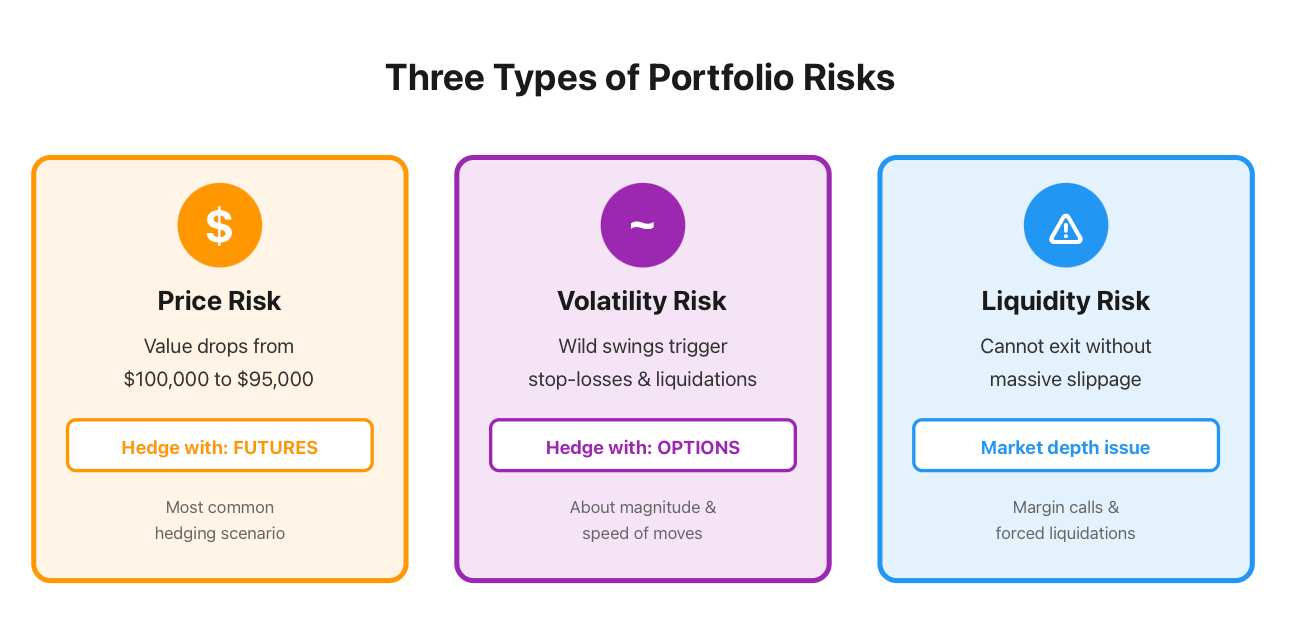
The types of tools that you select are important here. Futures contracts are designed to hedge price risk, while options contracts are designed to hedge volatility risk and certain price activity. If you hold spot Bitcoin and are nervous about a 20% price drop, futures contracts would help hedge that risk. If you are concerned that there may be a significant increase in volatility, but you don't have a directional bias, you would use options.
This is where losses are generated from misusing tools. Futures used to hedge volatility risk will cause you to acquire a directional bias that you do not want, and using options to hedge price risk will cause you to pay for volatility risk that you do not need.
To summarise, you have three types of risks when dealing with your portfolio: the chance it will rain (price risk), how much it rains (volatility risk), and if the roads are flooded so you cannot return home. While an umbrella will not help you get home if the roads are flooded, a weather app will not keep you dry. Be sure to determine which risk you are hedging against and then choose the proper tool to address that risk.
The most important aspect should always be identifying your risk and then finding the proper tool that addresses that specific risk.
The Time Decay Trap
One of the biggest issues that most traders have with options is that they can be correct in their assessment of an option's direction and timing, but still incur a loss. The reason for this is due to time decay.
Options prices consist of two parts: intrinsic value and time value. Every day, the time value of your option decreases in value. In the options world, this is referred to as theta decay.
If you buy a put option on Bitcoin with a strike price of $100,000 that expires in thirty days for $3,000 when Bitcoin is trading at $102,000, your option has no intrinsic value but $3,000 in time value. If, after one day, Bitcoin goes to $100,000, then your put option is now in the money; however, the time value has already decreased.
Now, let’s assume that Bitcoin drops to $100,000, but it will not get there for at least three weeks. By that time, your option's time value has decayed. So, despite getting the call correct in terms of price direction, your option may be down in value from the original time value paid.
Here are three misconceptions contributing to this predicament:
"Any movement in the market means I will make money." This is incorrect. The market has to move far enough away in order to offset time decay; slower movement is detrimental to profit.
"I am safer with long-term options." Although they do tend to be safer than short-term options, their price will also suffer significant time decay daily.
"Instantaneous spikes in volatility will provide me with profits." This will only occur if there are sudden spikes in volatility. In sideways trending or slowly moving markets, volatility tends to compress, further compounding the effects of time decay.
To illustrate this, an example would be concert tickets. As the date of the concert approaches, the value of the ticket will continue to decrease, even if they are incredibly exciting concerts. The day after the concert, an unused ticket has no value, regardless of how incredible the event was.
With futures contracts, this problem does not exist. For example, if you are shorting a futures contract on Bitcoin that is trading at $100,000, your profit and loss will move directly with the price, with no concern over theta decay or expiration or for watching value decrease while waiting for your theory to come true.
That is the reason traders use futures for hedging their price risk, as they are not paying for time; instead, they are simply removing their risk from having an exposed position.
Why Futures Win for Hedging
In many situations, you can hedge your crypto with futures, and many people do not understand this because they think that you are betting on the direction of the market when, in reality, you are offsetting price exposure.
Here's what makes futures better for most hedging situations:
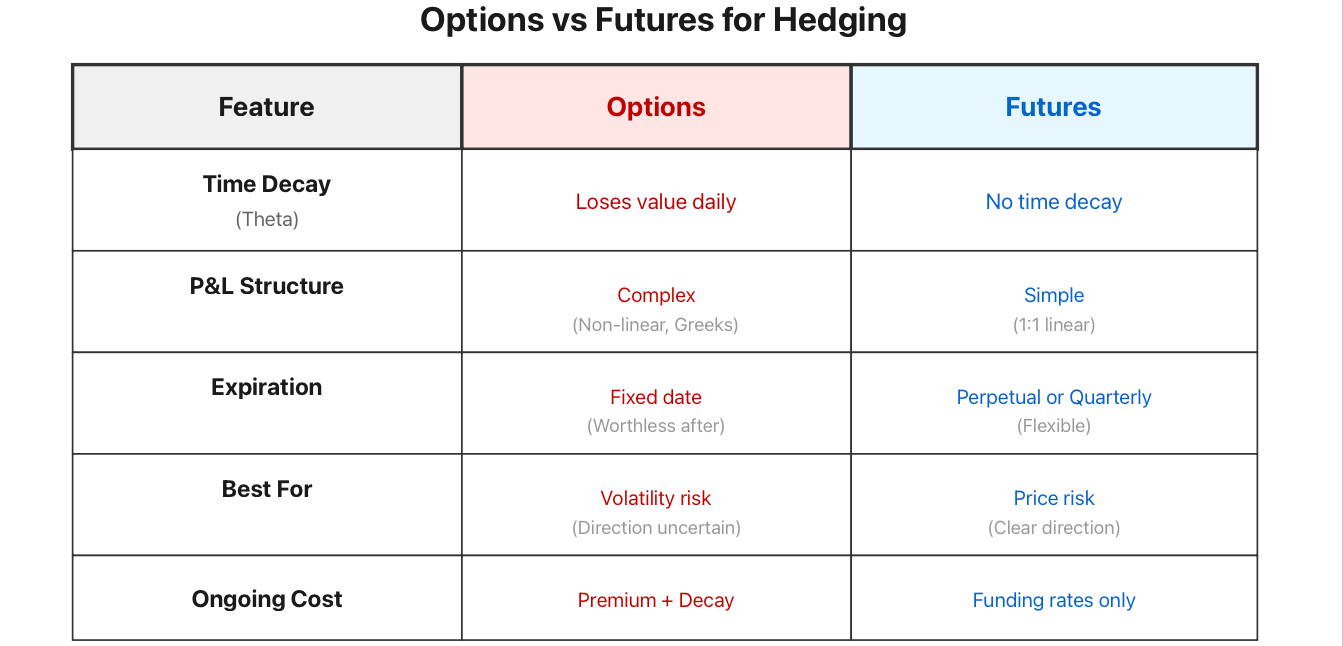
There is no time decay. Perpetual futures do not have a set expiration date; therefore, you can continue to hold your futures as long as you prefer. Quarterly futures do have expiration dates; however, there is no daily theta bleed on them. Therefore, your hedge will remain in place until you close your futures position or until the market moves against it.
You have a linear profit and loss (P&L) relationship with futures. For example, if Bitcoin goes up by $1,000, and you are hedging against that, your futures position will go down by the same amount. You do not have any complicated pricing models to manage, nor do you need to worry about tracking the Greeks. For example, if Bitcoin goes up $5,000, you are in a short futures position and will lose $5,000. It is simple and predictable.
They are a better way to manage short-term and medium-term risk. If you own Bitcoin and plan to hold it for many years, but have concerns about the next three months, futures allow you to hedge your risk for that timeframe without having to pay for option premiums that diminish more quickly than your risk horizon.
It is essential to note that hedging is not synonymous with shorting an asset. When you short an asset, you are making a directional bet on a price decline. When you hedge, you are neutralising the risk associated with an asset's price. When you hedge, you maintain your position on the asset and offset the price risk of that asset. Your primary purpose in hedging an asset is not to gain profit but rather to create more stability.
Consider this analogy: If you purchase a used car and want to know how much you could sell it for years down the road, then you are not necessarily making a directional bet as to whether or not you believe the used car market will crash. Instead, you are simply protecting yourself from the downside of the sale until you can make a decision on whether or not to sell your vehicle.
In conclusion, futures provide a great means to hedge your crypto investments. Futures will eliminate any potential upside on your investment unless you choose to hedge at 100%. For those with less experience with the cryptocurrency market, the use of futures will likely allow for less volatility and ease of mind when investing in Bitcoin.
Step-by-Step: How to Hedge with Futures
Understanding the mechanics of crypto as a trader will also help increase your knowledge as an investor.
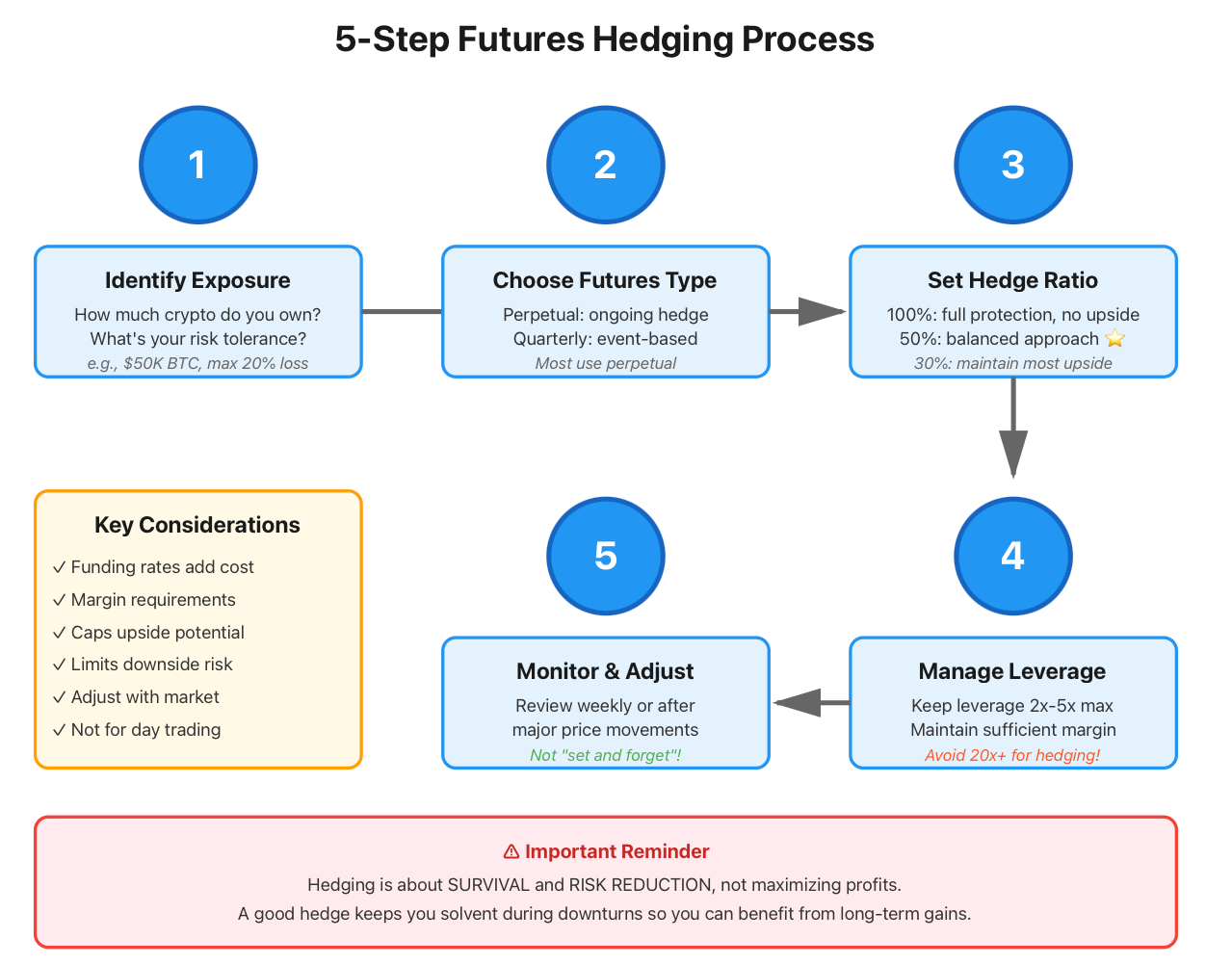
Step 1: Identify your exposure: Determine how much crypto you currently own and the level of volatility you’re comfortable with. For instance, if you currently have $50,000 in Bitcoin and can’t take the risk of losing $10,000 or 20% of your investment, then you might want to consider hedging your investment.
Step 2: Choose your futures type: Select the type of futures contract you want to use for your hedge. Perpetual futures don’t have an expiration date, and they are linked to the price of Bitcoin in the spot market through their funding rates. Quarterly futures do expire, but they have no daily decay. Since perpetual futures are typically easier to use for ongoing hedges, they are often used for this purpose. When hedging against an event whose timing is known, a quarterly future may be preferable.
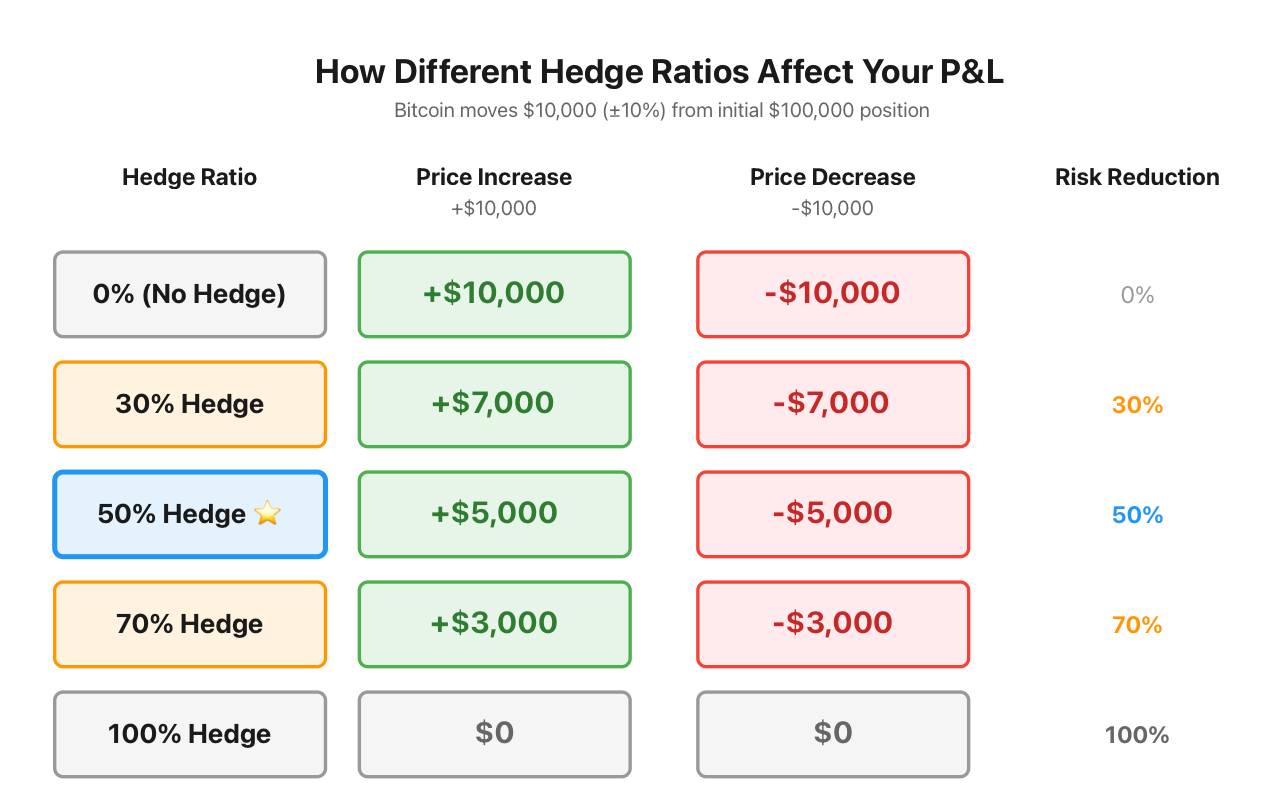
Step 3: Determine your hedge ratio: A 100% hedge means shorting the same amount of futures as you have of the spot position. This way, when the price of Bitcoin drops, you lose on the spot and gain on the futures. Therefore, the net effect is flat. Conversely, when you use a partial hedge (30%, 50%, 70%), you have limited downside while keeping some ability to benefit from the price appreciation, as well as having limited downside on the spot.
Step 4: Understand leverage and margin: Understand how leveraging works and the amount of capital you need to perform short futures. Futures are traded using leveraged capital, so you don’t need $50,000 in cash to short $50,000 worth of Bitcoin. However, leveraging also means that the volatility in the price of Bitcoin works both ways.
If the price of Bitcoin goes up while you’re in a hedged position, then you’ll lose money on your hedged futures position. Also, you need to maintain a sufficient amount of margin to avoid having your futures positions liquidated. For hedging, I recommend keeping leverage to a maximum of 2x to 5x instead of 20x or more when speculating.
Step 5: Know when to adjust or remove the hedge: Know when to modify or eliminate your hedge. A hedge is not a “set and forget it.” Modify your hedge if your risk perception changes. Close your hedge once the event you were hedging against has occurred. There is an ongoing cost associated with holding a hedge indefinitely, which will be discussed further in another article.
Consider the following example: You buy 1 Bitcoin for $100,000. If you do not use a hedge, then a $10,000 decline will either cost you $10,000 or gain you $10,000. However, if you have a 50% hedge, the same dollar decline would cost you $5,000 instead of $10,000. If Bitcoin rises $10,000, then your gain is limited to $5,000 with the hedge.
The point of using futures contracts to hedge is not to maximise gains but rather to protect against a large loss that would otherwise take you out of the market.
What Hedged Returns Actually Look Like
A large reason that traders do not hedge is that they tend to overemphasise the possible upside or maximum potential of trades, while ignoring the fact that hedging will reduce their total possible loss.
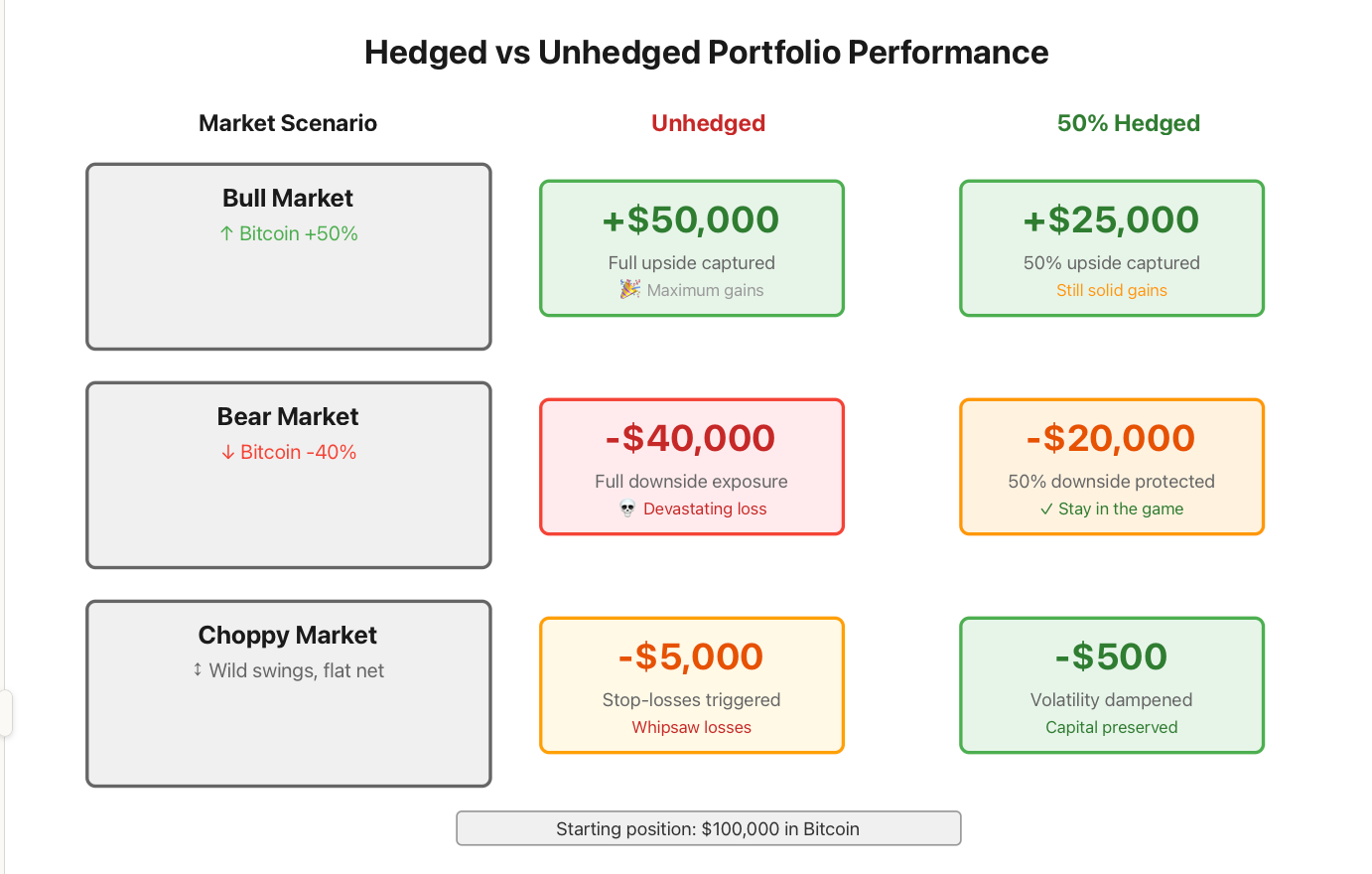
Hedging your positions will alter your distribution for return. In an upward bull market, it does not increase your profit potential; rather, it keeps you alive in a downward bear market and reduces stress associated with trading in choppy markets.
There are three typical outcomes when hedging:
Large bull market upward movement: The unhedged position has significant profits; the hedged position has less than the unhedged position, as the short future protects a portion of the upside. While this may seem like a bad decision looking back, it allowed you to maintain your place in the market through the bull run.
Large bear market downward movement: The unhedged position loses everything, and the hedged position limits losses as a result of a protected upside by means of the short future. This is one of the largest benefits of hedging, as it maintains a smaller maximum drawdown.
Sideways or choppy market movement: The unhedged position may move significantly in either direction, creating emotional reactions and potentially triggering stop-loss orders. The hedged position generally maintains a stable movement, protecting against whipsaw losses by preserving your capital.
Professionals focus on risk-adjusted returns, not just absolute returns. A portfolio with a return of 30% and a maximum loss from peak to trough of 50% may be less valuable than a portfolio with a return of 20% and a maximum loss from peak to trough of 15%. The 2nd portfolio allows you to remain solvent and sane.
Hedging is like wearing a seatbelt. Most of the time,e it feels like an inconvenience, but when you need it, it can mean the difference between living and dying.
If you are investing long-term in crypto, your purpose for hedging is not to try to outsmart the market, but rather just to continue to survive long enough to compound gains through a number of cycles.
The Hidden Costs
Hedging requires funding. If the cost of hedging were zero, many more people would be using hedging, rather than just those who can afford to do so.
Funding rates for perpetual futures represent a form of compensation between long and short positions, and are determined by the price difference between the future's and spot's asset price. When the market experiences an uptrend, funding rates will normally be positive. During downtrends, the rates are inversely correlated. Funding costs can compound to multiple percentages over weeks and/or months, depending on the size of the position held by the trader.
Hedging capital requires margin. Even if a trader uses five times their capital for leverage, to protect their $50000 of bitcoin, the trader will usually have to set aside at least $10000 in margin to pay the cost to trade some type of option, which means that the capital can to be used to buy more bitcoin elsewhere. The potential loss from that inactivity can be numerically and psychologically damaging in fast-moving markets.
The psychological effect of missing out on profits may be more damaging than the actual dollar cost of hedging. For example, when a trader hedges their position, the market will often break out to new highs, and, at that point, the trader will be forced to observe their profit from the long position eliminated by the loss from the short position.
Think of it similarly to having car insurance: while typically it is true that many car insurance premiums are not used, every year could potentially result in being glad to have been paying to have had that car insurance.
Be aware of these costs when you start hedging. If the funding rates are high and continually trending higher, one will incur a higher cost for hedging on a long-term basis than the risks they are guarding against; therefore, you will need to find a way to remove or lessen their hedge.
Adjusting Across Market Conditions
Markets change. So do hedge ratios. Professionals use different strategies depending on which stage of the market they are trading in.
In a bull market, having full hedge ratios may be unpleasant because of how much funding and upside caps you have to put up; however, having a partial hedge with a ratio of 30%-50% will help enable you to ride the trend while minimising your Catastrophic risk.
In a bear market, the reason hedging is important becomes clear because limiting your drawdowns by an increased ratio of 70%-100% keeps you solvent.
When trading futures contracts in a high volatility sideways market, there is a premium paid due to the high implied volatility associated with buying options. Therefore, the cost associated with options will generally be high, and their decay is extremely fast. Futures contracts do not involve volatility premiums; instead, they simply follow prices.
In a low-volatility and range-bound market, funding rates and opportunity costs in relation to hedges can exceed the potential benefits from insurance protection.
Dynamic hedging is constantly adjusting hedge ratios according to the market. Therefore, making one adjustment today does not give you the right to forget about your hedge for the next few months. Thus, adjust your hedges to align with the seasonal weather patterns; for example, you wouldn't wear a winter coat in July.
You don't need to rebalance your hedges every single day; rather,r the best thing you can do is check every week or immediately after significant price movements, ensuring your hedges remain matched with the risk associated with your portfolio.
Why Partial Hedging Often Wins
Although 100% hedged sounds like a good idea, it can often lead to more trouble than it solves. 100% hedged means no profits.
This would create a mental strain as traders will be unable to make any profit whatsoever. It creates an increase in cost to traders through Funding Rates, and it prevents traders from taking advantage of price increases.
Traders will find it difficult to psychologically maintain a 100% hedge. In reality, watching other traders profit on their positions, while your position is flat, is extremely difficult for most traders to stay disciplined on. Most traders exit from their 100% hedge before the crash they were attempting to avoid.
From a financial perspective, 100% hedges become extremely costly for traders. Funding Rates, Margin, and opportunity costs can add up very quickly with a 100% hedge.
Strategically speaking, 100% hedging takes away the upside for the trader. If a trader has a long-term bullish view, why would they hedge the upside?
A Partial Hedge is a more practical approach to hedging. A 50 % hedge allows the trader to benefit from a large price increase and reduces the risk of loss on a price decrease by 50 per cent.
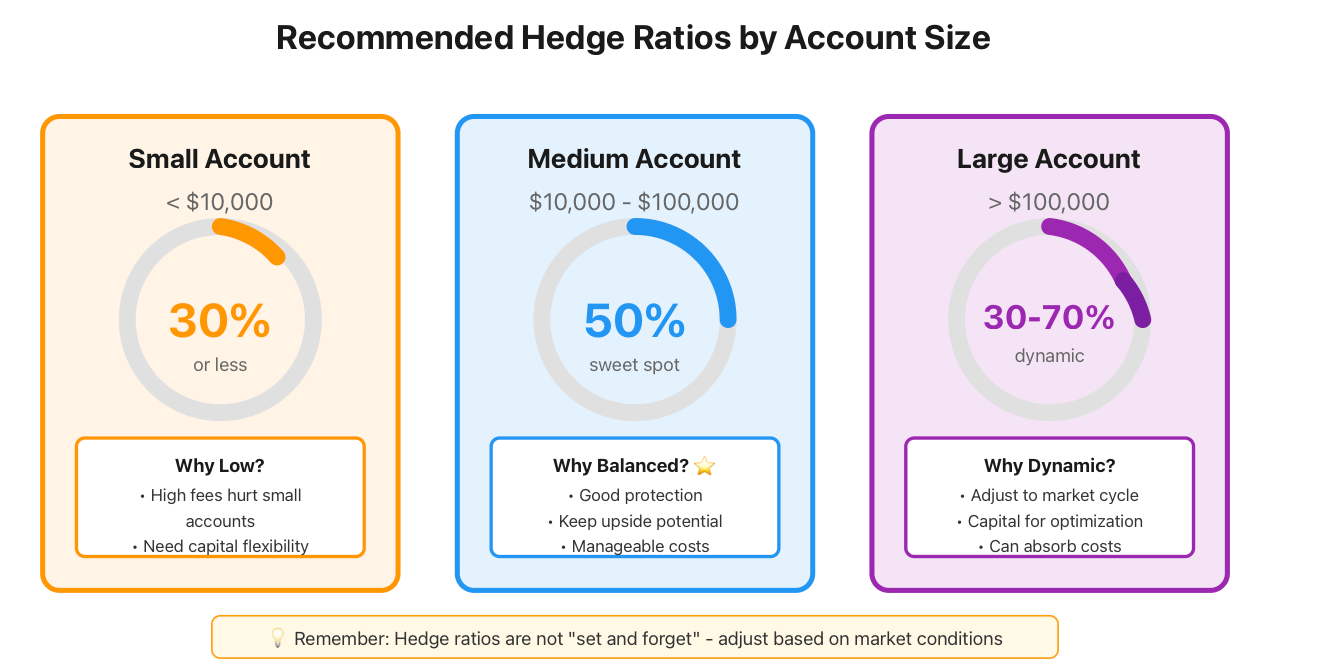
Partial Hedging Ratios Based on Account Size:
-
Small Accounts (<$10,000): 30% or less because Full Hedges take too much Capital to maintain.
-
Medium Accounts ($10,000-100,000): 50 % is the perfect ratio for most situations.
-
Large Accounts (>$100,000): Dynamic Hedges (Based on Market Condition) 30%-70%
Hedging should be viewed like a dial and not a switch. You wouldn’t "floor" the brake pedal every time you came to a curve you would apply pressure depending on your speed, road conditions and layout.
When Futures Hedging Can Backfire
Hedging does not work for everyone or every type of trading. In fact, there are several cases where adding a hedge actually makes the trade worse. For example, ultra-short-term traders scalping the markets do not benefit from using a hedge because the brokerage fees and funding costs will take away from any profits they hope to achieve with a hedge.
Another group of traders that should avoid adding a hedge to their position is high-leverage speculators. The hedge may compound any existing risk of being highly leveraged, as it requires both margin and added exposure to a market that may already be losing money.
Ultra-short-term traders primarily trade based on speed and not so much based on risk management; thus, hedges only add additional costs and complexities to their trades without reducing risk.
High-leverage speculators will have difficulty as well as hedging effectively due to the level of margin they are using to place their trades. When using extreme levels of leverage, even a small move against you may result in total loss of your account balance; this may happen faster than a hedge can protect you.
Additionally, traders that are beginning traders with trading accounts of less than $1,000 will experience a major disadvantage in using a hedge due to the extremely high fee and funding costs associated with hedging. These fees and costs will generally exceed the funds available in the trading account.
If a trader is panicking and selling every market dip, a hedge will not resolve their emotional problems. They should invest time in developing a proper trading strategy rather than applying a temporary solution.
To put it another way, if a person is driving by flooring the gas pedal and swerving from left to right while on the road and suddenly slams on their brakes, they will probably end up spinning out. Similarly, the driver needs to first fix the way they are driving before looking to fix how to stop.
From Single Position to Portfolio Hedging
Traders typically hedge at the position level; this is a common approach taken by beginner traders. The true nature of risk management is at the portfolio level because risk is correlated among all of your trades.
If you are holding Bitcoin, Ethereum, and Solana, those three cryptocurrencies are strongly correlated, so you will be paying three times as much in cost and complexity in each hedge for only a small amount of additional protection.
Therefore, hedge your entire portfolio's net exposure; for example, a single short position in Bitcoin futures could be used to cover 60% or more of your total dollar amount held.
Hedging your portfolio acknowledges the fact that certain cryptocurrencies will move together, so when you hedge Bitcoin, you are also hedging a significant portion of the value of Ethereum. This is not true with the correlations of Bitcoin and stablecoins; the two currencies' correlation is zero, and, therefore, by hedging Bitcoin, you would also be protecting a significant part of your entire portfolio in relation to the cryptocurrencies held.
This is how institutions view the market. They do not hedge their entire portfolio; they measure their net exposure, calculate their correlation, and hedge at the portfolio level. Hedging on a portfolio basis is more efficient, less expensive, and more effective than hedging at the position level.
Managing multiple baskets of eggs requires much more effort than managing a single larger basket of eggs. Therefore, take a consolidated view of your risk and hedge accordingly.
Conclusion: Survival Over Prediction
We have discussed several key points up to this point. Here is a brief recap of the key messages. The first is that even if you are correct in predicting the market, it does not guarantee you profitability if you do not have the correct structure of tools. The second is that what you choose to use as a trading tool will dictate your results. Options will experience time decay and therefore will "rot" over time, while Futures will give you a direct hedge in price. The third point is that Futures provide price protection and a hedge against price risk, but not against market risk.
A common question that investors have regarding how to hedge crypto with Futures is now answered: it’s about reducing or offsetting your exposure to maintain your portfolio’s value throughout the downturn.
Therefore, in reality, hedging is about maintaining your long-term survival, not merely short-term speculation. If you are seriously looking to stay in this cryptocurrency world for years or decades, then you must protect your investments.
Using Tradewill’s Futures and CFD risk management tools, you can take control of your portfolio's defence against the kind of volatility you’re facing in 2022 and 2023 as outlined previously. You may also develop an effective Strategy that withstands the severe volatility of 2026 and beyond.
Test strategies and explore futures-based risk tools built for real-world conditions at Tradewill.
Disclaimer: The content of the blog does not represent any position of Trade W, does not serve as any trading-related decision advice, and does not endorse any third-party.