

 Trade W
It's commonly believed that the U.S. Dollar ranks at the top of all currency rankings, yet this is not the case. For a long time, a small country in the Gulf has occupied first place in the rankings. Understanding this position can point out many interesting features of how the foreign exchange market works.
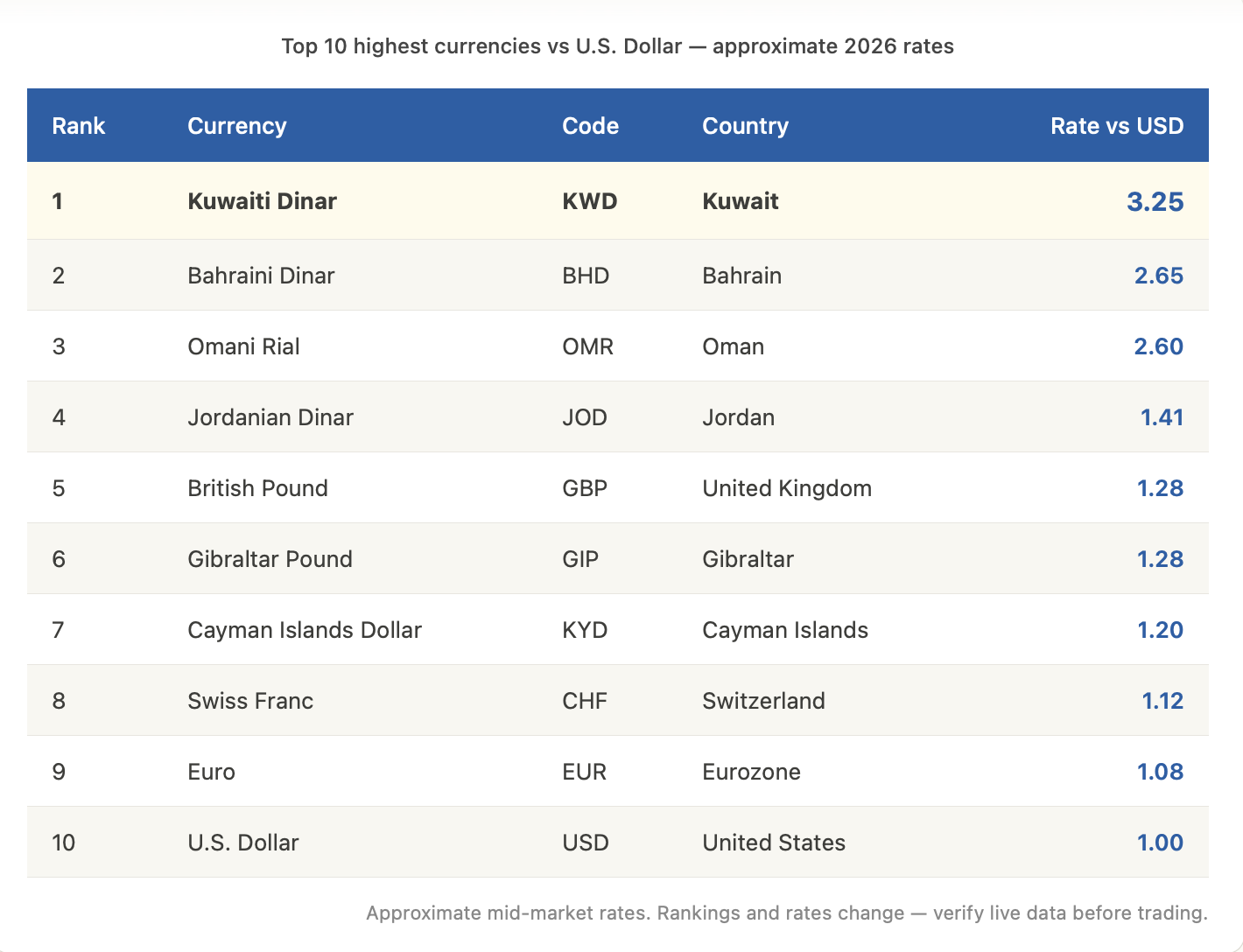
The Kuwait Dinar (KWD) has the highest currency in the world. As of 2026, the value of one Kuwaiti Dinar is approximately equivalent to 3.25 US dollars, which makes it the most valuable currency in the world at that time.
The KWD has three things that maintain its position: Kuwait's economy is an oil-based economy, a managed level of money supply and the KWD is pegged to a basket of other major currencies. Following the KWD and the USD, the next highest currencies in the world are the Bahraini Dinar, Omani Rial, Jordanian Dinar and British Pound.
When asked which currency is the most valuable in the world, many are likely to answer based on the normal consensus that the highest volume currency is also going to have the highest value. The Dollar has approximately 88% of the volume of international transactions and is the base for international trade.
Therefore, most people view the Dollar as a very powerful currency and associate its status as the world’s reserve currency as a function of its value. However, the distinction between having a high volume currency and a high value currency is very clear.
If you are asking the question to find the actual answer to which currency is the most valuable, it would be the Kuwaiti Dinar (KWD). By the year 2026, one KWD will have an exchange rate equal to over three U.S. Dollars, which makes it the most valuable currency in the world by a significant margin. The gap in value has existed for many years, but most of the world has “no clue” that this is true.
The cause of this misunderstanding is structural. The fundamentals of determining which currency has more “strength” are based on three aspects related to exchange rates, dominance of a currency, and purchasing power. While the Dollar is the foundation for the world’s finance, the KWD is valued much higher on an absolute basis.
Traders and investors can gain tremendous insight into their trading methodologies from understanding the difference between currency valuations associated with on an absolute basis versus volume. This understanding can provide critical input to carry trading, inflation hedging, and diversifying portfolios.
Top 10 Highest Currencies Throughout the World (Ranked in 2026)
The definition of the highest currency when referring to exchange relates to U.S. dollars, where 1 unit will purchase more U.S. dollars than 1 unit will purchase of many other types of currency. This method provides the simplest measure of currency strength based on paper values shown on printed currency.
Once you get through the top ten, it becomes clear that most of the high currency values are from oil-exporting countries within the Gulf Coast region and also countries that have stable economies throughout Europe.
Countries like Kuwait, Bahrain, and Oman all make billions upon billions of dollars each year through oil exports, with such an elite amount of government revenue being generated by so few people relative to the amount of oil exported, they have created an economy that has such a dense population per capita, therefore generating high dollar values for their respective currencies.
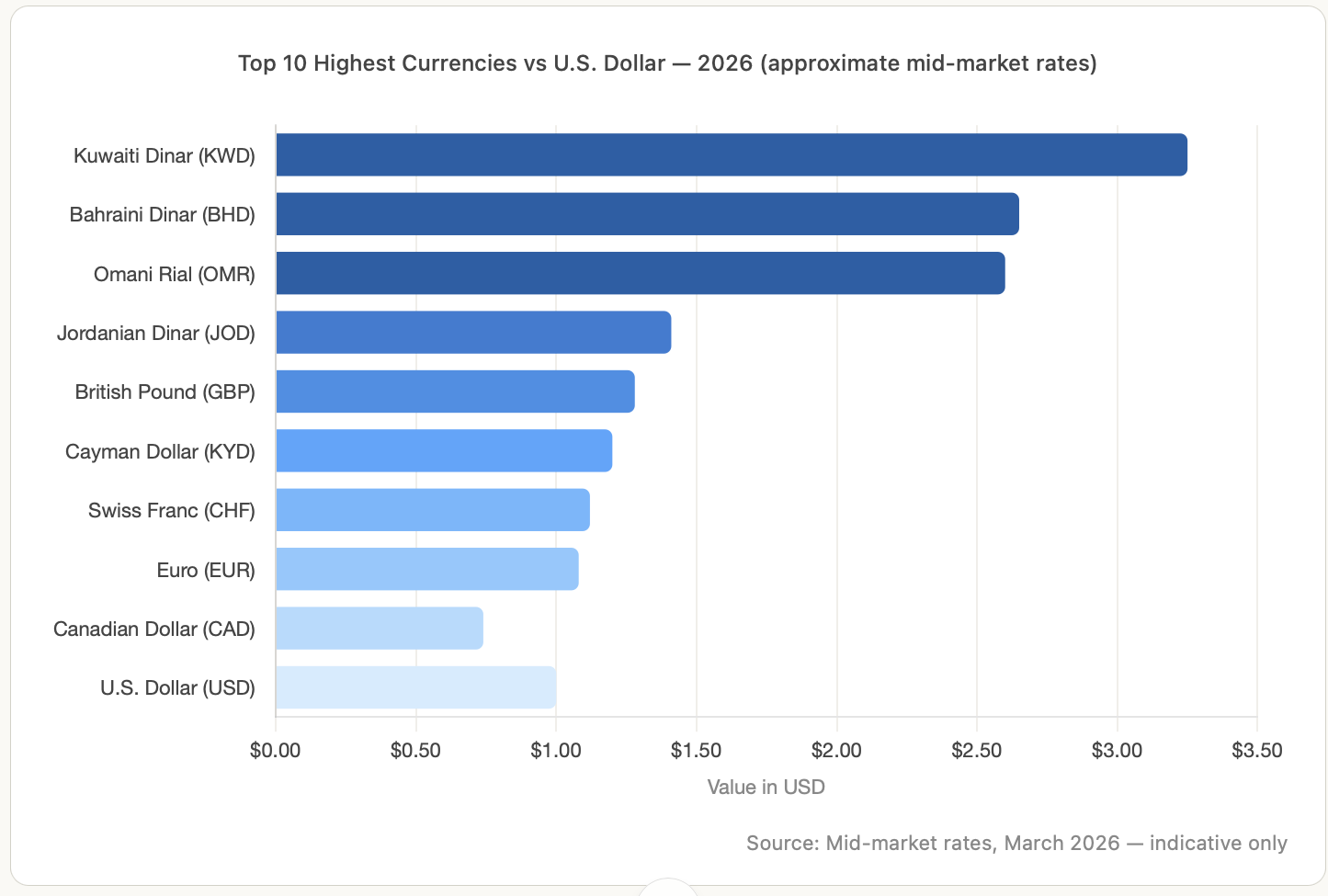
Among the nations, the most obvious outlier is Jordan. Although the country has no important oil reserves, the Jordanian Dinar's fixed exchange rate to the U.S. Dollar has kept it consistently within the top five highest-valued currencies in the world. Government intervention, coupled with proper reserve management, can uphold the value of a currency regardless of whether or not a country has commodities.
The British Pound is another type of currency, but it has a different structure than the Gulf currencies listed above; it trades on open international capital markets. Its price on the global market depends on three major factors: the size of the UK's financial service sector, the UK government’s trade relationship with the rest of the world, and the historical significance of the British pound as an internationally traded currency.
Therefore, there is more price fluctuation with the British pound compared to the Gulf currencies, yet the British government does not commit to defending its exchange rate.
Consider currency as a company stock. If a parent company accumulates exceptionally vast amounts of wealth and then confines that wealth to a few shareholders by restricting the number of company shares in circulation, the price of each company share rises because there are fewer shares available for the public to purchase. The same theory can be applied to the value of the Kuwaiti Dinar.
Why the Kuwaiti Dinar Is the Highest Currency in the World
Three forces combine to make the Kuwaiti Dinar what it is, and they reinforce each other in a way that makes the position remarkably durable.
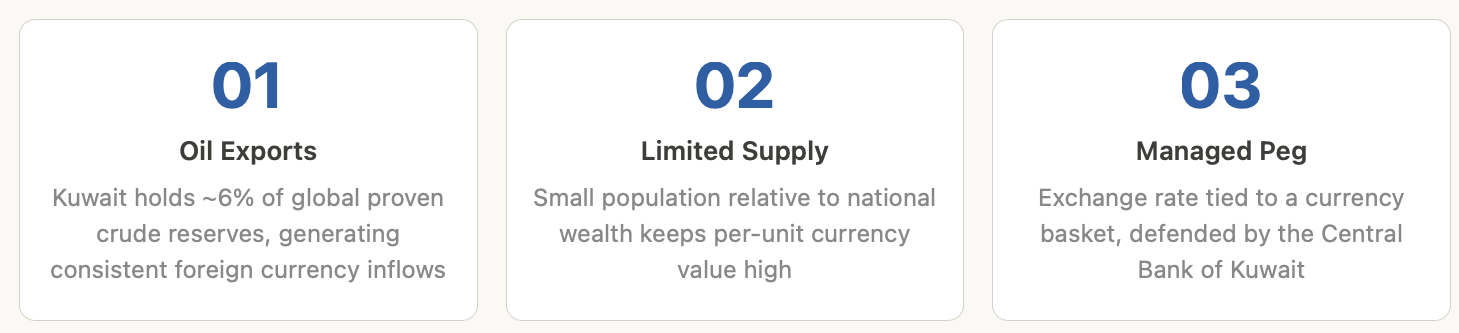
The national budget and the Kuwait Investment Authority receive funding from oil revenues. The Kuwait Investment Authority is one of the oldest and largest sovereign wealth funds globally, having over $700 billion in assets under management. Oil revenues back the value of the Kuwait Dinar; therefore, without oil, the value of the Dinar will change dramatically.
Regarding supply, the population of Kuwait is approximately 4,500,000. The Government of Kuwait carefully controls the growth of the money supply in Kuwait. They increase the money supply in relation to real economic output, which allows for more money to be available than what is produced in the economy, thereby keeping inflation and other forces from eroding the value of the Dinar.
The Kuwait Dinar is pegged to a basket of currencies of its trading partners, with the US Dollar being the most prominent. The Central Bank continually protects the value of the Dinar by purchasing and selling its foreign reserves. This continuous protection helps eliminate currency volatility in the Dinar value, which helps develop a high long-term Dinar value.
This process is only possible because of oil wealth, which creates the foreign reserve required to protect the Dinar's peg to its basket of currencies. Therefore, with an option to receive long-term investment and the controlled growth of the money supply, the Dinar retains value through the self-reinforcing process described above.
Pegged Exchange Rates: How Governments Maintain Strong Currencies
A fixed exchange rate, or pegged exchange rate, is a value that a government officially ties its own currency to another currency or a weighted basket of currencies. The central bank takes a commitment to maintaining a specific rate and will back that commitment with foreign exchange reserves.
Countries choose to peg their currencies for many reasons. For example, oil-producing countries typically price their oil sales in USD. Accepting a payment in USD and then converting it into a floating domestic currency becomes subject to a price risk in every transaction. By pegging their currency to the US dollar, oil-producing countries completely eliminate that uncertainty. With an accurate value of your currency in USD makes it much easier to plan for your business and invest over the long term.
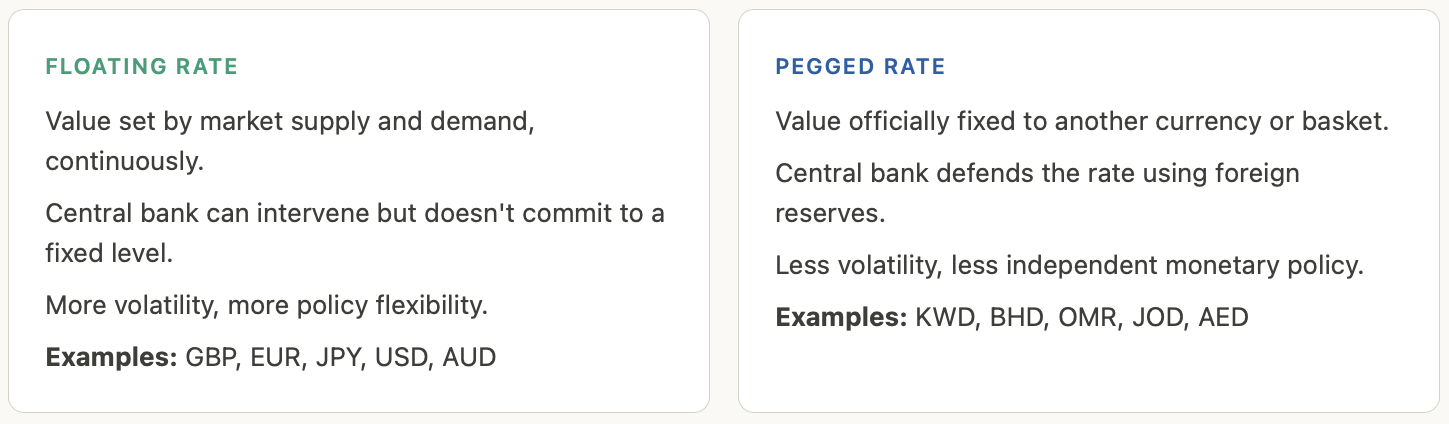
Oman and Bahrain have created a fixed exchange rate between their currencies and the U.S. Dollar that allows speculators to trade their currencies without any restrictions. In order to maintain this exchange rate, they hold large dollar reserves to absorb any breaches of their peg; however, because they are required to hold sufficient dollar reserves, they are unable to adjust interest rates according to their domestic economies.
On the other hand, a floating exchange rate allows the value of a currency to be determined by market forces in real-time. For instance, the GBP, EUR, and JPY all float with trade balances, interest rate differentials, investor confidence, and central bank cues, causing more volatility, but offering far better flexibility to react to domestic or foreign market dynamics.
Currency Value vs Purchasing Power: The Hidden Economic Reality
A frequently encountered pitfall is the assumption that a strong currency will give you more for your money than a weak one, when it is often the case that this is incorrect.
Purchasing power parity (PPP) is a method of comparing how much a certain amount of money will buy in different countries after one has accounted for local market values. The easiest to use example of this concept is the Big Mac index, which measures the price of a Big Mac at McDonald's worldwide in order to help determine whether the currency value is correct with respect to its actual purchasing power.
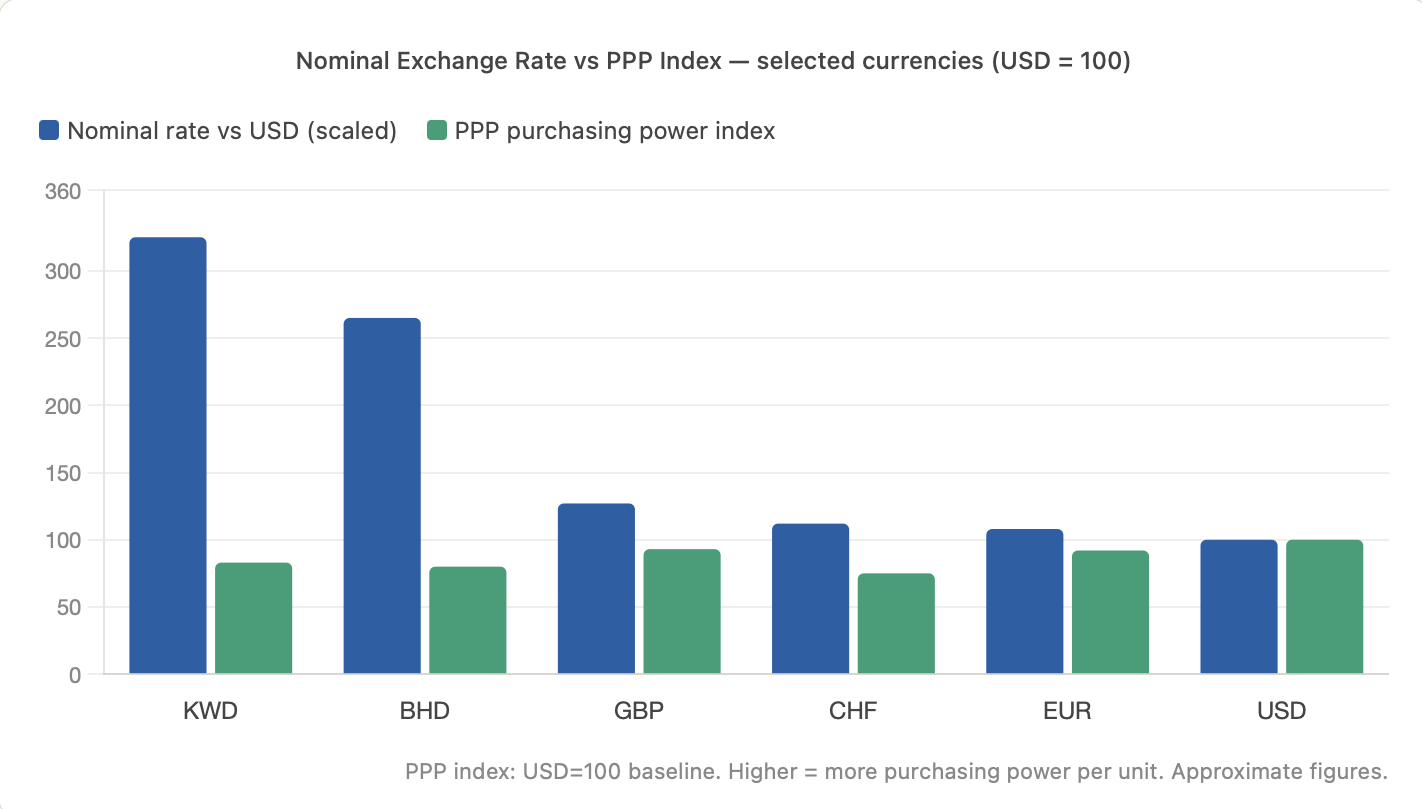
Kuwait has a very strong currency value compared to most other currencies, and thus, the prices for goods are extremely high to correlate with the strength of its currency. For example, the price of a coffee from a café in Kuwait City costs about $5–$6 USD, whereas in Jakarta, a café would charge less than $2 for the same beverage.
While the value of the Kuwaiti Dinar to U.S. Dollars appears to be greater than the value that can be translated into actual consumption in Kuwait, living in Kuwait is expensive because of high importation costs, high cost of living and high wages associated with all these things.
Switzerland serves as another good example of this same principle. Although the Swiss Franc is ranked in the top 10 currencies worldwide based on value, the cost of living in Switzerland consistently ranks among the highest in the world. Therefore, even though the value of the Swiss Franc appears to support purchasing in Switzerland, purchasing domestic items in Switzerland is not as easy as it might seem.
Investors need to be aware that simply because a currency appears to have a high value based on the exchange rate does not guarantee that a country is a good investment. Conversely, just because a currency has a low value based on the exchange rate does not indicate a weak economy. Vietnam, India and Indonesia have nominally inexpensive currencies, but their economies are very large and developing rapidly. As such, the PPP reflects the true costs of producing goods. Therefore, it is important to consider the actual cost of production when making purchasing decisions.
Trading Strong Currencies: Hedging and Carry Trade Strategies for 2026
Strong currencies and high-value currencies create specific opportunities for forex traders. Three strategies are worth understanding in detail.
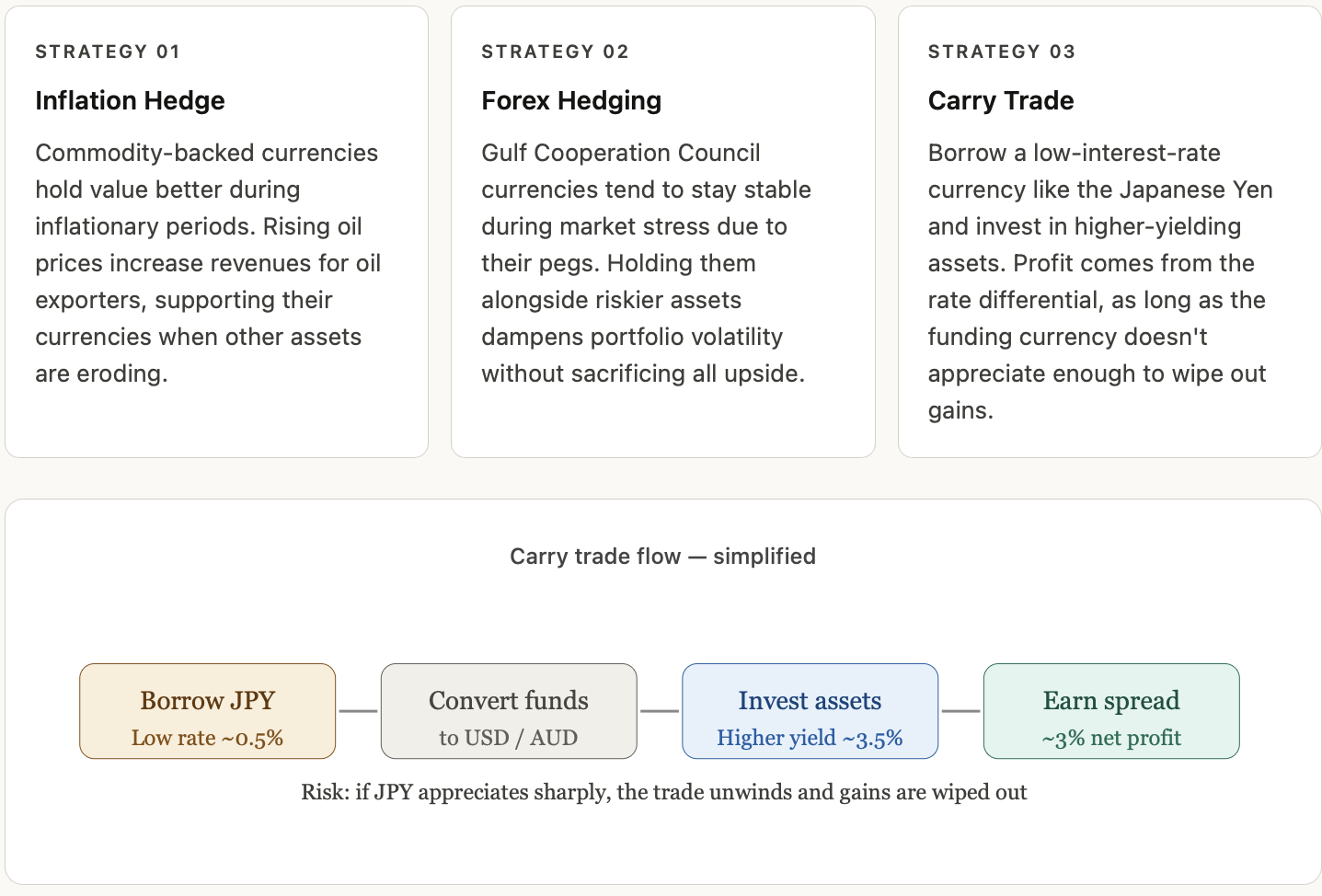
The carry trade is a widely known method of operation in forex. As has been the case for decades, the classic funding currency has been the Japanese Yen, due to an extended period of very low interest rates in Japan. Carry trades can reverse suddenly and very acutely, as was witnessed in August 2024, when the Bank of Japan raised rates, and the JPY surged in value, prompting a large-scale unwinding of positions globally.
When building a carry trade position, it is crucial that the interest rate differential is substantially greater than both the cost of executing the trade and the possible negative movement of the currency being traded.
Moreover, the higher the amount of leverage used to create your position, the greater your exposure to the risk of a rapid unwind in your position. Proper position sizing and adherence to stop-loss levels are very important.
Currency Wars and De-dollarisation: Global Monetary Trends in 2026
This year, three macro-level trends are reshaping the global currency system.
De-dollarisation continues, albeit at a slow pace. Increasingly, BRICS nations, such as Brazil, Russia, India, China and now more than 10 other countries, are attempting to lessen their dependence on the U.S. dollar for settling international trade transactions. Some countries have begun to settle trade transactions directly in their local currencies under bilateral agreements.
Earlier this year, Saudi Arabia participated in early discussions regarding pricing certain oil sales in currencies other than the U.S. dollar, but there is no clear timeline as to when this will occur.
While the dollar's dominance is not in immediate jeopardy, the dollar currently represents 88 per cent of all forex transaction volumes, reflecting solid institutional underpinnings that will not change overnight; however, currency traders have to pay attention to this increasingly valid directional trend.
Emerging markets are also evolving in this process. For example, the Nifty 50 stock index has gained significant standing in the global equity market. By developing deeper, more effective financial systems and attracting greater foreign investment into their economies, many of these emerging market currencies will rise in global currency rankings over time. Finally, although the Indian rupee is still very far from being in the top-10 currencies by nominal value, there is a continuous upward trend with respect to its usage in international financing via cross-border transactions.
While Central Bank Digital Currencies (CBDCs) remain somewhat nascent in the overall global currency market, more than 130 countries worldwide are currently involved in CBDC research, pilot testing and early implementation stages. China's digital yuan is currently functional and in practical usage, while the European Central Bank continues to fund the digital euro initiative.
At this point in time, it is too early to determine whether CBDCs will alter the dollar's dominance as the world's currency of choice or simply digitise the current methodology for transferring, settling and pricing currencies internationally. Nonetheless, the progression of CBDCs will certainly impact the transfer, settlement and pricing of currencies on an international basis in the coming 10 years.
Protecting Wealth During Currency Depreciation
If an investor saves all of their wealth in one currency, when that currency becomes less valuable due to inflation, a currency devaluation or an economic crisis, they stand to lose a lot of money. However, there are three ways to reduce this risk consistently.
Gold as a Long-Term Value: Historically speaking, Gold has been a form of money that has provided its owner with purchasing power for hundreds of years, despite the fact that it generates little more than the cost of storage each year. As paper money becomes less valuable, the price of Gold usually also rises in relation to that paper money. Thus, for investors living in countries that are experiencing high inflation or instability in their national currencies, investing in Gold can serve as a hedge against the erosion of their savings due to currency depreciation.
Diversifying Your Currency: By holding savings and investments in a variety of currencies, you can reduce the amount of concentration risk that exists within your investments. Thus, if your currency loses significant value, you may have some of that loss offset by your holdings in other currencies that are either stable or are negatively correlated with your devalued currency.
Historically speaking, the Swiss Franc, Kuwaiti Dinar and Singapore Dollar have maintained their status as "safe havens" during times of extreme economic or financial market turmoil.
Multiple Asset Class Diversification: Adding foreign exchange exposure with equity, commodity and fixed income positions will give you diverse, uncorrelated sources of return. In general, currencies depreciate, and commodity prices appreciate at the same time, and, therefore, commodity-linked investments may help to offset a portion of the depreciation in currencies in real dollar terms.
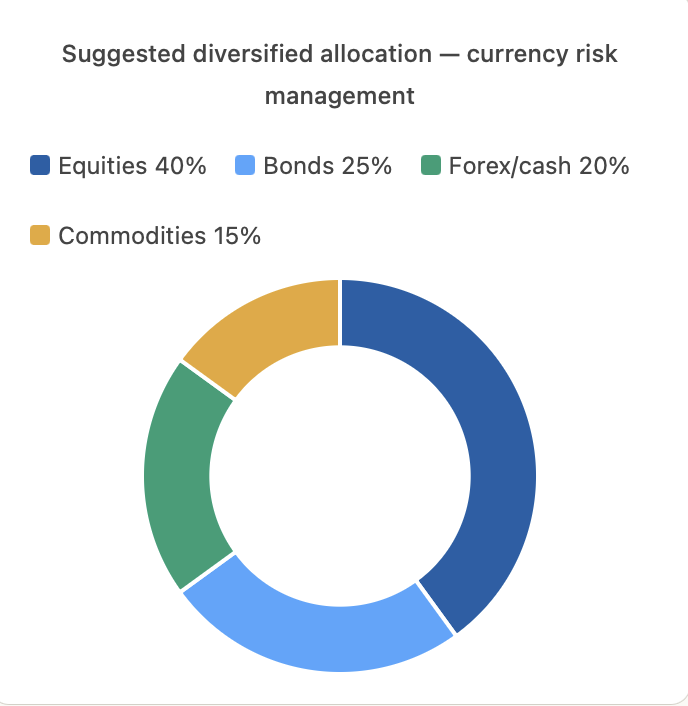
Of course, a good general rule is not to put all of your money into one "currency", particularly one that has political risk, fiscal imbalances or commodity price fluctuations. The most reliable method of long-term protection from depreciation is geographic and asset class diversification.
Real-time ranking: Highest currency in the world by early 2026.
Exchange rates are constantly moving, and the table below lists approximate mid-market values as of early 2026. These values will change based upon monetary policy decisions, commodity price movements and global economic conditions. Always use a live forex provider to confirm rates before making any transaction.
Understanding the True Meaning of the Highest Currency
The fact that the Kuwaiti Dinar is at the top of the world currency rankings is not just a random happening. It’s the result of decades of thoughtful monetary policies, abundant natural resources and a consistent and efficient management of the money supply.
The larger point to remember is what being ranked as a “high currency” actually means, and what it doesn’t mean. There is no assurance that a high exchange rate actually provides you with high purchasing power, good economic strength or strong returns from investment. The best currency for your portfolio is primarily dependent upon your specific objectives, whether it be hedging against inflation with a CPI-linked strategy, diversifying risk with stable pegs or capturing yield differentials through a carry trade based on technical analysis of rate cycles.
Nominal value, purchasing power, peg system, and trading strategies exist in a cohesive way. Gaining an understanding of each of the four elements will help you make informed currency decisions based on a comprehensive framework, rather than simply looking at one number from a listing.
Frequently Asked Questions
What is the highest currency in the world?
The Kuwaiti Dinar (KWD) is the world's highest-value currency by exchange rate against the U.S. Dollar. As of 2026, one KWD equals approximately 3.25 USD, giving it the highest per-unit value of any currency globally.
Why is the Kuwaiti Dinar so valuable?
Three factors work together: Kuwait's significant crude oil export revenues, a small population relative to national wealth (which concentrates purchasing power), and a managed exchange rate pegged to a basket of major currencies. The Central Bank of Kuwait actively defends this peg using substantial foreign currency reserves.
Does the highest-value currency always come from the strongest economy?
No. Currency value by exchange rate and overall economic strength measure different things. The United States has the largest economy in the world, but its currency ranks well below the Kuwaiti Dinar by per-unit value. China has the second-largest economy, and the yuan ranks far lower still. Exchange rate value reflects monetary policy choices, not just economic size.
Can traders profit from strong currencies?
Yes, through several strategies. Carry trades use low-rate currencies as funding to invest in higher-yielding assets. Forex hedging uses stable pegged currencies to reduce portfolio volatility. Commodity-backed currencies can act as inflation hedges when oil prices rise. Each strategy carries its own risks and requires a clear understanding of interest rate differentials and exchange rate mechanics.
Ready to trade the world's strongest currencies?
Use TradeWill's live forex tools to analyse KWD, GBP, and carry trade opportunities with real-time exchange rate data, CPI overlays, and technical indicators in one platform.
Disclaimer: The content of the blog does not represent any position of Trade W, does not serve as any trading-related decision advice, and does not endorse any third-party.