

 Trade W
Think of a country as a large corporation, with its fiscal policies acting as its budget and monetary policy determined by the company’s financial strategy of controlling interest rates and the money supply. Therefore, both will have direct effects on the company's stock price, i.e. the entire financial market.
Governmental spending fuels growth in GDP. Interest rates set by a central bank determine the cost of borrowing money. Fiscal and monetary policies create the basis of how investors value currencies and equities. Both government and central bank policies drive a shift in capital flows when either the government increases its spending or when the central bank lowers interest rates. This has an immediate effect on the prices of assets, movement in markets and in both financial and commodity markets.
These policies are not mere theories, but rather policies that have a direct impact on pricing now and will serve as price drivers in real time. During 2020 and 2021, the combination of a massive amount of fiscal stimulus, combined with near-zero interest rates, resulted in extreme volatility of the USD and contributed to a boom in the technology stocks. Traders that understood the policy backdrop were able to make better trading decisions.
Monitoring the changes in fiscal and monetary policies is among the most important things for investors to do to be able to properly assess market activity. Changes in government spending and interest rates can lead to significant price spikes in currencies; increase volatility and sector rotation. If you miss these signals, you will miss the larger picture of why the markets are moving.
This guide breaks down how fiscal and monetary policy work, why they matter, and how traders can use policy trends to build stronger strategies in forex and stock markets.
What Is Fiscal Policy and How Does It Move Markets?
Governments utilize fiscal policy in the economy by the means of spending and taxing to control and influence economic activity. When a government decreases taxes and/or increases its spending, this is considered an expansionary fiscal policy. Conversely, contractionary fiscal policy occurs when a government reduces its spending and/or increases taxes.
For example, if your parents suddenly increased your allowance and allowed you to spend more money, you would likely do so. This is an example of expansion; conversely, if your parents reduced your allowance, you would likely begin economizing with your allowance. This is an example of contraction. To a larger extent, the same type of thinking applies to an entire economy.
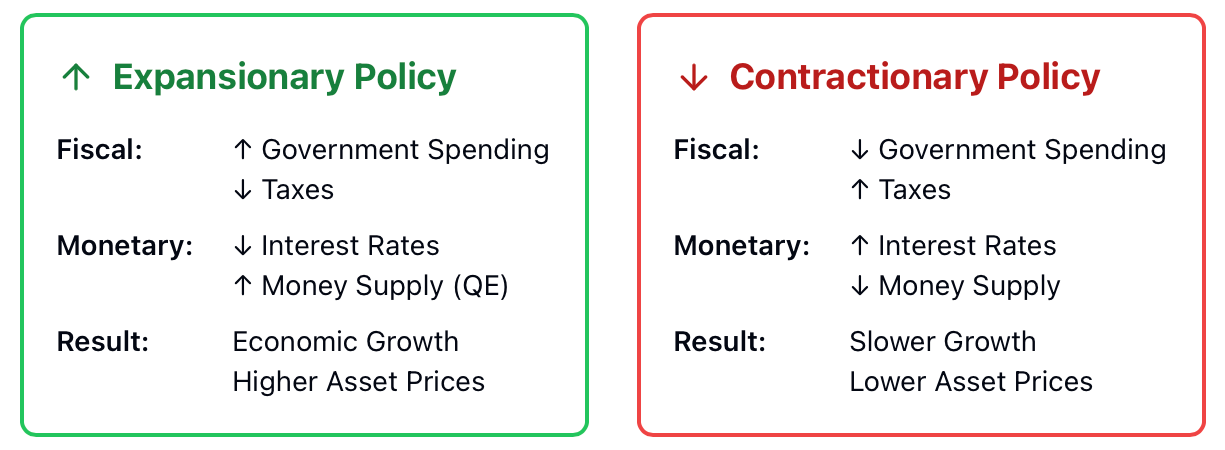
The expansionary fiscal policy creates a positive impact on the GDP by increasing the money supply in the economy. When infrastructure projects are created, jobs are created, and more materials are created; therefore, an increase in the demand for construction companies and cyclical stocks is created. Tax cuts on businesses provide businesses with additional disposable income to utilize towards either investing or making purchases.
Conversely, contractionary fiscal policy has the opposite effect on GDP. In many instances, when a government decreases its spending in trying to control inflation and/or reduce its debt load, this process slows down economic activity and ultimately impacts a company's earnings.
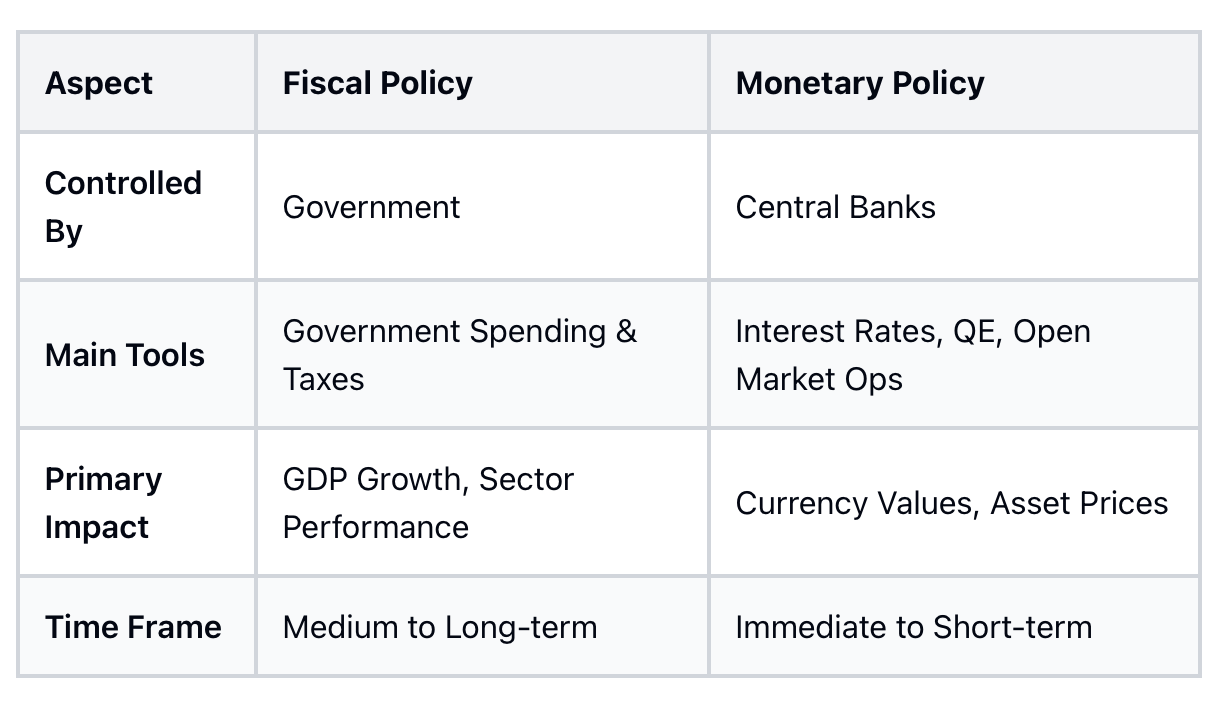
Fiscal policy impacts a company's financial performance in several ways. On the one hand, an increase in government investment in infrastructure directly correlates to an increased revenue for a construction company; on the other hand, an incentive created by an increase in government spending on structure is likely correlated with a higher level of inflation.
An increase in government spending on higher prices could also lead to currency depreciation as a result of the greater amount of currency being created and/or the increased possibility of higher price levels in the near future due to an increased level of government spending.
The American Rescue Offer, a $1.9 trillion fiscal stimulus package, was passed into law by the United States government in 2021. As a result of this announcement, the USD weakened as market participants began to consider higher inflation, but also drove up the price of equities as market participants anticipated stronger demand for goods and services.
Market participants observe the direction of fiscal policy to determine if the economy is accelerating or decelerating, and thus, understand which sectors may perform better than others over time. Market participants tracking government budgets and spending plans receive early notice about which sectors they may outperform.
What is the function of monetary policy?
Monetary policy refers to the methods used by central banks to regulate the money supply and influence economic activity. The three main methods that central banks use are interest rates, quantitative easing (QE), and open market operations.
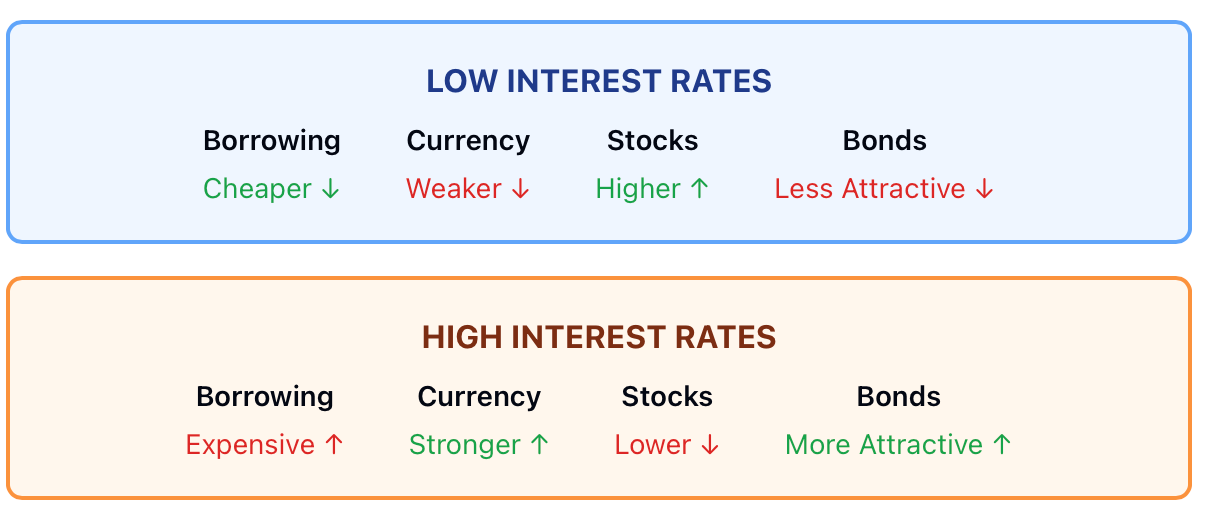
Interest rates represent the cost of borrowing money; when interest rates are low, borrowing can be less costly; this can encourage businesses to borrow capital to invest in their business, and consumers to borrow money to make purchases. Therefore, when interest rates are low, it is similar to when a school sells lunch for less. Conversely, when interest rates are high, this can slow the rate of borrowing and increase the rate of inflation.
Central banks conduct QE through purchasing government bonds and other securities to increase money supply within the economy. When central banks do this, it can decrease the yields on these bonds, causing investors to invest in alternative, riskier investments, such as shares of stock. In most circumstances, tech shares benefit most from QE programs due to their reliance on growth expectations and valuations based on future growth and performance, which generally look better with lower interest rates.
Open-market operations are buying and selling Government Securities to manage short-term interest rates and improve the banking system's liquidity.
Monetary policy tools can be adjusted according to economic data such as inflation or employment figures. For instance, if inflation were high, the Fed would raise interest rates to reduce inflationary pressure on the economy. Conversely, If the economy were growing slowly, the Fed could lower interest rates to encourage economic growth.
In 2022-2024, The Federal Reserve raised interest rates significantly in response to rising inflation. The USD became stronger as foreign investments were drawn to higher rates available in the U.S. Growth companies, especially in technology, experienced large declines in value due to higher interest rates diminishing the present value of projected future profits.
The single most significant force in the price of assets across the globe is the sensitivity of monetary policy to market prices. Therefore, one statement from the Fed can shift billions of dollars of capital between markets in minutes. Traders who pay attention to the schedule of central bank meetings and how they're expected to react to news related to economic indicators are usually better prepared than other traders for the potential shifts in the market.
How Fiscal and Monetary Policy Drive Inflation
The bridge between policy and the price of assets is Inflation. Both Fiscal Authorities and Monetary Authorities target Inflation because of its effect on Purchasing Power, Interest Rates, and Economic Stability.
When governments spend money without increasing taxes, more money is placed into circulation. If the money being spent does not allow for larger quantities of goods and services to be produced, then prices will rise. As an example, consider how a cafeteria may raise its prices each day so that you have to pay more to feed yourself than you would today.
To fight inflation, monetary policy raises the costs of borrowing by raising interest rates. High interest rates force people to stop using credit, which will reduce consumption and investment. Therefore, reduced consumption and investment creates a reduced demand for products, and as such, inflation is slowed.
The profit margins of corporations will fall due to inflation; it creates a risk for companies that they may incur additional costs for raw materials and supplies while, at the same time, not be able to charge their customers the additional costs incurred from inflation. Consequently, lower profits result in lower earnings, resulting in lower valuations.
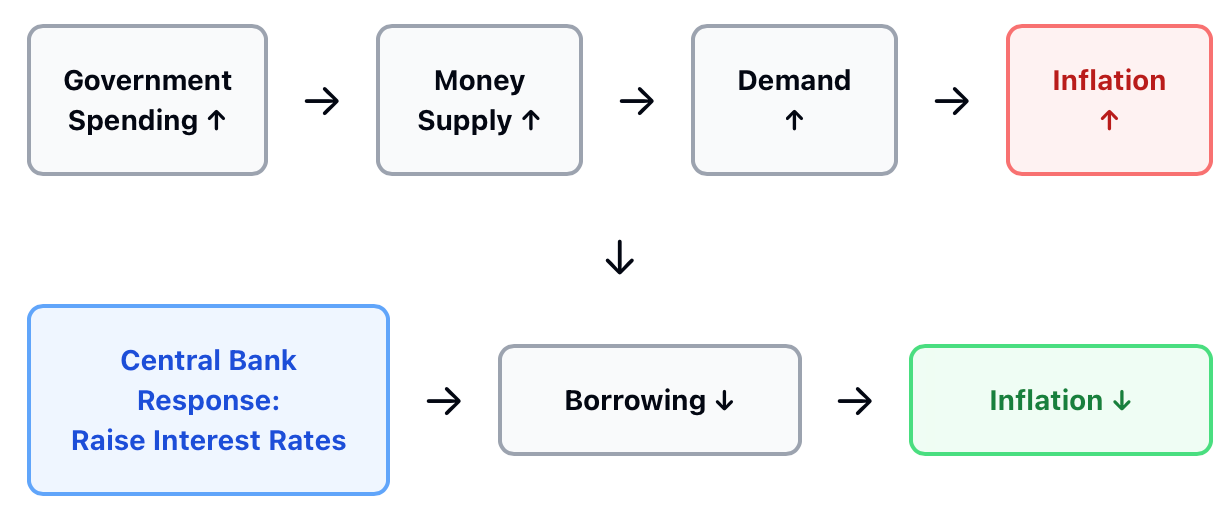
High inflation usually results in a decrease in value for a country's currency because the country's central bank has failed to raise interest rates fast enough to counter inflation. As a result, the real interest rates will become negative and investors will begin to move their money to countries that provide higher yields by selling their currency.
In 2022, inflation increased dramatically on a global basis after several years of loose fiscal and monetary policy. The Federal Reserve took action to counter the rise of inflation through significant increases in interest rates. Due to the influx of funds to the U.S. from other countries, the U.S. Dollar increased significantly versus many other major currencies. As a result of increased interest rates, the future earnings generated in global equity markets were reduced, thus causing a decrease in the value of equities worldwide.
In order to understand inflation, it is important to understand how policy influences the prices of assets. As inflation expectations change, so does the pricing of risk for currencies, equities, and bonds.
Market Forex Movements Are Driven By Monetary Policy
The forex market is a market for interest rates. The values of currencies depend on the differences in interest rates between countries. From this standpoint, if the United States has a five percent interest rate, while Japan has a zero percent interest rate, it makes sense for investors to want to purchase dollars, rather than yen. Increased demand for USD means that the dollar becomes stronger than the yen.
Currency appreciation frequently results from raising interest rates. When a country's central bank raises interest rates, foreign investors will seek to invest in that country because of higher yields on their investments. That increased demand for a currency will ultimately result in an increased demand for the associated currency.
This increased demand creates an opportunity for traders to enter into carry trades. Traders can borrow from a low-rate lending currency, and then invest that borrowed amount into a high-rate lending currency. An example of this would be for a trader to borrow in yen at a very low interest rate (close to zero) and then to invest their yen into AUD earning 4% interest. In this way, the trader generates profit from the difference in interest rates, assuming that the exchange rates will remain constant over the duration of the investment.
When central banks create more money through quantitative easing, the value of a currency will typically depreciate as the supply will increase. The increased supply leads to a decreased value of the currency. The USD has depreciated through periods of QE due to a significant influx of dollars within the marketplace.
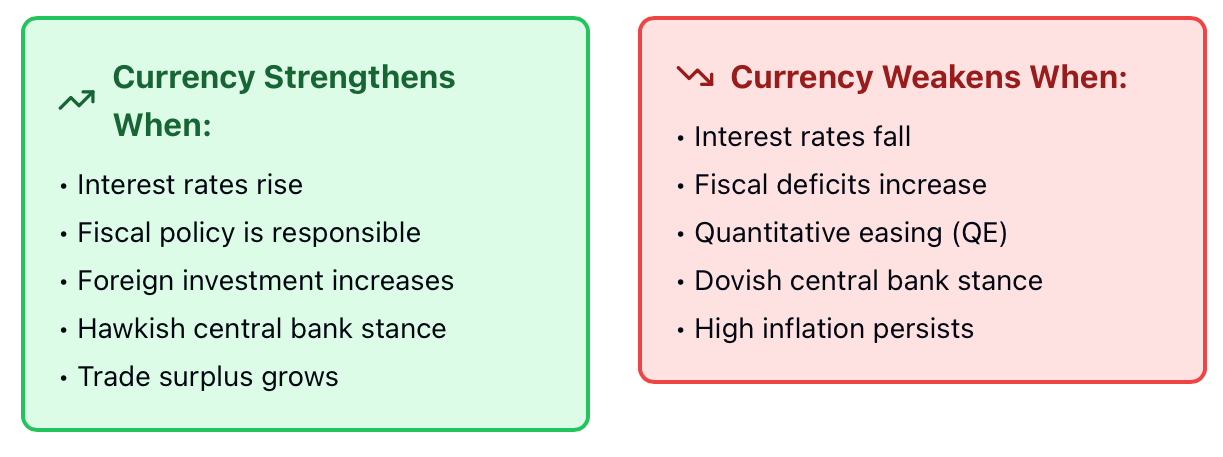
Currency volatility is primarily driven by market events such as Central Bank meetings and inflation data releases. A hawkish statement from a Central Bank (indicating potential Interest Rate hikes in the future) can significantly increase demand for a currency almost immediately. Conversely, a dovish statement (indicating potential Interest Rate cuts) tends to decrease demand for that Currency.
The value of the U.S. Dollar against many currencies such as the Euro, Japanese Yen, and British Pound increased during the Federal Reserve's (Centre bank of the U.S. ) increased interest rate hikes from 2022 to the end of 2024 due to investors' preference for U.S Dollar-denominated Assets.
Therefore, it is crucial for FX traders to keep a close eye on Central Bank activities to gauge the most probable direction for Currency value movements based on trends in Interest Rates. The Knowledge of where Interest Rates will move in the future provides great insight into predicting where Currency Values will also move.
What Fiscal Policy Does to Currency Values
Fiscal Policy affects Currency Values in terms of Investor Confidence and Capital Flows. The Larger Fiscal Deficits can cause the value of a Currency to weaken over a period of time due to the increased level of Debt Signified and the expectation of Increasing Inflation as a result.
Governments borrow additional money to finance their operating expenses through the issuance of Bonds. If investors begin to doubt the ability of a Government to repay its Debt, then they will demand higher yields on Bonds as compensation for additional risk. Due to Investor's concerns about Fiscal Sustainability, they may initially provide short-term Capital Inflows, but in time, these same concerns will cause the Currency to lose Strength Over Time.
Similar to a person who consistently overspends and accumulates significant amounts of debt, currencies that are tied to governments with excessive amounts of governmental debt, erode future trust in that currency through the fact that excessive debt will generally default on the ultimate promise of that government.
Additionally, even though higher yields may benefit the currency temporarily due to increased interest from outside investors attracted to the higher returns associated with those bonds, over time, as deficits continue without being addressed through a plan that will stabilize the overall amount of debt, a downward trend will occur within that currency.
The history of Japan serves to further illustrate this point. Years of negative fiscal balances have produced a history of increased government debt, creating long-term downward momentum for the Japanese yen. Even though the Japanese yen has generally been considered a safe-haven currency, it has suffered from an overall historical and continued downward trend due to ongoing negative fiscal balances.
Maintaining fiscal responsibility is a critical factor in the long-term trend direction of currencies. Countries that maintain a fiscal policy of maintaining a balanced budget and returning very little national debt typically produce stronger and more stable currencies. Currency traders monitoring fiscal policy changes through fiscal announcements and debt-to-income ratios are provided significant information regarding the direction a particular currency will take in either a negative headwind or positive forward trend.
How Monetary Policy Shapes Stock Market Valuation
Capital availability is affected by interest rates - low rates mean that borrowing capital for the majority of businesses is inexpensive. This allows businesses to borrow larger amounts of capital in the hopes of expanding their enterprises; therefore, investors are willing to accept lower returns from bond investments and are moving toward investing in equity markets such as stocks in order to obtain higher returns.
Discounted cash flow (DCF) valuation methods, which apply interest rates as discount rates to determine future cash flows, will show that a decrease in interest rates will cause an increase in the current value of future cash flows, resulting in an increase in stock prices. Increasing interest rates decreases the current value of future cash flow, resulting in a decrease in stock prices.
If borrowing capital is inexpensive for a business, then it is highly likely that investors will accept higher risk to potentially obtain future investment returns. Thus, monetary easing should positively impact growth and also technology stocks that have large projections of future cash flow. A lower discount rate makes future earnings appear more valuable.
As interest rates rise, stock price appreciation declines and fixed income securities such as bonds become more attractive to investors. Therefore when the yield on risk-free Treasury bonds is 5%, many investors will likely redirect their investments into fixed income markets resulting in lower stock prices.
The crash of technology stocks in 2022 occurred soon after the Federal Reserve began raising interest rates rapidly. Due to the negative effects of higher interest rates on valuations of technology companies with back-ending earnings streams, the NASDAQ fell over 30%.
Interest rates are the single most important factor that will ultimately determine the value of all publicly traded companies. Therefore, stock valuations are based on the projected stock valuation of a company, and investors who track the policies of central banks can make predictions about which sectors will outperform or underperform based on current interest rate conditions.
Fiscal Policy and Stock Markets: Which Sectors Win?
Different fiscal policies can have different impacts depending on a stock's sector. Some sectors will receive greater benefits from an expansionary fiscal policy versus other sectors.
For example, when governments engage in infrastructure spending, it has a direct impact on the construction, building material and certain industrial sectors. In general, companies that are in the construction industry typically have increased revenues as a result of government activity to build new infrastructure. A good example occurred in 2021, when the infrastructure bill passed in the United States, which led to a significant increase in the stock prices of companies that manufacture construction materials (cement, steel, and equipment).
Tax cuts tend to benefit business-to-business (or B2B) technology and manufacturing companies. A lower corporate tax rate means that more money flows to shareholders, which in turn supports a higher valuation for the stock. A useful analogy is a school (or any institution) building more playgrounds; thus school construction companies would earn greater profits as a direct result of government spending. This is the essence of targeted fiscal policy in the equities markets.
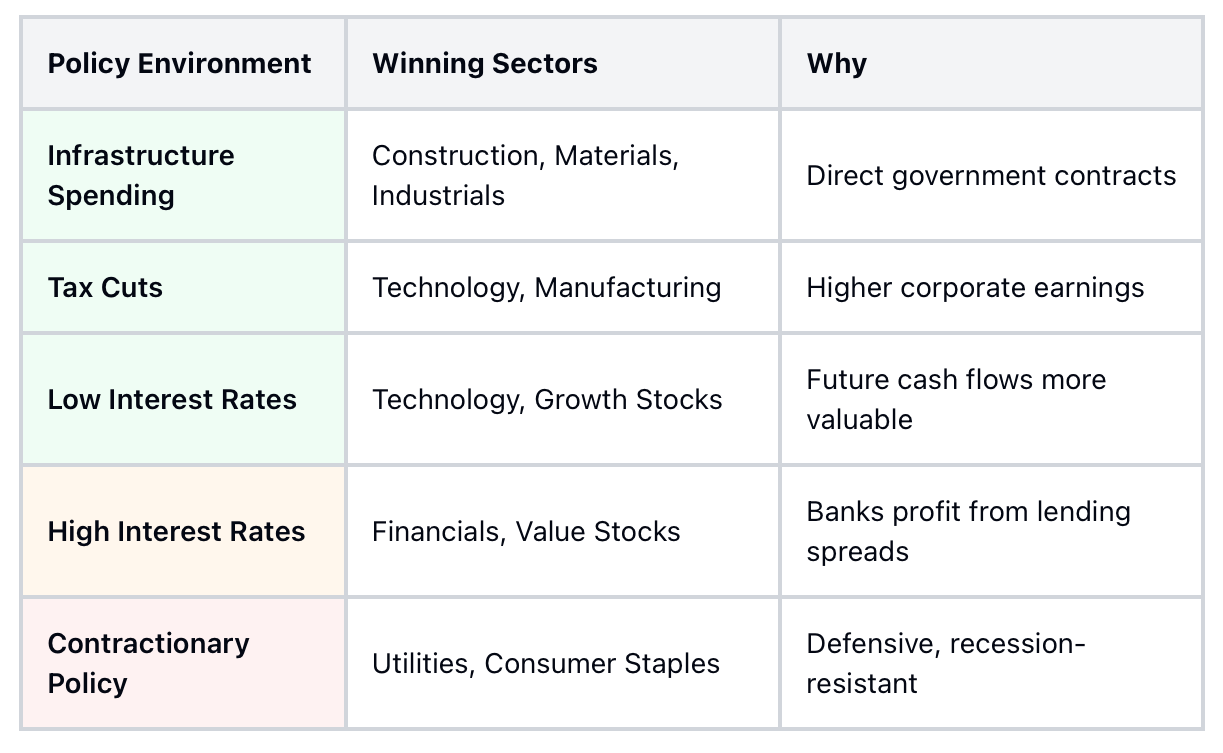
Finally, cyclical stocks that are tied to the overall economic expansion will benefit as a direct result of government spending. Typically, the Consumer Discretionary, Financial and Energy sectors tend to perform at a higher level than other sectors during times of increased government spending.
Unfortunately, Contractionary Fiscal Policy has a negative impact on the same sectors. Spending cuts reduce demand for all types of goods and services, and as tax increases reduce corporate earnings; therefore, it is in these defensive sectors (e.g., Utilities and Consumer Staples) that the revenues are less sensitive to economic cycles.
How Fiscal and Monetary Policy Work Together
When both monetary and fiscal policy are working together, financial markets experience the most rapid growth. The strongest upward movement in the stock market occurs when the combination of an expansionary fiscal policy (high spending) and a low-interest-rate environment (low-cost capital) creates a massive increase in risk-taking on investments among financial market participants.
The pandemic response from 2020 to 2021 showed this correlation. Nearly every country in the world implemented an expansive fiscal stimulus program at the same time that central banks lowered the interest rates on loans to zero. Because of this combination of two factors, there was an unprecedented rise in the price of technology stocks and other speculative assets, such as cryptocurrencies. In fact, financial markets had their fastest rate of growth in the last 50 years.
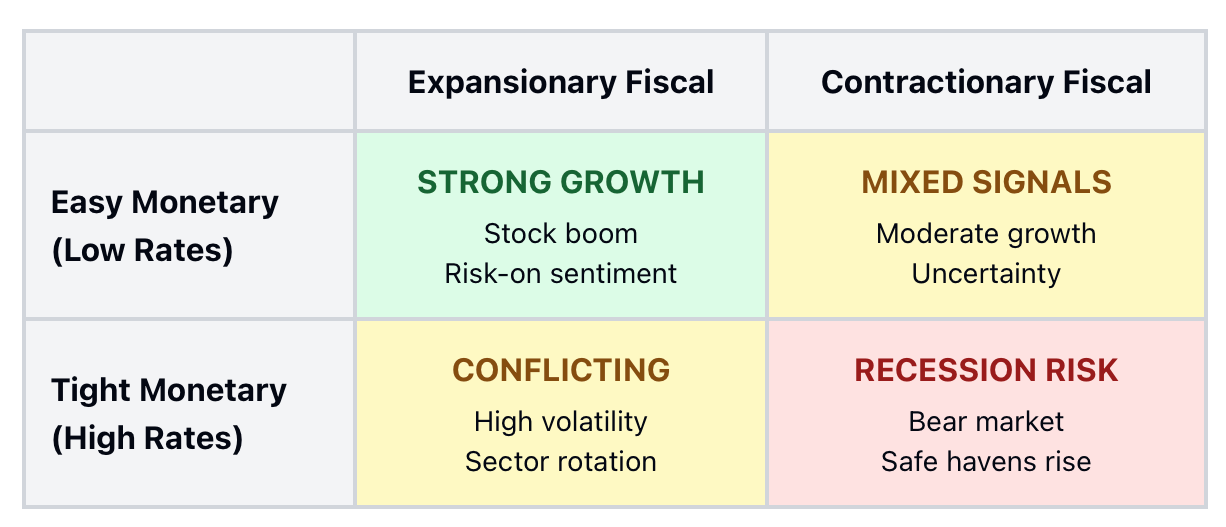
When monetary policy and fiscal policy do not work together or oppose one another, there is greater volatility and uncertainty in the financial markets. The combination of a tight monetary policy (high-interest rates) and an expansionary fiscal policy results in two very different directions for the investment community. While higher interest rates increase the relative attractiveness of capital investments , an expansive fiscal policy generates economic growth.
Both tightening, less liquidity and demand policies create conditions that lead to recessions and downward trends in the bear markets. Tightening monetary policies are usually accompanied by less overall economic activity.
A simple example: If your parents gave you a much more generous allowance as a result of changes in fiscal policies and your school permitted you to work part-time as a result of changes in monetary policy, you would have a tremendous increase in cash flow. This is an example of an 'easing' policy. If your parents reduced your allowance and your school prohibited you from obtaining any type of employment, you would have no money. This is an example of a 'tightening' policy.
Key Policy Indicators Traders Must Monitor
Traders gain a competitive advantage by establishing a routine for monitoring policies. Key indicators provide guidance on the probable direction of both fiscal and monetary policy decisions.
For monetary policy, relevant data to monitor includes CPI and Core CPI, PPI and NFP. Central Banks are under pressure to increase their interest rates due to rising inflation. Meanwhile, higher levels of employment create favorable conditions for a Hawkish type of monetary policy.
Traders should be closely following Central Bank Meetings and Rate Announcements. In the case of the Federal Reserve, European Central Bank, Bank of Japan, and Bank of England, the decisions and guidance relating to monetary policy have an immediate impact on financial markets. Traders are constantly looking for insight into upcoming policy changes by analyzing each word in the Central Bank Rate Announcements.
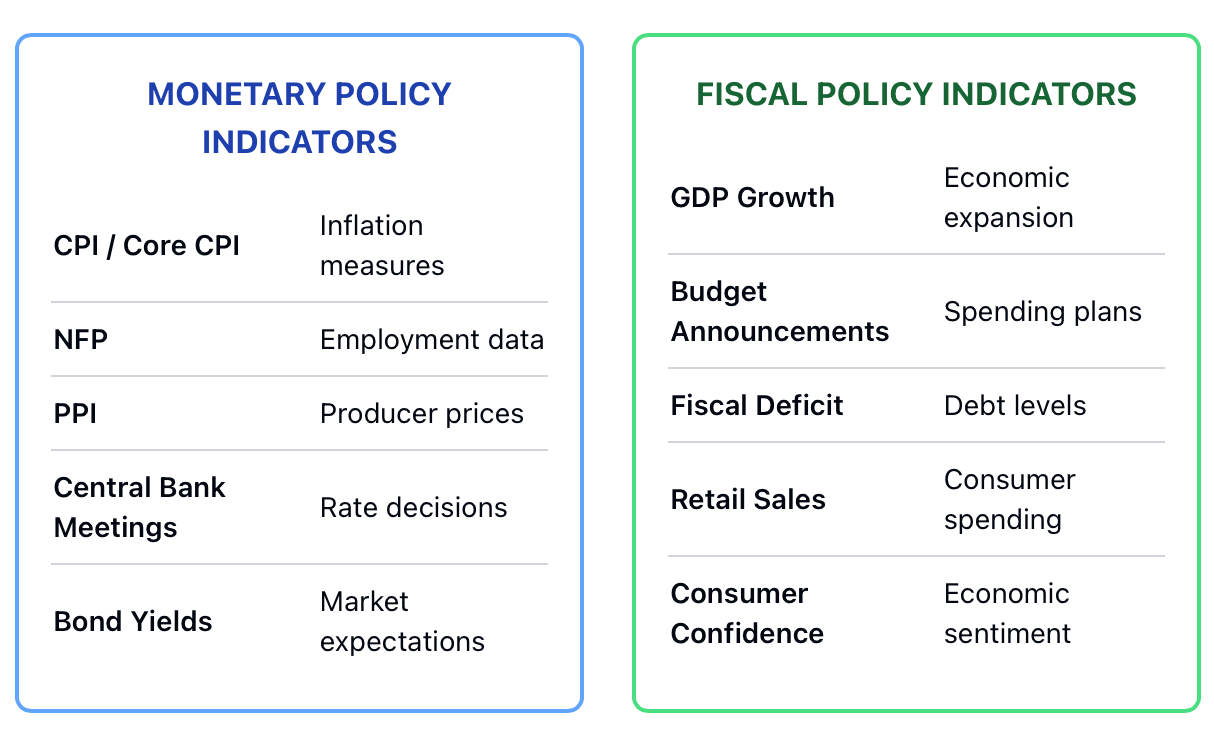
Another way to evaluate market expectations regarding monetary policy is through the use of Government Bond Yields. Generally, if the Government Bond Yields are rising, the market is expecting an increase in the short-term interest rates or an increase in inflation rates. Conversely, if Government Bond Yields are falling, the market is anticipating a decrease in the short-term interest rates or slower growth in the economy.
For fiscal policy, traders should monitor GDP Growth Rates, and Budget Announcements, and Fiscal Deficit information. Retail Sales, and Consumer Confidence provide evidence that fiscal stimulus is increasing consumer activity.
Economic Data acts as an examination score. If your examination score is sufficient, you will progress to the next level. Likewise, the details surrounding Economic Data are what determine whether or not a Central Bank will increase or decrease interest rates.
Simply put, when Core CPI continues to remain elevated over several months, Markets will begin to price in a series of anticipated increases in the interest rates; the U.S. dollar will appreciate, and Rate-Sensitive Stocks will decline in value. Therefore, there is an opportunity for Traders who monitor these types of economic indicators to establish a position prior to the official announcement of policy changes.
Practical Trading Strategies Based on Policy Trends
A trading strategy that is influenced by currency policy will position your money where it is most likely to benefit from the economic cycle based on the central banks' actions. Examples of these strategies include:
Forex strategies:
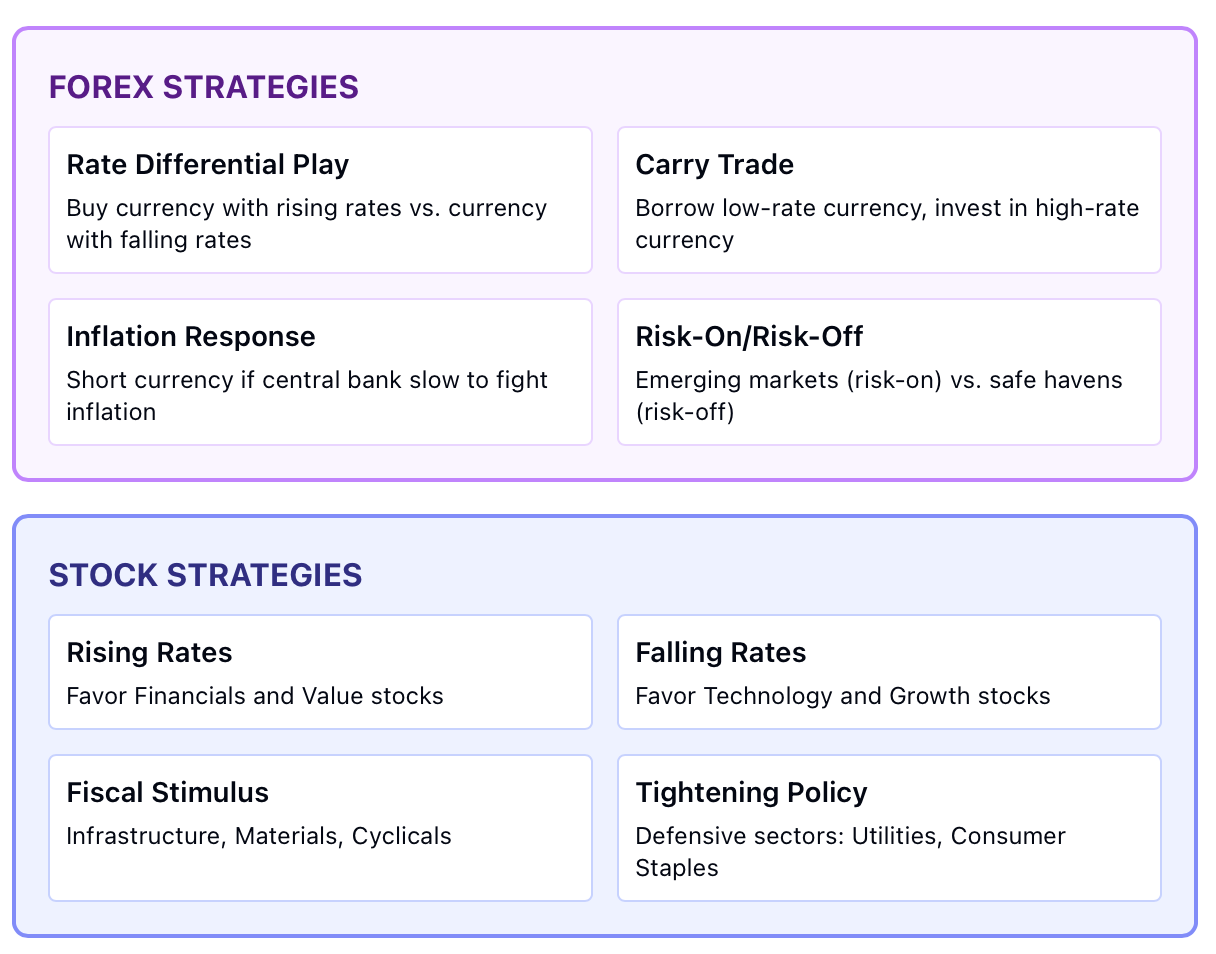
Buy currencies of central banks that are raising rates against those of central banks that are maintaining a dovish stance. Example: During the Federal Reserve's rate increase cycle.
Trading has been driven by rising inflation expectations. Traders could short a currency if inflation is rising but the central bank is slow to respond to that inflation. Conversely, if inflation is falling and market participants are anticipating rate cuts from the central bank, shorting the currency is appropriate to capitalize on anticipated currency movement but traders should always be vigilant for signs of potential reversals from these directional moves.
Selecting which currencies may be bought/sold within the context of an economic cycle will depend upon the risk-on or risk-off nature of current market conditions as indicated by the central bank monetary policies they are exercising at that point in the economic cycle. In risk-on market conditions, where monetary policy is more accommodative, it may make sense to purchase higher yields emerging market currencies. Conversely, in risk-off markets, where monetary policy is tight, it may be prudent to purchase safe-haven currencies (e.g. USD, CHF or JPY).
Stock strategies:
Increased interest rates benefit the financials and value equity asset classes. When interest rates increase banks can earn a larger profit from lending. Value shares tend to outperform growth shares because they generate strong earnings today thus do not rely on distant cash flows.
Policy stimulus will benefit the infrastructure, material, and cyclical sectors of the economy. Therefore if governments announce plans to spend public funds on projects these sectors should be one of the first areas to move into.
Many market participants know at what intervals they will be receiving their bonus checks and plan their spending from there. This is an example of how traders who follow policy and not their emotions can take a position before the rest of the market catches up to the information. Therefore, traders should be mindful of being disciplined and predictable in terms of how they trade based on the economic cycle and not their emotional state or feelings about what is happening in the markets.
Join Tradewill today and access forex, CFDs, and indices with tools designed for policy-aware traders. Start building your edge now at tradewill.com.
Disclaimer: The content of the blog does not represent any position of Trade W, does not serve as any trading-related decision advice, and does not endorse any third-party.