

 Trade W

Profiting from the CFD markets isn't merely a matter of having the correct strategy or sophisticated tools—it's mainly a function of possessing the mental fortitude to allow for consistent execution of said plan. Many traders seem to focus almost exclusively on either technical market patterns or some kind of analysis when trading. Yet, the most successful professionals know that trading discipline is really the bridge between mere knowledge and consistently profitable results.
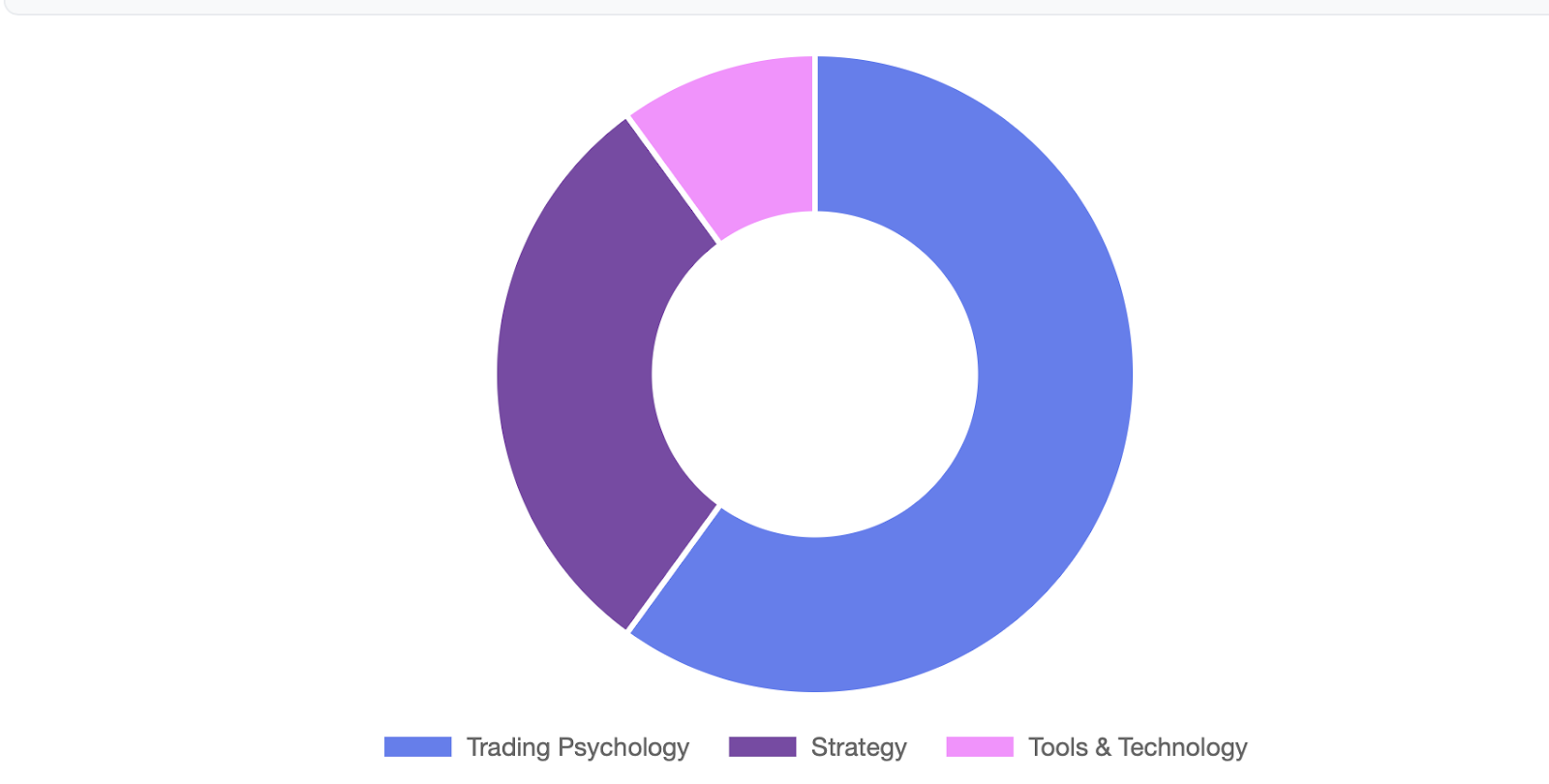
Psychology accounts for approximately 60% of trading success; strategy, 30%; and tools, only 10%. Yet, most of the beginner traders spend 90% of their time on strategy and tools, totally ignoring the psychological foundation that separates winners from losers.
In the words of the legendary trader Mark Douglas, "The consistency you seek in your trading results will come from your ability to create a carefree, objective state of mind." This article offers practical and psychological advice aimed squarely at CFD traders. It helps them develop the discipline required to achieve a consistently profitable outcome. Thrillingly, this outcome is something way too many CFD traders do not achieve.
If you're having problems with making emotionally charged decisions, buying and selling too often, or just sticking with the trading plan you said you would follow, this complete guide will completely alter your approach to the kind of trading that feels not just profitable but also sane and secure.
What Exactly Is Discipline in CFD Trading?
Discipline in the context of CFD trading means sticking to your defined set of rules, limits, and strategies, come what may. Markets can be in any number of conditions; that doesn't change what you should do if you have a disciplined approach to this. Emotional impulses can be stifled, of course, but one doesn't have to become a robot to be a decent CFD trader. The framework that guides decisions should be a structured one, with luminosity enough for the path to be seen in any conditions.
Many traders misunderstand the true meaning of discipline. Let's clear up some common misconceptions.
Myths vs. Reality of Trading Discipline:
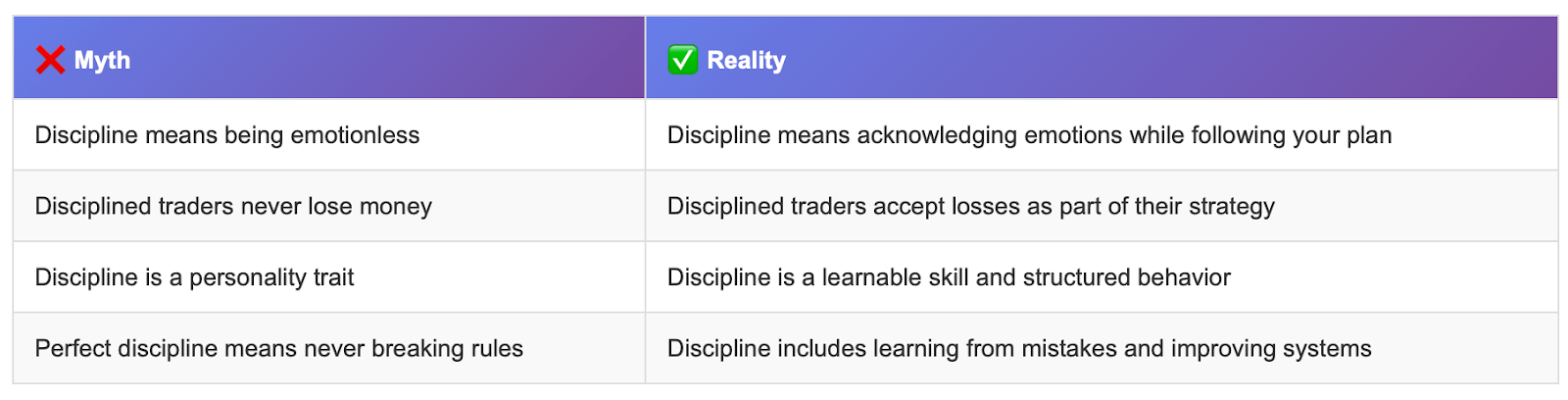
Disciplined trading habits involve active decision-making rather than passive restraint. When you see a setup that doesn't meet your criteria, a disciplined trader doesn't fight the urge to trade—they redirect their attention to more productive activities like market analysis or journal review.
Consider the case of Sarah, a retail CFD trader who struggled with inconsistent results despite having a profitable backtested strategy. Her breakthrough came not from changing her technical approach, but from implementing a simple rule-checking system before every trade. By focusing on process over profits, her win rate improved from 45% to 67% within three months.
The key insight is that discipline isn't about willpower—it's about creating systems that make good decisions automatic and bad decisions difficult.
The Relationship Between Discipline and Trading Psychology
Trading psychology forms the foundation of all disciplined behavior.
Traders of contracts for difference (CFDs) deal with psychological issues that are unique to them. These stem from the fact that CFDs are leveraged instruments, which can lead to very rapid outcomes—both positive and negative. How two professional psychologists believe CFD traders can better cope with the unique demands they face comprises the bulk of this article.
The core psychological enemies of discipline include:
Hesitation to enter valid setups or premature exit from winning positions shows that fear has a grip on traders. Greed drives traders to risk more than they had planned or to hold positions longer than was targeted. FOMO (Fear of Missing Out) leads to chasing breakouts and entering trades without the analytic work that should precede a trading decision. And revenge trading—a form of trading after which traders often swear they will never trade again—occurs after losses when traders try to get even with the market.
There is a connection between the trading actions and those emotions that a trader feels when trading. If a trader feels an emotional impulse, it can easily be converted into an action or reaction that is not necessarily a good trading action or a good trading decision. Connecting emotional impulses to trading actions can lead to discipline problems; therefore, a little circuit breaker must be installed between the two to curb a 'bad mood' trading day.
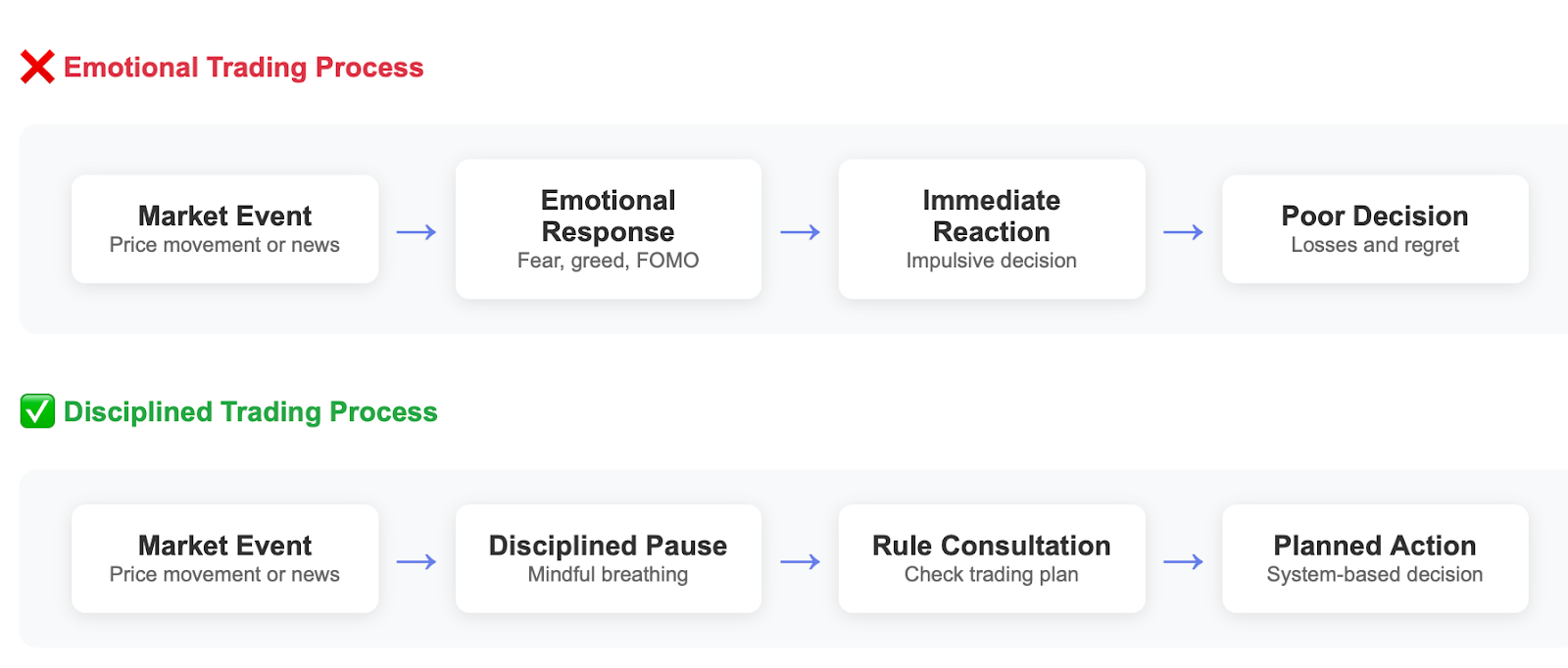
How We Make Poor Trading Decisions When We Allow Our Emotions to Control Us: Trading By Emotion: Market Event ⟶ Emotional Response ⟶ Immediate Reaction ⟶ Poor Decision.
Trading with discipline is watchful. It observes an apparent event occurring in the market.
Let’s break this down:
- Market Event: A market participant perceives an event. This could be a news item or the price behavior of an asset.
- Emotional Response: The perceiving participant has an emotional reaction.
- Disciplined Pause: Some participants act on their emotion, but those who trade with discipline do not. Instead, they take a moment to breathe.
-Rule Consultation: After the mindful breathing, they check any trading-related rules they might have.
- Planned Action: Finally, they take action as per their previously established plans or make a new plan to act on the observed market event.
The capacity to maintain a clear consciousness of one's own actions while making trading decisions is imperative for keeping to a disciplined regimen. It is not enough simply to be aware of what you are doing in the moment; you must also be capable of identifying when you are approaching the edge of behavioral or emotional extremes. And the best way to do that is to have a plan in place that dictates how you will respond to those not-so-great trade scenarios.
Consider the example of Marcus, a CFD trader who enacted a mindfulness regimen. Prior to each trading session, he spends five minutes in breath-focused meditation and in a review of his trading rules.
During trades, he simply checks in with himself: "Am I following my plan or reacting to the market?" Implementing this practice has helped him decrease his impulsive trades by 80% and has significantly improved his monthly returns.
The traders who have the most discipline develop the emotional regulation skills that allow them to feel the market without being controlled by it. They know that in trading, emotions are information, not directives.
Before Building Discipline: Trading Goals and System Design
Building discipline without clear goals and systems is like following a map to nowhere. CFD trading discipline requires a foundation of well-defined objectives and approaches that are somehow, in a way that is understandable to human brains, structured.
SMART Goals in CFD Trading:
I will take a chance on 2% per trade with CFD trading utilizing the major forex pairs.
Quantifiable: "I will obtain a 15% yearly return with an utmost decrease of 8%."
-
Acquirable: You have the money, know-how, and time to devote to this venture.
-
Realistic: Consistent with market conditions and your abilities.
-
Time-bound: "Monthly, I shall assess my advancement and each quarter, I will make modifications as necessary."
-
Creating a system means establishing a framework. This system serves as a discipline to follow. Your system should contain the following elements:
-
Entry criteria: Precise technical or fundamental conditions that must be satisfied.
-
Elucidation of exit directives: Targets for profit and levels for stop-loss must be established prior to the act of entering.
-
Determining how much capital to risk on each trade is a key factor in position sizing.
-
Managing risk means establishing maximum acceptable losses—both on a daily and a weekly basis—and setting position limits.
-
Selection of the market: The focus on which instruments and timeframes to concentrate on.
Think about how David transformed from a discretionary trader to a systematic trader. In the past, he made trading calls based on gut feelings and the ebb and flow of the markets. He now uses a well-thought-out systematic CFD trading plan with clear entry and exit rules and has dropped standard deviation by 40% while raising average monthly return by 25%.
The workflow is easy to understand: Objectives → Plan of Action → Guidelines → Self-Control
If this foundation does not exist, discipline turns into capricious rule-following instead of being the strategy-driven execution that we want it to be. Your system should be detailed enough that another trader could use your system and achieve results comparable to yours.
Quantifying Your Trading Discipline
What is measured can be managed. In order to construct discipline in trading Contracts for Difference, one must monitor adherence to a set of rules as one would monitor a profit or loss. This is not glamorous work, but it is necessary work.
Key Discipline Metrics:
-
Rule Compliance Rate: Percentage of trades executed according to your plan.
-
Entry Discipline: Was your setup criteria met before you entered?
-
Exit Discipline: Did you close positions at preplanned levels?
-
Compliance Risk Management: Did you adhere to your position sizing rules?
-
Tracking the Emotional State: Were you calm, anxious, or frustrated in making those trades.
Instruments to gauge the discipline of trading:
Spreadsheet tracking: Devise bespoke metrics for your particular regulations.
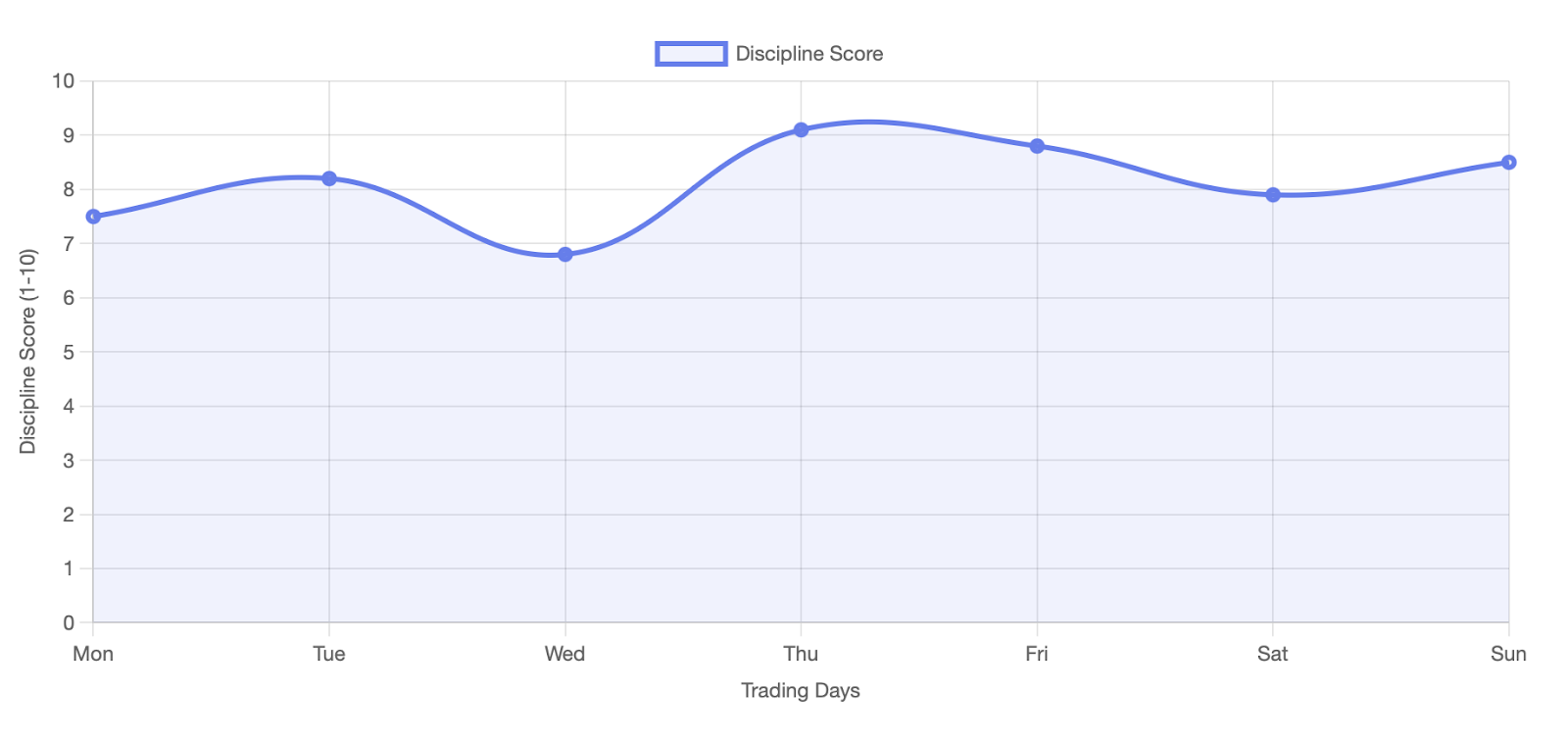
Daily discipline score: Assess your adherence to the rules each and every day on a scale of 1 to 10.
Performance audits: Weekly comparisons of planned versus actual performance.
Discipline tracking example:
-
Today's date is 15 March 2024.
-
Trade: CFD Long on EUR/USD
-
Setup Meeting: Yes (9/10 criteria satisfied).
-
Discipline in Entry: 8/10 (just made it in with several minutes to spare)
-
Exit Discipline: 10/10 (hit target exactly)
-
Risk Control: 10/10 (retains 2% downside risk)
-
Current Emotional State: 7/10 (little anxious during drawdown)
-
Total discipline score: 8.8 out of 10.
A CFD trader named John found that his discipline score had a strong correlation with his profitability. This score directly factored into how well John was performing as a trader. When his discipline score was higher, it meant he was adhering to the processes he had set up with greater fidelity. It might also mean, on some level, that he was still able to act in a certain way even when the market seemed to be bekend as panicking or predicting. He also had the foresight to know when discipline was going to help him work on processes better. It is a good trait to be able to see into the future in a Kodiak way.
The target is not flawlessness; it is steady enhancement. Monitor your discipline metrics with your financial outcomes to discover trends and pinpoint potential improvements.
Practical Strategies for Discipline in Daily Trading
Being consistently profitable in trading requires not just one overarching set of skills but several smaller skills rolled into one. There are many micro-actions that a disciplined trader executes on a daily basis, and these actions maintain the illusion of discipline without the necessity of being wholly disciplined. Here are some of the ways in which we CFD traders achieve this trick of the mind.
Pre-Market Routine:
-
Examine your plan for trading and the regulations governing it.
-
Verify the economic calendar for significant events that could impact the market.
-
Establish daily risk parameters and determine how large each position can be.
-
Rehearse in your head what you are going to do when you trade.
Remove all items from the workspace that are not absolutely necessary. Workspace should equal just your body, your materials, and your work. The internet can be a huge distraction, so log off and close anything you might be tempted to look at. If you can, work offline on a laptop or desktop without internet access. Alternatively, work in a program that does not require an internet connection. If you're in a distraction-free zone, the only external stimuli should be to your ears. Wear earplugs, or headphones playing some kind of ambient sound, to totally block out the outside world.
During Trading Hours:
-
Remove emotional exit decisions by using pre-set stop-loss and take-profit orders.
-
Enforce a cap on trades made in a single day (e.g., a ceiling of maximum 5 CFD trades per day).
-
When between trades, take a 5-minute break to reset your mind.
-
Before entering each position, use a trading checklist
-
Refrain from using social media and news when participating in trading that requires immediate action.
Managing Overtrading:
Establish explicit conditions for making more trades when you've reached your daily limit. For example, allow yourself one extra trade if you reach your targeted profit for the day and see a setup that meets all of your conditions perfectly—an ideal trade, in other words.
-
The "No Trade" Rule:
-
Establish the conditions under which you will not trade, no matter the market opportunities.
-
Following two back-to-back defeats
-
When emotions are running high
-
When one is fatigued or not focused
-
When significant news is breaking, if you are unprepared
Practical Example:
A CFD trader named Lisa uses a Pomodoro-style approach to maintain discipline. She works for 50 minutes and then takes a 10-minute break to journal her last trade and to prepare for the next 50-minute trading session. This rhythm prevents mental fatigue and maintains consistent decision-making quality throughout the day.
Technology Aids:
-
Establish mobile notifications for predetermined levels at which to exit
-
Enforce position limits with trading platform features.
-
Make templates for frequent arrangements so that you can cut down on the number of decisions you have to make.
-
Execute a "cool-down" span post-defeats to reestablish balance before committing to fresh trades.
Keep in mind that discipline is not about making yourself trade when you do not want to—it is about establishing good conditions so that when the time comes to trade, it feels right. And when it comes to discipline, there are two main areas where I think traders tend to go wrong.
Tips for Developing Disciplined Habits
Instilling discipline in traders follows the same principles as forming any other habit. Making a process more effective and sustainable begins with understanding the science of habit formation.
The Habit Loop for Trading:
-
Cues: Market setup looks good
-
Routines: Check market conditions, scrutinize risk/reward ratio, place order
-
Rewards: Traders get a nice endorphin rush when everything goes according to plan (that is, when they obey their plan).

Implementing Atomic Habits in Trading:
Begin with the Smallest Steps: Instead of trying to change everything all at once, substitute the one good discipline with another bad one you are already controlling. Here are a couple of examples:
A. Substitute hanging out with bad traders in chat rooms for studying with good trader friends.
B. Substitute making bad trades because you are not using your rules for making good ones.
30-Day Discipline Challenge:
-
Week 1: Concentrate solely on entry discipline.
-
Week 2: Incorporate exit discipline while sustaining entries.
-
Week 3: Embrace position sizing compliance.
-
Week 4: Emotional state management alluded to in the first four weeks.
Building Rituals:
Link existing habits to your discipline actions. For example, when Tom, a CFD trader, has a rule review, it is always while he is drinking his morning coffee. His review becomes automatic in that context and is much less likely to be skipped.
Avoiding All-or-Nothing Thinking:
Advance, and do not seek to arrive. If you find you have broken a rule, look closely at what led you to do so and modify your system accordingly. Do not give up on your approach. Remember, markets are designed to fool as many people as possible, and even pros are sometimes caught up in the moment and do just the opposite of what they know they should be doing. Learn to profit from your mistakes.
Environmental Design:
-
Discipline in trading is crucial, and the push to be disciplined must come from the environment a trader has created. Remove the phone apps that entice you to trade.
-
Set up your charts so that they just about scream risk/reward. (Very physical reminders of your rules can go a long way.)
-
Have different accounts for different strategies—not as a way to trick yourself into thinking you can trade impetuously if one account's losing, but as a way to keep your mind in the right place.
Self-Reward Mechanism and Positive Feedback Loop
Motivating a trader to maintain long-term discipline in trading calls for more than just the prospect of profit. It calls for the creation of a systematic reward mechanism that helps wire the brain to repeat the desired disciplined trading behavior even when conditions make it tempting to stray from the system.
The Dopamine Connection: Your brain releases dopamine not just when you receive rewards, but when you anticipate them. By creating consistent rewards for disciplined behavior, you can train your brain to crave rule-following rather than just profits.
Effective Reward Strategies:
Immediate Rewards:
Perfectly following your plan for a day, take a 30-minute walk. After five consecutive days of rule compliance, enjoy a favorite meal. Share with your trading community the successful discipline streaks you have accumulated.
Weekly Rewards:Maintain an 80%+ discipline score for the week, and you can enjoy a movie night. Perfect risk management for five days can earn you a small purchase you've been wanting to make. Consistently journaling all week could allow you to have some guilt-free leisure time.
Monthly Rewards:Discipline target completions funnel fun. Achieving monthly activity targets for discipline generates a fund from which a weekend or evening activity can be paid. This is a net-win activity, as the weekend activity is usually something fun and outside of The Box. Consistent rule-following earns you a trading education course from the firstffudio of the month. Process target completions allow for a small account bonus.
"If-Then" Reward Planning: Create specific connections between behaviors and rewards:
"If I stick to my position sizing rules for 10 straight trades, then I'll purchase that new trading book."
"If I keep my discipline score above 8/10 for two weeks, then I'll take a day off from trading."
Social Reinforcement: Share your discipline achievements with accountability partners or trading communities. The social recognition provides additional motivation and creates external accountability.
Example Implementation: Mark, a CFD trader, created a point system where following each rule earned him points. Perfect entry discipline = 3 points, proper exit = 3 points, correct position sizing = 2 points, good emotional management = 2 points. At 50 points, he treats himself to dinner out. At 100 points, he buys a new trading tool or book.
The Feedback Loop: Action (Following Rules) → Reward (Positive Feeling) → Motivation (Desire to Repeat) → Repetition (Consistent Behavior)This self-reinforcing cycle makes discipline rewarding on its own rather than just being a path to trade profits.
Examples of Disciplined Traders: The Power of Role Models
Obtaining knowledge from renowned CFD traders and within the hearing distance of the long-term successful traders makes me better. It allows me to aggregate and understand the reasons why these individuals were able to achieve what they did and the commonalities that exist among supposedly distinct personalities.
Mark Minervini - The Systematic Approach
Success is mine. It comes from my discipline. I follow SEPA, which stands for Specific Entry Point Analysis, and I have a system. No, I have a plan, and I stick to it. The plan is my guide and my path. I do not step off the path to chase apparently alluring opportunities. I refuse to trade just to trade, and only when the conditions are right, do I buy or sell—that is, if I can remember as well as I do what seems in times like these to be a good trade. (Earning profits after buying or holding a stock or fund just seems like a bad way to describe a good trade to me. And hey, nice to meet you, too!)
Linda Raschke - The Process-Focused Trader
Raschke stresses that the essence of successful trading lies in adhering to a process rather than attempting to forecast market movements. Maintaining a detailed trading log and reviewing each trade for compliance with her rules is part of her method. That method has also served her well for a number of decades, as it appears to serve many successful traders.
Paul Tudor Jones - Emotional Discipline
The following is a famous quote of Jones: "From a trading perspective, what you want to be is successful. In order to be successful, you have to have an indefatigable, an undying, and an uncompromising love for this game." What also shows in Jones is not just love for trading, but also discipline in risk management. Jones never risks more than he can afford to lose and always cuts losses quickly.
Key Characteristics of Disciplined Traders:
-
They adhere to predictable daily patterns that bolster positive practices.
-
Process-Oriented: Success is in the following of rules, not just the making of money.
-
Emotionally Regulated: They recognize feelings without allowing themselves to be governed by them.
-
Always Learning: They consider every trade a chance to gain knowledge.
It is not uncommon for highly probable setups to occur in the market, but it takes patience to wait for these setups rather than trying to make something happen. When the market environment is turbulent, even more patience is required.
Common Disciplines Among Successful Traders:
-
A meticulous record of all trades and decisions made.
-
Routine strategy appraisals and fine-tuning
-
Steadfast position sizing and risk oversight
-
Market hours and break times that are set in advance.
-
Ongoing education and competency refinement
The Long-Term Perspective:
These traders emerged not because of great talent but because they meticulously executed plans over lengthy durations. They compounded slight edges into big, long-term returns.
Their instances show that discipline is not concerned with perfection—it is concerned with being consistently applied and over time. Even solid professionals still lean on routine and rules because they see that what separates fleeting success and permanent achievement is that pesky D-word, discipline.
Pitfalls in Building Discipline and How to Overcome Them
Even the most well-intentioned traders face challenges when building CFD trading discipline. Understanding common pitfalls and their solutions helps you maintain consistent behavior over time.
Common Discipline Traps:
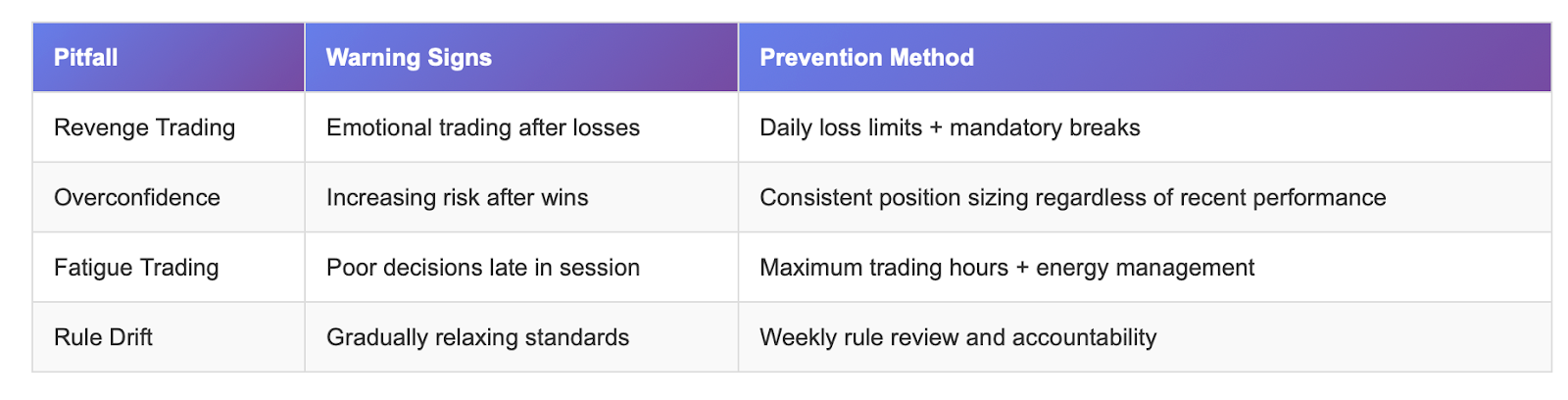
Revenge Trading: Symptom: Increasing position sizes after losses to "get even" quickly Solution: Implement mandatory cool-down periods after losses and preset maximum daily loss limits
Overconfidence After Wins: Symptom: Relaxing rules after profitable trades, thinking you "figured out" the marketSolution: Treat wins and losses identically in your rule application—success doesn't exempt you from discipline
Fatigue Trading: Symptom: Making poor decisions when tired or after long trading sessions Solution: Set maximum daily trading hours and mandatory breaks between trades
Analysis Paralysis: Symptom: Over-analyzing setups to the point of missing opportunities Solution: Time-box your analysis and create clear go/no-go criteria
Over-Optimization: Symptom: Constantly changing rules and strategies based on recent performance Solution: Commit to testing strategies for minimum time periods before adjustments
Pitfall Prevention Strategies:
Building Discipline Resilience:
Create Accountability Systems:
Trading associate who evaluates your adherence to regulations.
Each week, I share my discipline score with a mentor.
Specific discipline goals are achieved through rigorous work by the community.
Develop Failure Protocols:
When rules are broken, there should be a decided response:
1. Explain to the person why the rule exists.
2. Ask the person if they are unreasonable.
3. If they are not, why are they not following them?
4. If they are breaking the rules, why are they not following the route to reasonable discourse laid out by the route map of rules?
5. If you can't follow the rules, there is a problem at a deeper level of discussion that needs attending to.
Cease all trading activities without delay.
-
Record in a journal what took place and for what reasons.
-
Identify the trigger that caused the breach to happen.
-
Modify your system so the same thing cannot happen again.
Revert to previously smaller position sizes that were held prior to moving to larger sizes until confident that risk can be once again taken.
The Discipline Recovery Process:
Alex, a CFD trader, developed a "discipline failure checklist" after committing a number of revenge trades that cost him dearly. Whenever he breaks a rule, he promptly:
-
All positions are closed.
-
Takes a 24-hour pause from trading.
-
Examines the mental condition that caused the breach to occur
-
Rehearsing the proper answer in your mind.
-
Resume trading with half of the position size for five trades.
Burnout Prevention:
Requiring mental strength, discipline, can easily lead to burnout if not achieved through proper means. To ensure I do not burn out while attempting to structure my days around good habits, I keep the following in mind.
-
The organization of repeated, short periods away from trading.
-
Keeping pursuits unrelated to trading
-
Establishing practical anticipations for discipline score ratings.
-
Commemorating slight advancements instead of insisting on flawlessness.
Keep in mind that discipline is delicate and demands constant upkeep. Set up your systems to guard your discipline in times of weakness, instead of just counting on willpower to see you through.
Conclusion: Turning Discipline from Willpower into a Way of Life
CFD trading discipline is not about forcing yourself to follow rules through sheer willpower—it's about creating systems that make disciplined behavior natural and automatic. Throughout this guide, we've explored how discipline equals structure plus awareness plus consistency.
The key insights for building lasting discipline:
-
Foundation First: Clear goals and systematic approaches create the framework for discipline
-
Measurement Matters: Track your rule adherence as carefully as your profits
-
Habits Over Heroics: Small, consistent actions compound into significant results
-
Rewards Reinforce: Positive feedback loops make discipline self-sustaining
-
Models Guide: Learn from successful traders who prioritize process over profits
-
Pitfalls Prepare: Anticipate and plan for common discipline challenges
Your Next Steps: Choose one discipline habit to implement this week. Whether it's using a pre-trade checklist, setting daily loss limits, or keeping a simple trading journal, start small and build momentum.
Remember the wisdom of James Clear: "We don't rise to the level of our goals, we fall to the level of our systems." Your discipline systems will ultimately determine your trading success more than your market predictions or technical analysis skills.
Long-term trader success comes from transforming discipline from a conscious effort into an unconscious identity. When you think of yourself as a disciplined trader, following rules becomes natural rather than forced.
The journey from willpower to disciplined identity follows this progression: Willpower (forced adherence) → Habit(automatic behavior) → Identity (who you are as a trader)
Start today with one small disciplined action. Your future trading success depends not on predicting the markets, but on the consistency of your response to whatever the markets present.
As you build your CFD trading discipline, remember that every professional trader started where you are now. The difference between those who succeed and those who fail isn't talent—it's the willingness to transform good intentions into consistent actions through disciplined systems.
Your discipline is your competitive advantage. Build it systematically, measure it consistently, and watch as it transforms both your trading results and your relationship with the markets.
Disclaimer: The content of the blog does not represent any position of Trade W, does not serve as any trading-related decision advice, and does not endorse any third-party.