

 Trade W
It is common for most novice traders to lose money because of mistakes they make. You may think I am trying to scare you, but the facts and the experiences of thousands of traders across South Africa prove that it happens every day. They open a trading account with real money and then try to learn what forex is in the wrong order.
With so many people becoming interested in forex trading in South Africa, driven by high levels of mobile device usage, a young population, and the volatility of the Rand, there is an exciting opportunity for those who have the experience and knowledge.
Unfortunately, the problem is not with the forex market itself, but rather with the timing of when many new traders enter the market. Many beginners do not know what to look for when getting started. They often select unregulated brokers and confuse forex trading with CFDs, which frequently leads to losses within the first month.
This guide was created to provide a clear framework for how to correctly begin your journey as a trader in 2026, including a checklist of what to look for to ensure safety, the best way to verify whether your broker is regulated by the Financial Sector Conduct Authority, and practical guidance on the types of risks you can expect throughout your trading career. Always remember, trading forex is about making money, but safety must always come before profit.
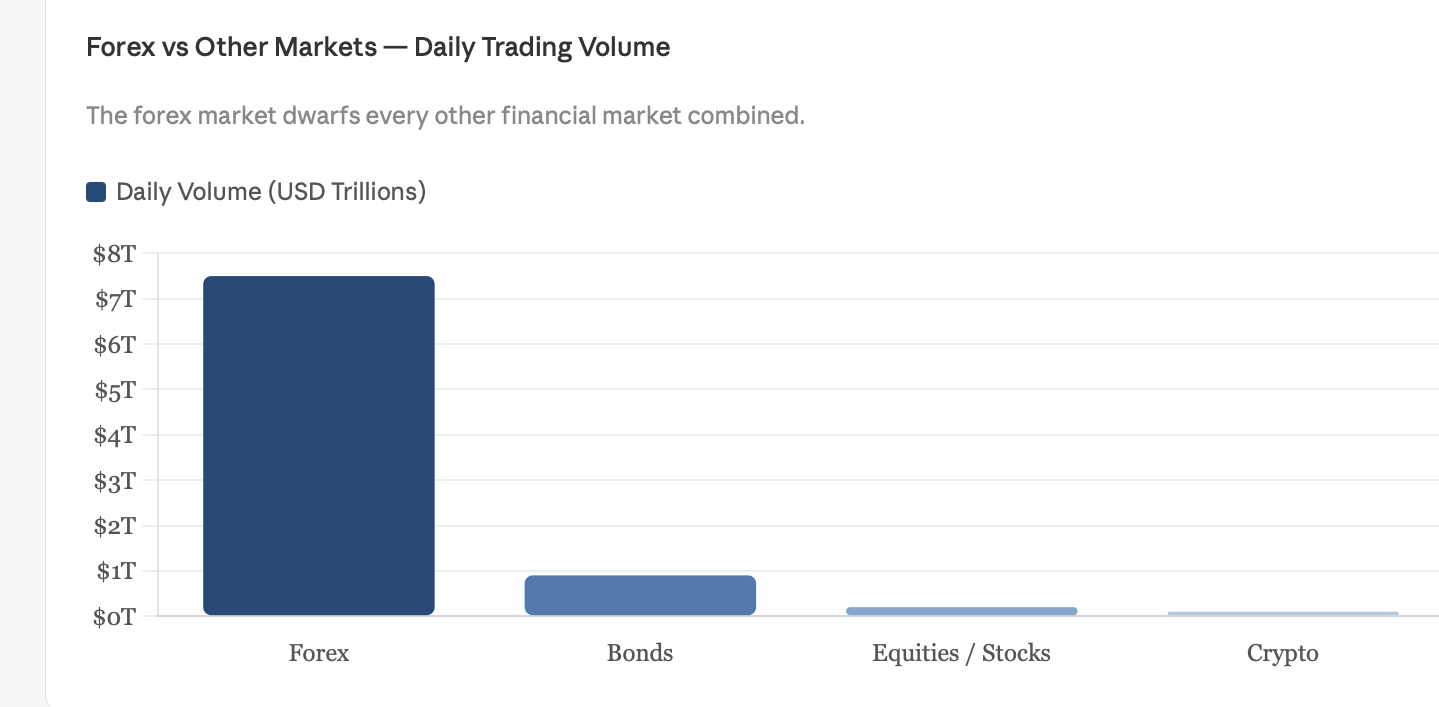
Is Forex Trading Legal in South Africa? Important Information for 2026
Absolutely, forex trading is 100% legal in South Africa. There are established regulations, and many South Africans participate in legal trading on a daily basis. However, legal and safe are often confused, which is where many new traders end up getting hurt.
The primary oversight agency is the Financial Sector Conduct Authority. The FSCA is the main financial regulatory body in South Africa. It licenses brokers, monitors and discloses suspicious activity, investigates fraud, and allows traders to file complaints against brokers. If your broker does not have oversight from the FSCA and the broker disappears with your money, there may be little or no legal protection available to help recover your funds.
In 2026, the FSCA further tightened its requirements for brokers through additional Know Your Customer (KYC) guidelines, along with expanded compliance regulations and audits. These changes are beneficial for traders because they improve transparency and reduce the number of bad actors operating in the market.
The most important thing to understand is that a broker may be operating legally in another country, but if that broker is completely unregulated in South Africa, there is no direct protection available to you as a South African trader. For example, if a broker is based in Seychelles, its overseas registration alone does not necessarily provide meaningful protection for traders in South Africa. You should ensure that you are trading with an FSCA-regulated broker, not simply a broker that claims to be “regulated overseas.”
Regulation is your first line of defence — not spreads, not bonuses, not leverage levels. Get this right before you think about anything else.
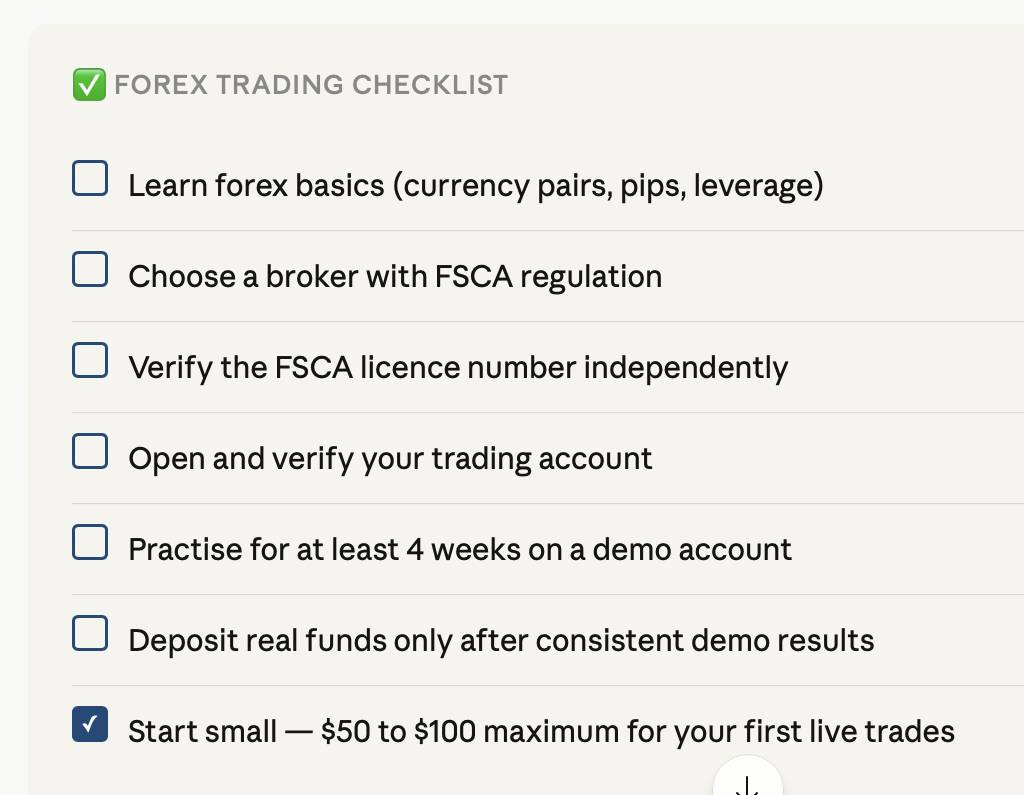
Step-by-Step Guide: How to Start Forex Trading in South Africa (2026 Checklist)
Here's the complete beginner checklist. Don't treat this as optional. Every step exists because skipping it costs traders real money.
STEP 1
Learn & Understand the Basic Concepts of Forex Trading
A currency pair (EUR/USD) shows how much of one currency you can buy with another currency. In this example, one euro costs 1.3106 US dollars. A pip is the smallest possible price movement, which is typically 0.0001 per pip. Leverage allows you to control large amounts of capital using small amounts of money. Leverage can make or break your overall success because it has an equal impact on both profits and losses. Spend at least two weeks learning how forex works before opening any account.
STEP 2
Choose a Broker That Works for You
A broker is not just a broker. A broker executes your trades, provides you with access to capital, and determines your trading costs. The right broker can help you become successful, but if you choose the wrong broker, you may not be able to fully apply your skills. When choosing a broker, look for brokers regulated by the Financial Sector Conduct Authority or a similar authority, along with fast withdrawal options and transparent spreads.
STEP 3
Check for an FSCA Licence - Be Sure to Do This
Visit the FSCA website. Search for the broker you are considering. Check the licence status, whether valid or expired, and verify that the broker is properly regulated by the FSCA. This process takes only about four minutes and can help prevent you from depositing money into a cloned broker or fraudulent platform. More information on how to do this is covered later in this guide.
STEP 4
Open and Confirm Your Account
A truly Financial Sector Conduct Authority-regulated broker will require verification of your email address, government-issued ID, and proof of residence. Do not deposit money until you have completed these three requirements with a regulated brokerage. If a broker allows you to fund your trading account without the above verification, this is a red flag and should be avoided.
STEP 5
Demo Trade for at Least 4 Weeks
Demo trading is an excellent way to gain experience trading real market conditions using virtual funds. Use a demo account until you can confidently read charts, use stop-losses, and manage position sizes. Many beginners skip this step, but you should not. Just because you recently had a successful session on a demo account does not guarantee success when trading with your own money. However, skipping the demo phase will often leave you confused and unprepared.
STEP 6
Deposit Funds
Trading in South Africa can be funded using EFT, credit cards, or cryptocurrency. Each deposit method has different processing times and fees. Bank wire transfers generally take 1 to 3 days to process, while cryptocurrency deposits are usually completed within minutes. However, there is a risk that cryptocurrency deposits may not be recoverable, which will be discussed further.
STEP 7
Start With a Small Amount - $50 to $100
The first time you trade a live account is not about making money. It is about learning how to manage the real emotions of greed, fear, and impatience that come into play when real money is involved. The amount you use to fund your first live trading account should ideally be between $50 and $100. When developing your trading strategy, limit the risk on each trade to between 1% and 2% of your account. As you become more confident and consistent with your strategy, you can gradually increase your position size.
How to Verify an FSCA Licence: Stop Scams Before They Start
Fraudulent brokerage firms create websites that imitate real licensed firms by copying their names and logos. They create the appearance of legitimacy but then take your money and disappear. Unfortunately, the only way to protect yourself from clone brokers is by verifying that the firm is legitimate, a process that takes only about four minutes to complete.
STEP ONE
Obtain the FSCA Licence Number From the Broker’s Website
Search for the FSCA licence number on the broker’s website. It is typically located in the footer or on the “About” or “Legal” page. Write the number down exactly as shown; do not simply write the broker’s name.
STEP TWO
Go Directly to the FSCA Website
The website address is FSCA. Type the address directly into your web browser. Do not click a link provided on the broker’s website, as it could redirect you to a fraudulent site.
STEP THREE
Search by Company Name and FSCA Licence Number
Use both the brokerage firm’s name and licence number when performing your search. A legitimate brokerage firm should appear in both searches with matching results.
STEP FOUR
Confirm Three Important Criteria
The licensed firm’s status should indicate “active,” the company name should exactly match the name displayed on the broker’s website, and the licence type should specifically cover forex or OTC derivatives, not unrelated financial services.
STEP FIVE
Be Aware of Clone Brokers Using Similar Names
A firm called “TradeMax South Africa” is not necessarily the same as “TradeMax (SA) Ltd.” Even a one-word or one-character difference can indicate a clone brokerage. Fraudulent firms rely on these small variations to deceive traders. Examine the broker’s name carefully, character by character.
How to Choose a Safe Forex Broker in South Africa
The first myth is that brokers offering the highest leverage provide the best services, and the second myth is that brokers offering large bonuses are honest and reliable. These two misconceptions have cost many novice traders in South Africa significant amounts of money.
The key issue to focus on is whether you will actually be able to access your profits when you request a withdrawal. A broker may allow instant deposits into your trading account, but it is a major warning sign if the same broker takes weeks to process withdrawal requests.
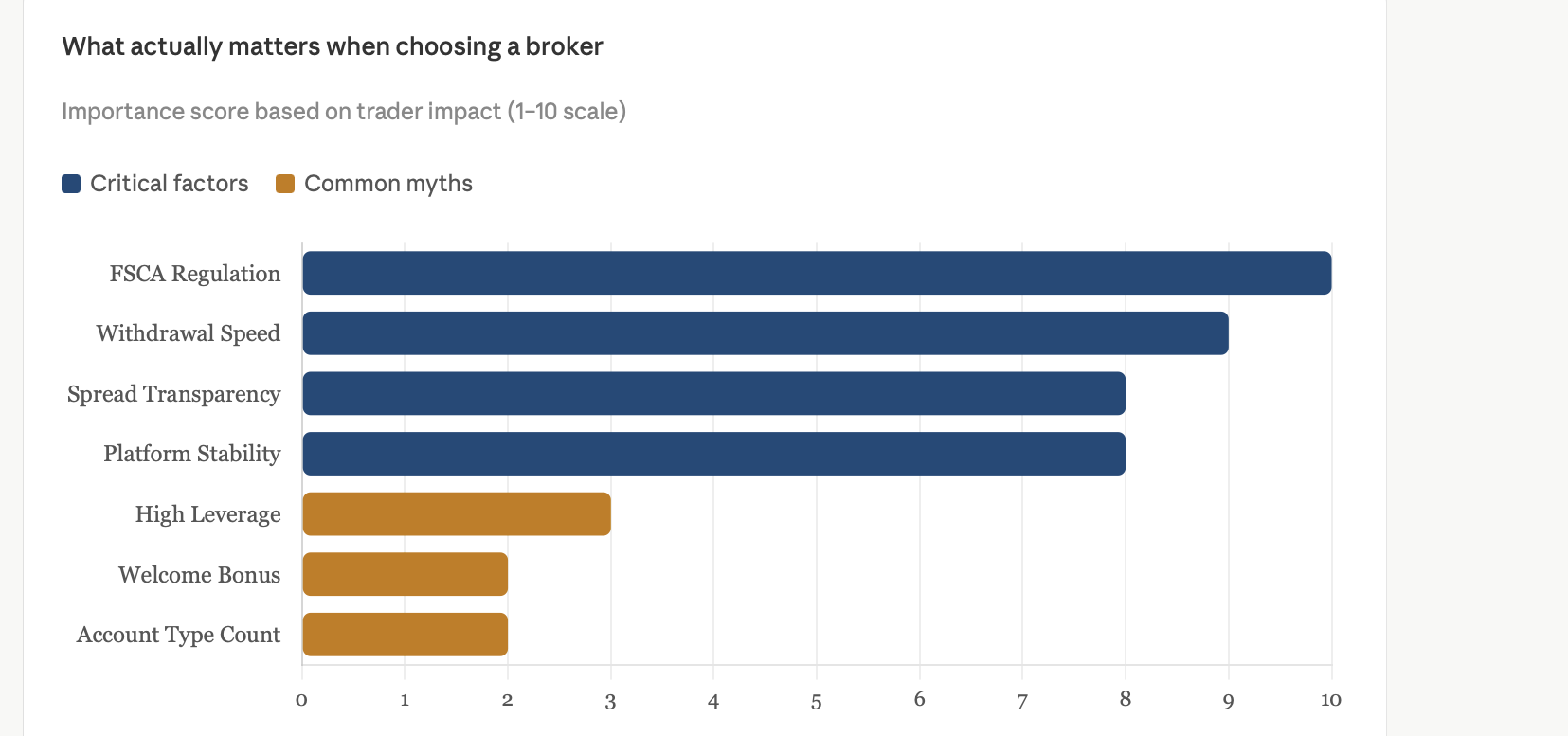
Slippage occurs when an order is filled at a different price than the one you intended. Good brokers typically offer tight spreads and minimal slippage, while poor-quality brokers may use excessive slippage to gradually extract money from your account through unfavourable trade executions.
Choosing a quality broker is the most important decision to make before attempting to use any trading strategy. If a broker is manipulating bid/ask spreads or delaying withdrawal requests, then no trading strategy will perform effectively over the long term. It is always better to first find a reliable broker and then focus on developing or selecting an effective trading strategy.
Managing the Risk of Foreign Currency Trading for Beginners
Managing risk is about staying in the game, which is what all successful traders focus on. Profitable forex traders build their careers around risk management rather than constantly searching for the perfect entry point.
A basic rule of thumb is to never risk more than 1% to 2% of your total account balance on a single trade. For example, a trader using a $1,000 account should not risk more than $10 to $20 on any one trade. This may seem like a small amount, but that is the purpose of the rule. It helps protect your account from large losses and allows you to survive losing streaks while continuing to trade consistently.
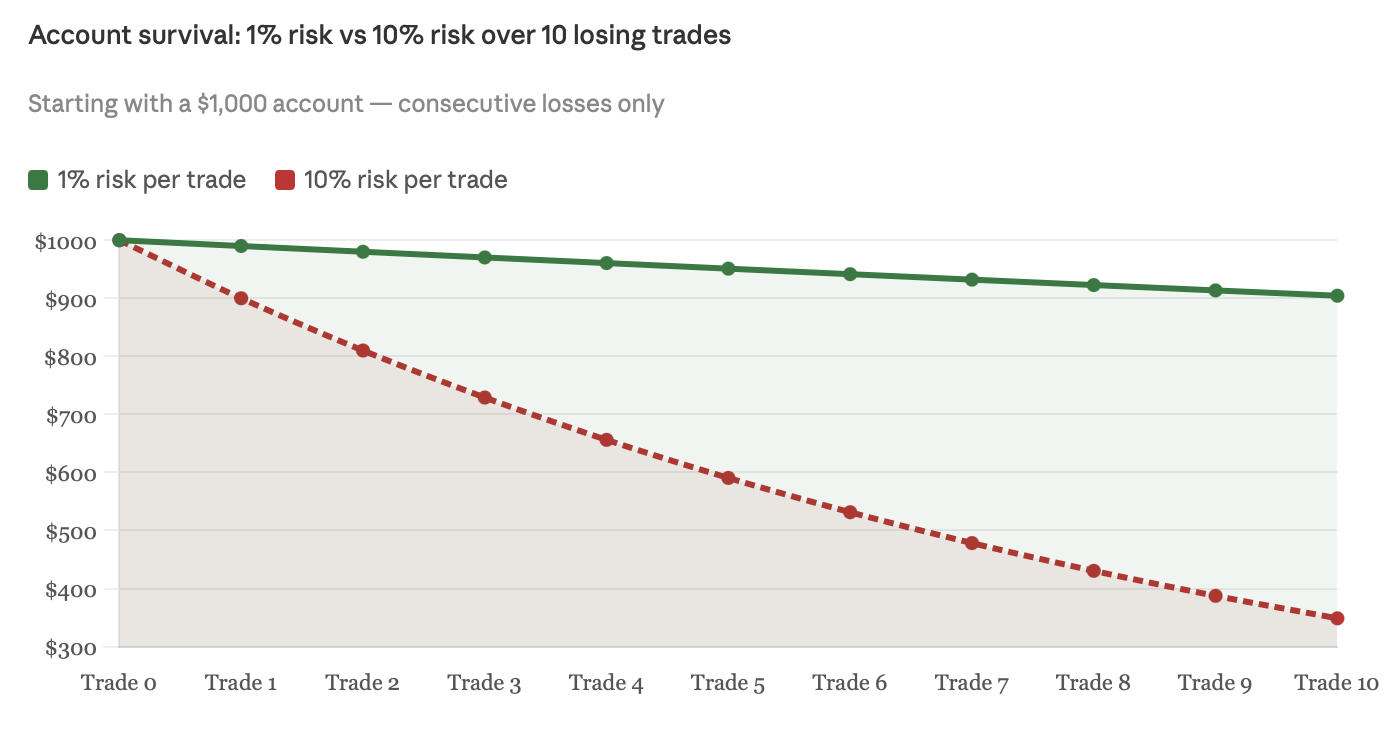
A stop-loss is your only true “no tolerance” rule. You must set your stop-loss before entering any trade. It should be placed at a price level that confirms your trade idea is invalid. If price reaches that stop-loss level, the trade is automatically closed without allowing the trader to make emotional decisions about whether to stay in the trade.
Leveraged trading can multiply both gains and losses. For example, with 100:1 leverage, a 1% move against your position can wipe out your entire account balance.
Use low leverage during your first six months of trading while focusing on executing trades consistently and applying strict stop-loss rules.
“Survive” should be your primary goal. Traders who remain in the market long enough to gain experience are the ones who eventually learn how to make money consistently.
Traders who do not use risk controls to limit losses have little chance of long-term success.
Crypto vs Bank Deposits: How South African Traders Fund Accounts in 2026
Deposits made using cryptocurrency in South Africa have become increasingly common among forex traders since 2026. This is mainly because bank wire transfers from South African banks to trading companies located overseas can take several days to process, often include currency conversion fees, and may occasionally be delayed or blocked.
However, faster transactions do not necessarily mean safer transactions. Cryptocurrency transfers are generally irreversible. If you send funds to the wrong wallet address or to a fraudulent broker, there is usually no financial institution that can reverse the transaction or help recover the funds. Once the transfer is completed, the funds are effectively gone.
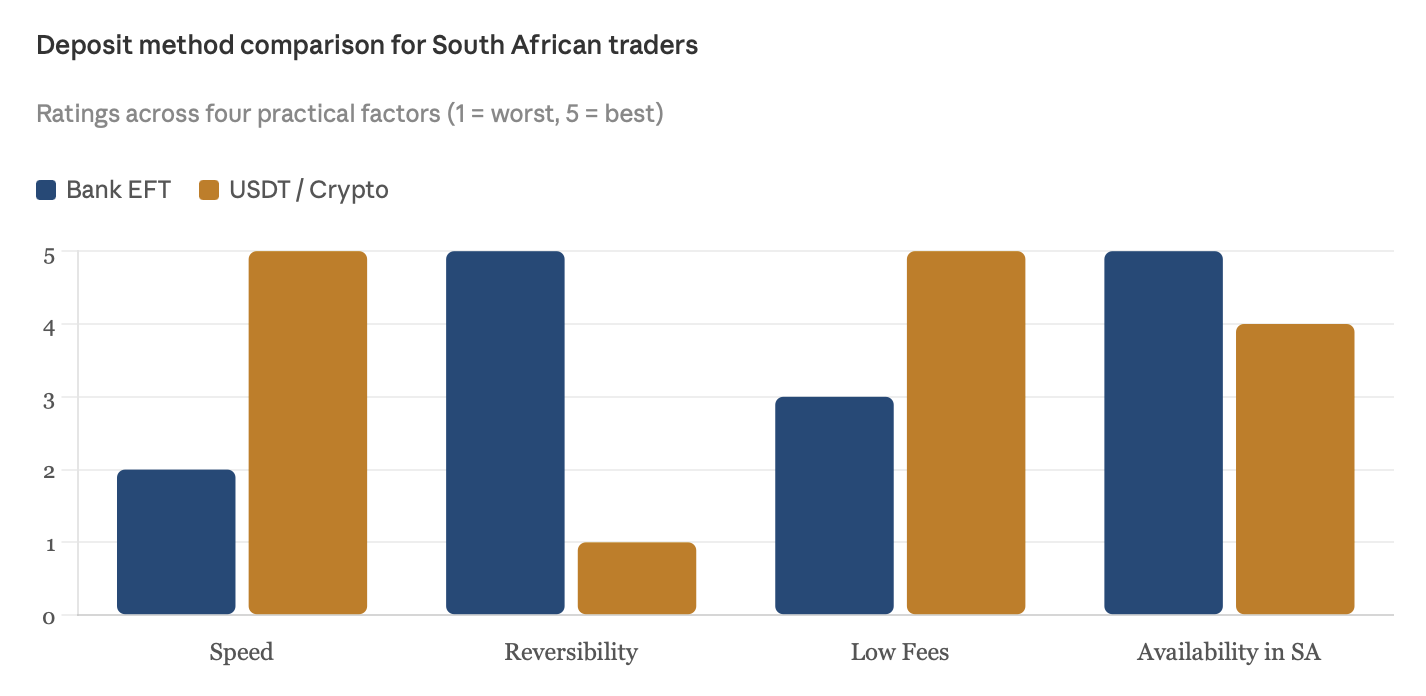
Use bank deposits when you're starting out. The extra day of waiting is worth the protection. Once you understand your broker and trust the withdrawal process, crypto becomes a practical tool for speed.
7 Forex Trading Mistakes That Blow Beginner Accounts
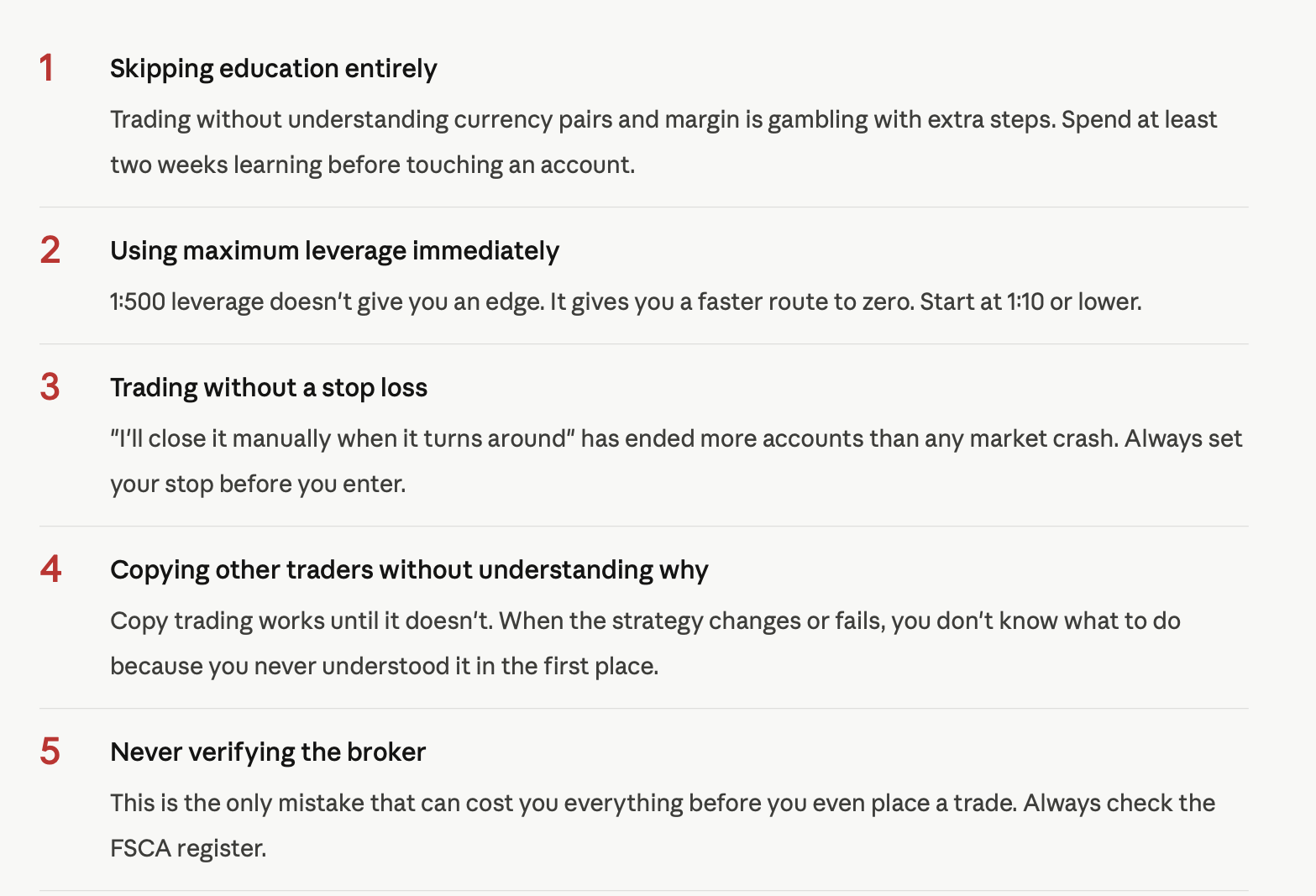
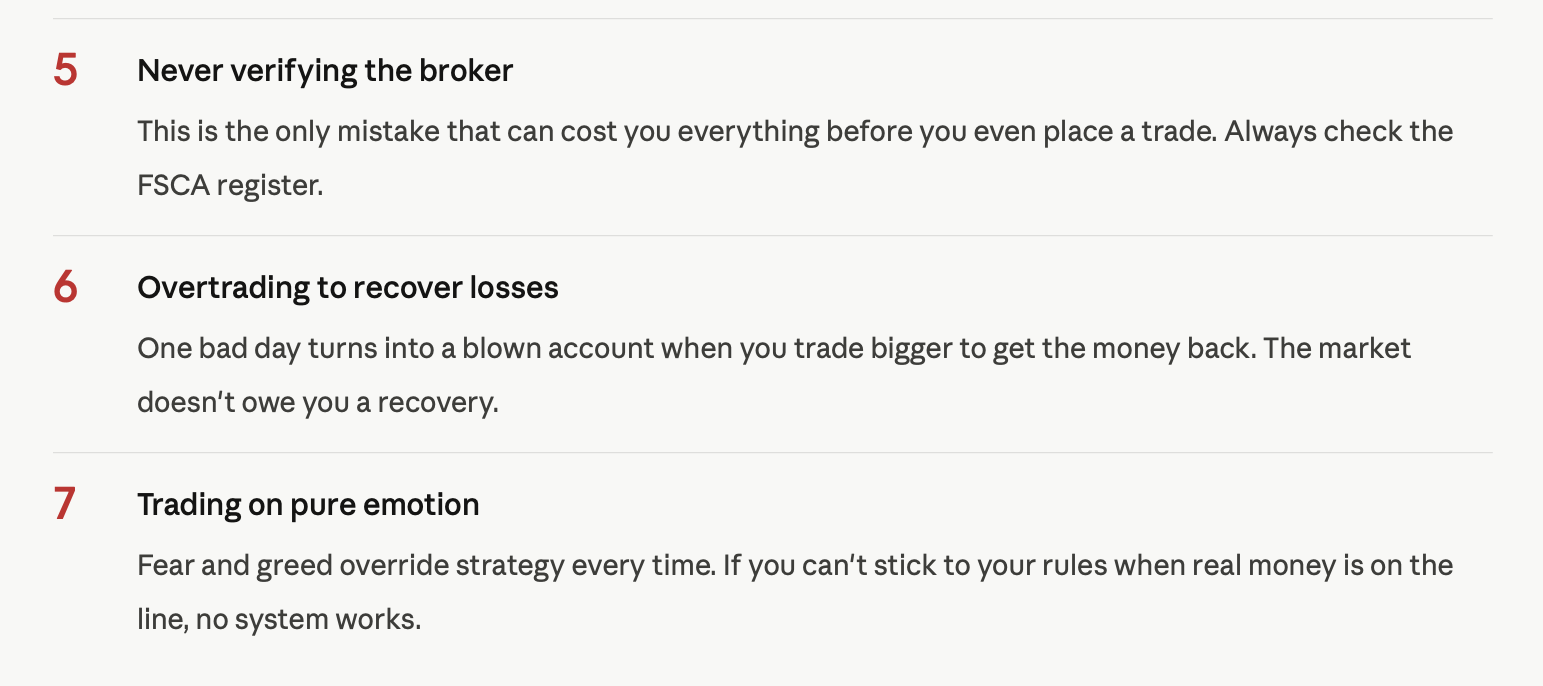
Most losses are preventable. Beginners don't lose because the market is unpredictable. They lose because of these seven mistakes, and they almost always come in order.
The Final Checklist for Safe Forex Trading in 2026
You can learn how to get started with forex trading in South Africa by first understanding the ultimate rule of trading success: survive before you focus on making profits. Long-term survival in the market is what allows traders to gain experience, improve discipline, and eventually become consistently profitable.
Therefore, before opening a real trading account, you should go through every item on this checklist and ensure that each one has been properly verified.
Before depositing real South African rand into your trading account, complete the following checklist items:
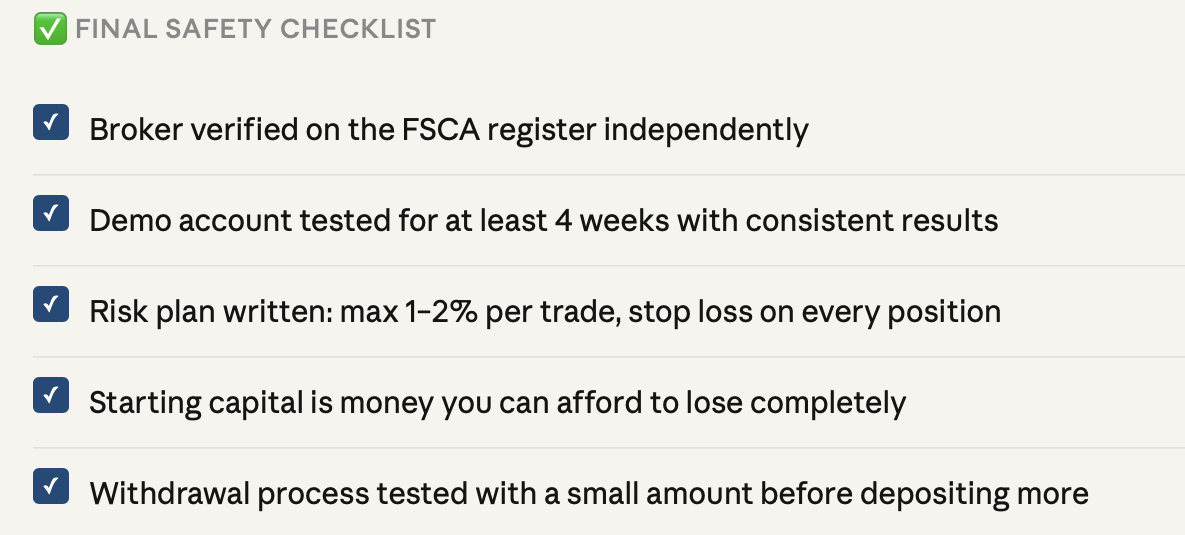
This is how to start forex trading in South Africa in 2026 and still have an account six months from now. Safety, discipline, and learning, in that order, every time.
Ready to trade? Verify your broker and open a free demo in 5 minutes. TradeWill connects South African traders with FSCA-regulated platforms with built-in broker verification so you never have to guess.
Disclaimer: The content of the blog does not represent any position of Trade W, does not serve as any trading-related decision advice, and does not endorse any third-party.