
 Trade W

Why Penny Stocks Keep Pulling Traders In And Why Most Walk Away Broke
A penny stock is highly appealing because it only trades for pennies. This gives beginner traders the opportunity to do the math and think. For example, if they buy a penny stock for $0.40 per share and it increases to $4.00 per share, they will receive a tenfold return on their investment. However, this type of thinking is what causes beginner retail traders to lose capital every year. Most of the time when a penny stock is selling for a low price, it is just that; the market simply hasn't priced the stock correctly; the underlying company has poor financial strength, has low trading volume, and does not have any institutional support.
A penny stock is actually any stock selling for less than $5 per share. Generally speaking, stocks that fall into the USA; according to the SEC's definition of small-cap stocks, they are classified as micro-cap stocks, and therefore have market capitalizations of less than $300 million. There are currently a number of high-profile sources, such as social media, Discord, Reddit, and others that are inundating individuals' feeds with promises of substantial returns from these stocks made with little money. The truth is most individuals who trade in this market without a well-structured plan lose a lot of money or even all of their invested capital.
The purpose of this guide is not to scare away people from trading penny stocks completely; it is to give all of the information you need to know before you stick actual cash into penny stock trading. The information you will find in this guide encompasses information on which brokers support this activity, the most successful trading strategies you can utilize, and how to manage your risk if the markets go against you in a matter of seconds.
What Are Penny Stocks? OTC Markets vs. Listed Small-Caps
The term "penny stock" is a broad classification used to describe stocks that typically trade on lesser-known exchanges or over-the-counter markets. In practice, understanding the distinction between over-the-counter (OTC) securities and exchange-listed stocks is critical for investors seeking to manage risk effectively. This distinction forms the foundation upon which many other market characteristics are built.
OTC markets, including Pink Sheets, OTCQB, and OTCQX, generally operate under different regulatory requirements than major exchanges. Many companies listed on these markets are not required to file audited annual financial statements with the Securities and Exchange Commission (SEC), and listing standards are often less stringent than those imposed by larger exchanges. As a result, analyst coverage is frequently limited, and publicly available information may be less comprehensive.
In addition, trading volume in many OTC securities can be extremely thin, making price discovery more difficult. A single large order from an institutional or high-volume trader can sometimes cause substantial price movements within a short period. Bid-ask spreads are also often significantly wider than those found in more liquid securities, meaning the difference between the price at which investors can buy and sell a stock can materially affect overall returns. In some cases, these spreads may exceed 10%, creating an additional cost that investors should carefully consider before entering a position.
If you are interested in understanding how bid-ask spreads can affect trading performance, it may also be helpful to review resources that explain bid-ask dynamics in detail, as many of the same principles apply across different financial markets.
In contrast, NASDAQ Small Cap stocks are listed on a regulated exchange and must comply with established listing standards, disclosure requirements, and transparency guidelines. All market participants have access to real-time pricing and a higher level of publicly available information. While these stocks can still be highly volatile and carry substantial risk, the market environment is generally more transparent, the competitive landscape is more balanced, and liquidity is typically much stronger than that of OTC-listed securities.
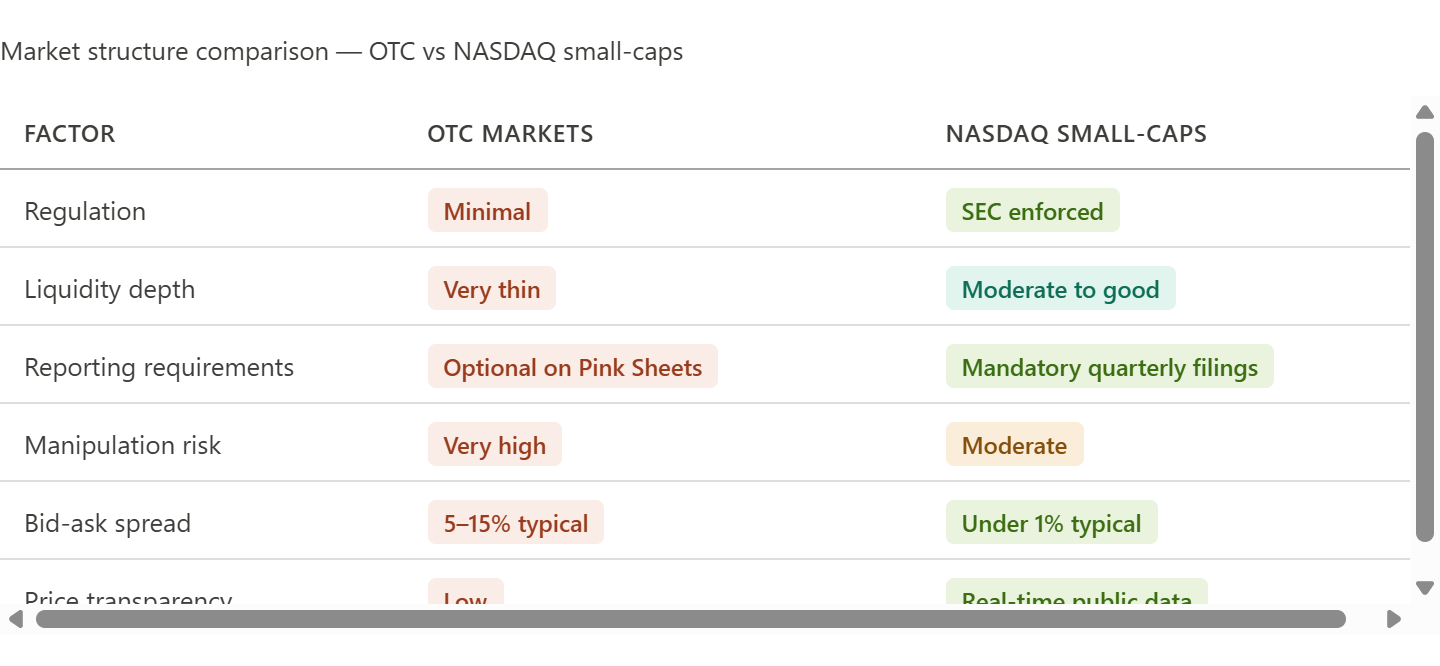
The way the entire market is set up has a greater influence over almost every aspect of trading than any other single factor. Many traders spend a lot of time researching stocks trying to find one that will give them the biggest return, but they don’t take into account which exchanges they are trading on and how that affects their ability to get in and out of trades smoothly and efficiently; nor do they realize how much of an impact exchange-wide price manipulation has on their profits and losses due to the way the exchanges are designed.
Why Penny Stocks Carry Structural Risk That Can't Be Traded Away
Penny stock trading is full of embedded risks that can’t be eliminated through superior technical analysis or selection. The risks associated with trading penny stocks are due to existing liquidity issues within these markets; thus having an understanding of these issues is all that can really prepare you for trading in these markets.
One of the most imminent risks associated with penny stock trading is liquidity risk. When you trade in a penny stock that has low average daily volume, your trades can cause the stock price to increase or decrease significantly due to the absence of a deep market where your order can get lost in a multitude of orders. Since there is very little volume when trading penny stocks, it is like a shallow pool; therefore, your acts of buying and selling will create large ripples in the water. Because of this, if you need to exit a losing position quickly, you may have no choice but to take a dramatically reduced price than the current quote.
Within this market, pump and dump schemes are a common occurrence. A coordinated group will acquire shares in a low float stock and subsequently spam social media with news and hype prompting retail buyers to jump on the stock. Volume will spike and price will increase rapidly. Then the initial accumulation will sell into the artificial demand leaving late traders holding shares that are worth a small fraction of what they purchased them for. This is the classic "bag holding" trap experienced in both penny stocks and crypto. Events such as unexpected macroeconomic events and/or regulatory developments could amplify the depth of these collapses and truly qualify as black swan events for those trading individually.
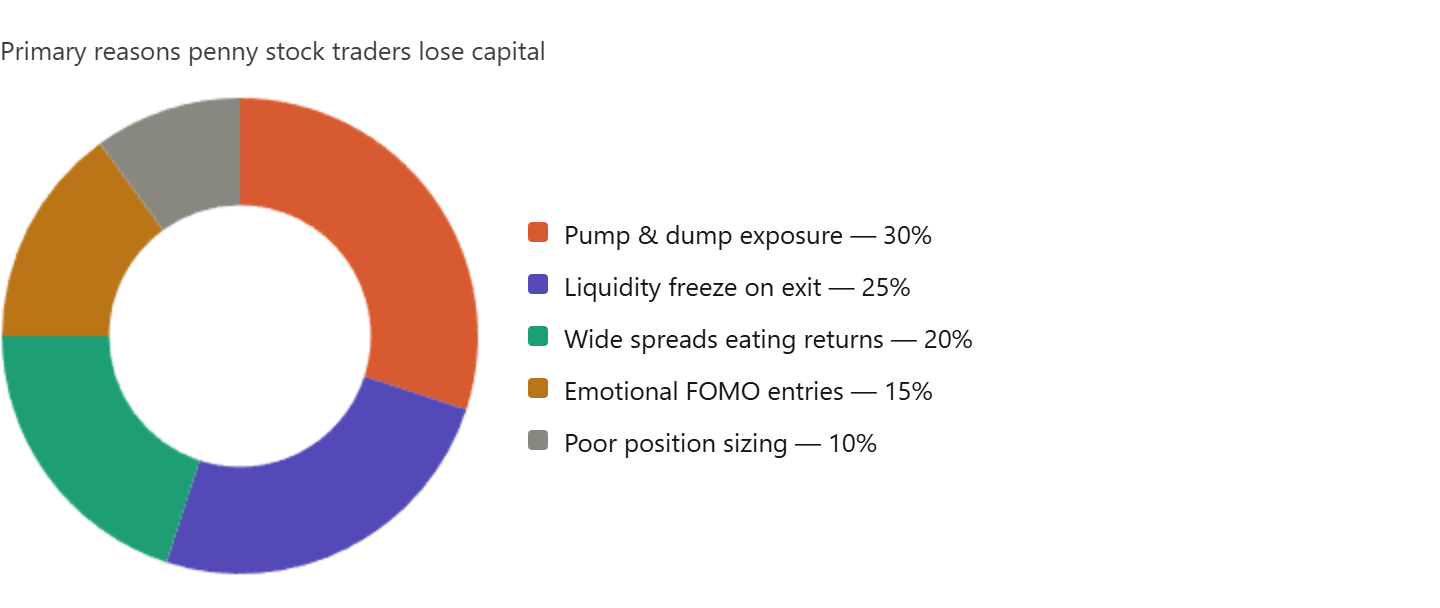
One type of risk that does not always receive sufficient attention is execution risk. In fast-moving penny stocks, there can be a significant difference between the price displayed on your trading screen when you attempt to place an order and the actual price at which the order is executed. This difference becomes especially important when using market orders during periods of high volatility, such as when a stock experiences a rapid momentum-driven price spike.
In these situations, slippage can occur, causing trades to be executed at less favorable prices than expected. In some cases, slippage can significantly reduce or even eliminate a trader's potential profit before they have an opportunity to implement an exit strategy. As a result, understanding the mechanics of trade execution and market structure is essential before attempting to trade penny stocks in a live environment.
Traders should also be cautious of false breakouts, price movements that initially appear to be legitimate momentum-driven advances but quickly reverse direction. These reversals can trap traders who entered positions during the breakout, creating what is commonly known as a bull trap and often resulting in rapid losses.
Choosing the Right Broker for Penny Stock Trading
While not all brokerage firms offer access to penny stocks, there are significant differences among brokers in terms of execution quality, OTC market access, and commission structures. These factors can have a direct impact on the profits earned or losses incurred when trading penny stocks.
For example, a broker may offer an excellent mobile platform and user experience, but if its execution quality is poor in thinly traded securities, the resulting slippage can cost traders far more than they would have paid in commissions at a broker with superior execution. In many cases, execution quality is more important than commission costs when trading illiquid stocks.
There are several key features to consider when selecting a broker for penny stock trading:
-
OTC Market Access
First and foremost, verify that your broker provides access to OTC markets. Many mainstream brokerage firms either restrict or completely prohibit trading in OTC securities, including Pink Sheet stocks. It is essential to confirm in advance that your broker supports the specific markets in which you intend to trade. -
Level 2 Market Data
Access to Level 2 data is extremely valuable for penny stock traders. Level 2 quotes display the depth of buy and sell orders in the market, providing insight into actual supply and demand rather than relying solely on the last traded price. This information can help traders better assess liquidity and identify potential support and resistance levels. -
Order Type Flexibility
Order-entry flexibility is another critical consideration. Placing a market order in an illiquid stock can result in execution at a price that differs significantly from the quoted price. Brokers that support limit orders, stop-limit orders, and real-time order routing provide traders with greater control over execution and risk management. These tools can significantly improve trading outcomes compared with platforms that offer only basic market-order functionality.
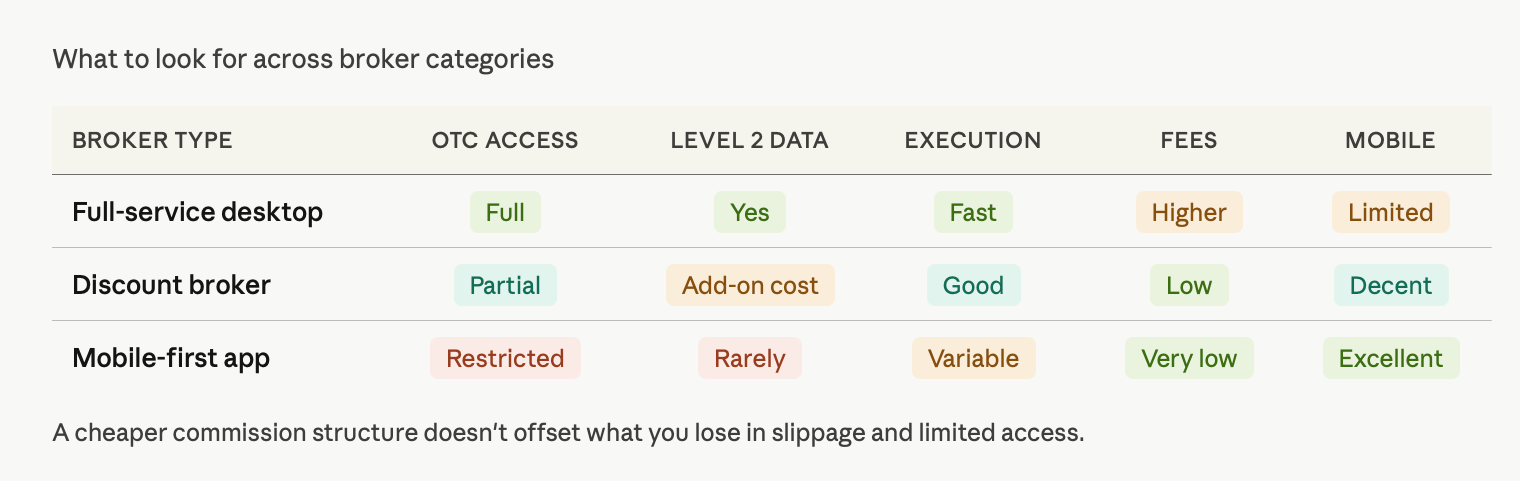
Finding the right broker for penny stock trading involves far more than choosing a platform based on its appearance or user interface. Execution quality can have a substantial impact on trading results, particularly in fast-moving and illiquid markets where the difference between fast and slow execution can significantly affect profitability.
Many novice traders are initially attracted to commission-free mobile trading apps. However, they often discover that some zero-commission brokers may offer limited access to advanced trading tools, such as Level 2 market data, and may provide less efficient order-routing systems. As a result, the hidden costs associated with poorer execution and increased slippage can, in some cases, exceed the savings generated by avoiding commissions. By comparison, a broker that charges a modest commission per trade but provides superior execution quality, faster order routing, and better market data may ultimately prove more cost-effective.
The same principles discussed in guides on minimising trading costs apply here as well: reducing hidden expenses such as slippage, wide spreads, and poor execution can be just as important as minimising explicit fees and commissions.
How to Actually Execute a Penny Stock Trade, Step by Step
The mechanics of entering and exiting a penny stock trade require a significant amount of discipline compared with simply clicking "buy" and waiting to see how your portfolio performs. Every decision made throughout the trading process can influence the ultimate profitability or loss of a trade.
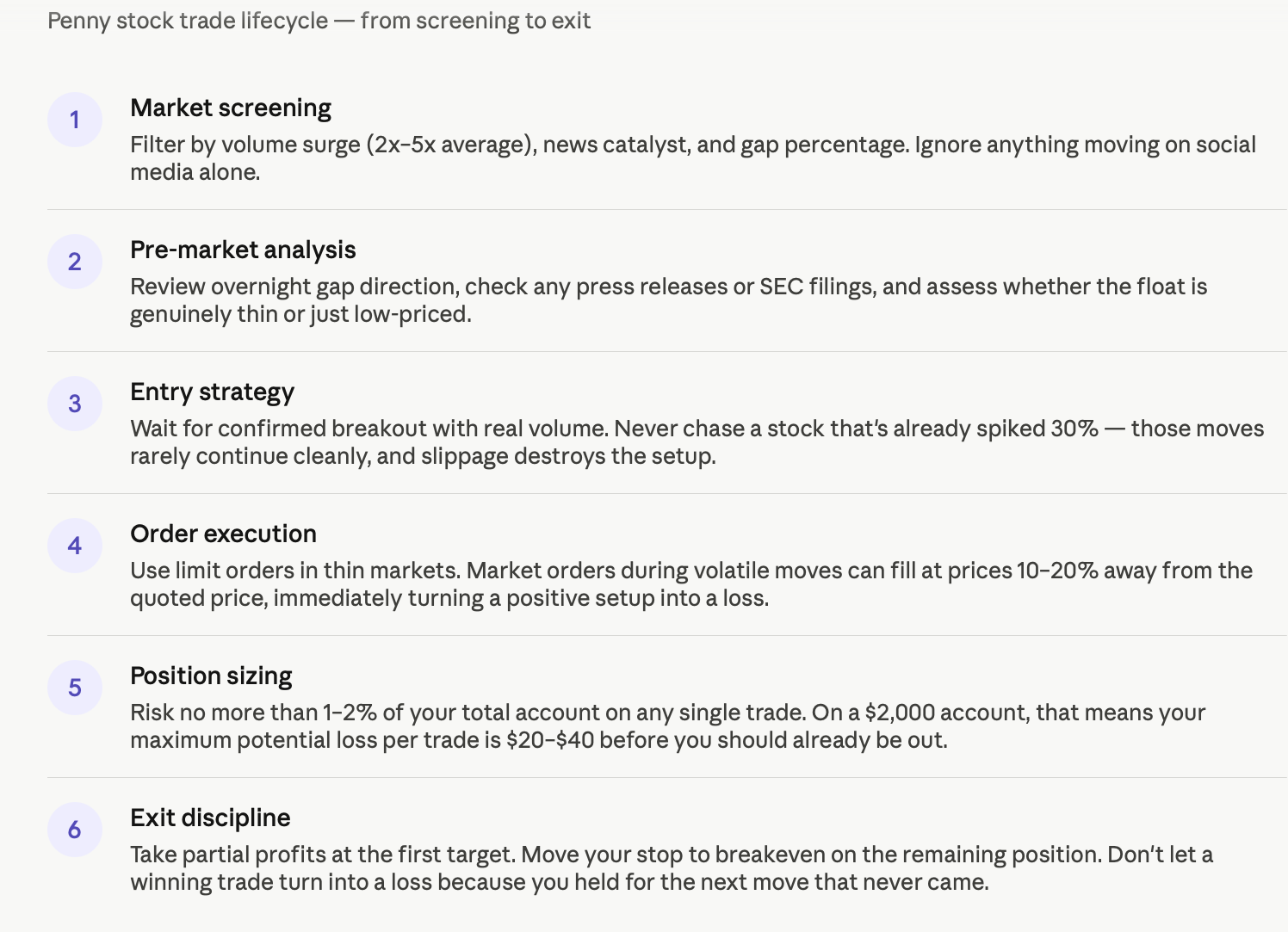
In reality, the outcome of many penny stock trades is often determined by a trader's ability to manage positions effectively. A common and costly mistake occurs when a trade moves in the trader's favor, but they remain in the position hoping for "just a little bit more" profit. As the position reverses, unrealized gains can quickly disappear, turning a profitable trade into a losing one. This tendency to hold positions too long is one of the most frequently observed and expensive behavioral patterns in penny stock trading.
Trading Strategies That Actually Have an Edge
There are three general strategies that can be effective in penny stock markets when implemented with an appropriate level of discipline. These approaches share a common characteristic: they are based on observable price action and market behavior rather than tips obtained from social media or online forums.
Momentum traders typically buy shares shortly after a stock has experienced a significant price move accompanied by strong trading volume. Their objective is to participate in the early stages of a developing trend, using volume confirmation as evidence that the move may continue.
Traders who enter positions after the initial momentum phase has already occurred often risk becoming exit liquidity for those who entered earlier in the move. For this reason, timing and volume analysis are critical components of a momentum-based strategy. Technical indicators such as Bollinger Bands can also help traders identify periods of increased volatility and potential momentum opportunities.
Momentum trading can be highly effective in penny stock markets when supported by sound risk management, proper execution, and disciplined decision-making. However, it is only one of several approaches available, and traders may also wish to explore other strategies depending on their objectives, risk tolerance, and market conditions.
Event-driven trading strategies focus on catalysts beyond normal market activity. Examples include FDA announcements for biotechnology penny stocks and earnings reports for companies with market capitalizations below $1 billion. These events can create substantial price volatility and trading opportunities.
The specific event often influences the optimal entry point, which can be assessed by analyzing how the stock behaved in the period leading up to the announcement. Risk-to-reward ratios can also be established before entering a trade by evaluating factors such as the stock's prior price movement, the distance it has already traveled from pre-event levels, and the trader's intended holding period.
False breakout patterns are particularly common in news-driven trading. A solid understanding of chart formations such as triangles, double tops, and reversal patterns can help traders distinguish between genuine continuation moves and breakouts that are likely to fail or lose momentum. Identifying the difference between a valid continuation pattern and a weakening breakout is a critical skill for event-driven traders.
Trading on news events can be highly profitable, but it requires extensive practice, discipline, and risk management. Volume analysis is especially important. When a breakout occurs on low trading volume, the probability of failure is generally much higher than when the move is supported by strong market participation.
The analytical tools used to evaluate whether a price move is likely to continue or stall are largely universal across financial markets. The same principles can be applied to stocks, stock index futures, commodity futures, and currency markets.
Risk Management That Keeps You Trading Tomorrow
Every sustainable penny stock trading approach is built on one idea above everything else: protecting capital comes before generating returns. A trader who loses 50% of their account needs a 100% return just to break even. Avoiding large losses is far more valuable than chasing large wins.
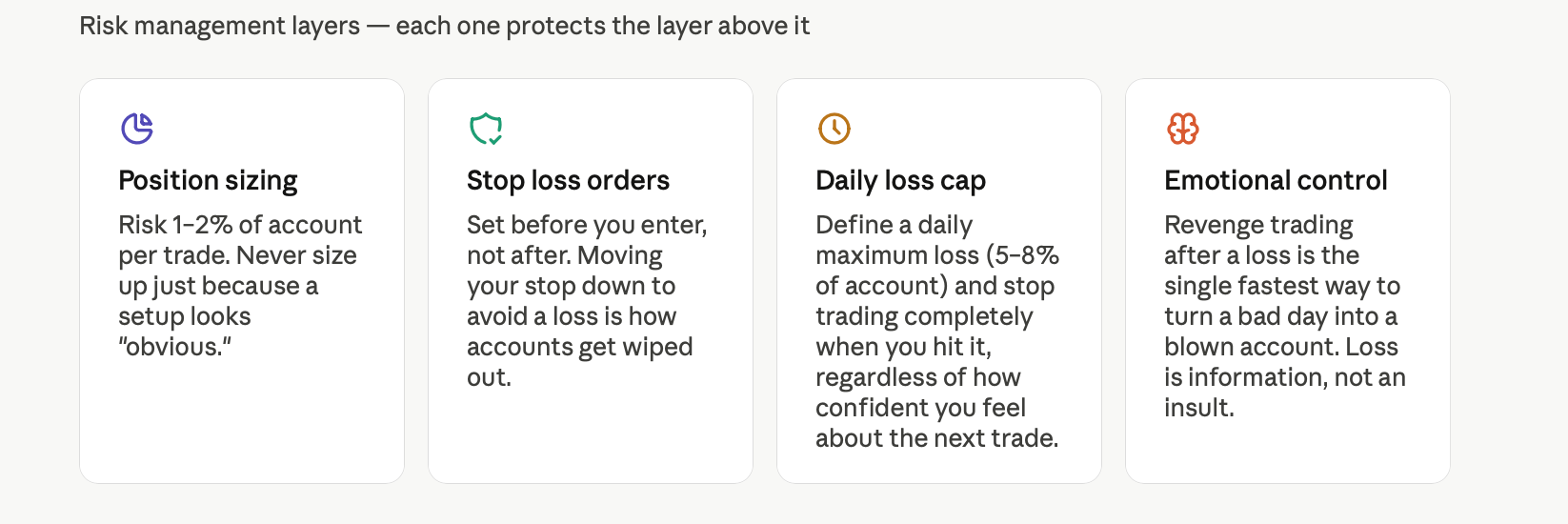
Understanding the reasons for initial margin requirements and the effect of leverage on the potential for gaining or losing money when investing in small-cap stocks will be necessary for any investment with anything more than just your cash balance. The discipline which is used in applying passive investment strategies to long-term management of a portfolio, including stringent rules regarding position size and the importance of avoiding emotional reactions to short-term price movements, is applicable to active penny stock trading as well except it takes place over a significantly shorter period of time.
Common Mistakes That Drain Penny Stock Accounts
The mistakes that most often damage penny stock trading accounts are rarely complex. Instead, they tend to be straightforward behavioral errors that occur when emotions override a disciplined trading process.
One of the most common mistakes is buying into a stock after the hype has already peaked. By the time a stock becomes "trending" on social media, a significant portion of its initial price move has often already occurred. In many cases, the individuals promoting the stock are the same participants who are selling into the increased demand they helped create. Traders who enter at this stage may effectively be providing liquidity for earlier buyers to exit their positions.
Another common mistake is ignoring the bid-ask spread. Although this may sound like a technical issue, it can have a very real impact on trading performance. For example, if you purchase a stock with a 10% bid-ask spread, your position may immediately show an unrealized loss of approximately 10% as soon as the order is executed. Recovering from such a disadvantage can be difficult, particularly in short-term trading setups. For this reason, it is essential to evaluate the bid-ask spread before entering or exiting a position in a thinly traded stock.
Not having a clearly defined exit strategy prior to entering a trade is one of the largest mistakes traders make, and it’s widely overlooked. When traders don’t have an established target and stop-loss, they often must make decisions based on their emotions, which will always lead to worse decisions than if they had established an exit strategy.
The second most common way to destroy an account is by following signals from social media without independently verifying them. Social media platforms, such as Discord groups, Reddit threads and Twitter users that are making recommendations on certain stocks, all have conflicts of interest. The risks of following unverified trading signals apply to both equity and foreign-exchange markets. Consider every alert that you receive from an outside source as a point of reference for your own analysis and not for you just to buy.
Should You Trade Penny Stocks?
Investing in penny stocks may not suit everyone, so when assessing whether they would work for you, it is important to think carefully about your goals and investment strategy before making any commitments of funds. Penny stocks do not qualify as traditional investments; they don’t offer an avenue for low-effort passive compounding returns. On the contrary, penny stocks represent lucrative yet extremely risky short-term trading instruments with design features conducive exclusively to informed, disciplined, fast-executing traders.
Small-cap stocks listed on regulated exchanges and displaying strong fundamentals, originally intended for long-term investors who want an avenue for developing wealth gradually and reliably, provide an opportunity for investors to embrace action and increase the potential for future profits while avoiding the significant risk associated with OTC penny stocks. If you’re serious about developing a long-term active trading career, penny stocks have much to offer as a means of educating yourself about execution, risk management, and reading actual market dynamics. Just make sure to start small and have a designated dollar amount you can truly afford to lose if things go badly.
Traders who remain in the penny stock market long enough to achieve consistent profitability typically share a common characteristic that has little to do with stock selection itself: they prioritize capital preservation. They trade with discipline, manage risk carefully, and view losing trades as a normal and unavoidable part of the trading process rather than as personal failures.
An active penny stock trading strategy can be complemented by other approaches, such as pairs trading or systematic algorithmic trading, which may provide a degree of market neutrality and portfolio balance. However, none of these potential advantages will matter if a trader loses a substantial portion of their account by chasing the latest market trend without proper risk management.
Ultimately, the broker you choose, the quality of execution you receive, and the consistency with which you apply your risk management rules before entering a trade will have a far greater impact on your long-term results than any individual trading setup or stock selection strategy.
The broker you choose, the execution quality you demand, and the risk rules you enforce before you ever place a trade will determine your results far more than any individual setup.
Ready to trade with a broker that doesn't slow you down when it counts? TradeWill.com gives you regulated access, fast execution, and the tools to trade small-caps with real discipline behind every move.
Disclaimer: The content of the blog does not represent any position of Trade W, does not serve as any trading-related decision advice, and does not endorse any third-party.