

 Trade W

1. What Type of Exchange Rate Does India Have?
What type of exchange rate does India have?
India operates a managed floating exchange rate system, also known as a "dirty float."
Here's what that means in plain terms. The rupee's value isn't locked by government decree, nor does it float entirely on market whims. Instead, the Reserve Bank of India lets market forces set the direction while stepping in selectively to prevent chaotic swings.
To understand this better, let's look at how India's system differs from the alternatives:India picked the third alternative, and this decision has far greater implications than you might otherwise assume. Your inquiry into “what form is the exchange rate in India?” is a direct indicator of why USD/INR behaves as it does and why certain trading opportunities arise out of it.
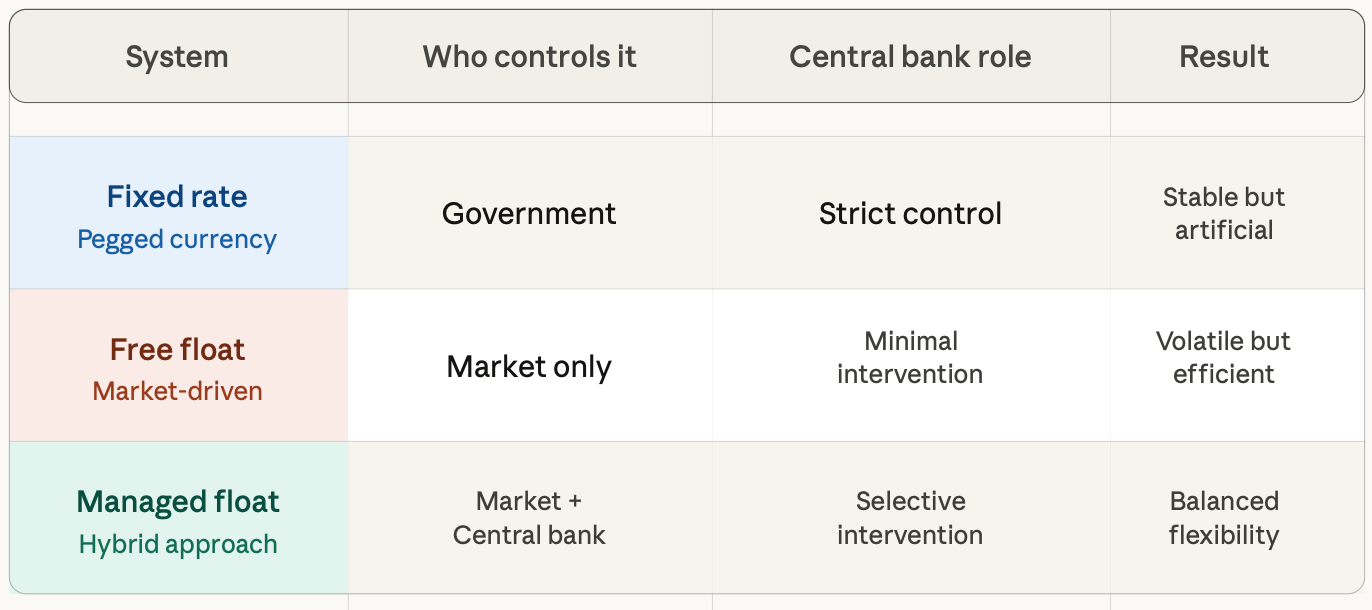
The managed float gives India the balance of providing both flexibility and maintaining stability at the same time. The rupee may weaken over time as a result of economic fundamentals, but major revaluations of the rupee should be buffered from major fluctuations. This means that traders and investors can anticipate how the rupee’s value will move based on its established patterns rather than random acts.
2. How India's Managed Float System Actually Works
The managed float isn't some abstract concept. It's a living, breathing system that shapes every currency movement you see in the markets.
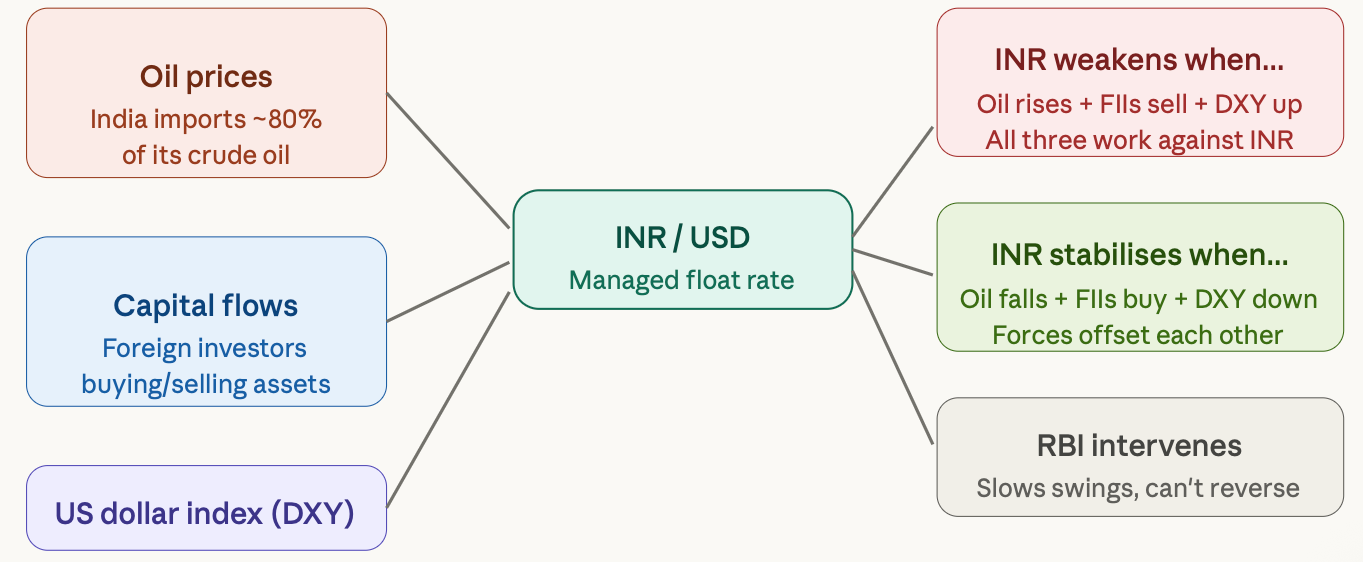
What Moves the Rupee? Three Main Forces
Initially, Oil prices rise. As India imports approximately 80% of all its oil, the resultant 20% crude oil price increase will cause Indian corporations to require an additional amount of USD to settle their respective obligations, resulting in an increased level of demand for USDs and a weaker Indian rupee. This is both mechanical and predictable.
Capital flows are far more important than trade flows. When a foreign investor buys an Indian share, the amount of dollars traded increases, therefore creating a stronger INR, whereas if that same investor were to sell the same shares during a stock market sell-off, the opposite would occur and the gradual strengthening trend for the INR would be reversed immediately. Capital flows change and fluctuate faster and further than trade flows.
The strength of the US dollar has global implications. Therefore, as the US dollar strengthens versus other currencies, the currencies of emerging market economies will experience a negative impact. The same applies to the Indian rupee, which will depreciate along with other currencies based on the strength of the US dollar and the fact that the Indian rupee is a part of the Global US dollar system.
How the RBI Steps In
There are 4 instruments of the Reserve Bank of India that you should know when you trade in the Foreign Exchange Market.
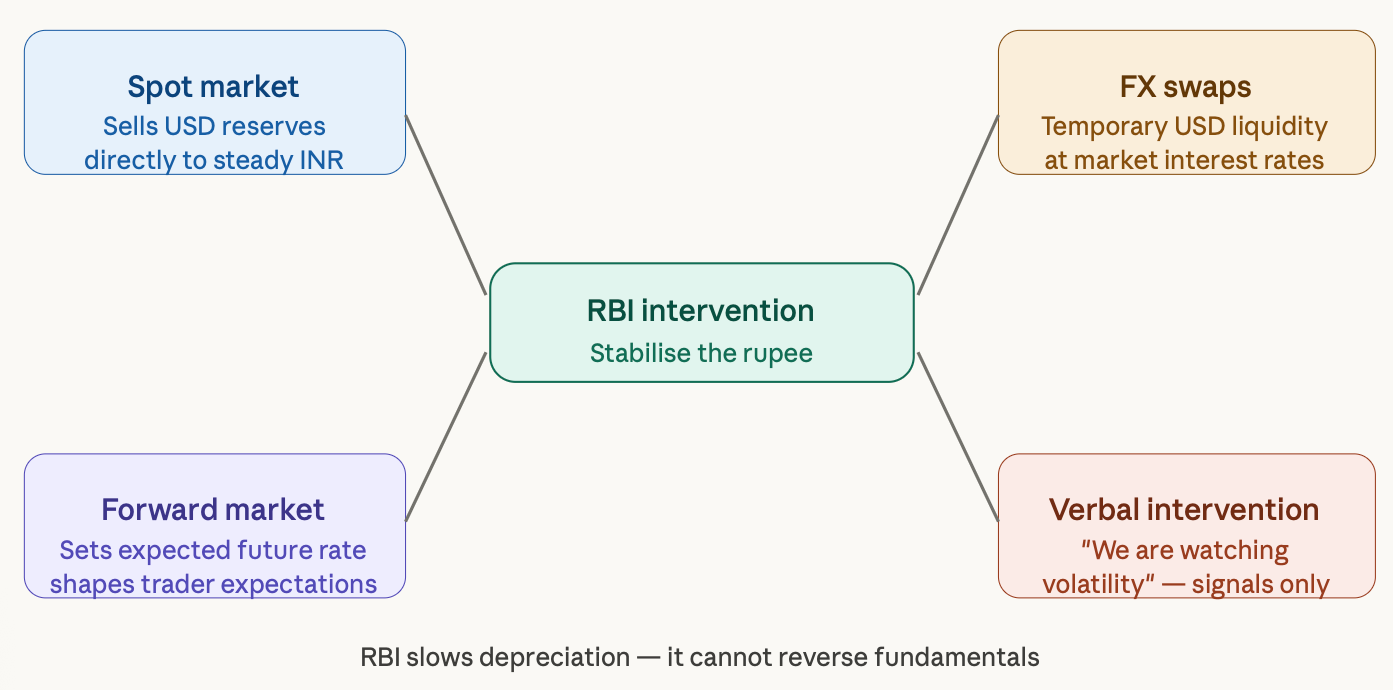
The first is a direct intervention in the spot market. That is when the Reserve Bank sells US Dollars out of its reserves to slow down a currency pair before it breaches a key level. The increased supply of US Dollars reduces the pressure on the Indian Rupee. It is straightforward but works effectively.
The second is known as forward market intervention. This is an indirect intervention working through expectations of the trader. As the Reserve Bank influences the forward exchange rate for the Rupee to the Dollar, traders are shaping their expectation of what the future currency will be worth, either 3 or 6 months out. These influences usually have a greater effect than cash transactions through psychological behaviour.
The third is the use of foreign exchange swaps to provide temporary US Dollar liquidity when there is a high level of demand for Rupees. The Reserve Bank is lending U.S. dollars at market interest rates for a limited time period.
The final instrument is verbal intervention, which, while not a significant market tool, is very impactful. If the Reserve Bank's official states that “we are watching volatility,” it is a sufficient statement to change trader perception of market volatility and, therefore, reduce demand for Rupees without having to take currency reserves out of inventory.
The most important takeaway of this article is that the Reserve Bank’s intervention will slow down disruptive changes, but cannot reverse the current trajectory of the Indian Rupee based on fundamentals. If, over the next 2 years, the fundamentals indicate that the Rupee is going to weaken in value, then it will. The Reserve Bank simply serves as a stabiliser along the way.
3. How India Got Here: The 1991 Crisis and After
To comprehend India's managed floating currency regime, you must first understand what happened prior to its implementation.
Since around 1988, India has pegged the rupee to the US dollar. Although this provided some stability in exchange rates, it also caused a problem: a very rapid depletion of India's foreign currency reserves. As of 1991, these reserves could only finance approximately two weeks' worth of imports, which led to India's currency crisis and subsequent request for assistance from the IMF.
The crisis resulted in a fundamental change in policy direction. The Indian government accepted that under contemporary financial conditions, floating currencies and flowing capital, an inflexible regime would not be able to function. Therefore, after ending the pegged exchange rate, India began allowing market prices to determine the value of the rupee in 1993.
However, India did not implement a completely free floating regime because that would have required abandoning the ability to stabilise it. Instead, India established the current managed float regime: markets establish direction, and the Reserve Bank of India provides stability.
This managed float regime evolved throughout the 1990s and 2000s, and the current exchange rate regime for India reflects many of the lessons learned during the last 30 years.
4. Capital Controls: The Foundation Most People Ignore
There is a critical point that rarely gets brought up in the normal day-to-day conversations regarding the Indian rupee, and that is the fact that the Indian government’s policies regarding capital flows ensure that the managed float operates effectively.
All transactions in the current account can occur without restrictions; one can purchase and sell goods across the border with no issues. This is not the case, however, for capital account transactions. Foreign investors cannot take unlimited amounts of capital out of or into India without permission from the government, and Indian residents cannot take unlimited amounts of rupees out of the country under any circumstances.
Without these restrictions, India’s managed float would not be able to function. If, for example, $100 billion could go in and out of India based on fluctuations in market sentiment, the Reserve Bank of India would not be able to stabilise the rupee because it would not have enough foreign reserves to do so.
Think about it in terms of a partially open door; capital can flow through, but it cannot do so without some form of control. This degree of uncontrolled capital movement facilitates growth in foreign direct investment (FDI) and limits the volatility associated with having completely open borders to the free flow of capital.
So when you ask, “What is the type of exchange rate that India currently has?” the answer is directly related to the country's controls on the capital account. The two cannot be separated.
5. Stability Across Emerging Markets: How Does the Rupee Compare?
The Indian rupee has experienced a slow decline over the long run. Since 2000, it has gone from about 45 to the US Dollar to 83 to the US Dollar today. This gradual decline is primarily due to structural reasons such as inflation differentials and shifts in global capital flows.
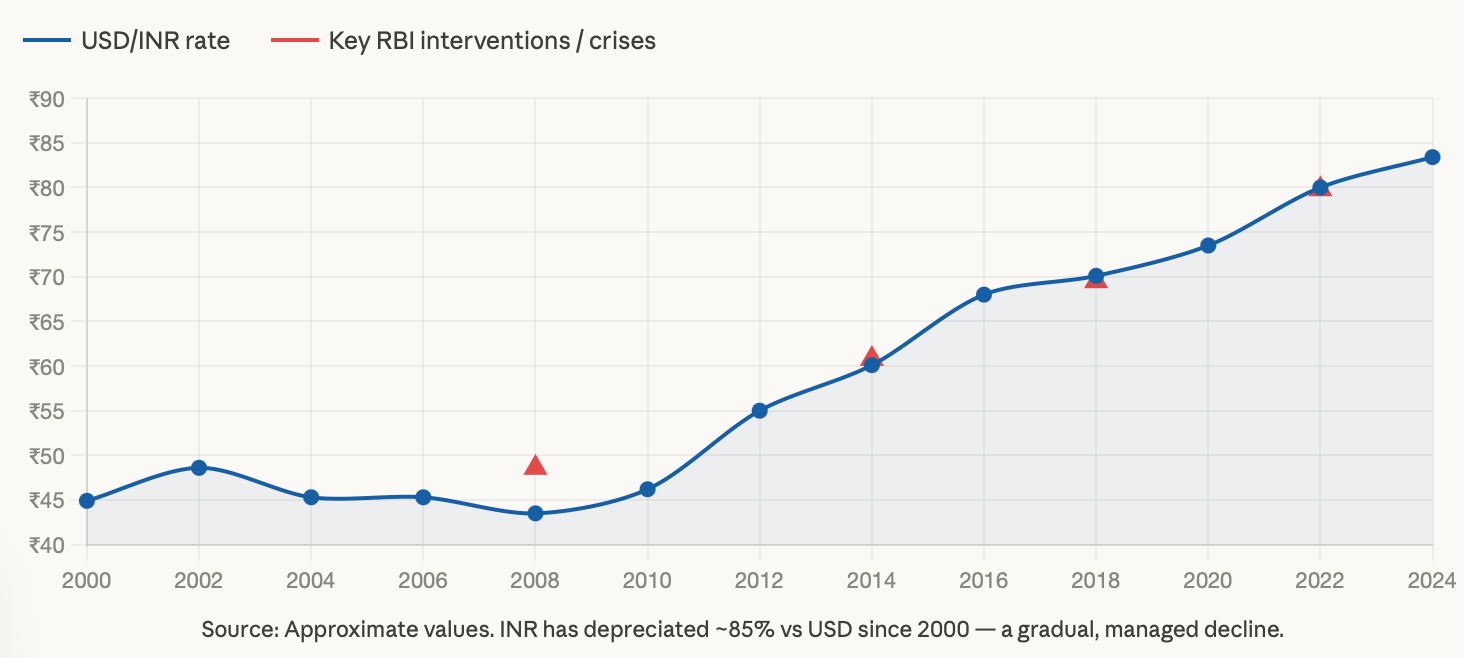
However, what's more interesting is that the Indian rupee has historically been more stable than many of its peers. For example, when you compare the Indian Rupee against the Brazilian Real or South African Rand, they have typically had far more volatility than the Indian Rupee will see in an average month. The volatility of the Rupee will typically remain within a range that traders can predict.
The stability of the Indian rupee can be attributed largely to the managed float system in which the RBI attempts to control movements by keeping the extremes to a minimum. By reducing tail risks, RBI creates a more controlled distribution of returns. As a result, it is not uncommon for you to wake up one day only to find that your rupee has moved -10% without any announcement of bad news coming out of India.
The Indian rupee tends to have a very predictable correlation with the US dollar index and oil prices. When both of these elements are working against India, there tends to be upward pressure on the Indian rupee. However, when one of those elements is offsetting the other, the rupee becomes much more stable. As a result, traders will use these relationships to build macroeconomic models to trade successfully.
6. The Real Costs of a Managed Float System
Stability has an accompanying cost - In order to maintain stability in India, the country has made trade-offs that most people do not realise exist.
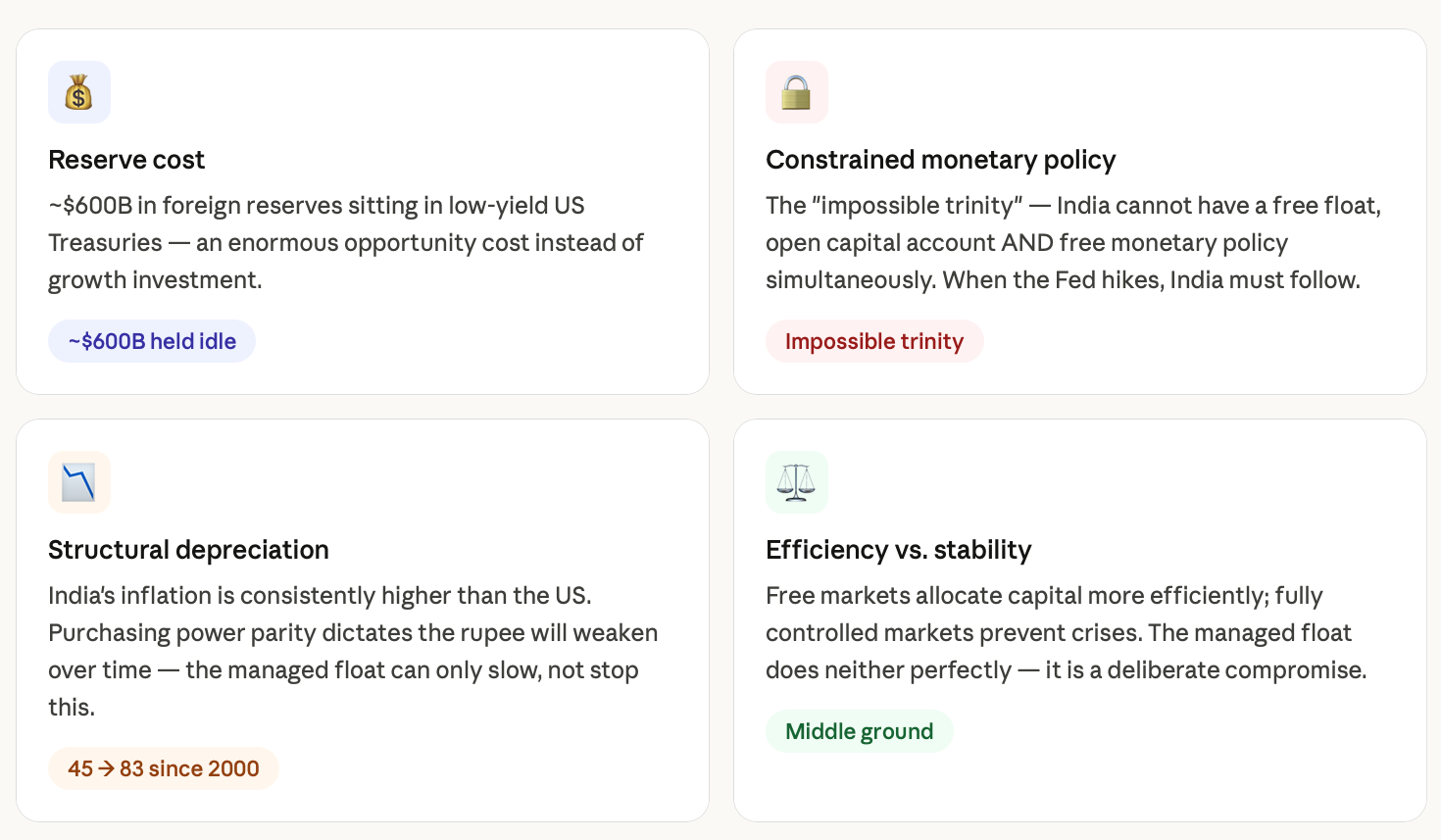
Reserves are costly to maintain - In the case of the Reserve Bank of India, the central bank currently has about $600 billion in foreign assets that earn virtually no return in US Treasuries. These reserves have an opportunity cost. India could have used those dollars for growth, but has instead kept them available for the defence of its currency.
Flexibility of Monetary Policy is Restrained - This is part of the "impossible trinity." India is unable to have a fully free-floating rupee, open capital account and free monetary policy at the same time. As a result, India has given up some of its flexibility to maintain a managed float. When the Federal Reserve increases interest rates, India may be compelled to raise interest rates, despite an ongoing need for easier monetary conditions in the Indian economy.
Many factors contribute to long-term expected depreciation - Inflation in India is significantly greater than inflation in the United States. The difference in inflation will ultimately weaken the rupee over time. The managed float has no way to prevent this from happening, but only to slow the rate of depreciation.
The different trade-offs between stability and efficiency - If markets were completely free, they would allocate capital much more efficiently. If the markets were completely controlled, they might prevent many of the financial crises. A managed float does neither perfectly, but rather tries to find some middle ground between the two.
There are important reasons to understand these trade-offs because they have a significant effect on the way that the value of the rupee can move.
7. The Federal Reserve's Shadow Over Everything
The exchange rate system in India is linked to the global dollar cycle. Therefore, anything the Fed does will have an immediate effect on India.
When rates increase at the Fed, the US becomes a more attractive option for investment dollars, causing dollars to flow out of emerging markets into US assets, resulting in a weaker rupee. This has been the consistent outcome of decades of tightening cycles at the Fed.
The Reserve Bank of India (RBI) will be faced with a dilemma during these cycles of tighter monetary policy at the Fed: to deplete its reserves defending the rupee from depreciation, or allow it to depreciate, therefore exposing the economy to the risk of imported inflation. The RBI usually does both over time. For example, in the 12 months prior to the start of The Fed's aggressive tightening policy cycle, the RBI's reserves will decline by 4-6% while the rupee will weaken by approximately 3-5%.
When the Fed pauses or decreases rates, there is typically an inflow of capital into emerging markets, causing an increase in the value of the rupee and the price of imported oil in rupee terms to decline and as a result, India gets some breathing room.
This experience is not unique to India. However, the transparency of the managed float exchange rate system in India provides a very clear view of how the RBI's interventions change as the Fed's policy changes.
8. What Traders Need to Know About the INR
If you are involved in forex or CFD trading where the floating 'rupee' is concerned, it is important to take the managed float system into account as you make your trading decisions.
Historically, over the long haul, the rupee has been on a gradual downward trend, reaching an eventual point of depreciation, thus making it impossible to make money by opposing this trend. Instead, your best chance of making money from the rupee over time is to look for points of entry and exit during this downward trend rather than trying to trade against the rupee's depreciation.
Because of the Reserve Bank of India (RBI) intervention that is designed to control extreme price movements in terms of the rupee, the rupee typically trades between two perceived price levels, namely, support and resistance. There is nothing random about these levels.
These levels are closely correlated with the RBI's intervention policy toward tolerable levels of price volatility and its reserves. Traders can therefore determine these price levels and, subsequently, choose to fade price moves towards each price point.
When trading the rupee, macroeconomic models will dominate technical analysis. For example, if at the same time you receive a signal that indicates that the U.S. dollar is strengthening and that India has a trade deficit, you would be more inclined to establish a position in USD/INR than if you received a signal that was based on a head-and-shoulders reversal pattern.
While technical analysis is valuable when trading forex and CFDs in the rupee through the managed float system, the RBI's intervention and managed float control take precedence over technical analysis by breaking the structure of technical analysis and/or invalidating it (e.g., having a perfect technical setup only to have the RBI intervene and render your technical setup void).
Finally, professional traders who trade the rupee first understand the managed float system and then augment their technical analysis with it.
9. What Type of Exchange Rate Does India Have
An arrangement in which the rupee is influenced by the market, but held within predetermined limits.
Indications for you:
-
Although the rupee will depreciate structurally, it will depreciate within prescribed limits.
-
Both operating capital controls and foreign exchange interventions are used to keep the volatility from happening.
-
The US dollar index and oil prices are the main factors that will drive the value of the rupee.
-
The rupee will eventually depreciate; however, the volatility in the short term can be controlled.
-
The macroeconomic fundamentals are more important than the technical indicators.
Having an understanding of the Indian exchange rate system will allow you to see the limits of volatility and trading opportunities. You are not trying to fight against a completely free market or an entirely controlled economy, but rather working with a set of rules and patterns that will give you an idea of where to expect intervention to occur.
Ready to trade USD/INR with confidence? Join Tradewill's advanced macro analysis platform and get real-time RBI intervention signals plus daily currency forecasts tailored for emerging market traders.
Disclaimer: The content of the blog does not represent any position of Trade W, does not serve as any trading-related decision advice, and does not endorse any third-party.