

 Trade W
What Every Stock Trader Must Know About Insider Trading
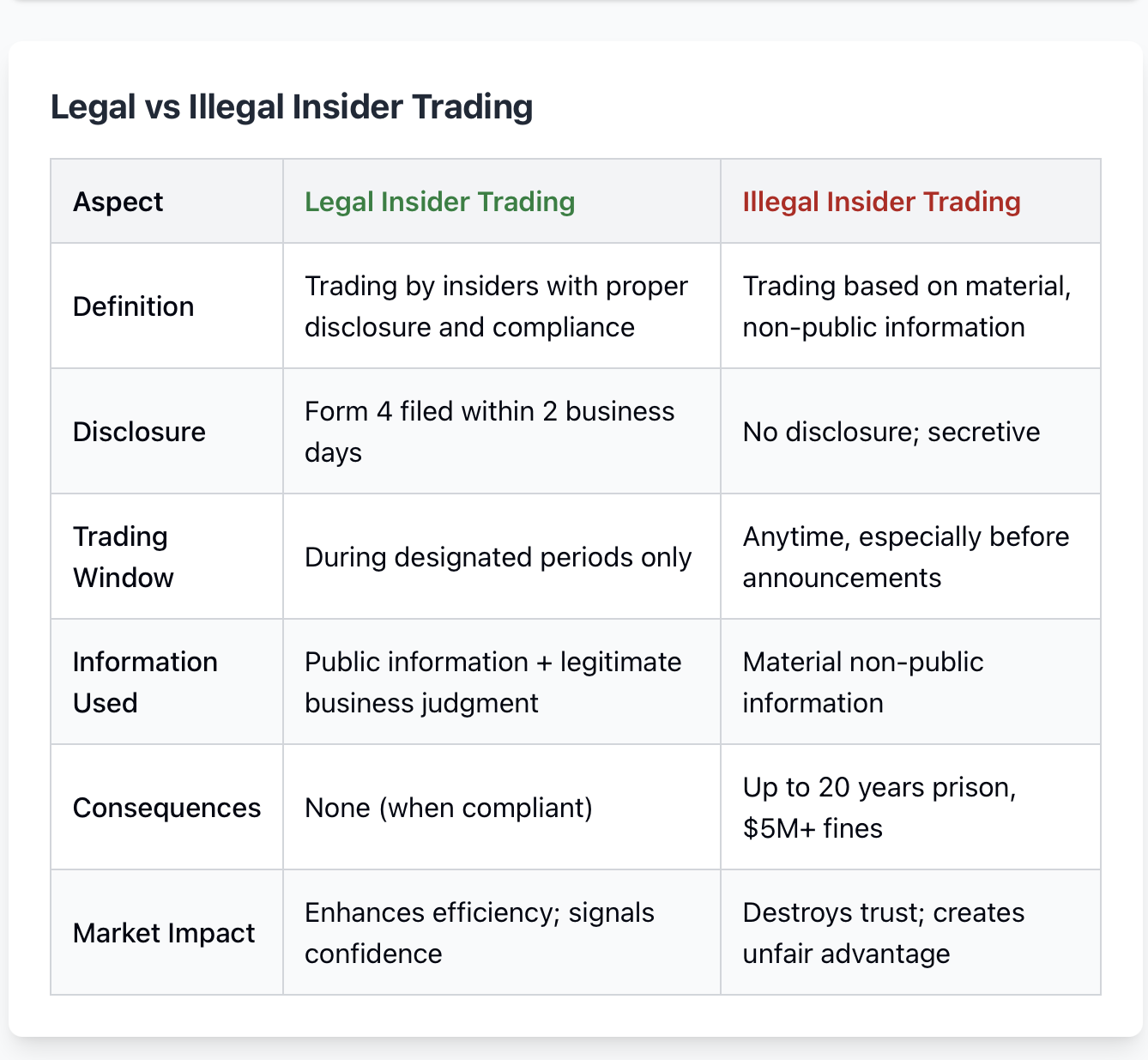
Insider trading is essential for establishing or eroding trust in financial markets. At its most basic, insider trading is the buying or selling of securities based on material nonpublic information. Importantly, not all insider trading is unlawful. Corporate executives often trade their company's stock legally, provided they comply with a disclosure requirement and a trading window.
It's the illicit form of insider trading that leads people to unfortunate outcomes and headlines. When someone uses undisclosed information to benefit unfairly in the market, they are cheating. Recall Martha Stewart's conviction for allegedly selling stock in ImClone Systems after she received a tip that the FDA had rejected their application. Or the massively publicised Enron scandal that had executives selling shares while hiding the state of the company's finances from future investors.
So what? Illegal insider trading doesn't just hurt individual investors who get left holding the bag. It undermines trust in the overall financial system. Trust is the bedrock of financial stability, and when people spend and invest on the false assumption that the game is fair, they swiftly withdraw their money when they believe the game is rigged. Markets become inefficient, prices move unreasonably, and, in the end, all participants except those with insider information or those cheating the system are worse off.
This guide will explain everything about insider trading so you will recognise red flags, understand distinctions between legal and illegal trading, learn how to protect your investments from market manipulation, and position yourself on the right side of regulation. It doesn't matter if you trade stocks, options or CFDs - by the end of this guide, you will have greater insight into navigating markets and will be able to avoid being used by someone else in their illegal trading scheme.
Breaking Down the Types of Insider Trading
Let's clarify the confusion right from the start. The term "insider trading" refers to two entirely different activities that are commonly grouped.
Legal insider trading occurs when company insiders (executives, directors, employees) legally buy or sell their own company's stock and comply with all rules surrounding the legal implications of "insider trading". They anticipate trading in any clearly assigned periods, file Form 4 with the SEC within 2 business days of the trade, and their holdings are public. A CEO trading shares in his/her company through proper channels? Absolutely legal! In fact, these trades can be evidence of a CEO's confidence in the future of the company and provide valuable information for regular investors.
Illegal insider trading is a completely separate issue. It occurs when a person buys or sells stock based on material, non-public information. "Material" information means information that could reasonably be expected to impact an investor's investment decision to either buy or sell the stock. This could be information about future earnings, potential mergers, FDA approvals, or major contract wins. "Non-public" simply means that it has not yet been released to the market. When you combine the two, you create an unfair advantage that violates securities laws.
The information can be derived from a range of sources. For example, company leaders have access to information that is not available to the general public. However, expanding the circle of people who may be considered to have traded on inside information would include board members, employees who have seen confidential information, lawyers working on the transaction, accountants preparing the financial statements, and even an employee who listens in on a conversation in an elevator. The law does not only punish the person who acquired the information first. Anyone who gets a tip and trades based on it can be in violation of the law; just one of many linkages in the chain of liability.
Insider trading has different meanings depending on the type of financial instrument. In the case of the stock market, one may buy shares of a situation before a positive announcement and sell the shares right before something negative hits the public view. For option traders, insider knowledge may provide even greater leverage on incomes, as the option to buy call options before positive news, or put options right before a downward trending stock, will provide a higher return on their insider trading knowledge. The CFD and derivatives markets provide even more chances for misuse as leverage distorts the natural impact of inside information.
Consider it similar to an exam in which you have already seen the answer to the test, while the rest of the students prepared for the exam in the way intended. Yes, you may perform better, but you are cheating. The market operates on this same concept, where some participants have information that gives them an advantage and is contrary to fair and equitable market standards, effectively making the whole exam pointless.
It is important to distinguish between illegal and suspicious because not every suspicious trade is illegal. Some executives may buy stock based on what they believe is a good future for the company, based on their knowledge of public information and their experience running the company. The threshold is crossed when they are acting upon specific information that would move the stock price when disseminating that same information to the public.
Historic Cases That Rocked Wall Street
Nothing illustrates the consequences of rule-breaking quite like watching someone lose everything. Let's look at some cases that changed our perception of insider trading.
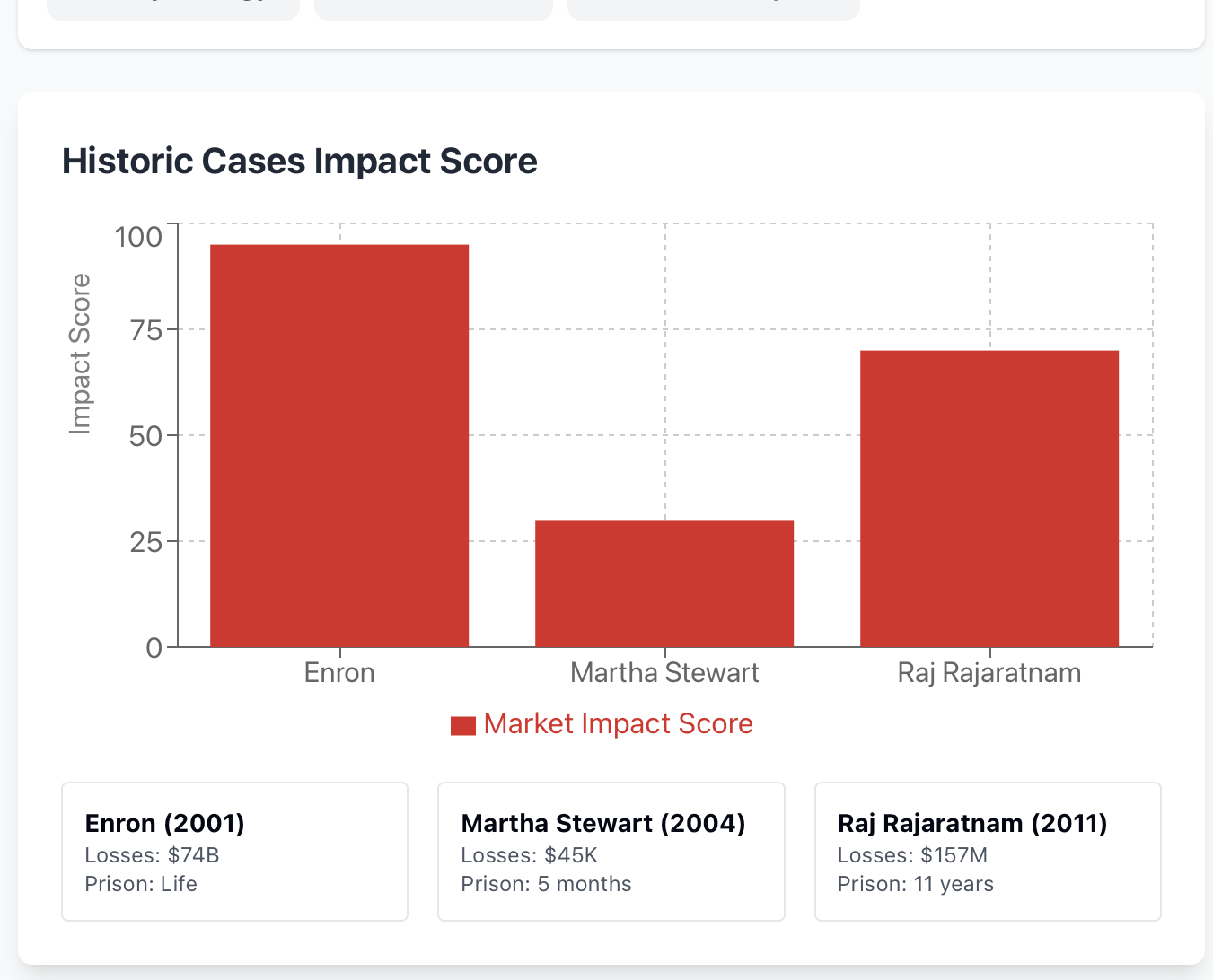
The Enron Scandal (2001) was perhaps the largest act of corporate fraud in American history. Executives Kenneth Lay and Jeffrey Skilling sold millions of dollars in company stock while publicly championing the fraudster company, additionally hiding massive amounts of debt by accounting tricks designed to mask the ledger. As the stock price went from $90 to pennies, average employees lost their entire retirement savings while the executives had already cashed out. The scandal led to the Sarbanes-Oxley Act, changing how companies report financial information.
Martha Stewart (2004) became the face of insider trading prosecution, although syntactically she was convicted of obstruction of justice, but in practical terms, she was doing insider trading. Stewart received a tip from her broker that ImClone Systems CEO Samuel Waksal was selling all of his shares before the FDA rejected the company. Stewart then sold her 3,928 shares, thus avoiding a $45,673 loss. Likely, the sale would have been handled quietly; lying to investigators turned a draconian case into a federal case. Stewart served 5 months in prison and paid hefty fines. One lesson learned: the cover-up often does more damage than the crime.
In 2011, Raj Rajaratnam ran the Galleon Group hedge fund and developed relationships with corporate insiders, who provided him with inside information and confidential research about technology companies and other significant firms. In the case against Rajaratnam for insider trading, prosecutors utilised wiretaps against him for the first time. They recorded discussions, including illegal tips, that amounted to millions of dollars in illegal profits. Rajaratnam was ultimately sentenced to 11 years in prison, sentenced to about half of that sentence before being released, and was fined $156.8 million. Ultimately, the case showed that even sophisticated hedge fund managers may not escape the state-of-the-art surveillance and tracking. They will eventually be caught.
Each case acted like an initiator and had an immediate effect - the markets shook as there was a drop in prices when the news was passed along to the reporters. Investor confidence took a hit, immediately speculating whether there was actual rule-breaking and how much participation was rigged in favour of the larger investors. The response from the regulatory officials has been to tighten discretionary disclosures, increase penalties, and expand the process prone to regulatory surveillance.
Of course, it was a crime that wronged many people. They were wronged and lost a lot of real money because people broke the rules that were agreed upon and did not share the same information as everyone else. Additionally, the trust in the health of the market relies on participants participating in the market believing that we are all playing on the same level field.
How Insider Trading Destroys Market Efficiency
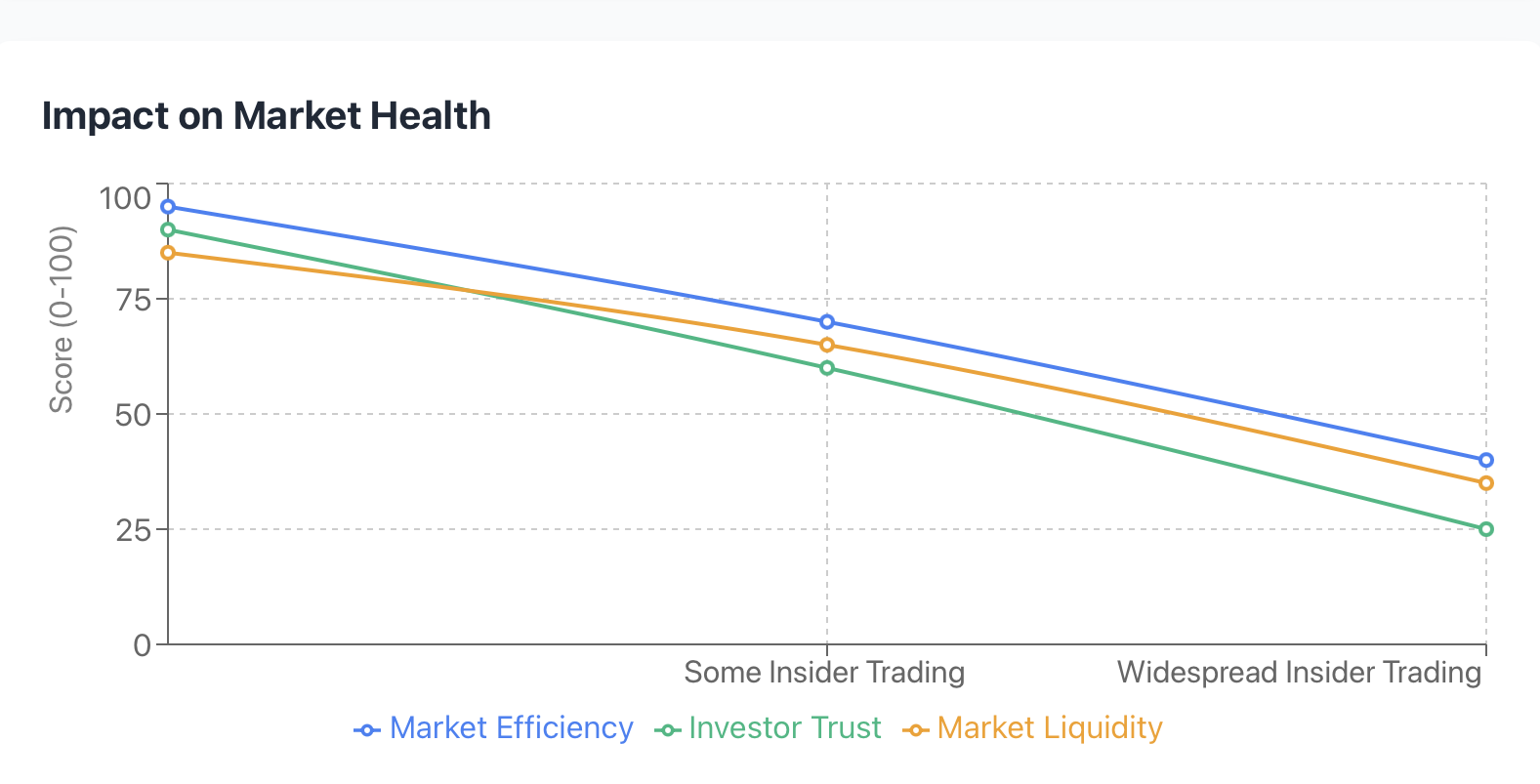
According to the Efficient Market Hypothesis, stock prices appropriately incorporate all relevant information almost immediately. However, insider trading contradicts this entire idea by causing asymmetries in the information available to investors that cause a disconnect in price efficiency.
In the case of legally sanctioned insider trading, however, efficiency may actually be enhanced. When an executive buys shares in their own company, it indicates confidence and is quickly reflected in the stock price. Other investors notice the trade and find it helpful in making their investment decision. The information is then disseminated through public filings, and the stock price adjusts accordingly.
In the case of illegal insider trading, however, we see something different. Imagine that a stock is trading at $50/share when there is a pending acquisition at $75/share that the market is not aware of. Insiders, aware of the news, begin buying shares, and the price increases to $55 or $60/share. The average investor is unaware of the reason behind the price change, and the price movement becomes noise. Finally, an announcement is made of the acquisition, and the stock price reflects the acquisition price. However, by that time, the insiders have effectively captured the majority of the profits, having outed and made the decision prior to other investors being aware, while the average investor has either missed the trading opportunity altogether or paid the inflated price.
This is increasingly relevant, depending on the market. Developed markets tend to have regulation and enforcement mechanisms to maintain market efficiency. Further, the SEC maintains advanced analytics and the ability to quickly notice unusual patterns. Conversely, emerging markets don't always have the same capabilities, or maybe there may be regulations that exist but lack enforcement mechanisms, leaving them the most vulnerable to manipulation and/or insider trading.
The repercussions of these actions extend to the whole financial system. If investors lose confidence in prices producing true value, they will demand higher risk premiums. This will raise a company's cost of capital, making it increasingly difficult to raise capital for growth. As traders grow fearful of being on the wrong side of information asymmetries, liquidity disappears. The market will become less efficient in allocating capital towards its most productive uses.
Imagine you are playing poker, but someone can see your cards. While it is technically still poker, the game has changed significantly. You would most likely stop playing or ask for different terms. Financial markets operate like this. Fair pricing relies on everyone having equal access to pertinent information.
Spotting the Red Flags of Insider Trading
Spotting insider trading is not only the responsibility of the SEC; smart traders can notice whether something strange is occurring.
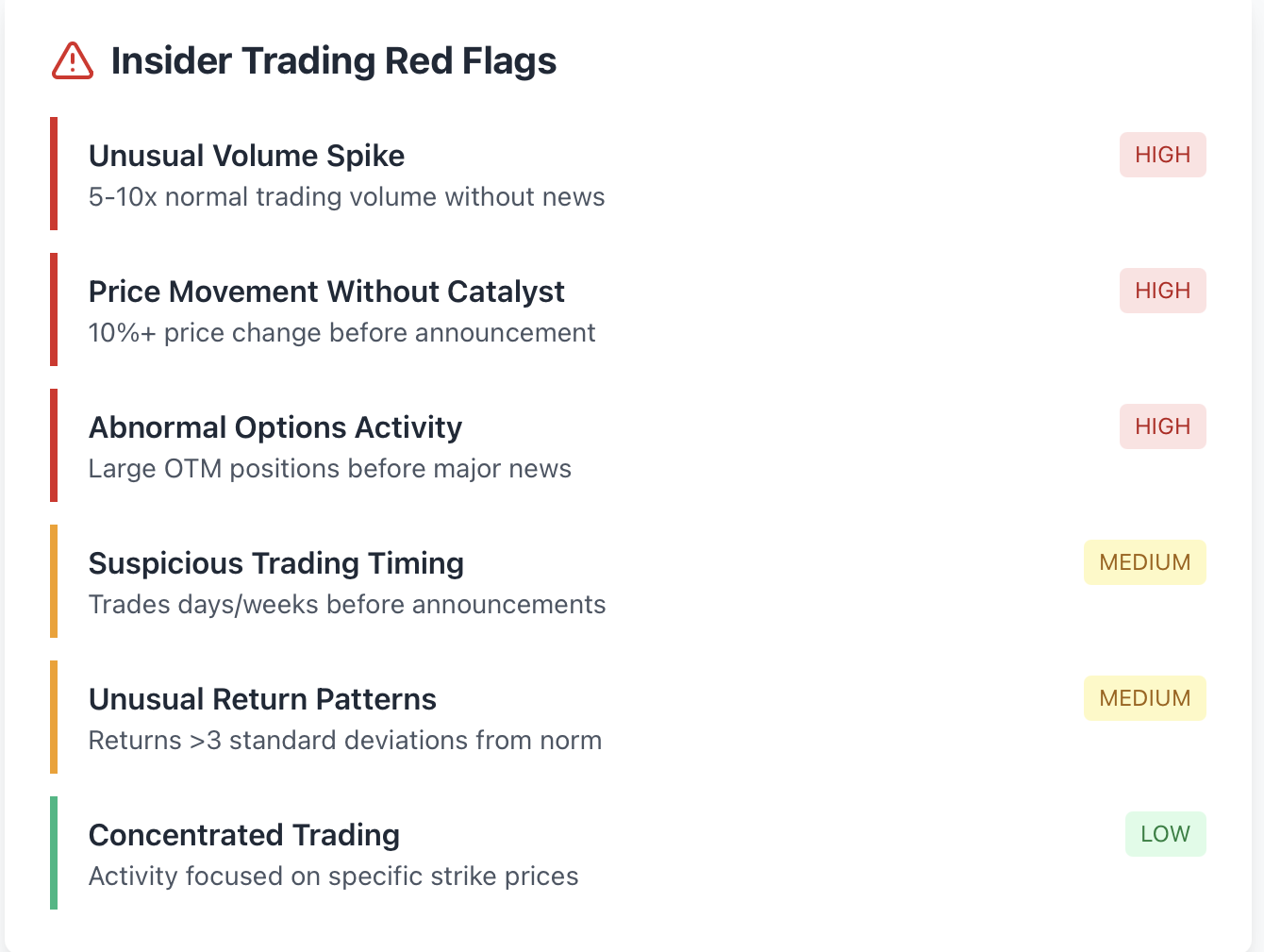
The first and most obvious red flag is an unusual increase in volume. If a stock usually trades 500,000 shares a day and suddenly trades 5 million shares without a news catalyst, then surely someone knows something. Almost always, the volume is focused on certain strike prices in options, indicating the bets are directional in nature.
Additionally, price movement without a news catalyst raises suspicions. If a stock has gone up 10% on no news, then a significant announcement comes out the next day, it is clear that a leak of information occurred. When the price action does not coincide with public information, it signals that some traders knew the event was going to happen.
Another method to quantify abnormal returns is with statistics. Financial analysts calculate the expected return based on movement in the market and based on the fundamentals of the company, and compare those expected returns against the actual return. Large deviations could indicate insider trading, especially when the deviation from expected returns occurs days or weeks before a significant announcement.
There are tools to help analyse trading behaviour for abnormal returns. The SEC produces the Edgar database, which is free and publicly available to monitor insider transactions. Other providers of financial data, including Bloomberg, FactSet, and Refinitiv, have developed analytics that allow institutional clients to analyse trading activity for abnormal returns. Retail investors also have options to analyse unusual options activity if services monitor and flag any unusual patterns for review.
The Z-score method is useful for spotting shifts in activity away from the average. You first calculate a mean and a standard deviation of your selected "stock" variable, commonly the trading volume or returns over a certain baseline period of time. Then you can assess how many standard deviations a stock’s activity is from being normal. You should spend extra time on stocks if their activity is more than three standard deviations from the norm.
A great example to illustrate this concept occurred in 2016 when the options activity in Yahoo made a considerable spike prior to Verizon announcing the merger. Call option volume, noted as unusual, reached extremely high levels in the days leading up to the announcement, with traders making extremely accurate bets on the timing and price. Ultimately, the SEC investigated many individual traders under the guise of insider trading related to the Yahoo and Verizon merger.
While studying these signals will not make you an expert investigator, determining unusual activity with these signals can keep you from investing in stocks that might portray suspicious activity and serve as an alert to the potential opportunity when news is made public.
Insider Trading Across Different Markets
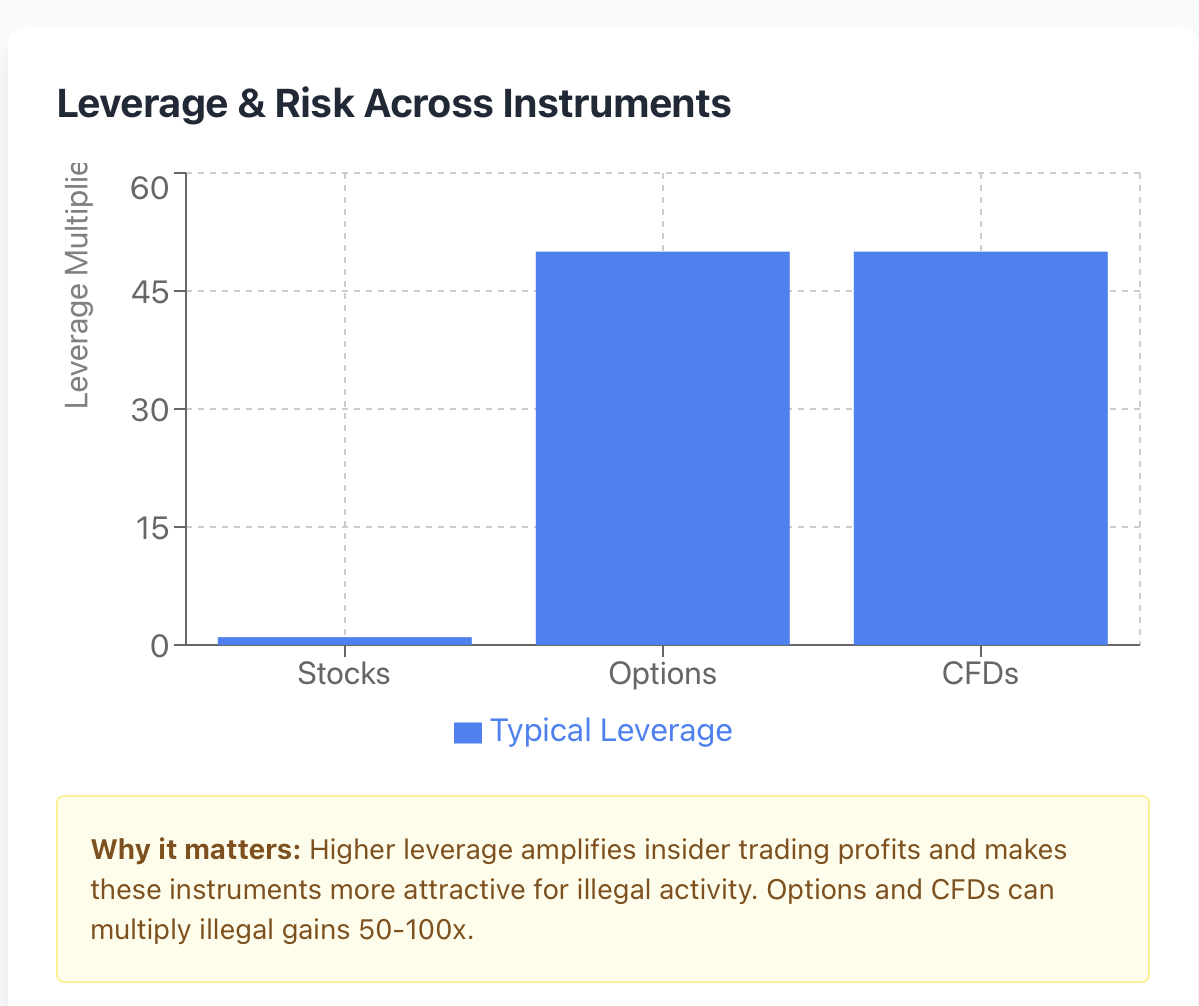
Insider trading can be very different depending on whether you're trading stocks, options, or CFDs. Each instrument type presents its own risks and attributes. Equity markets provide us with the most straightforward type of insider trading, where someone buys shares prior to good news or closes the position before bad news. The person's profit from insider trading is equal to the number of shares purchased multiplied by the change in price. This is relatively simple math, but it's much easier to track because direct stock purchases require disclosure to a brokerage account and then the SEC through filings.
In the options markets, this provides a different issue altogether. A call option price may only be $2, but that call option represents control of $100 worth of stock. Thus, you have a leverage of 50:1. This leverage of 50:1 means that insider information would provide such outsized returns on a comparatively small risk. Put options have the same dynamic but operate in the negative information context. Options traders, because of this leverage, are, as a general rule, the instrument of choice for practitioners of insider trading who want to maximise their illegal advantage. The SEC pays particular attention to unusual options trading, especially if it leads to sizeable option positions at out-of-the-money strikes, which only have value should a stock move substantially in either direction.
CFD and derivatives markets provide enforcement challenges because the majority of the markets operate offshore with reduced scrutiny and oversight. Contracts for difference (CFDs) provide investors with a means to speculate on price movements in either direction without holding the underlying assets. The leverage can range from 10:1 to 100:1 or greater. An insider with $10,000 in their account and 50:1 leverage can control $500,000 worth of exposure. If the insider acts on their information and the information is confirmed, they will multiply their gains, directly corresponding to the exposure.
Regulatory regimes matter too. Markets in the United States fall under the SEC jurisdiction and have stringent requirements for reporting and significant penalties for abuses and fraud. Markets in Europe are regulated under MiFID II. In Asia, regulation varies significantly, not only compared to the U.S. but also between markets in Asia. CFDs are often traded from jurisdictions with looser regulatory concerns and regulatory scrutiny, making it difficult to determine if illegal or manipulative actions are occurring.
The framework of legality also treats these instruments differently. Corporate insiders must disclose their stock trades using Form 4. Options and derivatives exist in more of a grey area, depending on the specific contract and jurisdiction. Some countries simply ban CFDs because of the potential for abuse and manipulation.
Understanding these differences will provide you with the ability to assess risk across your full portfolio of instruments. A stock that shows suspicious activity will frequently also have an unusual flow of options. CFD platforms may also provide asymmetric pricing around significant announcements. By being aware of patterns across instruments, you will have greater protection against manipulation.
The Psychology of Breaking the Rules
What compels people to risk jail and personal bankruptcy to commit insider trading? Understanding the psychology will allow us to understand the behaviour and to be vigilant about the risks.
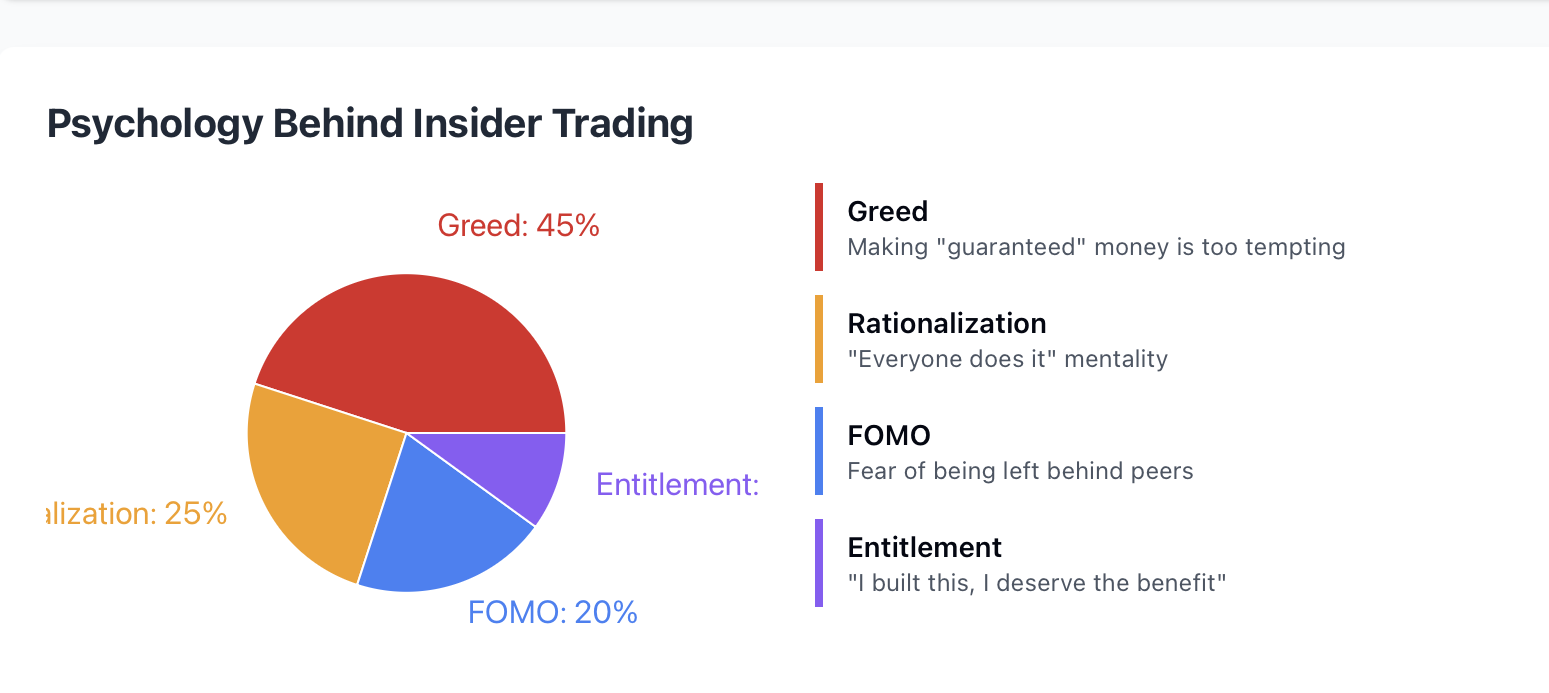
The number one motivation is greed. The prospect of making money with essentially no risk is just too tempting to some people. When you know for a fact that a stock will rise by 30% tomorrow, it is extraordinarily hard not to bet every last dollar you have on the stock. The rational part of the brain turns off as the person can only consider the upside of the investment while ignoring the downside.
Right behind greed is rationalisation. Insider traders convince themselves that they are not harming anyone. "The stock was going to go up anyway." "I am just getting in a little early." "Everybody does it." All of these justifications allow people to break the law while still thinking of themselves as good people. They lessen the infraction to themselves while maximising the rewards of that infraction.
Finally, fear of missing out drives behaviour too. Somebody else sees a colleague or competitor making huge returns and feels like they are always going to be behind. It is very hard to resist the urge when your colleagues and competitors are competing. It is human nature to want to compete and outpace one another in the world of finance. We see this behaviour in cultures that promote winning and sidestep how that win or great score was achieved as a virtue to be celebrated.
The ownership of information provides a sense of entitlement. People who have put in hard work to attain roles in leadership sometimes believe they should reap the financial rewards associated with having access to that information. "I built this company, so I should benefit from being in the know", is their rationale. The line that distinguishes compensation that is acceptable versus illegal trading gets muddled - at least in their mind.
When your normal investor discovers what they believe to be insider trading, reactions by the investor run the gamut. Some investors immediately freak out and sell out of fear that they are on the wrong side of the transaction. Some investors attempt to backtrack what insider information could be and buy into the transaction. The smart investors will take a step back, objectively evaluate the situation, and make decisions based on the fundamentals of that company rather than an assumption of what might be illegal trading to follow.
The psychology of a regular investor is similar to that of a student who finds the answer key for the test before going to class. The rush of exhilaration, the rationalisation that it may not be cheating, and the paranoia that some students may have seen wrong on the answers. Eventually, the professor finds out about the cheating,, the consequences are applied.
Global Laws and Penalties for Insider Trading
Regulations surrounding insider trading vary significantly across different countries. However, there has been a general trend towards stricter enforcement internationally.
The United States has some of the strictest insider trading laws in the world. The SEC can file both civil and criminal cases surrounding alleged insider trading. Civil penalties can be up to three times the profit gained or avoided loss. Criminal penalties can be up to 20 years in prison or up to $5 million for individuals or $25 million for corporations. In many cases, the SEC identifies suspicious patterns based on advanced data analytics and surveillance technology that are increasingly making turning below the radar less and less possible.
The European Union has introduced uniform, harmonised laws surrounding insider trading through the Market Abuse Regulation (MAR). The different criminal penalties for insider trading vary from country to country, although many of these penalties are substantial prison sentences and fines. Furthermore, the European Union believes in both deterrence and the maintenance of market integrity. Certain countries, like the UK, Germany, and France, actively bring prosecutions for insider trading, but the intensity of enforcement differs. The UK FCA (Financial Conduct Authority) has been particularly aggressive in the last few years when assessing cases of insider trading.
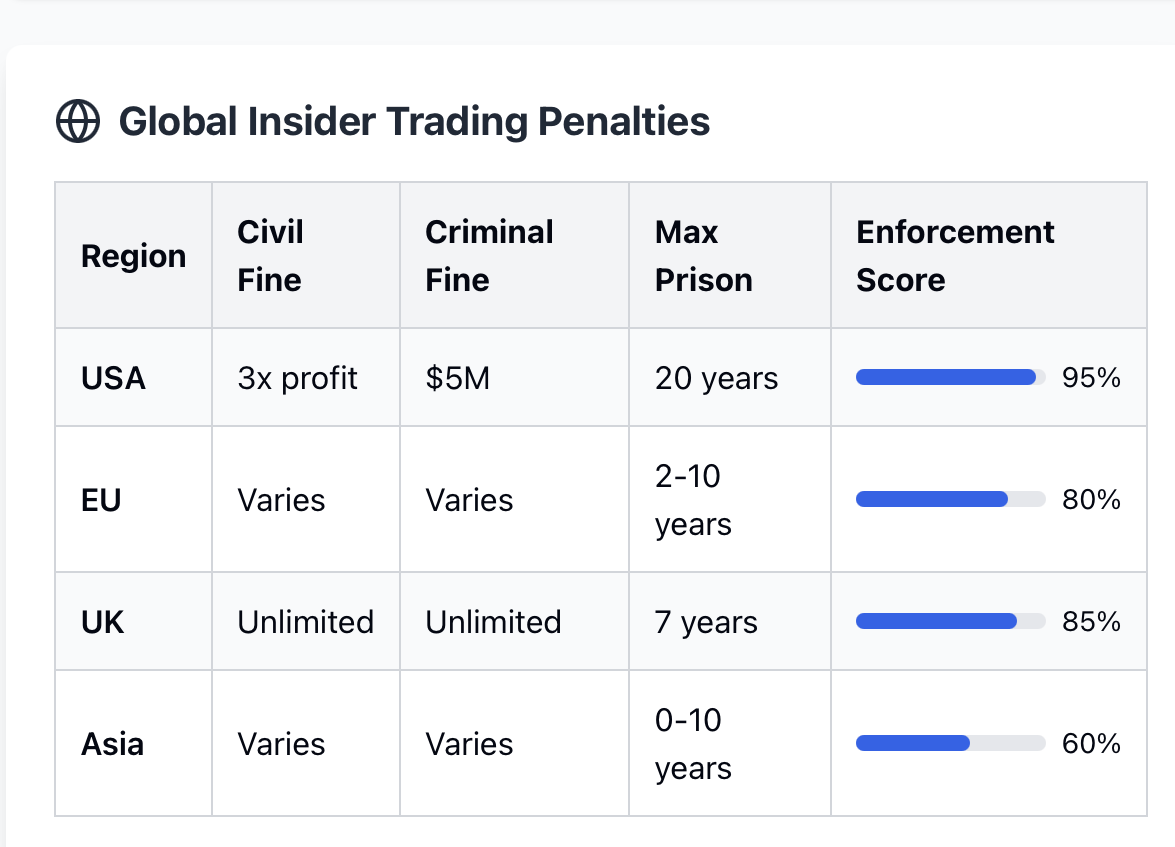
Developing countries offer more variety. Some nations do not have statutes in place regarding insider trading or seldom put them into action. Other nations are rapidly strengthening rules to gain foreign participation and bolster credibility in their markets. China has increased its enforcement activities significantly, though outcomes can be impacted by political connections. India's SEBI, or Securities and Exchange Board, has become significantly more aggressive in prosecuting allegations. Singapore has stiff rules and penalties to further secure its status as a financial hub.
Technology is changing the game as well. Machine learning algorithms scour billions of trades for patterns of suspicious activity. The SEC's Market Abuse Unit uses AI to reveal connections in insider trading networks and coordinated trading schemes. Social media monitoring targets people who cannot help but brag about making a profit. Phone records and emails provide evidence of information sharing. The time of behind-the-scenes insider trading through anonymous tips and payphones has come to an end.
Recent developments indicate tougher penalties and broader definitions for insider trading. Regulators are focusing not only on primary insiders, but also on their networks of individuals who receive and act on the tips. Some jurisdictions have softened their "personal benefit" requirement, which has permitted prosecutions. International cooperation has enhanced, allowing regulators to monitor suspicious conduct beyond their own borders. The message is clear: enforcement is becoming stronger, it is harder to conceal misconduct with technology, and the penalties are severe enough to ruin lives. The risk-reward calculus is more weighted toward staying compliant with the law.
Protecting Yourself from Insider Trading Risks
While it's impossible to control the actions of other actors in the marketplace, you can establish parameters for yourself concerning illegal conduct and mitigate the risks of being victimised.
Educate yourself about public information. Take the time to read a company's filings, earnings reports, press releases, and analyst reports. While those decisions may not always be prudent, using this available information is generally legal. If someone approaches you with "material, nonpublic information" about a company,, this would be considered a red flag and not a reason to consider making an investment or trading decision.
Use your monitors and alerts to your advantage in assessing unusual activity. Use alerts for changes in volume that are above average for your securities. You may want to compare your stock alerts with options activity and whether that activity appears suspect or not, i.e., options purchases well in advance of earnings releases or purchases of significant volume accompanied by purchases of puts or calls.
Avoid dark, opaque situations that create an information asymmetry that will benefit one person over another. Generally, very thinly traded stocks with little analyst coverage will create a trading environment associated with manipulation at the underbelly of public trading. There may also be reason to additionally scrutinise securities and professionals associated with companies whose governance or insider trading records are spotty or have a dismal history. In conclusion, focus your efforts on trading liquid securities and opening yourself to the realities of a well-covered stock, regional, or industry-based securities will give you better protection from manipulative activity engaging in public trading.
Continuously educate and inform yourself about regulations associated with public trading and enforcement histories. Subscribe to and follow SEC enforcement releases. It is not so important to understand the minutiae of the specific regulations in order to develop an understanding of what unlawful trading activity might look like. If you understand how a scheme works, you are in a better position to avoid engaging in the conduct.
Question anything that is outside the norm, or any suggestion of opportunity. If someone recommends a trade based on private (non-public) information, immediately decline and consider reporting it. You need to remember that even though you are not asking for a tip, if you ever trade on it, you could face the consequences of the law. A temporary profit made on inside information is not worth the permanent record of securities fraud.
Keep your own records that include the decision about trades and what information you relied on. If you become implicated in a situation where there are situational cues for possible insider trading, written documents showing that you consulted public or legal information demonstrate that you feel appropriate exercisedue diligence when deciding to trade. When documenting your trading, simply note the sources you studied, the analysis you made, or the reasons for trading.
If you suspect a violation of securities laws or regulations is happening, report it to the SEC on its online reporting portal. The SEC's whistleblower program allows knowledgeable individuals to report suspected violations entirely anonymously. Whistleblowers can receive anywhere from 10-30% of any monetary sanction that exceeds $1 million. The whistleblower program has paid hundreds of millions importantly to those who reported violations of securities law and regulation.
I am not trying to encourage you to be paranoid, but to exercise reasonable caution. The vast majority of market participants play by the rules. If you proceed to exercise homework and remain vigilant for indicators of potential wrongdoing, and responsibly choose not to participate in potential misconduct, you will protect yourself from harm, discouragement, and negative legal consequences.
Looking Ahead: The Future of Insider Trading Enforcement
While it is not correct to say that insider trading will completely stop, its operations and surroundings seem to be rapidly moving towards enforcement and investigation of insider trading rather than avoidance or evasion.
Regulators are currently more capable than they have ever been, and law enforcement may soon have further improvements with artificial intelligence and big data analysis to uncover abnormal and often unlawful patterns of insider trading. With machine learning, trade data can be evaluated in real time as well to highlight patterns of trading that humans may overlook. Natural language processing can read not just the news but also social media and company communications to search for signals that information was leaked. This technology will continuously improve, making insider trading less successful over time.
There is an increase in regulators cooperating across borders. The SEC is now able to work with foreign regulators, has cross-border sharing agreements to inquire about foreign involvement in trading, and tracks potentially suspicious activity throughout international markets. There may be fewer protections for foreign accounts and foreign brokers than there have been historically. The net around those still engaging in insider trading within complex networks is tightening.
There has been a cultural change within finance, sometimes even related to social media pressure, making the risk of insider trading less accepted by market participants, even if detection risks are low. Compliance training norms that emphasise legal obligations have been broadened to also include ethical obligations. Companies are developing more stringent internal controls for potential information leaks. Finally, the risk of reputational harm involved in agency or family insider trading scandals is now a significant motivator for firms to avoid reputational harm and also to keep a check on employees engaged in illegal insider trading.
Regulatory practices are increasing the definitions of insider trading and culpability from a legal liability perspective. Prosecutors will have to show less and less related to the state of mind and personal benefit. Additionally, the number of people who can be charged expands further away from simply the source of the information. In each case, a punitive range increases as authorities attempt to ensure crime does not pay off, even for the most sophisticated actors.
For investors, the trends create a more efficient, fair market over the long haul. To the extent that enforcement practices are bettered, the benefits of information advantages derived from illegal activity should become rarer and rarer, leading prices to better reflect fundamentals. The profitability of the outcome will be vastly reduced over time.
The takeaway is simple: know what insider trading is, know where the line is between legal activity and illegal activity, look for "red flags" in your own activity, and comply with insider trading laws as well as uphold them. It may be tempting at some point to "cheat" the system, but the consequences are more severe and detection is more likely than ever before. Smart investors do not create wealth in the effort of a lightning strike - they do it through research, analysis and patience. They do not create wealth in the efforts of "cutting corners" based on illegal activity that more often than not goes poorly.
Market integrity relies on the decisions of millions of individual market participants to follow the rules. Your commitment to ethical trading supports a financial system that works for everyone, rather than just those willing to break the rules. That is not just good compliance. It's good investing.
Ready to trade with confidence and integrity? Stop second-guessing suspicious market moves and start building a portfolio based on solid research and smart strategy. Bookmark this guide, share it with your trading network, and commit to being the kind of investor who succeeds without shortcuts.
Disclaimer: The content of the blog does not represent any position of Trade W, does not serve as any trading-related decision advice, and does not endorse any third-party.