

 Trade W

What is an In-the-Money (ITM) Option?
The term "in-the-money" is basically the entry point into options trading. An in-the-money option (ITM) is an options contract that already has value at the time that it is opened. If this same action took place now, then you would make money if you were to exercise that particular option.
An in-the-money option has a different definition based on its type. An option is classified as ITM if the underlying stock price is above the strike price for call options. For example, your call option has a strike price of $150, and the stock is currently trading at $160; therefore, your call option is ITM by $10. Opposite in this scenario for put options, if the stock price is below the strike price, then your put option is ITM.
You can relate ITM options as if they are an actual "discount voucher," and you have a value added to your options contract at the time it is opened. The intrinsic value is what separates the ITM options from both ATM and OTM.
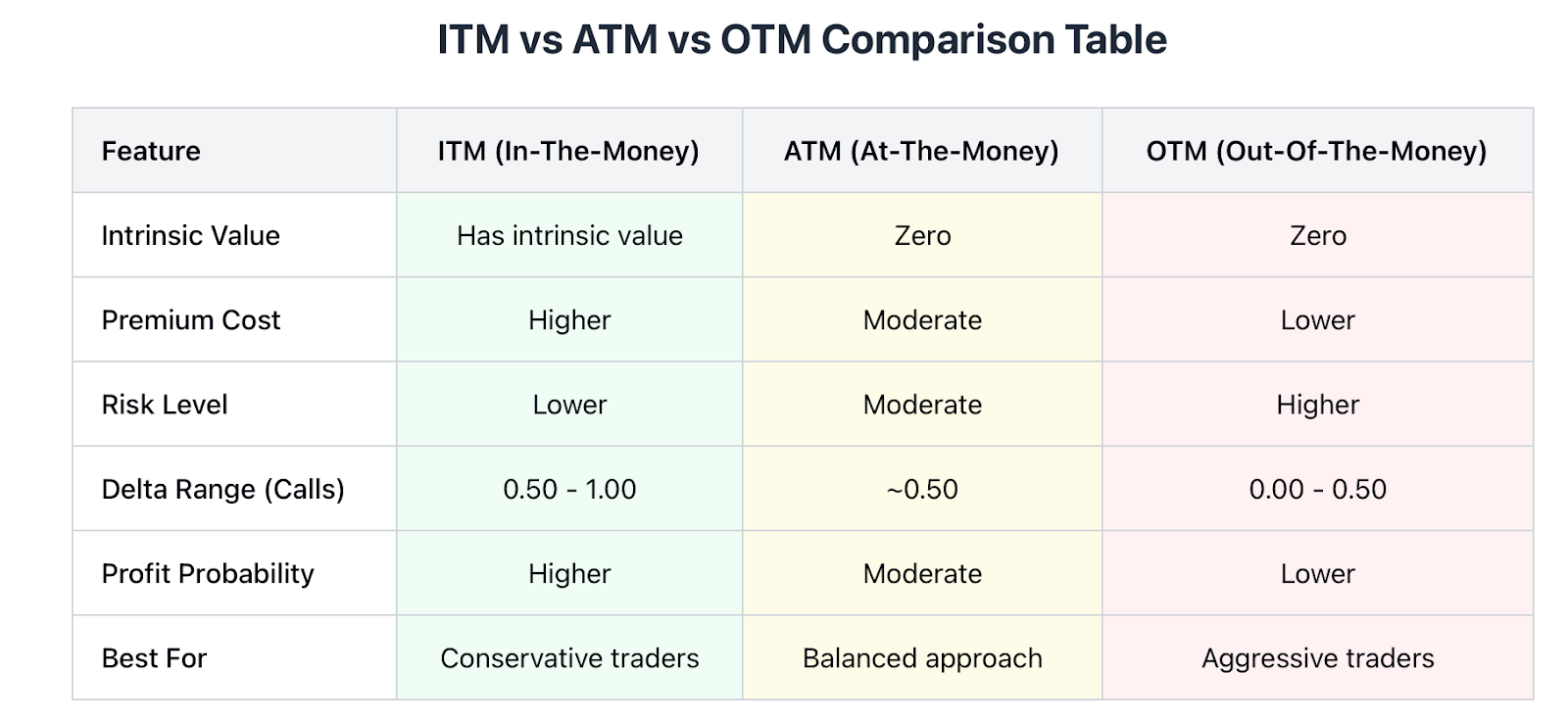
An ATM option is essentially a nominal value equal to the stock price when it was traded (hence the term), while an OTM option has no intrinsic value call options are priced greater than the stock price, and put options priced less than the stock price, so OTM options are generally cheaper than the ITM options, yet pose a higher risk because they require substantial movement to become profitable.
An ITM option is similar to having a "head start" in that the option holder has a real opportunity to earn money without relying on a large price jump. As such, ITM options have a lower risk level than OTM options; however, their higher pricing usually will require a more risk-averse investor.
As an example of the above, let's look at Microsoft (MSFT) on 1/1/26: At the time, MSFT was trading at approximately $445. If you purchased a call option with a strike price of $430, then if you exercised the call option, you'd be $15 ITM since you'd be able to sell for $445 and have bought back in at $430.
Continuing from before: The intrinsic value of the ITM option provides you with profitability; thus, you have the time value for taking options up to the expiration. Therefore, ITM options typically command higher prices than OTM options; nonetheless, they provide traders with a far greater chance of winning trades.
ITM Option Pricing: Breaking Down Intrinsic and Time Value
Every option consists of a combination of intrinsic and time value. Without an understanding of this distinction, you will be acting blindly.
Intrinsic value is the amount of “real” or “direct” profit available to you today with the option you hold. The calculations for intrinsic value are as follows:
- Intrinsic value for calls = Stock Price – Strike Price
- Intrinsic value for puts = Strike Price – Stock Price
For instance, in our example of Microsoft with the stock trading at $445 and you owning a $430 call, you would have an intrinsic value of $15. If you were to exercise the call option today, there is $15 already in the bank for you.
The time value of an option is the additional premium you are paying for the potential that your option may become more profitable prior to expiration. The amount of time left until expiration, the volatility of the stock and the expectations of the market all contribute to how much time value an option has.
The full equation for option pricing is as follows:
Option Price = Intrinsic Value + Time Value
For example, if a $430 MSFT call option is trading at $22, then the intrinsic value of the option is $15, and the time value of the option is $7. The time value represents the market's bet that MSFT could increase in price beyond $430.
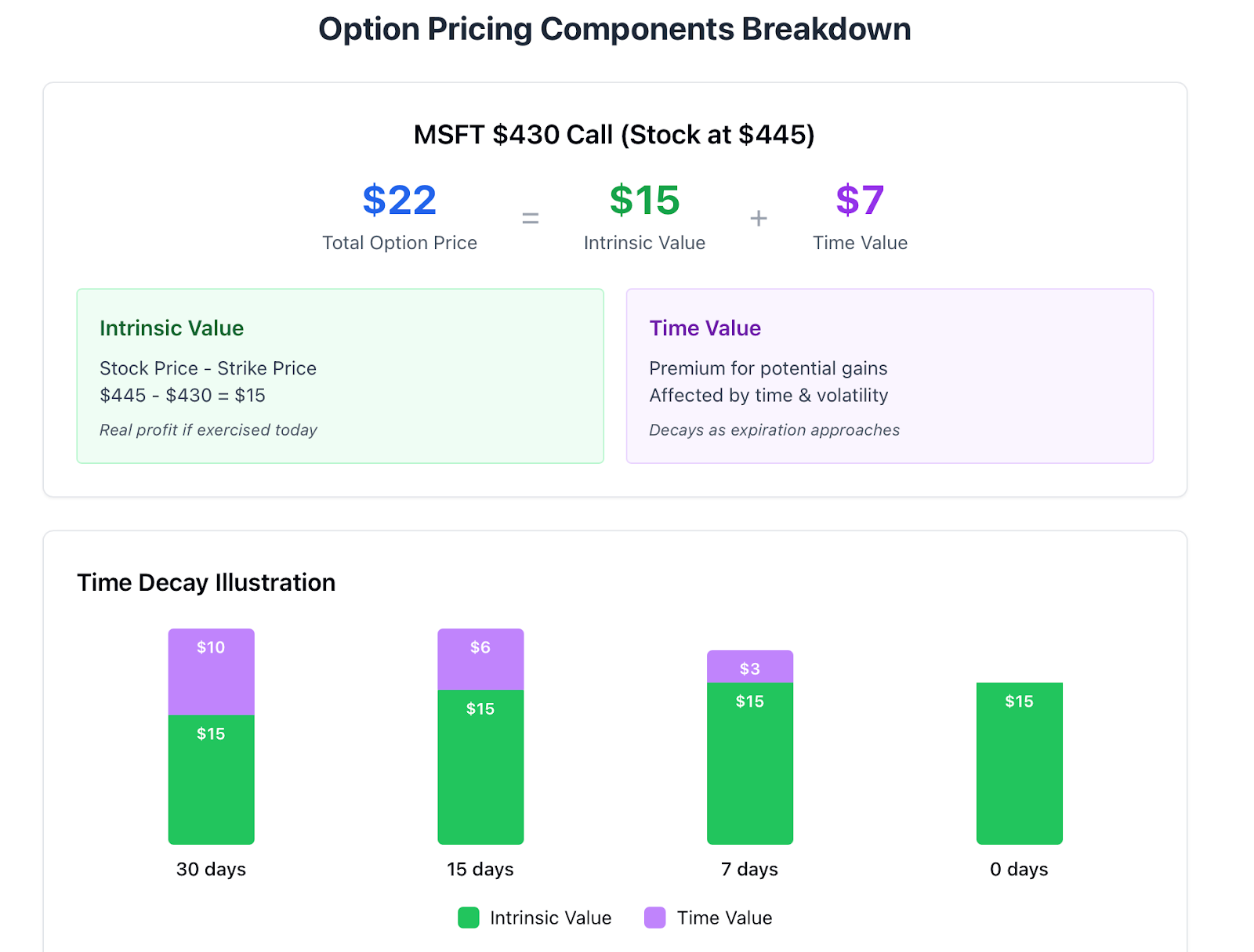
As you get closer to expiration, the amount of time value decreases. This is called time decay or Theta. When you have one month left until expiration for your option, you may have $10 of time value remaining. When you have one week left until expiration, your option may have only $3 remaining in time value. When you get to expiration day, the amount of time value is $0, leaving you with only Intrinsic Value.
Time value is an important consideration for ITM traders. Because you are paying a premium, you will need to determine if that premium is worth it for the time value associated with the option. Deep ITM options will tend to have less time value than shallow ITM options, as there is less uncertainty and a greater likelihood that the option will remain ITM. Therefore, since the market has less to do with hope that a stock will move in your favour, they don't charge you much of a premium for it.
The following example represents how understanding the components of options pricing can help you avoid paying too much for an option.
As an example, let’s say that Apple (AAPL) is currently trading for $235. There is a $200 call option available with 30 days until expiration for $38 per share (i.e., $35 intrinsic value plus $3 for time value). If you look at a $230 call option, it is priced at $11; this option has only $5 intrinsic value but has a greater component of time value because it is located closer to the 50% mark and thus may offer greater upside potential.
By breaking down the pricing components as illustrated above, you can help prevent yourself from potentially making a mistake in paying an excessive premium for your option. A buyer of an in-the-money option with an excessive amount of time value is taking a speculative risk on the price of that stock, making a drastic move. If you are looking for a safer approach, consider buying deep in the money options where intrinsic value constitutes the majority of the option price.
How to Identify High-Potential ITM Options
The process of identifying the proper In-The-Money (ITM) option doesn't simply revolve around deciding on any strike below the current price of the underlying security. You will want to also take into consideration liquidity, volatility and overall strength of the trend as well.
Use the option chain to help find available opportunities. A list of all available strikes and expiries will be found on any broker's desktop or app, showing the strike prices to be found on each contract, along with the respective expiration date, as well as all active volume information and open interest information.
Some characteristics to consider in evaluating contracts:
Liquidity is of utmost importance. The higher the volume and open interest are, the easier it will be to buy and/or sell contracts without suffering from excessive spread losses. If an ITM call has no volume/interest, you will likely have difficulty selling the position after you have purchased it. Ideal volume ranges are at least 100-500 contracts per day for stock and 1,000 or more contracts per day for an ETF such as SPY.
A tight bid/ask spread typically results in a lower cost to enter and exit a contract. A spread in the range of $0.05-$0.15 would be considered somewhat reasonable. Anything that exceeds $0.50 could be costing you a considerable amount of money when entering and exiting trades.
It is critical to also maintain your contracts along with the overall trend that the stock is presently experiencing. If you are bullish on Microsoft, and Microsoft is currently in a strong upward trending phase, ITM Calls will provide you with a leveraged position and further increase your exposure. Conversely, if you are bearish and expect Microsoft to experience some type of corrective movement downwards, this would be an ideal scenario for purchasing ITM Put Options because they provide the opportunity to take advantage of downward movement without requiring as much capital as shorting Microsoft stock would require.
Volatility will have an effect on your decision-making process as well. You want to take into consideration both Historical Volatility (HV) and Implied Volatility (IV) for the stock. If an IV is much greater than normal based upon the HV of the stock, the options premium will be inflated due to excessive time value. Conversely, if an IV is below normal, then options will be less expensive, giving you a better risk/reward ratio. The CBOE's VIX or IV percentiles of each stock can help you establish the IV of a contract.
Let's look at how an actual SPY (S&P 500) screening process would look in January 2026, assuming that SPY is trading at $610 per share. You would want an in-the-money (ITM) call option with an expiration date of February and, therefore, would look at the February expiration option chain.
In this particular case, there is a $600 strike price call option that is trading at $15. This option has an intrinsic value of $10 and a time value of $5. The volume for this option is 15,000 contracts, and the open interest is 50,000 contracts, with the bid-ask spread for this option of $14.95-$15.05. This option is liquid and is fairly priced as an in-the-money option. If you compare the $600 strike price option with the $590 strike price call option, which is being priced at $23, the $590 strike price option is not as favourable.
Comparing the choices available in these two options can be compared to picking fruit at a fresh produce market. You are going to want to choose the "ripe" options when picking an option to buy, the "fresh" options with liquid markets and low spreads, and the "fairly priced" options. The "bruised" options should be avoided; no matter how attractive they may seem in terms of price, do not purchase them!
Delta Explained: How It Drives ITM Option Profits
In the world of In-The-Money (ITM) options trading, Delta is arguably the most important Greek Factor. It shows the extent to which the price of an option changes when the underlying stock moves up or down by $1.
Delta will always have a value between 0 and 1.00 (for Call Options) and between -0.00 and -1.00 (for Put Options). For example, an ITM Call Option has a higher Delta than an OTM Call Option, as shown below:
A Delta value of 0.75 means that if the stock rises $1, your option's value will increase by approximately $0.75. A Delta value of 0.50 is typical of an At-the-Money (ATM) option; hence, for every $1 movement in stock price, the option value would increase by $0.50. Options that are Out-of-the-Money (OTM) generally have a lower Delta than ATM options, typically in the range of 0.20 to 0.30.
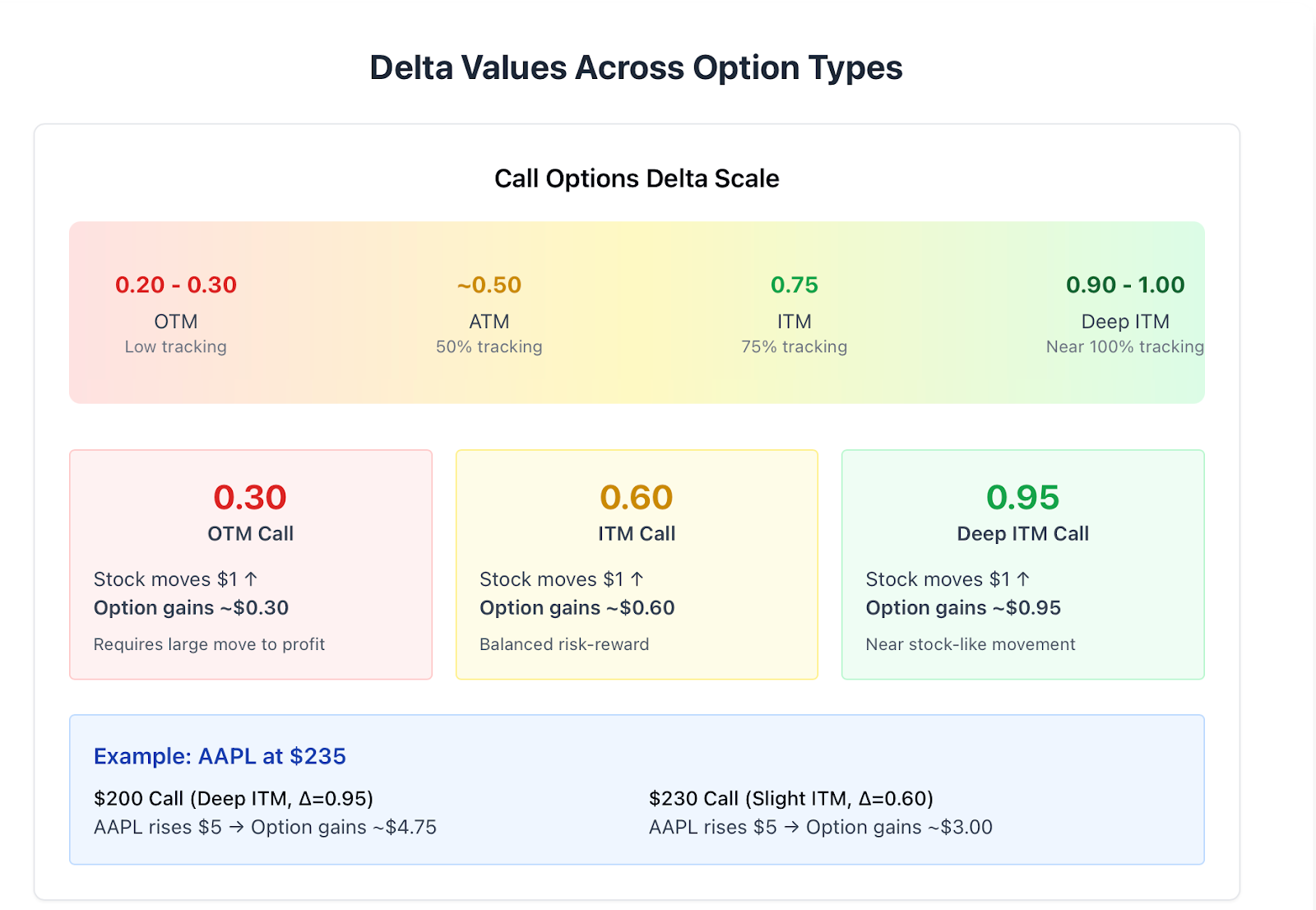
Delta is important for In the Money (ITM) options because as you go deeper into ITM, the delta increases. For example, a deep ITM call may have a delta of approximately 0.90-1.00, which means that it will track nearly dollar for dollar with the stock. Therefore, you can get stock-like exposure to AAPL with much less capital at risk.
Assuming that AAPL is trading at $235, you could purchase a call option at $200 (which is deep ITM) with a delta of .95. If AAPL goes up $5 to $240, your option will be worth approximately $4.75 ($5 x .95). On the other hand, if you buy a call option at $230 (which is slightly ITM) that has a delta of .60, and AAPL goes up $5 to $240; your option will only be worth about $3.
To think about delta like a leverage wheel, the higher the delta, the closer it is to being dollar-for-dollar tracked to the stock. For those ITM traders looking to make directional plays (i.e., they want their positions to profit), it is much safer to have more capital at risk. Conversely, the lower the delta, the greater the risk you must accept for potential returns.
Additionally, delta can also aid traders in sizing their positions and hedging. For example, if you want exposure to 100 shares of stock, but would like to invest less money upfront, you would buy one ITM call contract with a delta near 1.00. This contract would create a position that would move similarly to having 100 shares of the underlying stock, meaning that if you lost the premium you spent for the call, it would be far less than if you purchased 100 shares of stock.
For SPY ETF traders, this approach is powerful! If SPY is at $610 and you purchase a $590 call with a delta of .85 and SPY climbs $10 to $620, then your option gains approximately $8.50. Here, you are capturing 85% of the underlying stocks' move, but spending significantly less to do so.
It is important to note that delta is constantly changing, mainly because of the stock’s price movement - and that is referred to as gamma. As your slightly ITM option continues to be deeper into ITM, the delta will increase. Conversely, as your ITM option moves towards ATM, the delta will decrease. Understanding this can provide insight into predicting the amount of profit you will receive, but also exactly how that profit will change over time.
ITM Trading Strategies: Low-Risk, High-Reward Plays
The following are a few examples of how an ITM Option can help you generate profits with limited risk.
1. ITM (In-The-Money) Calls or Puts: You can purchase ITM (In-The-Money) Calls or Puts if you are bullish on Tesla. If you think TSLA will go up in price, an example of an ITM Call Option is a $380 Call option (ITM) vs. $420 Call option (OTM). Although an ITM call will cost more than an OTM call, and an ITM call has a higher probability of staying profitable at expiration than an OTM call.
2. Protective Puts: You can use Protective Puts to protect against declines in the market. Assume you own 100 shares of AAPL at $235 and wish to protect that investment from losses due to market corrections. You can buy an ITM Put (currently at $240) to protect against downside losses. Selling your stock at $240 is possible regardless of the price decline.
Thus, purchasing an ITM Put allows you to sell your shares even if AAPL's stock price falls below $240. By purchasing this put, your maximum loss is the purchase price of the put, plus $5 per share lost when you exercise your option. This type of insurance provides you with significant protection against portfolio losses.
3. Vertical spread: A vertical spread allows you to reduce the amount of premium you pay on your ITM options. If you want to buy ITM options but not pay the full premium, you have the option of creating a vertical spread. This means, for example, that you buy an ITM option and sell an OTM option (both with the same expiration). By doing this, you create what is known as a debit spread, which allows you to buy the ITM option for less upfront than if you purchased it directly. The disadvantage of this method is that selling the OTM option will limit your potential upside profit.
Suppose SPY is at $610, and you buy a $600 call option for $15 and sell a $620 call option for $7. The net cost of this trade will be $8 instead of $15. If SPY rallies to $625, you will have $12 in maximum profit ($20 wide spread less $8 cost). By entering into this trade, you have reduced your risk by more than half, while still enjoying a substantial profit.
4. ITM Straddles and Strangles: These strategies will take advantage of volatility: You will buy an ITM call option and an ITM put option at the same time in the event you believe there is going to be a large move in either direction. The reason it is so costly to enter into this type of strategy is that you're buying two options that are both ITM. If the stock does have a massive move, one of the options will have a larger payout, while the other option will lose a smaller amount.
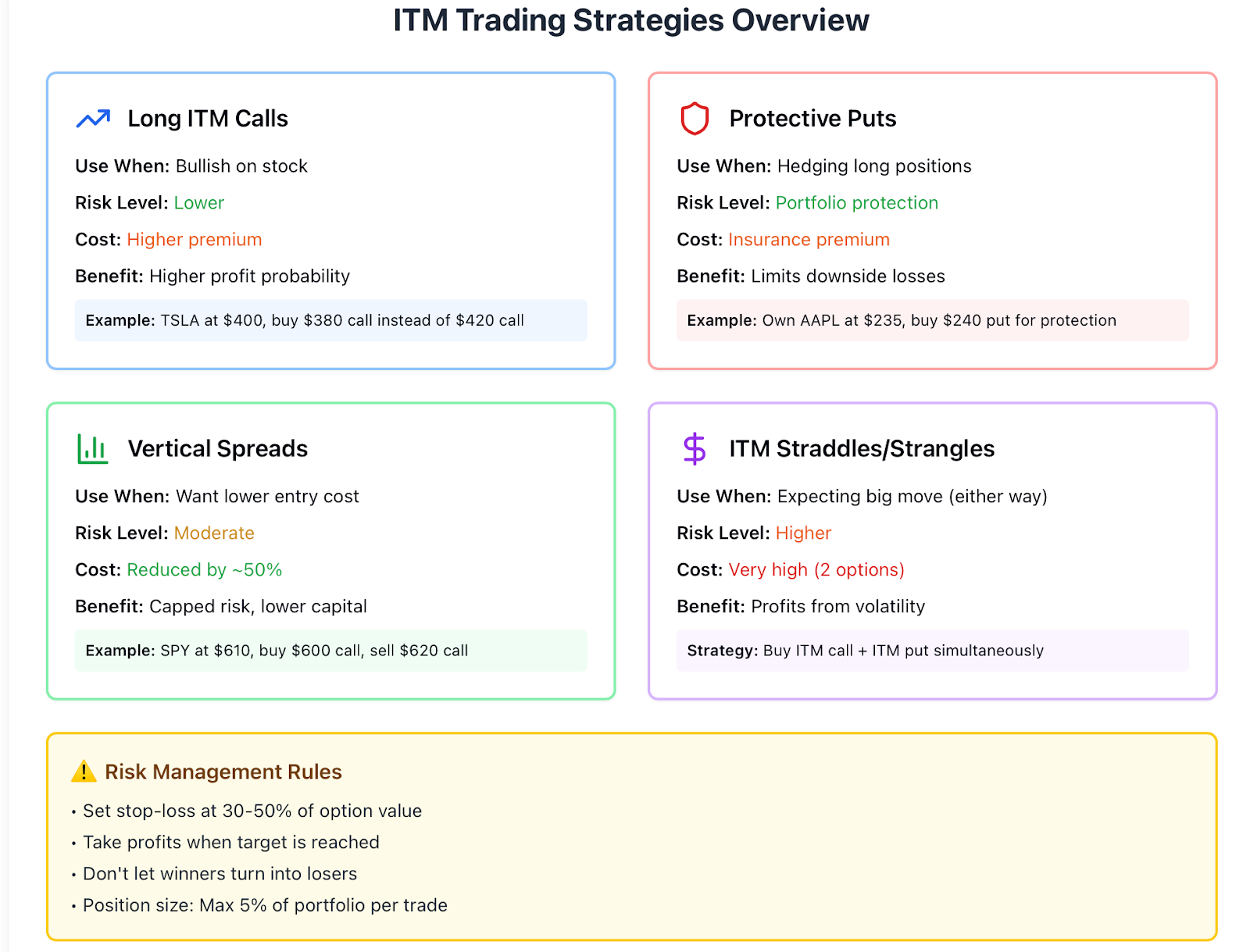
Risk management is your top priority. Regardless of what strategy you choose, you must implement stop-loss orders. A good rule of thumb is to sell your option when it has lost 30-50% of its value. Do not allow winners to become losers; when you meet your profit target, take the profit, even when you feel there may Confluence of Signals additional upside.
Think of it this way: You are purchasing ITM options in advance to get your ticket to see your favourite band in concert. Yes, the ticket costs you more money up front, but it guarantees you will be able to attend the concert. OTM (Out-of-the-Money) options are similar to trying to get last-minute discounted tickets for the same concert; they are cheaper, but you may not be able to get into the concert.
Conservative Hedging with ITM Options
For the conservative investor, ITM options are perfect hedging instruments. They allow you to hedge against your stock portfolio risk, and you don't have to sell your gainers to use them.
How it works is very simple. You purchase ITM put options as a hedge against your stock positions. This is often referred to as a protective put or a married put strategy. You're essentially buying insurance against your downside by doing this.
Let's look at an example. Suppose you own 200 shares of SPY purchased at $610 (which means your total investment in SPY is $122,000). You are concerned about the potential of a market correction, but you don't want to sell your investment. You buy 2 contracts of ITM puts that have a $605 strike price, which expire in 60 days, and pay $10 each for a total cost of $2,000.
Your SPY shares would have lost $30 per share in value ($6,000 loss) if the price of SPY were to drop to $580. However, your two $605 put options would have increased by $25 each in intrinsic value ($5,000 gain). Therefore, your net loss would be $1,000 plus the $2,000 cost of the puts for a total loss of $3,000 instead of $6,000. By purchasing the ITM puts, you have reduced your risk by 50%.
Determining the hedge ratio is also simple: for every 100 shares of stock you own, you should buy 1 put option (the put option will cover 100 shares). If you want to partially hedge your stock position, you can buy less than 1 put option for every 100 shares you own—perhaps 1 put option for every 200 shares you own would work.
The downside to hedging your stock positions with ITM put options is the cost. Due to the intrinsic value of the puts, they are relatively expensive, which means you are paying a premium for peace of mind. It's similar to buying home insurance in that you hope you never need it, but you feel more at ease knowing it's available.
Comparing the two: If you do not hedge with ITM puts and the market drops by 10% (which means your $100,000 portfolio would lose $10,000 in value), you could expect to lose $4,000-$5,000 from the market drop, taking into account the $2,000 cost of the ITM puts. This is incredibly different when a bear market exists.
One mistake that conservative investors should avoid when hedging with ITM puts is over-hedging. If you purchase too many ITM puts with a strike price that is too far in the money, you will be taking away your upside potential because of the premium cost associated with the purchase of the puts.
Reducing ITM Trading Costs: 3 Advanced Techniques
ITM options can be costly, so I am going to demonstrate several methods of obtaining comparable ITM benefits while avoiding high costs and improving risk-reward ratios.
Technique 1: Vertical Spreads. Instead of buying an ITM call option outright, buy the ITM call option and sell an OTM call option. Doing so will provide you with capped upside and significantly reduce the cost of entry into the position.
For example, if AAPL is trading at $235, and an AAPL $220 call option costs $20, and an AAPL $245 call option sells for $6 each, by buying an AAPL $220 call option and selling an AAPL $245 call option, your net cost would be $14/position. If AAPL goes to $250, you would receive a profit of $11 on your vertical spread (the difference between the $25 spread width and your net cost of $14) instead of receiving a $30 profit on the naked call option, and you would be at risk for $14 instead of $20.
Technique 2: Staggered Entries and Rolls. Do not put your full capital into an individual trade. Rather, you should purchase half of your shares now (equally dividing them) and add to them when the price moves in your favour. This will provide you with an average entry price and lower the risk of timing. Rolling has a very similar concept.
If you have a profitable ITM option that is approaching expiration, you can 'roll' it forward by selling the current ITM option and buying a longer-dated covered call position at equal or better strike prices. This will allow you to lock in your profits and maintain an open position in a longer-dated expiring option.
Technique 3: Optimise the Time Value of Your Position by Selecting a Thoughtful Expiration. Avoid overpaying for time on your ITM option. If you are actively trading ITM options, you typically do not need to obtain a 90-day expiration unless you are anticipating a long, gradual trend. You should focus on obtaining expirations in the 30-45 day range to obtain a reasonable balance of time value, cost and flexibility. The amount of time value lost with deep ITM options is smaller than that for shorter-dated ITM options; shorter-dated ITM options are often preferable.
Think about cost optimisation when selecting your airline ticket purchases. Instead of paying all of your travel expenses up front, you should use batch purchases to save money on both short and long-distance travel plans by capturing the ticket prices at the lowest point in time.
Advanced ITM Techniques: Greeks and Portfolio Management
When you understand the basics, you will want to learn about the Greeks: Delta, Gamma, Theta and Vega.
Delta: Delta reflects your directional sensitivity, but Gamma informs you how quickly the Delta will change.
Gamma: When you have a high Gamma, this means the Delta's shift will occur rapidly, as stocks move with ATM options. When you have a low Gamma, the Delta is stable (deep in the ITM).
Theta: Theta measures time decay. ITM options will have less Theta when compared to OTM options, because ITM options have the majority of their value in time. theta will continue to chip away at the value of ITM options if held for long periods (weeks).
If implied volatility increases, you will realise an increase in the price of your option. If implied volatility decreases, even if the stock does not move, you will lose money. ITM options will have a lower Vega when compared to ATM options.
You can use multiple contracts your return simultaneously, for example: You purchase an AAPL $220 CALL option (ITM) and sell two AAPL $240 CALL options (OTM) - this strategy is called a ratio spread. You are long one ITM call and short two OTM calls. If AAPL trades between the $220 -$240 range, you will capture the time decay on your short calls. If AAPL rallies above $240, your profits are capped, but you will still profit.
To successfully use these strategies, strict risk management must be applied. Establish position limits. Do not risk more than 5% of your portfolio on one trade and consistently use stop-losses. Monitor your Greeks daily to avoid the surprise of an adverse move.
To manage your portfolio, think of it as a baby diet with stocks (protein), options (fats for flavour and energy), and cash (carbohydrates for stability). Any excessive intake of one will create an imbalance.
Ready to put ITM options to work? Head over to Tradewill.com and open a demo account to practice these strategies risk-free. Our platform gives you real-time option chains, Greek calculators, and strategy builders to sharpen your edge before putting real money on the line.
Disclaimer: The content of the blog does not represent any position of Trade W, does not serve as any trading-related decision advice, and does not endorse any third-party.