

 Trade W

Hundreds of thousands of people start trading digital currencies every single week, take that first leveraged position with a lot of enthusiasm, but not much knowledge about what they’re doing. It’s easy to become excited at the notion of using $100 to control a position worth $10,000 and making a 10% return by simply making the price move by 10% against you.
These traders quickly learn that the same math applies to a loss; you can lose $1,000 when you don't have sufficient margin in your account to maintain your position. It’s precisely this lack of knowledge of how leverage works in crypto markets that consistently results in traders being liquidated.
Leverage is one of the most powerful tools in our financial system, and leveraged trading of cryptocurrencies can provide some of the fastest opportunities; however, if you don’t learn the mechanics of leverage, you will eventually lose all of your money.
This guide will help you understand how leverage works, why traders get liquidated, what happens between the successful and unsuccessful traders, and how to develop the discipline necessary to successfully use leverage. It doesn’t matter if you are a beginner in trading or a trader who has just suffered a major disadvantage; this guide is for you.
Traders utilise leverage trading to increase their position size significantly for trading cryptocurrency without having to put up large amounts of their own capital by borrowing from a broker or exchange. For example, with 10x leverage, a $100 deposit can control a single $1,000 trade. Therefore, not only does leveraging increase your profit potential, but it also increases your potential loss as well. If the market moves against you to a large enough degree, your position will be liquidated regardless of what you wanted to do.
What leverage trading actually means and why it's not magic
Leverage is the borrowed money used by traders to execute trades greater than they could afford from their own funds. For example, if you deposited $200 into a trading account and then traded using 10x leverage, your total position size would be $2,000. Therefore, that would mean, by using your $200 as collateral, the specific exchange would effectively loan you the $1,800 difference.
Your profit or loss will be based on the total position size of $2,000, not just $200. Thus, you can see why so many traders are attracted to trading on leverage. A 5% increase in the price of a $2,000 position will generate $100 in profit, which represents a 50% return on the initial $200 that you had in your trading account. However, without the use of leverage, a 5% increase in price would produce only a $10 return.
You need to understand four terms before placing any leveraged trades. They are margin, leverage ratio, initial margin, and maintenance margin. Margin is the amount of capital you are putting up as collateral for a trade. The leverage ratio is the multiplier that is applied to your margin. The initial margin is the minimum amount of capital you must deposit to open a position. The maintenance margin is the minimum balance that you are required to maintain in your account before an exchange will close your position automatically.
You have the opportunity to take either a long position or a short position. In both instances, the use of leverage will magnify the ultimate result you get from the activity in the market.
For example, you have $100 of your money in combination with a 10x long leverage contract on bitcoin at $60,000 USD price, your effective position is $1000 USD. If Bitcoin increases by 8% in value to a price of $64800, your profit will be 80% on your $100 margin.
If, instead, the price of bitcoin dropped by 10% to a price of $54000, your $100 will be completely lost, and the exchange would have automatically liquidated or closed your position.
How crypto leverage mechanics actually work: margin, liquidation, and the numbers behind it
Liquidation price is defined as the exact price point that your exchange will use to close your position to make sure that your losses do not exceed the margin you deposited. Knowing the location of your liquidation price before starting a trade is mandatory; this is the most important calculation you will make.
As an example of the math behind it. You deposit a total of $500 and enter into a long position in Ethereum using a leverage of 20 times your deposit. The size of your long position becomes $10,000. If Ethereum decreases in value by 5%, you will incur a total loss of $500, or your entire margin. This will trigger the closure of your position by the exchange. There will be no prior notice, and the system will automatically close your position when your maintenance margin balance is exceeded.
Exchange uses one of two different margin systems: Cross Margin and Isolated Margin. With Isolated Margin, only the funds you've allocated to a specific transaction are at risk. Therefore, the rest of your account balance would remain intact in the event of which you are liquidated.
In Cross Margin, the entire balance of your account can be used to provide collateral for all of your open positions and maintain the protection of liquidation. However, if you have multiple open positions, the total margin amount can potentially be lost if any or all of your trades become unprofitable.
CRITICAL MECHANIC
An account will not be liquidated because you have a zero balance; this will occur when the account has gone below the maintenance margin. Exchanges will also have built-in protection so they can fund their own exposure by liquidating positions before they are closed. You will lose more than anticipated when you are liquidated because of your position going into a negative balance.
Funding rates represent yet another can often overlooked by most new traders. Perpetual futures are a market where winning traders periodically pay losing traders and vice versa for making trades. So if you have a leveraged long position open and the funding rate is positive, then you will incur fees every few hours to keep that position open. As these fees will reduce your margin, this can happen without you suffering any price movement in the underlying asset.
How leverage multiplies outcomes: the numbers that change everything
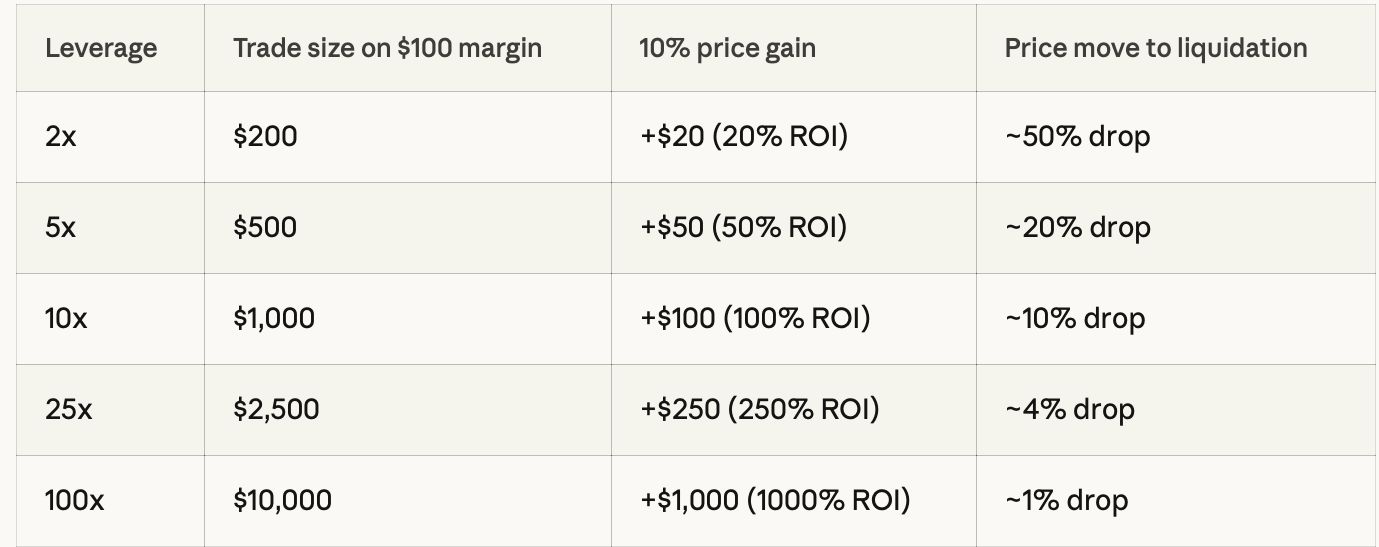
That table illustrates visually how, as you increase leverage, the margin for error decreases drastically. One per cent adverse movement on a position leveraged 100x will result in the loss of your entire margin. With the volatility of Bitcoin, it often moves by 1% within a short period of time; therefore, at 100x, you could lose your position before you finish reading this paragraph.
While the profit increase looks impressive on paper, high-leveraged risk has an asymmetry that makes it an extremely high-risk situation. You can only gain a multiple of your original margin, but you can lose your entire margin in less than a minute due to a short-lived price spike.
Why most beginners get liquidated, and why it's rarely bad luck
New traders often don’t lose money through the unpredictability of the market but by routinely making the same mistakes across over 1000+ accounts every day. The most devastating way new traders make money mistakes is by using too much leverage right out of the gate.
Companies that offer 50x and 100x leverage do not offer this type of leverage to you as a benefit; they offer these products so that they can generate commission through each trade you execute that is liquidated. These leverages are designed for the company and not you.
A second common mistake new traders make is to enter trades without stopping to consider where their potential losses are going to occur and pre-setting a stop-loss order. When trading leveraged cryptocurrencies, the absence of a stop order means that you are entirely dependent on the cryptocurrency market to behave in your favour. Unfortunately, the nature of the cryptocurrency market is not one of favourable behaviour.
MISTAKES IN TRADING PATTERN
A novice trader has put $300 in their account, opened a 50x leveraged long position on Bitcoin, and has not used a stop-loss because they feel confident in the position. The price of bitcoin dips in value by 2% during a market correction, and after seeing their position's value decrease enough for their account to be liquidated, they deposit again. And only at an increased level of leverage, go through this same sequence multiple times until there is nothing left in the account. This type of trading is referred to as revenge trading and is easily one of the most frequent ways to lose all your money in a trading account.
The third biggest mistake is overtrading. When there is leverage available, it is hard to resist opening several big positions at once. Each time you add a position, your exposure to market risk gets multiplied, and because of the way that the crypto market is correlated, opening multiple leveraged positions will usually just increase your risk. You will not lower it; you will just multiply it.
The fourth mistake is emotional decision-making when you are in an open trade. This mistake is probably the most costly. When a leveraged position moves against you, you become fearful and close too early. When a leveraged position is moving in your favour, you become greedy and will not take profits. Neither one of these is a rational response, and both of these responses produce a worse outcome than using a predetermined plan without any interference.
Risk management strategies that actually work for leveraged crypto trading
Making money in leveraged crypto trading necessitates thinking of risk management before anything else - it is a discipline that must be exercised at all times. Below are some guidelines that will help distinguish between successful and unsuccessful traders.
Begin with low leverage; traders with less than 1 year of experience should be trading between 2x and 5x leverage. This ensures that the price at which the position can be liquidated is so far away from current market prices that your normal doubts about the ability to trade will have time to resolve themselves before your position is actually liquidated. While limiting the amount of profit potential, this approach also limits the rate of failure from mistakes; most of your early trading has been trial-and-error, and you do not want to go bust while learning what works.
Always place a stop-loss order on every position taken before taking the position. You have to be able to determine beforehand the maximum amount of money you are willing to lose on any single trade.
Generally, this should be between 1% and 3% of the overall amount of money you are trading with; therefore, once your margin balance is determined, you can always set the stop-loss at the price corresponding to your maximum allowable loss. By not allowing yourself to suffer large, catastrophic losses, you will never have to try to recover from one.
Position-size must also be taken into consideration. A rule among professional traders is not to risk more than 1% or 2% of your trading account on any given trade. Therefore, if you had $5,000 in your trading account, you should never risk more than $50-$100 per trade.
This determines how large your position can be leveraged based on the price at which your stop-loss order is placed. While this appears conservative, it is the safest way to tolerate a significant number of consecutive losses and continue trading.
Every trade should also have a corresponding risk/reward ratio. You should always be looking to enter a trade with a predetermined profit target, with the profit target matching at a minimum two to three times your risk, or your maximum loss.
Example: if you are risking $50 to make $60, the potential upside is not worth the risk. If you're right on 50% of your trades and your average winning trade is twice your average losing trade, you should show a steady profit over time without realising any large win rate.
Choosing the right leverage level as a beginner
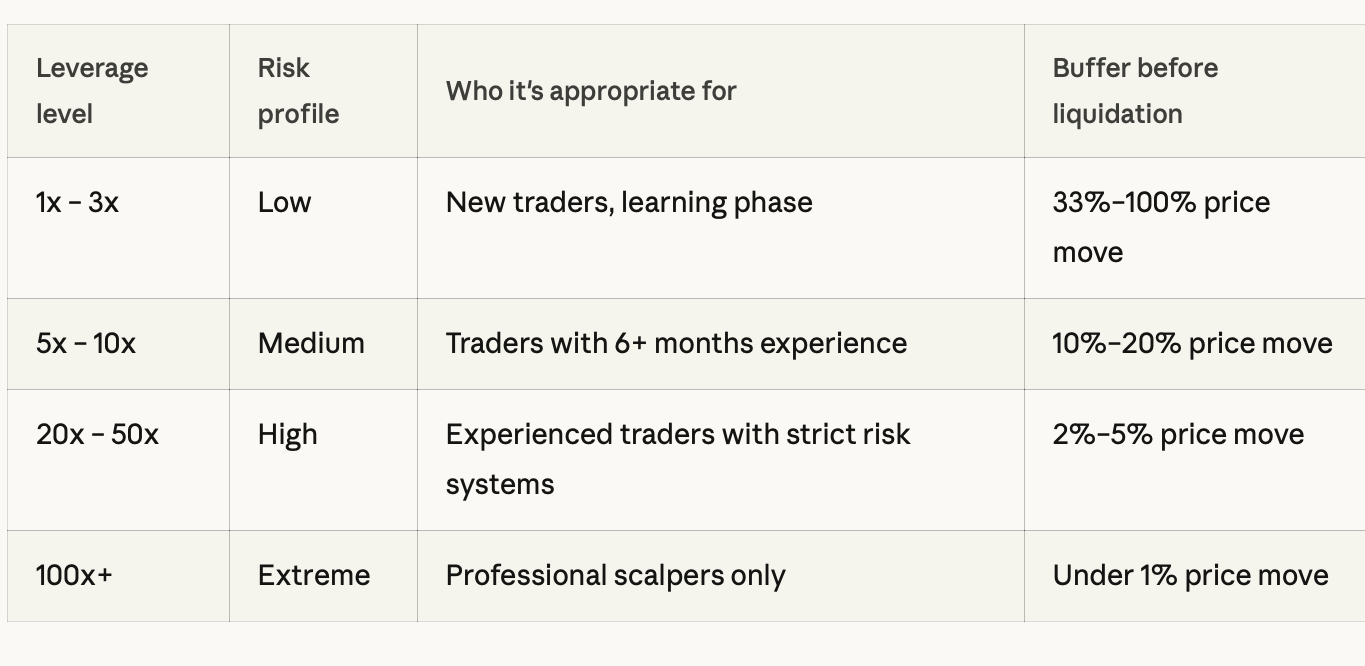
If you’re trading cryptocurrency for the first time, you shouldn't ever use 50x-100x leverage! The distance between using these two different leverage levels is very small, and therefore, small price movements can cause the loss of your total account balance. Using 3x or 5x leverage while you're learning will give you more time to learn what you've done wrong before destroying your account.
How crypto leverage compares to forex and stock markets
The nature of leveraged trading in the crypto markets is fundamentally different from that of the Forex and equity markets, and this distinction has a tremendous impact on how we measure and understand risk. In the regulated forex markets, retail traders can trade with a maximum amount of 30:1 in the EU and 50:1 in the US.
The reason there are limits on leverage is that regulators have observed how higher leverage has consistently wiped out retail trading accounts. The crypto markets, however, are generally less regulated, which is why exchanges can legally offer up to 100x and even 125x leverage to retail traders.
Volatility is an equally important factor in understanding risk when trading. The major currency pairs, such as EUR/USD and USD/JPY, usually move between a range of 0.5% and 1.5% over the course of one trading day in normal market conditions.
Bitcoin alone typically moves between 5% and 15% in a one-hour time period during volatile trading sessions, with other smaller cryptocurrencies often moving 30% or more in the course of just one 24-hour trading period.
Therefore, there is considerably more risk associated with trading the same level of leverage in the crypto markets than there is in the forex markets because the price movements that will trigger liquidation are far more frequent and develop much more quickly in the crypto markets.
In terms of overall volatility, the stock markets will fall somewhere in between the forex and crypto markets. While individual stocks can have considerable volatility, particularly due to earnings reports or other important news events, overall market volatility in the stock market is generally much lower than in the crypto markets.
Lastly, leverage is generally experienced with greater restrictions on retail stock trading in the majority of markets due to regulatory rules, compared to the lack of structure in the crypto markets.
Trading psychology and why leverage makes it worse
Traders often find that the emotional intensity of trading increases dramatically when moving from unleveraged spot trading to leveraged futures. In these situations, every price tick is psychologically weighted with an increase equal to the trader's leverage. Fear, greed, impatience and overconfidence will all be amplified in direct proportion to the level of leverage used.
Fear can lead traders to quickly close profitable positions before they reach their targeted profit. Greed can result in traders holding onto a losing position longer than their stop loss to wait for a reversal that never materialises. Many traders become overconfident after a series of successful trades, increasing their positions as a statistical correction is most likely to occur. Revenge trading after an emotional loss often leads traders back into the market, so embroiled in emotion that they aren't able to make rational decisions.
The only real way to avoid the impact of emotions when trading is by having a well-defined trading plan in writing, outlining the criteria for entering an order, the size of the position, the amount of stop loss and the targeted profit before executing a trade.
The creation of this plan occurs when the trader is completely calm, while executing the plan occurs when the market is moving, and their emotions are running high. If a trader deviates from their plan, they should understand why and whether or not they were justified in their deviation because of new information or emotions. More often than not, it's emotions.
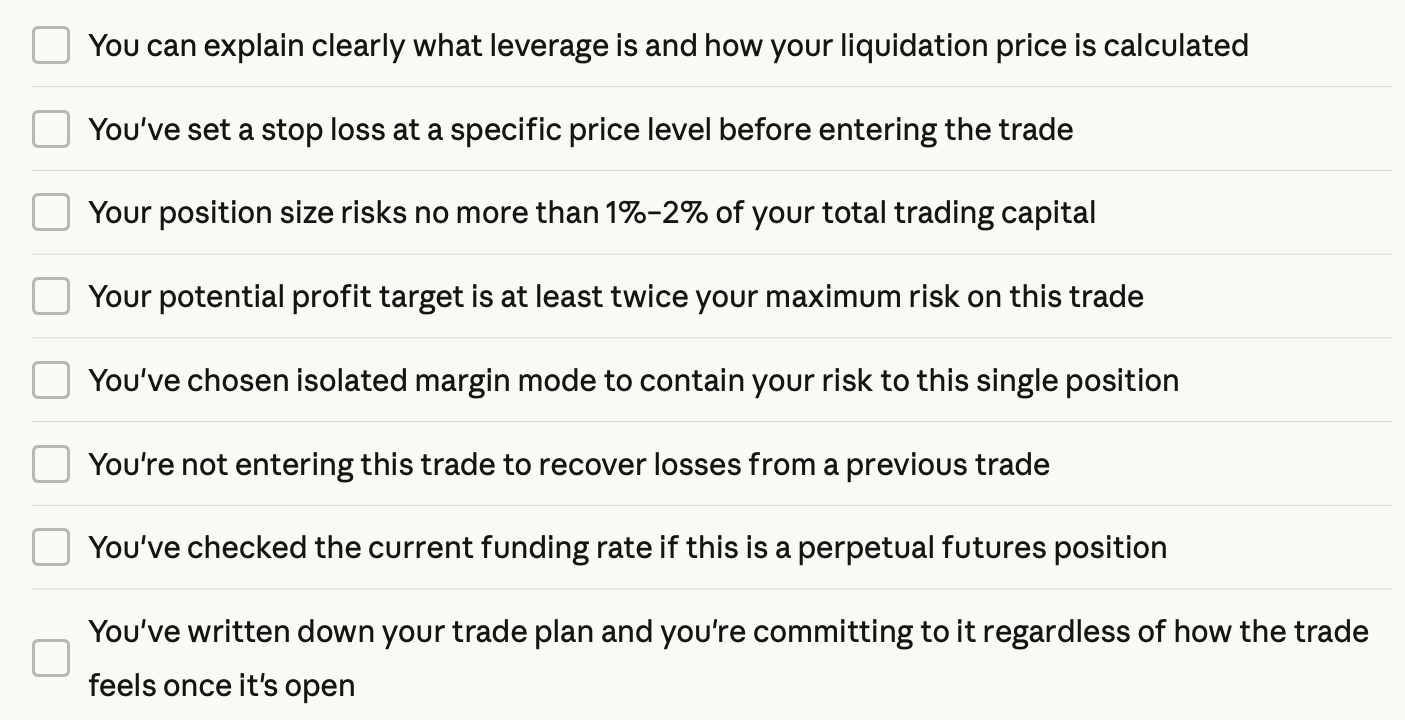
Checklist: before you open a leveraged position, run through every one of these
Practice on a demo account before any real capital touches a leveraged trade
Every suggestion regarding trading in this guide is now tremendously valuable for you to have been able to see it take place within live conditions of trading on your demo account, without risking any of your real funds in order to achieve that kind of learning experience.
Starting a new demo account provides the opportunity for you to simulate your placement of leveraged trades, your stop loss placement, the calculation of your position size, and experience watching the liquidation process take place in real-time while having access to funds that are not real.
While demo trading is not the same as trading with your own funds because of the difference in emotion associated with money that is not yours and money that is yours, the chance to experience the mechanical part of trading will be 100% accurate.
The experience will allow you to validate how quickly a leveraged position at 25x can get to liquidation during a volatile 15-minute price move. The experience will demonstrate the effect of the accumulation of funding. The experience will allow you to determine what your liquidation price is prior to entering into an actual trade.
All of these experiences will come at no cost to you when you are on your demo account, but all of these costs will be incurred by you should you skip this step and move directly to live trading.
The truth about leverage trading crypto
Leverage does not create new market opportunities. It simply increases the existing opportunities and risks. While many traders think of leverage as a quick method to make money quickly, they are often disappointed when they lose their entire investment instead. On the other hand, if a trader uses leverage as part of a disciplined approach, manages risk appropriately and has a pre-defined plan prior to executing the trade, leverage can be an extremely useful tool in their professional trading arsenal.
The successful trader in the long term in leveraged crypto markets is a trader who focuses on protecting their capital first, is willing to take smaller, yet frequent gains, and views losing as merely a cost of doing business rather than as an event requiring an immediate correction. Traders should start small, use very low leverage and increase their knowledge base over months, not weeks, and look at each new position as a test of their ability to exercise discipline and proper decision making as opposed to a test of their ability to read the market.
Frequently asked questions
What is leverage trading crypto?
Leverage trading crypto means using borrowed funds from an exchange to open a trading position larger than your actual capital. With 10x leverage, a $100 deposit controls a $1,000 position. Profits and losses are both calculated on the full $1,000 position size.
How does crypto leverage work mechanically?
You deposit a margin amount as collateral, then the exchange lets you open a position that's a multiple of that margin. Your profit or loss is based on the full position value. When your losses reduce your margin to the maintenance margin threshold, the exchange closes your position automatically.
What is a liquidation price?
The liquidation price is the specific market price at which your exchange will automatically close your leveraged position to prevent losses from exceeding your deposited margin. It's determined by your entry price, leverage level, and the maintenance margin requirement of the exchange.
Is leverage trading crypto safe?
It carries substantial risk, particularly for beginners. Crypto's high volatility means liquidation can happen very quickly at high leverage levels. With proper position sizing, stop losses, and low leverage, the risk can be managed, but it's never eliminated.
What's the best leverage level for beginners?
2x to 5x is the appropriate range for new traders. This keeps the liquidation price far enough from your entry that normal market volatility won't close the position before your trade thesis has a chance to develop. Higher leverage is appropriate only after you've built consistent experience managing risk at lower levels.
Open a TradeWill demo account and experience real leverage mechanics without the real-money risk.
TradeWill's demo environment runs on live market data, so every liquidation, funding rate, and price move you practice with reflects what's actually happening in the crypto market right now.
Disclaimer: The content of the blog does not represent any position of Trade W, does not serve as any trading-related decision advice, and does not endorse any third-party.