
 Trade W
Why Trading Costs Matter More Than You Think
Many traders spend a lot of time creating better entry signals, backtesting their strategies, and looking for perfect setups; however, the successful trader who has been consistently profitable over time realizes that the major factor in long-term performance is not their trading strategy, but rather their cost structure. This is not just a minor detail; it is the main factor that distinguishes accounts that grow in equity from accounts that decline gradually.
The following formula should be the primary focus of all serious traders:
Profit = Gross Market Movement – Total Trading Costs
In practical terms, this means that two traders can use the same exact strategy and enter and exit at exactly the same time, but if one trader's cost from the spread is 0.2 pips and the other’s is 1.8 pips, their respective profit at the end of the period could differ significantly, even though both trades experience the same gross market movement. Their cost structures effectively absorb part of one trader’s profit before it appears on their account statement.
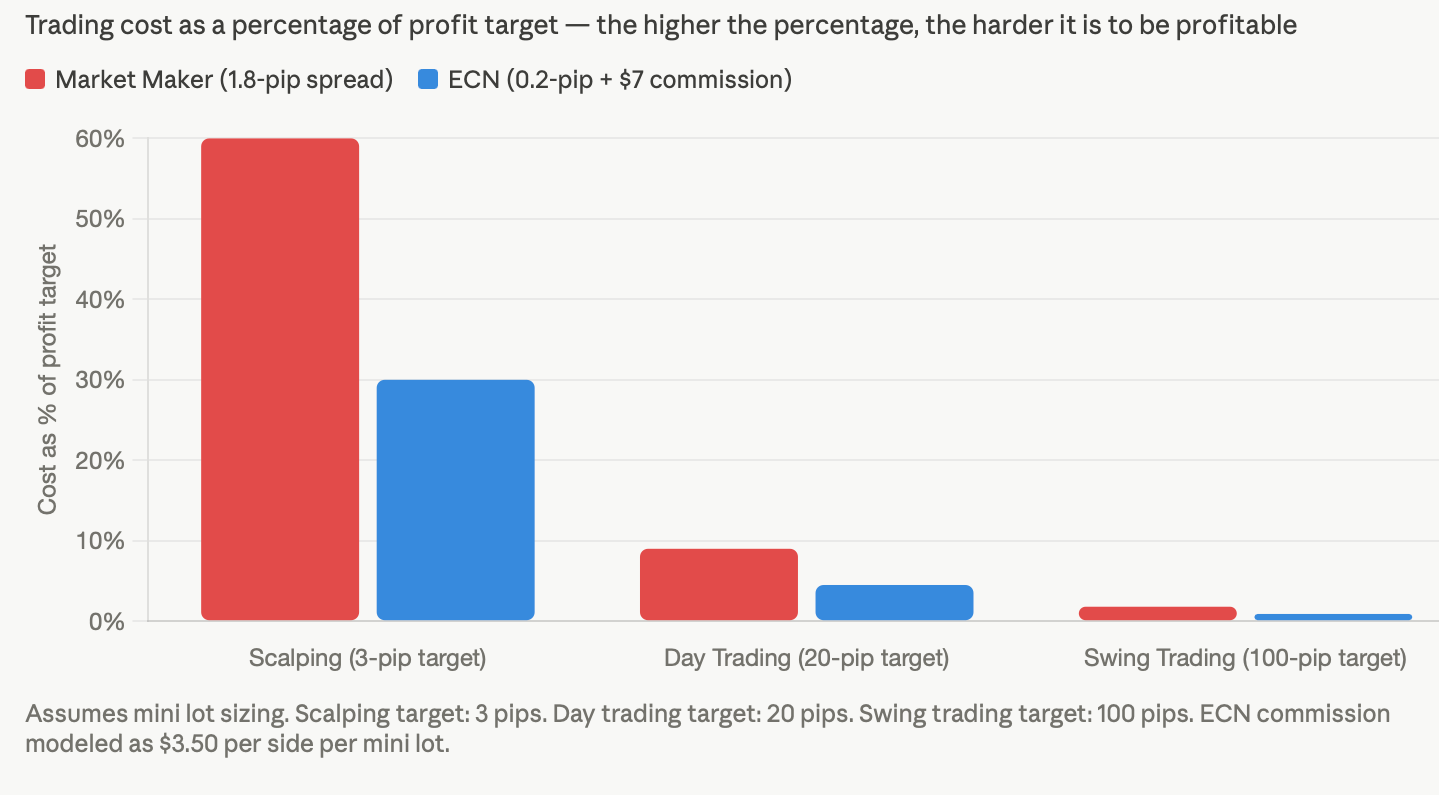
Scalpers and high-frequency traders feel a lot of pain due to their very narrow target size; when targeting a 3 to 5 pip move, the spread will cost them 1.8 pips. Therefore, before breaking even on a trade, the market needs to move over one-third of the target pips in their favor. And that is without considering commissions and slippage. Understanding the tick-by-tick movement of the market will make that even more evident due to the financial impact of each pip when dealing at that level.
The marketing machine in the trading industry has conditioned the retail trader community to look for zero commissions as the key benefit of selecting a broker; thus, they are attracted to that marketing strategy because it sounds so simple. No costs except for the actual trade, right? But this gets very confusing and the difference between the two types of traders is that those who are aware of this complex reality are able to make informed, meaningful decisions about cost while many others are being overcharged by brokers for years without their knowledge.
What Is Spread and Commission in Forex Trading?
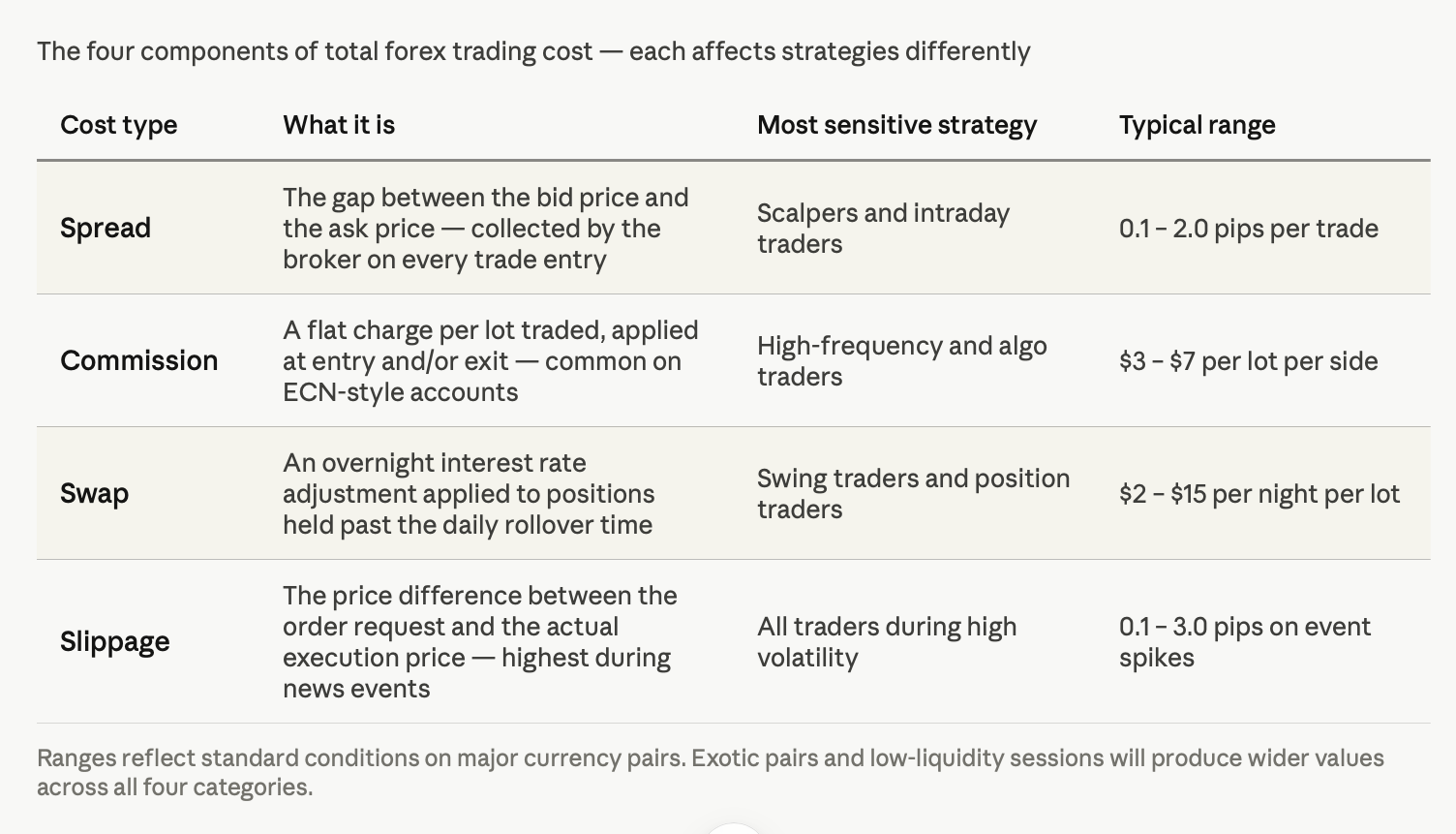
The actual costs associated with forex trading consist of several components, including spreads, commissions, overnight swap fees, and slippage. Each of these costs can affect profitability differently depending on your trading style. For example, a swing trader who typically holds positions for several days is likely to be more concerned with swap rates than a scalper, who generally opens and closes positions within a matter of minutes. Conversely, a scalper requires the tightest possible spreads and the fastest execution speeds, regardless of whether a commission is charged on each trade.
Understanding how the bid-ask spread works is essential because it represents a trading cost that affects every position you enter. Even if your market analysis is correct, spreads can gradually reduce profitability over time. As a result, traders who fail to account for these costs may find their capital declining despite making sound trading decisions.
The bid price represents the price at which you can sell a currency pair, while the ask price represents the price you must pay to buy it. The spread is the difference between these two prices and is therefore the most fundamental trading cost in the forex market. It is incurred on every trade from the moment a position is opened, before the trader has any opportunity to benefit from favorable price movements in the market.
Under normal market conditions, the EUR/USD spread on a competitive ECN account typically ranges from 0.1 to 0.5 pips. However, during periods of reduced liquidity—such as Friday afternoons, trading in less-liquid currency pairs, or around major economic news releases—the same spread can widen significantly, sometimes reaching 3 to 5 pips or more without advance notice. Many traders fail to account for this variability when estimating their trading costs, which can lead to a substantial underestimation of expenses and negatively affect long-term trading performance.
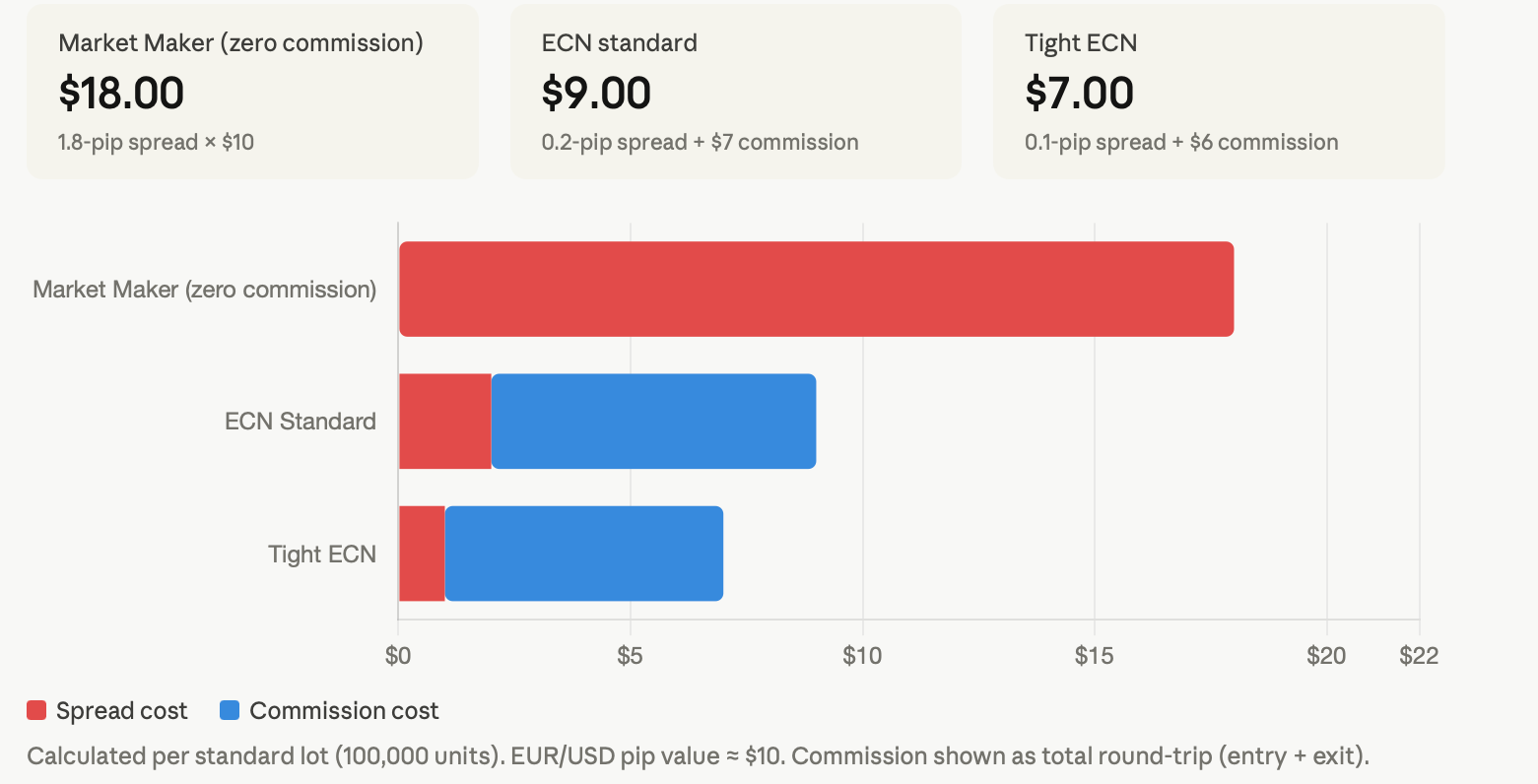
Unlike commission, which is a fee charged on each lot traded, the costs of ECN accounts, which have an average commission of $3 to $7 per lot ($6 to $14 round trip, including both opening and closing per standard lot), can look significant compared to brokers offering 0 commission and a 1.5-pip spread. For example, when trading a standard lot of EUR/USD, you may incur a commission of $15 based on 10 cents multiplied by 1.5 pips, which can be comparable to the highest tier of commission for an ECN account.
Most novice traders do not examine the math involved in comparing these costs, and therefore never realise that commission-free trading is not necessarily free for the trader. Instead, the cost is embedded through a spread markup that is hidden within the pricing structure, rather than explicitly stated on the trade confirmation.
The Truth Behind "Low Spread No Commission" Marketing Claims
Typically, when a "low spread, no commission" account is advertised by brokers, they are describing a market maker pricing model. The broker's total revenue, as well as all of its operating costs, is contained within the spread markup on all trades executed through that broker.
It is not necessarily misleading, but the way it has been packaged and presented can distort the true cost of each trade, providing a clear marketing advantage to the broker at the expense of the trader’s financial clarity.
Market maker brokers act as your counterparty when executing trades. Instead of routing your order to an external liquidity provider, they match your trading request internally with other clients’ orders. This effectively gives the broker significant control over pricing, since it internally matches buy and sell orders rather than routing them through an external provider.
They use this control over the pricing process to apply a markup to the spread, ensuring that their spread markup covers their operating costs and generates a profit margin. The spread shown by a market maker broker generally consists of the raw interbank price of the asset plus a markup of typically 0.5–1.5 pips, with higher markups often observed during periods of low liquidity.
"Zero commission" is a powerful marketing term because it simplifies broker comparisons for traders who may not fully understand pricing structures. If one broker charges a commission while another does not, the commission-free broker may initially appear to be the more cost-effective choice. As a result, many traders stop their analysis at that point and fail to examine the spread, which is often the largest component of the actual cost of trading.
The formula for calculating the total cost of a trade is:
Total Cost = Spread + Commission + Slippage + Swap
Slippage is a particularly important component of this calculation. Certain trading strategies, such as forex arbitrage, are designed to capitalize on price discrepancies and inefficiencies that exist across different markets or liquidity venues. These opportunities often arise because of delays in order execution or differences in pricing between market participants.
Slippage occurs when the price at which your order is executed differs from the price you expected when placing the trade. This can happen during periods of high market volatility, rapid price movements, or when a broker's execution infrastructure is unable to match your order with available liquidity quickly enough. During volatile market conditions, market maker brokers may experience higher levels of slippage because their execution models are often focused on managing internal order flow before seeking external liquidity. As a result, traders may receive execution prices that differ from those displayed at the time the order was submitted.
ECN vs STP vs Market Maker: Which Execution Model Gives You the Lowest Real Cost?
If you're looking to make an honest cost comparison that goes beyond what is advertised and more closely reflects the actual cost incurred when trading hundreds of trades, then understanding the three basic broker execution models can help.
An ECN broker will connect your order to multiple liquidity providers (e.g., banks, institutional traders, etc.). Because real buyers and sellers are involved in matching your order in the market, the spread on your trade will be raw and very tight when there is sufficient liquidity, as shown on the chart above. The downside of this type of execution is that you have to pay a per-lot commission associated with executing your trade. However, as illustrated in the chart above, the total cost of round-tripping an ECN trade is still lower in most cases than the cost of round-tripping with a market maker commission-free account, often by a significant margin.
ECN execution models are very beneficial to scalpers, algo traders, and anyone using quantitative trading strategies that do not require a high cost per trade across a high volume of trades.
STP (Straight Through Processing) brokers operate using a hybrid model. Rather than taking the opposite side of their clients' trades, they typically route orders to one or more liquidity providers, making their execution process generally more transparent than that of Market Maker brokers. Spreads offered by STP brokers are variable and usually competitive, although they often include an additional markup applied by the broker before the order is transmitted to the underlying liquidity provider. Some STP brokers also charge a small commission in addition to this markup, while others incorporate all of their compensation into the spread and therefore do not charge separate commissions. Execution quality with an STP broker is generally superior to that of a Market Maker broker; however, the level of direct market access is typically somewhat lower than that provided by a pure ECN model.
Market Maker brokers operate differently by creating and managing an internal market for their clients. When a trader places an order with a Market Maker, the trade is often not routed to an external liquidity provider. Instead, it may be matched against other client orders within the broker's system, or the broker may take the opposite side of the trade itself. This structure creates an inherent conflict of interest, although it does not necessarily affect the execution of every trade. Because the broker may profit when clients lose money, there is a potential tension between the broker's interests and those of its customers. In addition, Market Maker spreads are not always derived directly from external market pricing; they are often influenced by the broker's internal liquidity conditions and risk management considerations at the time the trade is executed.
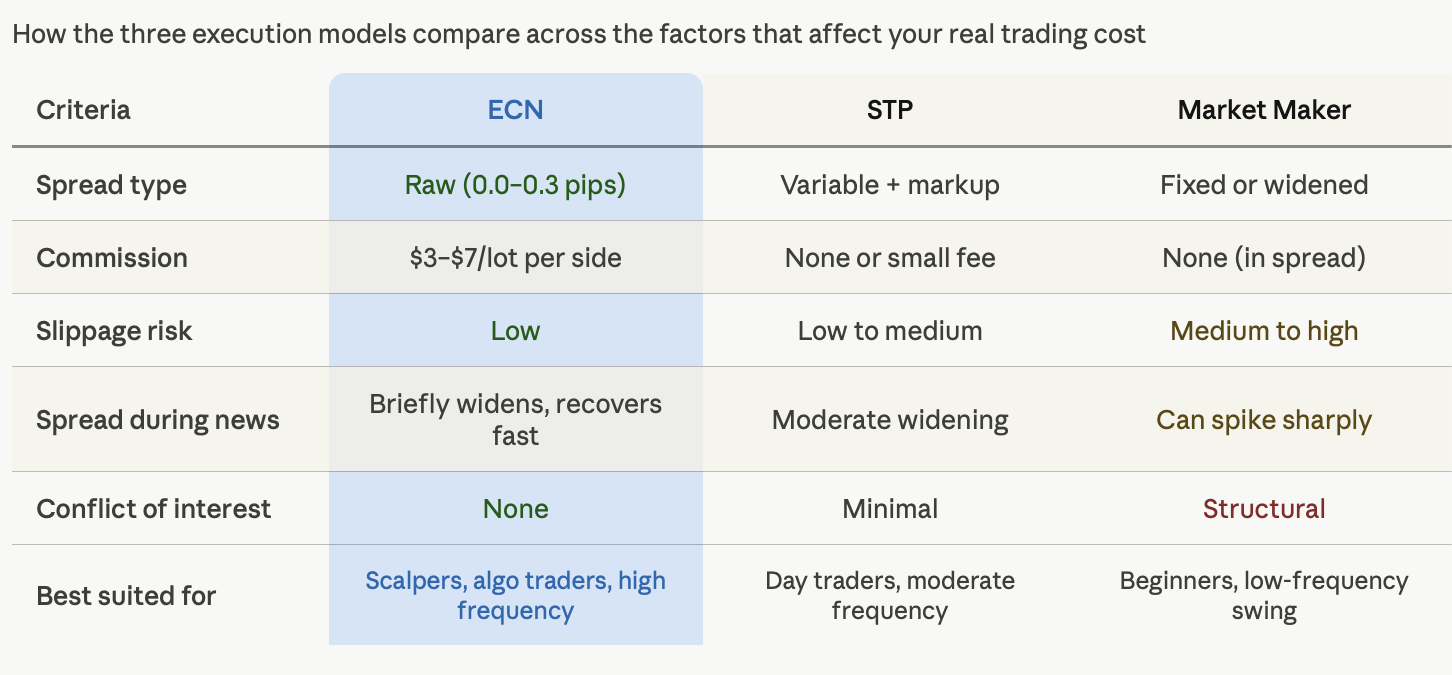
The difference in real-world performance between ECN brokers and Market Makers during a major news event, such as the release of Non-Farm Payrolls (NFP), can be significant. With an ECN broker, spreads may widen briefly as liquidity decreases, but they typically narrow again once market conditions stabilize. In many cases, orders are filled relatively close to their requested prices, although some slippage may still occur during periods of extreme volatility.
A Market Maker, on the other hand, may temporarily suspend executions during major news events, requote orders at less favorable prices, or maintain wider spreads for an extended period after the event. These factors can negatively affect traders who are attempting to enter or exit positions during periods of heightened volatility, particularly short-term traders whose strategies depend on fast execution and competitive pricing rather than long-term market exposure.
How to Evaluate a Low Spread Forex Broker Without Being Misled
The forex broker you choose that has the lowest spreads is not necessarily the one with the most advertisements or the most aggressive claims made on its website. The lowest-cost broker for your account is the one whose actual execution data, compared against your specific trading style and hours, produces the lowest total cost across a large number of trades.
When determining which low-spread broker has the cheapest overall cost, the following metrics hold true:
The average spread for the EUR/USD currency pair will be your main basis for evaluating any broker’s pricing. Many forex brokers will display their lowest possible (minimum) spread on their websites, but typically only during peak times when there is maximum liquidity in the London–New York overlap. If you are trading during Asian hours or around news releases, a broker’s minimum displayed spread will not reflect your actual trading conditions.
When reviewing brokers, you need them to be transparent about how they charge commissions. A broker should be extremely clear about how much commission is charged per lot and whether it is charged on both sides of the trade (entry and exit) or just one. Additionally, a broker should provide information detailing how their commission structure changes depending on the account tier. If there are any unclear aspects regarding the commission structure, the broker may not be trustworthy and may not be someone you should open an account with.
Commission transparency should be a non-negotiable factor when evaluating a broker. A broker should clearly disclose all commission-related costs, including per-lot commissions, whether commissions are charged on trade entry, exit, or both, and how commission structures may change as account size or trading volume increases. If there is any ambiguity in how a broker discloses its commissions, this should be considered a red flag and investigated further before depositing funds.
Another important area to examine closely is slippage data. Slippage statistics can be difficult to obtain because brokers rarely disclose them publicly. However, valuable insights can often be found on trading community forums and independent review websites where real traders share their execution experiences. This information frequently provides a more accurate picture of a broker's execution quality than anything contained in its promotional materials.
You should also consider the stability of your broker's trading platform. If you are trading a strategy that requires precise entry and exit timing, platform freezes, order delays, or execution interruptions during periods of high volatility can make it extremely difficult to execute trades effectively. In such situations, even a profitable trading strategy can become unworkable due to operational issues.
Be particularly cautious of brokers that advertise "always 0.0 spreads" on major currency pairs. Such claims should be viewed with a healthy degree of skepticism. Spreads are influenced by underlying market liquidity conditions, which no broker can completely eliminate. As a result, any broker making this claim may be oversimplifying how execution works or compensating for those spreads through other fees, markups, or pricing mechanisms that are not immediately apparent.
How Trading Costs Compound Against Profitability Across Strategies
A trader’s profitability is not determined linearly or directly correlated with the number of trades made in a particular day; it is compounded through calculations that many traders overlook until they do their homework across a representative sample of trades based on the price movement of the asset or contract in question.
If a trader or scalper has a $500 account and makes 10 trades each day with a 1–2 pip spread, under that model (using a tiny mini lot), the trader spends roughly $18 per day in spread costs alone, only to find that this represents about 3.6% of their account value before evaluating whether any individual trade is profitable based on the fundamental analysis used to develop the strategy and the rules used to enter a transaction. Over 20 days, a trader would need to generate a gross return of 72% ($360) just to break even on trading costs.
This means that although the trader may not ultimately fail to profit from the trading opportunity, it is their inability to account for the current cost of the trading environment in conjunction with their trading methodology that limits their prospects for success.
When comparing an ECN account with 0.2 pips (plus a $3.50 commission per side) to a market maker account using a basic pricing model (1.5–2.0 pips), the combined cost (including all applicable commissions) equates to approximately $2.70 in round-trip trading costs on an ECN account versus approximately $29 on a market maker account across those 10 trades each day. In other words, the difference in costs could allow an otherwise sound trading strategy to become sustainable when accounting for all costs in a trading plan. Therefore, knowing your breakeven point per trade will allow you to create a realistic trading plan that includes profit targets based on actual rather than assumed costs.
Swing traders face a different cost structure than day traders. Generally, swing traders hold positions for several days and often target profits ranging from 50 to 200 pips. As a result, the primary cost component of a swing trade is typically derived from overnight swap fees and carry trade dynamics rather than the spread. After a position has been held for several weeks, accumulated swap charges can exceed the initial spread cost of entering the trade.
For this reason, swing traders should pay close attention to the swap rates associated with the instruments they trade. They should also understand how central bank policy decisions, interest rate changes, and quantitative easing programs can influence those rates. Changes in monetary policy can significantly affect the cost of holding positions over time and may have a meaningful impact on the overall profitability of a swing trading strategy.
Matching Your Broker to Your Trading Style
For scalpers, the top priority should always be ECN execution because of the ultra-low spread, high-speed order processing, and minimal slippage, all of which are essential elements for making this strategy work. A slightly higher per-lot commission is acceptable in exchange for the level of execution quality that continues to tilt pricing in your favor after each trade.
Day traders should follow a mixed approach (ECN or STP pricing) to achieve competitive pricing, but they must also ensure they have stable platforms with consistent execution during important economic events that create intraday price action. Scheduled releases such as the FOMC Meeting Minutes are especially important for day traders because this is when the biggest differences in execution quality between broker types become most apparent and therefore most costly.
Swing traders can generally tolerate a wider range of spreads because spreads represent only a small portion of their overall profit targets. However, they must pay close attention to swap rates, particularly when there is a significant interest rate differential between the two currencies in a currency pair. For swing traders managing multiple positions across different currency pairs, it is also important to consider currency correlations. Achieving true cost efficiency at the portfolio level requires understanding how individual positions interact with one another, where exposures may overlap, and how duplicated risks can affect overall trading costs and portfolio performance.
For new traders, there is often a trade-off between cost efficiency and ease of use during the learning process. A user-friendly Market Maker platform with slightly higher trading costs may be suitable during the initial stages of trading, as it can simplify execution and platform navigation. However, as trading experience, confidence, and volume increase, transitioning to an ECN-based model can become an important step toward improving execution quality, reducing trading costs, and building a more sustainable long-term trading practice.
Mistakes That Cost Traders More Than Bad Trades Do
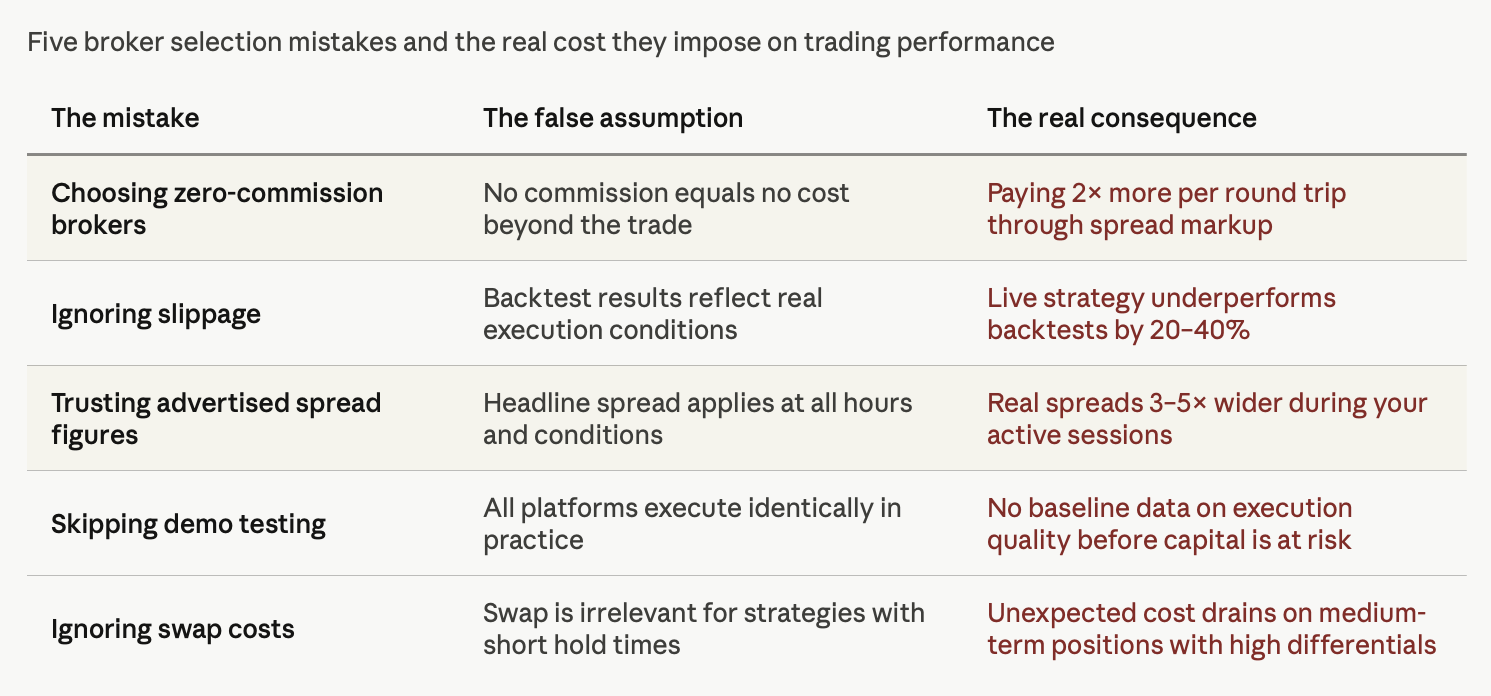
Choosing a broker just because it promises no commissions is a common mistake and one of the most financially damaging that new traders make. The rationale may sound reasonable until it is discovered that the broker’s commission-free pricing incorporates costs through spread widening and slippage, meaning that, on an absolute basis, a cost is still paid on every round trip.
Another key issue that is often neglected, which is also related to slippage and underperformance over time, is that traders build their strategies on historical data and then deploy them on market maker platforms, which can cause live results to differ significantly from backtest expectations. Slippage is often not properly modeled in backtests. The gap between theoretical and real performance is one of the key reasons algorithmic trading systems must be validated against live broker data rather than a clean historical price feed, as the two environments have materially different execution characteristics.
One additional consequence of relying on an advertised average spread is the assumption that the quoted figure remains consistent throughout all trading hours. In reality, spreads fluctuate throughout the day, and these variations can have a meaningful financial impact when accumulated across hundreds of trades. For example, an advertised "average spread of 0.2 pips on EUR/USD" typically reflects conditions during peak liquidity periods, such as the London and New York session overlap. If your trading strategy operates during the early Asian session or around high-impact economic news releases, the spreads you experience will likely be significantly wider than the figure that initially attracted you to the broker.
Skipping the use of a demo account because of an eagerness to begin live trading can be a costly mistake. A demo account not only provides an opportunity to become familiar with a broker's platform before risking real capital, but it also allows you to gather valuable information about spreads, execution quality, and platform stability under different market conditions. Without this experience, traders begin live trading with little practical knowledge of how the broker performs in real-world market environments.
Final Thoughts: What Really Matters When Choosing a Forex Broker in 2026
The forex trading market has grown substantially over the past decade, providing many more firms with access to the technology required to execute trades efficiently. Unfortunately, the increased popularity of ECN (Electronic Communication Network) pricing has also led to widespread marketing claims that do not always accurately reflect a broker's actual execution model. Many firms advertise ECN-style pricing or commission-free execution, making it essential for traders to evaluate real-world spreads, execution quality, and trading costs rather than relying solely on promotional terminology.
The key takeaway is that trading costs compound over time. Every unnecessary dollar lost because of poor broker selection reduces the capital available to generate future returns. Each pip saved through lower spreads, better execution, or a more efficient commission structure remains in your account and continues to contribute to your long-term trading performance. Over the course of hundreds or thousands of trades, these seemingly small differences can become substantial.
As a result, the difference between a broker charging an average spread of 1.8 pips and another offering a 0.3-pip spread plus a reasonable commission can have a significant impact on the long-term profitability of a trading strategy. While no broker can guarantee trading success, minimizing avoidable transaction costs improves the overall expectancy of a trading system and allows more of a trader's gains to remain invested rather than being absorbed by execution expenses.
Researching cost efficiency in forex trading may not be the most exciting aspect of the market; however, it is one of the most valuable subjects a trader can understand before placing any trades. Traders who develop a thorough understanding of their trading costs, including spreads, commissions, slippage, and swap fees, and who select brokers whose cost structures align with their trading styles, begin each trading day with a meaningful structural advantage over their competitors.
This advantage becomes increasingly important over time. Trading costs are one of the few variables that traders can directly control, and even small differences in execution expenses can compound significantly across hundreds or thousands of trades. A trader who consistently minimizes unnecessary costs retains more capital, improves the long-term expectancy of their trading strategy, and places themselves in a stronger position to achieve sustainable results.
By contrast, traders who select brokers primarily on the basis of marketing claims rather than execution quality, pricing transparency, and historical performance data often underestimate the true cost of trading. As a result, they may unknowingly sacrifice a portion of their returns through wider spreads, higher slippage, hidden fees, or inferior execution. Understanding and managing these costs is therefore not merely an administrative exercise; it is a fundamental component of long-term trading success.
Ready to see exactly what you're paying on every trade before you commit? TradeWill offers transparent pricing with real-time spread tracking, so you can measure your actual cost structure against your strategy's requirements and make a broker selection based on data rather than headlines. Open your account at TradeWill today and trade with full cost visibility from day one.
Disclaimer: The content of the blog does not represent any position of Trade W, does not serve as any trading-related decision advice, and does not endorse any third-party.