

 Trade W
Introduction
If you've ever thought to yourself that you'd like to get in a trade automatically once the market starts moving in your direction, you're already thinking like a professional trader. That's exactly what buy stop orders accomplish, giving you the ability to take advantage of breakout moves without being glued to your trading screen around the clock.
You can think of pending orders as your automated trading function. Instead of every time you see an opportunity, manually enter a trade, you can set up orders and let them execute automatically when certain conditions are met. Of these, a buy stop order is probably the most powerful order for trend-following strategies.
Buy stop orders are naturally just an instruction to buy above the current price. You are telling your broker; "When this currency pair goes above this level, buy it for me right away!" Just like setting up your gaming account to automatically buy those exclusive coins when their price reaches your target – but again, it is about real cash and the potential for real profit.
Buy stop orders are generally used by professional traders and institutions frequently. This especially happens around big resistance levels. For example, when EUR/USD approaches resistance at 1.0820, the smart money is placing their stopping orders just above the resistance level so they can ride the momentum in case of a breakout and usually end up selling for a profit.
Buy stop orders are also good in their trend following nature. You are not trying to catch a falling knife or determine a market bottom. You are putting yourself in a position to take advantage of strength and momentum; this is what breakout trading is all about.
What is a Buy Stop Order
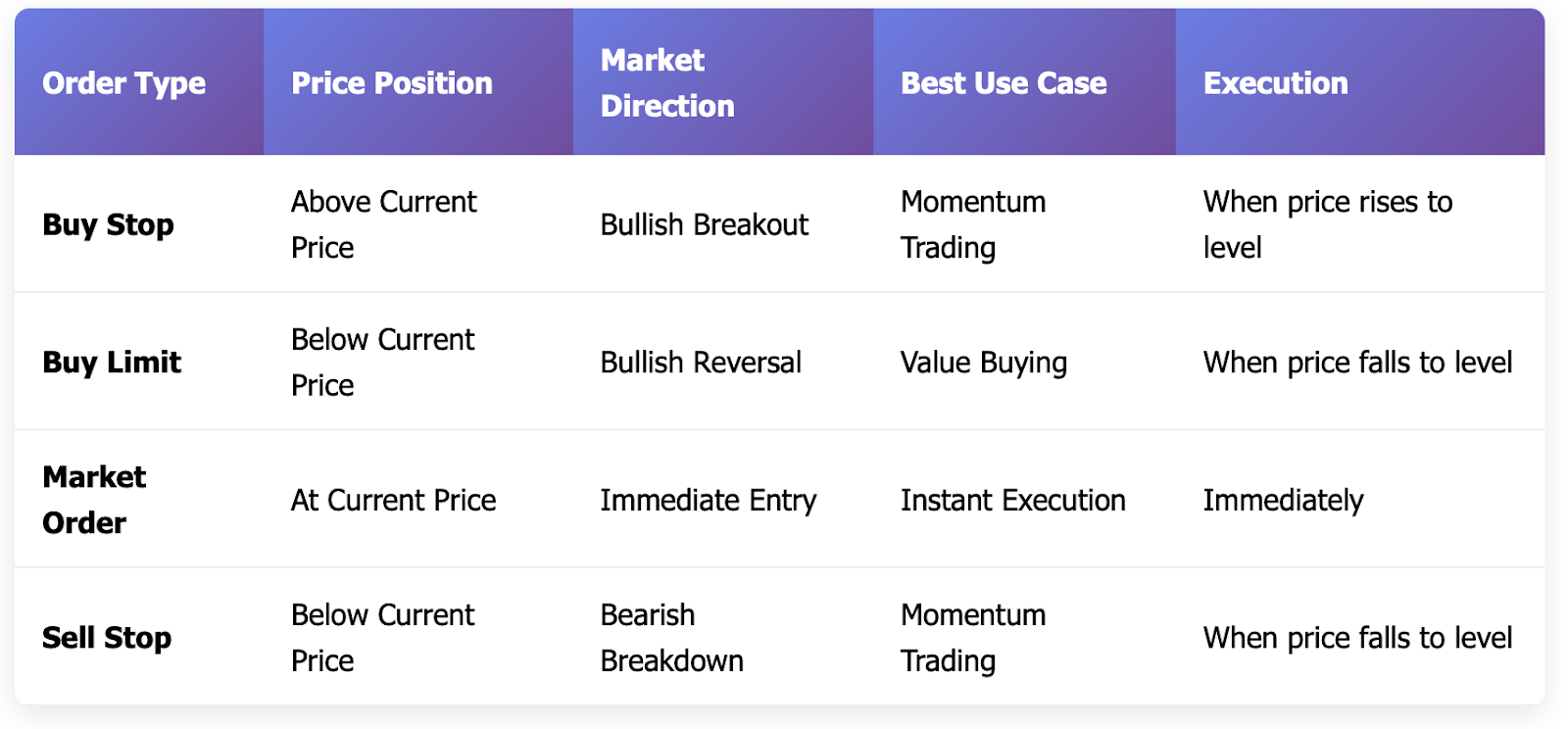
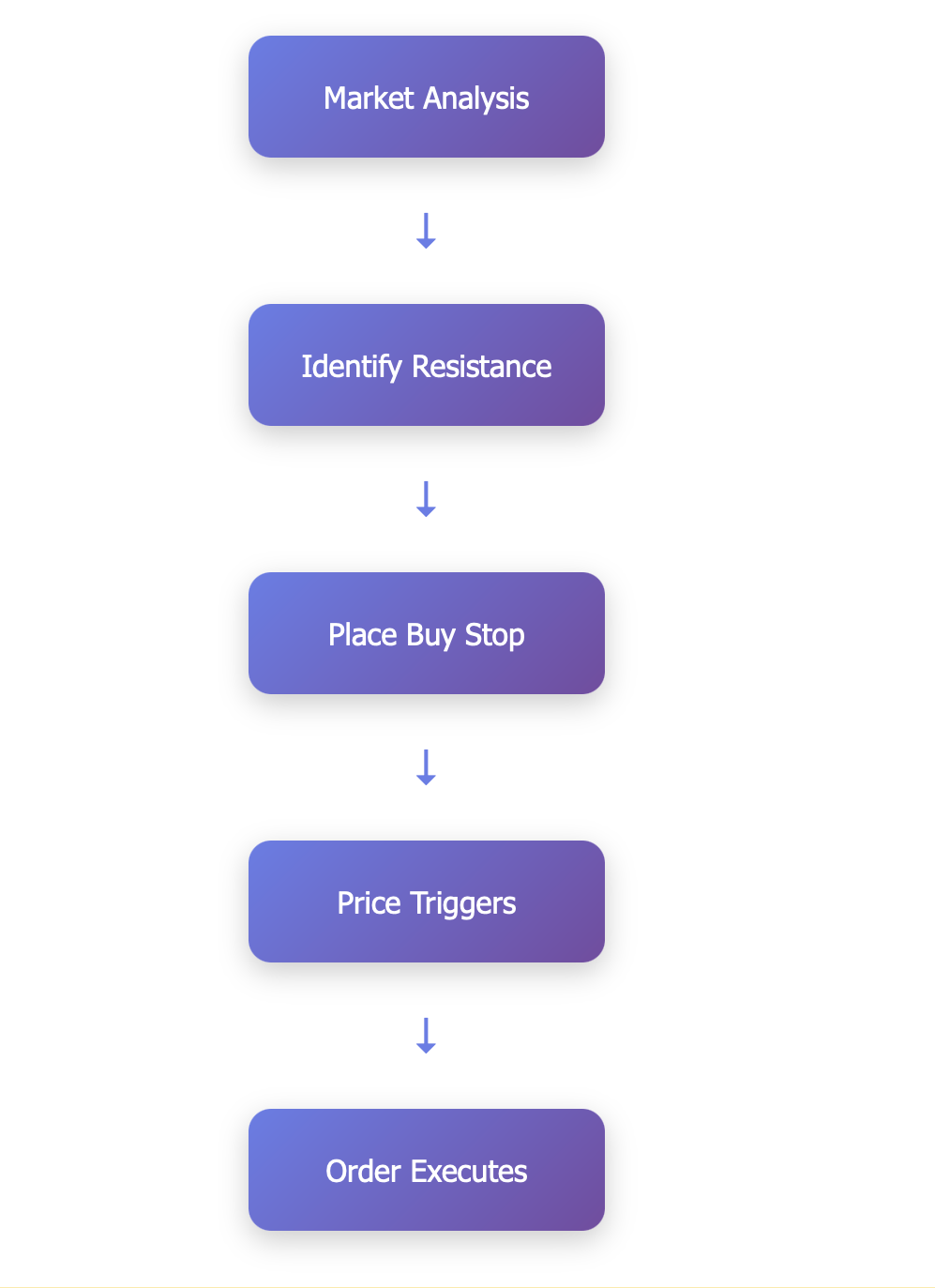
Let’s skip the hype, and get to the point. A buy stop order is an order to buy a currency pair at a price above the current market. A buy stop is not a market order; it will sit until the market comes to it.
Here is an example of how a buy stop works. Let’s say the EUR/USD is at 1.0800 and you think a move above 1.0820 would trigger some buying momentum. You would place a buy stop order at 1.0820. Your order sits inactive until the market trades at 1.0820, then BOOM, it becomes a market order and a fill takes place.
A good way to think about it is that you are setting an alarm to buy those limited edition gaming coins, you definitely do not want to pay the current price, but if the price pops to 100 bucks a coin, you want a few coins and you want to buy them immediately. Your buy stop will execute automatically at your target price.
The main difference is timing, and position. Buy stops always go above current market prices because you are trying to play the upward move. If you are trying to buy below the current prices, (Maybe expecting a dip first) would use a buy limit order instead.
This automated execution function makes buy stops incredibly useful for breakout trading. The second resistance level breaks and the price really picks up, your order triggers without any manual intervention. No more missing moves because you've stepped away from your computer or second guessing yourself as the price pops out of resistance.
Benefits of Buy Stop Orders
There are three distinct benefits a buy stop order can provide that can alter your complete trading operation. The first is they are just plain the best at capturing momentum. When a currency pair or asset crosses a significant price level, the first move is usually just a pop. Buy stops allow you to get on board at the station just as the train is leaving.
There is the automation aspect to buy stop orders that cannot be overstated. No need to babysit the charts for breakouts. You set your buy stop order, you walk away after it dictates your trading arrows and you wait for the market to come to you. It is like a trading assistant who is woken 24/7, who never needs a break or is ever distracted and who executes trades mechanically.
Paper orders, including market orders all of which are good for immediate execution, do not do too much to positively enforce your breakouts until the maximum price levels, While market orders indicate, by definition, "buy now at any price" a buy stop is buy when there is perceived strength. The difference in the timing of your execution is everything and it could swing your end of the month trading results.
Buy stops are a favorite of professional institutions looking to capture explosive moves when the retail traders finally figure out the level has broken. Think about it, when the EUR/USD starts moving above some extended resistance that has been established for weeks, the retail trader is blindly trying to slug their way in, and all the while institutional buy stops are filling waiting for whatever their level is to fill.
The psychological edge is significant here too. By pre committing to a breakout level you are reducing the emotional volatility that ruins many traders' plans when they decide they want to chase a move, and you will no longer have to watch someone else's breakout in awe thinking "should I chase that?"; if you have a buy stop in place, you already answered that question when you were in a better mindset than hours later wondering what happened to the move.
There is a speed advantage also - In fast moving environments, the act of entering an order manually allows for precious time wasted missing the best part of that move. Buy stops do this without hesitation once they are activated, and you don't miss any pips fumbling with order entry screens.
How to Set a Buy Stop Order
There is a methodical way to set up a buy stop order properly, but it's not brain surgery either; let's break it down step by step.
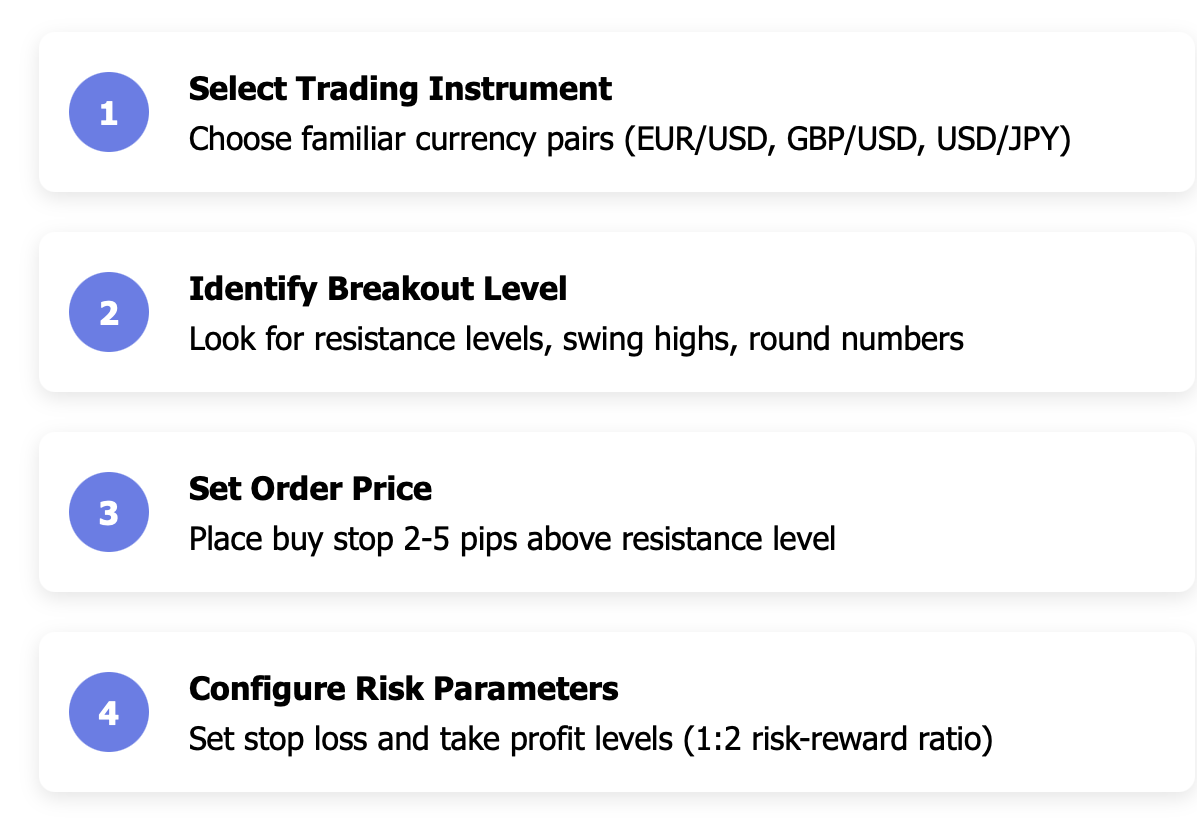
Step 1: Select Your Trading Instrument Select a currency pair you are familiar with, which typically has bullish breakout characteristics. Major pairs (e.g., EUR/USD, GBP/USD, USD/JPY) often respect technicals better than exotic pairs.
Step 2: Determine Your Breakout Level This requires some technical analysis, look for potential resistance levels such as swing highs, or round numbers, or any points at which price has struggled to push through. The more obvious the level the more likely other traders are watching it too.
Step 3: Enter Your Order price Enter your buy stop at 2-5 pips above the identified resistance level. A 2-3 pip buffer usually allows for traders to buy actual breakouts, not just a spike in price only to have it quickly reverse. If the resistance level in the EUR/USD is 1.0820, then you would enter your buy stop at 1.0823.
Step 4: Determine Your Risk Parameters
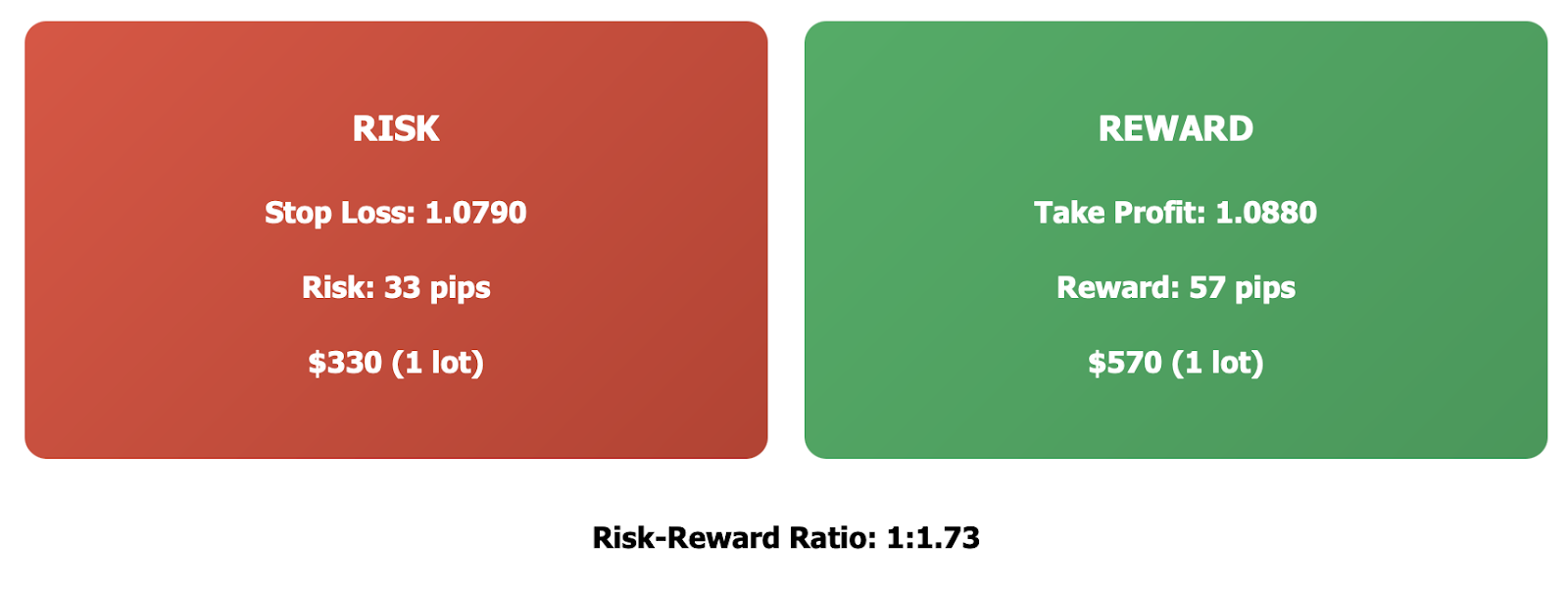
This point is key - never place a buy stop without first determining the stop loss and take profit amounts. An example of a trade setup might be: Buy stop at 1.0823, with stop loss at 1.0790 and take profit at 1.0880. That would essentially give us a 1:2 risk-reward ratio.
Back to the gaming metaphor - think of your account as having an allocation of $100 to buy rare coins, however, you have attached automatic sell orders if the coins drop to $95 (thus limiting your loss) or if they increase to $110 (thus taking your profit).
The professional trading approach utilises multiple timeframe analysis. For instance, in the example above, the breakout entry on the 4-hour chart may be identified, however, the decision on the take profit is made on the daily chart. This way, you are making sure you are not just trading "noise."
In terms of platform, for most brokers, this should be quite a straightforward process. If you are using MetaTrader, you would right click your chart, select Trading > New Order, select buy stop as the order type, and enter both the price and volume. Then you would add your stop loss and take profit levels.
Risks and Precautions of Buy Stop Orders
Buy stops are not a cure-all – they can carry legitimate risks that can have a negative impact upon your account if you don't know what you're doing. Knowing these risks in advance is what separates regular profit taking from real account loss.
Slippage Risk: This is your biggest enemy with buy stops. In volatile environments, your order can be filled well above where you were trying to get in at. You have a buy stop set at 1.0820, but then news breaks and price gaps higher and you get filled instead at 1.0835. Not such a big deal right? Well, 15 pips can ruin a risk-reward ratio in a heart beat and almost guarantees your stop is hit before you are able to make the trade.
False Breakout Risk: We all know markets love to fake traders out. Price comes to your buy-stop at 1.0823, it triggers the order, then instantly reverses and hits your stop loss at 1.0790. You lose 33 pips on a trade that was a "perfect setup". This happens all the time, especially the closer you get to major news events to boot.
It's like those gaming coins that spike to $100, the price triggers your buy-order and then crashes back down to $85 in about 5 minutes. Now you are stuck in something too high to sell while trying to process where the price just went.
Volume and Liquidity when Placing Buy Stops Buy stops work best in liquid markets with a steady flow of volume. During slow hours or while major news is being released, liquidity can evaporate, rendering your executions unpredictable. For example, while the EUR/USD may breakout during the Asian session, the move may not have the same follow through from the London or New York sessions.
Prevention Methods
Always use stop losses - no ifs, ands, or buts. Place your stop at key technical levels - not arbitrary pip amounts. If you have support at 1.0790, place your stop right below at 1.0785.
Think about the overall picture before placing buy stops. Is there major news on the horizon that could lead to whipsaw conditions? Are you placing your buy stops at liquid hours? Is the overall trend in your favor for the direction of the breakout?
Pay attention to volume when you see a breakout. A strong breakout ought to have strong volume. If the breakout past your level is during low volume, you should be cautious, as it may be a fraudulent move.
Historical Data and Statistical Analysis Numbers don't lie; with buy stop orders, the numbers show some interesting patterns that may enhance your decisions in trading.
An analysis of the major currency pairs over the past five years indicates that buy stop orders have approximately a 55-60% success rate when executed correctly. This may not sound all that great until you realize the majority of retail traders achieve barely 40% win rates with manual entries.
I have found that EUR/USD breakouts above daily resistance levels have even more compelling data. If the price breaks and closes above daily resistance that has already been tested three times or more, the follow-through from that breakout is almost 70%. This indicates that buy stops are most effective at well-defined technical levels versus random price levels.
Volatility also has a dollop of impact on the successfulness of buy stops. Typically in low-volatility times, like during summer trading, false signals occur more often with buy stops as the price does not have sufficient momentum to maintain a breakout. In high-volatility times, success rates increase, however, slippage becomes a bigger issue.
One interesting statistic: buy stops executed during the London-New York overlap (8 AM - 12 PM EST) have a 15% higher success rate versus buy stops placed in the Asian session. This makes sense given the higher level of liquidity and more institutional market participation during the London-New York session.
The research findings show stop buy orders to be effective in trending markets but not in ranging markets. In solid uptrends, breakout continuation rates were between 60-75%, but in choppy, sideways, and or ranging markets, breakout continuation rates were about 45%.
The selection of currency pairs matters as well. Major trades (EUR/USD, GBP/USD, and USD/JPY) seem to generate more consistent continuation breakouts than exotic currencies. The GBP/USD pair often generated the most explosive breakout trades and the most false breakouts - risk and reward work together.INDI
One fairly interesting finding: stop buys which were placed 3-5 pips above round numbers (like 1.1000, 1.2000) generated above average breakout success rates. Traders often use round numbers for their own decision-making, and many institutions resent their algorithms as sophisticated buy stop orders when markets approach these psychological price points, self-fulfilling the breakout and continuation.
Combining Buy Stop with Other Orders
The real opportunity for buy stop orders is when they are used in conjunction with other order types to create total trading models , not to consider a single specific event in a single event model process. Instead, think of the task similar to putting together a complete trading system instead of working from one-shot models.
Buy Stop + Sell Stop Strategy: This combination is great for traders looking to catch breakout patterns in either direction. You place a buy stop above resistance and a sell stop below support and then let the market account for which direction it wants to break. Once one of the orders fills, you cancel the other. It's like having bets on either side of a coin toss, but only paying for the winning side.
For example, if EUR/USD is trading in a range between 1.0800 support and 1.0850 resistance, you can place an order to buy stop at 1.0855 and another order to sell stop at 1.0795. Depending on which way the market breaks, you have placed a trade in that direction to take advantage of momentum either way!
Buy Stop + Buy Limit Strategy: This is useful if you expect there is going to be a breakout, but you want to build on the dips first. For example, you might place a buy limit at current support to try to catch price contracting in sequence, but also have a buy stop waiting above at resistance, in case price breaks for a breakout scenario!
The beauty here is flexibility. If price dips first and fills your buy limit, you're already positioned with a good entry. If it breaks higher and triggers your buy stop, you catch the momentum move. Either way, you're in the market with favorable risk-reward dynamics.
Incremental Buy Stops Pro traders will often layer multiple buy stops at different levels above a resistance area. The first buy stop will likely trigger during the initial break, the second buy stop will follow a small pullback and re-break, and the third buy stop will trigger if the price reaches a higher confirmation level. This allows for a gradual build-up of a position and manages risk.
Institutional professionals also apply this layering technique in and around larger technical levels. They aren't aiming for the best price – they are ensuring they partake in a major move, whilst managing their fill risk.
The secret to constructing successful combinations of orders (layered buy stops / layered sell stops) is to treat your setup (buy / sell) as part of a larger system. Your risk management must take into consideration all possible executions and your position sizing should consider the possibility of multiple orders executing.
Psychology and Discipline Management
Trading psychology is the factor that separates profitable traders from everyone else. Meaning that, buying stop orders are different in their psychological values which you need to manage directly.
One of the biggest psychological traps is the constant adjustment of your buy stops. You set a buy stop at 1.0820, the price approaches and suddenly you think "maybe I should move it to 1.0825, or perhaps this breakout is not going to work." Suddenly you have moved your stop three times and as a result, completely invalidated your original analysis,
The uncomfortable truth is: If you don't have the conviction to trust your original analysis and let your orders sit, you shouldn't have placed them in the first place. Constantly adjusting orders is either a sign of weak analysis, or you don't believe your system.
Going through a string of losing trades is also a struggle. Your first buy stop gets triggered, then immediately reverses for a loss. The second trade does the same thing. By the third setup, you are shy to take the trade, and either skip the trade, or drastically reduce your position size. Then of course, that's the trade that works out perfectly.
The answer isn't to ignore your losses – it is to accept them as part of the process. If your buy stops work 60% of the time, then that means if you are placing 10 trades, 4 of them will lose. The sooner you accept the truth, the better off you will be.
Professional traders think like what psychologists call "mechanically". They do not look at each trade as a life-or-death situation; they understand that it's just one trade in a large sample. Your job is not to be right on every trade - it is to put your trading system into action perfectly, and then allow probability to do the rest over time.
Maintain a trading journal, and document solely your buy stop orders. Include not only the monetary result, but what you were experiencing in emotions during each entry. Did you feel anxious about missing the move? Overconfident after a recent winning streak? The emotional profiles we have often tend to predetermine mistakes more than any technical analysis does.
Equally as important is the discipline element. You need to establish your rules for when to use buy stops, and consciously follow these rules to the letter. Perhaps you only trade buy stops during the first two hours of the day, or only after certain technical setups, or only when volatility is trading in increments. However you decide to define your rules, being disciplined and adhering to a pre-defined set of rules is the most important factor.
Advanced Optimization and Algorithmic Strategies
After you have visited your basic buy-stop functionality, algorithmic optimization, can improve your results and take your trading to the next level. Modern trading is not about feelings - it is about data-based decision-making and systematic execution.
Dynamic Buy Stop Placement: As opposed to placing buy stops by fixed pip distances to the upside of resistance, you can take volatility into account when placing your buy stops. During periods of higher volatility, you would want to place your buy stops farther from the price in order to avoid false breaks. Conversely, during periods of lower volatility, you will want to place buy stops closer to your price in order to enhance your risk-reward ratio.
The simplest way to approach this would be to use the Average True Range (ATR) indicator. For example, if the 14-period ATR for EUR/USD was 50 pips, you might decide to place your buy stops at resistance + (0.5 × ATR) which would give you a 25-pip buffer from the breakout level. This method automatically takes into account volatility in a simple and stress-free way without the need to constantly pay attention to the market's volatility.
Time Based Filters: More advanced algorithms will include a variety of time-based logic. With your specific example it could be as simple as only having your buy stops available for execution during higher liquidity times or perhaps you even took into consideration the time until major news would have an impact on the market and scaled position size accordingly. With this level of automation you completely eliminate any emotional decision-making.
Multi-Timeframe: Optimization More advanced systems can analyze multiple timeframes at the same time. With your example, it may look compelling to trade a breakout on the 1-hour chart but perhaps the daily chart displays major resistance immediately above which might cause the algorithm to either decrease position size, or leave the trade altogether.
Professional trading firms have the luxury of utilizing machine learning and data analysis to optimize their buy stop placement across thousands of historical scenarios. While retail traders cannot emulate the same level of sophistication, they can apply the principles of optimizing their buy stop placements to easily improve their outcomes over time, with a systematic approach.
The best strategy is to start simple and build on your knowledge. Focus on first mastering the manual closing buy stops, then introduce automation for a basic level of functionality, and finally, the advanced optimization when warranted by your trading progress.
Common Traps and How to Avoid Them
Even the best and most experienced traders fall into the same loop of predictable traps when using buy stop orders. Understanding and learning from these traps will save you substantial time and money.
Setting Buy Stops too Close to Current Price
This is likely the most expensive mistake traders make. They set buy stops at 2-3 pips above resistance thinking they are precise. In fact, they are catching every tiny spike and 90% of fake breakouts, leading to constant whipsaws and a losing position.
Solution:
Give your breakouts some room - a 5-10 pip buffer above resistance is often the minimum, you might even need a bigger buffer on more volatile pairs like GBP/USD.
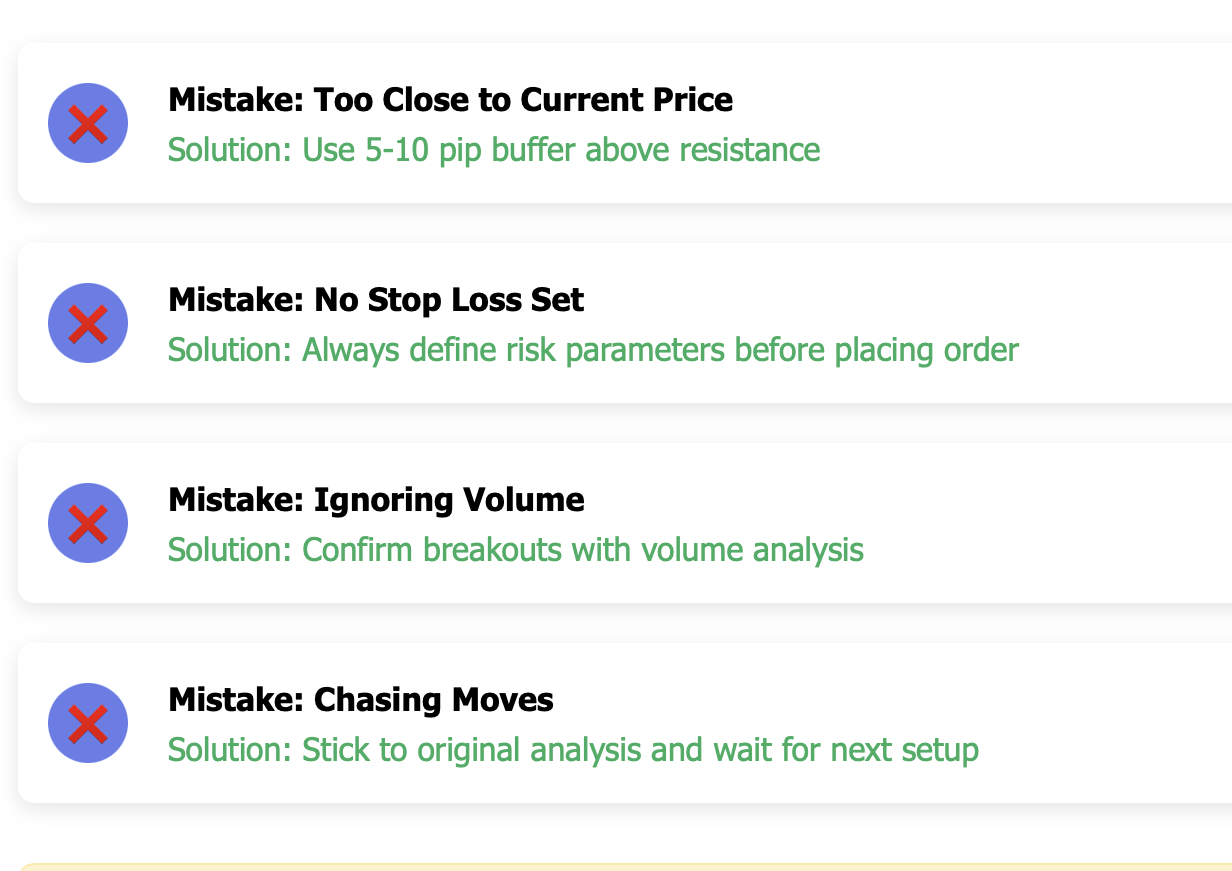
Ignoring the Stop Loss: Some traders become so entrenched in trying to catch breakouts that they forget to manage their risk and ensure they protect themselves when they are wrong. They will have buy stops risked while forgetting to place a stop loss, which can turn small losses into account blowups altogether.
This is similar to setting your gaming account up to buy rare coins at $100 but forgetting to place a sell order in case they crash to $50. Next thing you know, you own a bunch of worthless digital coins.
Trading Without Volume Confirmation: Price can break any level on low volume, but true and sustainable breakout levels require more trading activity. Placing buy stops without thinking about volume context will cause you to be caught in weak, unsustainable moves.
Chasing After Missing: The Original Moves You had a buy stop at 1.0820, but you cancelled it 5 minutes before the price broke through. Now you are watching EUR/USD rally to 1.0860 and feeling the fear of missing out on getting back into the trade. So, you place a new buy stop at 1.0865, effectively chasing the move at worse levels.
Potential Mistakes: Using Incorrect Position Sizes Buy stops can trigger in volatile market conditions, and there is almost always slippage associated with them. If you are using full position sizes without accounting for this execution risk, you may have taken more risk than you intended to, and your risk management is shot.
Over-Complicating the Setup: New traders often think they need to consider every possible variable when trying to optimize - ATR distances, volume filters, contour possibilities, time constraints, confirmations, etc. While there is an appropriate time and place to do some optimization, it often leads to confusion and missed opportunities.
In most cases, there is a rather simple solution to a mistake related to buy stops: crafting a systematic approach and using it. Write down your buy stop placement rules, rules for risk management, and rules for position size. Then, use those rules consistently and forget the recent results or market excitement.
Conclusion
Buy stops are some of the most powerful tools a forex trader has at their disposal. However, like other powerful tools, buy stop orders require skill and discipline to utilize effectively. Buy stop orders are not about predicting market direction; they're about providing the opportunity to profit immediately when the markets show their hand by making dramatic breakout moves.
The main principles we've discussed are not just theoretical principles; they are well-documented practices that are used by professional traders and institutions around the globe. When you place buy stops, you should be placing them above current price levels with the risk parameters defined, targeting known technical levels, and when the market is liquid – and this is never solely in isolation of other systematic methodologies.
You remember our analogy to gaming from the opening? In a similar vein to placing automatic orders to buy for the rare coins at specific values on the exchange, buy stops enable you to capture momentum in the market in an automated fashion. The main difference with forex trading is that it requires better risk management and more psychological discipline than you would need for any game.
Statistical evidence clearly supports that buy stops, if implemented correctly, will contribute to improved trading performance, but "implemented correctly" is the key phrase here. Random placement, bad risk management and emotional intervention can turn this trading tool that can significantly contribute to your performance into an account killer.
You should take an evolutionary approach, and not a revolutionary approach to work with buy stops. Start with simple setups, on major currency pairs at liquid market times, and learn the basics before complicating your approach. Keep detail on what is working and isn't working in your specific market trading environment.
Successful professional buying with buy stops is a result of using them as one piece of a comprehensive trading strategy, not to be viewed as the "magic bullet" of trading. Ready to take your forex trading to the next level? Open an account and start practicing with buy stop orders in a demo environment to master this powerful tool.
Disclaimer: The content of the blog does not represent any position of Trade W, does not serve as any trading-related decision advice, and does not endorse any third-party.