

 Trade W

What is Money Spread? Understanding Trading Costs
As a beginner in trading, you may have come across the term “money spread” before but never understood the true meaning or importance of it. This is what the money spread means: The money spread is the difference between the Bid price (the price buyers are willing to pay) and the Ask price (the price sellers are asking for).
To illustrate this difference, consider a retail store that sells a phone at retail price. The retailer buys the phone for $800 (wholesale) and sells it to consumers for $850 (retail). In this case, the difference of $50 is the spread, which is how the retailer makes money as the middleman. With trading, the broker will determine how much they will charge you by establishing a spread based on the level of revenue they must generate and what they deem as their risk of providing you with a place to trade.
When you open up a position, you will immediately pay the spread and therefore, be at a negative position, which is a cost incurred before you ever have the potential for a profit. A practical example of a spread would be EUR/USD when the Bid price is 1.1048 and the Ask price is 1.1050. The spread is therefore 2 pips or $0.0002, meaning if you traded a standard lot (100,000), this spread would equal $20 lost immediately.
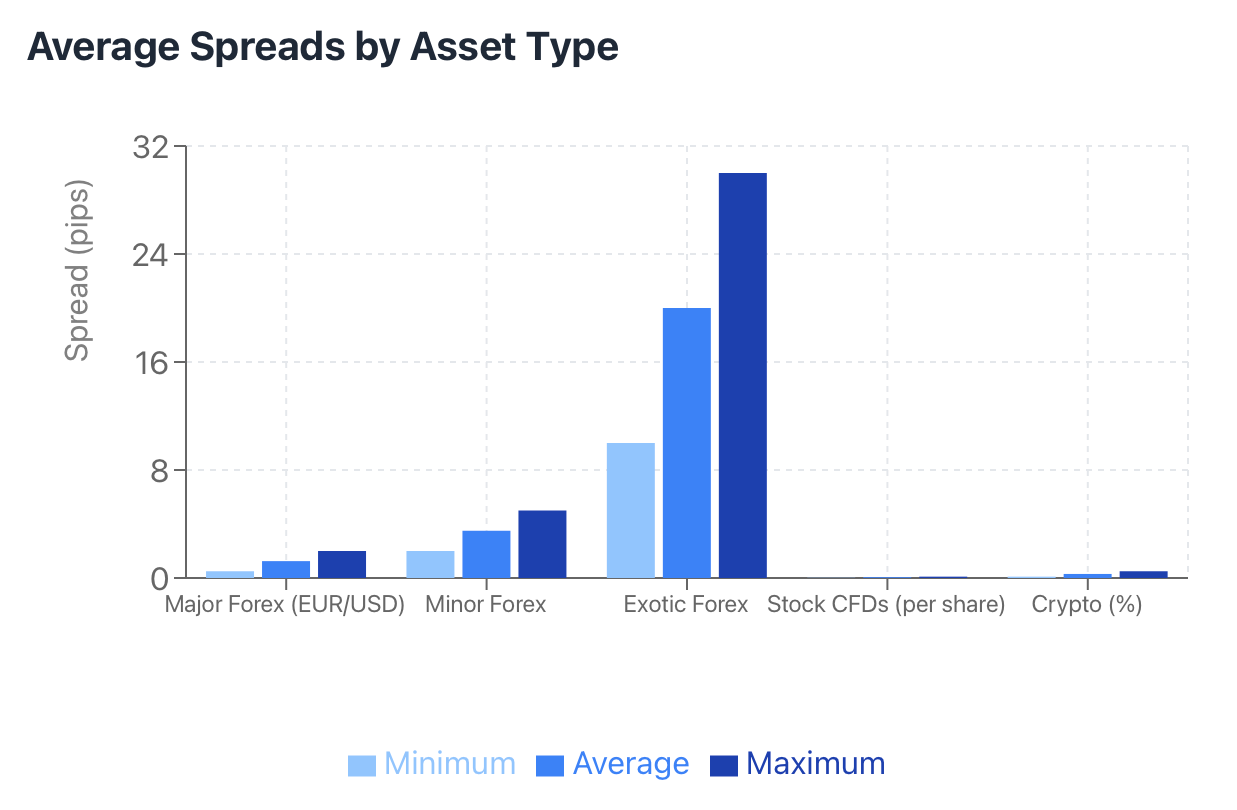
The difference in pricing of different markets is vast. For example, EUR/USD forex pairs have small spreads where an ECN broker may even have a spread of 0.5 pips. In contrast the spreads on exotic pairs or less liquid CFDs may be in excess of 10 pips. On the other hand, the stock spreads depend upon the volume of shares traded in each company and an example of large spreads are those on cryptocurrencies during periods of large market volatility.
Therefore, the bottom line is that spread is an important factor in calculating your overall trading costs. Your ability to accurately determine your profit risk will depend on whether you are going to trade short or long-term strategies. The spread will directly affect your ability to achieve trading profit targets and to develop trading methodologies that keep your costs at the lowest possible level.
Average Spreads by Asset Type:
-
Major Forex Pairs (EUR/USD, GBP/USD): 0.5–2 pips
-
Minor Forex Pairs: 2–5 pips
-
Exotic Forex Pairs: 10–30 pips
-
Stock CFDs: $0.02–$0.10 per share
-
Cryptocurrency: 0.1%–0.5%
Types of Spreads: Fixed vs Variable
Spreads offered by brokers can come in two different types; fixed spreads and variable or floating spreads. Realizing how fixed spreads differ from variable spreads will assist you in avoiding unnecessary costs as well as eliminating a lot of confusion.
When trading with a fixed spread, you are guaranteed that your spread will not change based on the conditions of the market. For example, if your broker offers you a fixed spread of 2 pips for the EUR/USD pair, you will always be charged exactly 2 pips, regardless of the level of volatility in the market at the time. Thus, the main benefit of this type of spread is that you know exactly what you are paying for each trade. The downside is that Fixed Spreads are generally wider than the majority of Variable Spreads during regular trading hours. Therefore, it is possible to pay a higher amount for the fixed spread vs. the variable spread in good market conditions.
Variable spreads are defined as spreads that fluctuate depending upon the levels of volatility and liquidity of the market at that particular time. Therefore, during high-volume trading activity (i.e. the London-New York trading overlap), you can typically expect to see the EUR/USD pair having incredibly tight variable spreads that are as low as 0.5 pips or less. In comparison, with heavily-weighted news events or during Asian time periods of low liquidity, that variable spread can increase to as much as 3 pips or more.
The taxi analogy for spreads is pretty useful. Fixed spreads will give you a fixed cost for your taxi ride, so if there isn’t much traffic, you might pay too much for the ride. Variable spreads will give you a cost that’s dependent on how much traffic there is. If you’re in an area with little to no traffic, your costs will be lower than if you’re in an area where there’s heavy traffic due to traffic jams or a large news event.
You will notice that spreads are treated differently for each asset. Typically, major forex pairs have the tightest spreads because they have the highest trading volume and, therefore, the most liquidity. For index-type assets like the S&P 500, spreads will typically be moderate as individual stocks’ spread will vary based on volume of trading. Commodities like gold will typically have wider spreads, especially when you’re not in peak trading hours.
So what type of spread is appropriate for you?
-
Scalp & Day Traders: Variable spreads during times of high liquidity. Watch out for news events; they will widen spreads.
-
Swing & Position Traders: It doesn’t matter what type of spread; Spread costs are insignificant over a longer time horizon.
-
News Traders: Fixed spreads will help prevent major spread widening during times of high volatility.
-
Beginner Traders: Fixed spreads will make the learning experience easier to understand; fixed spreads offer something predictable.
It is crucial that you determine which type of spread fits your trading style and risk tolerance.
How Brokers Earn from Money Spread
Have you ever wondered how brokers generate revenue? Most brokers rely primarily on spreads to generate income, which helps guide you in selecting the best broker for your needs and avoiding unnecessary costs.
To earn income through spreads, brokers operate on several different broker models. Each broker model determines how a broker generates a profit from the buy-sell difference:
Market-Maker Brokers: Market-maker brokers take the opposite side of the transaction to you. For example, if you buy EUR/USD, the market-maker broker sells EUR/USD to you. With this type of broker, you will pay a larger spread (typically 2–3 pips on the most traded currency pairs), and they make money off of the difference between what you paid and what they sold it to you for. The spread represents the markup of the broker. Some market makers also make money when you lose a trade, which creates a conflict of interest.
ECN/STP Brokers: ECN and STP brokers provide you with direct access to liquidity providers such as banks, hedge funds, and other traders. In exchange for providing you direct access to the liquidity provider, these brokers offer tighter spreads (often at 0.5–1 pips), but typically charge a commission on each trade in the neighborhood of $3–$7 per lot. The typical income source of these brokers is the commission that they charge, not the inflated spread.
Let's clarify the example. Suppose you have a huge forex brokerage that has 50,000 active traders and every trader, on average, trades 10 standard lots per month. If, for every trade, that brokerage earns 1 pip as compensation for providing their services (that equals $5 per lot), it means that each trader is generating $2.5 million per month for that brokerage in spread revenue alone.
Retailers have the same kind of relationship with their customers as brokers have with their clients. Retailers purchase their products in bulk from wholesalers at discounted prices and resell them to consumers for a profit; the difference between the discounted price and the intended retail price is the retailer's profit margin. Brokers do the same when they buy currency at the interbank market and sell it to traders at a higher price.
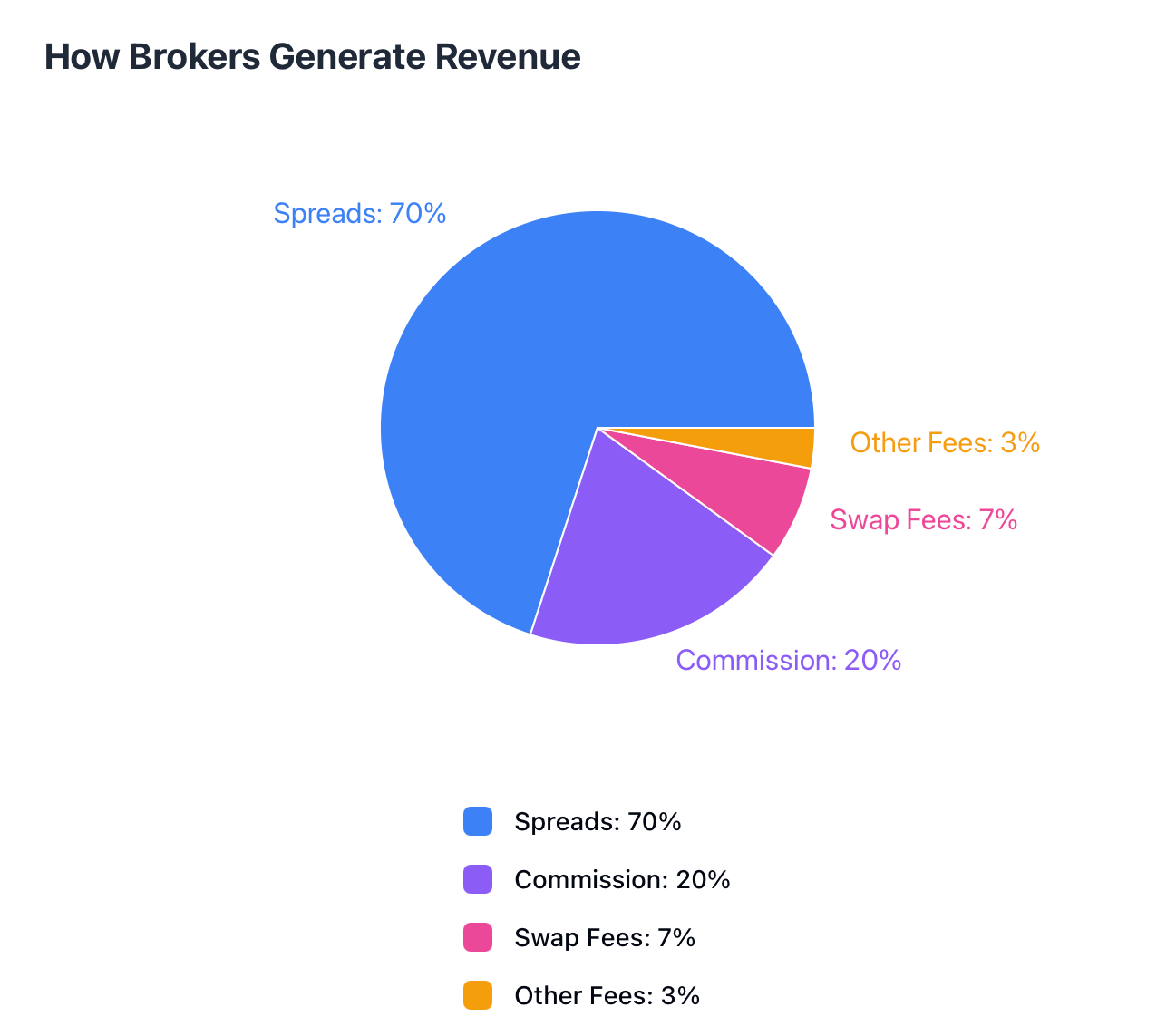
Here's a general breakdown of how brokers typically make money:
-
Spreads: 60% to 80% (particularly true for market makers)
-
Commission: 15% to 25% (mainly true for ECN/STP brokers)
-
Swap fees: 5% to 10%
-
Other Fees: 2% to 5%. (withdrawals, inactivity)
What does this mean for you? By understanding the various ways brokers make money, you can easily identify brokerages that offer low price options. ECN brokers that charge tight spreads and open and transparent commissions can be less expensive than market makers that charge wider spreads and hide markups. You should compare the full cost (spread + commission) before selecting your brokerage, instead of just comparing spreads.
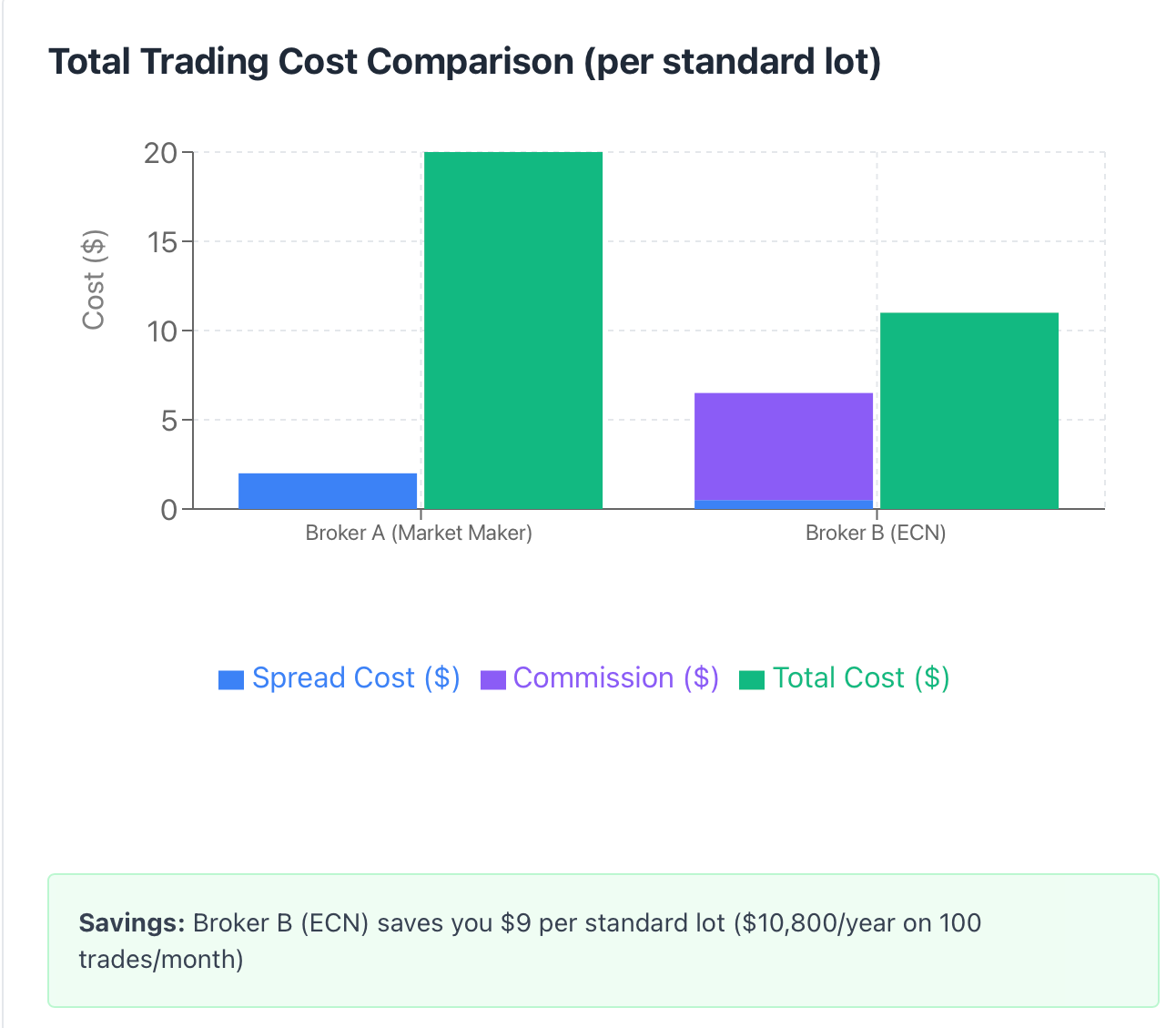
Broker A provides a spread of 2 pips and doesn't charge a commission, however, Broker B provides a spread of 0.5 pips and charges $6 per standard lot in commissions. In this case, the total price for trading a standard lot through Broker B is $11 ($5 + $6), thus Broker B is $8 cheaper than Broker A ($20). Therefore, it's important that you select carefully. What brokers make as revenue from your trades becomes your trading expenses.
How to Calculate and Understand Spread
The process of going through how to calculate the spread isn't overly difficult; however, it is really important to understand how to calculate spreads because they are the key factor for determining your total cost to trade.
The method used to calculate the spread is a really straightforward formula;
Spread = Ask Price - Bid Price
For example, let's take a look at an example for the EUR/USD currency pair. The bid price is 1.1048, and the ask price is 1.1050. To complete the calculation above, we will need to subtract these two amounts to find out that the spread in this case is 0.0002, which translates to 2 pips.
What does it mean when I say pips? A pip (percentage in point), as it relates to Forex Trading, stands for the smallest price change that can occur in Forex Trading. For the majority of currency pairs, the number of pips is equal to the price's fourth decimal place (0.0001) and for any currency pair involving JPY (Japanese Yen), a pip is equal to the second decimal place (0.01).
When we talk about the monetary values for pips, the amount will depend on the size of your position.
-
Standard Lot (100,000 units) - 1 Pip = $10 for the EUR/USD
-
Mini Lot (10,000 units) - 1 Pip = $1
-
Micro Lot (1,000 units) - 1 Pip = $0.10
Therefore, if you're trading a standard lot of EUR/USD with a spread that consists of 2 pips, your cost to enter the trade would be $20. Hence, the market must offset the spread by moving 2 pips in your favour before you can recoup the spread.
Consider it the same way you would if you were to order some food online. The total price for the food is $15, however you must pay $2 additional for delivery. Therefore, your total "up front payment" would be $17. In the trading world, the term "spread" represents the delivery cost.
Spreads will fluctuate during times of heightened volatility. For example, during periods of calm in the market, the EUR/USD may have a spread 0.8 pips wide. Conversely, when news events occur (for instance, announcements from the Federal Reserve regarding interest rates, or major job numbers) the spread may increase to as much as 5 pips or more, sometimes within a few seconds, due to dealers trying to protect themselves from fast swings in price and poor liquidity.
A practical example: during a normal day of trading you may see EUR/USD with the following spreads:
-
Asian Session (low liquidity): 1.5-2 pips
-
London Session (high liquidity): 0.5-1 pip
-
Major News Announcement: 4-8 pips
Pro Tip: Always look at the current price before you enter a trade, especially around events that create market activity. Most forex trading platforms (MT4, MT5, etc.) will post live quotes of the spreads. Something that may have appeared to be a very lucrative trade on paper can easily turn into a losing position if you enter during times of a spike in spreads.
Calculating accurately means knowing when your spread is good or if you should just wait it out.
How Market Liquidity Affects Spread
The abundance of liquidity is one factor that results in such narrow spreads among the various asset classes. Liquidity allows buyers and sellers to make their trades without significantly affecting the price of the asset. A large number of buyers and sellers represent a greater amount of liquidity, thus allowing more trades to occur at a lower price. Conversely, when there is a small number of buyers and sellers, there is a corresponding amount of decreased liquidity and, as a result, increased spreads. This is because fewer traders are participating in the market.
Here is a basic rule of thumb when it comes to liquidity: More liquidity will lead to narrower spreads, while less liquidity will lead to wider spreads.
Let's take an example of EUR/USD, which is the most widely traded currency pair across the globe. The most liquidity occurs during the overlap between the London Session and New York Session (which occurs from 8 AM to 12 PM EST). During this five-hour timeframe, there are a number of types of market participants actively trading. Therefore, the liquidity tends to be at its highest, which leads to spreads as low as 0.5 pips and typically no higher than 1 pip if you are using ECN type of brokers.
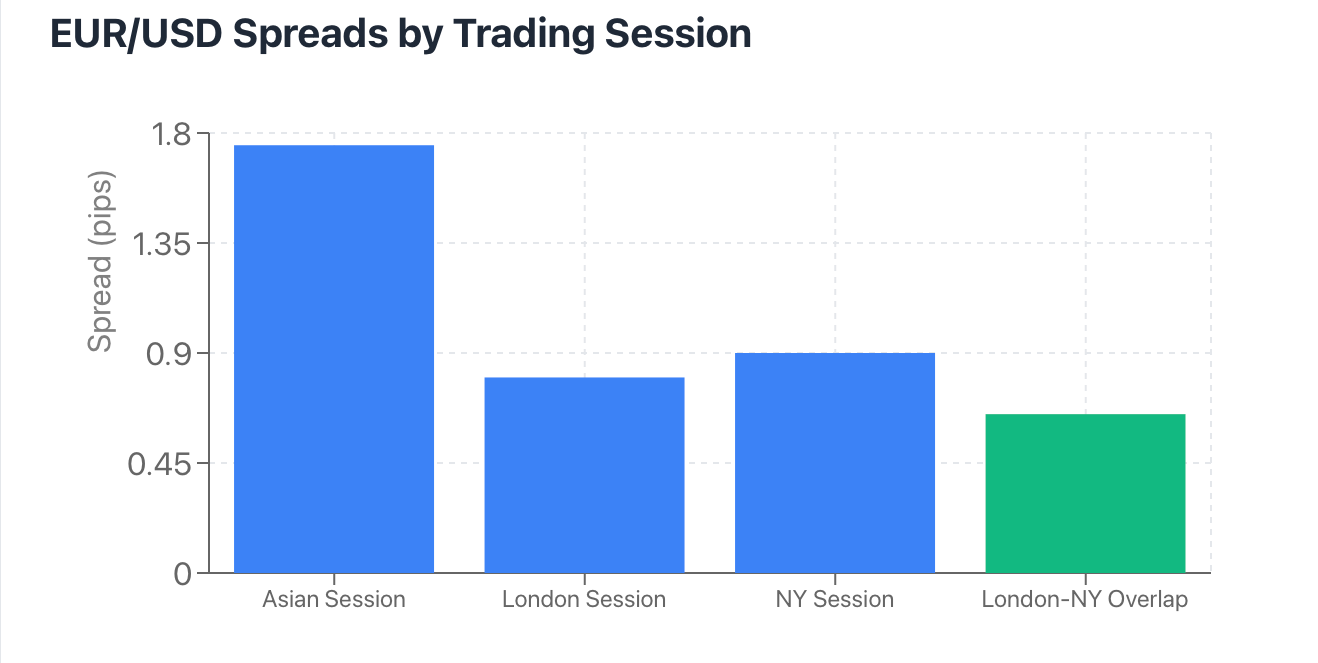
If you were to trade EUR/USD during the Asian Session (7 PM to 4 AM EST), you would most likely see spreads increase to anywhere from 1.5-2 pips. Why would that occur? Because of significantly fewer participants in the market, lower volume transacting, and lower levels of competitive advantages being exhibited among the liquidity providers.
Think of Liquid Market like going to the Supermarket - when shoppers pack out the aisles on any given day, they're buying and paying for their groceries at high volumes, which allow cashiers to check people out quickly, and all of these transactions result in lower prices on the checkout counter because the market is competitive.
However, if you were to go to the supermarket on a Sunday morning when there isn't much business going on (low liquidity), the prices at the checkout counter may be higher because the supermarket has less power when it comes to dealing with suppliers.
Different asset types have different levels of liquidity:
-
The major currency pairs (EUR/USD, GBP/USD) have ultra-high liquidity, and as a result have tight spreads.
-
Exotic currency pairs (USD/TRY, EUR/ZAR) have low liquidity, with spreads in excess of 10 pips.
-
Blue-chip stocks (Apple, Microsoft) have high liquidity during the trading hours of the market, while small-cap stocks have lower levels of liquidity and will have wider spreads.
-
The levels of liquidity of Cryptocurrencies can vary greatly depending on the exchange and also based on the time of day.
A comparison of spreads for EUR/USD based on session:
-
Asian Session based (Tokyo): 1.5 to 2.0 pips
-
London Session: 0.6 to 1.0 pips
-
New York Session: 0.6 to 1.2 pips
-
Overlapping Hours of London and New York: 0.5 to 0.8 pips
Scalpers and day-traders usually go for very tight spreads; therefore, timing is important to both groups. Traders should perform trades in the times of highest liquidity. The only exception would be if the trader's specific strategy is to execute trades during a period of low liquidity.
For swing traders and position traders, the fact that there are differences in spread on a session-by-session basis matters less because swing traders can hold positions for a few days or weeks at a time. However, even with their longer holding period, entering during high liquidity conditions will result in a lower cost for the trader when they enter the market.
To sum it all up, liquidity is your friend. When you trade during busy times, you will be able to execute transactions at lower costs.
How Spread Impacts Trading Strategies
The Spread is not just a cost to your trading, it is also a strategic element of your trading plan that can either help you to succeed or fail in executing your trading strategy.
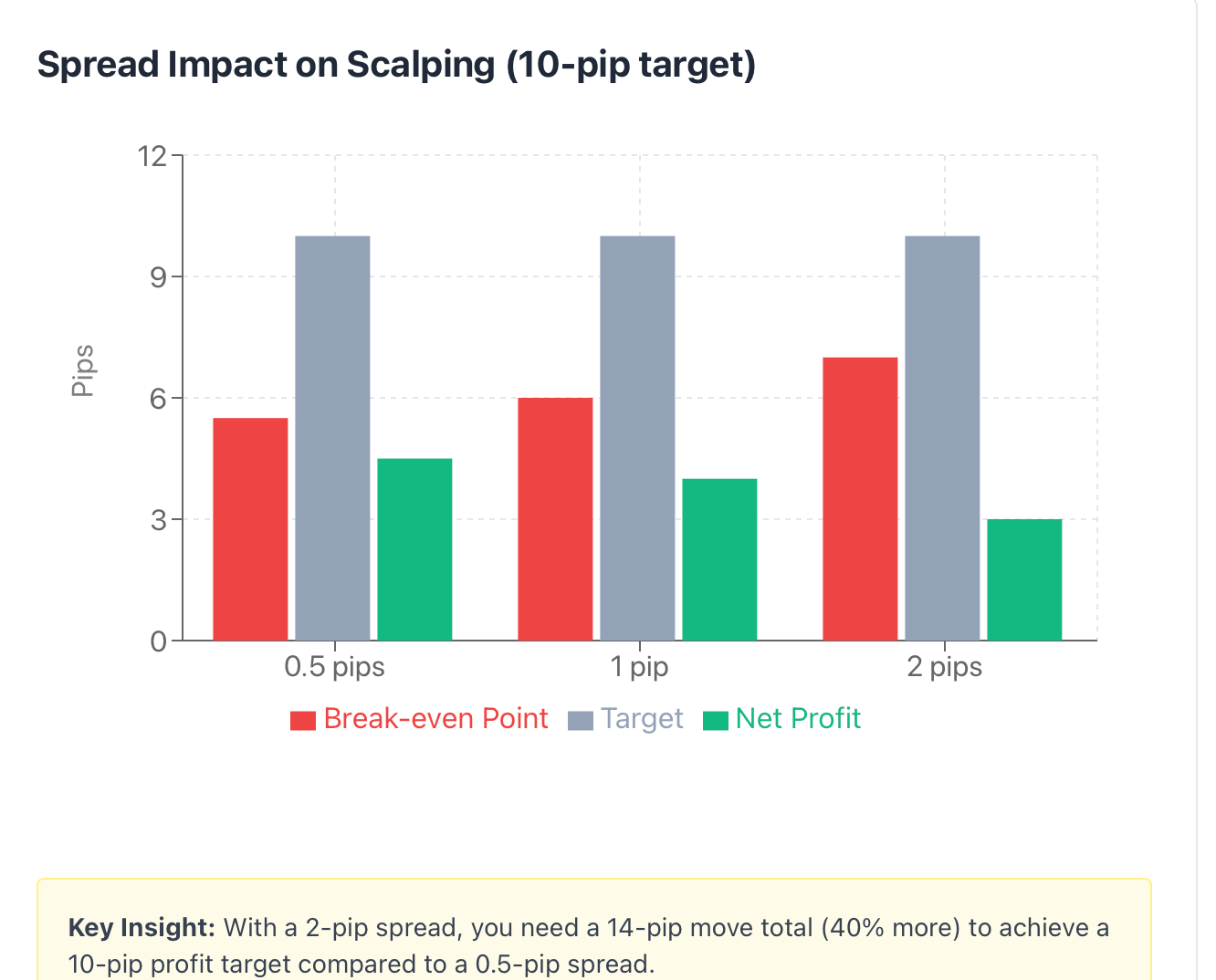
Scalping and Day Trading: Tight spreads are the lifeblood of the scalper and day trader. Scalpers attempt to capture 5-10 pips of movement per trade. Scalpers typically hold their positions for just a few minutes. However, when a scalper pays a 2-pip spread to enter and exit a trade, 4 pips are lost before the first dollar is made; thus a scalper has to achieve a 40% move in their favour to break even on a 10-pip target.
For example, suppose you are scalping the EUR/USD and your profit target is 10 pips. If your spread is 0.5 pips, you will need a move of 5.5 pips to hit your target (i.e., 10 pips + 1 pip total spread cost). If your spread is 2 pips, you will need a move of 14 pips from the time that you entered to the time that you exited (i.e., 10 pips + 4 pips total spread cost). That extra 8.5 pips makes a significant difference in your trading outcomes as a scalper.
Think of it like an online flipping business. You buy products for $20 and sell them for $22, you would think you were making a decent profit of $2. However, when you take into account transaction costs of $3 per trade, you are losing money on every flip of a product. The more frequent and smaller the trades, the more that each trade's spread cost affects your overall profitability.
Swing and position trading Strategies are considerably less prone to being affected by spreads. For example, let's say you opened a position on any given currency pair with the intention of holding it for 2 to 4 days for 100-300 pips of movement. A 2 pip spread would not matter because it would be insignificant noise. It is similar to purchasing a property and incurring $500 worth of settlement costs compared to having a potential profit of $50,000 due to appreciation.
Another key point is that many times when trades take place at the time of major market activity (e.g., Federal Reserve news releases (FNNP), Non Farm Payroll (NFP), or Central Bank Decisions), the spreads can often expand dramatically. For example: Typically, browsers would quote a 1 pip spread on Euro/$US Dollar (EUR/USD). However, that same spread during times of high volatility (due to a news event) could expand to between 5 - 8 pips within seconds.
Once you already have an open position at the time of the market activity, spread expansion does not directly impact your position. However, if your entry point occurs at a time of significant market activity, your stop and limit orders become farther away (on a relative basis) from your entry point.
Example: You are planning to open a position on EUR/USD with a stop-loss set at 20 pips at the time of the NFP News Announcement. The spread has now expanded to 6 pips. When you account for both the stop-loss and the spread, your risk has effectively increased to 26 pips (20 pips + 6 pip spread), or an increase in your risk by 30%.
Recommendations by strategy type for spreads:
-
Scalping: 0.5 to 1 pip spreads are essential for success in scalping. In scalping, only trade on the most liquid currency pairs during peaks in liquidity.
-
Day Trading: Acceptable spread for Day Trading is 1 to 2 pips. Only trade on the day of news events if you know the spreads will widen before the news release.
-
Swing Trading: Spreads of 2 to 3 pips are acceptable for swing trading and will not substantially impact the cost of the spread when traded over several days.
-
Position Trading: The spread has virtually no impact on position trades; instead, focus on the quality of execution and swap fee costs.
Spread and Risk Management
The impact of spread on trading costs extends well beyond the amount you pay in commissions; spread affects your risk management measures. When you consider how much extra money you are spending on spread prior to placing any bets on your trading strategies, what appears to be low-risk trades may actually represent a very high-risk situation that could lead to significant losses.
When you enter into a trade and use a spread measurement to determine the profitability of that trade, the moment you buy EUR/USD at the ask price (1.1050) and the bid price is at $1.1048, you are immediately down 2 pips. Therefore, your stop-loss and take-profit points will need to be adjusted because of this additional expense.
Now, say you will risk 1% of your total account balance ($100) when you trade with a stop-loss that is set at 20 pips ($100 for a half-standard lot, or 50,000 units) from the entry price, but due to the spread being 2 pips, your total risk is actually 22 pips, or $110. This means you have just crossed over the 1% risk threshold without it even crossing your mind.
How to incorporate spread into risk/reward calculations:
-
Adjust your stop-loss: Add the spread cost to your stop-loss distance. If you plan a 20-pip stop, factor in 22 pips if the spread is 2 pips.
-
Recalculate position size: Use your adjusted stop-loss to determine position size. Don't base it on the nominal pip value alone.
-
Account for entry and exit spread: You pay spread when entering and exiting. For scalping, this means 2× the spread cost per trade.
-
Use limit orders: Limit orders let you set your entry price, potentially reducing spread impact compared to market orders during volatile periods.
Example scenario:
-
Account size: $5,000
-
Risk per trade: 2% ($100)
-
Planned stop-loss: 25 pips
-
Spread: 2 pips
-
Actual risk: 27 pips (25 + 2)
-
Position size without spread adjustment: $100 ÷ 25 pips = 0.4 lots
-
Position size with spread adjustment: $100 ÷ 27 pips = 0.37 lots
The 0.03 lot difference may appear to be nothing to sweat about, but throughout the course of multiple trades, when you ignore spread, you run the risk of overtrading and accumulating excessive risk.
In addition to the risk of over-trading due to slippage, if the market drops quickly then a stop-loss order can execute at a much worse price than what was initially intended. Depending on how wide a spread is, a trader can easily experience up to a 25 to 30-pip loss.
Spreads are extremely important when it comes to managing your risk. They should not only be seen as an expense, but also as a risk multiplier that requires your attention.
Historical Trends and Spread Analysis
The spread is dynamic and is influenced by market dynamics, news announcements, and geopolitical events. By reviewing past spread movement patterns, you can time your trades. You can also predict when/if your costs may increase as the market becomes volatile.
Average spreads over the past ten years have shrunk due to an increase in brokers and advancements in technology in the foreign exchange market. For example, in 2010, a normal retail spread for EUR/USD was estimated to be between 2-3 pips. Currently, a typical ECN broker will have spreads that range from 0.50-1 pip for EUR/USD pairs within the high volume trading hours.
While the average spreads mentioned above have decreased over time, this trend does not occur in periods of increased market volatility. Major events cause larger than normal widening of spreads:
COVID-19 Pandemic (March 2020): When the COVID-19 pandemic hit, the EUR/USD spread widened significantly, going from a normal span of 0.8 pips to 5-10 pips. Many of the exotic pairs saw spreads that were higher than 50 pips. Many brokers widened their spreads to help protect them against the extreme volatility and very thin liquidity created by the exit of many institutional traders.
Brexit Referendum (June 2016): Prior to the vote announcement on the Brexit referendum, the typical spread for GBP/USD was between 1-2 pips. Following the vote result, the GBP/USD spread widened to 10-15 pips. After the GBP dropped 10% overnight, brokers were unable to accurately price their assets due to the extreme volatility created.
Flash Crash of January 2015 in the Swiss Franc: The Swiss National Bank's decision to halt support for its currency on January 15th led to a 30% drop in the value of the currency pair EUR/CHF. The volatility caused huge price movements in the spreads of currency pairs, with many brokers declaring bankruptcy, unable to absorb the losses incurred by their clients.
Think of it this way: when you go shopping around the holidays, you see competitive pricing at once due to the volume of customers, especially around Christmas or during Black Friday; however, near to the end of the shopping period, stores run out of stock, prices rise tremendously and you can be forced to pay extra due to the high demand for certain items, and thus the price increase. An example would be how financial markets behave during major events.
Spread Patterns before / after Major Events:
-
Federal Reserve Rate Decisions - Within 30 minutes of the Federal Reserve's announcement, and 30 minutes after the announcement, the spread on the EUR/USD will increase 2 - 4 times its normal spread level.
-
Non-Farm Payroll (NFP) Data - The major currency pairs have a tendency to see spreads increase 2 to 3 times their standard spread increase at 8:30 AM EST on the 1st Friday of each month.
-
Central Bank Surprises - Policy changes that come as a surprise to the market (ex: the Swiss National Bank Flash Crash) create such an extreme widening of spreads that it often creates instability for many asset classes.
-
Geopolitical Events - Wars, political instability, elections create drastic increases in volatility in all correlated asset classes.
Major Events that Affect Spreads from 2020-2025:
-
COVID 19 - March 2020
-
US Presidential Election - November 2020
-
Russia/Ukraine Conflict - February 2022
-
Inflation and begging of aggressive Federal Reserve Rate Increases - 2022-2023
-
Banking Crisis March 2023 - SVB, Credit Suisse
Historical records of spread behavior show the following:
Lowest spreads occur at these times:
-
The London-New York trading overlap of 8 AM to 12 PM EST.
-
Midweek trading from Tuesday through Thursday.
-
Periods of low volatility with no major scheduled events.
Highest spreads occur during these times:
-
Opening on Sunday evening and closing on Friday afternoon.
-
When major economic reports are released.
-
When there is an incident resulting from unexpected geopolitical crises occurring.
-
During holidays when liquidity is reduced.
Use historical spread data to establish your trading calendar. If you're a trader who is not prepared for widening to take place, don't open a position just prior to the release of significant news, and historical trends support the idea that while spread costs are relatively low compared to the market's movement over weeks or months, this is more pertinent to long-term traders.
Choosing Low-Spread Brokers
When you compare brokers, you will find that not all have the same type and amount of spread offered. Some brokers may offer larger or smaller spreads compared to others, and a better decision when selecting a broker can have a major effect on your future trading costs.
A comparison of the two types of brokers: ECN, STP brokers and Market Makers. ECN brokers provide you with direct access to liquidity sourced directly from multiple investment banks and/or liquidity providers. This means that their spreads tend to be very tight (e.g. 0.5-1 pips on forex pairs) but they typically charge a commission (approximately 3-7 dollars) for each round turn (meaning that if you buy a standard forex lot, you'll pay between 6-14 dollars depending upon the amount you trade).
Market Makers function as the "counter party" to your trades. While they also have a spread (normally 1.5-3 pips), they do not charge separate commissions for their services. Essentially the spread represents Market Maker profit.
To understand which is less expensive, let's look at an example:
-
ECN Broker: 0.6 pip spread + $6 commission for each LOT = $12 total cost
-
Market Maker: 2 pip spread, no commission = $20 total
For trades done in standard or mini lots, ECN brokers will normally be more economical; whereas if you are trading in micro lots, the fixed commission charged by the Market Maker may offer a better value.
The majority of brokers with low spreads will add additional costs that are not shown in the spread. Thus, it is important to avoid these hidden costs:
-
Swap Fees (Overnight Financing): These fees can cost between $5 and $15 per lot per night depending on how long you hold positions open.
-
Withdrawal Fees: Many brokers charge anywhere from $20 to $50 for each withdrawal.
-
Inactivity Fees: Dormant accounts can incur fees of anywhere from $10 to $50 per month depending on the broker.
-
Commissions on Stocks and Indices: Even though the forex spreads are tight, the commission charged for CFDs may be much higher than expected.
When evaluating the costs of trading, always consider the total cost charged by your broker, and not just the spread.
Examples of Low-Spreads Brokers:
-
IC Markets: An ECN broker with EUR/USD spreads starting at 0.5 Pips, and round-turn commission of $7.
-
Pepperstone: Razor account with an average spread of 0.6 Pips, and round-turn commission of $7.
-
FXCM: A broker with variable spreads starting at 0.8 Pips on major pairs, and select accounts with no commission on any trades.
The following are ways to check whether the spread is really low before signing up with a broker:
-
Demo Account: Set up a demo account with your broker and watch for the live spread during your normal trading hours.
-
MT4/MT5 Spread Indicator: Many platforms have the ability to view the current spread of that currency pair in the market watch window on MetaTrader.
-
News Events: Look at how much your broker widens their spreads when big news comes out, for instance, during a Federal Reserve announcement or Non-Farm Payroll report.
-
Comparison of Spreads Across Brokers: Set up demos at 3 to 5 different brokers and note how much each broker widens their spreads within a one week period.
The importance of Transparency can not be overstated. A trustworthy brokerage will provide the average spreads that they offer on their websites along with the ability to check if those averages are consistent in real-time. If a broker is not upfront about the spread or if they hide this information, consider this to be a warning sign.
When selecting a broker, think about what you would do if you were selecting a bank. You would want to compare the various services offered by different banks along with their fees, interest rates and service quality. The same approach should be used when selecting a broker for trading. A difference of just a few pips can amount to thousands of dollars in costs incurred when trading hundreds of trades.
When selecting a broker, you need to do your own research, test the brokers using demo accounts, calculate your total trading costs and determine which broker has the tightest spread, the best commission structure and the clearest pricing.
By combining low spreads with transparency, you can maximize your chances for long-term success when trading.
Spread and Profit Opportunities
While the spread is often viewed by traders as a cost, smart traders can view the spread as more than a cost but rather a way to trade with greater efficiency and profitability, and they can leverage that advantage by optimizing their short-term trades (scalping and day trading) by utilising lower-cost spreads. By trading through an ECN broker during the highest-volume trading sessions (when there is the most liquidity), traders can achieve a reduced cost of the spread of up to 50–75%.
For example: assume you are a scalper who trades an average of 20 times per day, and you trade with a standard lot size for each trade. Now, if the spreads were 2 pips wide, you would pay $20 for each entry (1 pip) and $20 for each exit (1 pip), thus the total spread cost for trading 20 times per day would be $800. If you were to reduce the spread cost down to 0.6 pips wide, then your total spread cost for trading 20 times per day would have been $12 per trade ($0.06 × $20 = $240) or $560 daily savings ($11,200 monthly savings).
Another way to leverage spreads for profit is through the use of spread arbitrage. Spread arbitrage involves taking advantage of the differences in the spreads between different brokers or taking advantage of discrepancies or inefficiencies in the trading market.
Here's a simplified example:
-
Broker A offers EUR/USD at 1.1050/1.1052 (2-pip spread)
-
Broker B offers EUR/USD at 1.1049/1.1051 (2-pip spread)
When you enter a trade at 1.1051 on Broker B while simultaneously closing that trade at 1.1050 on Broker A, you have ‘captured’ a 1 pip profit from this transaction (the 1 pip difference). To implement this trade strategy, you will need:
-
An ability to execute trades quickly (time frame can be less than 1 second)
-
A large amount of capital (because you will make only a small amount of profit per trade, you will want to execute many trades)
-
Accounts with multiple brokers
-
An advanced software program and/or algorithm
The strategy of spread arbitrage is quite complex and risky. Most brokers do not permit this type of trading and will put the transaction costs at such a level that your profit margins will become extremely small or none at all. This strategy is not for novice traders but does illustrate that using the right conditions, spreads can result in the opportunity to exploit the market inefficiencies.
Use tight spreads when conducting high-frequency trading. The profitability of your automated strategy (Expert Advisors on MT4/MT5) will directly depend on the spread. The same strategy may work successfully with a 0.5 pip spread but can become unprofitable and account for overall losses with a 2 pip spread, because these strategies are designed for high-frequency trading and small gains.
When conducting backtests of your strategies, use realistic assumptions about spread differences. Many traders design robots using historical data and assume tight spreads; therefore, they are baffled when they find out their robots lose money in live trading due to wider spreads.
Optimize your spreads like saving money through discount coupons. You only save a couple of dollars with each coupon you use, but when used repeatedly across numerous transactions, you can save thousands of dollars. In trading, saving 1–2 pips from spread costs creates exponential savings over time.
Practical profit simulation:
-
Strategy: Day trading EUR/USD
-
Average trades per month: 100
-
Position size: 1 standard lot
-
Average profit per trade: 15 pips
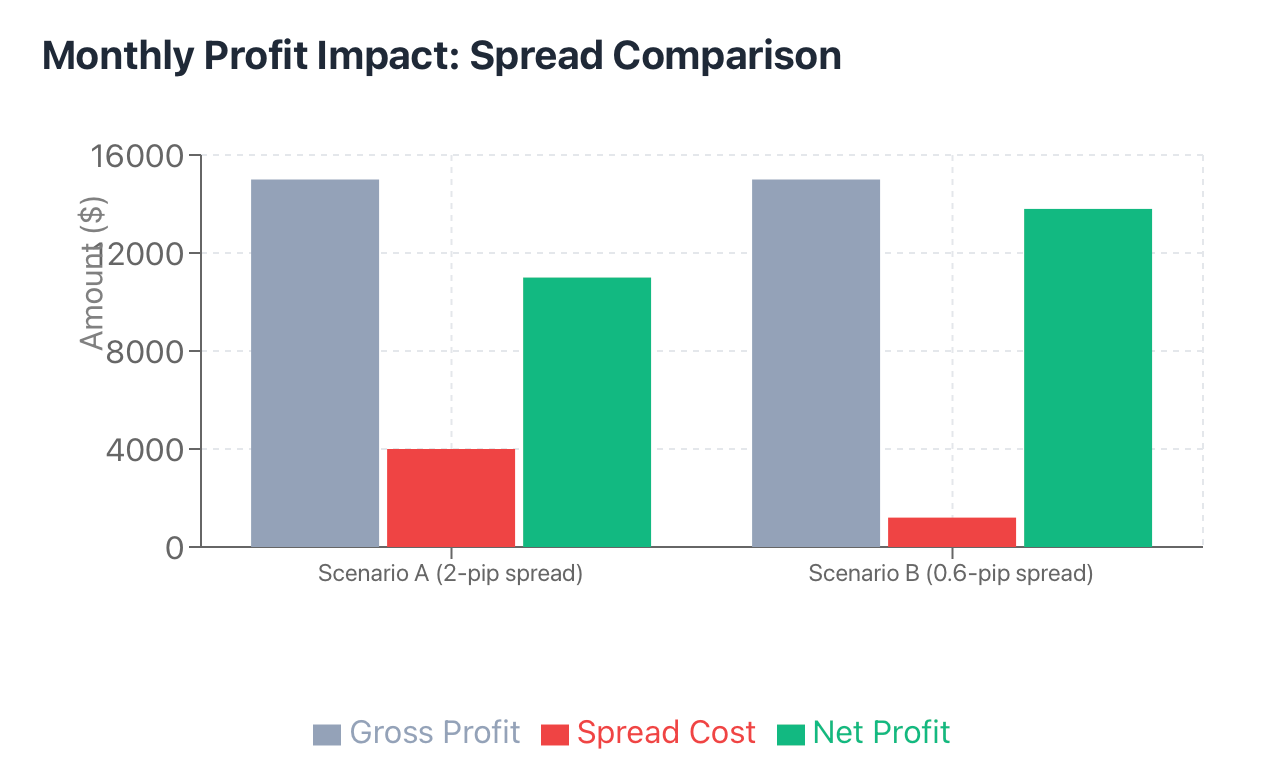
Scenario A (2-pip spread):
-
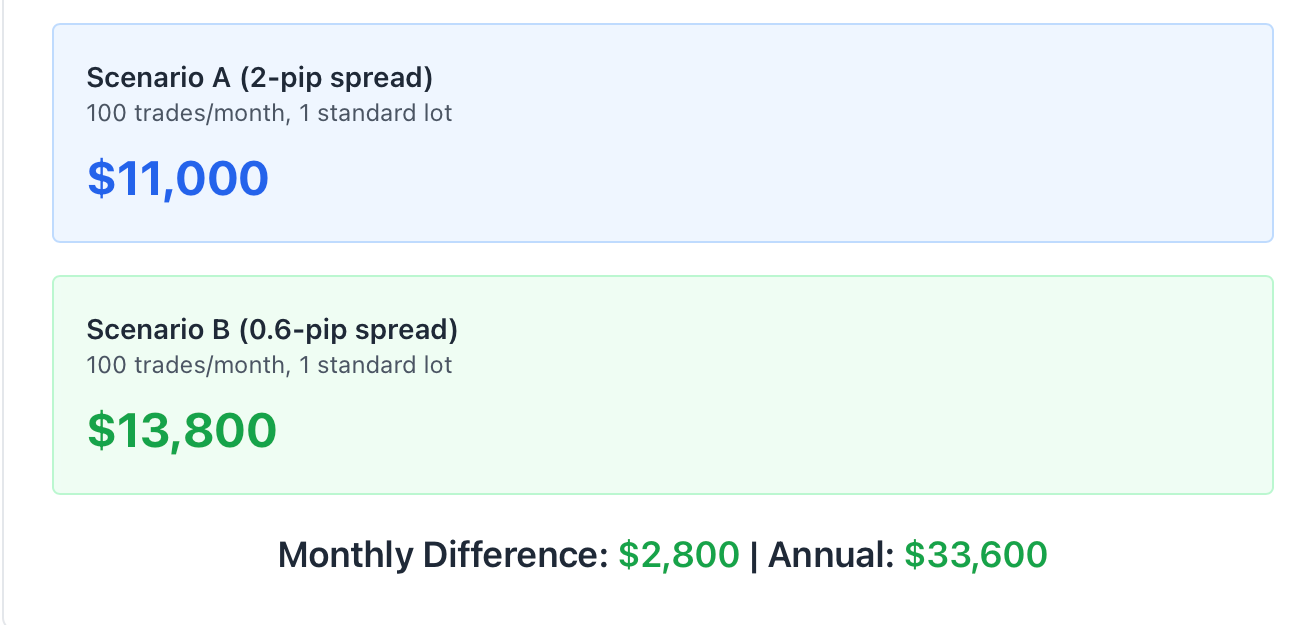
Net profit per trade: 15 pips - 2 pips (entry) - 2 pips (exit) = 11 pips = $110
-
Monthly profit: 100 trades × $110 = $11,000
Scenario B (0.6-pip spread):
-
Net profit per trade: 15 pips - 0.6 pips (entry) - 0.6 pips (exit) = 13.8 pips = $138
-
Monthly profit: 100 trades × $138 = $13,800
That's a $2,800 monthly difference just from choosing a lower-spread broker. Over a year, that's $33,600 in extra profit without changing your strategy.
Spread is both a cost and a tool. Minimize it where possible, and you'll maximize your edge.
Spread Optimization Tips for Traders
Your likelihood of eliminating spread costs completely is very low, however, if you follow smart trading practices, you can significantly decrease your chances of suffering from spread costs.
1. Trading in times of high liquidity
The highest liquidity and consequently the tightest spreads will generally occur during the period when the London and New York sessions overlap (8 am until 12 pm EST). During these hours, the major currency pairs (EUR/USD, GBP/USD, etc.) typically experience peak volume, which will result in brokers offering tighter spreads in the range of 0.5-1 pip or less.
Times to avoid trading:
During the Asian session (7 pm until 4 am EST) unless trading specifically targeting Asia.
At the opening of the market on Sunday evening (the spreads will be widest at this time due to the return of liquidity), as well as on Friday afternoon (the spreads will widen as institutional traders leave).
2. Order Types
When you place a market order, you will have your order executed at the current bid and ask prices. Therefore, if you buy at the currently listed ask price, you will incur the cost of the entire spread. However, by using limit orders, you are able to limit the price at which you are buying or selling. This gives you the opportunity to place an order at a lower price, effectively reducing the cost of the spread if there is a favourable market move.
Example: Suppose the EUR/USD has a bid price of 1.1048 and an ask price of 1.1050. If you buy at the market price of 1.1050, you will be paying the full price of the spread. If instead you place a limit order to buy the EUR/USD at 1.1049, if the price drops slightly you will be filled at a better price and will, therefore, benefit from a reduced spread cost.
3. Don't trade just ahead of a news event
When news events are released, the spread widens considerably prior to, and following, the news (NFP, FOMC meetings, GDP and inflation reports) 5-10 minutes. If you are not trading news with a strategy that takes advantage of this volatility, it is best that you simply do not trade.
Utilize an economic calendar (Forex Factory, Investing.com) to keep track of all significant news events scheduled for that day.
4. Select your broker based upon your trading strategy
-
If Scalper, select ECN/STP brokers with very tight spreads (0.5-1 pip)
-
If Day Trader, select brokers that offer variable spreads with very low commissions
-
If Swing Trader, both ECN and Market Makers suit your needs – focus on the quality of the broker's execution.
-
If News Trader, choose brokers who provide fixed spreads that will protect you against the potential to experience unstable, widening spreads due to volatility and market reactivity to an event.
5. Keep track of the real time spread
Most platforms (MT4, MT5, cTrader) provide the current spread of each currency pair. Take a few seconds to check the spread before you place a trade. If the EUR/USD normally has a 0.8 pip spread and suddenly has a 3 pip spread, this is an indication of a current market event (usually news or low liquidity). It is best to wait until the spreads return to normal before placing a trade.
6. Minimize slippage with stop-limit orders
Stop-limit orders provide protection from slippage and allow you to control the execution price. They will be activated at the level you specify, but they will only be executed at your limit price or better. This will help to reduce extreme slippage in a volatile market when spreads are much higher than normal.
7. Trade major pairs
Major pairs (EUR/USD, GBP/USD, USD/JPY, AUD/USD) have the tightest spreads due to high liquidity. Exotic pairs (USD/TRY, EUR/HUF) have spreads 5–10× wider. Unless you have a specific reason to trade exotics, stick to majors.
Session-based spread comparison for EUR/USD:
-
Asian session: 1.5–2.0 pips (avoid unless necessary)
-
London session: 0.6–1.0 pips (good)
-
New York session: 0.6–1.2 pips (good)
-
London-New York overlap: 0.5–0.8 pips (optimal)
Trading cost optimization checklist:
-
Trade during London-New York overlap
-
Use limit orders instead of market orders
-
Check economic calendar before trading
-
Monitor real-time spreads
-
Choose broker with lowest total cost (spread + commission)
-
Avoid exotic pairs unless strategy requires them
-
Use stop-limit orders for protection
-
Backtest strategies with realistic spread assumptions
Common Misconceptions About Spread
Let's bust some myths that trip up traders, especially beginners.
Misconception 1: The lower the spread offered by a Forex broker, the better.
Not necessarily; the spread (also known as the bid-ask spread) is just one element of your trading cost. For example, a Forex broker that posts a 0.3 pip spread may also have sub-standard execution quality, high slippage rates, or excessive commissions which negates the benefits of having a low spread. Make sure to calculate the total cost of trading including the bid-ask spread, commission, swap fees and any withdrawal fees associated with your trading activity.
Ultra-tight spreads (i.e. 0.1 pip) may come with other restrictions on how you trade (such as prohibiting scalping or placing limit orders). Make sure to read the fine print before opening an account with a Forex broker.
Misconception 2: High liquidity (e.g. EUR/USD) means that you will make a profit when you trade.
The presence of a high level of liquidity allows you to have access to tighter spreads and improved execution, but does not guarantee the direction of the underlying market. While you may trade EUR/USD during the London trading session with a 0.5 pip spread, you could still lose money due to your faulty analysis or faulty trading strategies. Although high liquidity reduces your transaction costs, it does not compensate for your lack of skill or knowledge in the financial markets.
Misconception 3: Fixed spreads are inherently safer than variable spreads.
Although fixed spreads may provide predictable levels of execution quality and transaction costs, fixed spreads are generally wider than variable spreads, especially during normal trading conditions. Therefore, if you are trading outside of major news events, you are likely paying for the security of knowing what your spread will be, even when you may not need that level of assurance. Thus, variable spreads will typically offer an advantage to experienced traders who know when the market may be experiencing increased volatility and avoid trading at those times.
Misconception 4: "The only cost of trading is the spread."
The spread is not the only cost associated with trading. There are costs associated with holding a position overnight (swap fees) and also with withdrawing money. So before you open a position just because you think you are getting a good deal for a low spread make sure to calculate what the total cost of the position will be, not just what the spread cost will be.
For example if you were to buy a EUR/USD position for 3 days at a spread of $10. You would also incur an overnight swap fee of $8, or $24, for the 3 nights the position is held. Therefore the total cost for the position would be $34, not $10.
Misconception 5: "Long-term traders do not care about spreads."
The spread means less to long-term traders, but still has some impact. If a long-term trader enters and exits the market on a regular basis, the "normal" 2 pip cost of the spread may seem trivial when comparing it to the potential $2000 that could result from a 200 pip price move. If you enter and exit frequently then those 2 pip spreads will add up fast.
Misconception 6: "All brokers have the same spreads."
Different brokers have different sources of liquidity, use different models for pricing, and set different markups for dealers. For example IC Markets may have a EUR/USD spread of 0.6 pips, while a competitor may show 2 pips for the same moment in time. You need to compare brokers.
Things to watch for regarding hidden fees:
-
Fees associated with withdrawals: $10–$50 per transaction
-
Fees charged for account inactivity: $10–$50 monthly if there has been no trading activity for a period of time
-
Currency conversion fees incurred when depositing or withdrawing in non-base currencies: 0.5%–1%
-
Commissions for owning shares of stocks or indices: $0.01–$0.10 per share, irrespective of the tightness of forex spreads
It’s similar to booking a plane ticket at an excellent rate; the original price of the ticket may be $50, but when you factor in check-in baggage charges, seat selection costs, and online booking service charges, you’ll likely pay at least $150. In the same way, your total trading costs should reflect numerous factors, including withdrawal fees, inactivity charges, currency conversion fees, and commission charges, without any exceptions!
Avoiding these common misconceptions will enable you to become a more informed and profitable trader.
Summary and Key Takeaways
The main takeaway from all the previous information is the following core lessons and actionable pieces of advice to help you trade more intelligently and reduce your overall trading expenses:
These are what we’ve covered:
-
The Money Spread (the difference between the bid and ask price) is an important cost of doing business when you trade.
-
You can use it as a reference point in evaluating your profit potential.
-
It's important to understand that fixed spreads are more predictable than variable spreads - variable spreads change based upon market conditions.
-
Brokers get compensated in different ways, including: spreads, commissions, and other fees.
-
To calculate a spread, simply subtract the bid from the ask and use pip conversion based on your position size to determine the total value in currency.
-
Close to market opening hours (high liquidity) the spreads tighten (get smaller) and as we get further away from the opening hours, or to a lesser extent during an uptrend or flat market, the spreads will widen.
-
Different trading strategies are sensitive to the size of spreads - for example, a scalping trader requires a very tight spread while swing traders are less impacted by the size of the spread.
-
Additionally, for traders who have invested in risk management techniques, the size of the spread must be factored when placing stop-loss orders.
-
Historical data indicates that during periods of crisis and significant economic news announcements, spreads tend to widen and ECN/STP brokers offer the tightest spreads and transparent pricing.
-
Finally, to optimize spread costs, trade during high liquidity conditions and use limit orders.
Actionable advice:
-
Choose the right broker: Compare total costs (spread + commission + fees) across multiple brokers using demo accounts. ECN brokers are usually cheapest for active traders.
-
Match strategy to spread conditions: Scalp during London-New York overlap with tight spreads. Swing trade when spread is less critical.
-
Avoid high-volatility traps: Check economic calendars and stay out before major news unless you're prepared for spread widening.
-
Monitor spreads in real-time: Use your platform's spread indicator to verify current costs before entering trades.
-
Calculate realistic costs: Factor spread into risk/reward calculations and position sizing. Don't base decisions on nominal pip values alone.
Simple trade simulation showing spread effect:
-
Trade: Buy EUR/USD
-
Position size: 1 standard lot
-
Entry: 1.1050 (ask price)
-
Exit target: 1.1080 (30 pips profit)
-
Spread: 2 pips
If you disregard spreads, you could earn a profit of $300 (30 pips x $10). However, remember that you are charged a spread on both the entry and exit (2 pips each). That totals 4 pips ($40). Therefore, the true amount you profit by is $260. That's $800 in spreads you did not factor, if you had a winning streak of 20 trades.
Optimizing and understanding spread is probably not exciting, but it is a critical element in obtaining long-term profitability from trading. Each pip that you save on the spread is an additional pip in your profit. Therefore, saving even a few pips on hundreds or thousands of trades can significantly add to your total profits.
Whether you are just starting as a new trader or currently refining your any area of trading, keep the spread in mind as part of how you evaluate your overall trading. Track your spread costs, reduce them, and take them into consideration when making your trading decisions.
Trade smart. Trade with knowledge. Make every pip count!
Create a Free Account at TradeWil.com, experience super-fast trade execution with spreads starting as low as 0.5 pips for the most popular currency pairs. You'll stop giving brokers way too much money with their crazy high spreads, and you'll start making the most with our totally transparent pricing, no hidden fees and ECN liquidity designed exclusively for serious traders.
Disclaimer: The content of the blog does not represent any position of Trade W, does not serve as any trading-related decision advice, and does not endorse any third-party.