

 Trade W

Introduction
The foreign exchange market is the largest and most liquid financial market in the world, with an estimated daily trading volume of $7.5 trillion according to the Bank for International Settlements (BIS). This figure is more than the annual GDP of most countries and dwarfs other financial markets. In this enormous market, currency pairs are the basic building blocks of all forex trading.
It is important to understand the major forex pairs and, more importantly, what makes them popular and attracts the most trading volume. Popular pairs have a few advantages for both rookie and professional traders: their huge liquidity allows you to enter and exit positions with ease; their small spreads lower your trading costs; and their greater transparency means more effective price discovery and technical analysis.
When you go overseas and exchange dollars at the airport for euros, you are participating in essentially the same process driving the EUR/USD currency pair, the most popular currency pair in the world. The only difference is that forex traders buy and sell those currencies hoping to profit from price movements, and they are not just exchanging money so they can spend it while being on holiday.
The fundamental question that this report, and ultimately our entire website is addressing, is quite simple and critical: what are the most traded currency pairs in the world and why are they rated so highly by millions of traders?
If we can understand why this is the case, it will help us make decent trading decisions when it comes to choosing currency pairs to trade.
The sheer size of the forex market is mindboggling; and it's not just a number, but reflects the decisions made by central banks, multinational corporations, hedge funds and individual traders involved in the international trade of currencies. This creates opportunities for people who know how to follow the market signals and who spot which currency pairs to trade that can give them profitable opportunities with minimal risk.
What Are Forex Currency Pairs?
Before we jump into the most popular pairs, we need to understand what currency pairs are and how they work. A currency pair is the quote of one currency against another. Every pair has a base currency (the first currency in the pair) and a quote currency (the second currency in the pair).
For example, if you're looking at the EUR/USD and it's trading at 1.10, that means you can exchange 1 euro for 1.10 US dollars. The EUR is the base currency and the USD is the quote currency. When you see this rate, you are basically looking at an amount of quote currency (USD) needed to purchase one base currency unit (EUR).
When you look through exchange rates, it is important to see the base currency and keep your focus on the base currency. Understanding how to read exchange rates is the very base of forex trading. If the EUR/USD moves from 1.10 to 1.12, that means the euro has strengthened against the dollarmeans that it requires more dollars to buy the same amount of euros. If the rate falls to 1.08, it means the euro has weakened against the dollar.
Currency pairs fall into three distinct categories, each with unique characteristics:
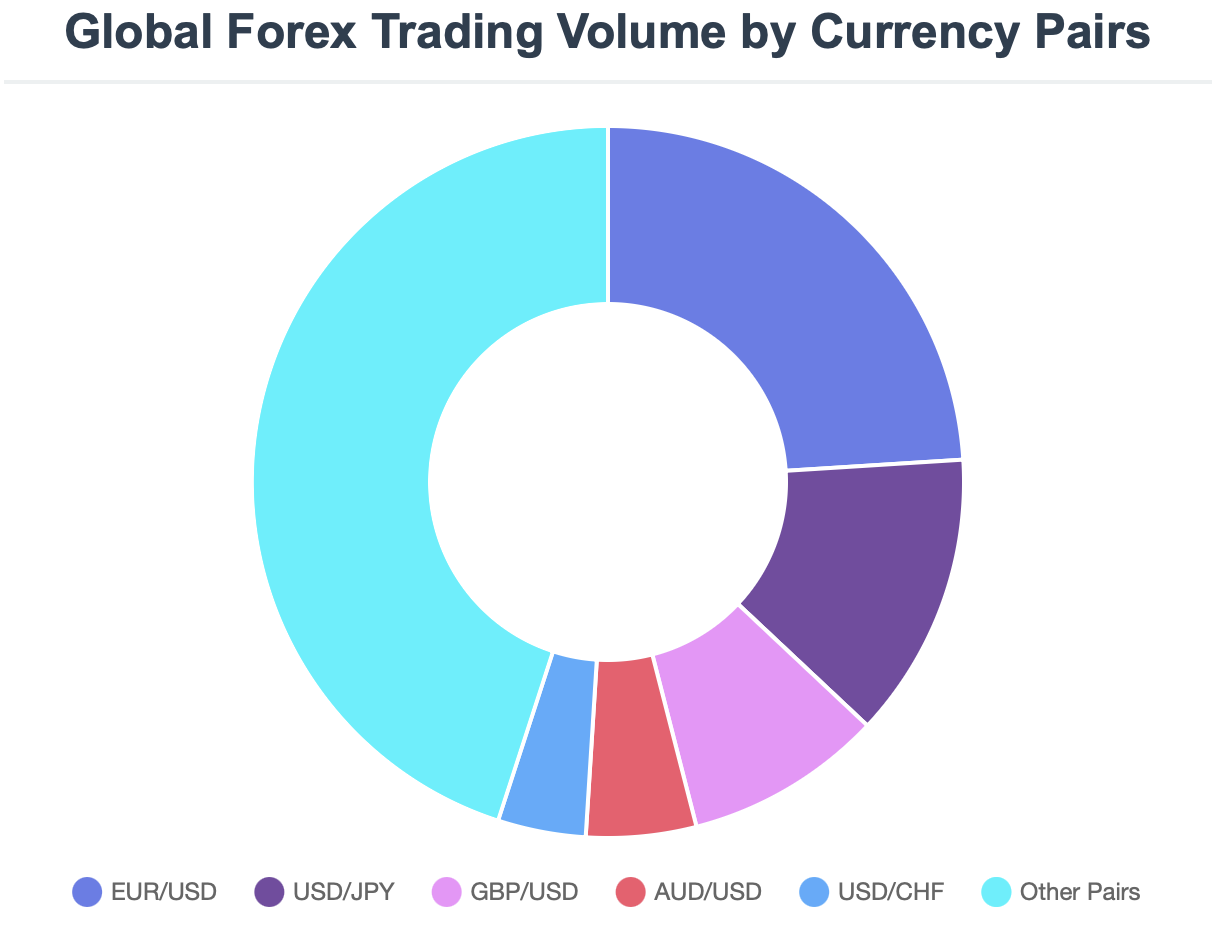
Major Currency Pairs include the most liquid and frequently traded pairings. Major Currency Pairs always involve the US Dollar (USD) as one of its components, paired with one of the several other major currencies. Major pairs include, EUR/USD, GBP/USD, USD/JPY, USD/CHF, AUD/USD, USD/CAD, and NZD/USD. According to Bank for International Settlements (BIS) data, major pairs represent approximately 84% of all forex market trading activity.
Cross Currency Pairs, or just "crosses" as discussed in Forex trading, contain no USD currency pairing. Some popular crosses include EUR/GBP, EUR/JPY, and GBP/JPY. Crosses can exhibit a different price structure and provide further diversity for traders to capitalize on.
Exotic Currency Pairs, which pair a Major currency and a currency originating from an emerging economy or a smaller economy such as USD for TUR (Turkish Lira), or EUR/ZAR (South African Rand). Exotic Currency Pairs typically will have higher profit potential; however, exotic pairs typically have wider spreads and greater volatility.
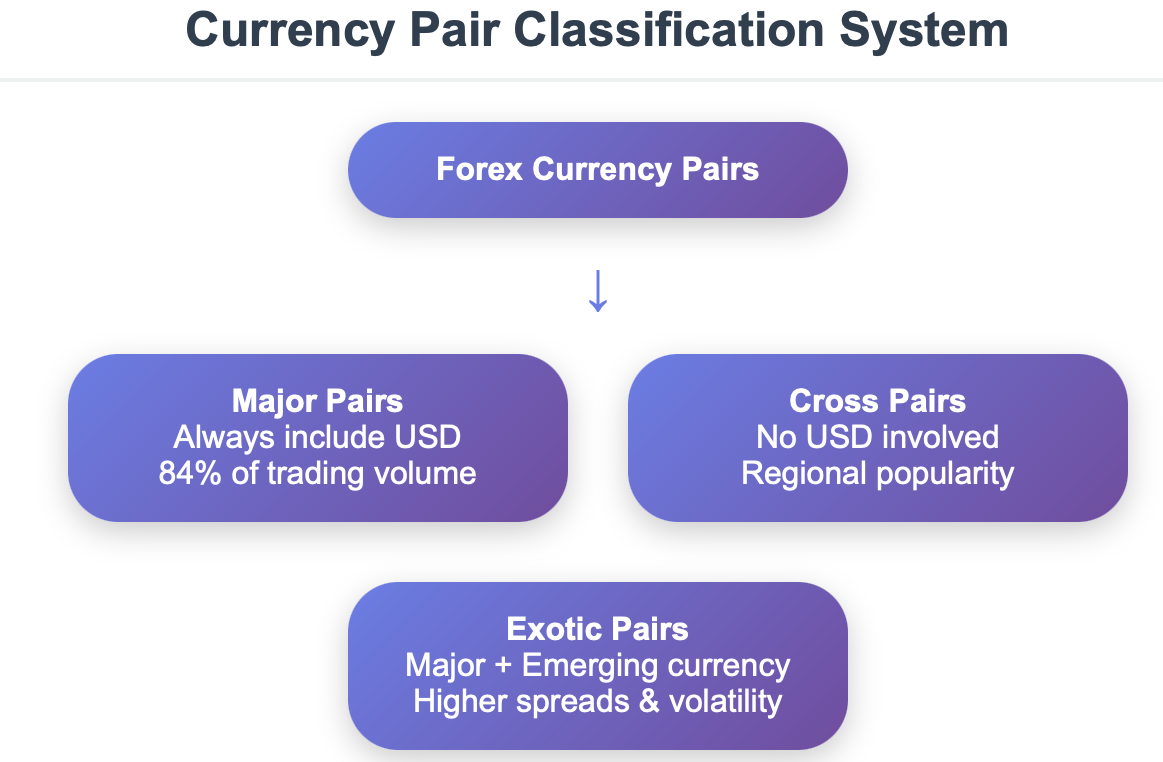
The classification system is Major currency Pairs as globally popular beverages they are extremely readily available, are typically very popular retaining a consistent taste, and can be found almost anywhere. Cross currency pairs could be popular in a region, while exotic pairs may provide interesting tastes, but have limited availability, can be pricey and provide less potential overall.
This classification system isn't random; it is grounded in real differences in trading costs, liquidity, and volatility, and these affect your trading experience. Major pairs usually have the tightest spreads and the most predictable price action, making them the easiest to trade from a behavioral standpoint for novice traders, while exotic pairs may offer opportunities to experienced traders who can accept higher costs and risks.
The Most Common Forex Pairs (Top 5 Listing)
According to an exhaustive review of trading volume, market analysis, and all that stuff; there are five currency pairs that are nearly always at the top of foreign exchange trading all around the world. They all have unique character and qualities that appeal to different types of traders and investment strategies.
EUR/USD The King of Currency Pairs
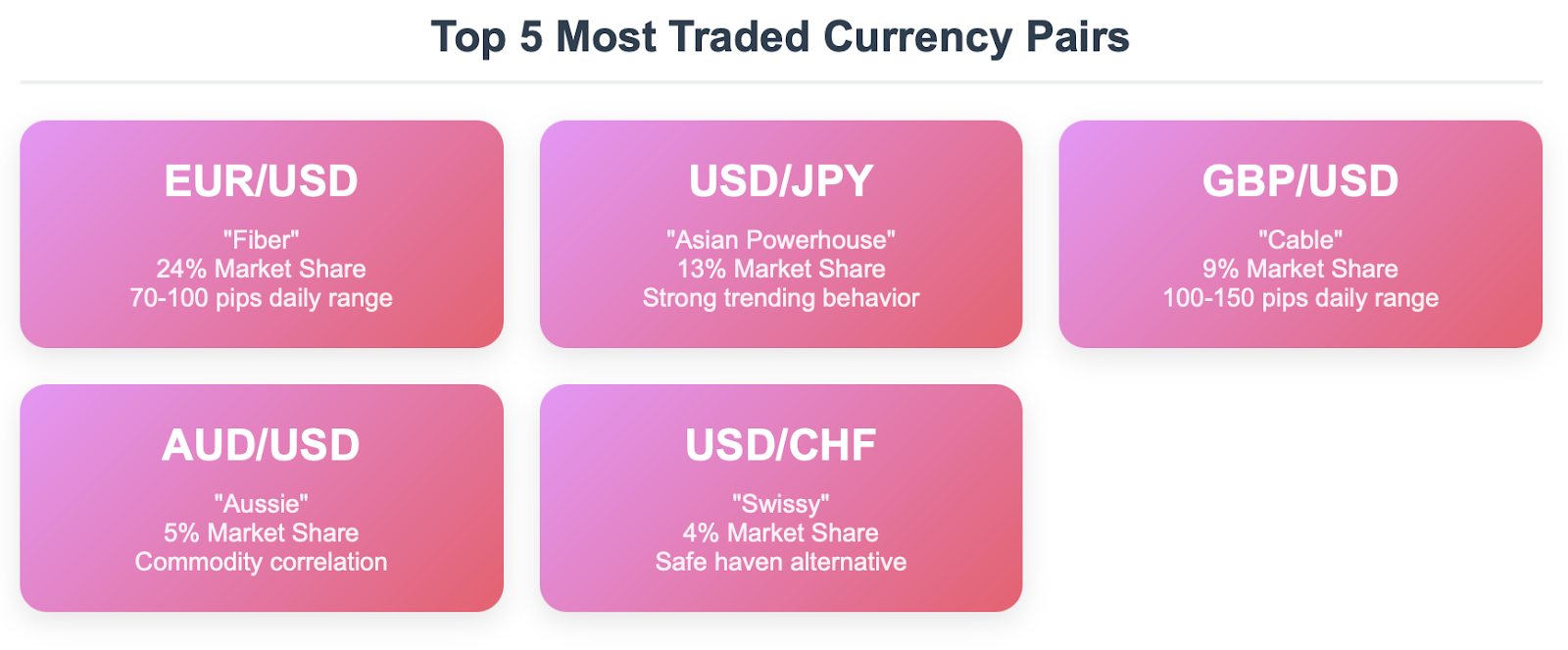
The EUR/USD pair (nicknamed "Fiber") represents approximately 24 percent of all forex trading volume making it the king of currency pairs. The EUR/USD features exceptional liquidity, with spreads sometimes as low as 0.1 pips during each major session as well. The popularity of this pair originates from the fact that it consists of and represents the two largest economic blocs in the world, the European Union and the United States.
Key characteristics include moderate volatility (typically 70100 pips average daily range), so it suits both conservative and aggressive trading styles. The pair responds predictably to major economic data releases, Federal Reserve announcements, European Central Bank policy decisions, and geopolitical events affecting either region. An example was in 2022 when the pair broke parity (1.00) for the first time in 20 years when the Federal Reserve began an aggressive tightening cycle and attention on the energy crisis in Europe increased.
USD/JPY The Asian Powerhouse
With around 13 percent of global forex volume USD/JPY is the entrypoint to Asian markets and a barometer of global risk sentiment. This pair has its own particular characteristics including that it always trends strongly when directional moves begin, often in longlasting and sustained trends over weeks or months.
The Japanese yen is a leading safehaven currency, which means USD/JPY typically drops in times of global uncertainty as investors rush towards the safety of the yen. Conversely, the pair can rally strongly in riskon scenarios. The volatility of USD/JPY increased dramatically during the 2020 pandemic, moving from 102 to 112 over a matter of weeks as the global economic consequences were absorbed by the markets.
GBP/USD The Volatile Aristocrat
GBP/USD is referred to as "Cable" (in reference to the transatlantic cable which used to carry the quotes). GBP/USD makes up almost 9% of forex volumes. This pair has a reputation for higher volatility than other majors; GBP/USD can move 100150 pips per day which makes it very appealing to traders seeking larger price movements.
GBP/USD is impacted by Brexit events, Bank of England policy decisions and UK economic data. Due to the pound's exposure to political developments, this pair is extremely newssensitive and hence represents both opportunities and risks for traders.
AUD/USD The Commodity Currency Champion
The Australian dollar represents about 5% of the global forex volume, which is why it is regarded as the commodity currency champion. The movements of AUD/USD follow commodity prices very closely, especially gold and iron ore, due to Australia's status as an exporter of natural resources.
AUD/USD also represents the broader global growth story and provides insight into the health of the Chinese economy, being Australia's largest trading partner. AUD/USD strengthens in times of global economic optimism but tends to weigh down the pair during tougher times or uncertainty.
USD/CHF The Safe Haven Alternative
Rounding the top five at about 4% of trading volume, USD/CHF has a unique dynamic between two safehaven currencies. The Swiss franc is typically a store of value when things are uncertain, which creates an interesting pair to trade.
Moreover, due to the relationship between the euro and Swiss franc, USD/CHF would often move inversely to that of EUR/USD. There are also times in which the Swiss National Bank intervenes to keep the strength of the franc from accelerating too far, which adds an additional dynamic for experienced traders to look to take advantage of.
These currency pairs act as a tugofwar between two economies. The economy with stronger growth, higher interest rates or a more stable political environment will generally pull its currency higher. If you want to know which direction each pair will move depending on economic fundamentals, knowing that one economy is stronger than the other is all that matters.
4. Macro Drivers and Central Banks
Central banks are the primary drivers of currency values through their monetary policy decisions, so understanding how they operate and what drives their decisions is fundamental to anyone serious about forex trading.
For all intents and purposes, the Federal Reserve (Fed) is the epicenter of the forex universe given that the US dollar is in approximately 88% of all currency transactions. If the Fed hikes rates, the ripple effect will be felt throughout the entire global financial system.
The 20222023 period is an excellent case study: by aggressively hiking rates from near zero to over 5%, the Fed created massive strength across all major pairs for the US dollar.
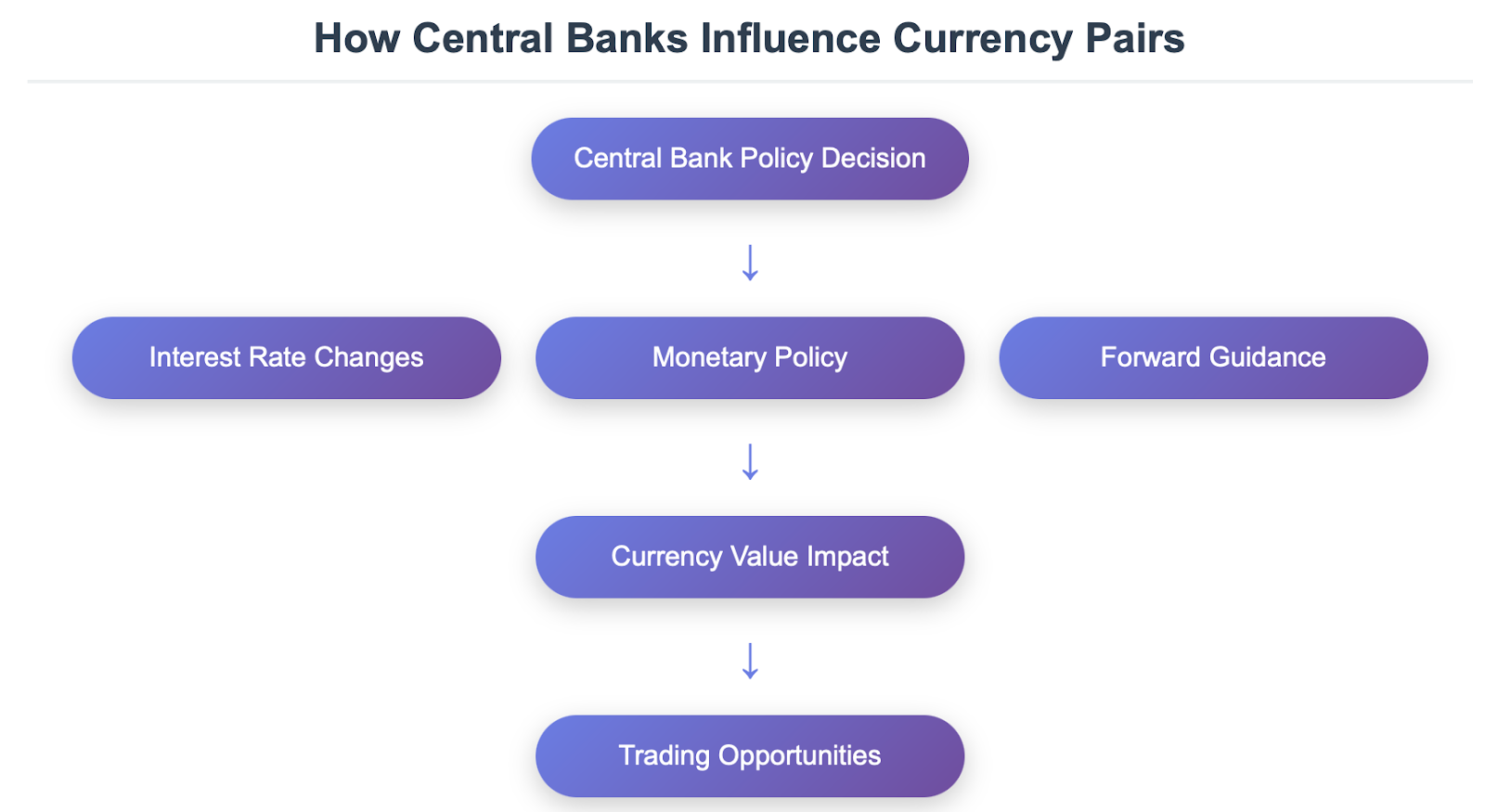
The European Central Bank (ECB) oversees monetary policy in the eurozone and can greatly impact EURbased pairs if they decide to change policy. The challenge the ECB faces is that it is managing monetary policy for 19 separate countries with different economic conditions. The ECB's decisions on interest rates, quantitative easing programs, and forward guidance will directly impact trading with measures such as the EUR/USD, EUR/GBP, and any other euro crosses.
The Bank of Japan (BoJ) has run an "ultraloose" monetary policy for over 20 years and the BoJ has kept interest rates near zero or negative as a countrypolicy choice. This would facilitate the recognised "safehaven status" of the currency and influence any trends in USD/JPY volatility. The BoJ's awareness of tricky and critical psychological levels, such as 150 with USD/JPY, demonstrates how central banks can create rapid trading opportunities should they intervene in currency trading markets.
The Swiss National Bank (SNB) operates in a different fashion to both the ECB and the BoJ by heavily focusing on not excessively strengthening the Swiss franc which could hurt the Switzerland economy that relies on exports.
In 2015, what surprised everyone in the global currency trading market was the degree of movement when the SNB decided to remove the EUR/CHF floor. This was unquestionably one of the most massive and dramatic currency moves in modern currency trading history showing how powerful a central bank's policy size can be.
Key macroeconomic indicators that make up the decisions of these central banks include:
Mostly, inflation data is what central banks will tend to focus on first, since these banks generally have inflation targets around 2%. In the case that inflation is above this target, central banks act ahead of higher inflation by raising rates, and the currency appreciates. Conversely, if inflation falls below this target, the losing of rates and weakening of currency often follows from.
Labour data such as the US NonFarm Payrolls gives a level of insight to the economy as well as whether wage pressure is growing. Strong labour data leads to more rate hikes and weak labour often leads to monetary accommodation.
Gross Domestic Product (GDP) growth rates tell a similar story. Higher economic growth typically demonstrates more strength in a currency appreciation cycle, while economic contraction often leads to currency depreciation as the central banks begin constraining monetary policy.
The complexity of a global economy results in similar decisions being made by countries based on the policy decisions of a central bank. For example, if the Fed is in a period of tsunami aggressive rate hikes at some point some banks may begin to take policy action related to their own interest rates to avoid any unnecessary capital leaving their currency.
Understanding these relationships will allow traders to interpret currency moves easier from economic data releases and central bank communications. The most important thing to understand is that central banks and monetary policy are working off of different time frames. For actors making responses to market moves to policy announcements from a central bank, you could expect these actors to develop trend patterns fairly quickly.
In the case of longer term policies from central banks that may take months and years to develop, such as interest rate hikes/cuts or new policies, there may not necessarily be the same type of trend patterns from the actors market responses as they would have a longer commitment horizon of decisions to make to comply with the monetary policies.
Geopolitics & Safe Haven Currencies
Geopolitical events and global uncertainty produce some of the biggest movements in forex markets, especially benefiting what traders call "safe haven" currencies. Safe havens rise in value as investors seek safety during uncertain times, creating patterns that are predictable and tradeable for experienced traders.
The US dollar is still the world's primary safe haven currency for many reasons: the size and liquidity of US Treasury markets, the dollar's role as the global reserve currency, and the stability of US institutions. At the onset of the 2020 pandemic, the dollar index increased over 8% in only a few weeks as global investors scrambled to find dollardenominated assets.
Meanwhile, the Japanese yen serves as the primary safe haven currency in Asia with quite a unique characteristic: when global crises arise, the Japanese yen tends to strengthen, even though the Japanese economy is struggling.
Strong demand for yen during uncertain times occurs because Japanese investors, who own significant investments in other countries, sell their foreign assets and repatriate their money back to Japan, increasing the demand for yen. The yen’s safe haven status was evident during the 2008 financial crisis when USD/JPY was crushed from 124 to 87 as panic spread globally.
The Swiss franc is the third and final safe haven. Switzerland's stance of political neutrality, a strong banking structure and a conservative fiscal policy provide strength for the franc in times of uncertainty. The significant complexity in trading the CHF lies in the Swiss National Bank attempt to fight excessive strength in the franc.
During times of crises, the capital flows tend to happen in predictable patterns that create trading opportunities for traders. Once geopolitical tensions arise, (not just from military conflicts, but from trade wars or political instability), money will flow from there risk assets (emerging market currencies, commodities or markets, stocks) towards safe havens. The movements will have a domino effect.
When money begins to flow from risky or emerging markets, then these emerging market currencies will weaken, commodity backgrounds will weaken and the fragile market will lose value. The other effect will be the strong safe haven currencies will appreciate value against the other currencies.
Sophisticated traders learn how to monitor ongoing geopolitical events not just to react for short term trades, but also for longer term positions. Safe haven currencies typically appreciate during crises and can potentially remain strong until it is clear that normalcy is back, thus creating a longer term trending opportunity for traders willing to wait.
Trader Psychology & Market Action
The psychology of forex has a selfperpetuating logic to it as well which explains why some currency pairs always remain en vogue. It is important to understand the psychology of why certain currency pairs are traded, for the purposes of successful trading in the forex markets.
Herd behavior is a key aspect of why the major monetary pairs remain such dominant currency pairs. When the majority of traders all trade pairs like EUR/USD, the aggregate liquidity and participation creates the very liquidity that these pairs are attractive for. When market liquidity is high, more traders come in so the cycle is selfperpetuating.
High liquidity can yield a few psychological advantages that make traders keep returning to more popular pairs. The first great benefit of trading in a liquid market is the lower risk of slippage, or the difference between the expected price and the actual execution price. When you place a trade in EUR/USD during normal market hours, you are almost guaranteed to get a price very close to what you see on your screen. If you were to try and do the same thing with a more exotic pair like USD/ZAR, you may experience enough slippage to drastically cut into any profits you were hoping to lock in.
Another advantage of trading in liquid markets is that technical analysis becomes more relevant. Chart patterns, support and resistance, and indicators work better in markets with high participation. When thousands of people are looking at the same EUR/USD chart, they all see the same support level and place orders based on that level of support. The motions of thousands of traders (placing stop losses, initiating trades, etc.) give greater significance to that price level.
Professional traders don't trade the major pairs because they offer the promise of the greatest return. They trade major pairs because they offer the greatest predictability in terms of risk and reward. A professional trader who manages millions of dollars of other people's money cares more about consistency than they do about longshot outcomes. They believe that they will have some predictability when trading EUR/USD so managing risk is easier.
The learning curve effect can enhance this psychological bias toward popular pairs. New traders are bound to gravitate toward the pairs they see most frequently covered in trading education and through financial media. EUR/USD dominates the educational content in trading, so if you are a new trader, it is understandable that you would start learning to trade this pair and that, even once you have gained some experience, you would continue trading it.
For instance, there is an interesting parallel to be drawn with the gaming industry. Popular online games are easier to learn because more players produce content, tutorials, and communities around them. The same argument can be made for trading because the popular forex pairs have large amounts of educational resources, analysis, and trading tools created by participants, they are more accessible to participants new to the trading arena.
For example, market sentiment indicators may work more effectively in popular pairs because they gained can take on a larger representation of participants in the market. If retail traders are generally long EUR/USD, this sentiment analysis will be useful for contrarian trading. In exotic pairs or other thinly traded markets, the data sets of sentiment may represent a less reliable sample of the small number of participants in the market and subsequently are less reliable.
Psychologically, it is significant to recognize that trading pairs you are already familiar with provides traders with comfort. Many great traders focus their attention on just a couple pairs and become specialists who recognize nuanced patterns and behaviors tailored to trading their pairs.
Nonetheless, these psychological preferences associated with popular pairs can lead to blind spots. This might limit the trader's ability to capitalize on opportunities in less popular pairs, or lead to an inappropriate assessment of risk when diversifying.
It is important to understand these psychological preferences while remaining objective about where the best opportunities lie.
7. Practical differences between Popular Pairs
For the purpose of matching your trading style to the right market conditions, it will be important to understand practical differences between popular forex pairs. Each of the major pairs have unique characteristics that tend to favour different styles and levels of expertise.
Volatility Comparison
The EUR/USD trades on average 70100 pips each day, making it ideal for traders who prefer predictable and less volatile movements. The moderate volatility offers opportunities for both scalpers (traders who make small frequent profits) and for position traders (longer term). The pair does not experience extreme spikes in volatility unless significant news events occur.
The GBP/USD is by far the most volatile, showing daily movement of 100150 pips. More volatility in price movement promotes higher profit potential but also incurs more risk. Overall, GBP/USD is best for swing traders, who are getting in and out of the position over a severalday period, to take advantage of larger price movement.
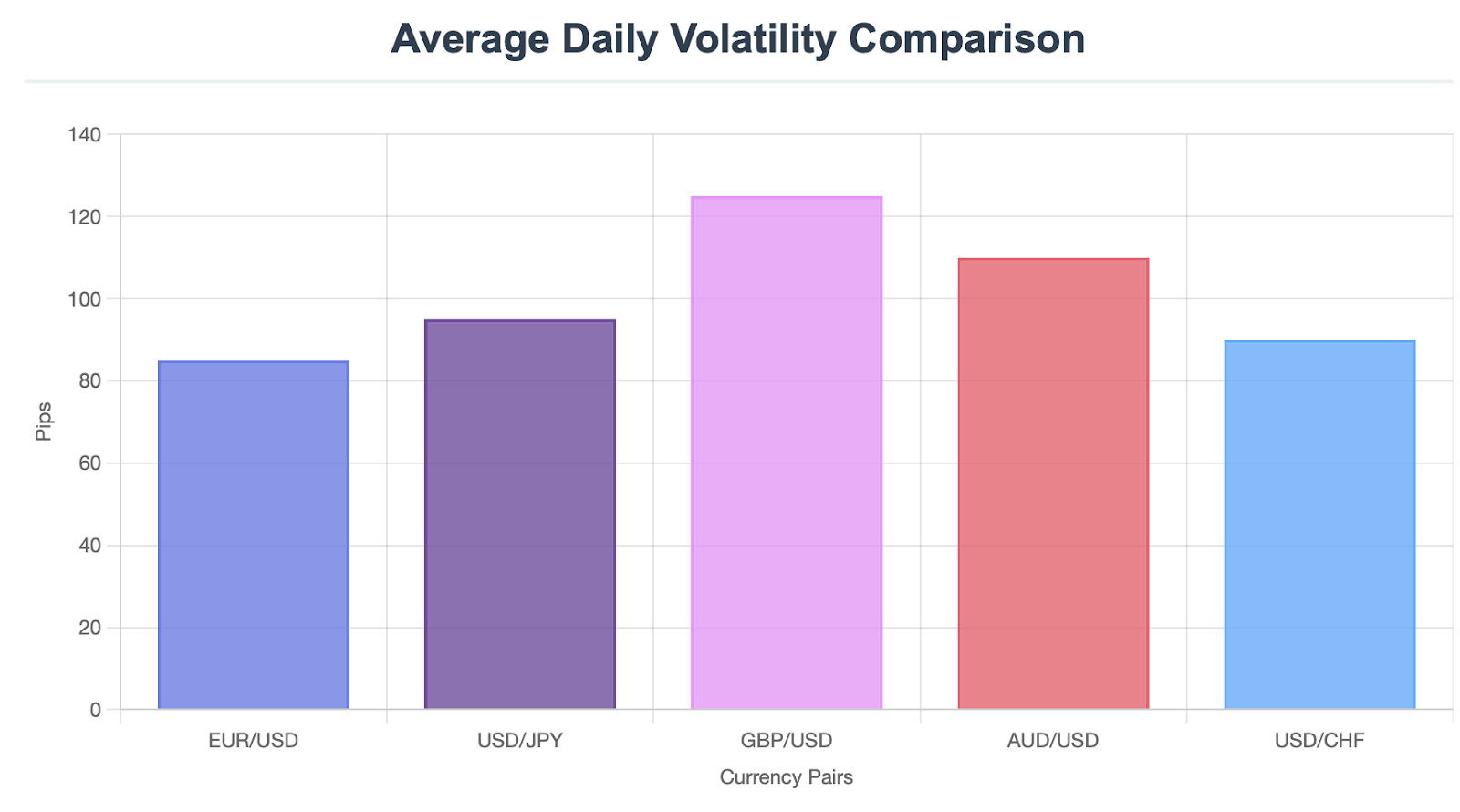
When considering the volatility of the USD/JPY, it lies between the EUR/USD and GBP/USD in terms of volatility; however, it has distinct fixed trending behaviors. Once the USD/JPY begins its directional move, it is more likely to have an extended move in that direction. This is great for trend following opportunities.
The volatility of AUD/USD is strongly tied to commodity price movement, and the sentiment of the Asian and Asiapacific markets. The AUD/USD can also be more stable during a European and US market session; there can also be gaps in the opening price action when the Asian markets digest the latest Chinese economic news and it impacts commodities.
Spread Comparison
Spread is the difference between the bid and ask price and also the costs associated with your trading. During high traffic trading times, spreads are as follows.
EUR/USD: 0.10.3 pips
USD/JPY: 0.20.4 pips
GBP/USD: 0.3.0.6 pips
AUD/USD: 0.40.8 pips
USD/CHF: 0.30.7 pips
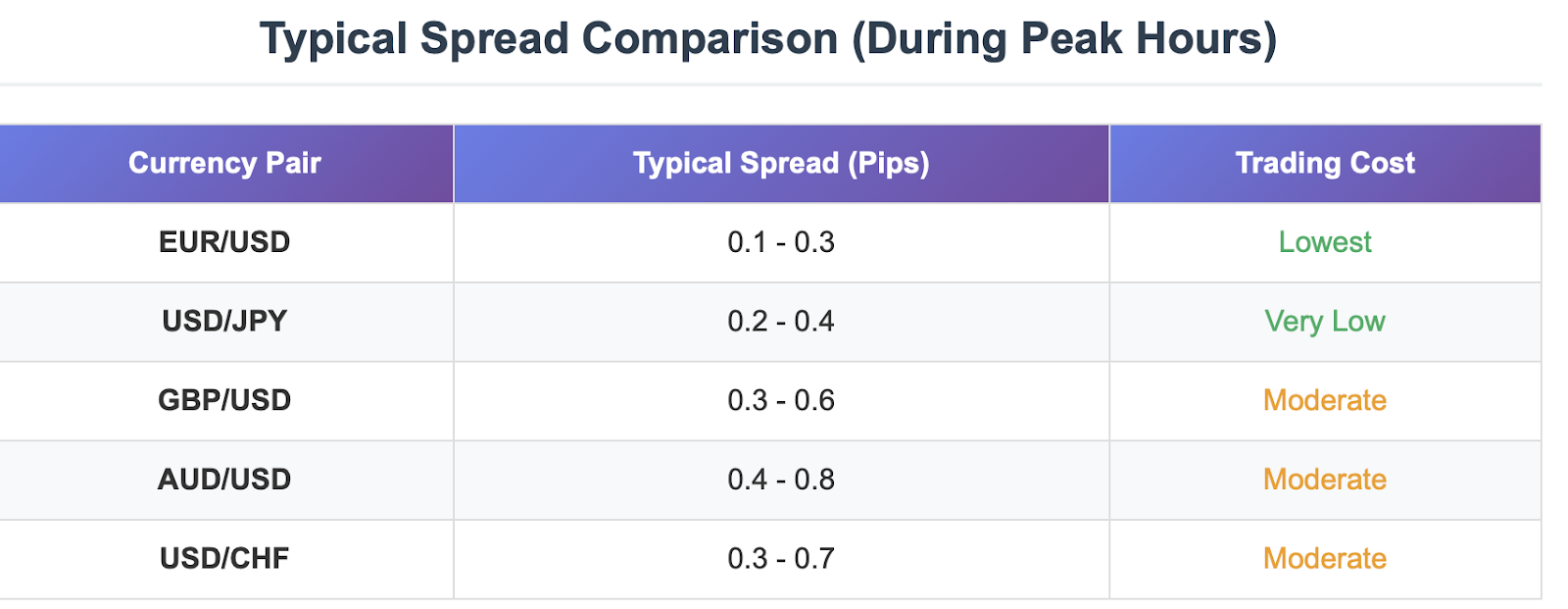
The differences might seem minor but can add up quickly for active traders. A scalper, trading 50 times a day, would incur far more costs on spread using GBP/USD compared to EUR/USD.
Active Trading Sessions
Each pair has high activity during different global trading sessions:
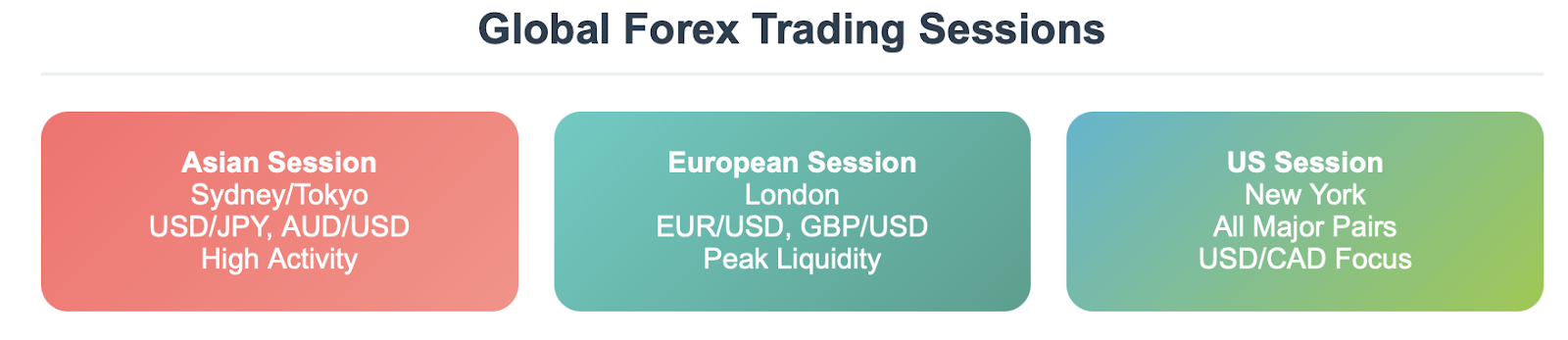
Asian Session (Sydney/Tokyo): USD/JPY and AUD/USD have high activity. The European and American pairs usually trade in a narrow range during Asian hours.
European Session (London): EUR/USD, GBP/USD, and USD/CHF reach peak liquidity. The European session usually creates the largest market movements during the day for European pairs.
US Session (New York): All major pairs retain liquidity, but USD/CAD and other pairs with US economic data releases exhibit higher volatility.
Overlap times of trading sessions create the best trading situations. The European/US overlap at 8 AM 12 PM EST usually creates the best liquidity and volatility for most major pairs.
Suitability for Different Types of Traders
New traders should stick with EUR/USD as this is a good pair with a moderate amount of price movement, a good spread, and easily accessible educational content. Additionally, the EUR/USD tends to react similarly to news events which is helpful for learning about basic news trading and fundamental analysis.
Once a trader gets used to understanding the forex market, he/she could progress to USD/JPY or GBP/USD. Take for example USD/JPY. This pair tends to trend more than other pairs making it an excellent pair for a trader who is focused on developing trendfollowing techniques. GBP/USD offers potential for a higher risk/reward trade, which will attract intermediate traders comfortable with higher volatility.
Advanced traders price for a particular pair or will trade multiple pairs at the same time. Advanced traders may select to use AUD/USD for a commodity trading strategy or USD/CHF for its safe haven characteristics.
Scalpers will tend to position themselves with EUR/USD or USD/JPY during peak trading periods. As a result spreads are tight and price action is consistent within the trading range.
Swing traders generally trade GBP/USD or AUD/USD as these pairs provide traders with more price range opportunities from daytoday which can be rewarded to the traders position held longer than a day up to several days.
The key understanding is that there is no universally "best" forex pair; only the forex pair that is most aligned to a trader's trading style, personality and risk appetite, and if they actively traded multiple pairs with success then they would be relatively new to "forex" trading. As is seen, many professional or successful traders eventually only trade one or two pairs and they become very good at only trading those two or one pair, rather than being some what average on 20 different markets.
The Application of Strategy and Risk Management
To execute successful forex trades utilizing popular currency pairs requires rigor in risk management, taking into account the unique properties of each pair. Without good risk management, even the most liquid pairs have the potential to make substantial losses.
Basics of Position Sizing
The single most important component of you forex risk management is proper position sizing, determined by your account size and from the pair's volatility. Generally, the rule is that you should be risking no more than 12% of your account on a single risk, and within this context the chance of using 12% is proportional to how volatile the pair is.
For example, if you are trading EUR/USD, with its relatively moderate 80pip average daily range, then perhaps you might set a to stop loss at no more than 40 pips, in this case risking 2% of the account. However, if you were trading GBP/USD with a 120pip average range, you alternatively might set a stop loss at 60 pips, and you would have to determine how to reduce your position size proportionately to risk it the same 2% of the account.
Use of Leverage
High leverage is the greatest opportunity and greatest danger associated with forex trading. You might justify the increased risk with a larger margin level on majors due to the seeming stability, but remember that even small moves in currency markets can translate to large impacts to the account when leveraged.
Here is an example: The EUR/USD moves 1% (or approximately 100 pips). That represents an impact of approximately 10% on your account if you are trading with 10:1 leverage. In the same situation, if you had 100:1 leverage, the effect on your account would be 100%. Even though major pairs have some predictability, it does not remove the responsibility of careful leverage usage.
StopLoss Strategy Applications
Different currency pairs require different stoploss strategies:
EUR/USD: This pair has respect for support & resistance and uses technical stops excellently. I would recommend placing your stops 1015 pips past key levels of support and resistance so that you can be protected without being prematurely stopped out of the trade based on normal, everyday volatility.
GBP/USD: This pair's high volatility means you will need wider stops. This pair often spikes well beyond levels of support or resistance technically and then reverses back in the direction of the original trade, which is why stops can go out 2030 pips or further beyond key levels.
USD/JPY: Trendfollowing stops are effective. In markets with trends, trailing stops enable pricefollowing trades to capture larger moves while still protecting profit.
Hedging Examples
Advanced traders will sometimes hedge positions using correlated pairs. EUR/USD and USD/CHF are two pairs that will typically move in opposite directions as the EUR and CHF are highly correlated. A trader long EUR/USD might take on a very small long position in USD/CHF to hedge risk in the portfolio and dampen overall volatility.
Like commodities, other currency pairs are often correlated, such as AUD/USD and NZD/USD move somewhat together as example. Trading either pair and monitoring the other pair can provide confirmation signals or hedging.
Example of Implementation of Strategies
Trend Following in USD/JPY: Since USDJPY is tendency to trend, it is a good candidate for trendfollowing systems. A simple strategy in this case might be:
-
Long on a break of the 20day high.
-
Place stop below most recent swing low.
-
Trail stop to lock in profits as price makes new highs.
-
Exit once the trend seems to tire.
Range EUR/USD Trading: When volatility is low, EUR/USD will often move sideways, or in a defined range. If you are a range trader, you may want to:
-
Identify clear support and resistance areas
-
Buy below an area of support with a stop below that support
-
Sell above an area of resistance with a stop above that resistance
-
Take profit at the opposite end of the range
News GBP/USD Trading: The volatility leading up to news releases with GBP/USD offers the following shortterm opportunities:
-
Set pending orders above and below the current price, before the release of major UK data
-
Use tight stops (1520 pips) to limit risk
-
Take profits quickly (3050 pips) before volatility appears to dissipate
Portfolio Approach
Much like investing, you wouldn't place all of your retirement funds in one single stock. When trading forex, don't put yourself in a position where most of your forex risk comes from one pair, or one direction of trade (long or short).
You can lower the volatility of your entire portfolio while maintaining the potential for good returns, by diversifying your positions across pairs, different times frames, and strategies. But keep an eye, many pairs are correlated that trading EUR/USD simultaneously with GBP/USD for instance, may give you double your exposure to USD strength or weakness.
The important takeaway for successful risk management is consistency. You want to create a set of rules that document each pair that you consider trading and stick to these set of written rules no matter how the market is behaving or how you are personally feeling at the time. In fact, keep in mind that successful traders often use create strong risk management as a job.
Forex Pairs of the Future
The means by which forex is traded continues to evolve over time, partly due to technological advances, but also to shifting of economic growth throughout the global economy and the rise and fall of certain international trading relationships. If traders can identify these trends, they can be positioned correctly for future investments while being aware of the inevitable changes that occur in the forex market over time with what is popular to trade.
Growth of Emerging Markets Currencies
Emerging markets currencies are attracting more and more interest as their economies grow and the financial markets that accompany them develop. As a result, newly established currency pairs (especially related to the abovementioned growth) are experiencing higher trading volumes. Pair, like USDINR (Indian Rupee), USDBRL (Brazilian Real) and USDCNH (Chinese Yuan), share more commonalities with emerging markets than USD pairs.
People want to invest in growth area of the world, and emerging markets with stable currencies can provide that alternative. India's economy is projected to have the thirdlargest economy in the world by 2030. The rising interest to trade USDINR just shared a peak with the latest Reserve Bank of India's gradual liberalization of the capital account, and increasing foreign investors into Indian markets.
China's Belt and Road Initiative and the growing trading relationship with other economies in the region, continues to elevate its ability profile. While the CNH remains subject to capital controls of the overall currency in the "Onshore" markets, CNH trading volumes are steadily growing with the prospect of a continued route to internationalization of the currency.
Cryptocurrency Disruption
More and more traditional forex brokers are beginning to offer Bitcoin and some other major cryptocurrencies as forex style pairs (Bitcoin/USD & Ethereon/USD), which is further blurring the lines between trading fiat currencies (forex) and cryptocurrencies. It is possible that new "major pairs" may eventually be created that include a digital asset.
The volatility of futures pairs is something that stands out. For example, if the EUR/USD moves on average between 70100 pips per day, the BTC/USD may move (on average) 35% every day equal to about 300500 pips in a more traditional forex pair. This volatility creates opportunities and challenges, and requires you to address risk management which is much different.
Central Bank Digital Currencies (CBDC) may also be a game changer. Some major economies are developing a digital version of their currencies. If they are successful, the impact on the currency dynamic may shift and not just the digital asset pairs. It also has the potential to change the dynamics of future currency pairs.
The dedollarization trend
There are several major economies that are making strides to move away from the dollar in international trade. Increased bilateral trade settlement in domestic currencies between China and Russia, or increased promotion of euro usage in energy trades by the European Union, have shown evidence of the desire away from dollar settlements.
Yet, barriers such as deep capital markets, a legal framework around forex and trade, multiple use cases and the network effects of the dollar itself suggest it will take some time before the dollar is dethroned, if ever. Thus, the dedollarization will likely take decades and not years and therefore, we will likely see slow movement in the currency pairs that are favored which only leaves room for addition at most.
Technology and Market Structure
Algorithmic trading has grown to comprise over 70% of forex volume, which has altered how currency pairs behave. Whole currency pairs have become less volatile and price discovery has become more efficient. This may even make our recently popular pair even more popular with unbearable behavior for human traders.
Highfrequency trading creates the tightest of spreads in congested hours of volatility, but can leave gaps in liquidity when quiet. It is becoming increasingly important to understand these technological developments as they relate to retail traders.
Central Bank Policy Changes
It appears that the ultralow or negative interest rate policy that defined the 2010s is fading away. This may return yield differentials rather than arbitrages to currencies and make carry trading (borrowing lowyielding currencies to invest in higheryielding ones) more attractive. We may see an improvement of pairs that have historically failed to take much of the volume in currency flows begin gaining extra attention.
Climate change issues are starting to be considered in central bank actions (especially for commoditydependent economies) for instance Australia's carbon tax policies may factor into AUD value over time as climate policies become important to the economy.
Regional Trading Bloc Development
Regional trade agreements like the RCEP (Regional Comprehensive Economic Partnership) in Asia may lead to more intraregional currency trade while potentially lessening dollar reliance for regional trade, and Africa's Continental Free Trade area may eventually lead to more intraafrican currency trade, although it would be a long way off given the current state of infrastructure.
While these changes might be evolving, the fundamental characteristics of why certain pairs are popularliquidity, stability, and representation of major economiesindicate that current major pairs likely will not come under pressure as the dominant pair of its financial instrument in the near future. The EUR/USD, USD/JPY, and GBP/USD relationships demonstrate the world's largest economy groups, and their significance will continue to exist relative to forex regardless of technology, thinkpieces, or political movements.
A successful trader can adapt to changes by remaining alert and aware of these developing patterns, but also not abandon effective and proven methodology to pull liquidity from existing, known markets. The idea should be to seize the potential opportunity as it emerges, without relinquishing the characteristics that make the major pairs attractive.
How to Pick the Right Pair for You
Finding the right forex pair for your trading style requires being honest with yourself and then matching your personal situation with the characteristics of each pair.
There isn't a single universal "best" pair just the "best" pair for you in your specific situation, with your goals and constraints.
Matching Pairs to Trading Styles
Scalping: If you prefer to take lots of small quick profits each day, then your best chance is to trade EUR/USD during the London/New York overlap. It has tight spreads (often 0.1 pips), high liquidity, and moderate volatility. You will achieve consistency taking small profits in this environment. You can still scalp USD/JPY, just make sure to trade Asian hours when European pairs are quiet.
Day Trader: GBP/USD provides you with lots of opportunities as a day trader, with higher volatility (100150 pip daily ranges) providing more opportunities during the intraday session. But you will have to be more skilled as the pair can make big large moves quickly and stop you out of your trades.
Swing Trading: AUD/USD is a great pair for longerterm swing traders who can hold trades for days, or weeks. The correlation with commodity prices and attitudes towards global growth allows a swing trader to capitalize on successive trends that can develop. As a swing trader you should consider smaller position sizes because of potential gap risk on overnights and weekends.
Position Trading: USD/CHF is another good pair in which to say longer term positions based on safe haven flows and diverging central bank policy. Position trading fundamentals tend to play out over months while the actual technical patterns seem to be less important than general macroeconomic trends.
Time Zone Considerations
Your geographic location and trading hours can greatly affect what pair you choose to trade.
Asian Time Zone Traders (Tokyo, Sydney, Hong Kong): The more favorable conditions while asleep are with USD/JPY and AUD/USD during local market hours. EUR/USD tends to trade narrow ranges during Asian sessions, making it less appealing for active traders.
European Traders: EUR/USD, GBP/USD, and USD/CHF are typically in peak conditions during 8 AM 12 PM London time. During this overlap, the European pairs have the most liquidity and volatility.
American Traders: Traders can trade all majors equally well, but trading US economic datasensitive pairs and USD/CAD during local New York hours presents a special opportunity.
PartTime Traders: These traders generally have fewer available hours to trade. Traders with fewer hours available should focus on currency pairs that are more active during the time they have available to trade. For example, a trader based in New York typically available to trade in the evenings will typically only have late US session opportunities or early Asian session gaps available to trade with a 90 timeframe.
Assessing Your Risk Tolerance
Conservative traders should focus on capital preservation instead of chasing maximum returns and should therefore preference the EUR/USD because of its relative predictability and tight spreads. Outside of major news events, this pair does not have extreme moves, which enable easier risk management.
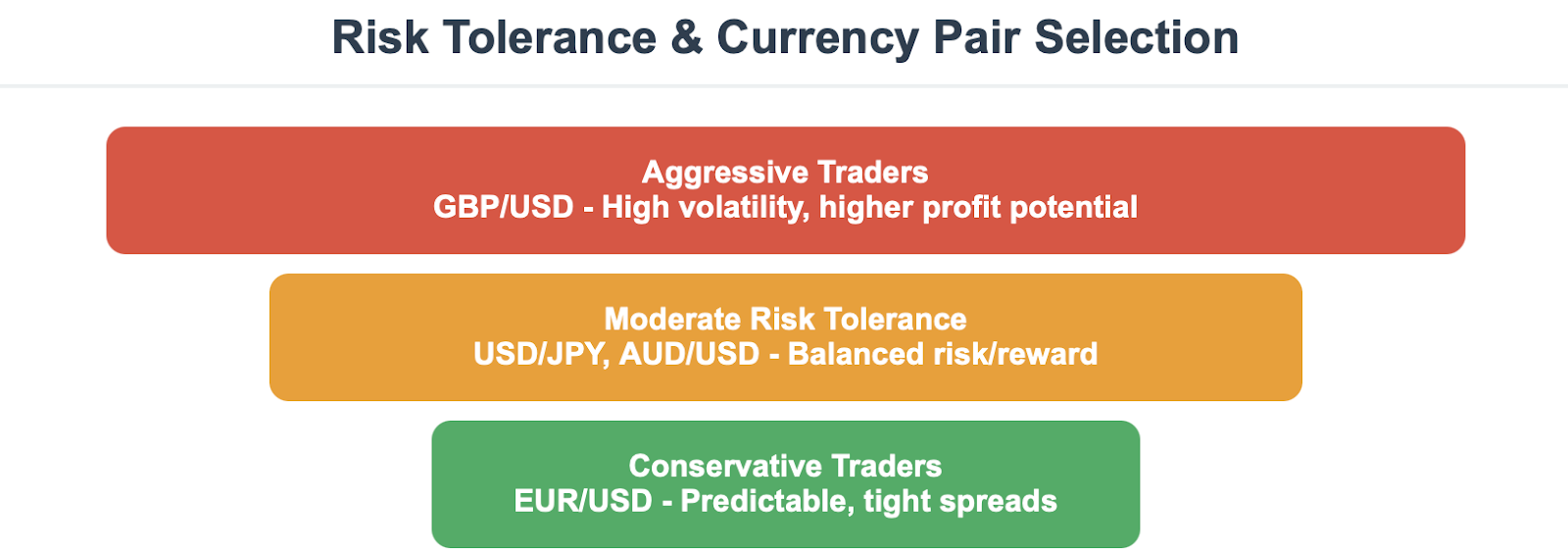
USD/JPY or AUD/USD is appropriate for a moderate risk tolerance. Although these two pairs can be highly unpredictable, they are still more predictable than EUR/USD with greater profit potential.
Aggressive traders comfortable with higher volatility will prefer GBP/USD since this pair has greater daily ranges and profit potential than other pairs, even if it can have sudden adverse moves.
Assessments Based on Account Size
When trading from smaller accounts (less than $1000), your focus should be on the smallest spreads, since the cost of spread has a more significant impact on your available capital. With spreads on EUR/USD that are only a few pips (often smaller than the spread on GBP/USD), less capital is deducted from your account as you focus on actual trading profits with EUR/USD.
In larger account sizes, traders can weather GBP/USD or AUD/USD's wider spreads for more significant profit potential per trade.
Example Trader Profiles
College Student Limited capital, irregular schedule, and focused on learning
Recommendation: EUR/USD in the overlapping hours of the European and US sessions
Rationale: Tight spreads to maximize a small account, predictable trading behavior to learn the market, and flexible trading times
FullTime Worker Stable income from fulltime employment, trading at night, moderate experience
Recommendation: AUD/USD or USD/JPY in the US to early Asia session
Rationale: Actively traded during available hours, moderate volatility aligns with parttime trading
Retiree Larger account and flexible daily trading, slower approach to trading
Recommendation: EUR/USD or USD/CHF with a longerterm trading approach
Rationale: Less volatility suited to a conservative trading approach and flexible timing to execute entry and exit
FullTime Professional Trader Large accounts, available for trading fulltime, and very experienced
Recommendation: Multiple pairs based on various opportunities in the market
Rationale: Try to diversify trading and reduce risk; experience will allow you the flexibility to manage multiple pairs
The DecisionMaking Process
When assessing a trading situation, first be honest about:
The amount of hours any traders have available and if they coincide with the activities of the pair
-
The traders' risk tolerance and limitations of the account
-
The level of trading experience of the trader and the traders learning goals
-
The traders preferred holding period (Minutes, hours, days, or weeks)
-
The traders preference for technical analysis or fundamental analysis
After taking these factors into consideration, match their desired setup with 12 pairs characteristics and abilities to focus on first. Learn them ALL before looking at any other pairs. Many respected traders have made their entire living based on expertise of 1 or 2 currency pairs vs. trying to trade everything!
Finally, keep in mind that your best pair might change over time as you change. For example, a beginner can start with EUR/USD, move to GBP/USD, and finally, as capital and experience allow, start trading exotic pairs.
Conclusion
The forex trading market centers around a limited number of currency pairs that have become popular due to their steady liquidity, relatively small volatility, and clear underlying fundamentals. EUR/USD remains the dominant currency pair and the best mixture of tight spreads, moderate volatility, and quality analysis. USD/JPY provides access to Japanese markets, safehaven dynamics, and good liquidity when trading currencies in Asia. GBP/USD offers traders more volatility for higher rewards but inuring resulting potential downside.
When you see why these pairs generate the most global trading volumes, superior liquidity, lower transaction costs, and consistent and reliable technical analysis makes sense to help develop an informed trading strategy. Central bank policy affects economic events which affects trader psychology creating a lot of predictable patterns that skilled traders can exploit across different markets.
However, one of the most important takeaways from this extensive analysis is that being popular does not mean being the best forex pair for you. What is the "right" forex pair to trade will be determined by your trading style, time available to trade, risk tolerance and experience. A scalper making rapid trades will benefit from the EUR/USD with its typically very tight spreads and deep liquidity, while a swing trader may find the correlation of AUD/USD with global growth a better pair to trade because they have the time and patience to allow a trade to run for days or weeks.
The forex landscape continues to evolve, with emerging market currencies growing in prominence, a gradual integration of cryptocurrencies and technological advances that help reshape the shape and structure of the market. Nevertheless, certain fundamental factors that make some pairs more attractive than others major global economies, sufficiently deep liquidity and manageable risk/reward will help ensure that most popular pairs will continue to dominate for the foreseeable future.
Before anything else, you should begin your forex trading journey with good education and using one (or two) general pairs, rather than trying to master too many markets at once. I would recommend beginning with EUR/USD to get an idea of how the markets work and how to use the information. As you become more skilled and accumulate capital, you can switch to and begin trading additional currency pairs.
The knowledge you developed about pairs' characteristics, central bank influences and the tenets of effective risk management give you a solid foundation on which to build. However, knowledge has no value until it is put into action. In the forex world, you are rewarded for your preparation, discipline, and execution of effective trading methodology.
Take Action Today
Are you ready to put this knowledge into action? Tradewill.com offers the ability to trade all the major currency pairs discussed in this guide with competitive spreads, professionalgrade trading platforms, and a suite of educational resources to support your forex trading journey.
Whether you are prepared to trade the beginnerfriendly characteristics of EUR/USD or are ready to choose GBP/USD and deal with higher volatility, you will also want to use the right trading platform, so there are no additional headaches. Don't let analysis paralysis stand in your way of acquiring the practical experience necessary to convert 'knowledge' into 'trading profits.'
Begin your forex trading journey today at Tradewill.com and find out why millions of traders around the globe have selected these popular currency pairs.
Disclaimer: The content of the blog does not represent any position of Trade W, does not serve as any trading-related decision advice, and does not endorse any third-party.