

 Trade W
Why Global Capital Is Returning to the Nikkei 225 in 2026
Over the past several years, global capital has experienced a significant shift away from fixed-income investments and towards equity markets - though this is certainly not a subtle development. There has been a rotation out of fixed-income securities such as bonds and dollar-denominated financial instruments back into equities due to many factors, one of which is Japan; thus far, Japanese companies have emerged as leaders within this rotation.
There are multiple reasons why the Nikkei 225, which represents Japan's 225 largest publicly listed companies, is now at the forefront of global asset allocation discussions.
First, Japan's Inflationary environment had been trapped within an ongoing state of deflation for far too long, and only now does it appear to have possibly re-entered the realm of how developed markets behave. The Bank of Japan (the central bank) - the first 'dove' in central banking history - has begun to change its outlook towards inflation over many years, in parallel to its long-standing status as the world's 'dove' central bank.
Another driving force for the move back into equities is that, following decades of poor corporate performance by Japanese firms, meaningful capital returns to shareholders through corporate governance reforms are beginning to occur.
For many long-term investors who had previously allocated some exposure to Japan and viewed it as a market that could potentially provide some form of capital appreciation, they will see a very different picture going forward from 2026 than they have seen in the past.
At the core of the question that continues to drive capital back into the Nikkei 225 is: "Will Japanese equities continue to outperform global markets, or will this recent rally simply be viewed as just yet another false start within the many examples of past attempts at Japanese false dawns?"
For professional investors, the answer to this question relates to the rotation dynamics occurring within capital markets today. As money continues to flow out of fixed-income and into equities, it appears that Japanese equity risk premiums are significantly more attractive compared to comparable risk premiums in the US and Europe.
For newer investors, the simple answer is very straightforward: Money that was previously sitting on a bank balance earning nothing is now actively looking for greater returns, and Japanese equities increasingly reside on that list. The Nikkei 225 index no longer simply benefits from a declining yen.
Rather, the Japanese equity market is transitioning structurally, and understanding how and why this is occurring will be critical to making sound, appropriate capital allocation decisions moving forward.
What Is the Nikkei 225?
The Nikkei 225 measures the performance of the top 225 publicly listed companies on the Tokyo Stock Exchange. The Nikkei provides a measure of the overall market activity for Japanese stocks, just as the S&P 500 does in the U.S. The stock index uses a price-weighted average calculation to take into account each company's shares and their market price. The price-weighted average gives greater weight to companies with a higher stock price compared to their total market capitalisation.
Nikkei 225 Structure: Key Companies and Sector Breakdown
A key to understanding the performance of the Nikkei 225 Index is understanding how it is constructed. While members of the Standard and Poor’s 500 Index are weighted according to their market capitalisation, companies in the Nikkei 225 are weighted according to their stock prices. For example, company Fast Retailing (owner of Uniqlo) may have a great impact on the daily fluctuations of the Nikkei Index even though its total market value may be less than that of other companies listed on the index, simply because of its high stock price.
The Nikkei 225 Index consists of companies from a variety of sectors; however, three of those sectors dominate the character of the index: the automotive manufacturing sector, the consumer electronics and technology sector, and the financial services sector.
In fact, Toyota is still the most recognised corporate name in the world when it comes to Japan, and companies such as Sony Corp., SoftBank Group, and Tokyo Electron Corporation are greatly represented on the index and are responsible for attracting a large number of global growth investors into the semiconductor sector.
For professional investors, this is noteworthy as the sector composition of the Nikkei Index causes it to behave differently from that of the heavily technology software-driven Nasdaq.
The Nikkei Index is much more industrial-like, much more export-sensitive, and materially impacted by currency fluctuations, primarily the yen vs. U.S. dollar exchange rate. A perspective for new investors is to consider a purchase of a wide range of Japan's most prominent businesses rather than just the shares of any particular company on the index.
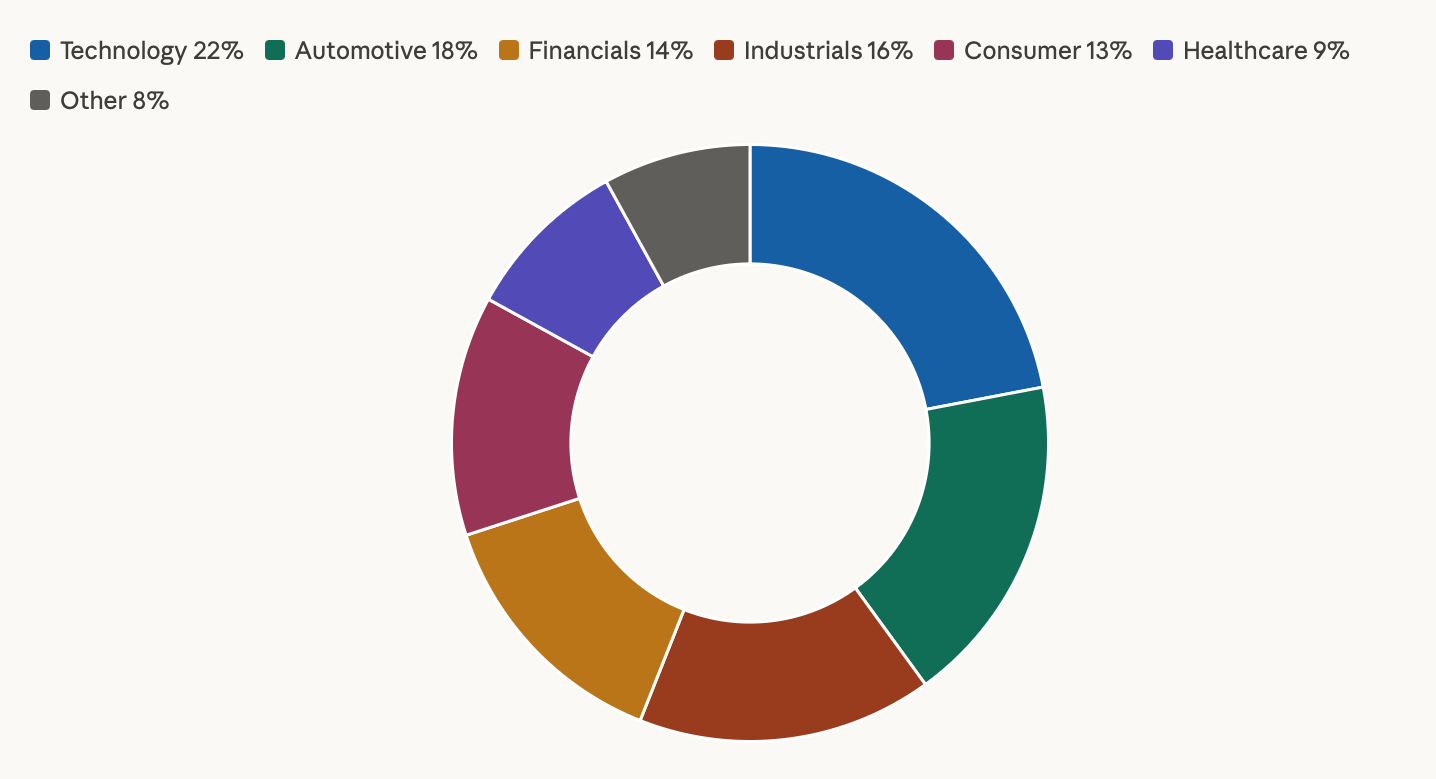
The Nikkei 225 represents not just one company, such as Toyota or Sony, but rather, it is a representation of how Japan's overall economic performance would be reflected in all sectors of the economy, making it an indirect indicator of the country's economy as a whole, and therefore, you must consider both the risk and opportunity associated with this index differently than if you were only investing in one company.
How Interest Rates Affect the Nikkei 225 in 2026
The single most significant macroeconomic variable influencing the Nikkei 225 today is interest rate policy from both the Bank of Japan and the Federal Reserve Bank of the United States. The Japanese bond market has a much more complicated relationship with interest rate trends than many developed countries.
For decades, Japanese rates were pegged at or below zero as a result of the Yield Curve Control policies. As this period draws to a close, it is having an effect on all economic variables in Japan. When interest rates rise, companies must pay more to borrow money to expand their businesses.
Higher costs mean lower profit margins, and lower profit margins equate to less money available for investment by the market into the stock market. Analysts often say that rising rates "compress the valuation multiple," which means that as interest rates rise, investors will require a lower P/E ratio for their equity investments.
In Japan, there is considerable watchfulness surrounding the gradual change in the BOJ's policy to eliminate its zero-interest-rate policy. A sudden or unanticipated increase in rates could cause capital flight from the country, an increase in the value of the yen, creating downward pressure on the Nikkei, or both.
Also, a gradual increase in interest rates, well-communicated by the BOJ, which seems to indicate normalising inflation rather than panic tightening, would actually be interpreted as a bullish signal for future long-term equity investment because it signals that the economy is actually recovering.
For those without any financial expertise, the simple example to understand is that if the cost of loans increases, then corporations will obtain fewer loans to finance their expansion and therefore will not be able to invest as much and grow as much. A slowing down of the stock market will follow. If the rate of increasing loans is attributable to the economy actually doing well, then this is a very different scenario.
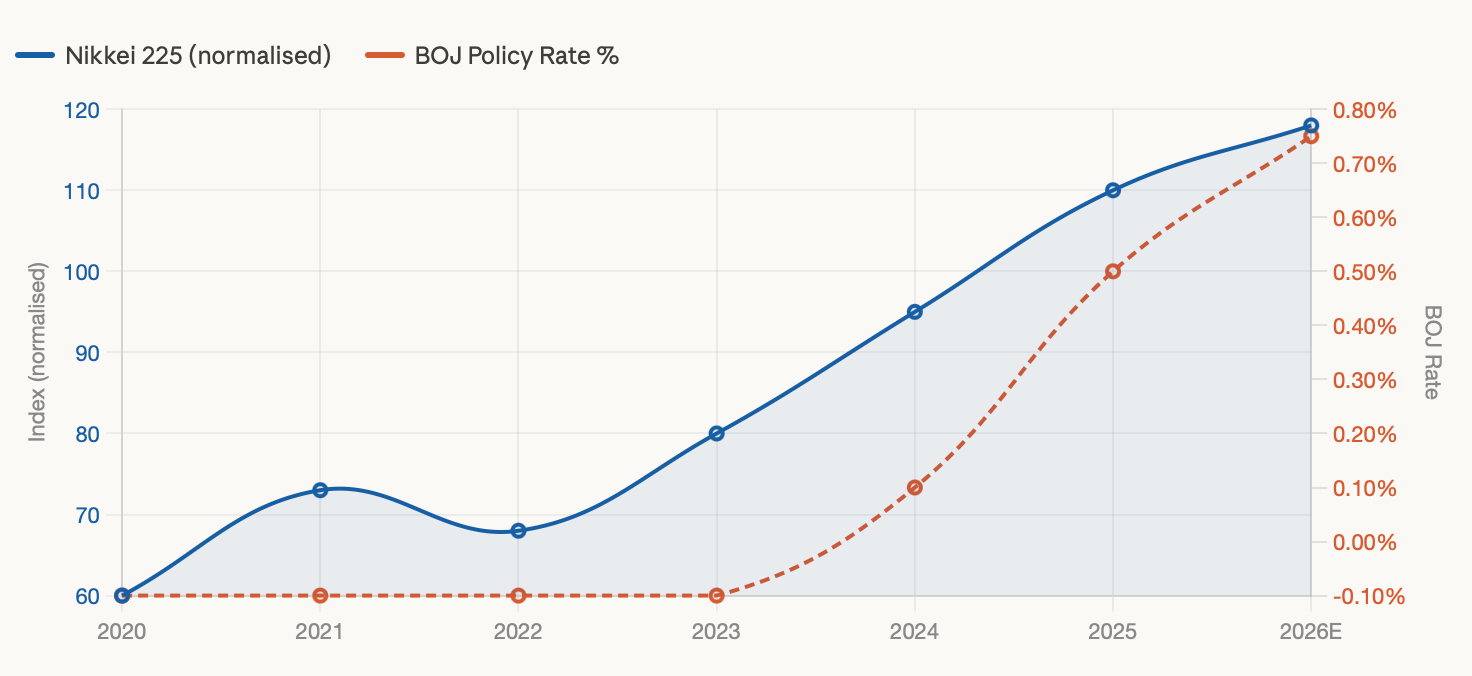
Compared to the US, where the Fed has been functioning in an elevated interest rate environment since 2022, and Europe, where the ECB has dealt with their own inflationary pressures, Japan is still at a relatively earlier timeframe when it comes to its interest rate cycle. This relative positioning explains why certain global macro managers view Japan as possessing a more attractive risk/reward profile as we move through the remainder of the year 2026.
Why Corporate Reform in Japan Is Driving the Nikkei 225 Higher
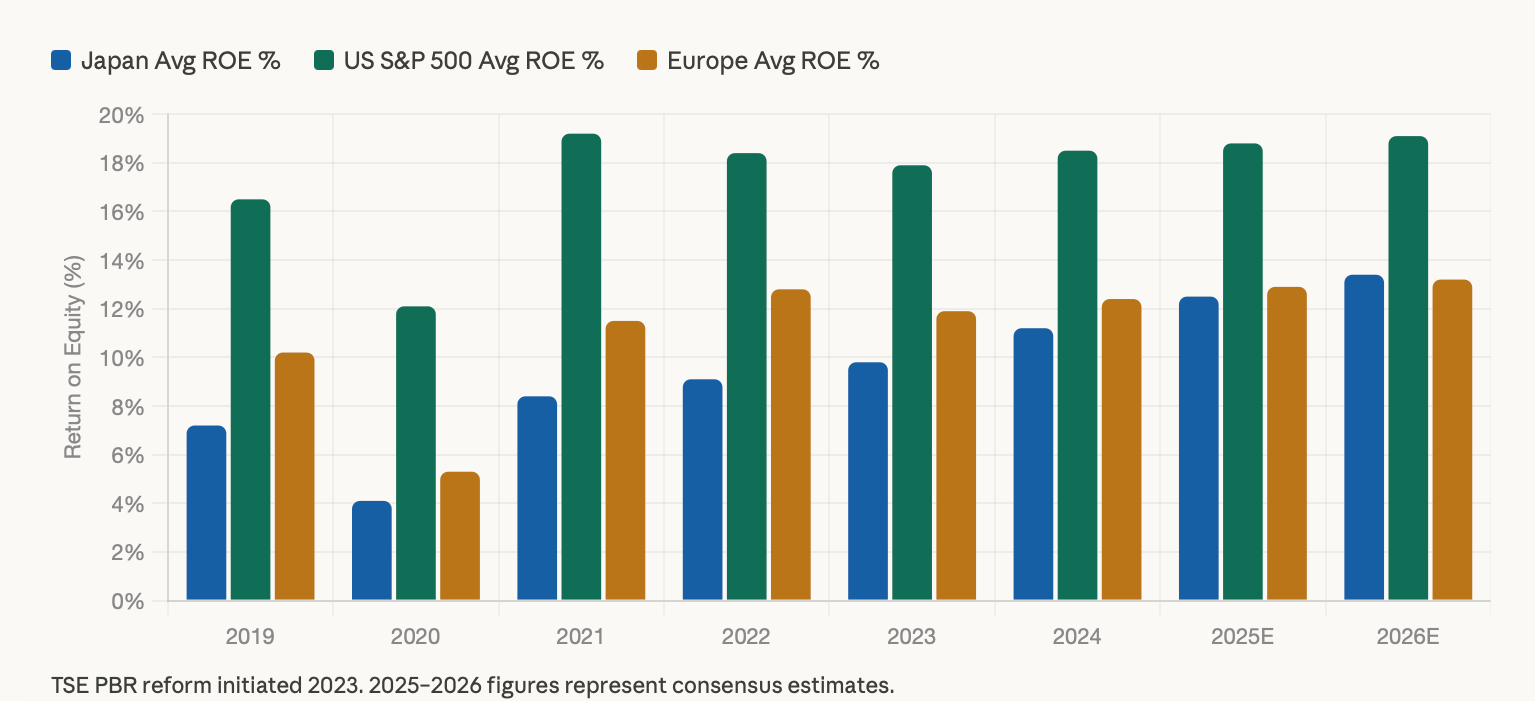
For many years, international investors viewed Japanese companies unfavourably because they kept large amounts of cash on their balance sheets and ignored shareholders. The return on equity (ROE) for Japanese companies has consistently been lower than that of US and European companies, but this isn't because the companies weren't profitable; it was because they had inefficiently managed capital. The Tokyo Stock Exchange finally decided to address this issue with direct action.
The TSE's Price-to-Book Ratio reform was one of the largest policy changes to take place in the Japanese equity markets over the past several years. This reform has forced companies that trade at less than book value to increase their ROE or risk being delisted. As a result, companies have stepped up share repurchases, increased dividend payments, and created greater transparency in their governance structures.
To institutional investors, this presents an opportunity for a true re-rating of the stock price. As ROE increases, capital from around the world will begin to flow into these stocks because they now produce a greater return on equity for every dollar invested by the shareholder. To retail investors, the net effect is that Japanese companies have become more profitable on a per-share basis and therefore are of greater value at virtually any price point.
Japanese equities have started to attract foreign capital through institutional buying activity from foreign investment funds. This increase is a reflection of the quality of governance reforms and the resulting increase in transparency.
Toyota Motor Corporation and Sony Corp., which represent the two largest and best-known companies on the Nikkei Index, continue to demonstrate a commitment to improving dividends and capital returns, with many smaller Japanese listed companies, in turn, following their example.
However, the focus of the corporate governance story should not be interpreted as a short-term trade catalyst; it is instead a structural change within Japan that may require 10 years to fully materialise.
Nikkei 225 Forecast 2026: Bull Case vs Bear Case
In order to be considered a valid market analysis, all aspects of the market need to be taken into consideration, not just those that appear favourable for investment. The Nikkei 225 is currently portrayed in 2026 as being in a mixed situation due to both good and bad reasons for optimism and significant risks that cannot be ignored.
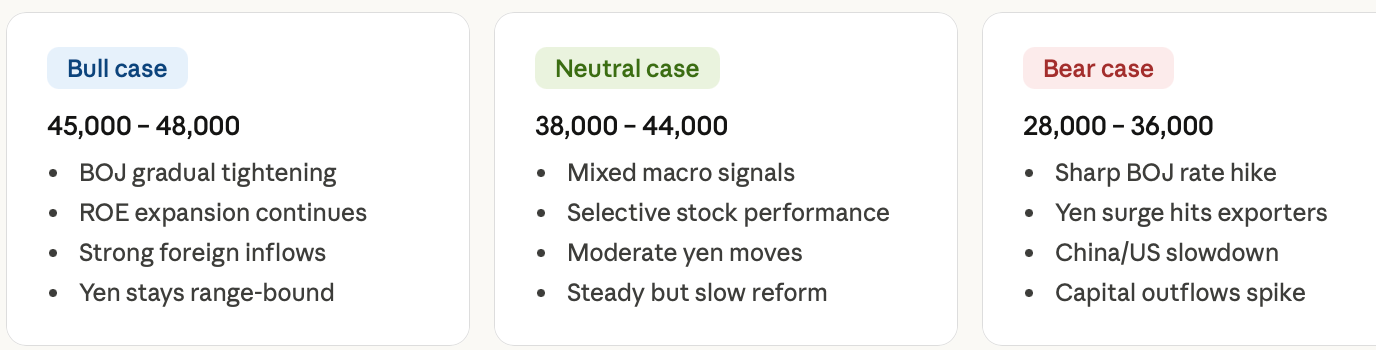
Three foundational elements support the bull case, including ongoing corporate reform generating additional ROE's, an appropriate rate environment existing from the BOJ and the potential for sustained foreign inflows as global investors shift away from the concentration of equity investment in the US. If all three of these factors remain in place, it is possible for the index to continue its upward trend through 2023 to 2025, as some forecasts expect the index to reach between 45,000 and 48,000 by the end of 2026.
The bear case focuses on two main areas of concern. The first is with a potential for a larger-than-expected BOJ interest rate increase, which could cause a sudden increase in the Yen exchange rate. This would negatively impact revenues from the export sector and significantly lower the index. Secondly, a major global economic contraction, particularly in China and the US, both of which are Japan's largest trading partners, would severely impact earnings in both the industrial and automotive sectors.
The neutral case is probably the most objective and basic view on the performance of the Nikkei: it will continue to rise incrementally with a degree of volatility, driven by individual corporate performance, and not by the performance of the overall index. There is both opportunity and uncertainty in this market.
Nikkei 225 vs S&P 500 vs Nasdaq: Which Deserves a Place in Your Portfolio in 2026?
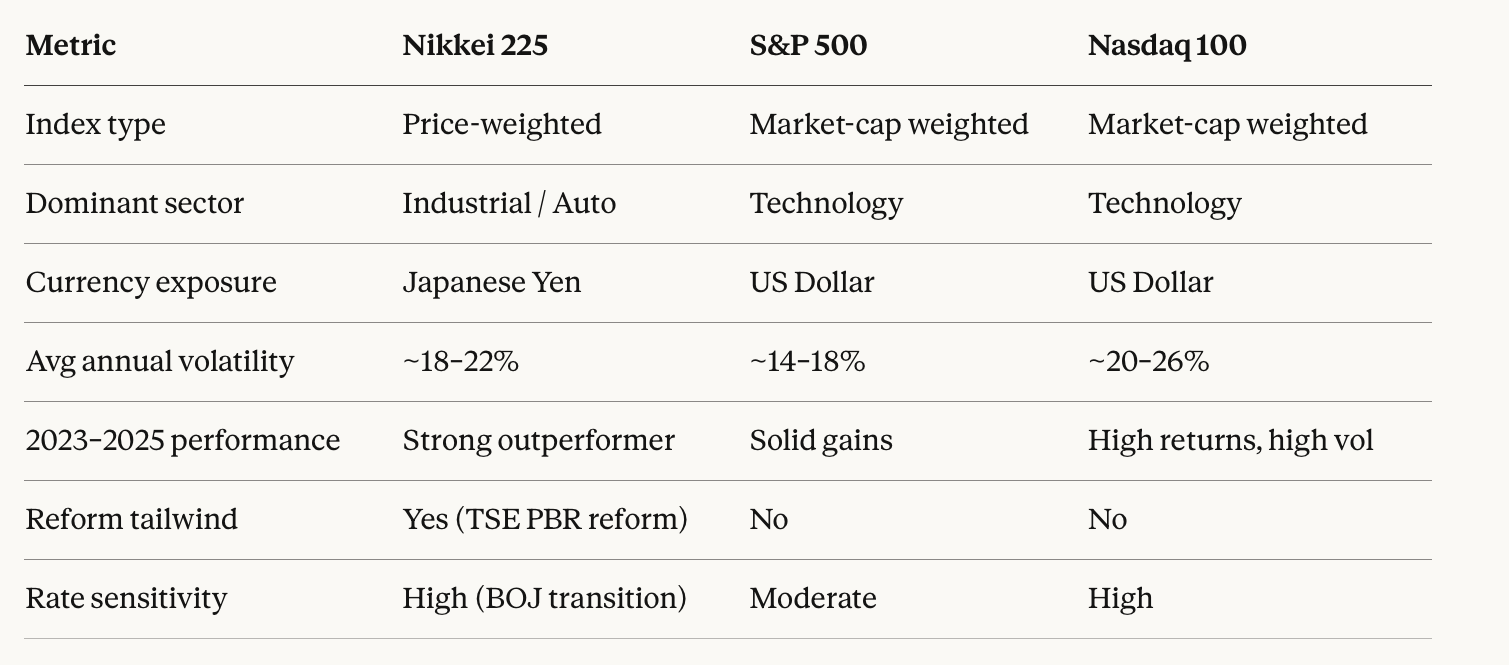
By examining the three stock market indices, it is not so much about determining which one is best, but rather gaining an understanding of each index's place in an investor's portfolio and what an investor is purchasing with each index.
An investor will obtain exposure to a broad swath of U.S. stocks with the S&P 500; however, there is a strong emphasis on the largest technology companies in that index. The Nasdaq is essentially an extension of the tech focus of the S&P 500, with the concentration of technology companies in the Nasdaq market capitalisation being much more pronounced than that of the S&P 500. Conversely, the Nikkei 225 Index has elements of structure that are different from the U.S. stock market, such as the industrial composition, relationship to exports, and the stage of corporate development in the market that Japan is currently in.
The risk profiles of these indices also vary substantially. Historically, the Nikkei 225 was more reactive to movements in the Japanese yen and changes in global trade, thus allowing for large variations in value based on those two factors. The S&P 500 is viewed as more stable during episodes of global risk-off; however, due to the nature of the U.S. dollar being the world's reserve currency, as well as the U.S. consumer outlook, it remains subject to the same types of influences as other indices.
Diversifying investments across these three indices is not only appropriate for risk-averse investors; it is also a practical answer to the fact that no one market will return the highest for every year and that risk can be concentrated in any market; however, risk is still a reality in even the most robust bull markets.
How to Trade the Nikkei 225 Using CFDs
CFDs, or Contracts for Difference, allow traders to gain exposure to the Nikkei 225 without owning the underlying shares or the index itself. Instead, you're entering into a contract with a broker to exchange the difference in price between when you open and close your position. This structure makes CFD trading flexible in ways that traditional equity investing isn't.
The most significant advantage of CFDs is the ability to go both long and short. If you believe the Nikkei is heading higher, you open a long position and profit if you're right. If you expect a market decline driven by a BOJ shock or a global risk-off event, you can open a short position and profit from the fall. For traders in more traditional markets, this two-directional flexibility is one of the defining differences of CFD instruments.
Leverage is the other distinguishing feature. CFDs typically require only a fraction of the full position value as margin, which amplifies both gains and losses relative to the capital deployed. A trader who understands and manages leverage carefully can express a market view with capital efficiency. A trader who doesn't will find that losses accumulate just as quickly as gains.
Three strategies suit the Nikkei 225 particularly well. Trend trading involves identifying the dominant directional move and positioning with it, using technical levels to define entries and exits. Swing trading is a shorter-cycle approach that captures multi-day or multi-week price swings within a broader trend. Hedging uses short CFD positions to offset existing portfolio risk during periods of anticipated volatility.
Risk Management When Trading the Nikkei 225
It is not a mystery that Markets are unpredictable, but the truth is that the markets will remain unpredictable, and it is the reason why successful traders do not lose money on trades that they do not believe in. Although all trading strategies will produce both winning and losing trades, the most important aspect of trading is whether or not you will be able to survive in the long term and what percentage of your total trading capital you will lose.
The principles of successful risk management in Nikkei 225 CFD Trading are simple. Keeping your risk to 1% to 2% of your total trading capital on each trade will allow you to lose multiple trades, but not have your whole trading account wiped out. If you do not use a stop-loss, you are not trading, but instead taking a gamble with unlimited potential for loss. You should also avoid increasing your leverage beyond what you can handle to allow yourself to have enough time to make a correct decision when the market moves in your favour.
Some of the primary risks associated with the Nikkei 225 are BOJ rate surprises, which can change the index by several per cent in one trading session, yen fluctuations resulting from global dollar movements, and unexpected capital withdrawals during risk-off moments in the global markets. Black swan events are very rare, but they have hit Japan at a higher frequency historically due to the proximity of other countries and Japan's dependence on trade.
Conclusion: Is the Nikkei 225 Still a Strong Opportunity in 2026?
Corporate Governance Reform and the return of foreign capital are real forces driving the market. BOJ's gradual normalisation of rates is managed and is seen as a sign of economic strength rather than panic. Therefore, these are not catalysts for short-term trading, but rather, the foundations of a multi-year investment.
Many risks exist, i.e., currency fluctuations, external demand shocks, and the risk of BOJ policy errors, all of which could derail the current trajectory of the Nikkei 225. Anyone investing in the Nikkei 225 in 2026 and thinking it is a guaranteed success is not taking those risks into account.
The correct framework for looking at the Nikkei 225 is as preparation rather than prediction. Create a risk tolerance, know your investment vehicle, develop your macroeconomic outlook and act with discipline. The best-performing traders and investors in Japan in 2026 will not be the ones who guessed the index on the nose; they will be the ones who manage their risk consistently.
Ready to test your Nikkei 225 strategy without risking real capital?
TradeWill's demo account gives you live market conditions, full CFD functionality on the Nikkei 225, and a real-time environment to build confidence before you commit a single dollar. Start your free demo at TradeWill.com and trade Japan's most important index on your own terms.
Disclaimer: The content of the blog does not represent any position of Trade W, does not serve as any trading-related decision advice, and does not endorse any third-party.