

 Trade W

When you type 'No Deposit Bonus Broker' into Google, you'll find thousands of entries, all claiming to give you free money to start your trading career with. The sheer volume of this keyword search reflects how popular it is among Forex traders, as they are either curious or brokers competing for your attention; plus, who wouldn't want free money to start their trading journey?
What's also interesting and something that most of the articles won't mention is how the Forex market has been gradually getting rid of bonuses over the past couple of years. The brokers that serious Forex traders use today no longer put bonus money at the top of their priority list; there is a reason for this as well!
In this post, I'll give you a breakdown of what a no deposit bonus really is, how it's being affected by the increased regulation on Forex brokers, what many investors will not see the risks before they sign up for a no deposit bonus, and most importantly, what you should be looking for when choosing your next Forex broker.
What Are No Deposit Bonus Brokers?
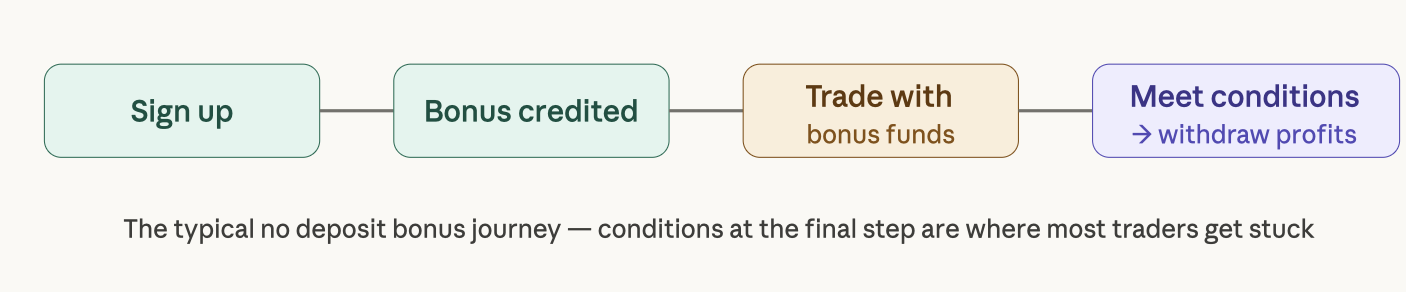
No deposit bonus is just that. You open an account with a broker, confirm your information, and they will give you some actual trading capital to use; generally, somewhere in the vicinity of $20 to $100, without having to put money into your account first.
The process is simple. You get the bonus, trade the funds, and if you achieve a profit, you can withdraw the funds. The conditions are where it starts to get complicated, and we will get into those later.
Why do brokers even bother offering these? It’s essentially a way for them to acquire customers (CAC), as they are making it look like a gift. Acquiring new retail clients can be very costly, including advertising, affiliate commissions, creating landing pages, etc. A new account with a retail trader that wants to see the verification of the account funds is justifiable from a marketing perspective for the broker.
There are typically two varieties of no deposit bonuses: signup bonuses given at the time of opening an account and promotional offers that pop up around market events or seasons. Both bonuses are offered under the same general premise: to get new traders through the front door and hopefully new deposits from them shortly thereafter.
The only real analogy for a no-deposit bonus that works well is the gaming app that promises free coins on the first day to hook you into playing on their app, so you will ultimately spend your hard-earned cash.
Are No Deposit Bonus Brokers Legal in 2026?
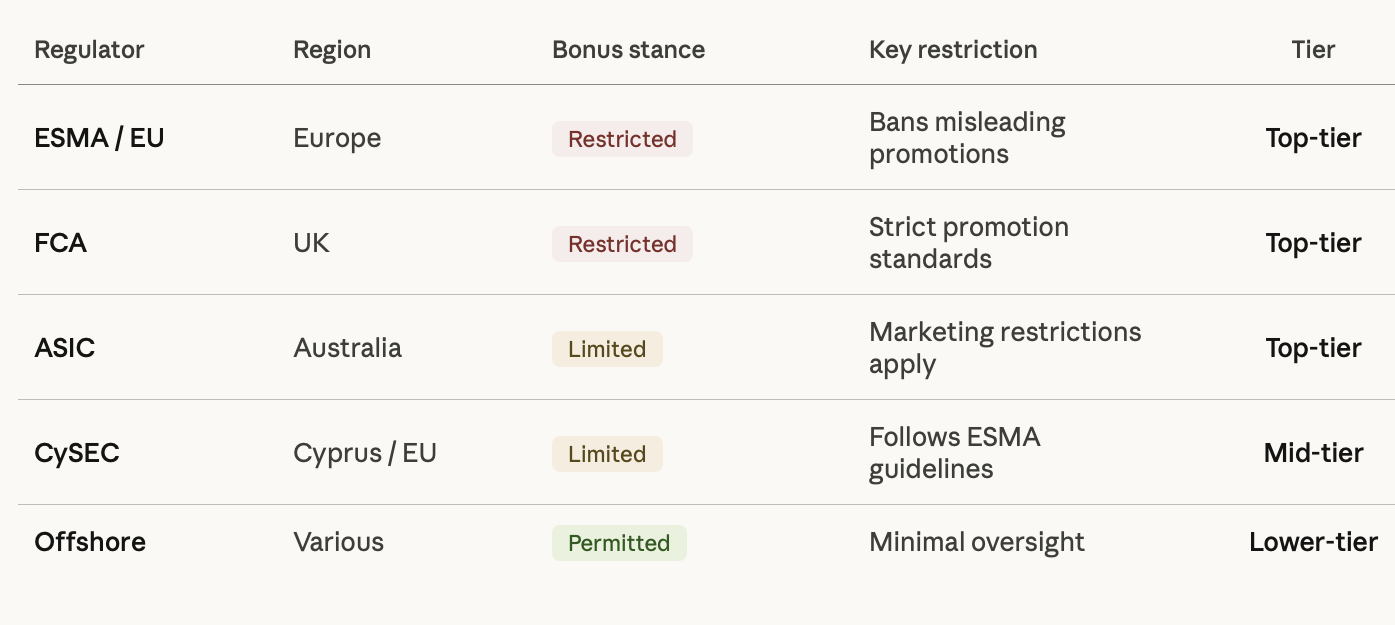
Is there any way to get a bonus? That all depends on the jurisdiction in which your broker is regulated. In fact, due to increasing pressure from regulators globally, the answer is now leaning more towards "no" than it ever was.
For example, regulators in Europe have taken a very aggressive stance toward bonus incentives. The European Securities and Markets Authority (ESMA) has implemented several rules that not only severely restrict the usage of bonuses but also set limited, if not virtually impossible, criteria for offering a bonus.
The primary issue isn't that the bonus itself is fraudulent; rather, it's the way that bonuses affect the behaviour of traders. Traders who use "free" money are more inclined to take on risks that they would otherwise not normally take on with their own capital, causing problems like overtrading, blown-out accounts, and eventual complaints. One of the many reasons why ESMA has capped leverage limits and restricted broker incentives is due to these very issues.
The U.K. Financial Conduct Authority (FCA) has taken a similar view. Brokers regulated by the FCA may not use bonuses as a primary means of attracting new clients, as offshore brokers can do.
Additionally, recent guidance from the Australian Securities and Investments Commission (ASIC) has tightened its position on promotions associated with financial products; bonus terms must be clear and not misleading to the consumer.
So, where are brokers able to promote bonuses? They mostly exist in offshore jurisdictions with less stringent regulations, such as certain Caribbean and Pacific island jurisdictions. This isn't necessarily an immediate red flag; however, it's important to note.
So remember this rule of thumb: if your broker is advertising an on-deposit bonus and is regulated by a tier-one regulator, thoroughly read the terms. If your broker is regulated outside of a tier-one jurisdiction and is led by an aggressive no-deposit bonus, tread cautiously.
The Hidden Risks Behind "Free" Bonuses
Remember that ads don't mention that 'Free' may end up costing more than one expects.
Typically, the greatest risk to bonus withdrawal is the trading volume requirement. Trading volumes are necessary before you can withdraw profits earned from a bonus. Retail brokers rarely, if at all, promote those trading volume requirements.
You could be required to do anywhere from 50 to 200 standard lots of trading before you can withdraw any profits made on your bonuses, putting retail traders in a position to be required to do a lot of trading and accumulate significant transaction fees, such as swap and/ or spread costs.
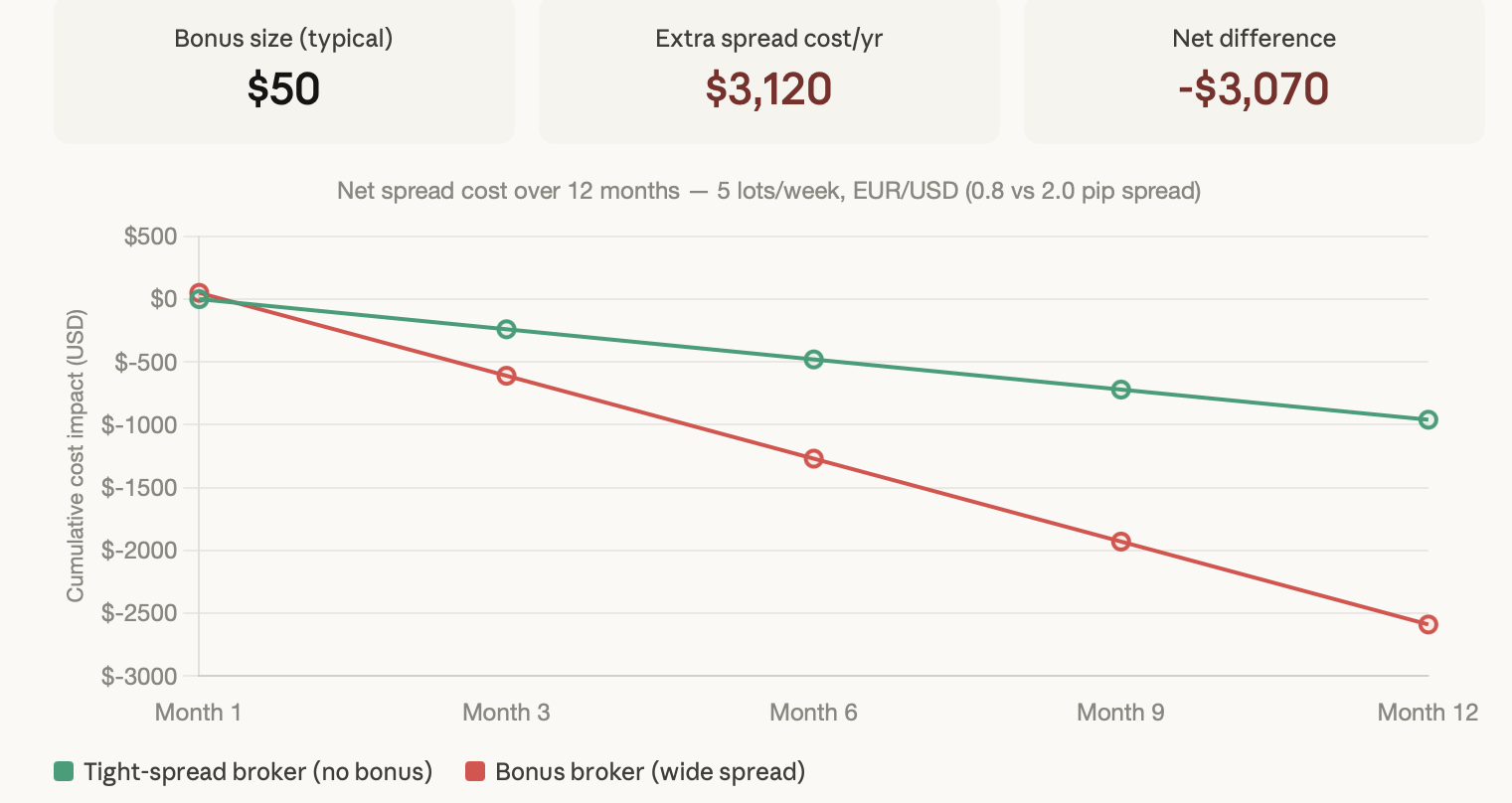
Furthermore, many brokers who offer excessive bonuses may compensate by widening their spreads. A broker without a bonus may charge 0.8 pips to trade the EUR/USD currency pair, while a broker who is providing a $50 no deposit bonus may charge 2.2 pips. The difference in spread price between the two brokers will likely accumulate more than $50 from hundreds of trades.
Other aspects to consider are slippage and execution speed. Many of the resources that could go towards tight execution and a timely order process are used to support the advertising expense for the bonuses.
Then there is the issue of the fine print. Bonus accounts typically have different terms than regular accounts when it comes to: request limits for the particular accounts; limits on types of instruments (e.g. stock versus options) being traded in; limits on positions sized; restrictions on how long you have to use your bonuses; etc. Some brokers will void the entire bonus if certain account activities occur; not all triggers for this activity are clear to the customers.
In standard operations, if you are required to trade 100 lots before you can withdraw bonus profits, then as a retail trader, you will very likely incur substantially more than the bonus amount due primarily to spread cost, as you will do so much trading before you reach the minimum volume requirement to withdraw the bonus.
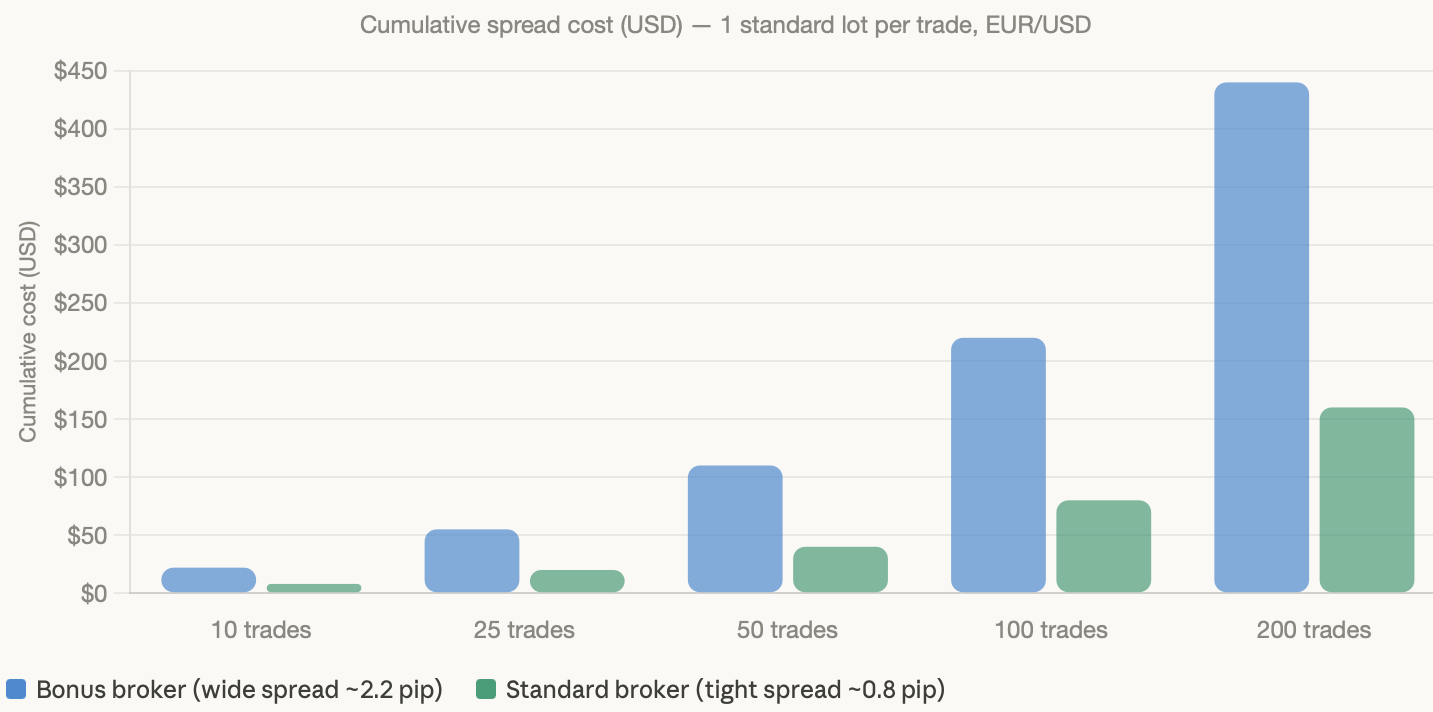
The chart makes it clear: by the time you hit the 100-trade threshold many bonus brokers require before withdrawal, the wider spread has already cost you more than the bonus was worth.
Why Regulated Brokers Are Phasing Out Bonuses in 2026
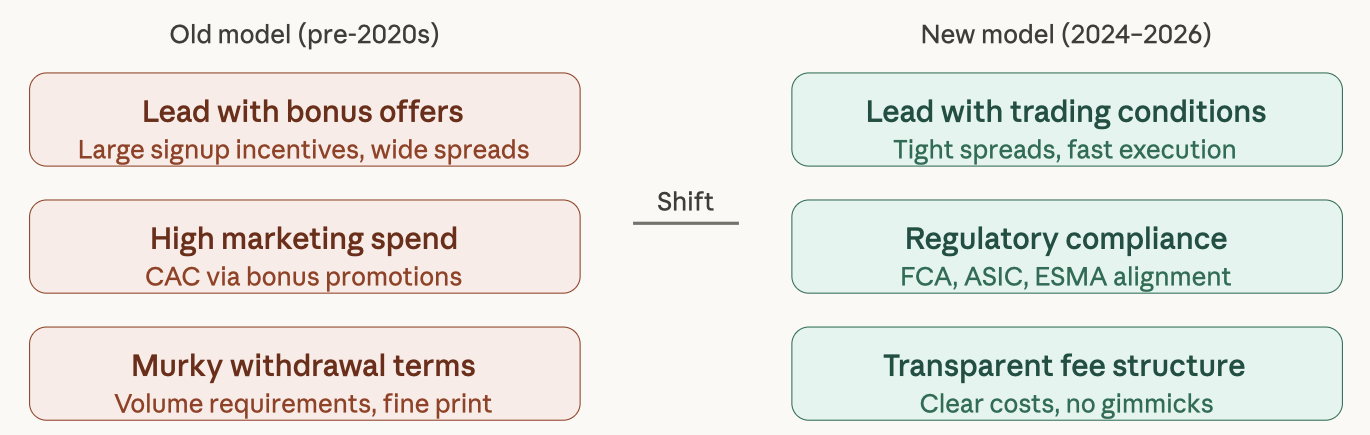
In the past several years, this trend has developed. Experienced brokers who have good regulation have not just stopped offering bonuses through regulatory action, but rather, most have concluded that it attracts the wrong type of clients.
For instance, a trader who gets $50 for free is statistically less likely to become a long-term, serious trader than is a trader who has put their own money in. The serious trader is going to ask a different set of questions when they are signing up, the trader who will be hunting for a bonus.
Serious traders will want to know what the spread is, the latency in execution, and if there will be any slippage during times of news. The trader who hunts for bonus money will only be asking how quickly they can get access to the bonus.
As brokers have switched to a focus on the fundamentals of being a brokerage firm, a new means of competition has developed between them in relation to offering lower spreads, faster execution, better charting tools, stronger customer service, separate client funds, and negative balance protection. All of these things are what ultimately matter to the bottom line of a trader, and they are also what will become more different between brokers as we move forward into 2026.
The brokerage model has really switched; ten years ago, bonuses were a primary way for brokerages to market themselves. Now, the leading brokers are promoting themselves as not having gimmicks.
Bonus vs Trading Conditions: What Actually Matters?
On one side of the scale, you have a $50 no deposit bonus, and on the other side, you have a broker whose spread for every trade you make on EUR/USD over the next 2 years is 0.8 pips instead of 2.0 pips.
There will be a huge difference between the spread method. A low spread results in average savings on each trade you make, and those savings compound for potentially hundreds or thousands of trades. Whereas a bonus is just something you receive once, the terms of a bonus will eventually run out, while a low spread will continue for the entire term of your trading account.
To properly evaluate this, if you generate 5 lots per week on EUR/USD with a spread of 1.2 pips larger, that costs you an additional $60 per week ($3,120 for the year) with the bonus broker than it would at a broker who does not offer you a bonus.
The same can be said for execution speed. A broker with slow execution can create slippage of 10, 20 or 50 pips on any given trade during news time. Conversely, brokers who have co-located servers with true STP execution will experience slippage on trades only occasionally.
How to Choose a Safe Broker Without Relying on Bonuses
Once there's no longer an interest in free money, the choice of a broker is less difficult. Here's what makes a difference:
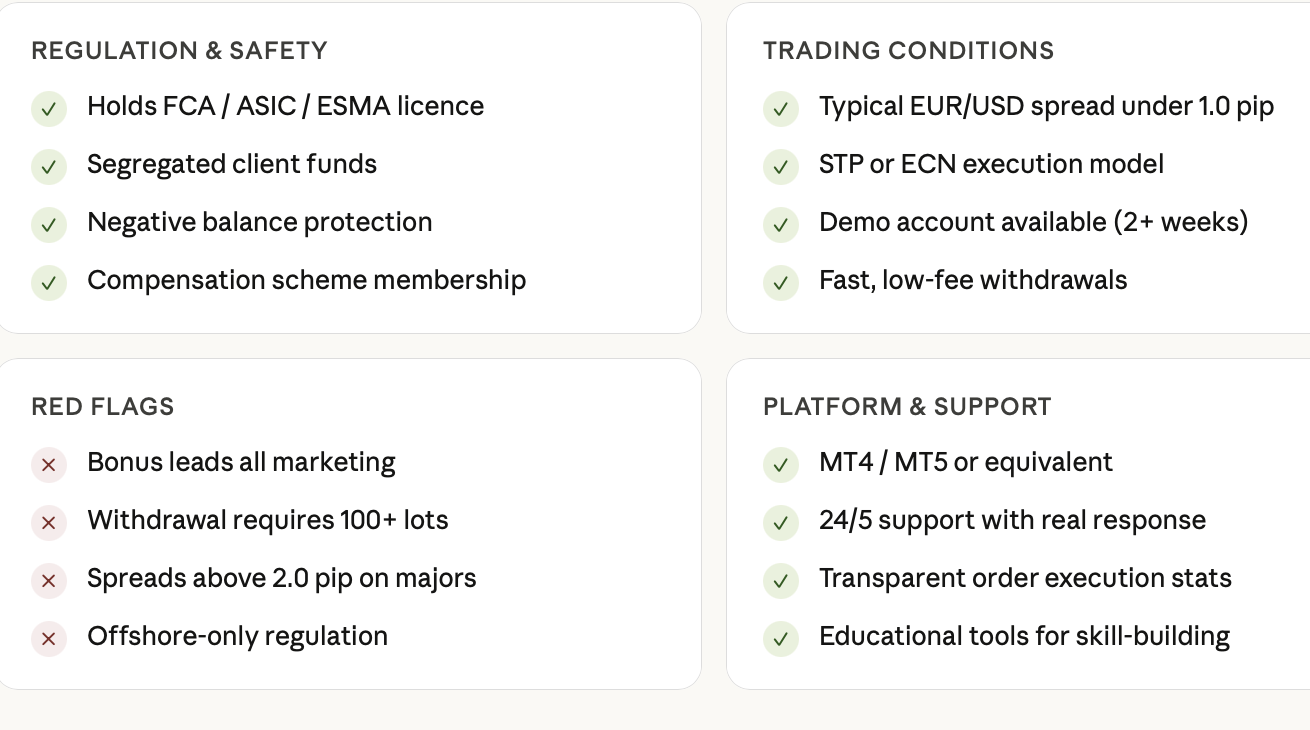
Regulatory Authority: Check to see if the broker has been granted a license by a regulatory authority that is well-known. You can also verify the authenticity of the broker's license on the website of the regulatory authority. You cannot simply trust the logo displayed on the homepage of the broker.
Fund Safety: Are client funds kept separated from those used in conducting business? Does the broker participate in a compensation program? For instance, in the United Kingdom, the Financial Services Compensation Scheme (FSCS) will provide up to £85,000 for one client. This is critical if the broker fails.
Trading Conditions: Due diligence will occur mostly when trading conditions are reviewed. Look at average spreads for the instruments with which you will be trading; you should use the average of actual trades. Be aware that a broker will advertise a pitifully low spread but will not give you an honest representation of what your spread would be during the peak volume hours.
Also, check the types of execution: market maker, STP, and ECN; inquire about slippage policies related to news releases, and test your platform on a demo account at least two weeks before placing funds there.
Withdrawal: The withdrawal process is critical and practical. You should know how long it takes for your withdrawals to be processed and if any additional costs will apply. Also, will you be using the same method for deposits as you will for withdrawals? A broker that provides you with rapid deposits but has low-cost, slow-processing withdrawals is indicating to you that they are not a good partner.
Why Trade Will Focus on Trading Conditions Over Bonuses
TradeWill doesn't use bonuses as a way to entice new customers, and it doesn't do so as part of its marketing strategy.
This is intentional — they have built their entire trading philosophy on the idea that your profitability as a trader over time is based on the trading environment you are trading in, rather than what bonuses are or were given to you at the start of your account.
They have constructed their infrastructure with tight spreads, fast order execution, and an effective risk management system; these systems effectively protect the trader through things like negative balance protection and properly segregated funds.
When you consistently use high-performance tools, your results compound over time. Therefore, there is a very large difference between using a trading platform that will support your growth over the long term and provides bonuses to get you in the door, and one that lures you into using their service with a $50 gift and then recouping that gift through the spreads charged over a number of months.
There are no other trading conditions besides those provided by the broker; most brokers today provide the same or similar conditions, and all the other things that brokers provide are essentially just background noise.
FAQ
What are no-deposit bonus brokers? Brokers that credit your account with a small amount of real trading capital, usually $20–$100, without requiring an initial deposit. You trade with that credit and can withdraw profits after meeting specific volume or activity conditions.
Are no deposit bonuses safe? Some are offered by legitimate brokers, but many come with restrictive terms that make them difficult to actually benefit from. The key questions are: what are the withdrawal conditions, what spreads apply on the bonus account, and is the broker regulated by a reputable authority?
Can I withdraw profits from a bonus account? Usually, yes — but only after meeting volume requirements that can be substantial. Some brokers also separate the bonus itself from profits, meaning only the profits (not the bonus amount) are withdrawable.
Why are bonuses restricted by regulators? Regulators like ESMA and the FCA have found that bonus promotions encourage overtrading and risk-taking beyond what traders would do with their own capital. They've been restricting or banning certain bonus structures to protect retail traders.
Are bonuses worth it for beginners? Rarely. The conditions typically require trading volumes that beginners aren't ready for, and the wider spreads on bonus accounts eat into any potential gains. A better approach is to start with a small real deposit on a tight-spread, regulated platform and learn properly.
Stop chasing bonuses. Start trading smarter. Open a TradeWill account today and experience what tight spreads, transparent pricing, and real execution quality actually feel like — tradewill.com/open-account
Disclaimer: The content of the blog does not represent any position of Trade W, does not serve as any trading-related decision advice, and does not endorse any third-party.