

 Trade W
What Is an OPA and Why Does It Move Markets?
Offre Publique d'Acquisition (OPA), or public tender offer, is the process by which one company makes a public announcement of its intention to purchase shares of another in exchange for a premium price. In effect, it is a corporate acquisition that is made public directly to shareholders.
The announcement of an OPA can cause a ripple effect throughout the markets, as many different market factors are affected by the announcement. When a company makes an attractive offer to another company's shareholders, stock prices of the company making the offer will soar.
Furthermore, since there will be speculation on the outcome of the deal, the market sentiment will change. In addition, the major indices (such as the S&P 500 and the Dow Jones) will fluctuate due to the fluctuations in share prices of the companies involved in the transaction. As a result, investors will also change their behavior, and traders will try to take advantage of any price discrepancies that may exist.
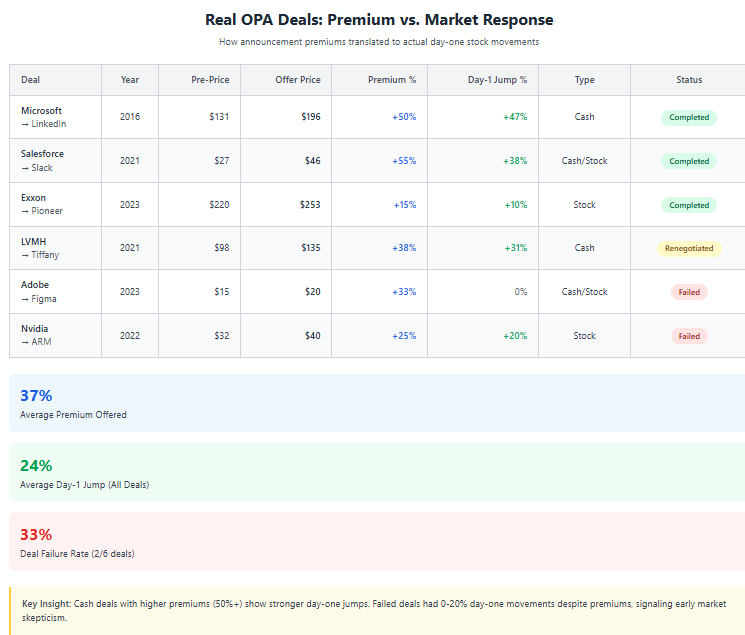
There are three basic types of OPAs. These are "friendly" OPAs, "hostile" OPAs and "partial" OPAs. Friendly OPAs occur when both companies agree to the terms of the proposal. An example of a friendly OPA is Microsoft's acquisition of LinkedIn in 2016 for $26.2 billion, which increased LinkedIn's share price by almost 50 percent in one day.
Hostile OPAs occur when the target company does not agree to proceed with the purchase, which creates volatility and drama in the market. Partial OPAs occur when the intent of the acquirer is to only obtain a controlling interest in the target company, instead of the entire company.
To illustrate how an OPA operates, let’s look at this example: A well-known hamburger chain is trading at $50 a share. A different company announces that it will purchase the entire chain for $70 a share. All of a sudden, there’s great excitement from all existing stockholders to get their hands on as many shares as possible because they know that they can sell their stocks for $70 after the transaction. As a result, the stock has now moved closer to the acquisition price of $70. This is an example of how an OPA works.
The primary strength of an OPA is that it provides immediate results. OPAs are unlike earning reports or gradual market trends, where the effects are seen over an extended period of time. Due to their immediate and measurable impact, OPAs have become one of the most prominent factors leading to movement in today’s financial markets.
How OPAs Work: From Announcement to Completion
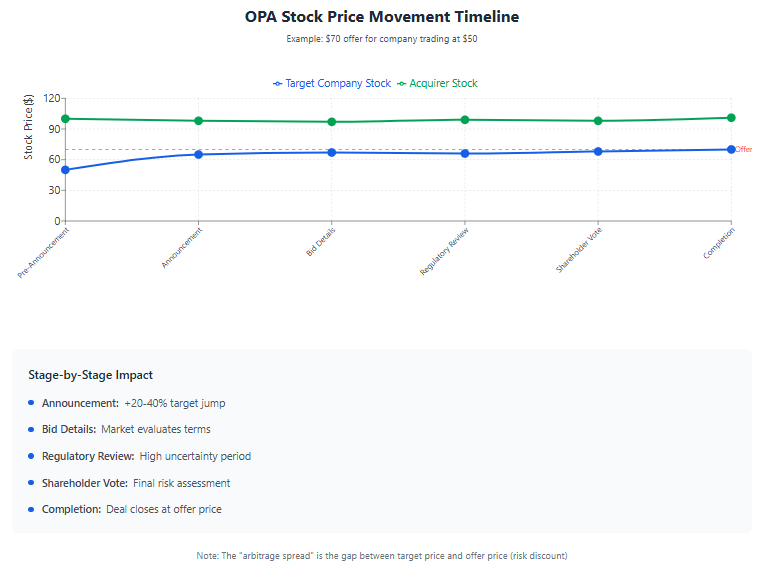
There are 5 key stages of the OPA process and each produces "ripples" in the marketplace.
Stage 1: Announcement - The acquirer officially announces their offer and intent, indicating the proposed price for each share. At this stage, the target companies (typically) see a jump of 20-40%.
Stage 2: Bid Details - The parties outline the details of the bid such as what the theoretical future will look like; the premium; whether it is cash or stock; when closing is expected. The markets will then evaluate if the 'proposed' deal makes 'economic sense'.
Stage 3: Regulatory Review - Various antitrust authorities and financial regulators will review the deal. This stage will give rise to uncertainty and volatility; for instance, the BHP-Anglo American deal in 2024 saw dramatic price fluctuations, as investors were unsure of whether the deal would receive regulatory approval.
Stage 4: Shareholder Acceptance - The shareholders of the target company will vote whether or not they accept the deal. If they are likely to accept, the share price should remain near the offered price, whereas if there is a high probability of rejection, it is expected that the share price will decline.
Stage 5: Settlement and Integration - The acquiring company pays the agreed-upon price and the two companies merge their operations. The stock of the target will be delisted, assuming a full acquisition.
The premium is very important - as it defines the difference between the current market price and the offered price. A 30% premium means that the acquirer will pay 30% in excess of the current value. A premium that is higher indicates that the acquirer has confidence but also puts more financial pressure on the acquirer to close the deal. Conversely, a lower premium can put pressures on the acquirer from shareholders not to accept the deal.
Consider a scenario where you are attempting to sell a used mobile phone. A potential buyer offers to pay $800 for the phone, which may sound tempting depending on how much you paid for it and how many minutes of usage are left. However, just because you have an agreement with a potential buyer based on the price they quoted does not guarantee payment will occur, company approval will be received, or any type of shipping arrangement agreed upon. All three steps will determine whether the sale succeeds.
Take Broadcom's Acquisition of VMware (closing date of this transaction occurred in 2023). This transaction has experienced over a year of price fluctuations due to multiple companies' regulatory approvals across many separate jurisdictions. Therefore, a company planning to acquire another entity under the current economic climate based on success must work its way through this complicated maze of legislatures rather than just announce itself as successful.
Why Companies Launch OPAs: Strategic Motives Behind Takeovers
Purchasing or acquiring a company with a billion-dollar offer isn't something companies do on a whim, there are three main reasons or 'strategic' motives behind that.
Growth- Accelerating Your Business: It's always better/faster to purchase than to build your business. When Amazon purchased Whole Foods in 2017 for $13.7 billion, it gained 460 grocery stores and a pre-existing reputation among consumers overnight. If Amazon had developed its grocery network, it would have taken decades to build up to this level of sales. It immediately changed Amazon from an online-only retailer to an omnichannel retailer.
Synergy: "Treasury Synergy" is a finance buzzword describing how two companies can work together and become greater in value together than they were separately. Cost Synergies allow for the elimination of duplicate functions across the organizations, including Supply Chain and Vendor Performance. Revenue Synergies are created by cross-selling products, leveraging Technology, and utilizing combined expertise. When Exxon acquired Pioneer Natural Resources for $60 billion in 2023, both companies worked together to achieve drilling efficiencies and economies of scale that neither could achieve alone and improved their ability to produce Oil at a lower cost per Barrel by combining.
Competitors: Why fight with your competitor when you can simply buy them out? Acquiring a competitor eliminates pricing pressures and the ability to gain market share to create a near-monopoly, unless prohibited by regulation. Several technology companies have acquired potential competitors by the acquisition of other companies as a means of eliminating the competition before they could challenge them, such as the acquisition of Instagram and WhatsApp by Facebook, which effectively eliminated potential threats to Facebook's dominance in Social Media.
When it comes to school basketball programs, think about recruiting star players from rival schools. The new players make the whole program more successful (growth), the new players’ skills help one another to improve (synergy), and the competition among the other teams is eliminated through the more robust team.
The same kind of financial calculations apply when talking about a Company A trading at 15x the company's earnings and acquiring another Company B, which is trading at 12x its own earnings. Therefore, the combined company could realistically trade at 14x earnings and, therefore, create immediate value through combining the two companies. If you factor in the costs associated with the eliminations of redundant upper-level executives and the combination of headquarters, the profit margins could potentially increase even further.
The OPAs then become not just financial transactions but also include strategic positions of attack in the marketplace, similar to chess moves. Some of the best OPA deals have the potential to be industry reshaping, creating competitive moats that keep competitors out of the marketplace for extended periods of time.
How OPAs Affect Stock Prices: Short-Term Market Impact
There is a fairly predictable set of behaviors in terms of stock price movement right around the time of an OPA. Most target company stocks see immediate increases of 20-40% towards the offer price. In this example of Company X we see that Company X had a stock price of $50 at the time of announcement of its $70 buyout offer , therefore its stock jumped $65-68 immediately. It did not reach the offer price of $70 due to the perceived risk of a possible failure for this deal. This gap between the stock price and offer price is commonly known as the “arbitrage spread”.
Target Company Stock Jumps: Most buyers see a decrease in their stock prices when they announce acquisitions. The reason for this can be due to the fact that the buyer is spending billions/updating their debt, diluting their shares etc. Thus investors begin to wonder if the management of the company is paying too much. For example in 2022 Microsoft announced that it was acquiring Activision Blizzard for $69 billion, the market reacted quickly with Microsoft share prices decreasing due to the potential concerns of the acquisition price and regulatory related matters
Acquirer Stock Often Drops: Many times stocks of the competitors rise due to speculation that the companies that were just purchased may be the next acquisition targets. Additionally, stock prices of the competitors may go down. This is because when a company has been combined with another company through the acquisition process, the combined company may become more competitive than their individual competitors. When there is large scale consolidation of companies within a particular sector, you will see extreme movement in stock prices for companies across the industry sector.
Competitor Stocks React Unpredictably: The magnitude of the movements in stock price post-acquisition announcement is determined by the premium that is quoted. When there is an acquisition at a 50% premium, it causes more excitement than an acquisition that is only being acquired at a 15% premium. Generally, you will see target company share price increase more significantly in the case of a cash transaction than in a stock transaction. This is because cash offers investors certainty that their funds will be returned no matter if they accept or decline the offer.
An actual example would be Microsoft’s acquisition of Activision. The day that announcement was made, Activision’s stock price increased from approximately $65 to $82 (the offer price of $95 minus a risk discount). Other video game companies such as Electronic Arts and Take-Two Interactive saw their shares increase based on speculation that Microsoft may also be interested in acquiring them. At the same time, the value of Microsoft’s stock decreased by 2.4% as investors digested how much money Microsoft is putting into this deal.
As an example of this, think of it this way: If someone offers to buy your collectible sneakers for two times what you paid for them, then all of your friends with similar collectible sneakers will also think that their collectible sneakers have increased in value. On the other hand, you hope that the person who offered to buy your sneakers at two times the price actually thinks that they are worth that much.
OPA's are one of the most powerful short-term stock price movers. Traders watch for updates on OPAs because their stock prices move dramatically and quickly and therefore can often be profited from.
The Impact of OPAs on Market Indices
When one of the large components of an index has an impending acquisition, the balance of that entire index can now ripple out to affect all companies on the index.
For example, let's say XX Corp (representing 2%) is bought out by a third-party company (let's call this the Acquirer), that 2% will be reallocated either amongst all of the other companies that are part of the index or the remaining companies will be upgraded with a replacement (let's say Company What'sit, representing 1%). This process creates a buying frenzy among the remaining companies on the index.
Acquisitions of large technology companies significantly impact both the Nasdaq and Nasdaq-100 indices. Because these two indices are technically oriented, when a $50 billion technology company gets acquired, it removes a large component of their value, and that loss is now reallocated to all of the remaining companies on the index, thereby increasing their weighting and also resulting in an influx of money into the index through passive index funds.
A similar situation exists with the CAC 40, the main stock exchange for France. Each time one of the top French corporations gets acquired by a foreign corporation, the international exposure of the index changes, as well as its sector weighting. When an oil company acquires one of the large French corporations, the energy sector becomes a larger proportion of the index than it was before, which will increase the index volatility when oil prices fluctuate.
Concentration matters in industries as well. For example, when three major pharmaceutical companies are acquired during the same year, the healthcare industry becomes increasingly concentrated and therefore more volatile based on any individual company's stock movements. Consequently, if Company A's stock experiences a significant price decline, that decline will have a significantly greater effect on the other two companies also acquired in that same year than if those three companies were independent of each other.
If one of the best students in your class transferred to another school, your class' average would go down, but the other students in your class would raise the average for their new school. The same thing happens to an index when a company is bought out; the index remains stable until after the acquisition, and then it adjusts its components based on the new composition of the company.
Index funds will have to change their components based on the way they see fit due to the change in their constituents and will create predictable patterns of trading for traders who are savvy enough to take advantage of those trading patterns prior to the completion of the index fund's re-balance.
Investor Behavior During OPAs
A variety of investment strategies can be combined into one "umbrella" to categorize investors.
Merger Arbitrageurs: Merger arb traders buy shares of the company being acquired (target), and arbitrage profits based on the difference in price between what the company is worth at this moment (the current value) and what buyers are willing to pay for it (purchase price). If XYZ Inc's target trades at $85, and the buyer is willing to pay $95, the arbitrage trader buys at $85 and "bets" that he will receive $10 per share when the deal closes. He may also hedge against any potential loss by taking a short position on the acquirer, meaning he sells short, and progresses, the stock.
Hedge funds invested billions in arbitrage strategies regarding Microsoft's acquisition of Activision, anticipating that the deal would be approved.
Short-Term Momentum Traders: Traders who focus primarily on the initial rise of a company's stock after a merger announcement are known as "momentum traders." Unlike arbitrage traders, they aren't necessarily betting on the completed merger; they are simply trying to capitalize on the price surge within the first 24-48 hours of the announcement. This strategy is very risky and offers potentially high rewards.
Long-Term Holders Making Exit Decisions : As with momentum traders, long-term shareholders face the decision of whether they should present their shares for sale or hold on to them in hopes of receiving better terms. If they are confident that the company is worth more than the merger offer, they will refuse to sell and hope for a competing offer.
Defensive Shifters: Some investors avoid investing in publicly traded companies on the basis of a potential buyout; these investors, called Defensive Shifters, will often sell all of their shares immediately after the announcement and reallocate their money into another investment.
Psychologically, OPAs are similar to advertisers releasing a 'surprise' 50 percent discount at their stores. Customers will hurry into a store, with a small portion rushing in solely to buy products that can be resold for profit, while most are simply looking for savings. Those that come in to 'flip' items for profits generally have short-term risk tolerances and timeframes; however, those that come into the stores looking to save will likely hold items long-term and have greater risk tolerance.
During OPAs the trading volume increases dramatically; whereas a company typically has approximately 5 million shares traded every day, on the day of an OPA the trading volume could easily reach 50 million shares. This increased volume creates liquidity and attracts professional traders who can take advantage of this opportunity if they act quickly.
Risks and Uncertainties of OPAs
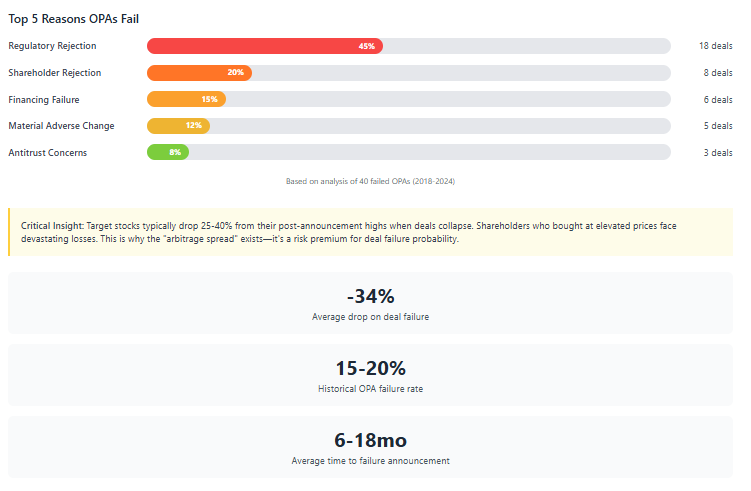
There is no guarantee of success for every OPA, and on those occasions when the OPA fails it is often very costly.
Regulatory rejection: Regulatory authorities can prevent the completion of an acquisition if they perceive it to be anti-competitive. Nvidia's attempted acquisition of ARM for $40 billion in 2022 fell apart after being met with significant regulatory pushback from antitrust authorities in the US, the EU, the UK, and China. After the deal was publicized the stock price of ARM skyrocketed, but after the acquisition was blocked the stock price plummeted back down to pre-acquisition levels. Nvidia did pay a $1.25 billion breakup fee, but by failing to complete this acquisition they avoided a bad deal.
Shareholder rejection: Target company shareholders may be unwilling to accept the offer for the target company if the shareholders perceive the offer price to be undervalued. Shareholder rejection is more likely to occur based on OPAs that face hostile opposition from target company management who actively lobby shareholders to vote against the acquisition.
Financing failure: If the acquirer cannot obtain financing for the acquisition due to tighter debt markets, the closing will not occur. Several OPAs failed during the Financial Crisis (2008) due to the freezing of credit markets.
Changes in business conditions: Due to the deteriorating performance of the target company between the announcement of the acquisition and the closing, the acquirer may invoke a "material adverse change" clause in order to renegotiate or abandon the acquisition.
Government intervention: Governments often restrict foreign investments in strategic industries. National security or economic protectionism may ultimately prevent a transaction from being completed.
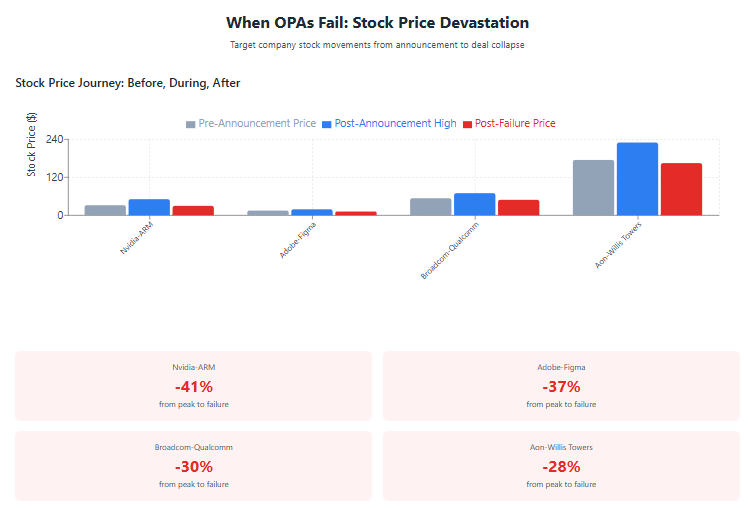
After regulatory backlash knocked down Adobe's 2023 $20 billion acquisition of Figma, Figma's previously private value decreased as Figma experienced decreased growth without being able to fall back on the acquisition's safety net.
Shareholders who had relied on the acquisition are extremely disappointed. Failed OPAs typically drop the price of a target company's stock by 20-30% in one day, as the acquisition premium disappears or is lost.
The company that previously had the acquisition premium will return to its standalone value, which may also be lower than it was before if the conditions of their business worsened because of their lengthy acquisition process.
Smart investors will evaluate the success rate of a merger before acquiring shares in a target company; for example, a deal with a 90% chance of going through at $95 per share is better than buying into a deal with only a 50% chance of going through at $100 per share.
Famous OPAs That Shaped Global Markets
Microsoft-LinkedIn (2016): Microsoft acquired the professional network for $26.2 Billion which was approximately 50% more than its then current market value of $131 per share to $196 per share. This deal gave Microsoft access to over 400 million professionals and allowed Microsoft to integrate LinkedIn's data into the Microsoft Office product line. This deal changed the nature of enterprise software by combining a productivity tool with a Professional Networking Tool.
Exxon-Mobil (1999): The $81 billion merger created the largest publicly traded oil company in the world and has served as a model for the continued consolidation of the Energy Industry to this day. The companies indicated that by combining their resources and operating on a larger scale they would be able to reduce their costs and increase the returns to shareholders.
Salesforce-Slack (2021): Salesforce purchased Slack for $27.7 Billion in order to compete against Microsoft Teams. Salesforce paid a premium of 55% and the price of Slack's stock increased twofold. This transaction highlights how competitive market pressures can drive companies to pursue acquisitions even when the price is high and that Salesforce required communications tools in order to round out their Enterprise Solutions.
LVMH-Tiffany (2021): Initially, LVMH and Tiffany agreed to an $16.2 billion acquisition. However, after COVID-19 occurred, LVMH attempted to renege on the deal and claimed they had discussed a material adverse change. After lengthy legal battles, the companies finally completed the transaction at the price of $15.8 billion. This dramatic story demonstrates how deals can disintegrate and be renegotiated. Tiffany's stock price fluctuated considerably during this time.
Exxon Mobil Corporation (Exxon): 2023 saw Exxon Mobil Corporation (Exxon) make a historic acquisition of Pioneer Natural Resources Company (Pioneer) for over $60 billion. The transaction represented a continued trend for oil companies to consolidate their holdings within the United States' shale basin and allowed Exxon to secure a dominant position in the Permian Basin (located in Texas). Additionally, this acquisition illustrated how large, established businesses are now utilising acquisitions as a means to increase their scale rather than inventing or finding new avenues for growth.
In the past, each of the previous OPAs that shaped their respective industries represented a significant shift in the way traditional businesses view themselves and their respective industries. An example of this is the merger between Microsoft and LinkedIn. The combination of Microsoft’s software technology with LinkedIn’s social networking capabilities enabled both organisations to leverage each other’s strengths in order to better compete in the marketplace. Other examples are Salesforce’s purchase of Slack and LVMH Moët Hennessy Louis Vuitton's acquisition of Tiffany & Co. These combinations represented a range of different types of strategic repositioning, including responding to competitive pressures, increasing luxury brand consolidation and combining core competencies, respectively.
Typically, when an organisation announces a large OPA, it sparks a series of additional OPA(s) by competitors who seek to establish a similar competitive position in their respective industries. Therefore, as a result of the transaction between Exxon and Pioneer, it is expected that there will be a number of additional large, industry specific OPAs occurring within the next few years through organisations taking advantage of the competitive environment created through Exxon's acquisition of Pioneer.
How Traders Can Profit from OPA Events
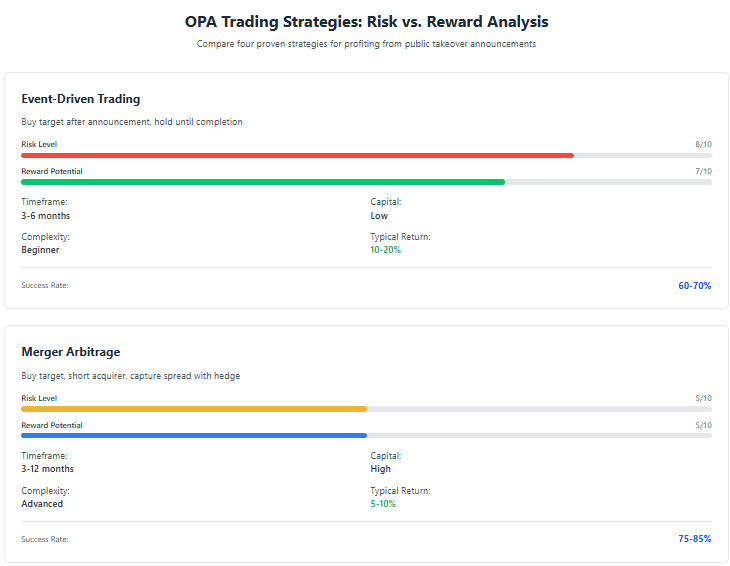
Event-Driven Trading
-
Buy target stocks immediately after the announcement, hold them until the transaction completion date, and then sell the stock at the offer price.
-
Risk: the transaction could fail, resulting in the stock crashing.
-
Reward: typically captures 10-20% spreads on a regular basis.
-
Requires the ability to obtain information and execute trades quickly.
Merger Arbitrage
-
Purchase shares of the target company and short the shares of the acquiring company in a predetermined ratio to hedge against market risk while simultaneously capturing the spread between the target and acquirer’s shares.
-
This is a professional strategy that requires a large amount of capital and sophistication; these strategies are used by hedge funds.
-
Because these trades are inelastic to movement in the stock price, the return is typically between 5-10% annually, with low correlation to overall market movement.
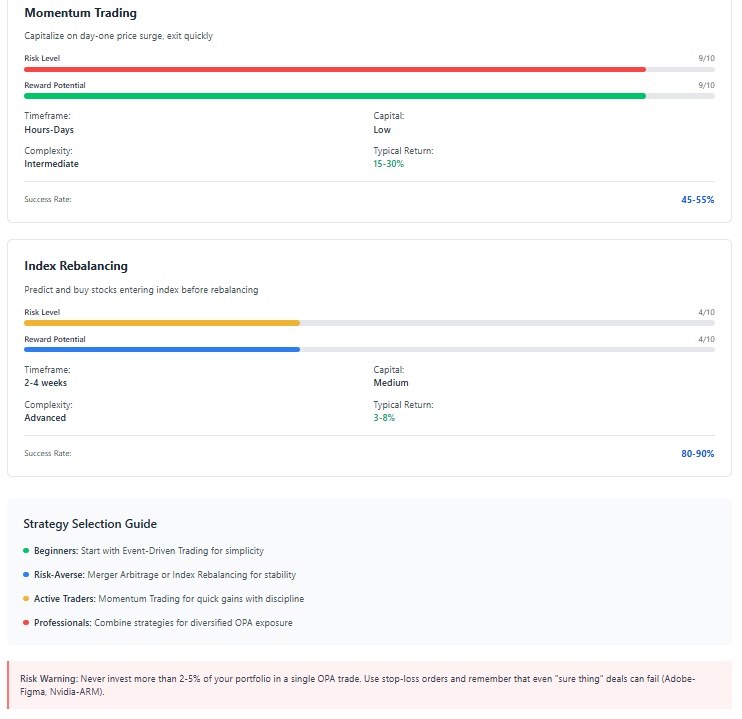
Momentum Trading
-
Buy shares of the target company and sell shares within hours or days after the announcement to capitalize on emotional buyers prior to completion of the transaction.
-
This trading strategy does not expose you to long-term risk; you can sell quickly and place stop orders to close out positions quickly if necessary.
-
Requires the discipline to take profits quickly and close losing trades quickly.
Index Rebalancing Plays
-
Predict which stocks will replace a major company when it exits the index and which stocks will gain in importance.
-
Buy stocks prior to being purchased by index funds based upon their rebalancing and index construction rules.
-
This is an advanced trading strategy and requires a good understanding of how to construct indices.
While all these strategies have different risk-reward profiles, Event-Driven Trading is the simplest, but carries the highest binary risk (success or failure). Merger Arbitrage offers a more complicated approach to trading with lower overall risk. Momentum Trading strategies require quick decision-making abilities; index rebalancing plays require patience and the ability to research efficiently.
Risk management is an important aspect for all businesses and investors in building a portfolio. A good rule of thumb is to not invest more than 2%-5% of your total portfolio on one trade. Many deals that appear to be a sure thing will eventually fail, such as Adobe-Figma, GPU Technology Conference - Nvidia this year and many other technology stocks. It would be best to put in place a stop-loss order to limit losses on your trades.
The concept of making a profit is simple: Buy Low, Sell High, based on the expected performance of a company's stock price. However, timing, risk management and being able to remain unemotional is key to successfully executing a trade. As you are learning, I do suggest you paper trade and get comfortable with the strategies before risking real capital.
What OPAs Mean for Long-Term Investors
Several repeated acquisitions of competing companies have created smartphone industry consolidation among larger companies. Examples of tech, pharmaceutical and energy companies that have undergone consolidation over the last two decades include, but are not limited to, Google, Meta, Amazon and Apple. In doing so, these companies create oligopolies with increased pricing power and larger competitive advantages.
Companies operating in an industry experiencing consolidation usually trade at a higher multiple over time due to an expectation from the investing community that they will eventually become acquisition targets. As an example, the average price of biotech stocks is substantially above that of an average publicly traded company. Larger pharmaceutical companies are engaged in a continual search for up-and-coming biotech firms with possible drug candidates.
Long-term investors have the opportunity to acquire quality companies operating in fragmented industries likely to experience consolidation in the future. This typically occurs when there are many small players within one industry, and there are clear and compelling economies of scale within that industry.
One example of this opportunity can be illustrated by the smartphone industry. In 2008, there were hundreds of different smartphone manufacturers operating; by 2024, Apple and Samsung had around 70% of total market share. Early investors in the consolidation of the smartphone manufacturing market generated significant profits because acquisitions-related growth led to repeated acquisitions and consolidation of the industry.
For long-term investors, OPAs should be viewed as a strategic decision, not one made based on the moment. An acquisition offer represents an opportunity that presents an investor with two choices: accept the premium price and leave or reject the offer in hopes that the company will achieve independence. Rejecting the offer may make sense if you believe the management is undervalued the company; however, there are always reasons why premium prices are offered, and management likely has access to additional information that is not available to shareholders.
The ideal long-term investing strategy is to have a portfolio of quality companies, where acquisition becomes a bonus rather than the primary investment thesis. Typically, purchasing mediocre companies in hopes of becoming an acquisition target will result in disappointment.
The OPA Analysis Checklist for Investors
When considering an OPA target, consider the following:
1. Ensure that the price being offered for the target is reasonable based on the target's financial situation. A 60% premium for a company with low growth expectations might be too high. On the other hand, a 20% premium for a rapidly growing company may not be high enough.
2. Determine whether the acquisition will be viewed by regulatory agencies as anti-competitive. Acquisitions that create market dominance in a given market, or that use sensitive technology, will be scrutinized more than others.
3. Understand whether the acquirer has secured financing for the acquisition. Acquisitions that will be financed with cash, and that are supported by a solid balance sheet, are more secure than leveraged finance deals.
4. Investigate how the market is reacting to the announcement of the acquisition. If the target company's stock price is trading significantly below the price offered for it, the market is not confident that the acquisition will go through. Conversely, if the stock price is trading close to the price being offered for the company, there is a high level of confidence that the acquisition will go through.
5. Assess whether the contemplated acquisition is a logical fit with the acquirer's business. There should be opportunities for synergy that can be quantified, and claims of "strategic value" are often euphemisms for overpaying for the target company.
6. Evaluate whether the acquirer has successfully integrated past acquisitions. Companies with a strong history of merging and acquiring other firms typically do a good job of integrating their acquisitions, while others may create value-destroying integrations.
7. Determine the expected length of the closing process for the proposed merger. A merger with an expected closing period of less than six months has a lower probability of experiencing issues than an acquisition that requires longer than 18 months to close due to regulatory reviews.
Key Takeaways: How to Read Market Signals Like a Pro
Stock price movements caused by "Offers to Purchase" (OTC) announcements can range from 40% jumps up to 20% dips for companies making an offer for another company's stock.
Additionally, competitors usually react differently depending on what industry they operate within. So, as can be seen in the example above, the impact of the news is felt immediately and covered fairly accurately in terms of market moves.
When large companies acquire other large companies, the entire indices and sentiments of each index will shift due to the merger's impact and subsequent portfolio rebalancing due to the merger. Such indexes experience
The best traders view OPAs as puzzles to solve, not lottery tickets to buy. They assess probability, measure risk-reward, and act decisively when odds favor them. That's how you turn market-moving events into consistent profits.
Ready to catch the next market-moving OPA before everyone else? Track takeover events in real-time, set custom alerts, and access institutional-grade analytics on Tradewill.com. Start turning deal flow into profits today.
Disclaimer: The content of the blog does not represent any position of Trade W, does not serve as any trading-related decision advice, and does not endorse any third-party.