
 Trade W

Most new investors think of traders on Wall Street reading charts with lots of numbers and blinking lights when they hear "options." However, options can be used by any average individual in addition to professional traders. They are logical agreements with a structure. Once you learn the basic concepts, they will make sense to you.
For example, let’s say you want to buy a ticket to see a band in concert in three months. You don’t know if you are going to attend or if the band will sell out in three months. You pay a small amount of money today for the right to buy a concert ticket at today’s price. If the concert sells out and the price of tickets goes up three times per ticket, you still have the price you originally locked in today.
If you decide not to go to the concert, your loss is limited to the original fee you paid to reserve the right to buy the ticket. An option provides the same type of ability to the investor in today’s financial or commodity market.
What Are Options Contracts?
An Options Contract is a type of financial derivative. It is based on the price action of an underlying asset, such as a stock, currency, crypto asset, or market index. However, you do not actually own the underlying asset, but you can obtain an economic interest or investment in that underlying asset.
Options contracts involve two parties. The first is the buyer of the option, who pays a premium for the right to complete the transaction at a certain price in the future. The second party is the seller of the option, who must honour the buyer’s right to complete the transaction if the buyer decides to proceed.
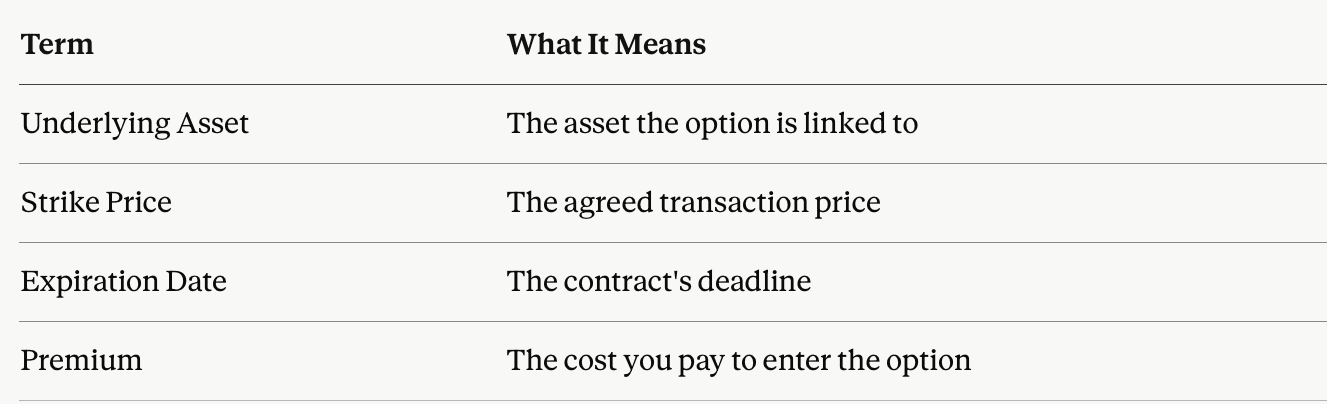
Options exist to provide financial risk management solutions and to enable traders to maximise returns and hedge potential losses by using leverage without tying up their entire capital.
Call Options vs Put Options
Options fall into two categories, call options and put options, and it is essential that you understand both before you execute your first options trade.
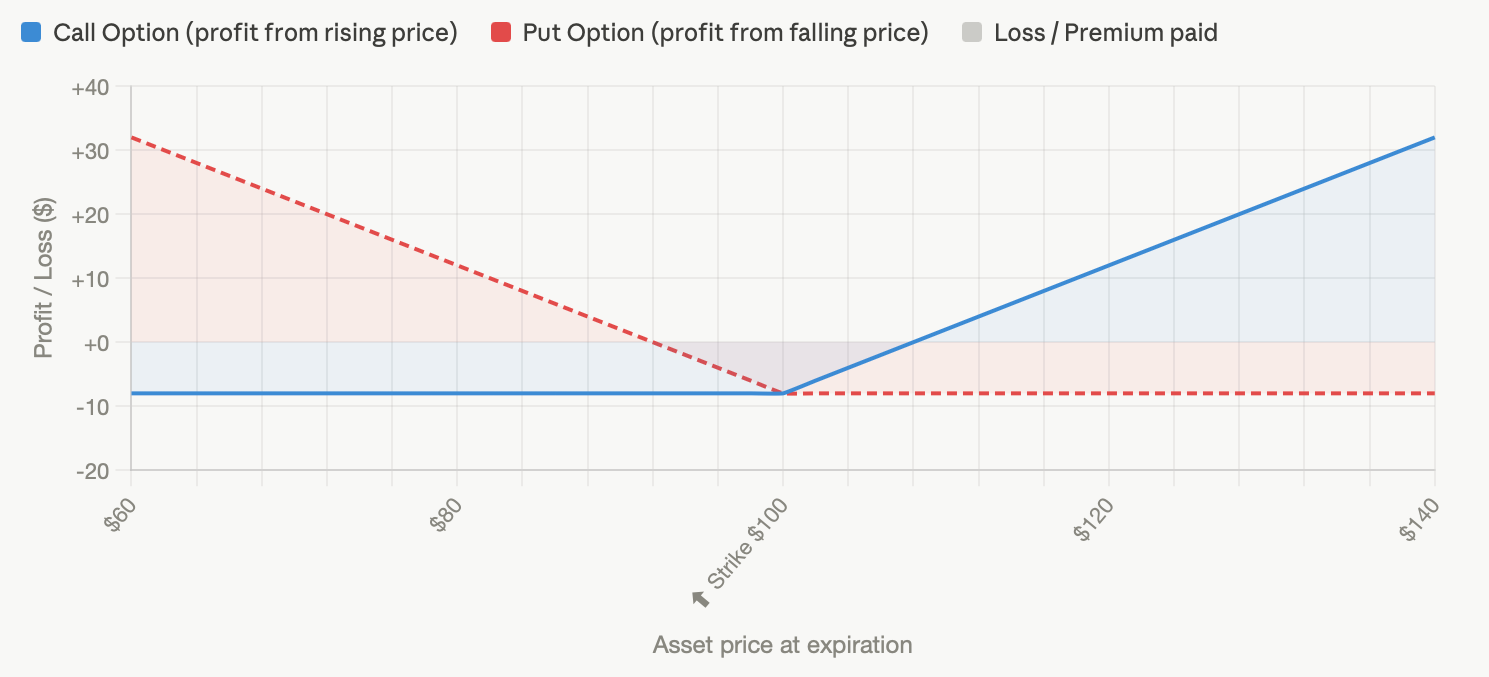
Call options provide the purchaser with the right to purchase an underlying asset at a particular price, called the strike price or exercise price, on or before the expiration date. You would purchase a call option if you believe that the price of the underlying asset will increase, thereby making it profitable to exercise your option. However, if the price of the underlying asset does not increase, you would only lose the cost of purchasing the option, the premium.
Put options provide the holder with the right to sell the underlying asset at the strike price on or before the expiration date. You would purchase a put option if you believe the price of the underlying asset will decrease, and you would typically use put options to hedge against existing long positions.
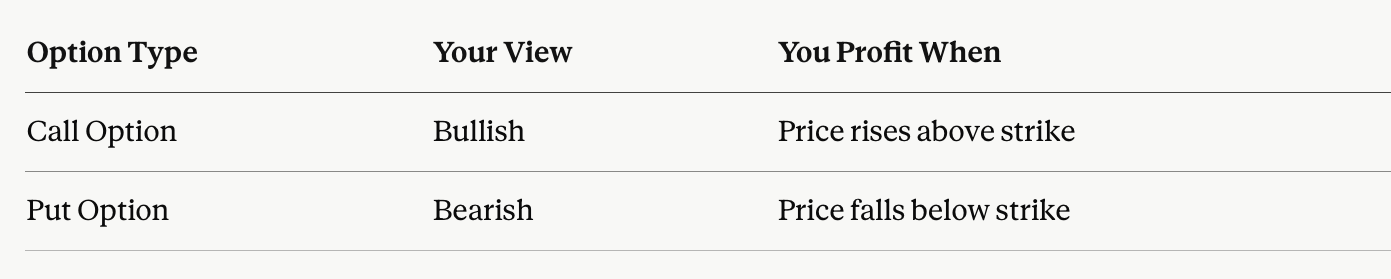
Simply put, call options gain value as the underlying asset's price increases, while put options gain value as the underlying asset's price decreases. The maximum loss for both call options and put options is limited to the premium paid for the option.
Premiums, Strike Price and Expiration Date
Three basic mechanics control every options trade. Get those three right, and you will understand 80% of how options actually work.
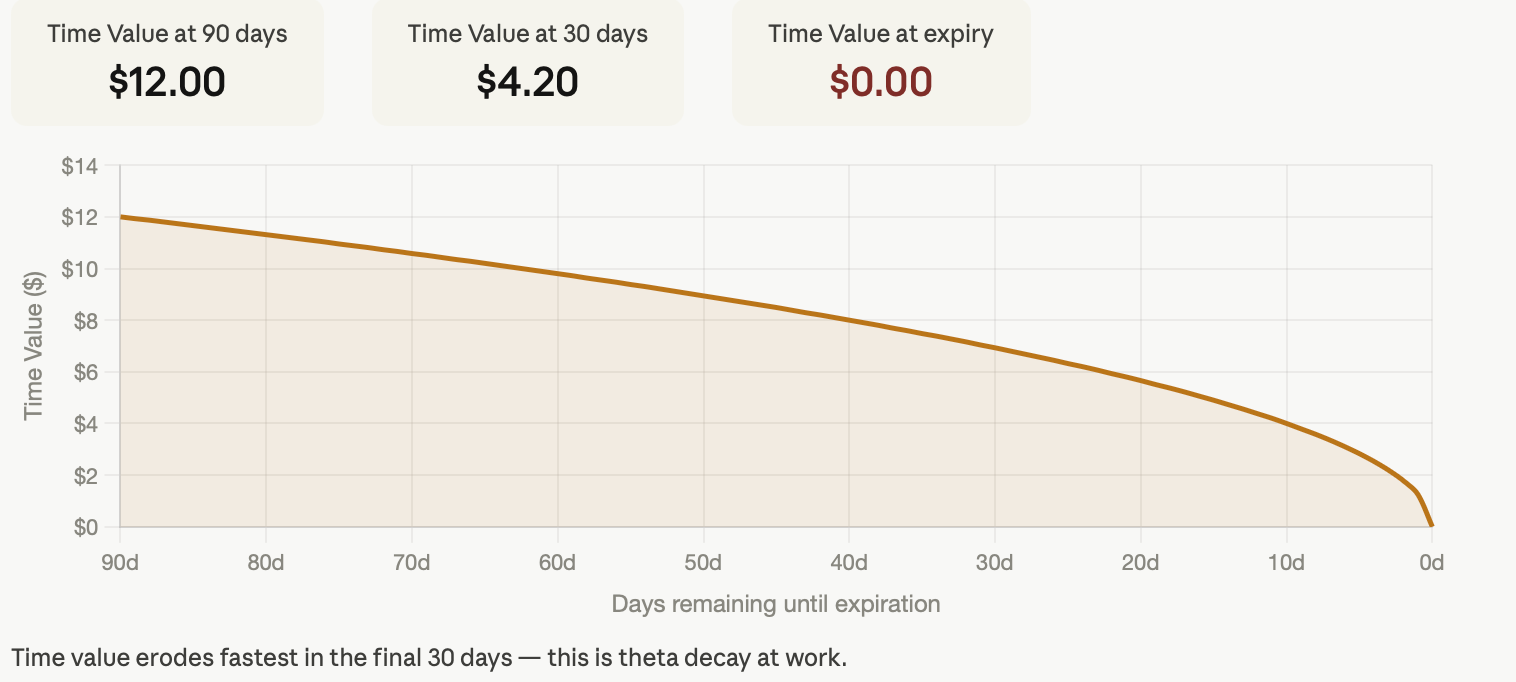
The premium is simply the price you pay to enter the trade. It is not a deposit; it disappears as soon as you buy it. The premium reflects the market's perception of how likely the option is to be profitable and how much time is left.
The strike price is the predetermined transaction price that is embedded in the contract. For example, if you purchase a call option with a $100 strike price and the underlying asset rises to $120, you have the right to buy the asset at the $100 strike price. This means your intrinsic value is the $20 difference between the current market price ($120) and the strike price ($100).
The expiration date is the deadline by which the option must be exercised. After this date, the option expires worthless. The graph shows an important aspect of options trading, that is, time decay (or theta) is not linear, meaning that the rate of time decay increases dramatically during the last 30 days before expiration. Therefore, think about time decay in the same way that you would a ticket for a flight. The longer the refund period is for your ticket, the higher the price you must pay for it. Conversely, as the refund period nears its end, so will the value of the ticket.
There are three states that every options trader should know:
-
In the Money (ITM): The option has intrinsic value today.
-
At the Money (ATM): The price of the underlying asset is equal to the strike price.
-
Out of the Money (OTM): The option does not have intrinsic value.
Understanding How Options Trading Works
So let's go through a complete example from beginning to end.
Let's say you're bullish on Stock A, trading at $95, when its earnings report comes out next month, and you think there is a good chance the stock price will go up after the announcement of the results. You do this by purchasing a call option with a strike price of $100 that expires in 30 days. You would pay a premium of $4 per contract. Since each contract represents 100 shares, you would pay a total premium of $400.
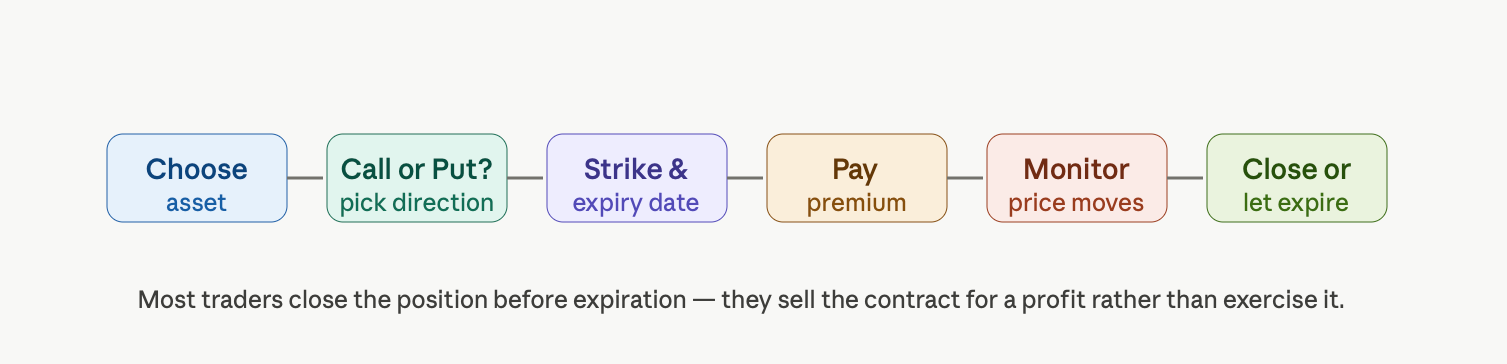
Once the earnings are announced, the stock price skyrockets to $115, and as such your option now has a value of $15 per share, or you could sell your call option to someone else for a gain of $1,100 ($15 × 100 = $1,500 - $400). If the stock price stays flat at $92, you would have no other outcome than losing your original premium of $400 and nothing more.
Most traders will never actually "exercise" (use) their option, as they will sell their contract before it expires and pocket the difference. The right to purchase becomes a value of its own.
Why Traders Use Options
Derivative instruments (options) can be used for more than speculation. There are 3 distinct purposes for derivatives: hedging, speculation, and income.
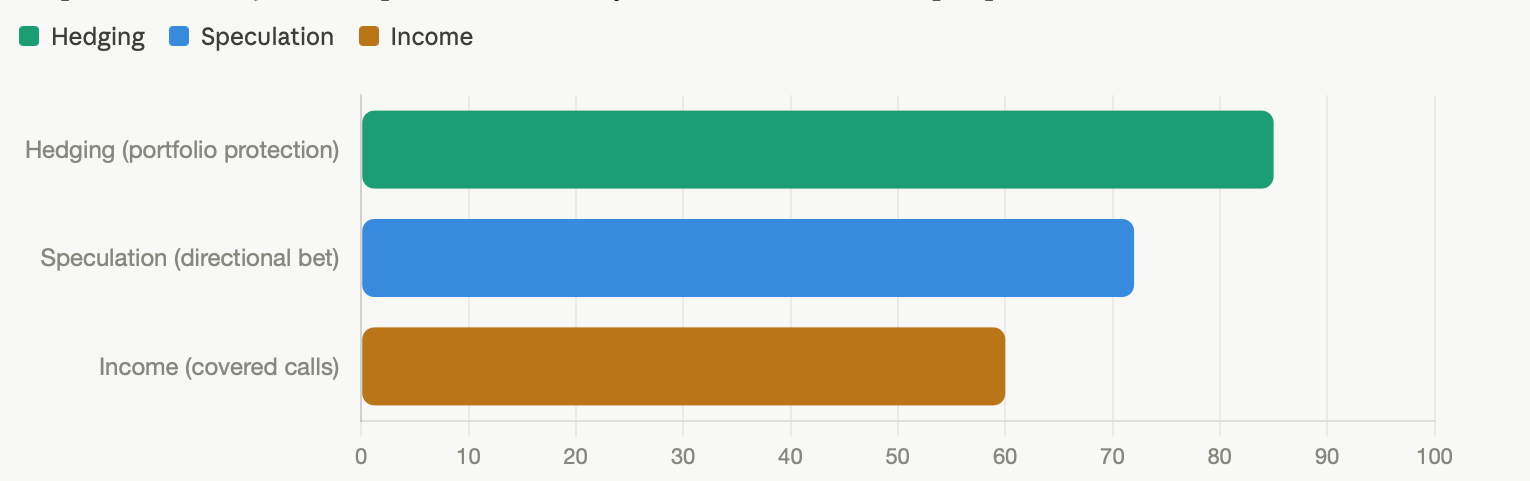
Hedging is by far the most common reason to use options and is used predominantly by institutions. A fund that has $10 million in technology stocks may purchase put options on those stocks prior to an announcement from the Federal Reserve. If the stock market experiences a 15% decline, the put options will offset the fund's loss on the underlying stock. If, however, the stock market rises, the fund would only lose the premium on the puts, which is considered a low-cost form of insurance.
Speculation allows traders to take advantage of leveraged positions without having to invest a large amount of capital. For example, by purchasing an option that costs $500, you are able to control $10,000 worth of the underlying asset.
Using options for income generation involves strategies such as covered calls, which allow you to sell call options on positions you own. When you sell call options on a position that you own, you are able to collect the premium from the sale of the call option upfront, regardless of whether the market declines, remains unchanged, or increases.
What risks do you need to be aware of when using options?
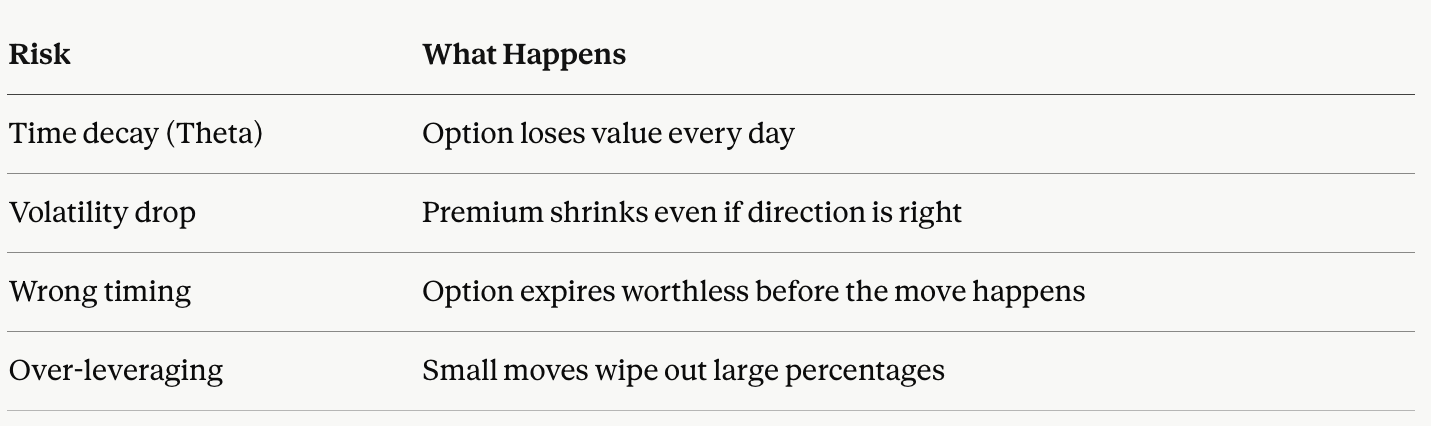
Options can experience a rapid decline in value. Here is a list of the risks that can negatively affect the experience of a new options trader.
Time decays each and every day. The time value of an option will decline every second you own the option, even if the price of the underlying asset has not changed. For example, if you purchase an out-of-the-money (OTM) option one week before expiration, you can expect the odds to be against you.
Volatility shifts can greatly affect the premium you paid for your options. When the market is very volatile, options will typically cost much more than when markets are calm. If you purchase an option when volatility is at its peak and the market becomes less volatile after you have purchased your option, the premium you paid may drop significantly, regardless of whether your trade direction is correct.
Leverage can work both for you and against you. For every dollar of gain you make from your leveraged option, you can also face the same amount in losses. Therefore, you should only invest an amount in options that you are comfortable losing.
Understanding Option Greeks in Simple Terms
The "Greeks" are a way of measuring how an option's price will respond to changes in the various forces of the marketplace. Although the Greeks might sound intimidating, they are not. They simply give you an idea of how your option will respond to market forces and what its future movement may look like.
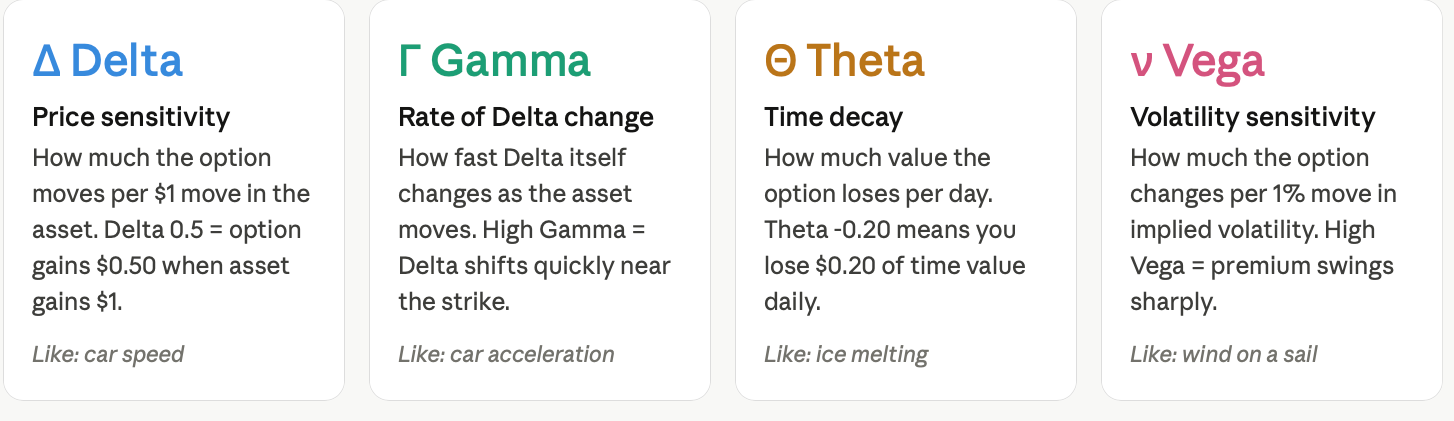
You do not need to know how to trade with the Greeks today. However, the Delta reading alone gives you a lot of information. A Delta reading of 0.30 indicates that there is approximately a 30% chance that the option will finish in the money before expiration. The Delta reading also tells you that if the underlying asset moves in your direction by $1, the option will gain $0.30 in value. This type of knowledge is much more practical than simply viewing it as a statistical value.
Options Are Available on Different Types of Assets
Options exist on more than just the stock market, and options are available on most asset classes that can be traded. For example, Bitcoin options trade at some of the highest premiums in the entire marketplace.
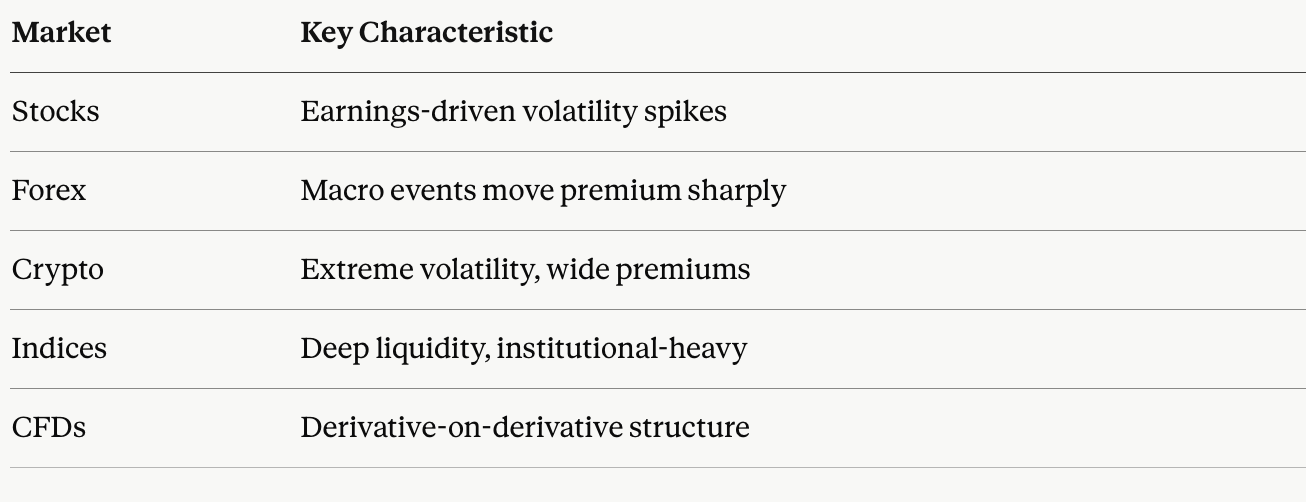 This is mainly due to the volatility of Bitcoin options, which can fluctuate by as much as 80% to 100% overnight, making them both very expensive to purchase and also potentially very profitable opportunities for the seller. A similar trend exists for stock options during earnings reporting season, although not to the same extent.
Simple Strategies That Are Successful
Do not start with Iron Condors or Straddles. Do this first:
Long Call: Buy a Call if you believe the price of the stock will increase. The maximum risk for this trade is the amount you paid for the Call Option, the premium. The potential reward is unlimited.
Long Put: Buy a Put if you believe the price of the stock will decrease. The risk/reward structure is similar to that of a Long Call, except in this case, you are attempting to profit from a decrease in the stock's price.
Covered Call: If you own the stock, sell a Call against your stock position to collect premium upfront. This strategy works well in flat and mildly bullish markets.
Protective Put: This strategy is simply using a Put Option as a form of protection for your stock position. While you are capping your downside risk, you do need to pay the premium for the Put Option.
Bull Call Spread: Buy a Call Option at a lower strike price and sell a Call Option at a higher strike price. This decreases your premium cost while at the same time capping your profit. However, Bull Call Spreads usually offer an attractive risk/reward ratio for most investors.
For a beginner, simple strategies will provide a better chance of success over time than complex strategies. Once you master one simple strategy, you can then proceed to try a different simple strategy.
Frequently Asked Questions
What are options contracts?
Financial contracts that give you the right, not the obligation, to buy or sell an asset at a specific price before a set expiration date.
How do call options work?
You buy a call when you expect the price to rise. You profit if the asset exceeds the strike price before expiration.
How do put options work?
You buy a put when you expect the price to fall. You profit if the asset drops below the strike price before expiration.
What is a strike price?
The predetermined price at which you can buy or sell the underlying asset if you choose to exercise the option.
Why do options lose value over time?
Because of Theta (time decay). Every day that passes removes time value from the contract. The closer you get to expiration, the faster this happens.
Are options risky for beginners?
They carry real risk, especially leverage and time decay. Starting on a demo account and sticking to simple strategies makes a big difference.
What are option Greeks?
Measurements of how an option reacts to price changes (Delta), time (Theta), volatility (Vega), and the acceleration of Delta (Gamma).
Can you trade options on forex and crypto?
Yes. Options exist across stocks, forex, indices, crypto, and CFD-linked instruments. Volatility characteristics vary significantly between them.
Stop watching options from the sidelines. Open a free demo account on TradeWill and place your first simulated options trade today: real market data, zero real risk, and every tool you need to build confidence before you commit a single rupee.
Disclaimer: The content of the blog does not represent any position of Trade W, does not serve as any trading-related decision advice, and does not endorse any third-party.