

 Trade W

The stock market does not always increase in value. The stock market can rise on some days; it can also decrease in value on some days, and it can stay the same. Many investors feel like they are "stuck" when the market does not move as they expected. However, options traders do not experience this type of stuck feeling. With the proper options trading strategies, you can earn profits the same regardless of whether the market goes up, down, or sideways.
This comprehensive guide covers all you need to know about options trading from ground zero to using advanced combination strategies in all types of market environments. After reading this guide, you will know how to use these tools for managing risks and seizing opportunities that are not available through common stock investing.
Options Trading 101: Understanding Options Strategies
Before looking into specific options strategies, we should first comprehend what options are.
An option is essentially a contract that gives you the right, but not the obligation, to buy or sell an asset at a predetermined price and on or before a specified date. It would be best to think about an option like a coupon or a reservation. You are essentially locking in a certain price now for a future purchase of the underlying asset.
There are two primary categories of options:
Call options enable you to buy at a specified price. You would buy a call option if you thought the asset price was going to increase.
Put options enable you to sell at a specified price. If you feel the asset price will decrease, you will likely purchase a put option.
Unlike stocks, which you can buy and hold until Forex Derivatives you sell, options expire on an expiration date. Because of the leverage of options, even a small fluctuation in the underlying security price can already provide massive percentage gains/losses in your options portfolio. Therefore, your overall gain/loss on your option portfolio can vary considerably, depending upon the price movements of the underlying securities.
There are four core elements found within an option contract:
-
The Underlying Asset refers to the security type (stock or ETF) upon which the option is based (e.g., SPY or AAPL).
-
The Strike Price represents the price whereby the underlying will be purchased/sold under the conditions set forth within the contract itself by both buyer/seller.
-
The Expiration Date indicates the last date by which the contract can be exercised by the buyer/seller.
-
The Premium represents the monetary amount paid by the buyer to the seller to acquire the contract.
To put this into context, let us consider a very basic example: Imagine that you believe that the SPY media ETF (which closely tracks the SP500 Index) is going to go up to $470 in a single month; instead of buying 100 shares of SPY at $45,000, you purchase a call option for about $500 with an exercise/strike price of $455.
If SPY goes up to $470, you could sell your call option for approximately $1,500, earning you an impressive 200% gain on your investment; however, if SPY does not go up from today’s value of $450 or experiences a price decline, your option may expire worthless, and you lose the full premium of $500 that you originally paid. On the other hand, the stock investor simply has to continue to hold on to their shares while waiting for SPY to reach $470 before they can make a profit.
Understanding this risk-reward analysis is critical to investing success. Options can neither be considered "better" nor "worse" than stocks, but rather are tools designed for specific market conditions.
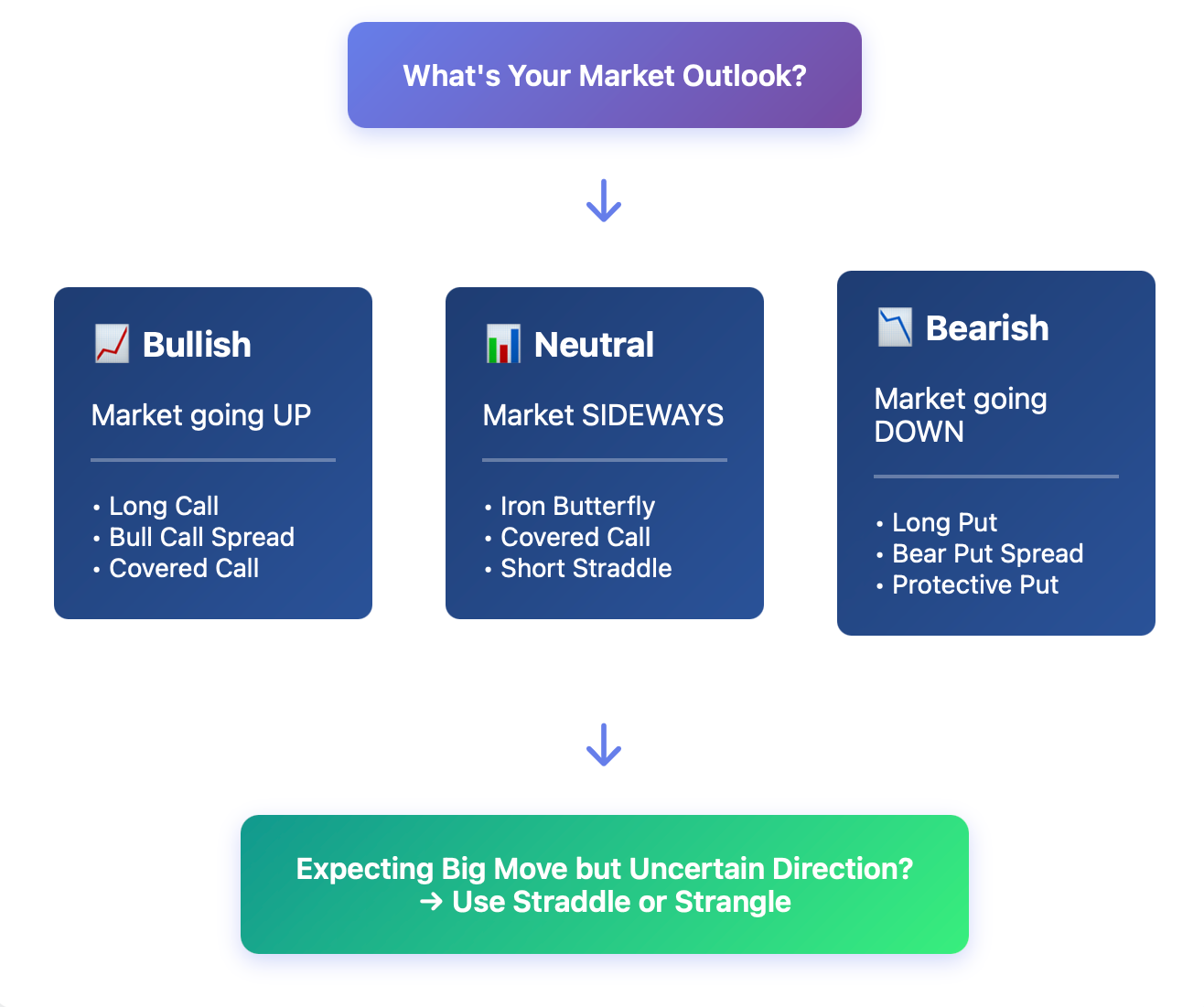
Top 3 Basic Options Strategies
Options trading strategies that all traders should be familiar with:
Long Call
The long call option strategy is fundamental to bullish trading. Investors buy a call option to take advantage of a stock's price increase above the strike price. The call option functions much like a coupon for a product or service; an individual pays a small fee to save money later by securing their eventual purchase at a discounted rate.
For example, if an individual purchases an AAPL $180 call option that expires in 30 days for $3/share ($300 total), AAPL rises to $190 next month, the call option will be worth at least $10/share ($1,000), resulting in a $700 profit to the individual. If AAPL doesn't reach $180, then he/she has lost the premium of $300.
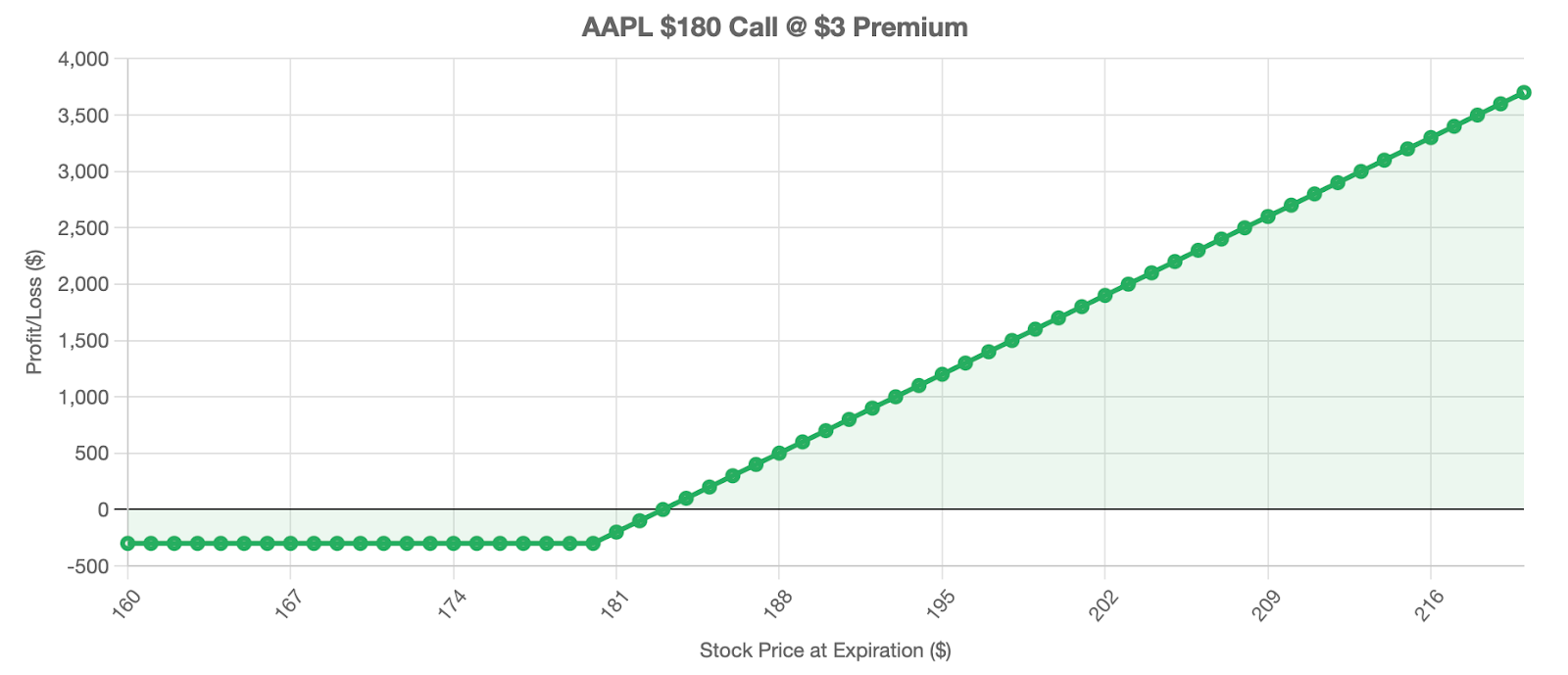
When using this strategy, the maximum loss will always be equal to the total premium paid for the option. The maximum potential gain is theoretically unlimited, as long as the price continues to rise.
Long Put
The long put option strategy is the opposite of the long call. Long puts are used when investors expect their stock to decline below their option's strike price. In essence, long puts are similar to buying insurance against unexpected losses.
For instance, if an individual purchases an SPY $450 put option for $4/share ($400 total), and SPY prices drop to $430, then the put option will be worth at least $20/share ($2,000), and the individual will make a profit of $1,600. If SPY prices increase or remain unchanged, then he/she will lose the premium spent on the put option.
In addition to protecting your investment from loss, the long put option allows the investor the opportunity to make substantial profits should the value of the underlying stock decline over time. The maximum loss will always be equal to the premium spent on the put option, while the gain potential can reach $0.
Covered Call
Covered calls are created when investors own the underlying stock and sell calls against that underlying stock. The investor currently owns 100 shares of the underlying security and sells a call option to an investor that gives the investor the right to purchase the shares from the investor at a higher price than the current market price.
This is analogous to renting out a property. While renting, an individual is compensated for renting property(called a premium), but he/she is forfeiting the opportunity to realise a potentially large gain if the underlying asset appreciates substantially.
For example, if an individual purchases 100 shares of TSLA for $250/share and sells a $270 call option for a premium of $5/share ($500), on the expiration date, if the price of TSLA is less than $270, the investor maintains both his/her premium and 100 shares of TSLA. Alternatively, if the price of TSLA appreciates beyond the set strike price to $280, then the investor's shares will be "called away" at the price of $270; however, the investor still realises a $20 profit on the stock in addition to the premium earned from the sale of the covered call.
This is a strategy designed for neutral to slightly bullish investors. It helps individuals generate additional income as a result of their current holdings, while limiting both their upside potential and downside risk.
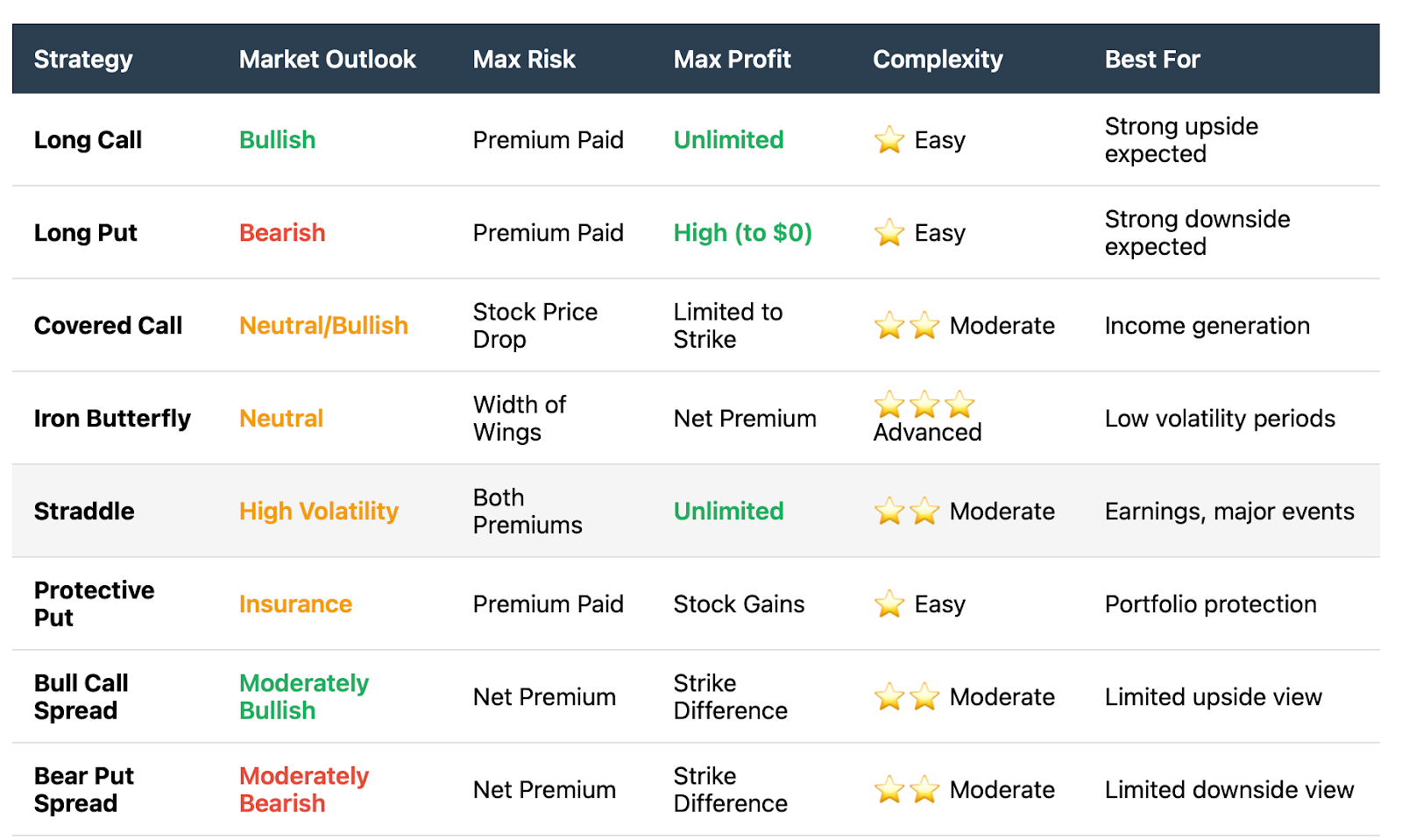
Surviving Sideways Markets: Iron Butterfly & Straddle Strategies
New traders primarily focus on price movement, whether it’s a bullish or bearish trend, and neglect the fact that sometimes prices will consolidate and wait for a big move before making any significant move either up or down. One way to participate in price consolidation is through an iron butterfly option strategy.
Iron Butterfly
The iron butterfly option strategy is a strategy that looks to profit from stocks that maintain an extremely narrow price range. Essentially, you’re setting up a trap where you collect premium by selling options while simultaneously ensuring that you can protect yourself against a major move up or down by buying a further out-of-the-money call and put option.
You can think of the iron butterfly strategy like setting up tolls along a perfectly straight road, where you will collect tolls from cars driving on the road (i.e., the stock price) as long as they continue travelling on the road and not going off the road onto another road.
To set up a position using an iron butterfly, you would sell a call option and a put option at the money, while at the same time buying a further out-of-the-money call and put option to limit your risk. The result is a position that has a limited risk profile and a potential for limited gains.
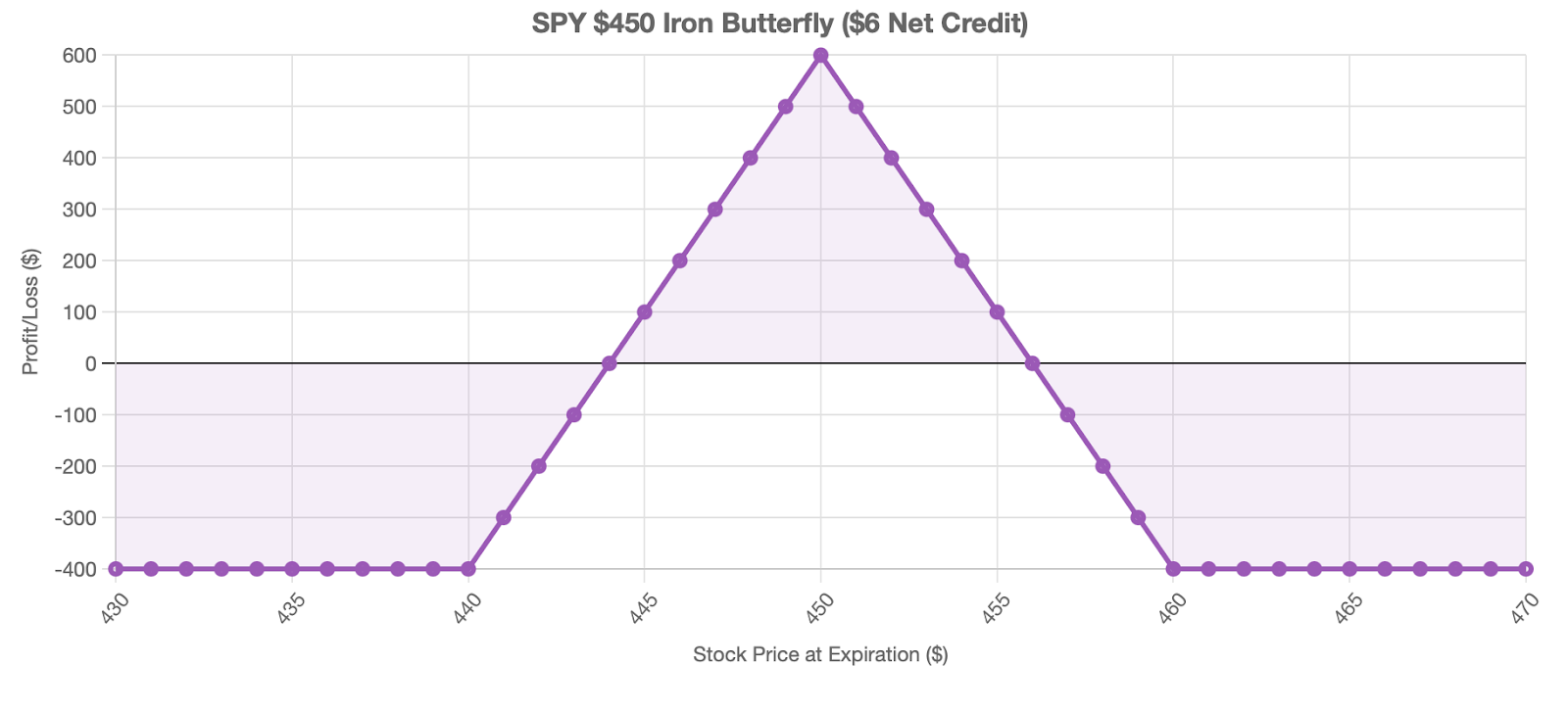
For example, the SPY ETF is trading at $450. You would create an iron butterfly by:
-
Selling a $450 call option for $5.00
-
Selling a $450 put option for $5.00
-
Buying a $460 call option for $2.00
-
Buying a $440 put option for $2.00
Your net credit would be $6.00 per share, and if the SPY ETF is trading at exactly $450.00 upon expiration, you will receive $600.00 at expiration. If the SPY ETF trades to either $440.00 or $460.00 and/or does not trade at all at expiration, your maximum loss will be $400.00 for that trade.
Straddle and Strangle
Three popular types of volatility strategies include straddles, which are purchased at the same strike price, while strangles use two different strike prices to establish a position based on anticipated directional movements; all volatility strategies are appropriate for positions based on an unknown direction but a known magnitude of movement.
As an example, assume that you anticipate a large move in TSLA stock prior to the company's upcoming earnings announcement. You may purchase one $250 call option for $8 and one $250 put option for $8, costing you $1,600.
Then, when TSLA stock rises to $275 or falls to $225, your profit from one of your options will more than cover the loss on the other option, and you will have a net gain. On the other hand, if TSLA stock does not move significantly, you will lose all of your premium paid for both options.
However, since you have purchased two options to establish a position, to be profitable, TSLA has to experience much larger price movements than if you had purchased one option. These types of strategies also provide the opportunity for traders to speculate on the volatility of a specific security, not just which direction that security may be moving.
Protective Puts: Safeguard Your Portfolio from Downside Risk
Protective puts are a way to protect against stock price declines for stocks you hold. Buying a protective put gives you a way to limit your losses by putting a floor on how low the stock could drop before it becomes worthless if you need to sell before the stock price begins to recover.
For the investor, when you buy the put, and the stock drops below the put strike price, the put option increases in value. As such, the loss that would have occurred in the stock is offset by the corresponding gain of the put, providing the investor with considerable peace of mind.
For instance, you hold 100 shares of AAPL at $180 per share. You think AAPL may have some short-term price fluctuation, so you decide to buy a $170 protective put contract for $3 per share, or $300 total.
If AAPL had fallen to $150 per share before the expiration date of the put option, you could sell your shares at $170, so your loss would be limited to $10 per share, or $1,000 (100 shares x $10) plus the $300 premium on the put option, totaling $1,300 in losses rather than $3,000 in losses you would have incurred had you not purchased a protective put.
The protective will give you psychological assurance during these periods of uncertainty. You will be able to hold your shares through these volatile times rather than selling out at the absolute worst time.
There is a cost-benefit analysis that should be made, as you will not want to spend money buying protection for every stock you own; rather, you will use protective puts selectively during times of uncertainty, or on your largest positions.
Mastering Risk-Reward: Vertical Spreads Explained
Vertical spreads are option trading strategies that allow you to take a directional position and limit both your risk and profit potential. They are less expensive than purchasing options outright because you are using the proceeds from selling one option to help fund the purchase of the other option.
Bull Call Spread
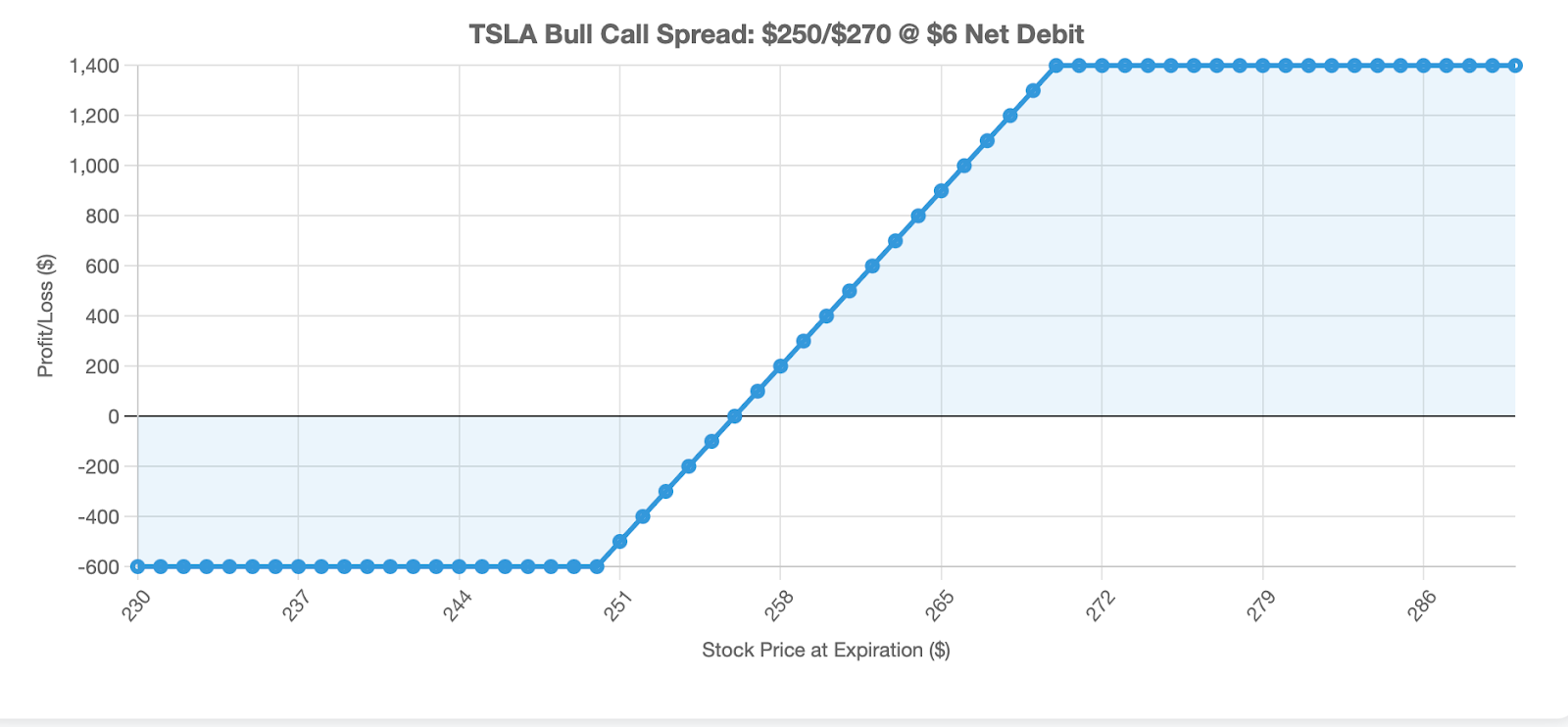
A Bull Call Spread consists of buying a lower strike call option and selling a higher strike call option at the same expiration date.
Example: If TSLA were at $250, then you could purchase a $250 call for $10 and sell a $270 call for $4. Therefore, you would have spent a total of $6. Should TSLA increase to more than $270, you could potentially earn $14. Should TSLA remain below $250, then you would lose your $600 investment.
As you can see, this strategy costs 40% less than buying the call option outright. However, the above strategy restricts your profit potential to $270. If you believe that TSLA will increase but not surpass $270, this strategy would work well for you.
Bear Put Spread
A Bear Put Spread is a mirror image of the Bull Call Spread described above. In this case, you would buy a put at a higher strike price and sell a put at a lower strike price.
Example: If SPY were trading at $450, then you would buy a $450 put for $7 and sell a $440 put for $3. Therefore, your total cost would be $4. You could make a maximum profit of $6 (or $600) should SPY decrease below $440. If SPY remained above $450, you would lose your $400 investment.
Vertical Call and Put spreads will reduce your costs and define your risk before executing the trade. Thus, Vertical Calls and Puts are a great way for traders to gain directional exposure without risking everything they have.
Volatility Insights: The Key to Options Pricing
Many beginner traders overlook this: The price of options depends on the underlying stock price, as well as how volatile that stock is over time.
Implied Volatility (IV): The price/IV that market participants assign to options is based on the "implied volatility," or the expected volatility the market has for that stock in the future, based upon current and past price movements and trends. In particular, when implied volatility is high, options tend to be very expensive due to the expectation that the underlying stock will move significantly in a large number of different directions, thus increasing the perceived risk.
Implied volatility is much like how weather forecasts can affect the price of aeroplane tickets. When there is an impending storm, flight ticket prices will increase because there is a higher demand for them and/or because there is a greater amount of uncertainty about whether there will be available flights.
For example, before a company's earnings report, an AAPL $180 call option may have an IV of 45% and a price of $8. After AAPL releases its earnings report, if AAPL goes up to $182 immediately after the earnings report, the price of that same option may fall to $6 when IV has dropped to 25%. Even though the trader was correct about the stock's direction, he or she nevertheless lost money because of the "volatility crash."
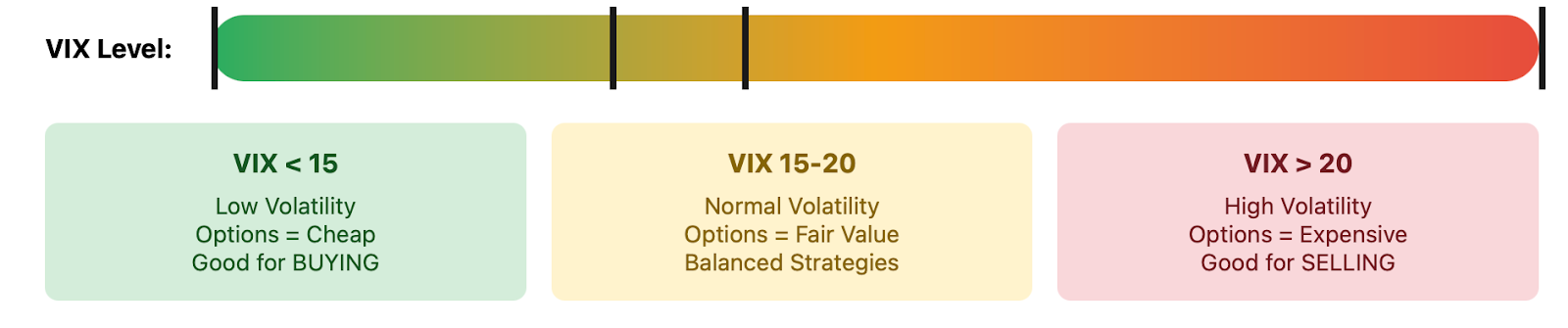
In summary, understanding the volatility of a stock and buying options when implied volatility is low, and selling options when implied volatility is high, will give a trader an advantage beyond just correctly predicting the underlying stock's direction.
Also, it is wise to watch the VIX (CBOE S&P 500 volatility index) for general market uncertainty. When the VIX is above 20, options are typically expensive across the board. When the VIX is below 15, they are typically relatively inexpensive.
Practical Combinations: Integrating Basic and Advanced Strategies
When you've mastered options strategies individually, it is time to combine them into multifaceted option positions to match your specific views of the market, as well as how much risk you are willing to take on.
Much like having a portfolio of stocks, it is important to create multiple layers of protection by combining strategies.
Bull Call Spread Plus Covered Call – You have shares that you've purchased, you have sold calls against them as a source of income and created a bull call spread to accelerate possible upside with little to no capital requirement.
Bear Put Spread Plus Protective Put – You can safeguard your current holdings by using a protective put while also profiting from the anticipated downward price movement with a bear put spread.
Iron Butterfly Plus Covered Call – Generate income off of your existing stockholdings and simultaneously earn premiums on short-term options using a narrow-range iron butterfly on an index ETF.
Example Portfolio: You hold 100 shares of SPY at $450. You:
-
Sell a $460 covered call for $3 ($300 profit) and an Iron Butterfly (two Sale/Purchase of date Table Call and Put Option) about $450 on SPY for $600
-
Buy an Insurance Policy (Protection Policy) for the share price at $440 and make a $4 ($400) investment in your shares.
-
You have now combined your position with $500 on Premium Income and protected your Downside Conversion at $440 and capped your Upside Conversion at $460. If SPY stays within the $450 price range, you benefit from all three combinations.
This combination requires more management but has the best risk-adjusted payouts than just one strategy at a time.
Trading Psychology & Money Management for Options
Discipline is an essential component of any successful approach to options trading. Even if you have a solid understanding of various options strategies and the risks associated with each, if you do not possess sufficient discipline to utilize proper money management techniques and remain psychologically stable, then your strategies cannot succeed.
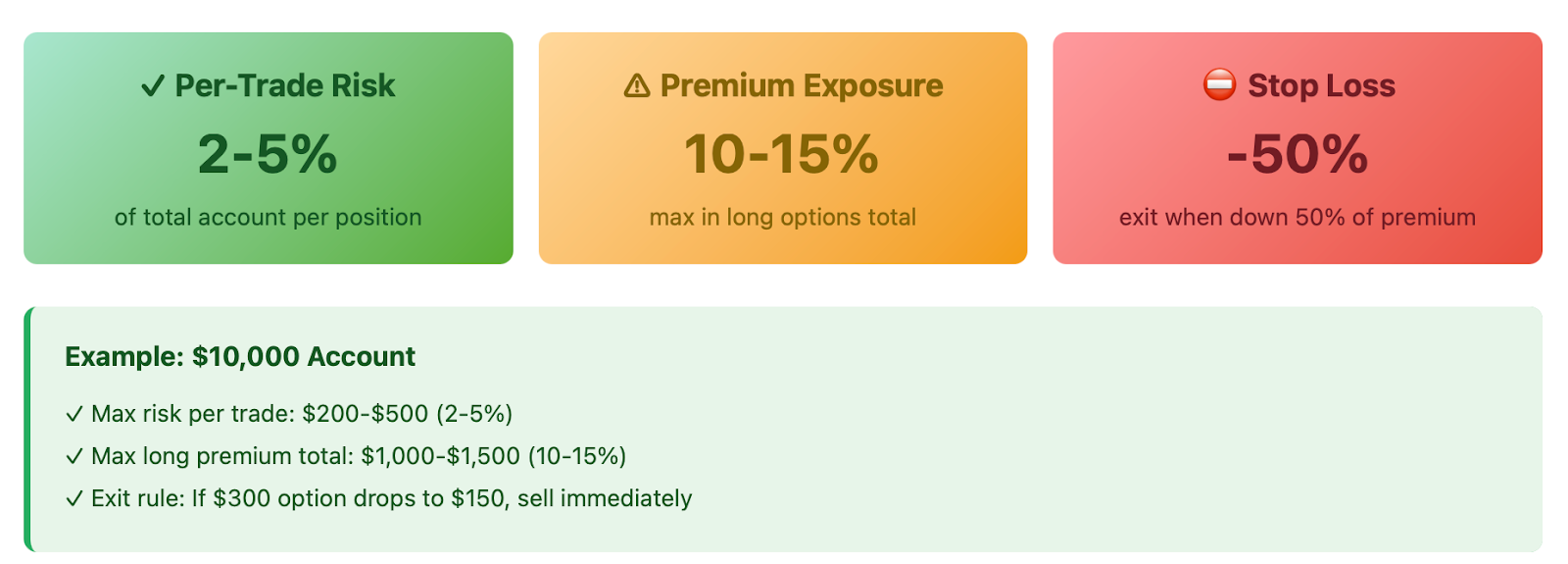
Position Sizing: Your maximum risk on any single options trade should be 2%-5% of your entire account balance. Options have the potential to become worthless, so you must treat each trade as potentially disposable.
Premium Control: The maximum amount you should spend on long options is 10%-15% of your total account balance. You need enough preserved capital to protect against future losing streaks.
Stop-Loss Discipline: You should create "mental" or "actual" stops based on 50% of the premium that you paid for the option. For example, if you purchase an option for $500 and it drops to $250, exit that position immediately. Don't think or hope it will recover, because hoping is not an effective strategy.
Avoiding Revenge Trades: If you lost money on a trade, the market does not care. So don't try to "double down" and get it back by increasing your investment. Stick to your trading plan.
Example: You have a $10,000 trading account. If you risk $300 (3% of your account value) on a long call option, and the price drops to $150, you will lose $150 (1.5% of your account value) when you exit the position. Because you followed the above guidelines for this option, you still have over 60 trades to maintain the same level of risk before losing all of the capital in your trading account.
Initially, you should use a paper trading or demo account to test strategies without risking any real money until you have consistently shown a profit over 30+ trades. After this time, you may consider trading with real money, but only with small position sizes.
Your mindset is more important than your strategy in options trading; therefore, you must remain disciplined, patient and unemotional in order to be successful. To do this, your goal will be to outlast the remaining 90% of options traders that blow up their accounts in search of fast profits.
Start Trading Smarter with Options
You've gained a comprehensive understanding of the most effective options strategies in varying market conditions; from basic long calls to complex iron butterflies, your toolbox of strategies can be adjusted to fit the current market conditions. Matching the correct strategy to your market outlook, properly managing your risk, and above all, staying disciplined even during the most emotional of times are the keys to successfully using options.
Are you ready to implement and apply the aforementioned strategies? Go visit tradewill.com and begin the process of opening your account now! After all, the market will not wait, nor should you, for your advantage to be ready!
Disclaimer: The content of the blog does not represent any position of Trade W, does not serve as any trading-related decision advice, and does not endorse any third-party.