

 Trade W

What Is Pairs Trading? A Must-Know Strategy for Global Traders
Pairs trading is an advanced market-neutral approach which involves buying one asset and selling another highly correlated or co-integrated asset at the same time. The main principle is to capitalize on the spread between the two assets returning to its historical mean, which is called mean reversion.
Unlike directional trading strategies that are wholly reliant on market direction, pairs trading is rooted in the price relationship between two assets, thereby making the strategy market-neutral.
The name of this strategy comes from the “pairing” of two assets that have moved together over time. Traders will look for pairs and trade when the prices diverge, expecting the assets will reconverge. Since profits will be derived from the relative performance of the two assets, rather than the absolute price fluctuations, much of the market risk is removed.
To help illustrate this concept, consider a simile from high school: take two students that correlate with similar scores on examinations. Then, one student scores 20 points higher than the other on a particular exam. You, based on your historical knowledge of their performance, would expect, on average, the students to score closer together on subsequent exams. In the same way, when two correlated assets diverge and deviate from their normal relationship, pairs traders expect the assets to reconverge.
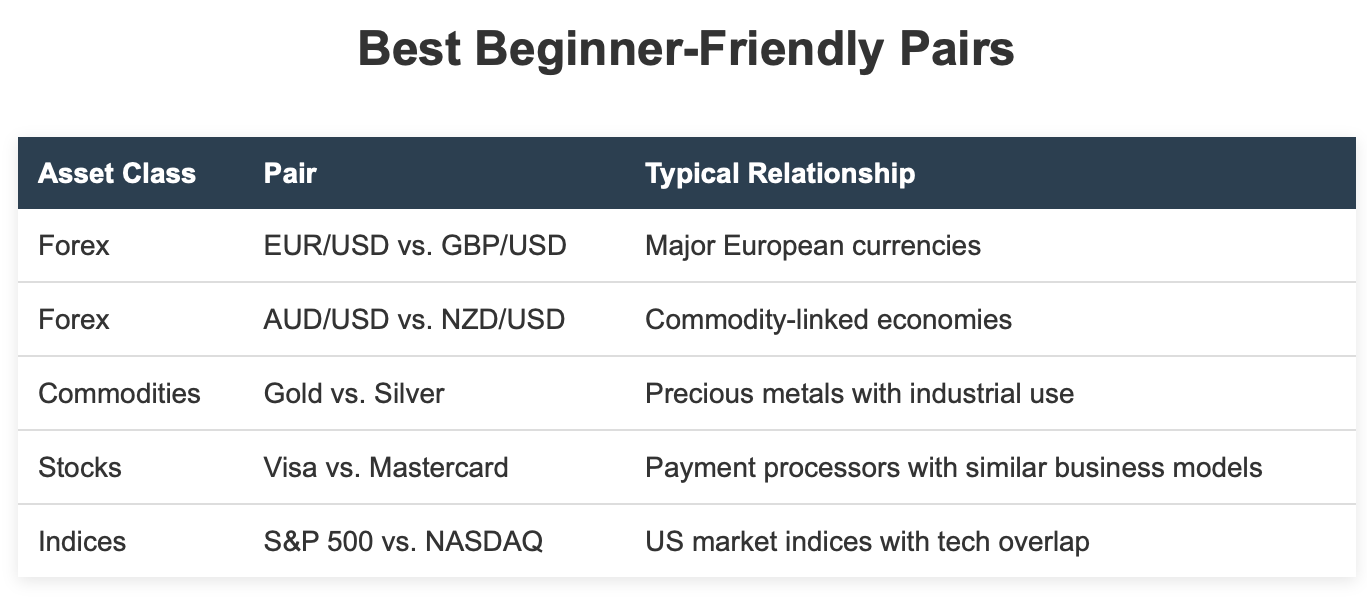
Professional traders utilize this strategy across multiple markets. For instance, they can pair Gold (XAUUSD) with Silver (XAGUSD), Exxon (XOM) with Chevron (CVX), or any two currency pairs like EUR/USD and GBP/USD. These pairs generally have their market moved by economic fundamentals that will support their relationship over extended periods of time.
Applying Pairs Trading Across Markets: Forex, Commodities, Indices, Stocks, Crypto
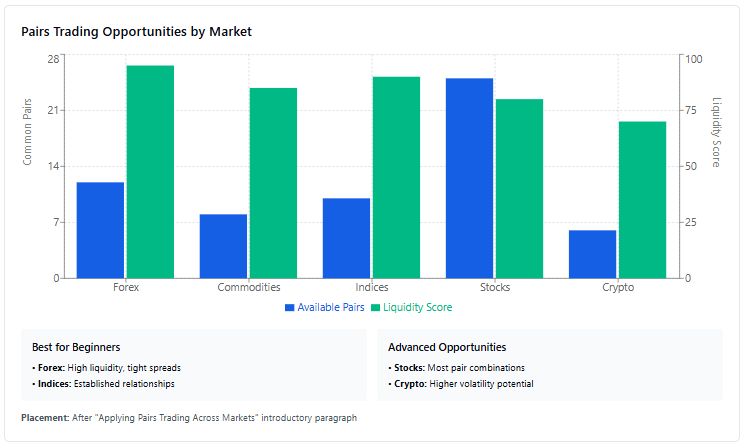
Pairs trading is not restricted to a single market; it is a flexible strategy applicable to different asset classes. A big part of the pairs trading process is identifying pairs who have a true economic relationship as the driver of their long-run correlation and cointegration. Now we will analyze some good pairs trading universes across a few different markets.
Forex (Foreign Exchange)
Currency pairs should provide a wealth of opportunity for pairs trading, particularly for economies with strong trade relationships:
-
EUR/USD versus GBP/USD: Both major pairs are correlated because of their connection to the European economy
-
AUD/USD versus NZD/USD: Australia and New Zealand have a close trade dependence therefore the pairs are highly cointegrated
-
USD/JPY versus USD/CHF: Both are considered to be "safe haven" currencies during instability in the market.
Commodities
Commodity pairs frequently have similar supply-demand dynamics:
-
Gold vs. Silver: Both are precious metals that respond to similar macroeconomic factors although silver can be more volatile.
-
Brent vs. WTI Crude Oil: These are two different benchmarks for crude oil that usually have a spread relationship.
-
Copper vs. Aluminum: These are industrial metals with correlated demand in construction and manufacturing.
Indices
Market indices that represent similar economic sectors or regions can make great pairs:
-
S&P 500 vs. NASDAQ: Both US stock indices although NASDAQ have a larger concentration of tech stocks.
-
DAX vs. Euro Stoxx 50: German and European indices that are correlated in economic relationships.
-
FTSE 100 vs. DAX: UK and German indices that are correlated in economic relationships.
Stocks
Stock onboarding focuses around companies in the same sector or dealing with similar business models:
-
Visa vs. Mastercard: Both are payment processing companies, with very similar business models.
-
Coca-Cola vs. PepsiCo: Two competitors in the beverage industry.
-
Exxon vs. Chevron: Two leading oil companies that have very similar leverage to energy prices.
Cryptocurrency CFDs
The relative newness of the crypto market also allows for pairs trading opportunities:
-
Bitcoin vs. Ethereum: The two most significant cryptocurrencies tend to move, sometimes in different intensities.
-
Bitcoin vs. Litecoin: The relationship promotes Litecoin as "Digital Silver," while Bitcoin plays the role of "Digital Gold."
-
Stable DeFi tokens: An example would be Uniswap vs. SushiSwap, which are in the same crypto sector.
History has shown that pairs trading has worked. In 2020, when COVID-19 hit, Gold and Silver diverged significantly when Industrial Demand for Silver collapsed while Gold became a friendlier "safe haven" as prices soared. This created a great pair opportunity as the spread continued to normalize.
In a similar vein, during early 2023, Bitcoin and Ethereum provided numerous high frequency opportunities as sentiment shifted between the two most dominant cryptocurrencies. Traders that recognize the parallel could take advantage of ephemeral divergences during periods of shifting market sentiment.
The universal theorem is that pairs trading provides the best fruit when the two assets will have an economic relationship. Without this foundation, any kind of correlation may only be in the market for a temporal and inconclusive time frame.
Consider market liquidity (an essential component for regulation) when selecting pairs, transaction costs (as a pair could lose much of their profit on a somewhat tight spread), and a lack of stability in their relationship (as some pairs may become inconsistent with a correlation).
By recognizing these characteristics unique to the market, traders can find the best pairs trading setups in the asset class they prefer.
Pairs Trading Risk Management: Breakdown of Cointegration, Double Loss, CFD Leverage
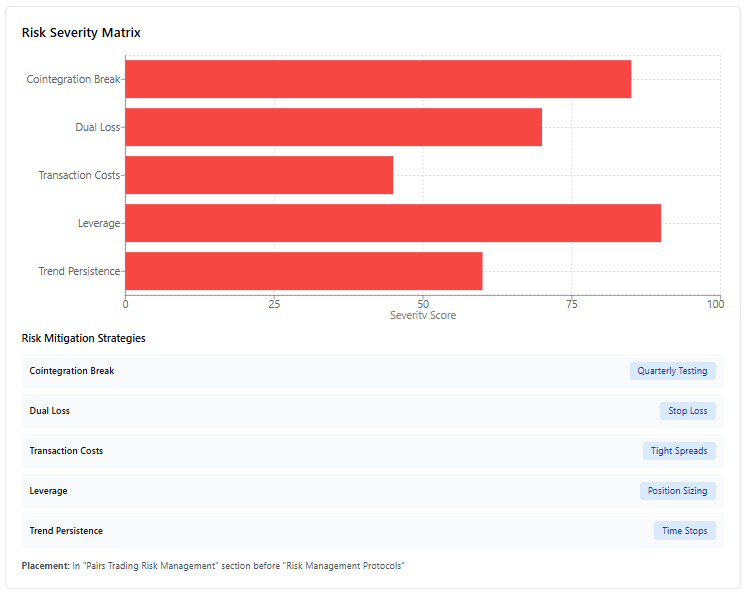
Pairs trading is usually sold as a "market-neutral" strategy, but it's just as risky as any other strategy. It is imperative to understand and manage these risks effectively in order to sustain triumph over the long term. Let's look more closely at the primary risks involved in pairs trading and what can be done to mitigate them.
Structural Risk: Break of Cointegration
The biggest risk in pairs trading comes from the breakdown of the statistical relationship of the assets. This "regime change" can happen because of:
-
Fundamentally-driven shifts in business models or competitive advantages
-
Regulatory shifts, which impact one of the two securities,
-
Technological disruptions that shift the dimension of industries, or
-
Major economic changes that impact relationships between sectors or countries.
For example, during the 2022 rate hike cycle, we observed a shift in the historical relationship of EUR/USD and GBP/USD as the UK and Eurozone adopted two different monetary policies. Traders that did not recognize this break suffered significant losses.
Dual-Loss Risk
Pairs trading, unlike some hedging strategies, can result in losses in both directions of the trade. If the stronger asset continues to rise and the weaker asset continues to decline, both positions can create losses. This risk is perhaps greatest during market crises, when correlations may break down completely.
Trend Market Risk
Pairs trading structure requires long and short positions to have mean reverting properties, but all markets can trend to the downside and then back to the upside for longer than observers might expect. A spread that may normalize may actually persist in separating indefinitely.
Cost-Related Risks
Trading costs can have significant impact on pairs trading profitability:
-
Transaction fees for each leg of the trade
-
Bid-ask spreads for equities or commodities, specifically in less liquid markets
-
Overnight financing costs on leveraged positions;
-
Dividend adjustments when there are stock pair trades
-
Slippage in periods of increased volatility
CFD Leverage Risks
While CFDs opened up pairs trading for all types of investors, as they allow an investor the ability to go long or short simultaneously on the same pair, the use of leverage in CFDs adds risk.
The reason is that the investor is borrowing as part of the leveraged position; therefore the effect of leverage can be compounding for losses as well as profits. If the spread moves against the investor's position, the investor could see a margin call, just on a degree of a move in the spread price which might create a 20 percent loss on a 10-point difference in the trade, as an example.
Identifying Strategy Failure
It is essential to detect strategy failure early for the purpose of risk management. Keep an eye out for these potential warning signs:
-
The Z-score not reverting back to historical levels for prolonged times (much longer than what has happened before)
-
The spread has created historic extremes, and has continued to separate even more
-
Fundamentally news impacts one asset, but not the other
-
Statistical tests show decreasing cointegration strength
Risk Management Protocols
Effective risk management in pairs trading includes:
-
Position sizing: Limit your exposure to any single pair (usually under 1-2% of your portfolio per trade)
-
Stop-losses: Clearly delineate your exit points based on statistical extremes.
-
Diversification: Trade multiple uncorrelated pairs to spread out your concentrations
-
Re-testing: Periodically again test the cointegration to make sure it is still valid
-
Fundamental economic event awareness: Make sure that you understand the economic news that relates to either asset in the pair.
Again, risk management, and a rigorous regiment of backtesting or simulation, is more important than capacity for signal identification. A pair that holds up statistically can still fail due to the right (or wrong) confluence of events. Professional pairs traders understand and respect risk and implement risk management procedures that protect their capital.
Classic Global Cases & Beginner Examples of Pairs Trading
When real examples are used to illustrate concepts, a theory becomes an action. Below, we start with some classic pairs trading cases and more beginner-like comparisons to make this investing strategy more real for you.
Professional Cases
Gold-Silver Spread Cases (2011-2020)
The relationship of gold/silver provides one of the most aged pairs trading opportunities you can find. Throughout this decade, the gold-silver ratio (the number of ounces of silver to buy one ounce of gold) experienced multiple structural deviances away from its historical mean hovering around 50:1.
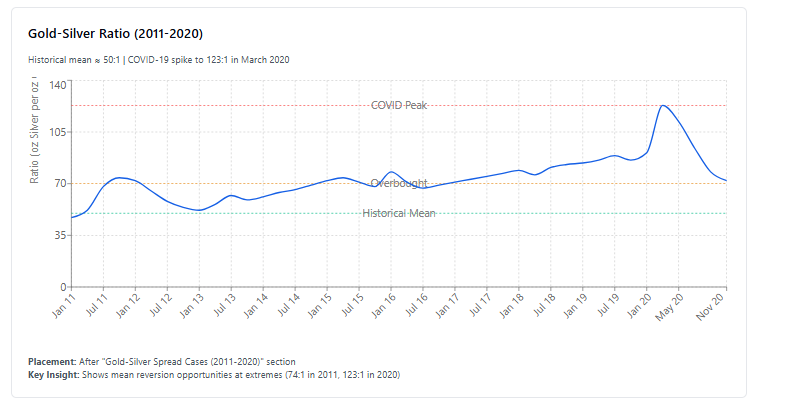
In 2011, the gold-silver ratio reached above 70:1 as the silver market significantly underperformed gold pricing. Consider pairs traders selling intraday gold to go long on silver at this extreme deviation, and they profited as the ratio compressed back to the mean. We saw similar cases in early 2020 when industrial demand for silver collapsed due to the Covid19 pandemic, yet another double deviation once again.
Change in Relationship Between S&P 500 and NASDAQ
While the relationship between these two important US indices is generally strong, that relationship has changed over time. In the tech bubble of the late 1990s, a strong outperformance of NASDAQ relative to S&P 500 created a pair trading opportunity, as well as the COVID-19 recovery when technology stocks outperformed the broader market (where NASDAQ was heavily weighted). Traders able to understand this dynamic were able to find trading and investment opportunities on the way back to normalcy or the old relationship.
"Overlapping Movement" in Bitcoin vs. Ethereum
In the world of cryptocurrencies, Bitcoin and Ethereum are consistently shown to be cointegrated over the years, since they have completely different use cases. During the 2022 crypto winter, both declined together, but Ethereum declined more due to risk around its move to proof-of-stake. This created a pair trading opportunity for people who were betting on Ethereum to recover back to Bitcoin.
Analogies at the High-School Level
-
Popularity Index of Coffee Shop Chains
Imagine there are two competing coffee shop chains in the same city. Up until now, their customer volumes have been quite stable, with Chain A capturing 60% of customers and Chain B 40%. However, due to a temporary promotion, Chain A's share jumps to 75%. As a pairs trader, you might take the side that this performance is crypto and would eventually return to historical levels. This analogy could be considered as pairs trading two competing stocks with a market share relationship that has broken down.
-
Athletic Performance Comparison
Imagine you have two elite sprinters with essentially the same personal best and have competed against each other numerous times. In 90% of the races, they would finish within a 0.1 second margin of each other. In one race, one runner wins by one full second, which is a highly unusual event and an outlier. Based on their racing history and performance, you'd probably expect their next race to finish much closer for either sprinter. This thought process is very much what pairs traders experience when they observe unusual divergences with stocks or other asset classes they have been historically correlated to one another.
Actual Historical Spreads Charts
Having a visual of these relationships makes it understandable. The historical charts for the gold-silver ratio clearly displays its mean-reverting characteristics over time. Notice that the ratio has more than fully recovered from extreme highs and lows. Similarly, you find charts showing the spread between the prices of Coca-Cola and PepsiCo stocks, and can clearly observe the divergence and convergence pattern that the prices revealed over the course of several decades.
Overall, these examples illustrate that pairs trading is more than an abstract statistical concept; it is actually an active trading strategy used by professional traders in all markets. In fact, this sort of the study was meant to help novice traders develop an instinctual understanding of how relationships between securities create trading opportunities.
The takeaway from both the professional examples and the examples above is that pairs trading exploits temporary inefficiencies in relationship measures that have proven stable over longer time periods. You can never dismiss theory, but perhaps the greatest understanding will come from seeing these things happen in real life.
How to Conduct Pairs Trading on the Tradewill Platform
Pairs trading theory is helpful, but populating them as a practice is what returns come from. Tradewill has a complete platform to execute pairs trading strategies across multiple asset classes. Here's how to engage in pairs trading on this platform:
-
Assets Available for Trading on Tradewill
-
Tradewill offers a variety of CFD instruments that fit pairs trading.
-
Forex: Major, minor and exotic currency pairs.
-
Crypto: Bitcoin, Ethereum and any other fixed cryptocurrency.
-
Commodities: Gold, silver, oil, etc. precious metals or energy or energy.
-
Indices: Global stock indices from key markets.
This allows the trader to build out pairs in the same asset class (EUR/USD vs. GBP/USD) or through separate markets (requires additional analysis on cross-asset pairs).
Simultaneously Opening Long and Short Positions
Pairs trading involves executing two trades at the same time. In Tradewill, this involves:
-
Locate the selected pair from the instrument list on the platform
-
Open a long position on the asset considered "cheap"
-
At the same time, open a short position on the "expensive" asset
-
Confirm the position size is consistent with your calculated hedge ratio
For example, if you want to execute a Gold-Silver pairs trade with Gold overvalued relative to Silver:
- From the platform, go to Gold (XAUUSD)
- Click "Sell" to open the short position
- Go to Silver (XAGUSD)
- Click "Buy" to open the long position
- Adjust position sizes to your hedge ratio (typically based on beta)
Practical Examples on Tradewill
Forex Pair Illustration: EUR/USD and GBP/USD
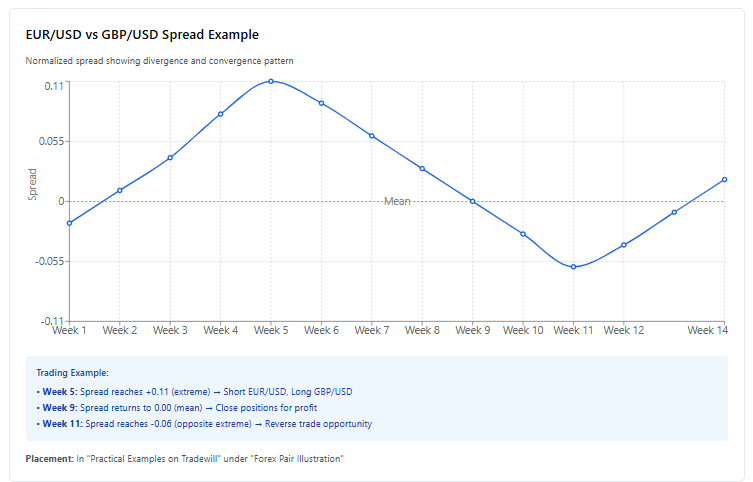
If the Z-score shows that the EUR/USD is overvalued in relation to GBP/USD:
-
Short EUR/USD CFDS
-
Go Long on GBP/USD CFDS
-
Watch the spread for reversion
-
Close out the two positions at the same time
Commodity Pair Illustration: Gold vs. Silver
If gold is trading at an unusually high premium to silver:
-
Short gold
-
Go long on silver
-
Set the take profit at the historical average spread
-
Set a stop loss at an extreme spread
-
Leverage
Tradewill provides leverage on CFD positions, which can amplify gains and losses:
-
Higher leverage provides greater risk to spread movements
-
Consider cutting position sizes when using higher leverage
-
Assess margin requirements on both sides of the trade
-
Know that leverage has a financing cost for overnight hold
Fees
Understanding Tradewill’s fee structure is important for pairs trading to be profitable:
-
Spreads: Bid & ask difference on each individual instrument
-
Overnight fees: Swaps for holding any position overnight
-
Commission: Any fee charged as a commission for each trade.
-
Inactivity fees: Any fees for having a dormant account.
These incurred costs will impact pairs trading profitability, but narrow profit margins are more easily incurred.
Risk Management Tools
Tradewill provides several risk management tools for pairs trading:
-
Stop-loss orders: Close trades when the price reaches a level set by the trader
-
Take-profit orders: Secure profits when the spread reaches a pre-set level
-
Trailing stop orders: Adjusts the stop-loss when the spread moves under the pre-selected level
-
Price alerts: Notify trader when the price reaches some level specified
Platform-Specific Techniques
-
Use the watchlist feature on Tradewill to watch multiple instruments at once
-
Set up price alerts for key spread levels to identify trading opportunities
-
Use some of the platform's chart tools to assess the spread of instruments
-
Consider trying Tradewill's demo account to try out pairs trading strategies
The first step in trading on Tradewill successfully as a pairs trader is to trade in instruments with low spreads and high liquidity! These tools will save you transaction costs and get both legs of the trade executed faster. In addition, a detailed trading journal will help modify the strategy over time.
Traders can successfully employ pairs trading in different global marketplaces by using the features of Tradewill and a position trading strategy framework.
Quick Cheat Sheet for Pairs Trading
If there are traders looking for a one-stop reference point for pairs trading, we have boiled down the basic concepts and decision points into a concise set of essential points for reference.
Pairs Trading Generic Work Flow
-
Pair Selection
-
Choose pair of assets that have economic connections
-
Look to see if they co-moved historically
-
Conduct cointegration test for two series (ADF test)
Spread
-
Spread = Asset A – β × Asset B
-
Calculate mean and standard deviation of the spread
-
Establish the current spread in relation to the historical spread of the asset pairs
-
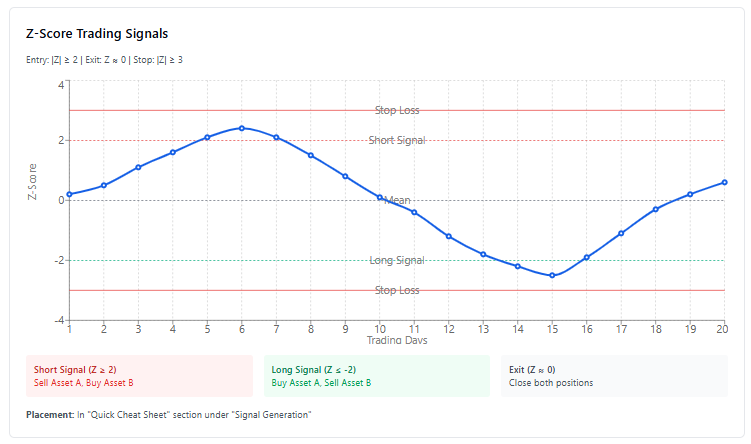
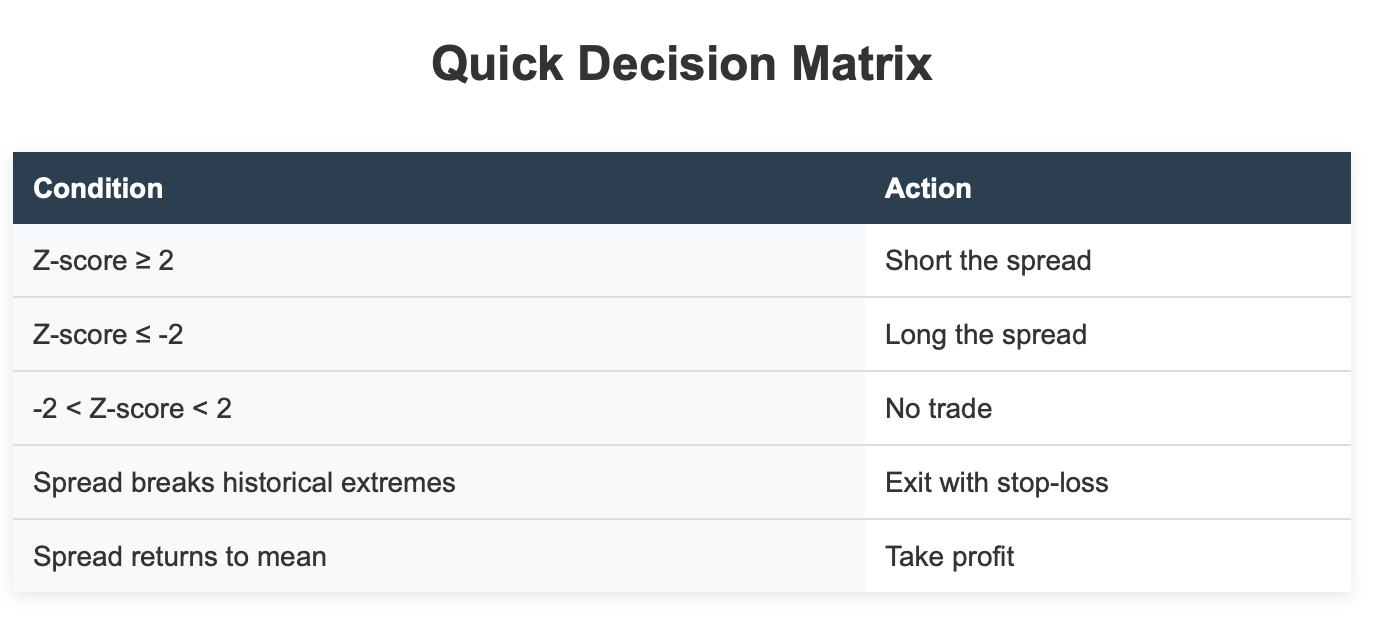
Z score ≥ 2 → Short the spread (Sell A, Buy B)
-
Z score ≤ -2 → Long the spread (Buy A, Sell B)
-
Z score around 0 → No signal
Trade Execution
-
Enter/Exit trades both at once
-
Size trade based on the hedge ratio of spreads
-
Order type matters
Exiting Position
-
Take profit = Spread reverts to the mean (Z score ≈ 0)
-
Stop loss = Spread breaks historical extremes (Z score ≥ 3 or Z score ≤ -3)
-
Time stop = No reversion occurs on predetermined time line
-
Size of position: Limit to 1-2% of portfolio size per pair
-
Maximum exposure: Limit all pairs in total to 10-15% of portfolio size
-
Correlation: Analyze the correlation of the pairs to avoid multiple pairs with high correlations to one another
-
Fundamental news: Monitor any news on either of the assets in the cointegrated pair
-
Testing: Re-test the pair for cointegration every quarter
Common Mistakes
-
Confusing correlation to cointegration
-
Not considering transaction costs
-
Taking on too much leverage on the pair
-
Not implementing stops
-
Not considering fundamentals for any changes in relationships
Key Performance Indicators to Monitor
-
Success rate (percentage of winning events)
-
Average profit/loss ratio
-
Maximum drawdown
-
Sharpe ratio (risk-adjusted return)
-
Average holding period
This toolkit outlines what you need in order to engage in pairs trading strategies. Use it as an "easy-access" reference guide when evaluating possible pairs and executing existing trades. As always, successful pairs trading involves both a rigorous statistical approach and disciplined practices.
This brings me to the ninth (and final) section of this cheat sheet: The Conclusion: Every Global Trader Needs to Get Familiar with Pairs Trading - and I mean that sincerely. Pairs trading is one of the most complicated yet simple global trading strategies in your toolbox.
As we have explored thus far, pairs trading employs a methodical process that is market-neutral and aims to generate profits regardless of market direction, which is especially valuable during uncertain or volatile (equity) market periods.
What is so beautiful about pairs trading is that it is so logical.
Instead of trying to forecast unpredictable price direction of one or more individual assets, it takes a more systematic approach of focusing on the less volatile price relationship between two assets. Thus, traditional trading and the mind's guess-work is replaced by statistics and probability.
Pairs trading is particularly effective for:
-
Analytical traders who enjoy working with statistical studies.
-
Risk-averse investors seeking a market-neutral strategy.
-
Quantitative traders wanting to use a rule-based approach.
-
Portfolio managers wanting to diversify their trading strategies.
-
Traders in all global markets, from Forex to digital currencies.
The merits of pairs trading are substantial. As a market-neutral strategy, pairs trading can work in bull markets, bear markets, and sideways markets. It allows for trading decisions to be based on statistical analysis rather than emotion. If done right, pairs trading can provide controlled risk with predefined entry and exit points.
However, pairs trading is not a way to get rich quickly. Pair trading takes research, statistical testing, and disciplined practice. Risk is real, especially risks like 'cointegration breakdown' and the potential for losses in both instruments. Successful pairs traders respect risk and build a robust risk management process.
The first step to learning pairs trading is to learn and practice. To truly understand pairs trading, you must know the statistics of mean reversion and cointegration. Learning to find candidates and calculate the best hedge ratio takes time. Learning to practice risk management takes discipline and experience.
If you are prepared to take the next step into pairs trading, your path is clear:
-
Sign up on Tradewill and you will have access to multiple markets that can facilitate pairs trading utilizing trading platform accounts
-
Practice demo trading to find what strategies work while risking no capital
-
Learn terms and meanings relative to trading A-Z which will give you a full overview of how the market works behind the scenes
-
Take stock with paper trading before committing real capital to pairs strategies
-
Have the habit of keeping a trade journal where you log your trades, often, to track your progress, and identify which methods need refinement.
Constantly analyzing and taking note of the process of learning pairs trading may be overwhelming at first but in due time, it will become second nature and also potentially ginormous amount of profits.
This is why pairs trading offers an advanced way to enter the market that traders can incorporate. Pair trading is different because it places less emphasis on directional signals and instead on relationships. It brings unique opportunities, that other methods rely on technical indicators, often missed entirely.
In a global market, pairs trading can provide a detailed view on the statistical edge, that can be mediocre to wow and unique market insights, sets pairs trading aside from the rest.
In conclusion, whether you are a new trader ready to branch out from the basics, or an experienced trader looking to diversify your method, pair trading is an important aspect to consider and put into motion. Create a demo account on tradewill and get more information about trading.
Disclaimer: The content of the blog does not represent any position of Trade W, does not serve as any trading-related decision advice, and does not endorse any third-party.