

 Trade W
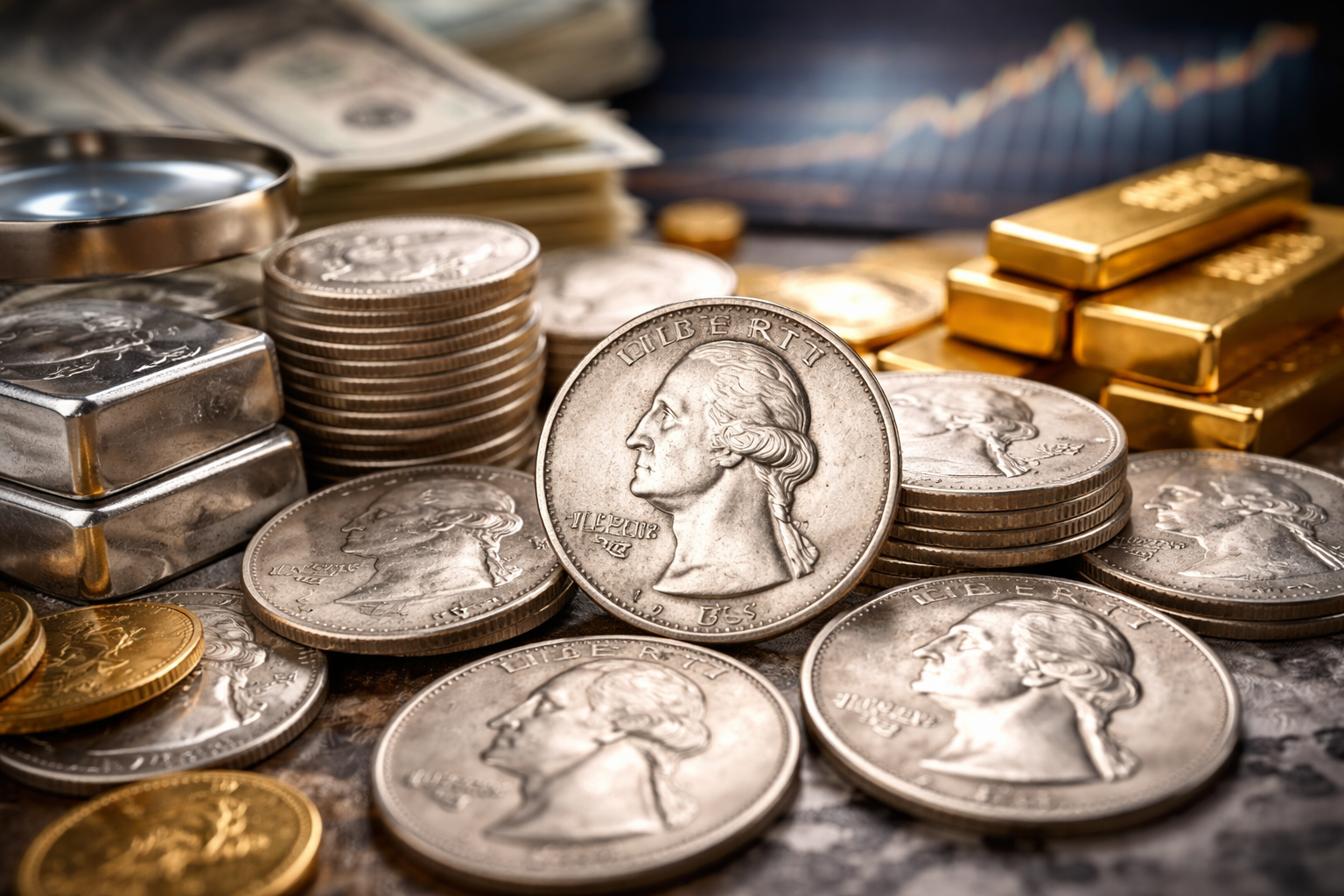
The majority of individuals will be more concerned with looking through their change to find a quarter to use at the local coffee machine as opposed to verifying the value of their portfolio strategy. Yet, there could possibly be an old quarter, hiding in the bottom of a coin jar or the back of a long-forgotten drawer, that will have substantially more than 25 cents worth of value.
However, the increased value will be based on a specific set of economic decisions made many years ago and the resultant effects of those decisions when considered along with every other old American coin. One of the conclusions reached by the author is that coins, as with all forms of currency, lose purchasing power as time goes by.
In this guide, we will examine how the value of coins and the value of other forms of currency are lost over time due to numerous factors; such as the loss of value in the economy due to inflation, how precious metals may act as stores of wealth, and how a modern day investor may access the precious metals market through various types of financial instruments that were not available at the time the coins were originally minted.
What Makes Some Quarters Worth Money?
According to the U.S. government, the value of a quarter is 25 cents. However, the market places more emphasis on the compositions of items than it does on the face values the government places on them. Therefore, occasionally a large discrepancy exists between what both entities would label as the "value" of a quarter.
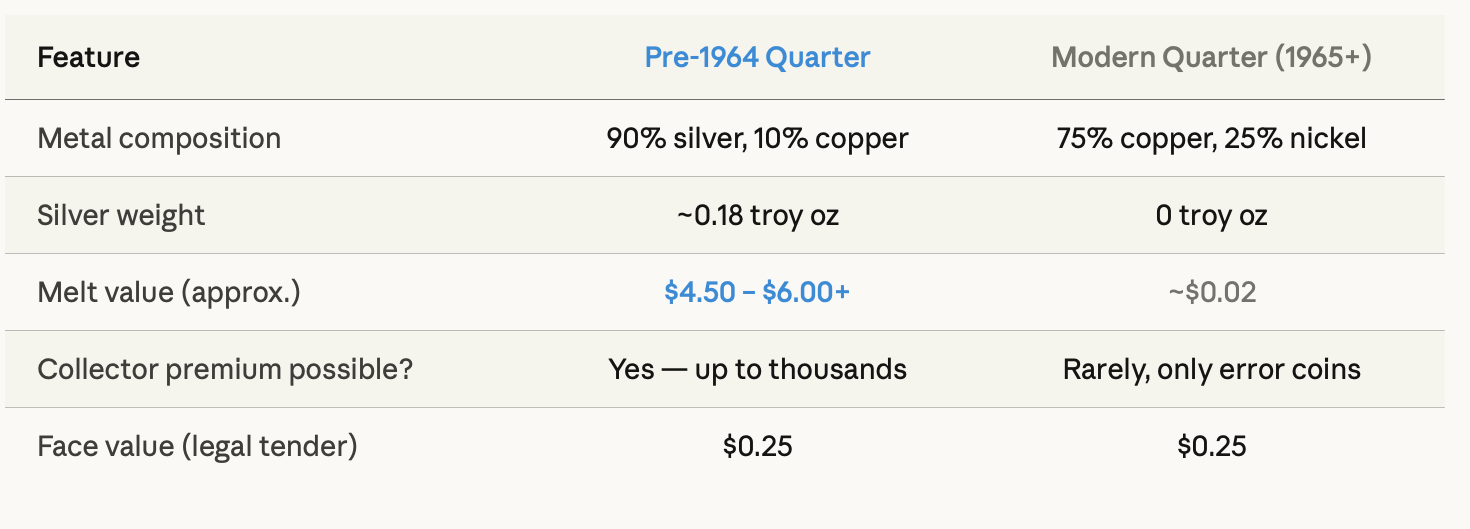
Three main factors determine the high value of pre-1964 quarters. First, they are made from actual silver, and the amount of silver metal contained in each coin is much more valuable than anything the government says. Some specific dates and mint locations were limited in production; therefore, they have higher values for coin collectors than just based on the silver content.
The condition of the coin is important; professional grading services such as Professional Coin Grading Service (PCGS) and Numismatic Guarantee Corporation (NGC) can evaluate coins and assign grading scores. An MS65 or higher will receive a significant premium above the base silver price.
Think of pre-1964 quarters in the same way as limited-edition products. The raw materials used to make the coins have greater intrinsic value than their retail selling prices due to the scarcity and condition factors, adding additional value.
Some good examples of the factors mentioned above are the 1932-D Washington Quarter and the 1964 Washington Quarter. The mintage for the 1932-D quarter was just 436,800, and depending on the condition, a collector could pay thousands of dollars for that coin. On the other hand, the 1964 issue had a much higher mintage, so it isn't nearly as rare; however, since it also contains the same amount of silver as the 1932-D quarter, it has a higher value than its face value based solely on the amount of silver contained in the quarter.
The Coin Value Composition: What You're Actually Paying For
When a rare quarter sells for $500, that price doesn't come from nowhere. It's built from a stack of value drivers that layer on top of each other.
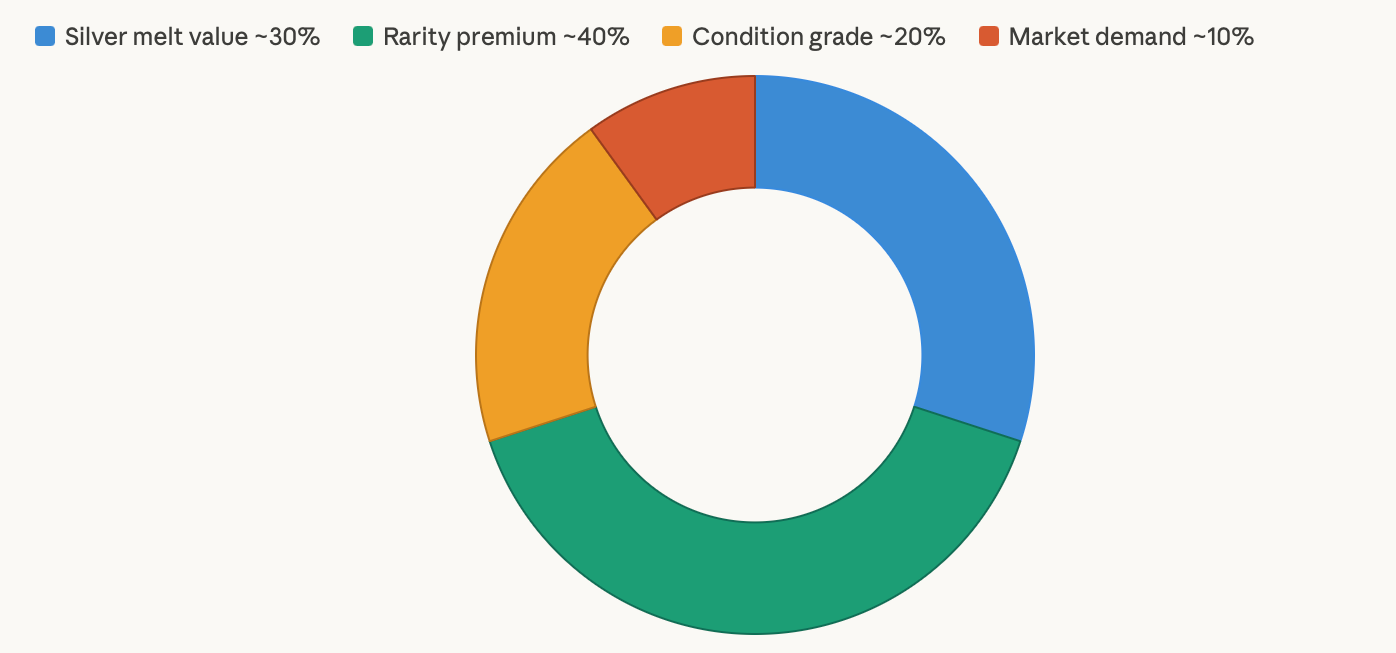
The silver content is the floor, not the ceiling. For a common 1964 quarter, it's nearly the entire value. For a rare key-date coin in exceptional condition, the melt value might be a fraction of the total price. Understanding this distinction is what separates a casual collector from an investor with a clear-eyed view of what they own and why it's worth what it is.
The Monetary Pivot That Changed Everything: The End of the Gold Standard
To help you to understand the reasons for the transition in 1965 in the composition of coins, it is important to know about how money has changed over the years leading up to that time.
Historically, for most of the history of modern economics, the US dollar has been based on gold. When the Bretton Woods Agreement was signed in 1944, the dollar was attached to a value of $35 an ounce of gold, and the other worldwide major currencies were attached to the dollar. By pegging the dollar to gold, it provided a foundation or anchor for money in the world. So when you held a $1 bill, it was not merely a piece of paper. It represented your right to obtain physical assets with a set amount of gold.
With President Nixon's decision in 1971 to eliminate the ability to exchange US dollars for gold, the Bretton Woods system was effectively terminated. This event, commonly referred to as the Nixon Shock, resulted in the transition of the dollar from a currency based on an actual physical commodity to a currency based solely on the confidence and authority of the government and not the physical assets it once was based on.
The reason that there is a strong connection to coins is due to the fact that there is a very practical connection with the fact that when the market value of silver reached close to or surpassed the value of the coin, people began to collect them. The real value of a silver coin would outweigh its currency value and would therefore be removed from circulation extremely quickly.
In response to this monetary phenomenon, Congress passed the Coinage Act of 1965, which replaced the silver in the coins with a copper-nickel alloy. Therefore, the quarter, post-1965, has no real intrinsic value as an actual metal, as it has been totally replaced by a metallic composition that has no real intrinsic value.
How Inflation Erodes the Value of Paper Money
Governments can use fiat money to create more money. This leads to inflation if the money supply is expanding more rapidly than the real economy. Inflation is defined simply as a decrease in the purchasing power of one unit of currency.
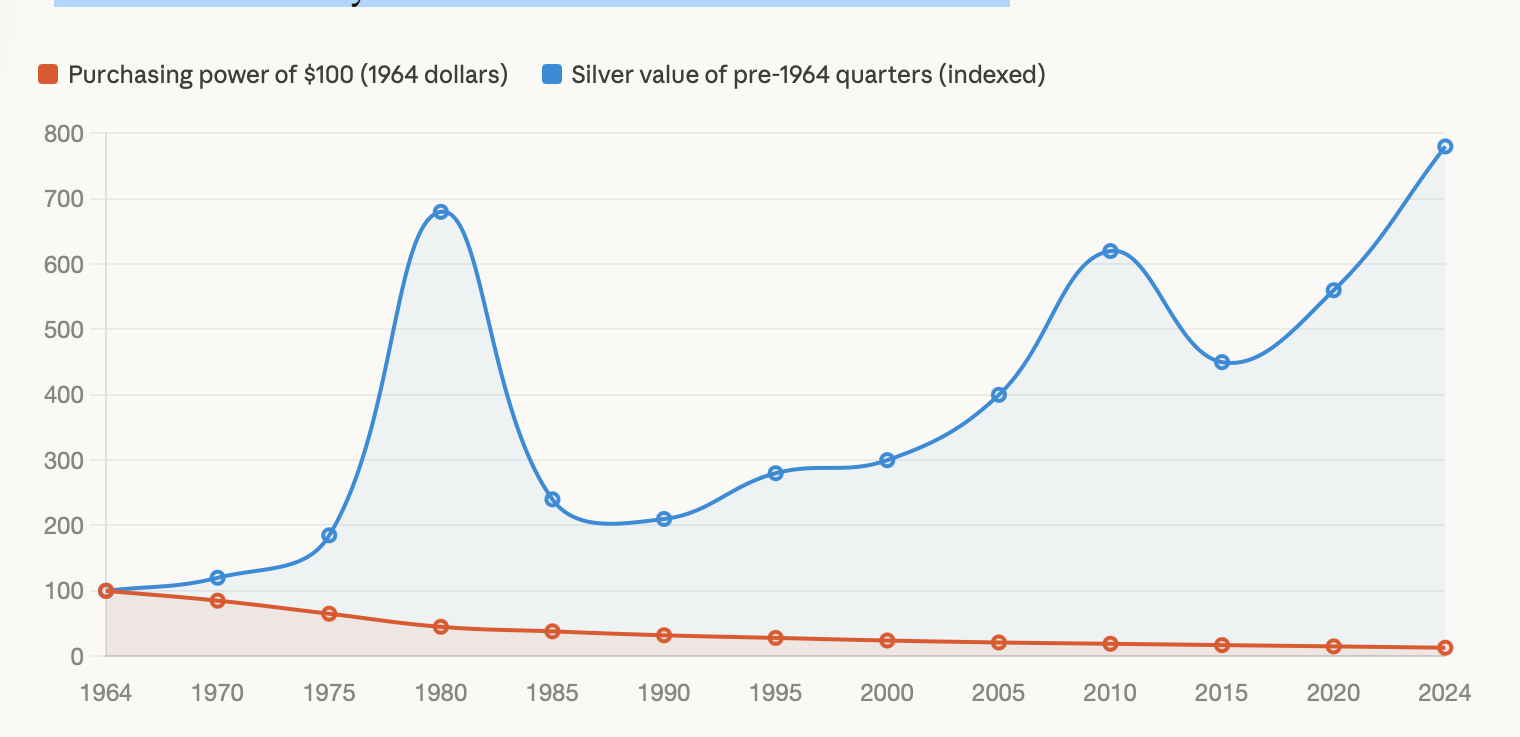
The information provided in the table illustrates how inflation has reduced the purchasing power of 100 dollars in 1964 in a linear fashion, compared to how the value of an ounce of silver has increased in approximately the opposite direction.
Since silver is a precious metal, there is only a limited amount of it available for use. A government cannot print silver as it can with paper currency; therefore, while the amount of money supply can increase with a government, the amount of silver available on the global market increases at a much slower rate.
Because silver is a precious metal that cannot be printed or produced at an unlimited rate, silver is seen as a store of value in real versus paper currency in terms of real purchasing power.
The difference between the real purchasing power of the old 1964 quarter and the silver that has been mined from the old quarters is a stark comparison. In 1964, the purchase price of an average-sized candy bar or newspaper was approximately 50 cents, while the purchase price of a quarter of silver today has the potential to be much higher.
On the other hand, the current quarter of modern currency received in change does not have the same value as the silver that has been mined from the old quarters.
How to Identify Rare Quarters That Are Worth Money
Most people don't know what to look for. The process is methodical and accessible even without specialist knowledge.
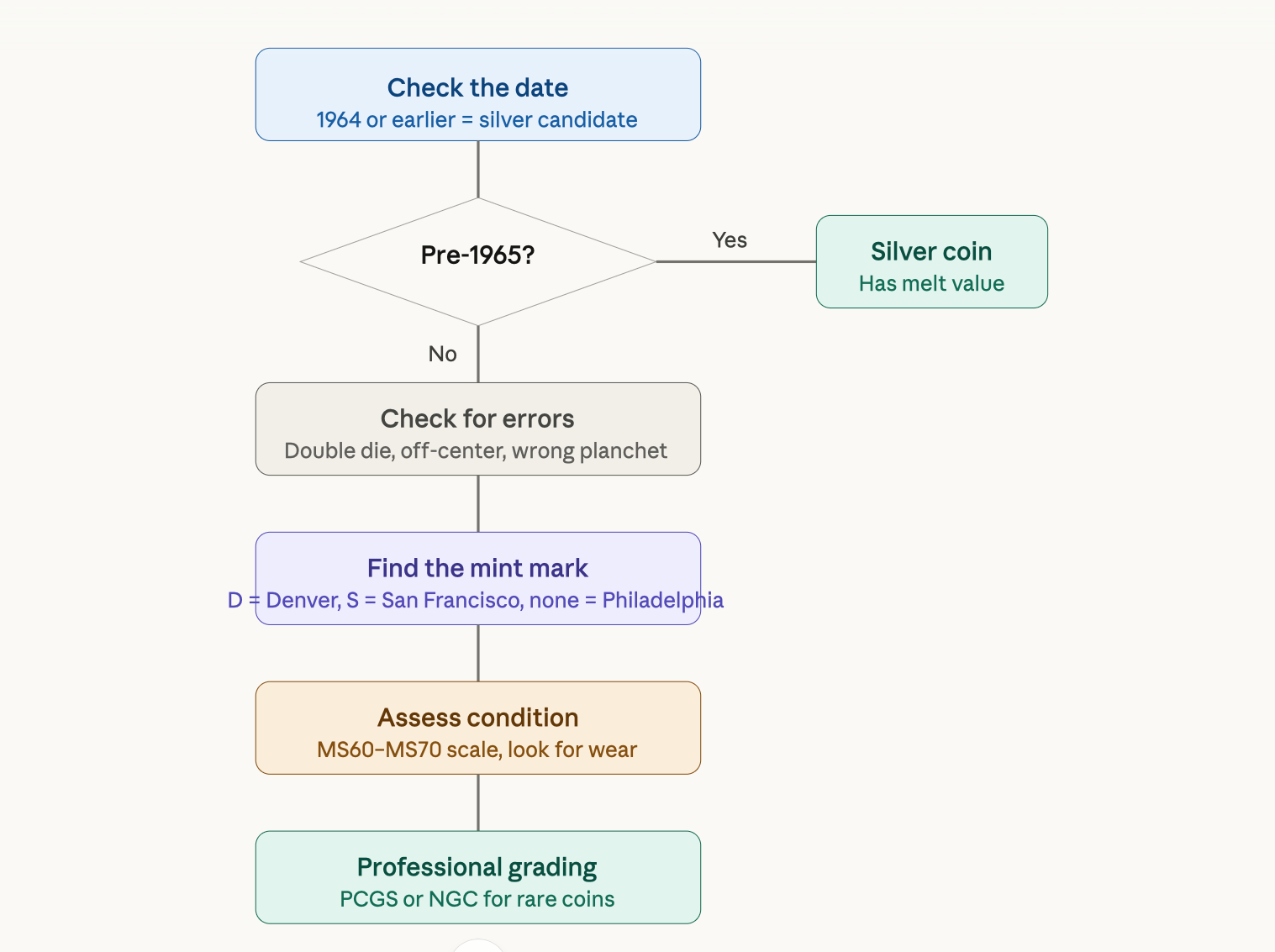
The initial step in evaluating any quarter is checking the date. Quarters struck before 1965 clearly indicate silver content. The mint mark, which is the small letter located near Washington's portrait, indicates the minting location. Years with low mintage numbers from specific mints have the potential for significant premiums from collectors.
To determine the condition of a coin, it is measured on the Sheldon scale, which ranges from Poor-1 to Mint State-70. A Mint State-65 (MS65) coin will have no visible marks under magnification and appear almost identical to the day it was minted. There may be significant price differences between an MS63 and an MS65 for a key-date coin.
If a coin appears to have been genuinely graded and valued, then having it authenticated and graded by a professional grading service (e.g., PCGS or NGC) will authenticate the coin and certify it in a sealed plastic holder, thus providing significant increases in both buyer confidence and market value.
Silver vs. Modern Quarters: The Investment Math
Let's put some actual numbers around the difference to make the case concrete rather than abstract.
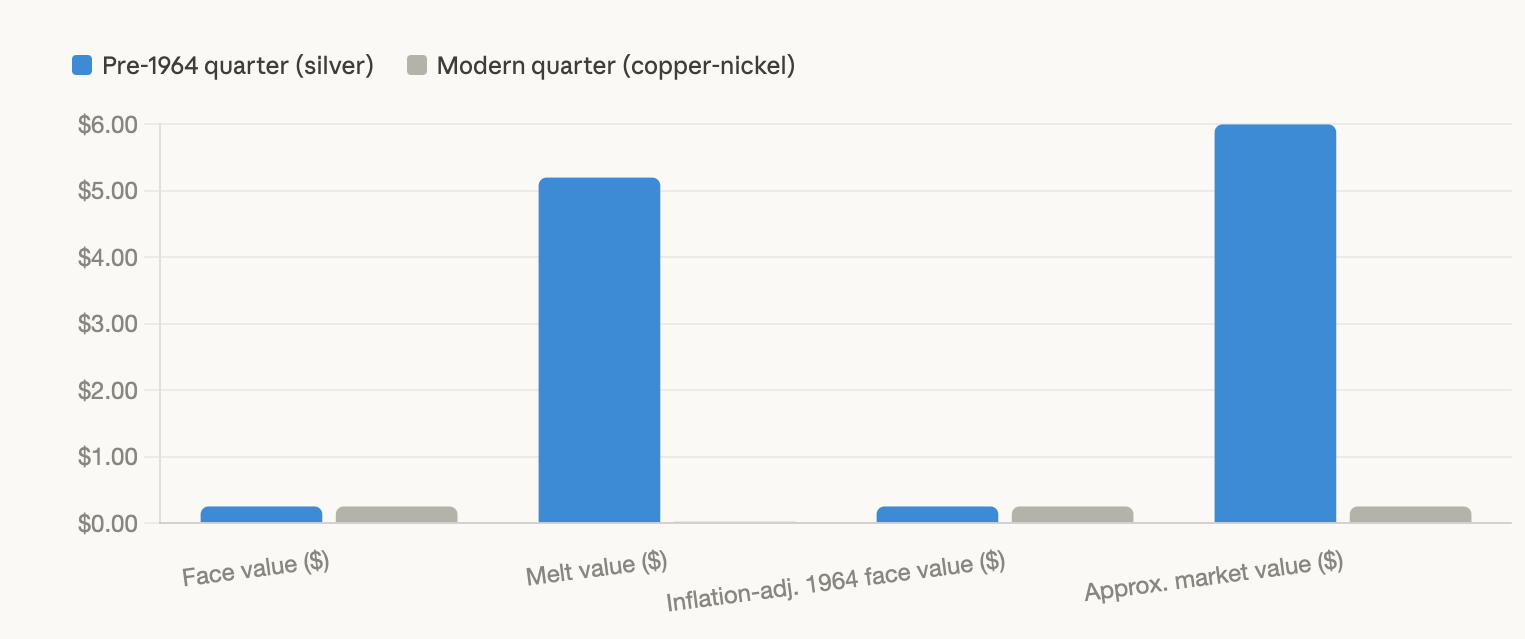
There is a considerable gulf between the values of these two coins. Although both have the same nominal value, the melt value of a quarter made before 1964 currently represents about five dollars based on an average price of approximately twenty-eight dollars per troy ounce for silver, which has been relatively stable throughout the last several years. On the other hand, the metal content value of a modern quarter would only amount to about two cents.
To look at it another way, whenever you receive a pre-1964 quarter, you're effectively giving away a significant amount of real metal value to someone else at a much lower actual price than what it is worth. This has been the reason that collectors who are aware of this fact have been able to systematically hoard silver coins from common circulation, and it has caused them to effectively no longer exist in common transactions.
Precious Metals as an Inflation Hedge: The Investment Logic
Between inflation and precious metals, there is much more than just a theoretical relationship. This has been documented throughout history, in thousands of years of monetary affairs. Expansionary monetary policies increase the money supply during periods of economic distress, such as wartime expenditures, recessionary stimulus and pandemic economic aid. Therefore, the ability of precious metals to maintain their value is greater than that of other investment vehicles such as stocks or bonds.
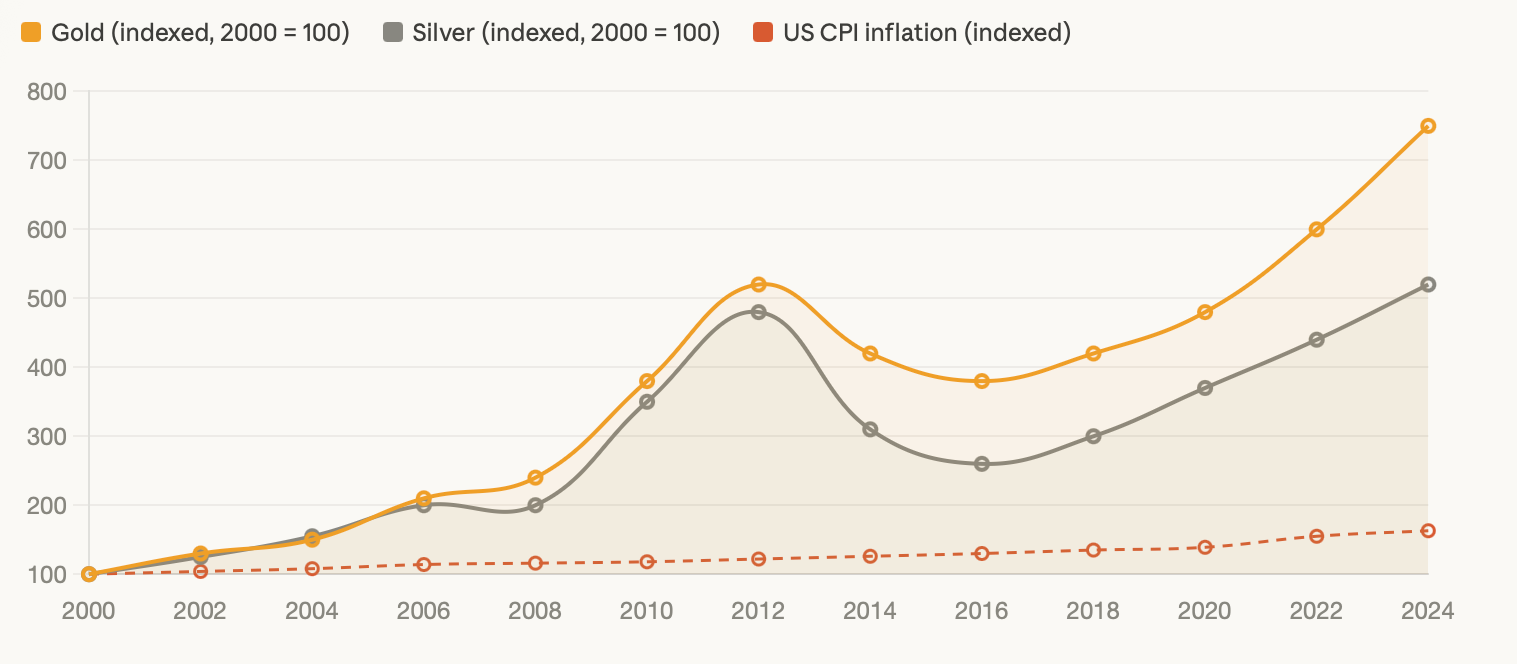
From 2000 to 2020, gold and silver prices grew significantly faster than the U.S. Consumer Price Index (CPI) due to the Global Financial Crisis, massive government quantitative easing, and unprecedented increases in the money supply during the COVID-19 pandemic. While inflation was slowly rising, precious metals were climbing at an even faster rate. Unlike other assets, the price of gold and silver is not solely determined by monetary policy actions.
However, gold and silver are not necessarily low-risk or steadily appreciating assets. Silver has a high degree of price volatility as it has both industrial and investment uses. Investment demand for silver is related to its industrial application in electronics, solar panels, and medical devices; therefore, its price movements are more closely correlated with inflation than gold.
The argument for including precious metals in a portfolio stems from their ability to offset declines in other asset classes (stocks, bonds, cash) during inflationary environments by typically outperforming them. To achieve this, the investor needs to have some form of diversification through investments that do not correlate with each other.
From Coin Collecting to Modern Precious Metal Trading
Physical silver coins are one way to own precious metals, but there are limitations with physical silver ownership because of things such as storage costs, insurance requirements, concerns over the authentication of the metals, and limited liquidity when an owner needs to exit a position quickly.
Instead of owning the actual metal, many modern-day financial instruments allow traders the opportunity to trade on price movements for gold and silver using Contracts for Difference or CFDs. If the price of silver increases, then
Any long CFD position would generate a gain that is equal to the increase in the underlying asset's value. Conversely, if the price of silver decreases, then any long CFD position would decrease in value.
CFDs also create an opportunity for leverage, which means that with a small initial capital amount, you can control a much larger notional position. This means that potential profit or loss is significantly increased with the use of leverage; therefore, managing position sizes through discipline and applying stop-loss orders is even more important when investing in leveraged financial instruments than when owning the physical metal.
The key benefit of trading silver as a CFD lies in speed and flexibility. CFDs can be opened and closed very quickly at any price offered in the market. There is no need to physically transport the metal to your location or store or authenticate the metal. Therefore, if an investor is using this type of strategy as part of their overall asset allocation in conjunction with macro-economic signals, then trading silver as a CFD would provide them with many advantages over owning silver coins.
Frequently Asked Questions
What is a quarter worth in money? Pre-1964 US quarters are worth money primarily because they contain 90% silver, giving them a melt value far above face value. Certain rare dates and mint combinations can command significant collector premiums on top of that.
What makes rare quarters so valuable? A combination of silver content, low original mintage, preserved condition, and collector demand. Key-date coins like the 1932-D and 1932-S Washington quarters are rare because relatively few were struck, and even fewer survive in good condition.
How can I find quarters that are worth money? Check dates on any quarters you come across. Pre-1965 coins are candidates. Look for mint marks and compare them against published mintage figures for key dates. A coin dealer or grading service can provide a professional assessment for potentially valuable pieces.
Are silver quarters still legal tender? Yes. A pre-1964 quarter is still 25 cents by law. Spending it that way is simply one of the most expensive things you can do with it, given current silver prices.
Is coin collecting a good investment? It can be, particularly for silver and gold coins, where the metal value provides a baseline. Rare collector coins require more expertise to evaluate, but silver bullion coins and common pre-1964 quarters are relatively straightforward to understand and value.
Start Trading the Metals Behind These Coins
If the economics of silver and gold have your attention, TradeWill gives you direct access to gold and silver CFD markets with institutional-grade tools built for traders who want more than a buy-and-hold position.
Open your TradeWill account at tradewill.com and trade the same metals that made those old quarters worth holding, without needing a coin jar to do it.
Disclaimer: The content of the blog does not represent any position of Trade W, does not serve as any trading-related decision advice, and does not endorse any third-party.