

 Trade W
You may have come across one of three different concepts: proprietary trading firms offering you a $100k account, brokers providing low spreads and high leverage, or copy trading apps allowing you to copy a successful trader's trades if you spend any time in the TikTok, Reddit, or YouTube trading communities. All of these, to an outsider, provide retail traders with access to the financial markets, but the business rationale behind each of these models is unique. Without understanding how each model really works, you'll be evaluating your risk, potential for profit, and trust with a blindfold on. Your trades are executed through each broker's revenue model. Therefore, the business practices associated with each of these concepts can introduce multiple levels of dependency, the majority of which beginner traders underestimate.
This guide provides a thorough breakdown of how each of these models operates from the inside out and describes how they generate income, what they expect from you, and which models are best suited to different types of traders. This is not a listicle filled with affiliate links to various platforms; rather, it is an honest explanation of the trading ecosystem that most top prop firm reviews have completely ignored.
What Is a Proprietary Trading Platform?
Originally, proprietary trading, commonly known as prop trading, referred to financial institutions using their own capital to buy and sell financial instruments in the market rather than investing or managing capital on behalf of clients. For many years, major investment banks such as Goldman Sachs operated proprietary trading desks that provided liquidity to financial markets while also using the firm's own balance sheet to generate profits from price movements in stocks, options, currencies, commodities, and other financial instruments.
Since 2020, however, retail prop trading has experienced significant growth. Unlike traditional institutional proprietary trading operations, modern retail prop trading firms generally do not provide traders with direct access to institutional capital from the outset. Instead, they offer retail traders the opportunity to access simulated or funded trading accounts after successfully completing a structured evaluation process, commonly referred to as a prop trading challenge.
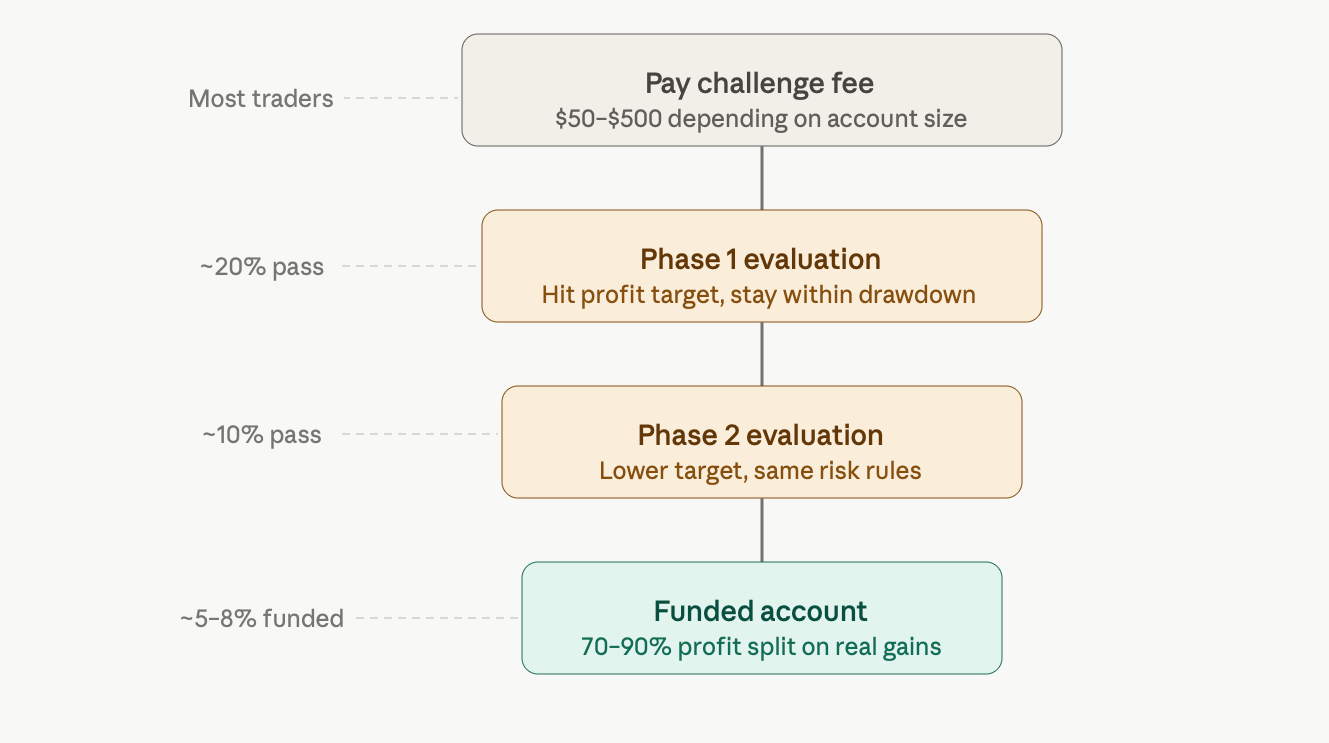
These challenges are designed to assess a trader's ability to manage risk, maintain consistency, and generate profits while adhering to predefined trading rules. Traders who meet the firm's performance requirements may become eligible to trade larger amounts of capital under the firm's funding program, often receiving a share of any profits generated.
As a result, retail prop trading has created a pathway for individual traders to access larger trading allocations without having to deposit substantial amounts of their own capital. However, success in these programs depends heavily on risk management, discipline, and the ability to follow trading rules consistently over time.
Originally, proprietary trading, commonly known as prop trading, referred to financial institutions using their own capital to buy and sell financial instruments rather than investing or managing capital on behalf of clients. For many years, major investment banks such as Goldman Sachs operated proprietary trading desks that both provided liquidity to financial markets and generated profits by trading stocks, options, currencies, commodities, and other financial instruments using the firm's own balance sheet.
Since 2020, however, retail prop trading has experienced significant growth. Unlike traditional institutional proprietary trading operations, modern retail prop trading firms generally do not provide traders with direct access to firm capital from the outset. Instead, they offer retail traders the opportunity to access simulated or funded trading accounts after successfully completing a structured evaluation process, commonly referred to as a prop trading challenge.
These challenges are designed to assess a trader's ability to manage risk, maintain consistency, and generate profits while adhering to predefined trading rules. Traders who satisfy the firm's performance requirements may become eligible to trade larger amounts of capital through the firm's funding program, typically in exchange for a share of the profits they generate.
As a result, retail prop trading has created a pathway for individual traders to gain access to larger trading allocations without committing substantial amounts of their own capital. However, success in these programs depends heavily on effective risk management, discipline, and the ability to follow trading rules consistently over time.
What Is a Forex Broker?
A forex broker is a financial entity that acts as a bridge between you and the currency markets, as well as providing access to an increasing number of other products such as CFDs on indices, commodities, and cryptocurrencies, using your own money. You deposit money into your trading account, the broker gives you a platform and access to the market, and you start trading.
Brokers make money through the spread between the bid and ask prices on each trade you enter. On some account types, they charge commissions. On positions that are held overnight, they may charge a fee based on overnight interest rates, and certain brokerages will take the opposite side of your trade directly.
It is this last point that creates the debate between Market Makers and ECN brokerages. Market Makers internalise your order flow instead of sending your order to an external liquidity provider. As a result, they can create their own bid and ask prices and, depending on the specific model they follow, profit from your losses by keeping the trade on their books. This practice is not illegal and is quite common, but it does create a conflict of interest that traders need to consider.
Unlike Market Maker brokers, ECN (Electronic Communication Network) and STP (Straight Through Processing) brokers generally route client orders to external liquidity providers, such as banks and institutional market participants, rather than consistently acting as the counterparty to client trades. These brokers typically earn revenue through commissions, spread markups, or a combination of both. Brokers such as IC Markets, Pepperstone, and Interactive Brokers are often associated with execution models that emphasize transparency, competitive pricing, and varying degrees of direct market access.
The primary difference between a prop trading firm and a broker lies in the ownership of the trading capital. When trading through a broker, you are typically using your own funds and therefore retain all trading profits after accounting for commissions, spreads, financing costs, and other fees. In contrast, when trading through a proprietary trading firm, you are generally trading under the firm's funding program after successfully completing an evaluation process. Profits generated are then shared between the trader and the firm according to a predetermined profit-sharing agreement.
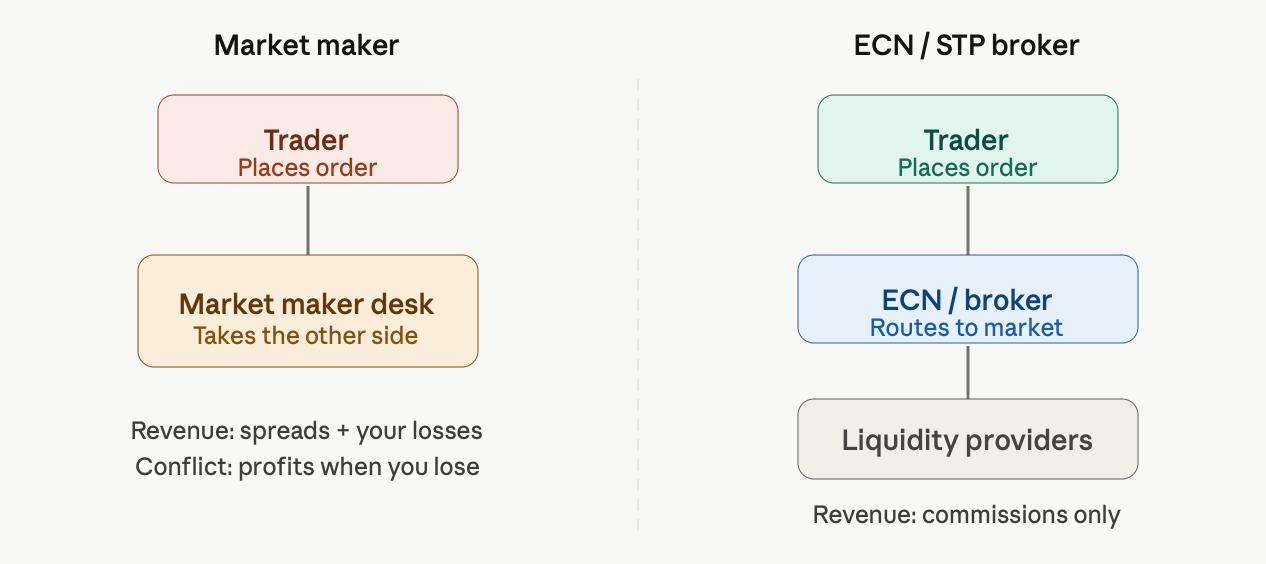
The business models of brokers and prop firms also differ significantly. Brokers primarily generate revenue through trading-related costs such as spreads, commissions, financing charges, and other account fees. Prop firms, by comparison, often derive a substantial portion of their revenue from evaluation fees, subscription programs, and the management of their trader funding programs, although business models vary among firms.
Understanding these structural differences is important because the choice between a broker and a prop firm affects capital requirements, profit retention, risk exposure, and the overall trading experience. Traders should evaluate both options carefully based on their financial objectives, trading style, and level of experience.
What Is a Copy Trading Platform?
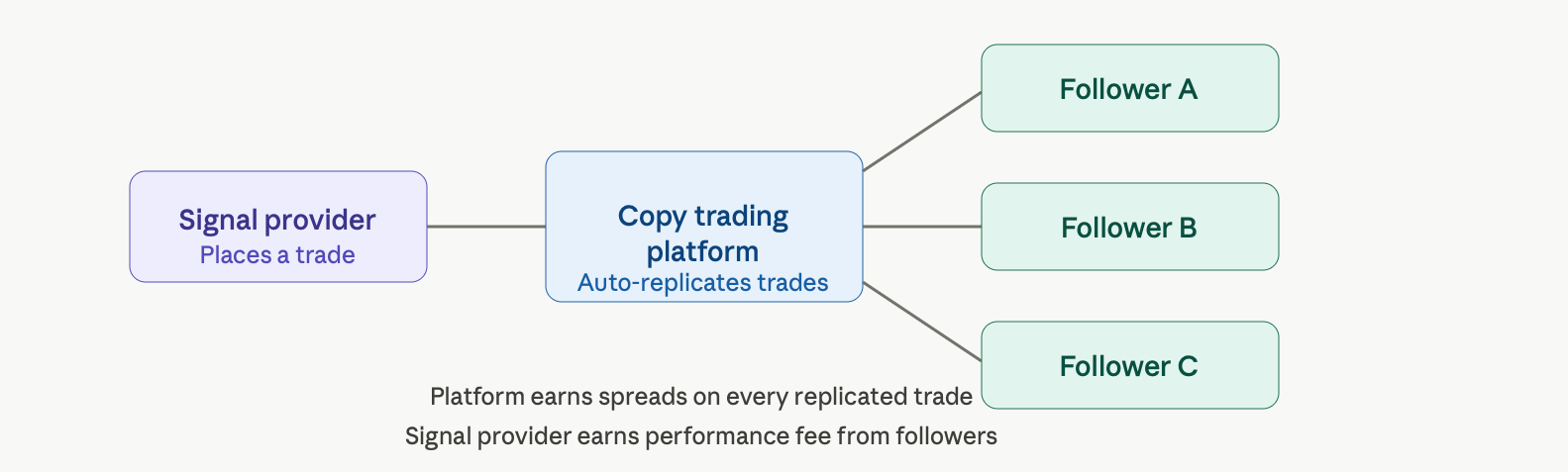
The best copy trading platforms are a completely different type of trading platform from a standard broker and do not require you to develop your own trading skills or pass any kind of qualifying evaluation. When using a copy trading platform, you can fully replicate the trades of another trader (known as a signal provider or strategy provider) on a proportional basis according to the amount of capital you have available for trading.
This also has a definite appeal, especially for people who are less comfortable with or overwhelmed by the technical aspects of trading. It allows you to view a leaderboard showing which traders are performing the best, as measured by their overall trading results on a monthly basis, and choose one whose risk profile and trading strategy align well with your own. You can then allocate a portion of your capital to copying that trader. The trading platform will automatically replicate each of that trader's trades and open those positions in your trading account on your behalf.
As trading platforms such as eToro, ZuluTrade, and Bybit Copy Trading demonstrate, this format of trading has become highly mainstream. One of the biggest potential advantages of being a signal provider is the ability to earn performance fees or a percentage of the profits generated for their copiers. However, while that should be an incentive for them to perform well, it is only a theoretical incentive at best. The trading platform itself earns money from the spreads on each copied trade, subscription fees, and/or revenue-sharing agreements with signal providers.
The risks associated with copy trading are often more subtle than most beginners realize. One of the most significant is survivorship bias. The signal providers featured most prominently on leaderboards are, by definition, those who have recently achieved strong performance. However, strong recent results alone provide little insight into the long-term consistency, risk profile, or sustainability of a trading strategy.
For example, a trader who generated an 80% return during the previous quarter may have achieved those results by taking exceptionally large positions or assuming levels of risk that are not immediately apparent to prospective followers. While such an approach can produce impressive short-term gains, it can also lead to substantial losses if market conditions change. The same position-sizing decisions that generated outsized profits can just as easily result in severe drawdowns or even the loss of a significant portion of trading capital.
As a result, evaluating a signal provider based solely on recent returns can be misleading. Metrics such as maximum drawdown, risk-adjusted returns, consistency of performance, position-sizing discipline, and the length of the trader's track record often provide a more complete picture of the risks involved.
Understanding how trading signals are generated and how signal providers manage risk is an important part of conducting proper due diligence before allocating capital. Traders who focus exclusively on headline returns without examining the underlying risk characteristics may expose themselves to far greater risk than they initially expect.
Key Differences: Prop Firm vs Forex Broker vs Copy Trading Platform
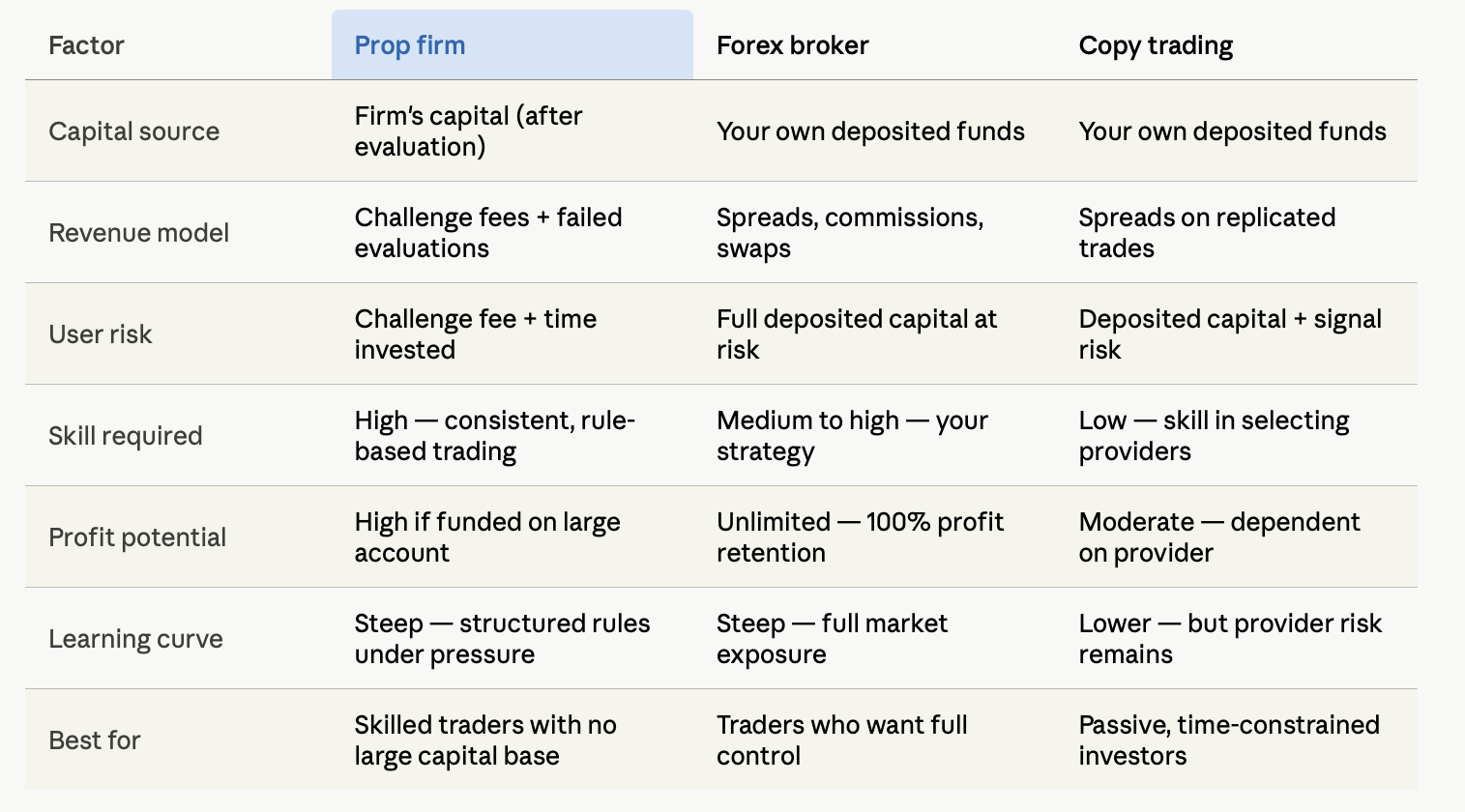
According to the chart above, these three trading systems have different incentives and functions. Brokers earn money from every trade placed by a trader, regardless of whether the trade is profitable. Therefore, their objective is to keep users trading on a consistent basis.
A prop trading firm makes money when a trader fails its evaluation, thereby benefiting from multiple attempts by aspiring traders to pass the firm's assessment process.
Lastly, a copy trading system earns money from the spreads generated by replicated trades. As more followers copy an increasing number of daily or monthly trades, the copy trading company can increase its revenue regardless of whether those followers ultimately make or lose money.
None of the firms listed above are inherently bad. However, when considering these platforms, evaluate them carefully with respect to their revenue structure rather than relying solely on the marketing material provided by each firm.
Which Trading Model Fits Different Types of Traders?
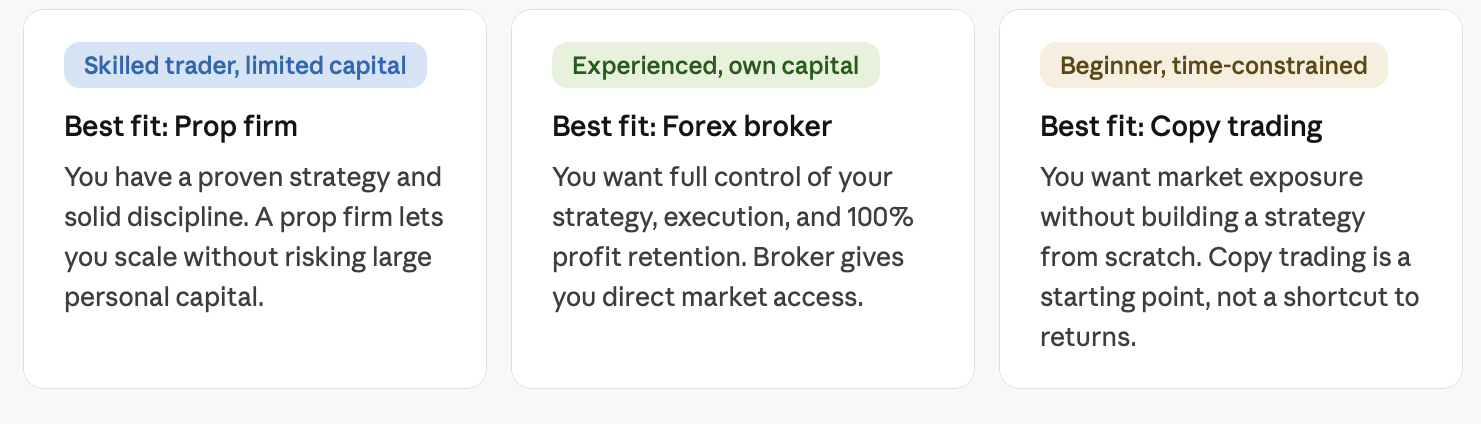
When deciding which of these models to pursue, never take into account which one offers the most benefit. A trader with poor strategy execution cannot afford to invest in prop firm challenges at $200 each, as they will join the 85% of failed challenges. An investor who wants exposure to currency markets but does not want to spend time evaluating charts may want to utilise copy trading in the early stages of development, but they must also be aware of the risks associated with relying on someone else's decisions when investing other people's money through copy trading.
As a trader, if you are new and want to develop a good skill set before putting your capital at risk in the forex market, consider reading the Tradewill guide to passive investing for beginners, as well as the full guide to forex day trading prior to selecting your trading platform.
The Hidden Risks in Each Model
Skills learned through prop trading challenges do not necessarily translate to long-term profitability with funded accounts. Challenge psychology occurs when traders trade more aggressively than their plan in order to make profits as quickly as possible. These traders often develop behaviours that are not sustainable in normal market conditions. Some traders believe they will be as successful by connecting their skills and short-term prop trading experience as they would be through the experience of managing funded accounts over many years.
Another area of potential risk in prop trading is working with a broker. Most of the fear surrounding brokers stems from broker manipulation of prices in an effort to trigger stop losses, commonly seen with unregulated brokers. However, this is not a current issue with regulated brokers, and they do not regularly practice this type of behaviour. Overleveraging and lack of compliance are far greater concerns for prop traders when using brokers. Even a 100:1 leverage ratio may seem attractive until a 1% adverse price move causes your entire account balance to be wiped out, with no margin remaining. Refer to the section above on how to properly structure your position in accordance with the Tradewill guide on risk management.
The risks of copy trading are often under-explained compared to the other two categories, including copy trading performance. Copy trading platforms are also affected by survivorship bias, meaning you are selecting from traders who have already shown strong historical returns, but this does not guarantee that they will continue to perform well in the future. Signal providers who have generated returns of 15% per month in low-volatility conditions may experience catastrophic losses in more volatile markets, and those losses are reflected in real time directly in your account, without any action taken by you to mitigate them.
The Future of the Trading Ecosystem
The distinctions between these three models are becoming increasingly blurred. Many fintech companies have begun experimenting with hybrid solutions that combine traditional brokerage infrastructure with prop-style funded accounts or integrate copy-trading functionality directly into brokerage platforms. For example, eToro operates both as a regulated broker and as a social trading platform, allowing users to trade independently or copy the strategies of other traders.
Similarly, numerous proprietary trading firms have established partnerships with brokers, enabling funded traders to execute trades through broker infrastructure while allowing the firms to generate revenue from both evaluation programs and trading-related fees.
Artificial intelligence is also playing an increasingly significant role within these evolving ecosystems. Some market participants are exploring AI-generated trading signals, algorithm-driven strategy development, and automated systems that can be incorporated into copy-trading frameworks. As a result, due diligence has become more important than ever. The growing separation between the end user and the underlying trading strategy can make it more difficult to understand how decisions are being made, what risks are being taken, and whether performance results are sustainable over the long term.
These developments point toward a broader industry trend: the emergence of blended trading ecosystems in which a single provider may offer broker-style market access, prop-firm funding programs with evaluation challenges, and social trading features that allow successful traders to build audiences, attract followers, and earn compensation based on their performance.
As technology continues to evolve, the boundaries between brokers, prop firms, copy-trading networks, and algorithmic trading providers are likely to become even less distinct. This makes it increasingly important for traders to evaluate not only performance metrics, but also the underlying business model, risk controls, execution quality, and transparency of any platform they choose to use.
Which Model Is Best?
The honest answer to whether a universally "best" trading model exists is that it does not. Any content that claims otherwise is often more reflective of a sales pitch than an objective assessment. Each model serves a different type of trader and is designed to meet different goals, risk tolerances, and capital requirements.
Proprietary trading is generally best suited to experienced traders who have developed a proven methodology and require access to external capital in order to trade at a larger scale. Traditional forex brokers are often more appropriate for traders who want full control over their execution, risk management, and profit retention by trading their own capital. Copy trading, on the other hand, may be a suitable option for individuals seeking market exposure with a lower time commitment, provided they fully understand the risks associated with following other traders.
Regardless of the platform or model you choose, it is important to understand how the underlying business operates before committing capital. The incentives of a platform can have a significant influence on the services it provides and the risks it presents to users. For example, a platform that generates revenue primarily from evaluation fees, trading activity, spreads, commissions, subscriptions, or other sources may have incentives that differ from those of a platform whose success is more closely aligned with the long-term success of its clients.
For this reason, evaluating a platform's business model should be considered an essential part of the due diligence process. Understanding how a broker, prop firm, or copy-trading provider generates revenue can help traders make more informed decisions and select the model that best aligns with their objectives, experience level, and approach to risk management.
Ultimately, the most suitable trading model is not the one that is marketed most aggressively, but the one that best fits your trading style, financial goals, risk tolerance, and level of experience.
Tradewill.com gives you more than just a trading platform. It gives you the ecosystem understanding to make smarter decisions about where, how, and why you trade. Start with a demo account to explore multi-asset trading across forex, CFDs, and crypto before you commit real capital to any model.
FAQs
What is a proprietary trading platform? A proprietary trading platform in the retail context is a firm that offers traders access to a funded trading account after passing a paid evaluation challenge, with profits shared between the trader and the firm.
How do prop firms make money? The primary revenue source for most retail prop firms is the challenge fees paid by traders who fail the evaluation, not the trading profits of funded traders.
What is the difference between a forex broker and a prop firm? A broker provides market access for you to trade your own capital, earning from spreads and commissions. A prop firm provides funded capital after an evaluation, earning primarily from evaluation fees.
Is copy trading profitable? It can be, but past performance of signal providers isn't a reliable indicator of future results. Survivorship bias, hidden drawdowns, and strategy deterioration all pose serious risks.
Do forex brokers trade against clients? Some Market Maker brokers do take the other side of client trades, which creates a conflict of interest. ECN and STP brokers route orders to external liquidity providers and earn commissions instead, removing that conflict.
Which trading model is best for beginners? Copy trading has the lowest technical barrier, but it doesn't remove market risk. Beginners should focus on education and demo trading before committing real capital to any of the three models.
Disclaimer: The content of the blog does not represent any position of Trade W, does not serve as any trading-related decision advice, and does not endorse any third-party.