

 Trade W
Many retail traders pay too much attention to central bank announcements, interest rate differentials and momentum factors. While all of these factors are important, they tell you why a currency moved last Tuesday rather than where it will go in the next three years. Long-term directions are explained through the concept of purchasing power parity, which is among the most valuable yet underutilised concepts in a forex trader's toolkit.
In its essence, purchasing power parity is an economic theory that says that the exchange rate between two currencies will, in the long run, equalise so that identical goods will be priced the same when priced in a common currency. For example, if you can buy a laptop for $1,200 in the USA and an equivalent model costs £1,000 in the UK, PPP will suggest that the exchange rate should be at approximately 1.20 USD/GBP.
In other words, if the exchange rate is higher or lower than what PPP predicts, then one currency is over- or undervalued compared to the value where it is supposed to be at the PPP equilibrium, and that value will, eventually, converge towards the PPP equilibrium.
The importance of this dynamic is critical for forex traders, global investors and all companies that price goods or services in a cross-border transaction. Currency misalignments arising out of PPP will not correct themselves immediately; they will eventually correct themselves. Traders who understand this concept have an advantage in establishing medium and long-term positions.
The most well-known representation of the underlying principle of purchasing power parity is The Economist's Big Mac Index, which has tracked the price of McDonald's Big Mac burgers in multiple countries since 1986. The logic is simple: First, the Big Mac is produced using substantially the same factors of production (labour, rent, ingredients) in virtually all countries.
Therefore, after adjusting for the current exchange rates, the prices of Big Macs should converge towards one another globally. In the example, if you paid $5.58 for a Big Mac in the USA and $2.20 for one in Egypt using current exchange rates, then the Egyptian pound appears to be severely undervalued when compared to the dollar.
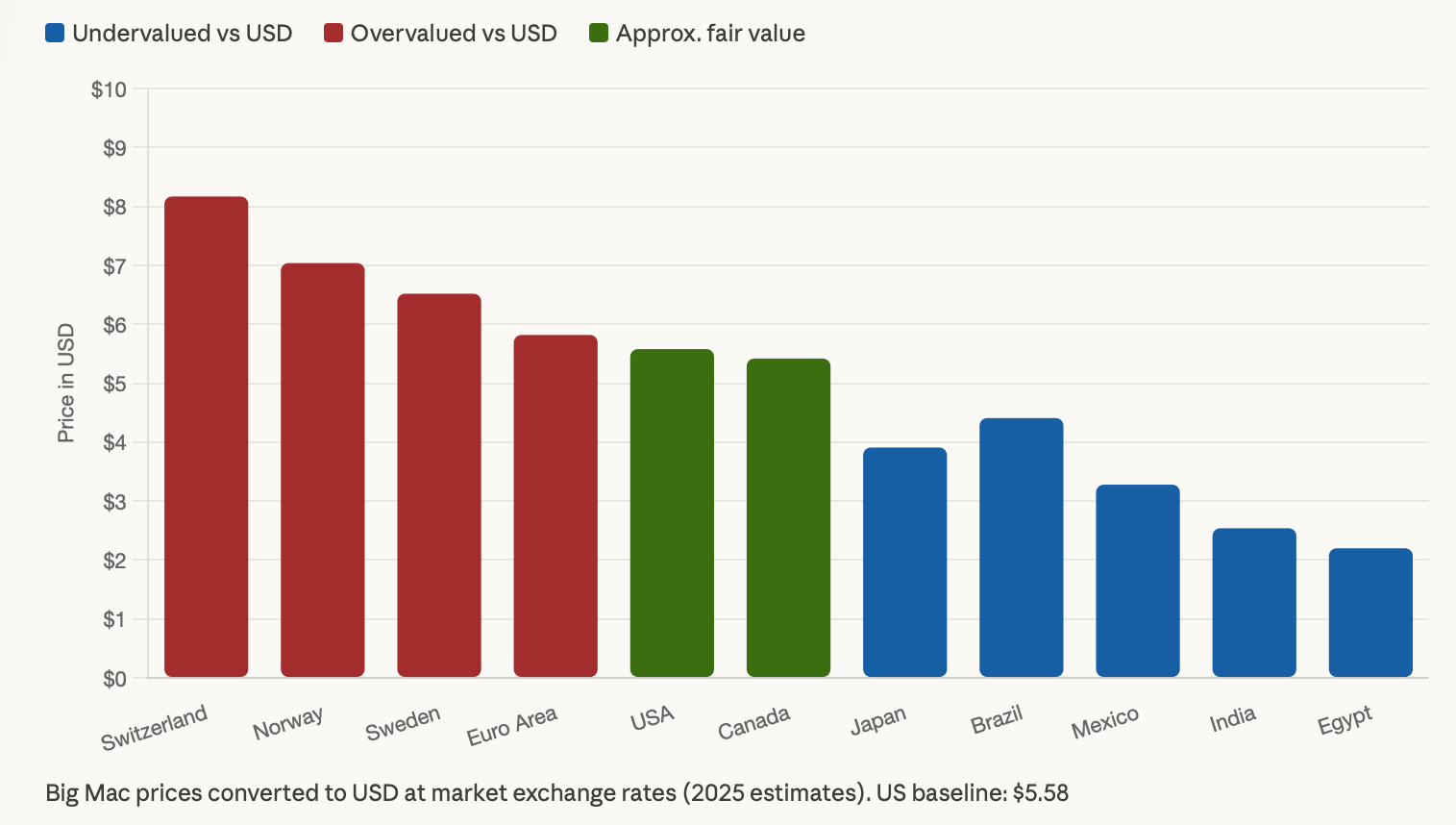
The chart above makes it immediately obvious that Swiss and Norwegian currencies look expensive relative to the US dollar, while Asian and emerging market currencies appear cheap. That's the power of PPP thinking applied simply. Now let's build on that foundation with actual theory.
What is Purchasing Power Parity? The Core Theory
The Law of One Price is the intellectual basis for purchasing power parity (PPP). When a market is perfectly efficient, and there are no trade barriers, transport costs, or limited access to markets, a given item should have the same price in every country around the world, when the prices are priced in US$.
In other words, if a smartphone costs $800 in the US but only €500 in Germany, an arbitrageur could buy the smartphone in Germany and convert €500 to $800 or would sell the same smartphone in the US until the price difference between the two countries disappears.
However, while the pure theory of PPP represents a theoretical ideal, we can observe that other factors have a real impact on the existence of price disparities between countries. These factors are typically caused by tariffs, services that are not traded between countries, and tax policies.
In addition to tariffs and taxes, inflation rates are another force that causes buying and selling price differences over time. Long-term price differentials between countries will exist as a result of price increases or decreases in goods and services as a result of inflation. Therefore, the purchasing power of a country will ultimately decrease relative to other countries.
If Country A has higher inflation rates than Country B, the purchasing power of its currency decreases relative to Country A. Consequently, Foreign Buyers are less likely to purchase Country A's goods because they are more expensive, and therefore the exchange rate of Country B will decrease to equalise the prices of goods in all countries. As a result, this pricing channel and the inflation differentials represent the primary connection between inflation and long-term currency exchange rate changes.
In light of the preceding discussion, the International Monetary Fund (IMF), the World Bank and the OECD all evaluate the economic strength of different countries using PPP-adjusted data in order to remove distortions created by fluctuations in the market value of currencies. The commonly held belief that China has the largest economy in the world in PPP terms, despite its nominal GDP being lower than that of the US when measured in US$, stems solely from the use of PPP-based data to measure economic size.
Absolute vs Relative PPP: Two Models, Two Different Questions
The Purchasing Power Parity (PPP) Approach consists of two different models that serve different purposes; mixing them will create incorrect analysis.
Absolute Purchasing Power Parity (PPP) examines whether the existing exchange rates reflect the same price levels of goods and services in two economies. Absolute PPP is the purest theoretical version of PPP because it states that a certain amount of currency in one economy can purchase an equal amount of goods and services in another economy.
In reality, Absolute PPP tends not to be fulfilled due to different measurement methods between nations, huge differences in the availability of non-tradable services, and the difficulty of isolating quality differences.
The relative version of Purchasing Power Parity (PPP) asks a more practical question - whether exchange rates will move in line with inflation differentials over time, and thus can be evaluated. If, for example, inflation in the United States is at 4% annually while inflation in Japan is 1%, based upon Relative PPP, then we would anticipate that the dollar will depreciate against the yen by approximately 3% each year.
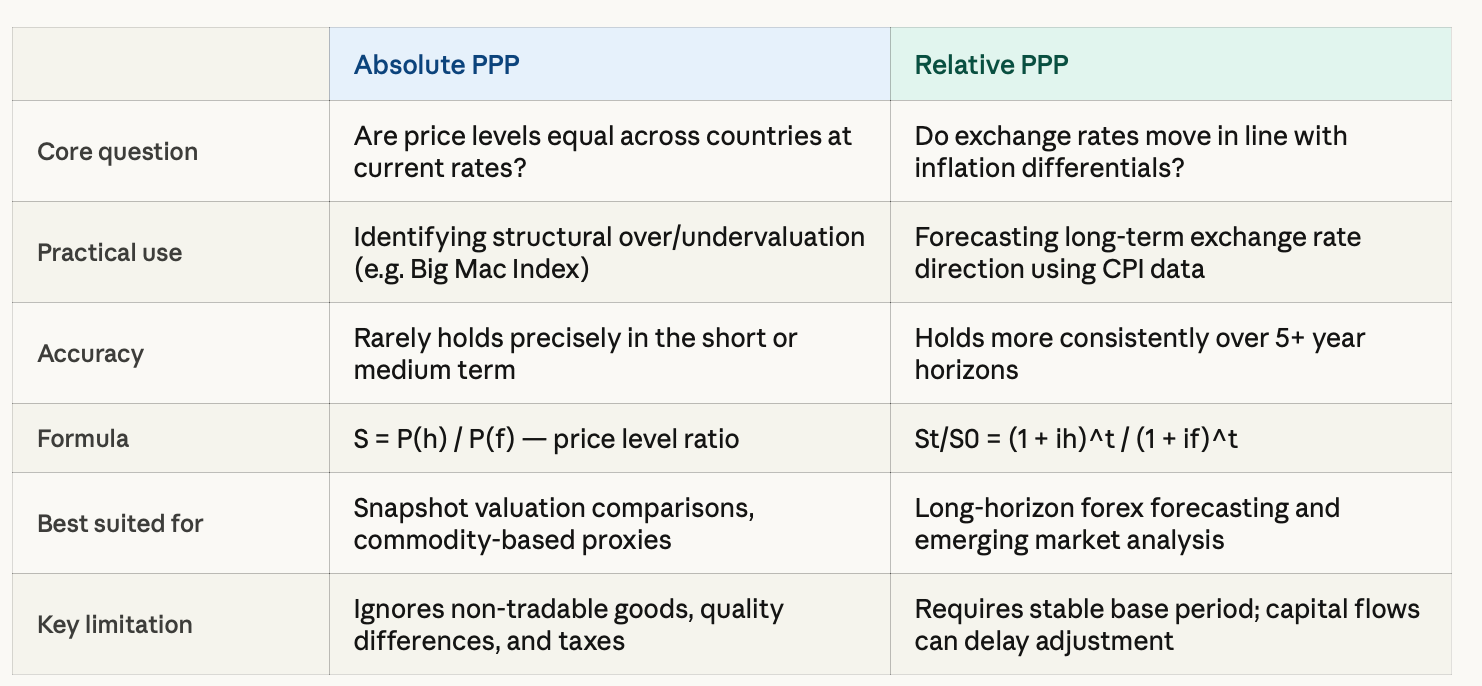
Most currency analysts and economists use the Relative PPP Formula to make currency exchange predictions. To explain the Relative PPP Formula, we will analyse the variables used to calculate it. The formula will determine what will be the expected future exchange rate denoted as St between the two currencies being compared; this is done by using current exchange rates denoted as S0 as well as the average inflation rates denoted as ih and if for both the domestic and foreign countries, respectively, over the period of your forecast denoted.
If, for example, the United States has an average inflation rate of 3.5% over the next five years and Germany has a 2% average inflation rate, then according to the Relative PPP Formula, the Euro should appreciate by approximately 7.5% relative to the Dollar over that five-year forecast, assuming all factors remain constant.
How PPP Drives Long-Term Exchange Rates
The difference between how successful or unsuccessful the PPP model has been over different timeframes is due to there being two opposing forces, particularly in the short term vs the long term.
In the short run, PPP is highly sensitive to capital flows, interest rate differentials, risk sentiment, and momentum trading. Currencies can remain highly misaligned to PPP for years while investors take advantage of carry trade opportunities, or even while central banks defend a specific exchange rate.
Longer-term, however, the fundamental forces associated with foreign currency balances and trade relationships eventually force the currency to correct itself to an approximate equilibrium value as the misalignment persists over time. For example, the export prices in Turkey consistently exceed those in the U.S., thereby resulting in a trade imbalance for that country. Thus, the depreciating lira vs. the dollar that Turkey has experienced since the early 1980s is indicative of a long-term, gradual depreciation.
Traders should note that while PPP can indicate the general direction and approximate magnitude of a long-term adjustment in the value of a given currency, they cannot anticipate with any precision when such an adjustment will occur. PPP serves more as a basis for constructing a trading thesis than signalling the timing of an entry point when trading that currency.
Trading Strategy: Using PPP to Find Market Opportunities
Trading strategies based on PPP are based on the concept of Value Investing as a means of investing in currencies. To create a trading strategy based on PPP, calculate the implied PPP exchange rate using either a calculator or by looking up the PPP exchange rate, then compare the PPP implied exchange rate to the market exchange rate, and then determine whether the currency is overvalued or undervalued based on fundamental analysis.
When a currency is trading significantly below its PPP implied fair value, it is considered undervalued. Purchasing that currency or purchasing an asset that is denominated in that currency. It is one of many long-term value-related trades to be initiated from the underpricing of that currency.
The supporting trading perspective is that the price discrepancy will be resolved between 2 and 5 years due to both changes in inflation rates and changes in trade flows, the price of the commodity being traded that is pushing the value of the currency back towards its equilibrium value.
A better outcome occurs when the undervalued currency also has a positive carry component to it because it has a higher interest rate than the base currency that the investor is currently using. When this happens, the investor is said to "get paid to wait" when the PPP convergence occurs. This sweet spot is what most large institutional macro funds look for when establishing long-term positions in emerging market currencies.
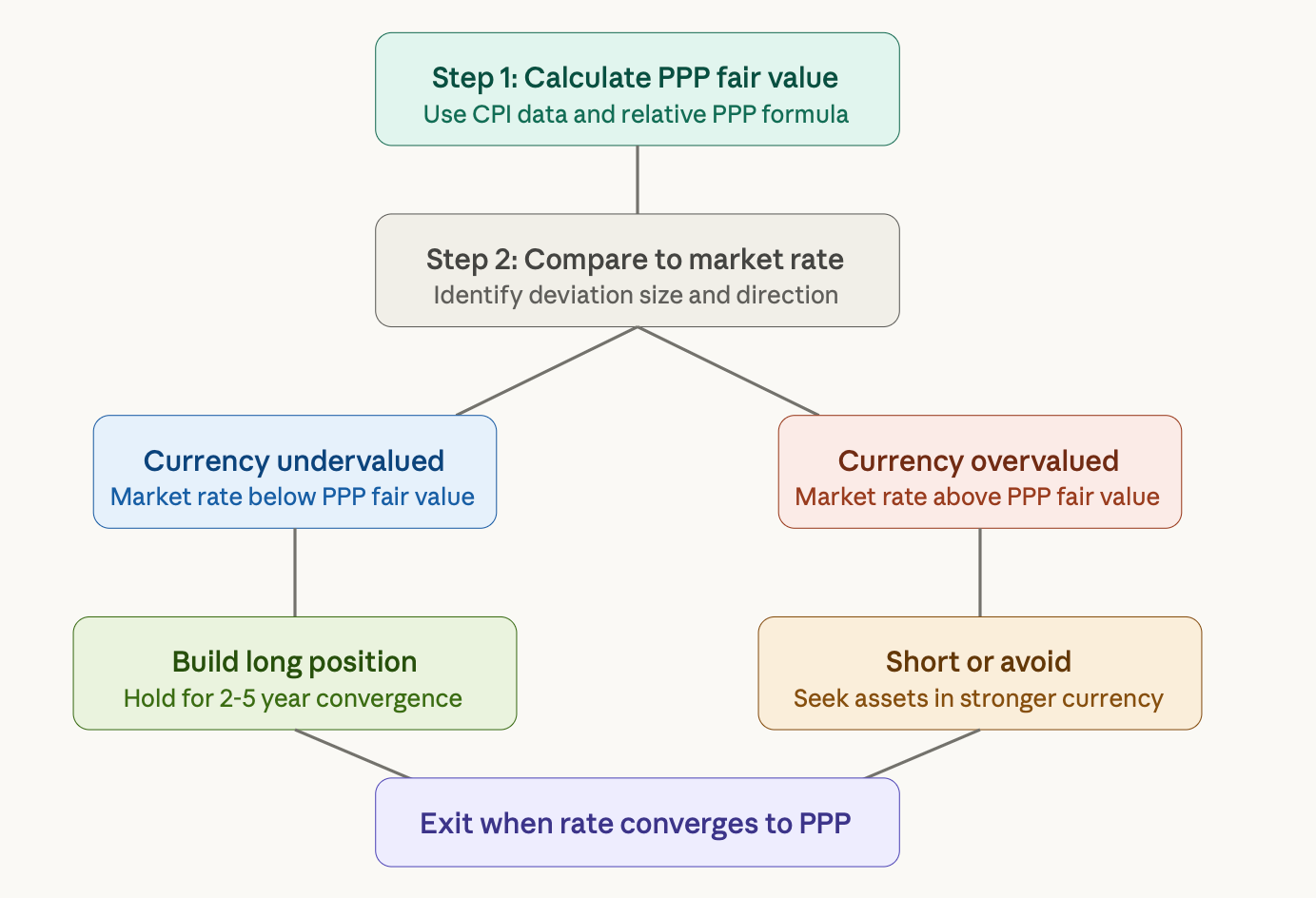
Signals of trend reversals corroborate entry dates based on PPP. A currency that is strongly undervalued will develop technical momentum toward the point of convergence with its PPP. This combination of fundamental support plus technical confirmation provides the best macro-trading research setups available. Patience is the biggest risk involved. The length of time it may take to close out trades related to PPP mispricing can be greater than the time period necessary to recover a margin buffer, so both position sizing and risk management are as critical to a trading scenario as the supporting thesis.
Macro Perspective: PPP vs Interest Rate Parity
While purchasing power parity is a long-term driver of exchange rates, interest rate parity provides an explanation of short to medium-term movements of currencies caused by capital inflow. Understanding both concepts and identifying which concept best fits each situation are the keys to differentiating between casual analysis and true macro-trading.
According to interest rate parity, the difference in interest rates between two nations is included in their respective forward exchange rates; thus, a currency that pays a higher interest rate would be discounted in its forward quotation due to the expected higher yield from that country. In the short term, capital follows the yield, which can result in a strong inflationary environment, with a low or negative PPP currency experiencing capital inflows and having significant appreciation against weaker or higher PPP currencies until stability is achieved.
The two concepts are not based upon contradictory principles because they operate over different time periods. The interest rate parity concept drives capital flow over a period of months to a few years, while the purchasing power parity concept drives capital flows over a five-plus-year period. Thus, as a trader, being correct in identifying the purchasing power parity would not necessarily translate into making a profit if the capital market reaction due to interest rate parity continues to push the exchange rate away from the actual value or equilibrium before the two rates converge.
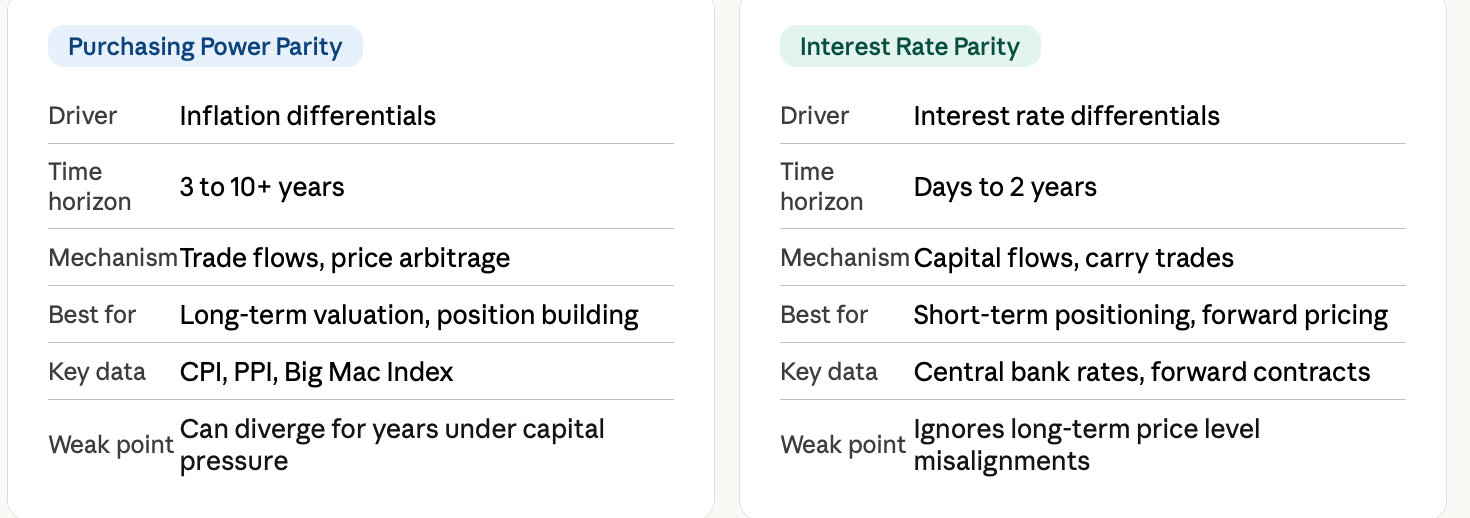
The most powerful macro analysis combines both frameworks: use IRP to understand the near-term catalyst environment, and use PPP to assess whether the broader trend is working for or against you.
Limitations of Purchasing Power Parity
The concept of PPP serves as a long-term indicator of the value of a currency and is therefore not intended to serve as a short-term trading vehicle. Its limitations can be better understood to allow you to avoid the misapplication of PPP. Numerous structural factors can cause a currency to experience significant deviations from its PPP equilibrium for an extended period of time; some of these structural factors may be permanent.
The largest source of structural deviation from PPP relates to the presence of non-tradable goods. Non-tradable goods are goods whose prices cannot be arbitraged in the marketplace because of their unique characteristics.
For example, a person may have to pay five times more for a haircut in Zurich than they would in Manila; the excess cost of the haircut is not due to currency mispricing, but rather due to the fact that labour costs vary considerably from one country to another.
The Balassa-Samuelson effect explains the phenomenon of countries with higher productivity in traded goods, as it relates to overall higher price levels and gives the impression that the currencies of these nations are perpetually overvalued in absolute terms relative to PPP.
Thus, it would be reasonable to expect that the Swiss franc would always be rated "expensive" or valuable in terms of PPP. Capital flows resulting from the investment of portfolios or from sovereign wealth funds can create substantial gaps between the actual exchange rate and the rate implied by the flow of goods and services and can continue to cause gaps for extended periods of time.
Also, government intervention in currency markets through the establishment of currency pegs or through the use of managed float systems provides another means through which price distortions can be maintained.
Likewise, trade barriers and tariffs disrupt the process by which arbitrage becomes available to create equality of price levels and therefore PPP. The so-called safe-haven currencies (e.g. yen and Swiss franc) generally trade well above their PPP-implied price during times of risk aversion, irrespective of the impact of inflation.
PPP Exchange Rate Calculation in Practice
CPI data is needed to test the concept of relative Purchasing Power Parity (PPP). The following example illustrates how to use CPI data with an example of the USD/BRL currency pair over the course of five years.
Let's take the exchange rate between the US dollar and the Brazilian real at the beginning of 2020, which was 4.02. In the five years following that point in time, the average inflation rate in the United States was 4.1% per year, while the average inflation rate in Brazil was 8.3% per year.
When we take these averages and plug them into the equation for relative PPP, we can estimate what the exchange rate will be in 2025. Based on the CPI data, our calculation indicates that we can expect the USD and BRL to be valued at approximately 5.04 reals for every dollar in 2025 based on the CPI data. However, when we look at the exchange rate at the beginning of 2025, we see that the USD/BRL exchange rate was actually somewhere around 5.7 reals for every dollar. This indicates that the Brazilian real is still undervalued compared to what we would expect based on relative PPP calculations.
However, we must keep in mind that there are many factors that can affect the USD/BRL exchange rate, including Brazil's economic performance and commodity prices, and these may help explain some of the difference between the estimated and actual USD/BRL exchange rates.
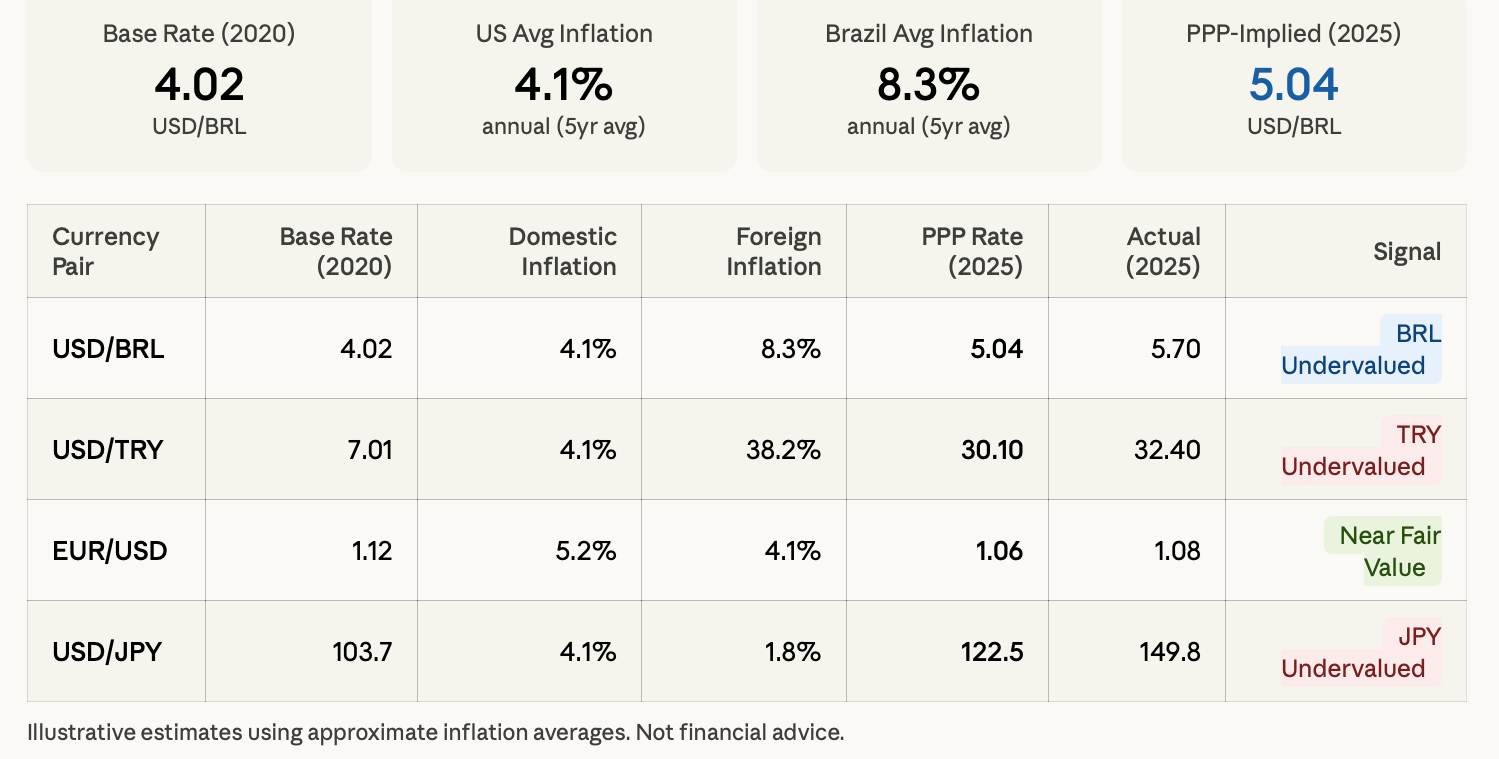
Out of the currencies illustrated in the table, the Japanese yen is the most notable. Although there has been gradual policy normalisation from the Bank of Japan since 2024, the value of the yen continues to be significantly below its relative purchasing power parity. This consistent deviation has led to a large amount of institutional interest and remains one of the most discussed instances of structural mispricing within the broader global FX market.
PPP in 2026: What the Current Environment Means for Traders
The global macroeconomic landscape as we enter 2026 demonstrates that the use of Purchasing Power Parity (PPP) Analysis will be more relevant than it has been in many years. The inflationary spikes from 2021 through 2023 created significant differences between the inflation rates of the various economies around the globe, leading to significant inflation differentials between both developed and emerging markets.
Currently, the differing levels of inflation that occurred during this period are directly contributing to the PPP calculations utilised by institutional macro funds for creating their multi-year currency strategies.
In general, the majority of the emerging market currencies in Latin America, South and Southeast Asia, and Sub-Saharan Africa experienced a dramatic decline in value during the years in which high inflation was present. At present, these currencies are generally trading below their fair value according to PPP calculations that are based on the progress these countries have made toward disinflation and fiscal consolidation over the years.
Also, the U.S. dollar has remained the preferred choice by global investors for safe-haven flows, and it continues to trade at or above nearly all of its PPP-implied cross rates. Historically, the trend of the dollar trading above PPP has been followed by an extended period of dollar price weakness.
The divergence in the monetary policy cycles of the Group of Ten (G10) nations is the most significant risk factor. If the Federal Reserve maintains high-interest rates for a longer period than the central banks of the Eurozone and the UK (Bank of England), then the interest rate parity, or IRP, capital flows will continue to support the strong dollar even while the expectation of the dollar reverting to PPP is in play.
When creating currency trading strategies based on purchasing power parity, it is crucial that traders explicitly account for the tension that exists between the PPP and the IRP, and treat the purchasing power parity framework as merely one tool within the broader strategy.
Cross-Border Investing and PPP
The purchasing power parity (PPP) concept applies directly to how to allocate investments, particularly for investors who are not strictly currency traders. When a foreign currency appears to be undervalued based on PPP calculations, investors have two reasons to invest in foreign-denominated assets: they receive the returns associated with holding an asset and the potential for currency appreciation as that currency moves toward its "fair value."
Therefore, finding undervalued foreign currencies based on PPP is a routine component of how global equity investors allocate investments into emerging market securities.
On the other hand, investing in a country whose currency is valued above the PPP level creates a headwind that can offset the performance of local assets. For example, if a portfolio of strong European equities is expected to return 12% in euro-denominated terms, and the euro currency depreciates by 5% during that period, then the portfolio actually will return only 7% in U.S. dollar terms.
FAQ: Common Questions About Purchasing Power Parity
What is purchasing power parity? PPP is an economic theory stating that exchange rates should adjust over time until identical goods cost the same in different countries when converted to a common currency.
How does PPP affect exchange rates? Through inflation differentials and trade flows, countries with higher inflation see their currencies depreciate over time to maintain price-level equilibrium across borders.
Is PPP accurate in the short term? PPP is a poor short-term predictor. Capital flows, interest rate differentials, and risk sentiment dominate short-term currency movements. PPP becomes meaningfully predictive over 5 to 10-year horizons.
What's the difference between PPP and the market exchange rate? The market exchange rate is determined minute-to-minute by supply and demand in global FX markets. The PPP rate is a theoretical equilibrium based on price levels. The two can diverge substantially for years before converging.
How do traders use PPP? Primarily as a valuation framework to identify structurally undervalued or overvalued currencies, then combine that thesis with carry trade analysis and technical confirmation to build long-horizon positions.
Conclusion: Building Long-Term Trading Positions with PPP
The concept of Purchasing Power Parity (PPP) may help you understand whether or not the exchange rate between two currencies will rise or fall, but it cannot predict how the rate will be tomorrow. PPP can provide an accurate representation of the value of a currency compared to the price of the same goods overseas. The underlying data is statistically valid and has been collected over a long period of time. Be aware that this method is only applicable to currencies that follow a long-term cycle and thus provide a valid measure of their trip to a given destination.
Smart macro traders treat PPP as just one piece of many elements that contribute to a more thorough analysis of the economic climate. They incorporate PPP as one signal of valuation into their toolbox in conjunction with interest rate differentials, trend confirmations, and risk management to identify trades that fit the fundamentals, cycle, and technical picture at the same time. This is where the most confidence-generating opportunities live.
Currently, trading is taking place in these mispriced currencies, and the inflation divergence environment for 2026 has increased the number of available opportunities.
Start identifying undervalued currency pairs on TradeWill's live analysis platform, where macro signals, real-time rates, and position tools sit in one place, built for traders who think in years, not minutes. Open your TradeWill account at tradewill.com and run your first PPP screen today.
Disclaimer: The content of the blog does not represent any position of Trade W, does not serve as any trading-related decision advice, and does not endorse any third-party.