

 Trade W

Can You Actually Make Money When Prices Fall?
A common belief is that trading is simply buying low and selling high. However, there is a way to profit when prices go down, and that is with put options.
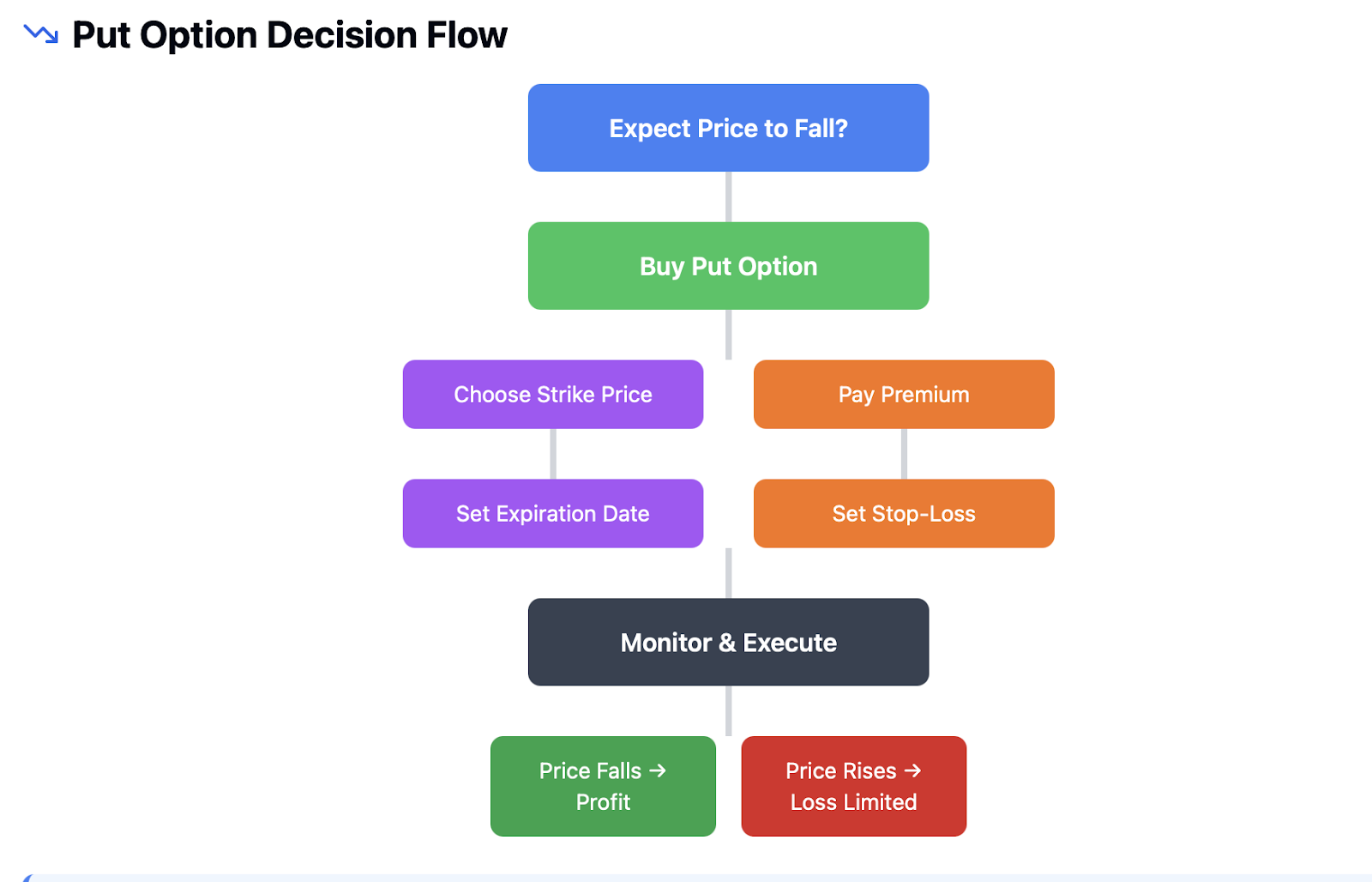
A put option is a contract that gives you the right (but not the obligation) to sell an asset or stock at a certain price and date. You could think of a put option as insurance that pays if prices drop. Just like call options give you the right to buy, put options give you the right to sell.
Let's look at two examples to help clarify this:
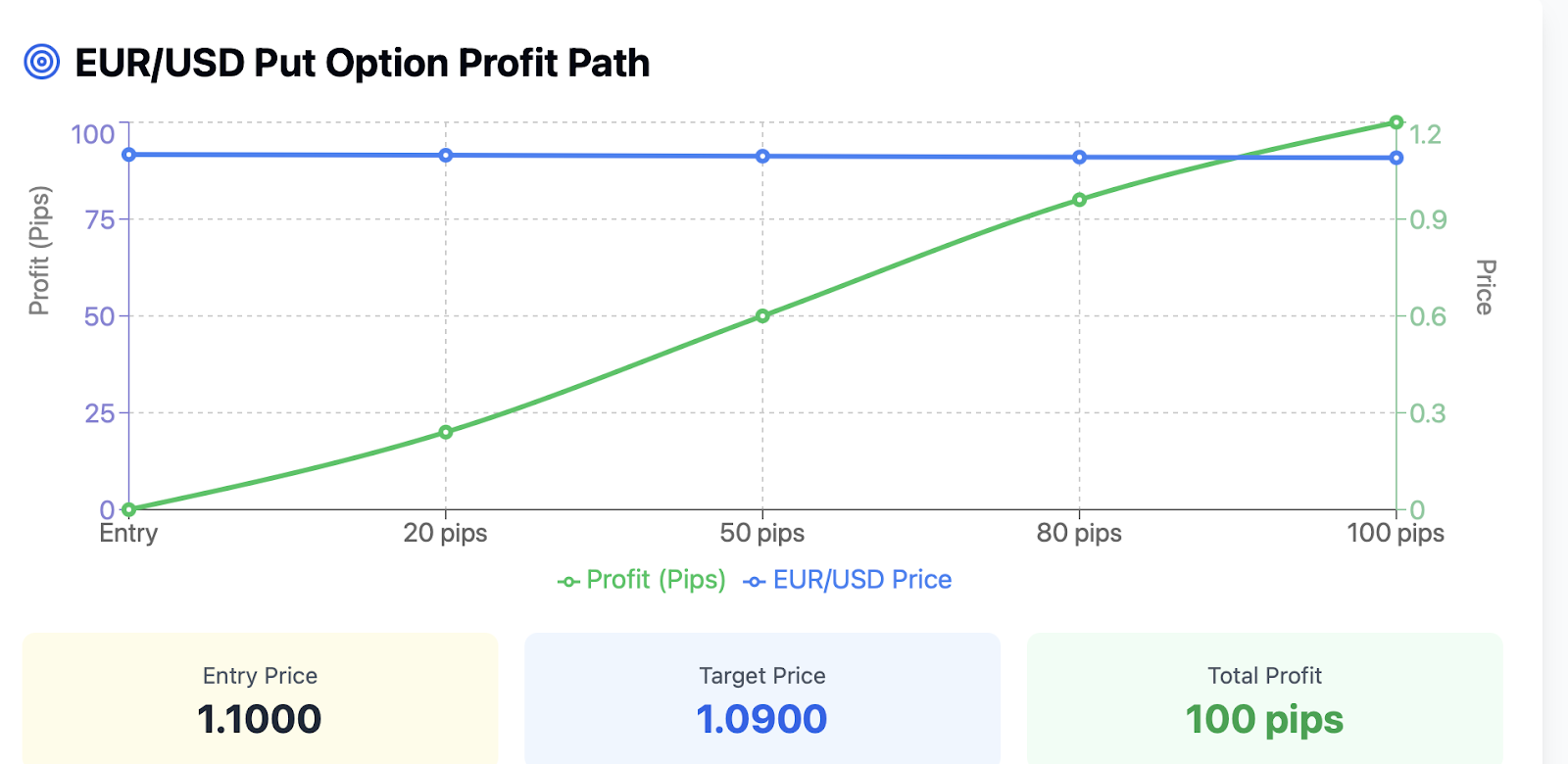
Professional scenario: You buy a Euro put option with a strike price of 1.1000. When the EUR/USD pair expires and drops to 1.0900, you make 100 pips in profit.
Everyday scenario: You are selling a used textbook. You agree to sell the book for $50; however, the market price drops to $40. You have effectively used a put option, because a price of $50 has been locked in while the market price dropped.
Put options can serve a purpose beyond speculation. They can be used to hedge against risk, especially if you believe prices will decline. In this article, we will share how put options work, when you would want to consider either selling or buying to minimise the risk of decline, and common pitfalls that often lead beginners astray.
So what is a put option? A put option is, essentially, a contract that gives the purchaser the right to sell the underlying asset, at the pre-determined strike price, by a specified date in the future. Please keep in mind that the holder has the right to sell, but there is no obligation to do so.
Like all option transactions, there are two segments involved:
1. Buyer (you, if you are buying the put): the buyer will pay a premium for the right to sell at the premium price previously agreed to.
2. Seller (or option writer): The seller will collect the premium set forth by the agreement and, should you decide to sell, will be required to buy it from you at the agreed-upon price.
Put options can be transacted against an array of underlying assets, including foreign exchange (FX) pairs (ex., EUR/USD), CFDS, stocks, commodities, and much more.
For example, in a professional instance, if you were to purchase an underlying USD/JPY put option with a strike price of 110. If the USD/JPY were to expire at 108, you would profit 2 points multiplied by the contract size.
A straightforward example is the concert ticket, which you sold to someone at an agreed price, knowing that ticket scalpers have similar tickets for a cheaper price. In reality, you have created a put option.
Essential Components
Every put option contains four important elements:
-
Strike Price - Remains the level at which you can sell the underlying asset
-
Expiration Date - The date you must use the option, or you will lose it
-
Premium - The price paid up front to be able to own the option
-
Intrinsic Value- The amount of profit that you could claim if you exercised the option at that moment
Risk v. Reward
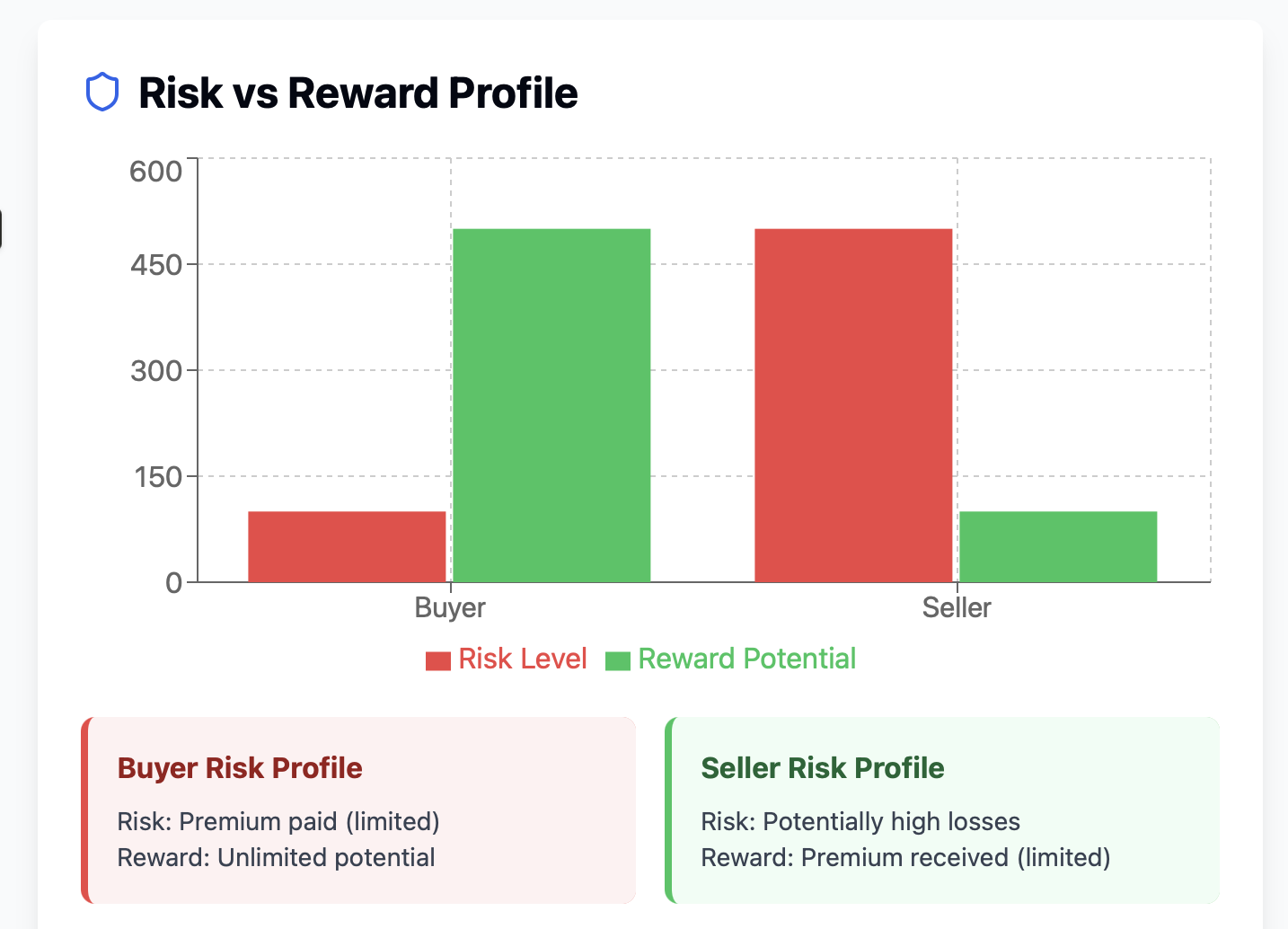
Here is what makes put options interesting: the risk to the buyer is limited to the premium paid, which has the potential for increased profits on the underlying price decline. For the seller, the funds provided are kept as long as the price does not decline, but they ultimately may experience a greater than the premium amount loss at expiration.
That is the beauty of purchasing put options. The option presents an asymmetric risk profile in that you know the maximum you can lose is limited to the premium paid; however, your profit can increase exponentially on underlying asset price declines. This can be appealing to speculate or protect existing positions as an alternative to short-sell borrowing.
Where Put Options Come From.
Put options aren't some modern financial gimmick. They've been around for centuries, evolving in addition to the markets.
The idea of options originated in the 17th-century Dutch tulip market, when traders utilised rudimentary option agreements during the tulip mania phenomenon. Then, options evolved to being more organised in the 18th and 19th centuries through the introduction of futures contracts, based mainly on commodities like wheat and cotton.
The revolution occurred when standardisation set in. Early options were bespoke agreements between two parties and were difficult to trade or exit. However, as markets matured, the exchanges developed standardised contracts with a fixed strike price, expiration date and size of contract.
The evolution across markets went as follows:
-
Stock options (early 1900s): First used as hedging instruments to protect you on the downside of markets
-
Forex options (1970s-1980s): As currencies floated freely in the currency markets, forex options appeared to hedge against exchange rate risk
-
CFD and derivatives options (1990s-2000s): As we moved into modern digital electronic platforms, options became open to retail and individual trading, NOT just institutional trading.
Now we are into algorithmic trading and smart order systems, and execution of a put option occurs much faster and more efficiently than ever. What once involved calling a broker/agent and having them complete the required documentation now happens in a matter of milliseconds via electronic platforms.
Put Options Across Different Trading Styles.
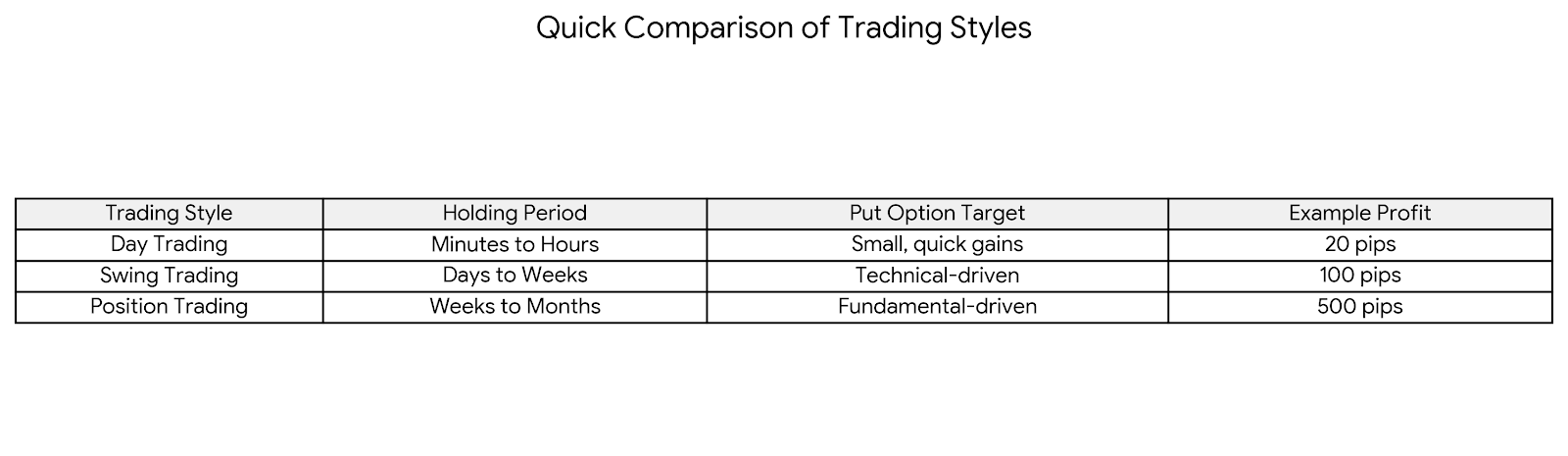
The application of put options varies based on the timeframe you are trading. We will now analyse how day traders, swing traders, and position traders utilise put options.
Day Trading
Objective: Capture a small intraday decline in price.
The day trader's objective is to take advantage of short-term downward price movement and will generally only be in the position for a few minutes or hours.
Professional example: There are generally around 50 pips of daily movement in the EUR/USD currency pair. A day trader may buy a put option to take advantage of a 20-pip decline. The asset price may be at 1.1000, and the day trader targets the decline to 1.0980.
Simple example: You buy and sell used textbooks in between classes. You buy in the morning, and then by lunchtime, you attempt to have realised the profit of $5 by selling the textbook immediately once you reach your target profit.
Swing Trading
Objective: Surfing medium-term downtrends (3 days to weeks).
A swing trader looks to hold put options positions for a longer amount of time, after classifying technical price movement into distinct price patterns, such as breaking through support or failing to break previous highs.
Professional example: GBP/USD breaks through a major support level at around 1.2500. A day trader would take a put option with an anticipated price target of 1.2400; the trader holds the put options for several days to see if the downward price trend continues for 100 pips.
To use a simple example: You have saved your allowance for a week. You wait for the best time to sell when the price of your favourite store drops, anticipating a political shift during the week to generate a profit of $10.
Position Trading
Objective: Generate profits from huge declines, with the basis of your decision based on fundamental reasons.
Position traders will hold onto put options for weeks or months, as they anticipate economic shifts, politically induced decisions, or structural trends to move the market significantly.
Professional example: A position trader expects the Federal Reserve to increase its interest rate policy, which will strengthen the dollar ultimately. They will buy long-dated EUR/USD put options, with a price objective of declining 500 pips from 1.1000 to 1.0500 over the next several months.
Simple example: You are planning to sell some collectables during the semester. You lock a minimum selling price today to protect yourself from a potential crash in the market by year-end.
Put options must fit your trading style. Day traders want tight targets and quick executions. Position traders want patience and conviction in their fundamental analysis. Use the wrong time frame, and it just won't work regardless of how good your analysis is.
The Psychology of Put Options.
The market won't care about your feelings, but your feelings matter when it comes to trading. Put options accentuate the psychological challenges because you're literally betting against the market, which is tougher psychologically than trading the direction of the market.
Psychological pitfalls:
Greed: You hit your profit target, but the price keeps falling. Instead of taking the profit you hold and watching it bounce back against you, only to see your profit vanish.
Fear: The opposite problem. You exit the trade way too early. I missed out on the larger decline you predicted. You feel safe with your 5-pip profit, but you planned this trade for 50 pips.
Survivorship bias: You only recall the time you held a big decline and made bank, now you expect every trade to be a home run, while you forget about the 1,000 times you got stopped out.
Real Examples:
A trader purchases a EUR/USD put option at 1.1000, with a target at 1.0900. The market declines to 1.0950, and they have the option up 50 pips (and could be better off had they traded it down). They think, "It's going down fast, I'll get to 1.0900," and hold on to the 50 pip option. But the market rallies back to 1.0980, and they take the option off for 20 pips instead of the 50 pips they had at one point.
Example 2 - Simplicity
An example of this would be selling a used textbook. You have a $50 target in mind, but the buyer offers you $48. You panic into pulling the trigger as opposed to waiting. The following day, you get an email that someone else is offering $52 for the same textbook. You let fear cost you $4.
Building discipline into your trading.
The solution is not eliminating emotions (not realistic), but creating systems that will work, regardless of your emotional state:
-
Pre-plan everything: Before you enter a trade, you need to write out your entry price, target, and stop-loss. Do not change prices unless your fundamental premise changes drastically.
-
Use Automation: Automatically set take-profit and stop-loss in advance. Remove the decision-making from your judgment.
-
Management of a journal: At a minimum, weekly review your trades. When did you let your emotions lead you astray from the plan? What are the trends?
-
Accept there will be trade imperfections: The result may cost you a little in missing a big move, or you will get stopped out. That is trading. The goal is consistency over perfection.
The greatest threat to successful put option trading isn't the market, broker, or luck. It's that little voice in your head trying to advise you to "just this once" take a detour from your plan. Discipline will outperform intelligence in option trading every time.
How to Set Realistic Put Option Targets.
Setting profit targets is not left to chance. Rather, it is a combination of technical analysis, risk management, and noticeable market behaviour. Here's how it should be done.
Technical Analysis Use
Support and resistance levels: These are prices that have proven troublesome for the market to pass through historically. If the EUR/USD is showing strong support at 1.0950, then the put option target should be set at 1.0940 (which is just below support).
Technical indicators: Some of the other tools, such as Bollinger Bands and Fibonacci retracement levels, provide a way to estimate the area in which the fall in price may occur. For example, the lower Bollinger Band will let you in on where the price may find temporary support as the security heads lower.
Professional example: EUR/USD is headed lower from 1.1000. The support area is located at 1.0950, with a level of the lower Bollinger Band at 1.0945. You will choose your put option area to target at 1.0940, both satisfying the metric for support, as well as in the pursuit of a successful put option trade near the anticipated level.
When you take an examination, your score needed to pass is 60 points. You then determine a safety threshold of 55 points that factors in the potential for small mistakes, so you have a cushion to play with.
Risk-Reward Ratio
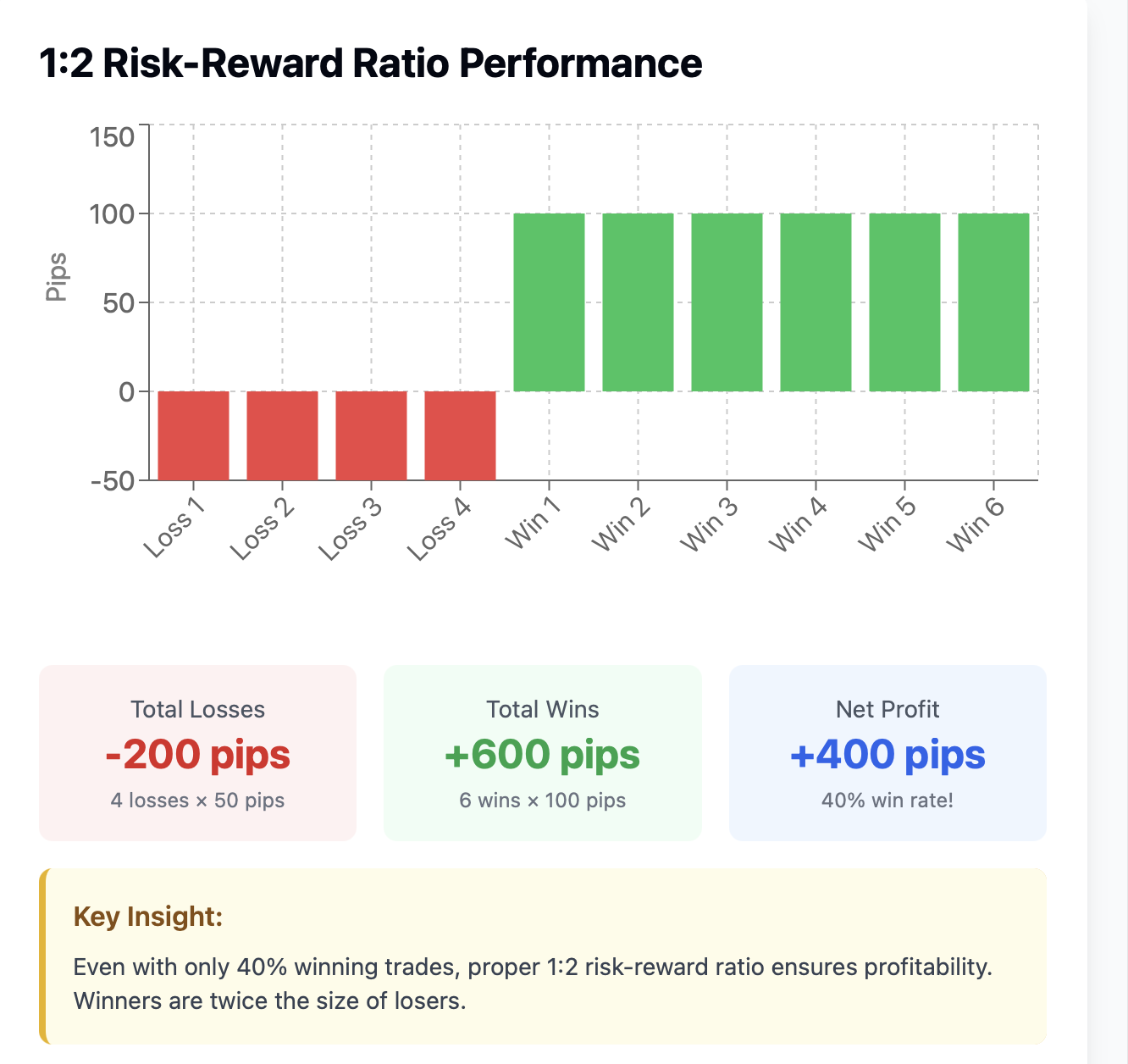
A positive risk-reward ratio (RRR) is paramount to being able to be profitable in your trading. Most professional traders are looking for at least a 1:2 RRR, meaning they are looking to risk 1 dollar to earn 2 dollars.
Formula: If your stop-loss is 50 pips away from your trade entry, then your put option target should be at a minimum of 100 pips away (which is a 1:2 RRR) or you could target 150 pips away (1:3 RRR).
Why does this matter? Because if you win only 40% of your trades, you can still be profitable, and with a risk-reward ratio of 1:2 you will factor in your profits vs the losses:
4 losses of 50 pips on each trade = -200 pips
6 trading opportunities won at 100 pips on each trade = +600 pips
Net = +400 pips
Volatility (ATR)
Average True Range (ATR) is a measure of how much you would expect a currency pair to move on average in a given timeframe. It is your reality check.
If, for instance, you were to see that the EUR/USD has an ATR of 70 pips per day, then your target of 200 pips for the day is completely unreasonable, simply because this pair is just not going to move that much on average in a given day timeframe.
High Volatility = Larger targets possible, Low Volatility = smaller targets more reasonable
Volatility tends to increase during significant news events (the Fed announcements, NFP report). This is when you would be able to justify larger targets on put options. However, in a quiet summer trading period, you would scale your targets downward.
Use Partial Profit-Taking
It's not always the first target or nothing. After reaching your first profit target, take some profits, and allow the rest to ride via a trailing stop.
For example, you buy a put option that has a target for a total of 100-pips lower. When you are up 50 pips, close half your position. This allows you to bank some profits when the market goes your way, and it relieves stress knowing you already have profits in the bank.
If the market continues to go your way and declines, you gain from the remaining position, closing your full decline target. If the market goes your way and then reverses, no problem- you have already banked some profit and all you had to do was close half of your position at or near your first target.
Conflate with Fundamental Analysis
Your technical analysis tells you where the price moves, and your fundamentals analysis tells you why the price should move there.
Before significant economic announcements (rate decisions, employment reports, GDP releases), the market can undergo longer and larger price moves. When a movement is supported by fundamental analysis, you can go for a larger target on your put options. For example, the Fed indicates it may cut rates.
Normally, a rate cut devalues the dollar. Now, you have the target. The technical analysis indicated EUR/USD now has support at 1.0900, but the fundamental picture shows it could fall to 1.0850. Time to push that first target lower!
The Formula for Success
The best put option targets are a combination of:
-
Technical levels (support, indicators)
-
Risk-reward ratios (minimum 1:2)
-
Market volatility (ATR)
-
Fundamental backdrop (news, economic trends)
-
Your trading style (day, swing, or position)
If you are missing any of these elements, you're guessing instead of trading purposefully.
Common Mistakes That Kill Put Option Trades
Even seasoned traders fall into these mistakes, and recognising them is the first step to avoiding making the mistake again.
Mistake 1: Targets Too Greedy.
The mistake: You put option targets way beyond the reality of what the market will return in your frame.
Professional example: A trader puts a target on a EUR/USD put option (that is being offered as 3000:1 and a put option, based on market price action) of 500 pips, while the currency is moving a daily average of 70 pips. Unless the trader is holding for the short or for weeks and a historical crisis-level event occurs, this type of target isn't even close to reality.
Simple: You have a monthly budget of $200 and have plans to save $5,000 in one month. The math doesn't add up.
The fix: Check historical volatility, ATR, regular timeframes, and charting, etc. Your target put option should be aligned with the price action expected for your time frame.
Mistake 2: Targets Too Conservative
Mistake 3: Failing to Use Stop-Losses
The issue: You have a target in mind for profit, but not where you're going to exit if you're wrong.
A put option target without a stop-loss is like driving with an accelerator but no brakes. You can get where you’re going, but you're going to crash.
The solution: Always set a stop-loss prior to entering the trade. No exceptions. Ever.
Mistake 4: Ignoring High-Impact Economic News
The issue: You have set put option targets but haven't checked the economic calendar.
Normal volatility is shot to bits with Non-Farm Payroll releases, Fed announcements, or a surprise geopolitical news event. Your 50-pip target could evaporate in seconds, or the market could whipsaw you violently.
Professional example: A trader sets a fairly conservative 30-pip target for a put option right before NFP. The report indicates soft job growth, and the USD plummets 150 pips within minutes. The put option target was instantly executed, and the trader now smells profits, but loses out on 120 pips of extra profit, because they failed to make any adjustments based on market conditions.
The solution: Before establishing targets, check the economic calendar. Major news days actually require unique strategies; options will need to have wider targets to take advantage of volatility, or avoid trading altogether until the dust settles.
The Pattern
Do you see a commonality? All of the mistakes came from avoiding the reality of the market for your reality of what you would like to have happened. Good trade practice understands the difference between what the market can offer versus what it needs to offer to pay your bills or prove you are smart.
Real-World Put Option Case Studies
Theory doesn't mean much without practice. Let's take a look at how put options actually can work in practice of trading.
Case 1: Professional trader of EUR/USD
Background: A swing trader of EUR/USD selects put options first by daily reading with overall considerations for risk management and common notice of variations in risk profile.
Setup:
-
Entry: Buy put options as EUR/USD displays bearish signals
-
Stop-loss: 50 pips
-
Target: 100 pips with a (1:2 RRR)
-
Position sizing: 0.5% of account per trade.
Results over 5 trades:
-
Trade 1: Loss (-50 pips)
-
Trade 2: Win (+100 pips)
-
Trade 3: Loss (-50 pips)
-
Trade 4: Loss (-50 pips)
-
Trade 5: Win (+100 pips)
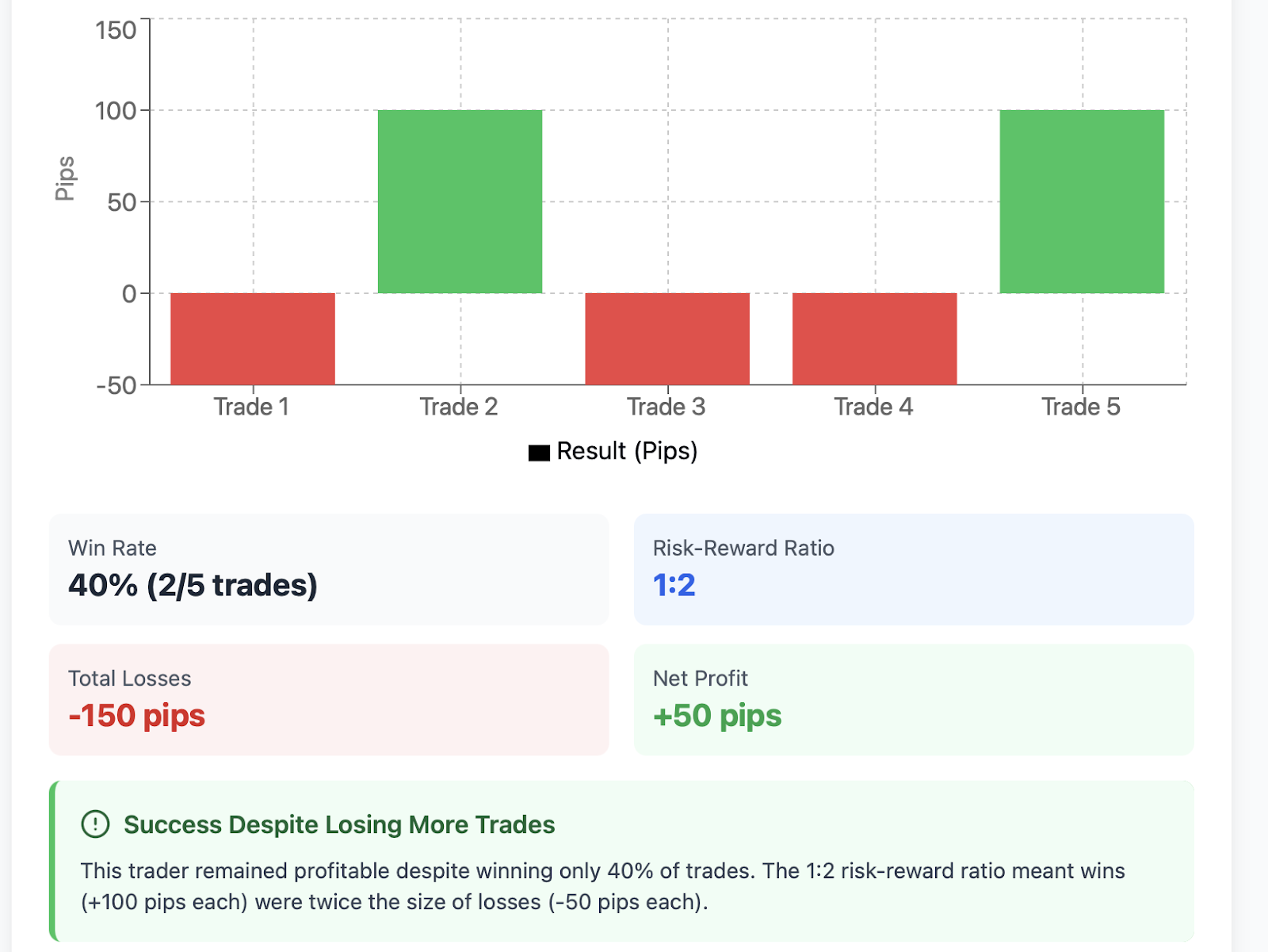
Total: +50 pips profit despite winning only 40% of trades
This is the power of proper risk-reward ratios. Losing most trades didn't prevent profitability because the wins were twice the size of the losses.
Case 2: Gold CFD Trader
Setup:
-
Gold trading at 1950
-
Technical analysis shows resistance at 1970, support at 1930
-
Buy put option at 1950
-
Stop-loss at 1970 (20 points risk)
-
Target at 1930 (20 points reward)
-
RRR: 1:1 (not ideal, but acceptable for high-probability setups)
Outcome: Within two days, gold values decreased to 1930, exactly hitting the target. A 20-point move on a standard gold CFD contract, yielded decent profits in relation to the risk taken.
The key takeaway: The trade would have worked even with a 1:1 RRR because it was a high-probability technical setup. Sometimes smaller rewards with trades you are very confident in, is better than aiming for bigger targets without being as confident.
Case 3: The Textbook Example
Now, let’s bring this into reality and use a non-trading example to illustrate the same concept.
Scenario A (More realistic): You would like to sell used textbooks three times per week. Each time you sell a textbook you need to take 30 minutes to list, photograph and ship the book. You can do this three times while balancing school and classwork. If you were to sell three a week at a profit of $10 per book you can earn $30 per week, or $120 a month.
Scenario B (Less realistic): You would like to sell ten textbooks each day while taking a full course load of classes. This would be a full-time job on top of attending class, doing homework, sleeping and eating enough. In reality, this is impossible, as you would either burn out when you get behind in your classes.
The principle also applies to put options. Scenario A is a trader who has realistic targets based on available market movement, while scenario B is a trader who does not factor in constraints and gives themselves a fantasy target.
Case 4: The NFP Volatility Play
Background: Non-Farm Payroll (NFP) reports are released every month and generally cause at least a 100-200 pip move in major Forex pairs.
The Set Up:
-
NFP report released Friday at 8:30 am EST.
-
EUR/USD is trading at 1.1000
-
The trader expects the US jobs data to be bad and weaken the USD.
-
Normal daily movement is around 70 pips.
-
Expected movement based on NFP is over 150 pips.
Strategy: Buy put options with a target of 1.0850 (150 pip target), but place a stop on the trade at 1.1075 for a 75 pip loss. A 1:2 risk/reward ratio that will allow for explosive volatility.
Outcome: NFP data reports much lower than expected job growth. EUR/USD spikes down to 1.0820 within 30 minutes of the report and blows by the target of 1.0850. The trader captures 160 pips, leaving the trade at 1.0840.
Key Lesson: Large events that impact the market justify larger profit targets for trades because the situation has changed significantly. Expectation should be adjusted to better fit the event.
What These Cases Teach Us
Sustained performance beats hitting home runs: the EUR/USD trader made their money winning less than half their trades.
-
Application is important: The gold trader accepted a 1:1 risk-reward ratio because it was a high-odds setup.
-
Reality checks will save you from failing: the book example illustrates why you must align your targets with what you have at your disposal (time, market movement, #, etc.)
-
News will generate opportunity: NFP volatility provides the ability to have targets larger than normal.
Put options won't fix all of your problems, but they can be precise and powerful if you pair them to a realistic plan, disciplined execution, and the right risk management.
Putting It All Together
Put options create a defined, structured way to profit when prices are falling while limiting risk to downside exposure. However, they will not work for you if you do not engage them and formulate the plan in a structured, unemotional manner.
The principles are vital but simple:
Targets are established scientifically: Different situations will create different price targets, but you will need to determine the odds on the risk-reward ratio if you wish to get paid, while utilising technical analysis and market volatility (ATR). And before you enter any trade, you must check the economic calendar for high-event news, which is important.
Execute with discipline: I recommend pre-planning your entry, target and stop loss before entering into any type of trade will maximise your overall success. I recommend even encouraging use of automated entry and exit orders to take the emotion out of it. Keep a trading journal to look back for patterns. Remember, there is a time and place for emotion, and trader duties require you to be unemotional and disciplined to your plan to be successful long term.
Steer clear of the most common mistakes. Don't set such ambitious targets that the market can't attain them. Don't take profits that are too small to adequately compensate for any losses. Always use stop-losses. Always be mindful of major news events.
Make sure your targets are consistent with your trading style. Day traders need to target small amounts quickly, swing traders will have medium-term and technical targets, and position traders will require patience and fundamental conviction to target larger amounts.
Be aware of market psychology. The biggest hurdle is not the market; it is your own greed, fear, and cognitive biases. Systems and discipline will always prevail over raw talent.
Are you ready to trade put options while managing risk? Open your account with Tradewill today and access sophisticated option tools, real-time analytics, and risk management for serious traders. You can construct your trade strategy now at Tradewill.com.
Disclaimer: The content of the blog does not represent any position of Trade W, does not serve as any trading-related decision advice, and does not endorse any third-party.