
 Trade W

Can You Actually Make Money When Prices Fall?
Most people believe that trading is simply a matter of buying low and selling high. But what if I said you could make money if prices drop? That's where put options come in, and they just might change your opinion about trading.
A put option gives you the right (not the obligation) to sell an asset at a specified price on or before a specific date. You can think of it as buying an insurance policy, only you make money instead of pay out when things go down. Whereas a call option gives you the benefit of buying at a specific price, a put option does the opposite. It gives you the opportunity to make money in a declining market.
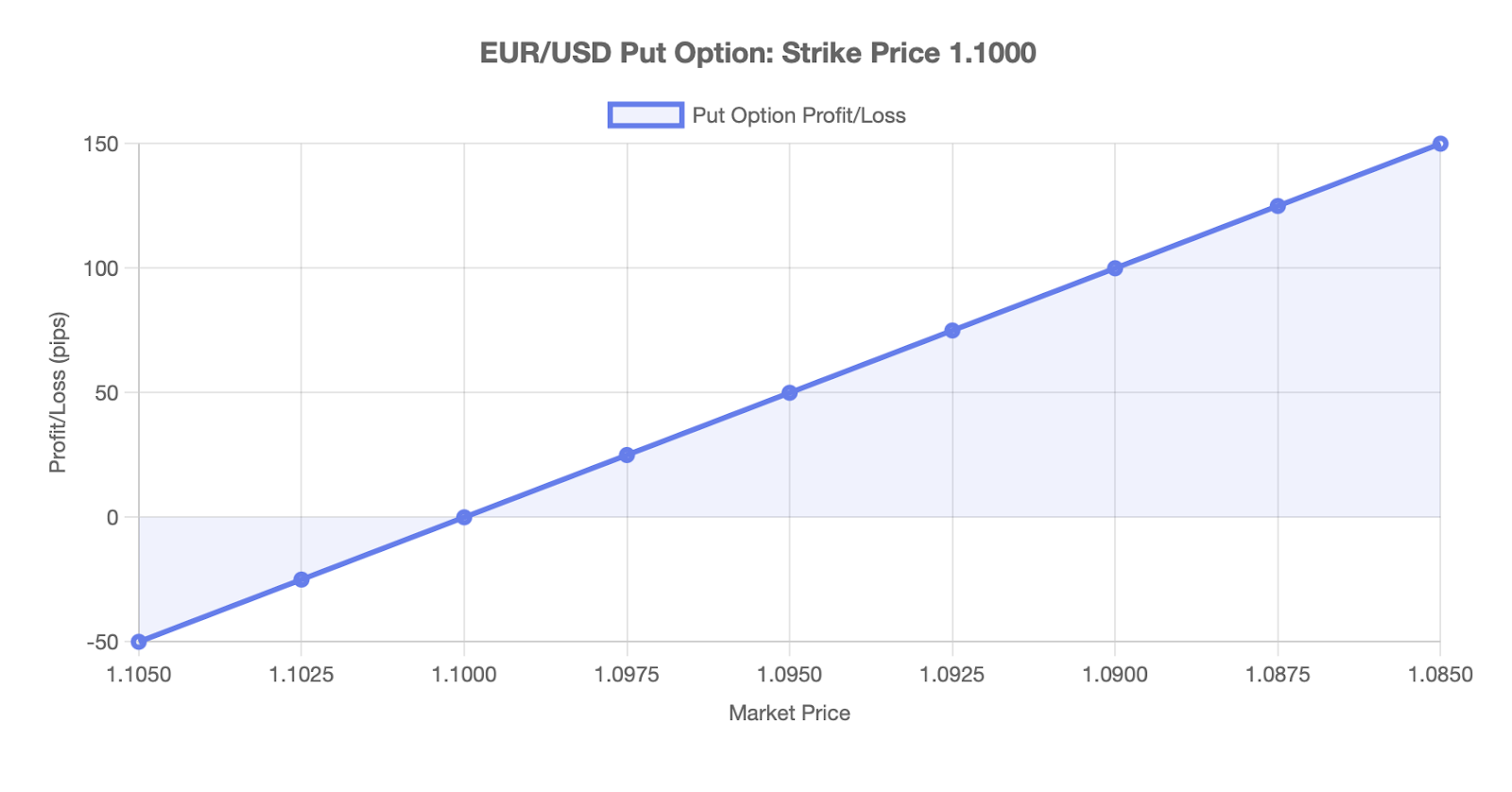
So, say you are watching EUR/USD trade at 1.1000, but you believe it is going lower. You buy a put option with a strike price of 1.1000. At expiration, the pair dropped to 1.0900. You just made 100 pips in profit. The market fell, and you won.
Xiao Ming is trying to sell a used textbook. He buys a "sell right" which guarantees him a price of $50. Even when the market price hits $40, he can sell the textbook for $50 and pocket the difference. Same idea, just a different scale.
Put options are not just a tool for speculation. They are a significant way to manage risk when you believe prices are headed lower. Whether you are hedging your portfolio or looking for a profit somewhere in a downturn, simply understanding put options gives you an advantage over most beginners.
In this article, we want to clarify everything possible about put options: what they are and how they work, how and when to use them, how to have a reasonable target price, and what mistakes can blow up a trading account. We will look at actual case studies, examine trading alternatives, and show you how to use a put option without letting emotions destroy your use of the/option.
After reading this article, you will understand how to use put options to profit from a declining price.
What Exactly Is a Put Option?
A put option gives the holder the right to sell an underlying asset at a specified price (strike price) on or before a specific date. The holder does not have to sell. They simply have the choice.
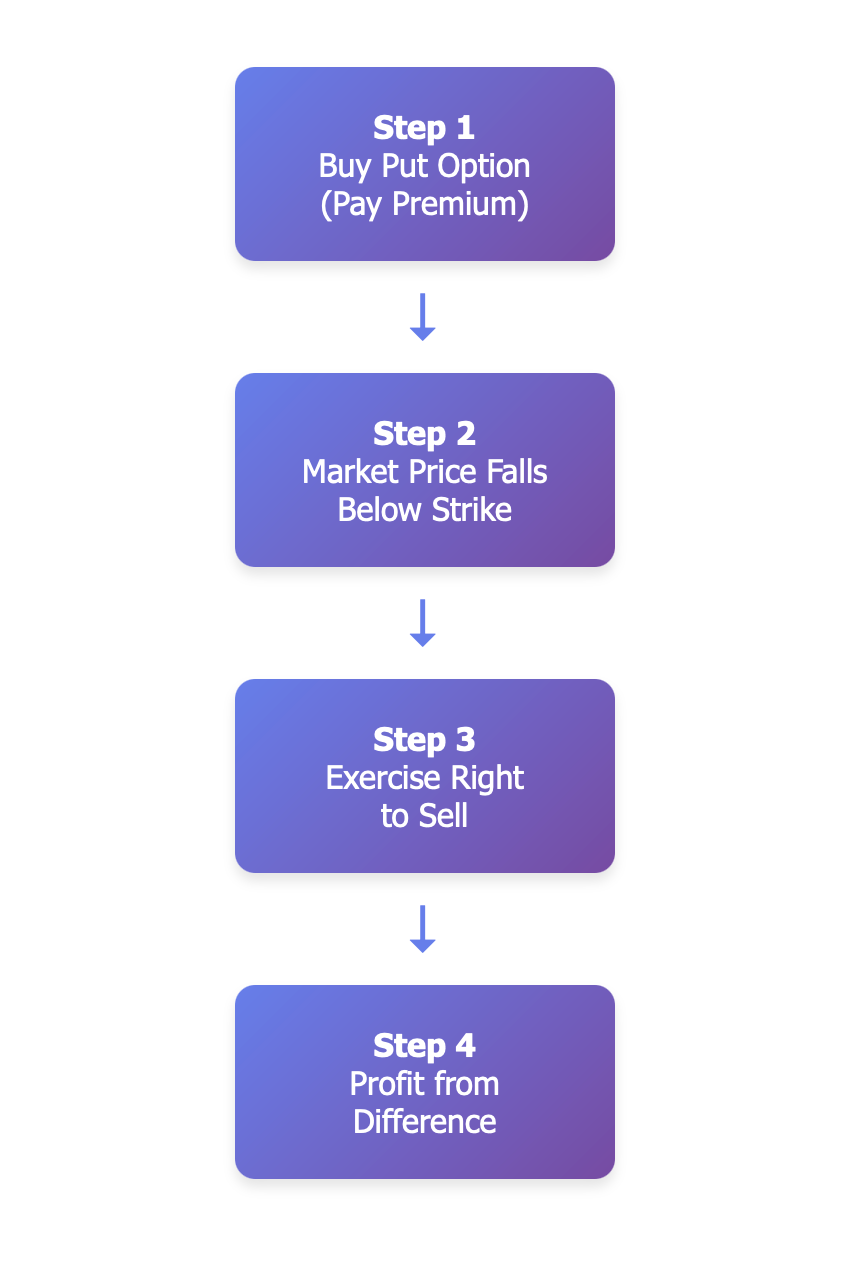
Whenever there is a put option, there are always two sides. There is a buyer (you, if you buy) and there is a seller. The buyer of a put option pays a premium that entitles the buyer to sell the underlying asset. The seller of a put option collects the premium but has the obligation to buy the asset if the buyer decides to sell.
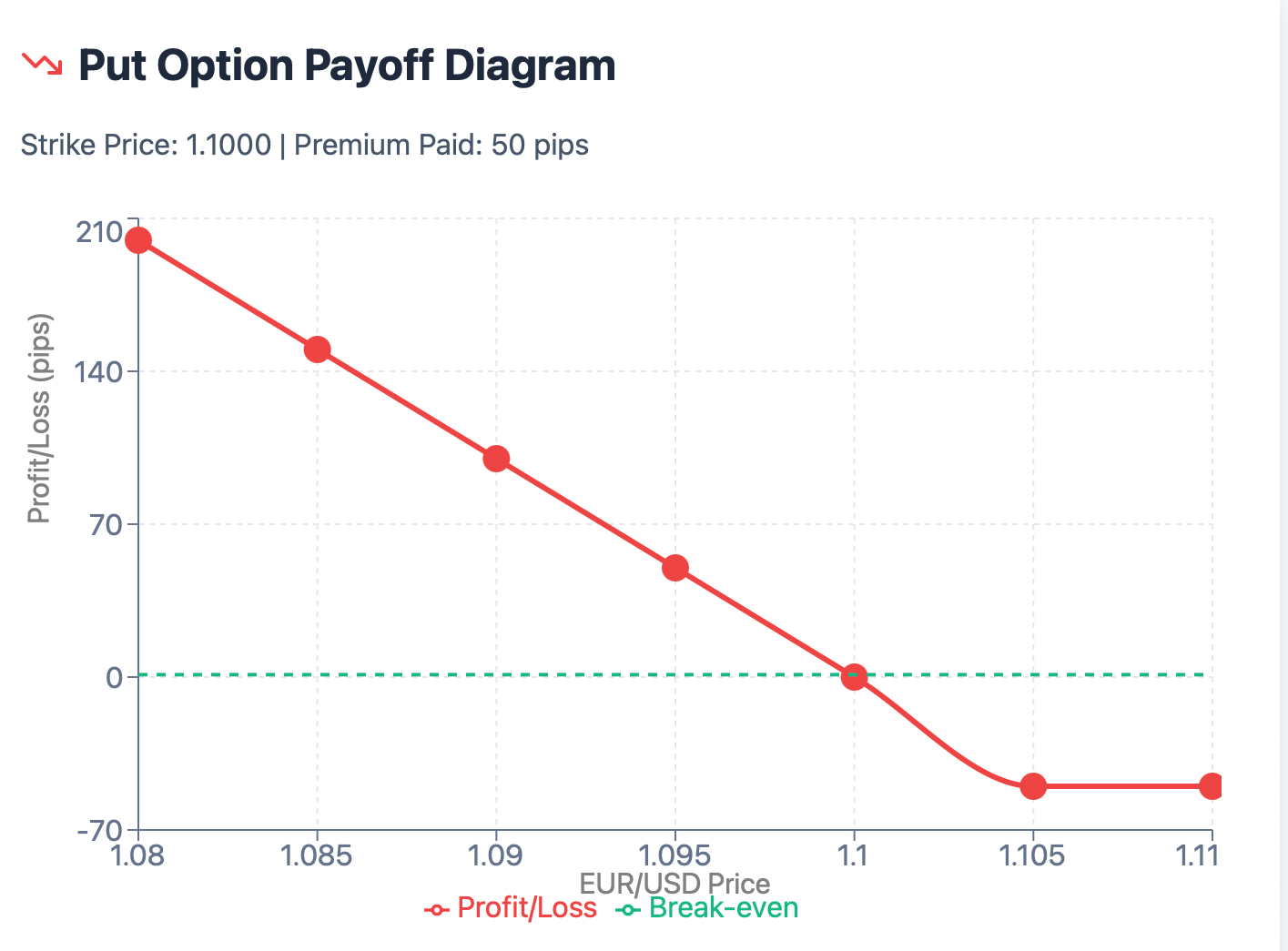
Put options can work in any market, for example, in the currency market with forex pairs like EUR/USD, in the commodity markets with a product like gold, in the stock market with equities, and in CFDs (Contract for Differences). It does not really matter what the underlying asset is, as it will all work the same.
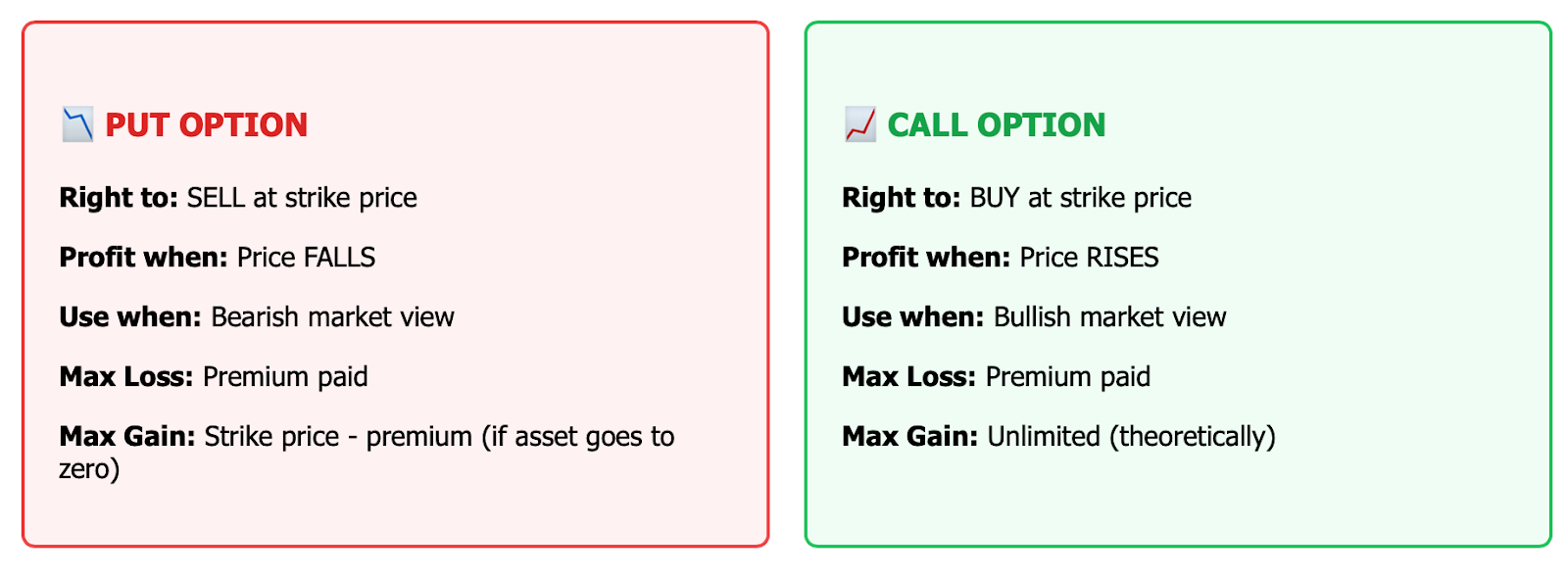
Put options are the only extreme to call options, as a call option gives the buyer the right to buy an asset at a predetermined price as well. A put option gives the buyer the right to sell.
As you can see, they are in opposite directions, with opposite payoffs. If you think that the prices will increase, you want to buy a call. If you think the price will decrease, you want to buy a put.
Here is a more professional explanation: You buy a put option on USD/JPY with a strike price of 110. By expiration, USD/JPY has now dropped to 108. You have a guaranteed profit of 2 points per unit, which you can multiply by your contract size, and you've made guaranteed money while the market is strongly bearish.
Xiao Ming has a ticket to a concert. He purchases a "sell guarantee" that allows him to sell his ticket for 100 CNY, even though scalpers are only offering 70 CNY. On the open market, the price drops to 70 CNY, and Xiao Ming decides to exercise his right and sell the ticket for 100 CNY. He has been protected.
Every put option has four basic features:
-
Strike Price: The price at which you can sell the asset
-
Expiration Date: The date the right can be exercised
-
Premium: The amount paid upfront for the option
-
Intrinsic Value: The amount the option is worth right now based on the underlying price
Risk and reward are not equal. As a buyer, your risk of loss is only your premium. That's it. Your profit will keep increasing as the price of the underlying asset drops. The risk to the seller, however, is significantly increased because the seller must buy the asset for the strike price regardless of how low the underlying asset drops in the market.
You can benefit from falling prices while having your downside opportunity capped to the premium amount. You are not shorting the market. You are purchasing the right to sell, which grants you control without giving you unlimited exposure.
To put it differently, the market can only fall so far before it goes to zero (which is very rare). Even if it does not fall to the point of zero, as long as the put option is priced right, you can still make a good return. You are essentially betting in a certain direction while having a cushion.
Put options have been around forever. They have been in the financial markets for hundreds of years, and they are here to stay. They are an established method of managing risk and capturing profits when the market goes down.
The History of Put Options
Put options were not discovered. They have been in the financial markets for hundreds of years as well, and they have evolved from a crude agreement to being the exact instrument that we have today.
The story begins in 17th century Holland and pertains to the tulip mania. Traders found themselves in need of ways to lock in the price to hedge against market swings and created early options contracts, not formalized put options, but the principle existed to sell at a predetermined price.
In the 18th & 19th centuries, options trading as a concept was then transported into stock and commodity markets. Farmers used them for grain prices. Stock traders used them as a hedge in a stock portfolio. The mechanics were further refined, but the basis of the business concept remained.
The big change occurred with the introduction to electronic platforms. In the late 20th century, as the paper tickets and manual order books gave way to electronic platforms, options became standardized, automated, and ultimately available to even retail traders. You no longer had to physically be at a trading desk on the floor in Chicago or New York to execute a put option from your computer on your couch.
Stock options became a popular hedge for portfolio risk, likewise in the Forex market, which led to tools to hedge against currency market volatility. Options were adopted in CFDs and derivative markets on short-term trades to capture price movement without holding the underlying asset.
In the present times, algorithmic trading and smart order routing have made put options as brisk and efficient as possible. You can establish a trade, apply automatic stop-loss and take-profit levels, and let the algorithm execute the trade without any human involvement.
Put options are not a modern-day gimmick. They have been tried-and-true for hundreds of years, and across all kinds of markets. In the case of tulip bulbs, or even in currency pairs, it is the same principle: securing the right to sell and profiting when the price drops.
How will Put Options Fit into Different Trading Styles
Not every trader will trade put options in the same manner. Your method will depend on the length of time you are holding positions, and what kind of price movements you are expecting.
Day Trading with Put Options
Day traders want to capture small and rapidly occurring price movements. They will open and close a position over a few hours (or even minutes). In this case, a put option is simply to profit on brief drops in value.
If the EUR/USD pair is moving around 50 pips range in a day, you may find a technical set-up that indicates a drop of 20 pips. You buy a put option with an immediate target, then exit the position. You are not looking for an enormous crash. You are simply trying to scalp on the downside.
For someone who's just starting to learn this process, imagine that Xiao Ming is selling his textbooks first thing in the morning. He sees a buyer who is willing to buy a textbook for 50 CNY, but he thinks that by the afternoon, he may only be able to sell the textbook for 45 CNY. He decides to lock in the price of 50 CNY noting that he has a "sell guarantee," and completes the transaction before lunch. He has a target to profit 5 CNY, and he is done.
Day trading put options requires speed, narrow spreads, and low slippage. You will not have the luxury of considering macro trends. You will be focused on reacting to intraday price action.
Swing Trading Put Options
Typically, swing traders are in positions for days or weeks at a time, and are focused on medium-term trends. A put option in this context is really about riding a technical breakdown.
Let's consider when a currency pair like the GBP/USD breaks below a key support level. The trader may buy a put option that targets a drop of 100 pips in the value of the pair, expecting the pair to drift lower over the next week. You are not glued to the screen as the day trader, but you are actively managing your trade.
Xiao Ming's version: He saves his allowance from the week, and is monitoring the price of a gadget that he wants to sell. When the price of the gadget drops he locks in a sell price, and waits until he is satisfied to exit that market. He may be targeting a profit of 10 CNY over several days.
Swing trading with put options merges technical analysis with patience. You want an identifiable setup, not random noise.
Position Trading with Put Options
Position traders think in terms of weeks or months. They're interested in macroeconomic developments, central bank policy, and shifts in longer-term market sentiment.
For example, you see that the Fed is going to be aggressive with rate hikes, and you believe EUR/USD will drop in a quarter of a year. You might buy a long-dated put option with a target of 500 pips. You aren't worried about daily fluctuations; you are simply betting that the market has a sustained move lower.
For Xiao Ming, this translates to deciding to liquidate collectibles over the next semester. He locks in a sell price in advance. He knows that if the collectibles market crashes, he's protected. His target is profit in the long term, and he is willing to wait.
It takes conviction to trade position trading with put options. You're holding onto your position while short-term noise plays out before trusting your macro analysis.
Summary Table
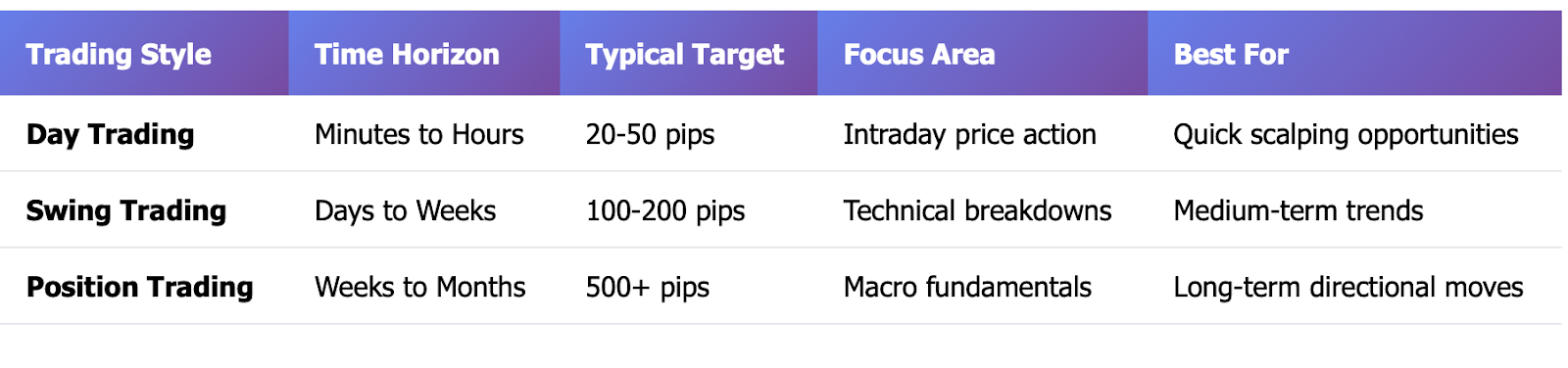
The important thing is to align your put option strategy with your trading style. Day traders want tight targets and quick execution. Position traders can afford to be patient and can use longer-dated options. If you misalign these, you'll be too early on the exit or not early enough.
The Psychology of Trading Put Options
Put options may seem simple on paper: you buy the right to sell, and if the market drops, you make money. But when you trade live, your emotions can derail even the best put option setup.
The Greed Trap
Let's say you buy a EUR/USD put option to make 100 pips. The EUR/USD comes down to 1.0900, your profit target. But you think, "it might come down more," so you stay in the trade. It then bounces back to 1.0950. You exit the position with only 50 pips and think about how you should have taken the 100 pips.
It is greed that causes you to chase that extra pip that may never happen. You accomplished your target, but convinced yourself the market owes you more.
Xiao Ming's re-version: He planned to sell a textbook for 50 CNY. The buyer offered just that amount. He waits to see if his buyer would offer the textbook for 55 CNY. When he accepts the offer, the buyer is gone and Xiao Ming is stuck with a 48 CNY sale price.
The Fear Trap
You purchase a GBP/USD put option with a target of 100 pips. The first hour sees a 60 pip drop in the pair and you are left paralyzed. What if it retraces upward? You exit prematurely, realizing a 60 pip gain. However, the trade goes an additional 80 pips down, without you.
Fear forces you to exit too soon. You begin to second-guess your own analysis, and exit the transaction before it has time to take place.
Xiao Ming's version: He planned to sell a device once the price hit 500 CNY. It dropped to 480 CNY and he freaked out, thinking it would crash to 400 CNY. So, he sold at 490 CNY, and it bounced the next day to 510 CNY.
Survivorship Bias
You see a trader on social media share about a put option profit of 300 pips, and you instantly surmise that every single trade should offer that type of return when you place trades. As a by-product, you set unrealistic expectations for pips of profit and miss out on smaller, consistent wins.
Survivorship bias gives you confirmation assumptions to disregard losers, and pay attention only to big winners. You forget that most traders will lose more than they win.
The Discipline Fix
The fix is not removing your emotions, but rather, automating your exits, to make sure your emotions do not have a vote as to whether you exit or stay in the market.
you will set your take-profit and stop-loss when you enter the trade on the automated order. By doing this it will automatically exit you from the trade. You don't have to watch every tick, only if you want to second-guess yourself while you are in the trade.
You want to keep a trading journal. You will write out your plan before you get into the trade. During your exit you will review what took place. Did you stay with your rules? If not, why? You will eventually see a trade pattern develop over time.
To outline your strategy a professional trader will buy a EUR/USD put option at the 1.1000 level, and is expecting it will reach the target price of 1.0900 and stop at the 1.1050 level. The trade hits the target and the system exits the trade. No emotions, no hesitation, no second-guessing.
The biggest enemy to trading put options is not the market. It is you. You are the one who is emotional and biased, and then cannot stay with the plan you established. If you fix you, your results will improve overnight.
How to set realistic put option targets
Setting a put option target price is not a guess. Setting your target price is based on data, structure in the market and lots of risk management to establish exactly where it makes the most sense.
Make Use of Technical Analysis
Technical analysis can provide you with levels to shoot for. These may be support or resistance zones, trendlines, or even Fibonacci retracements but they are not coincidental. They are a price level the market has reacted to before and is likely to react to again.
Let's say you saw that EUR/USD is trading at 1.1000 and it has a strong support level at 1.0950. You want to buy a put option at 1.0940 just below support. You are essentially betting that support level is going to fail and you have plenty of room for profit without the possibility of pretending you know where the price is going.
It's the same with Bollinger Bands, if the price is at the upper band, you can target the lower band with a statistical advantage that price tends to revert to the mean.
Beginner social work students may want to think of it as setting a target for your exam. You scored 70 the last time, so getting to 75 should be realistic. Targeting 95 when you have never scored above 70 is a pipe dream.
Risk-Reward Ratio (RRR)
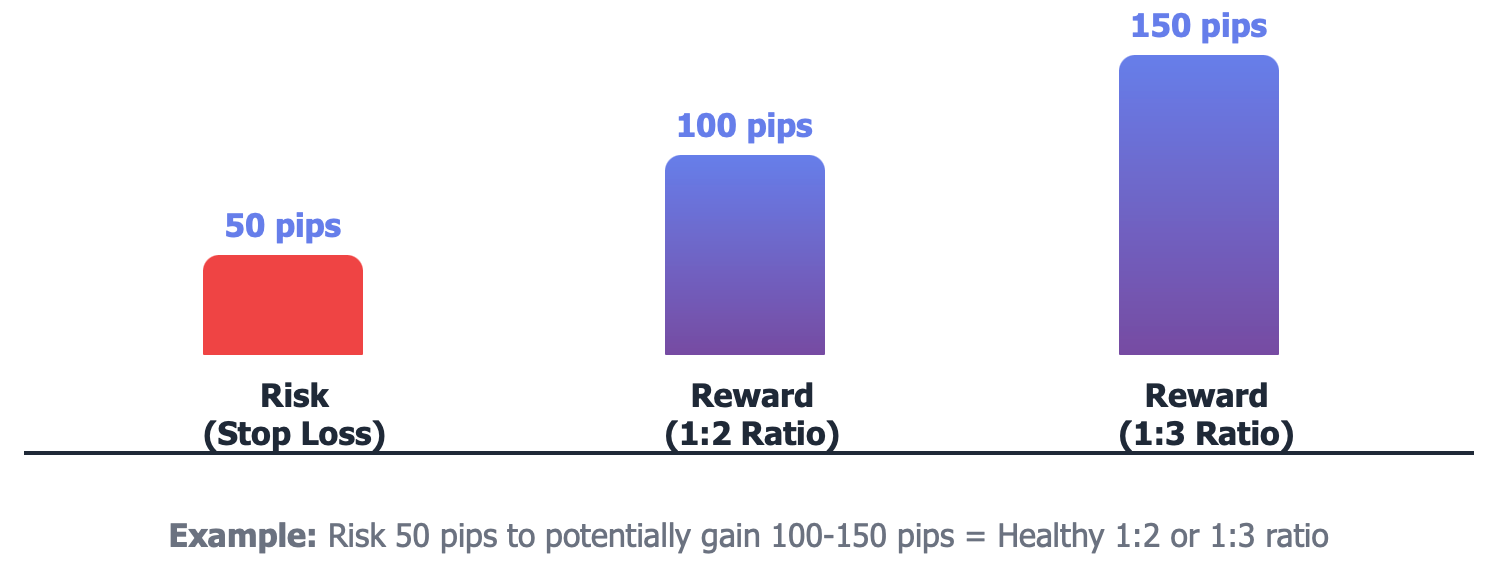
A healthy risk-reward ratio keeps you in the trading business, even when you are losing money and not winning trades. A standard risk-reward ratio is 1:2 or 1:3. If you're going to take a 50-pip stop loss, the target for the put option should be 100 pips or higher. That way you can win 2 out of 5 trades and you are still profitable.
Let's analyze it: You risk 50 pips to gain 100 pips. You lose three trades (150 pips lost) but win two trades (200 pips earned). Cumulative result: +50 pips.
If you don't have an RRR, you're just gambling. You could have 60% on your side, but if the losses are larger than your winning trades then you're going to lose money.
Average True Range (ATR)
ATR provides a measurement of how far a currency pair typically moves in a day. It is how you can measure yourself against your targets.
If EUR/USD has an ATR of 70 pips per day, you should not set your put option target at 500 pips unless you plan to be in it for weeks. However, you can make 50 pips in the day as that provides a target in normal variance.
Having high volatility = higher targets, having low volatility = lower targets. ATR is how you begin to form expectations that align with the current conditions of the market.
Partial Profit Taking Methodology
Instead of going all in or all out of a position, you can scale out of a position.
Let's say you purchase a put option with a target of 100 pips. Now when the market comes into 50 pips you sell half. You've locked in your profits but still ride the other half risk free.
A professional trader may take 50% of profits at 100 pips, then trail the rest of the position with a stop-loss. If the market continues to fall, they take additional profit. If it reverses, they have already locked in profit.
Add in Fundamental Analysis
Technical levels are helpful, but fundamentals may override technicals. If the Fed is getting ready to raise rates, EUR/USD may fall much more than the technical levels suggest.
Non-Farm Payrolls (NFP), central bank meetings, GDP announcements, etc, can send the market flying. If you are trading these events, adjust your targets accordingly. For example, a trader may buy a EUR/USD put option before hawkish comments from the Fed, setting a target of 150 pips instead of 100 pips to reflect the fundamental support for a larger move and volatility.
Conclusion
-
Technical levels: Support/resistance, Fibonacci, and Bollinger Bands
-
RRR: Risk 1 to make 2-3
-
ATR: Target the move to expected market movement
-
Scale out, taking some profits along the way
-
Fundamentals: Adjust for news events
Setting realistic put option targets is not being conservative; it is being smart. You are not limiting your profit; you are giving yourself a fighting chance to reach them.
Common Mistakes When Creating Put Option Targets
Mistakes are made even by traders who are experienced. Recognizing them earlier rather than later can help save you a lot of anguish.
Mistake 1: Targets Are Too Greedy
You buy a put on the EUR/USD, expecting 500 pips, but in past several days, the currency pair has averaged only 70 pips per day. In this instance, you are hoping for the market to reward what is a week's worth of price action, all in one day.
Greedy targets seem appealing, but usually go unmet; all you end up doing is holding through reversals as the profit slowly disappears.
Xiao Ming's scenario: Xiao Ming gets 200 CNY a month for an allowance—but decides to save 5,000 CNY. This seems unlikely; he has increased his chances of disappointment.
Mistake 2: Targets Are Too Conservative
You buy a put on GBP/USD with a target of 10 pips even though the currency pair has been averaging 80 pips a day. You are taking too small a profit to even take into account the commissions and spread.
Conservative targets seem safe; however, they do not cost as much to trade. You are going to need to win a several trades to make up for a loss.
Mistake 4: No Stop Loss
You set a put option target without a stop loss. What is the point? A target without a stop is like driving a car without brakes. You are left open to unlimited risk.
A trade should have both. A target to lock in profit and a stop to limit your loss. Without both, you are gambling.
Mistake 5 : Not Accounting for News Events
You set a EUR/USD put option target one Blue Friday for NFP week, but your target is there without a thought of the volatility. Before your plan can come into play, the pair moves 200 pips in 10 minutes. Your target was left in the dust.
News events change all of the rules of the game. Volatility increases, spreads widen, and your anticipated target is moot. Either rewrite your plan, or stay out.
A trader set a put option target at 500 pips on the EUR/USD. The daily average movement is 70 pips. After entering a trade, the price gradually moves lower, the trader's unrealized profit goes to 80 pips and reverses. The trader holds on, waiting for that 500 pip winner. The pair ultimately rallies back and the trader exits the trade, with nothing to show for the effort.
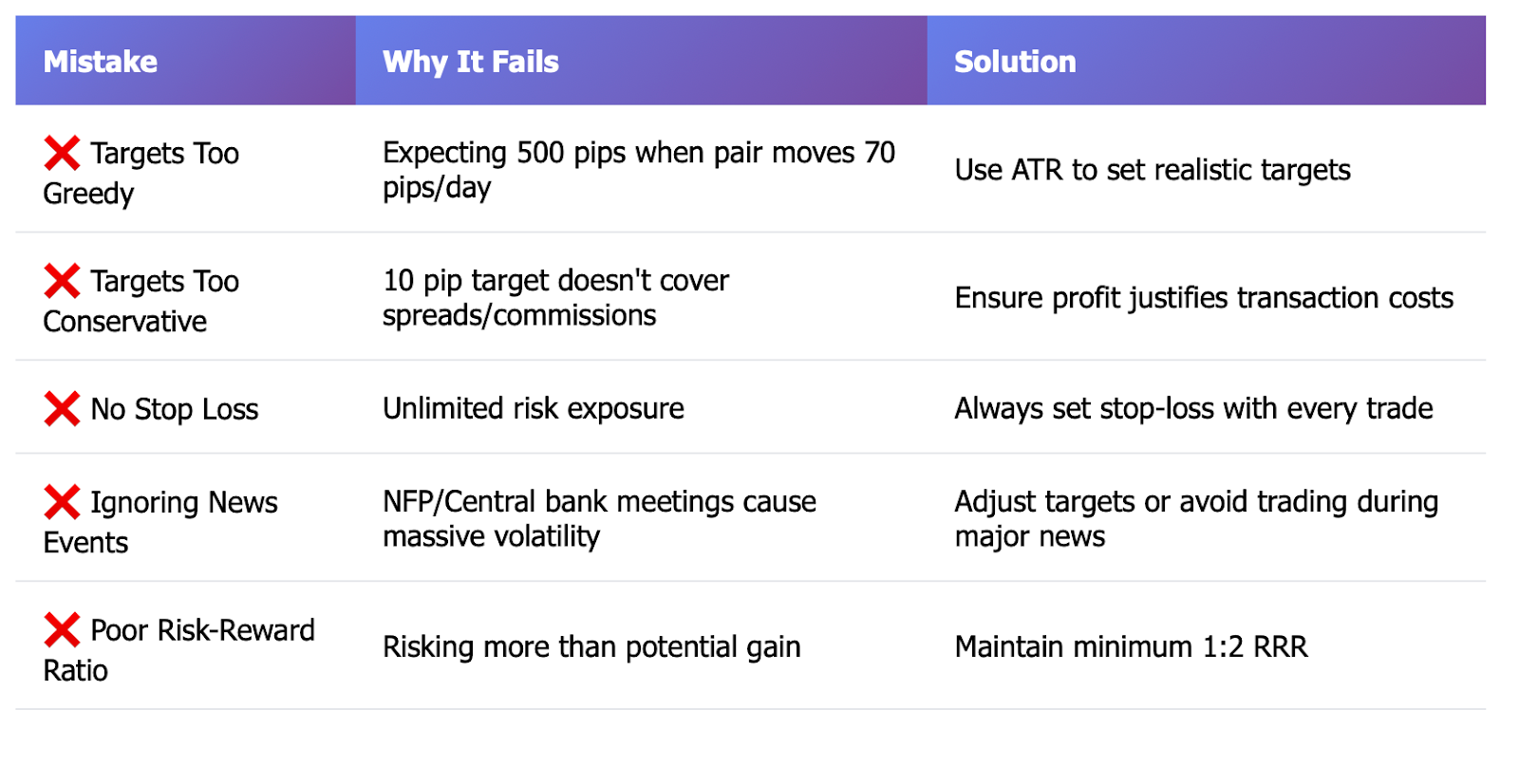
If the trader set a reasonable target of 100 pips, they would have likely banked profit and moved on with their day.
Put option targets should not based on your hypothetical and fantasy projections. It is based on logic with the use of data, market structure, and risk management, not how you feel about a target price. Leave your feelings at the door.
Real-World Put Option Case Studies
Theory is great, but let's see how this works in practice.
Case 1: Professional EUR/USD Put Option Trader
A forex trader sets up five consecutive EUR/USD put option trades:
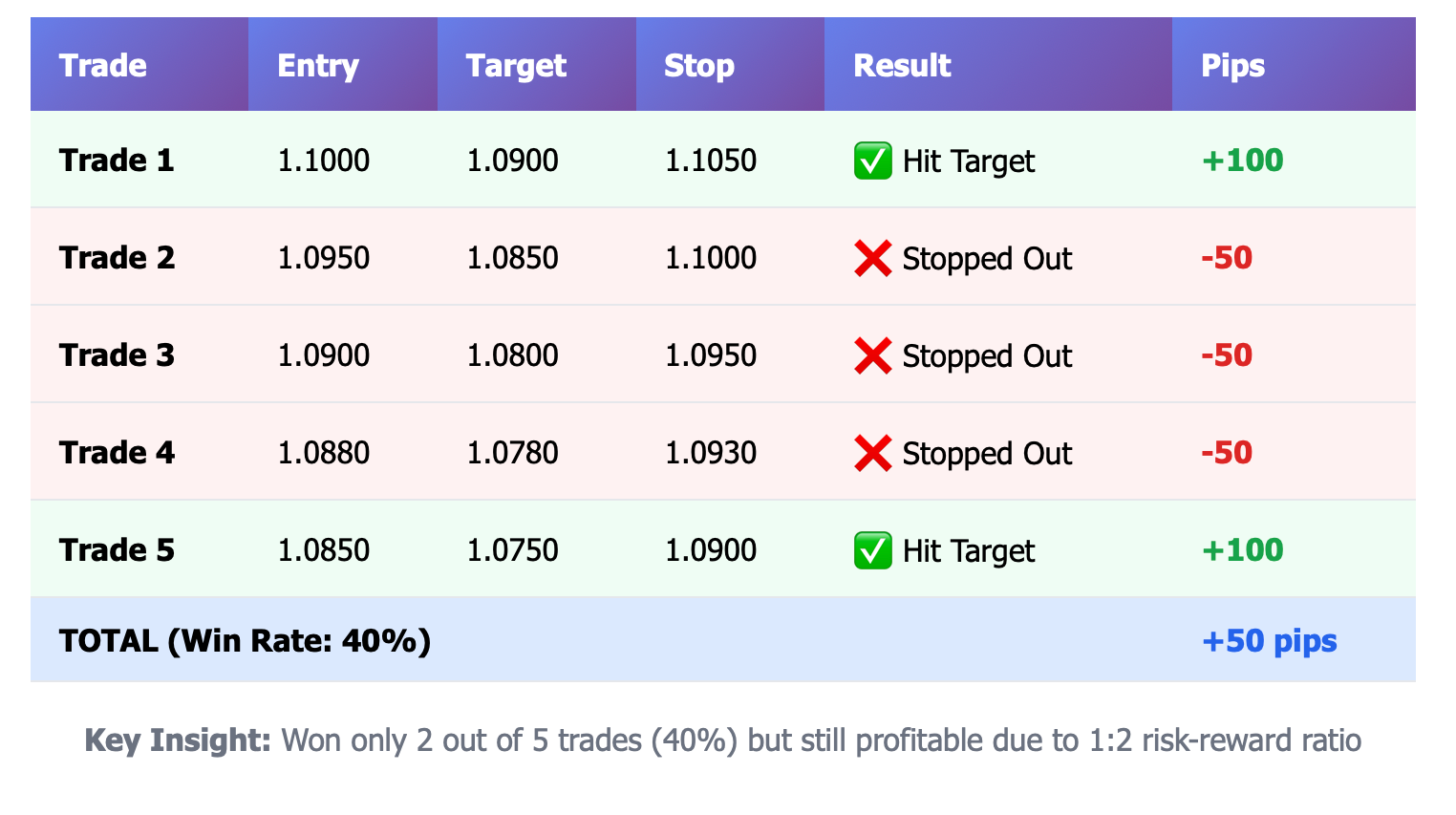
Total result: +50 pips overall (two wins, three losses).
This trader won only 40% of trades but still made money. Why? Risk-reward ratio. Each win delivered 100 pips. Each loss cost 50 pips. The math worked.
Case 2: CFD Gold Put Option Trade
The price of gold has reached 1,950. A trader purchases a put option with a target of 1,930, having decided to place an obligatory stop order at 1,970.
Two days later, gold trades down to 1,930. The trader captures 20 points for each contract. Simple, easy, unemotional. The trader simply hit their target and exited.
This is a case of textbook execution: clear entry, clear target, clear stop. The market behaved, and the trader adhered to their trading plan.
Case 3: Beginner’s Textbook Trading Plan
Xiao Ming decides he wants to sell 3 used textbooks per week. His plan:
-
Find 3 buyers who will pay 50 CNY per book
-
Lock in at the 50 CNY price with his “sell guarantee”
-
Exit after he has closed the deal
Is this realistic? Absolutely. He is not setting a target of selling 10 books a day. He is not going to chase 100 CNY per book. He is working in a space he can manage.
Compare this to another student who sets a target of selling 50 books a week. That is not a plan, it’s a fantasy. The first student meets his target every week. The second student gives up.
Case 4: NFP Volatility Trade
Typically, EUR/USD has a 70 point normal range of movement in a day. But, during Non-Farm Payrolls (NFP), it can more than double it with 200+ pip moves in minutes.
A trader buys a put option in anticipation of NFP and makes a plan to take off a target a full 150 pips instead of the usual 100 pips planned. The data is worse than expected, USD is strong, and EUR/USD trades down 180 pips in 20 minutes.
The position is set to automatically exit at 150 pips. Profits are locked in without second-guessing anything.
This case demonstrates why sizing targets according to volatility matters. At the same time, a normal 100 pip target would have felt too conservative and a 300 pip target would have felt too greedy. 150 pips was appropriate according to the event.
Lessons from the Cases
-
Win rate isn't as important as RRR: In the case of the EUR/USD trading, the trader's win rate was at 40%, but still returned profits.
-
Plans are better than guess work: In the case of the gold futures trader, the trader had a target, a stop loss order, and executed cleanly.
-
Realistic is better than ambitious: In the case of Xiao Ming his realistic plan produced better profits than the unrealistic plan.
-
Adapt for volatility: The trade using the put option adapted to the NFP event and was able to catch the extra profits without second-guessing.
Put options are not just theoretical. They are a practical tool when your are able to combine discipline, logic to your execution.
Wrapping It Up: Your Put Option Game Plan
Put options are not magical. They are a tool. However, when you utilize them correctly, they provide you with an advantage in falling markets that most traders miss.
Let's recap what is important here:
Establish targets through objective means. Analyze technical levels, ratios of risk-reward, and ATR to create realistic points of exit, and do not guess. Don’t chase. Let the market tell you what it wants.
Execute the plan with discipline. If you allow your emotions to come into play, they will sabotage you without you recognizing it is occurring. Automated take-profit and stop-loss orders should be utilized. Follow your plan. Review your trades frequently to find patterns in your behavior.
Avoid the traps. Greedy targets, conservative targets, misunderstood stop-losses, news events; these are common mistakes, but they are expensive mistakes. Learn to distinguish between these traps before they cost you.
Match your style. Day traders require tight targets and efficiency in execution, swing traders need projected targets in mid-term setups, and position traders need patience and an opinion based on macro convictions. Understand who you are and trade accordingly.
Put options uniquely provide risk management with a profit opportunity. You are more than just protecting risk, you are producing profits based on the market falling . That is a powerful sentiment.
Ready to put this into action? Open your Tradewill account and test these strategies with our smart options tools. Start small, track your results, and build the discipline that separates profitable traders from everyone else.
Disclaimer: The content of the blog does not represent any position of Trade W, does not serve as any trading-related decision advice, and does not endorse any third-party.