

 Trade W
What Is Quantitative Easing Anyway?
If you've ever questioned why the currency markets shift suddenly due to a central bank announcement, quantitative easing may be at work. QE is a monetary policy instrument in which Central Banks buy long-term government bonds and other financial instruments to increase liquidity in the economy. Think of it as the central bank turning on the money spigot, but under a controlled process.
The ultimate purpose? Strengthen economic activity when other monetary items are no longer effective. Central banks utilise QE to lower interest rates, facilitate borrowing at a lower rate, and incentivise business and consumers alike to once again begin spending and investing. It's not merely about printing money for the sake of printing money! There is always a reason for every purchase.
The 2008 financial crisis comes to mind. The Federal Reserve instituted massive QE programs to support crashing markets and try to prevent a total economic collapse. Banks were frozen, credit was running dry, and the Fed needed heavier medicine than simply dropping interest rates.
To make this a little easier to visualise, picture a school's cafeteria running out of money to serve lunch. The principal stepped in and handed out extra vouchers to the students so they could still eat. Think of what central banks do in QE terms in precisely the same way they feed the entire economy, instead of simply the cafeteria.
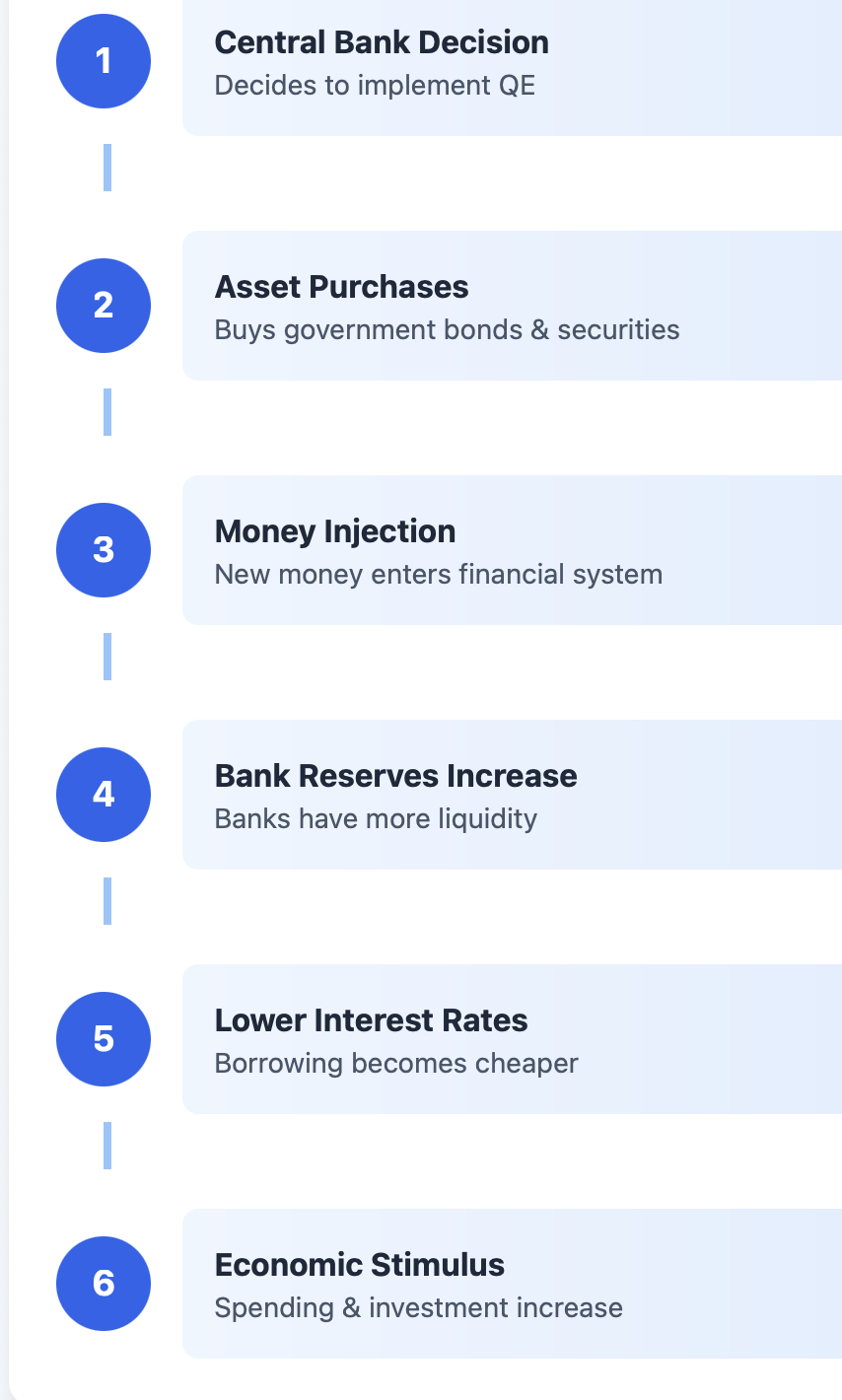
More specifically, this looks like the following: Central Bank → Purchases Assets → Expands Market Liquidity → Stimulates Economy.
Some recent examples include the U.S. Federal Reserve's QE programs starting in 2008 or the Bank of Japan's early experiments with QE in the early 2000s. Both situations demonstrate how a central bank turns to QE-type actions once it exhausts conventional policy options.
How QE Works
Let's explain the mechanics: when a central bank decides it will use QE, it begins buying assets, typically government bonds. The purchases do inject new money into the financial system. Now, banks have more reserves sitting around, and all that liquidity pushes bond yields lower. Lower yields mean lower borrowing costs for businesses and homebuyers.
When banks have large reserves of cash, they're more likely to lend it out. Credit spreads more evenly across the economy. Businesses can borrow to expand. Consumers can finance purchases. The entire economy starts to move again, at least in a theoretical sense. The European Central Bank's Quantitative Easing (QE) program of 2015 is a clear example.
The ECB purchased hundreds of billions in bonds, flooding the Eurozone with liquidity. One intended consequence of this was a depreciation of the euro against other currencies, especially against the dollar. This currency weakness helped European exportersが compete in the global market but imposed a cost for importing goods.
Think about a parent loaning their child money at no interest. Suddenly, buying a snack is far easier to do. The child can spend their disposable income much more easily because the act of borrowing carries no cost. This is the kind of behaviour central banks want the economy to exhibit.
Charts of yield curves tracking the value of bonds before and after QE capture buy-backs in dramatic fashion. You will see yields plunge when central banks hoard bonds in large amounts, which raises prices and lowers returns. For example, the euro/dollar exchange rate in more recent years, after the launch of the ECB's QE, dropped from around 1.20 to nearly par.
The intended consequence of QE is to make money abundant and cheap. High rates of return on borrowing should generate subsequent spending and investment, pulling economies out of stagnation.
QE's Impact on Forex and Global Markets
This is where it becomes really intriguing for traders. Typically, QE (quantitative easing) will weaken the domestic currency as it expands the money supply. More currency in circulation means each currency unit is worth less. When the Fed started QE1, the dollar declined substantially, while emerging market currencies strengthened as investors looked for better returns.
And the effects will extend far beyond exchange rates. Stock markets typically rally during QE as investors chase yield into riskier assets, as bonds are yielding almost zero income. Commodities such as gold may rally as investors look to hedge against inflation. Real estate markets also begin to heat up as mortgage rates decline. It’s all interconnected.
After the Fed’s first QE program, the U.S. Dollar Index collapsed while equity markets were recovering from their crisis low. The funds did not just stay in U.S. banks. The funds moved into emerging market countries, and one could see currencies such as the Brazilian real and South African rand rallying. Investment capital pursued better returns anywhere it could find them.
To visualise this, if a school hands out more coupons, over time, each coupon becomes less valuable in the playground trading economy. Kids start demanding two coupons for what used to cost one. The same can be said of a currency amidst a QE program.
Japan's history with QE exhibits similar trends. The Bank of Japan's aggressive bond-buying efforts led to a devaluation of the yen and provided a competitive edge for Japanese exporters such as Toyota and Sony. With the yen value falling, Japanese exports became more affordable to global buyers.
A cross-comparison of the three major QE programs shows the trend clearly: USD fell during the Fed's QE, the EUR fell during the ECB's QE, and the JPY fell as the Bank of Japan embraced its second round of stimulus.
The main point? QE makes waves that crash into global markets. Domestic monetary policy decisions turn into international monetary policy events where informed trades can front-run major market moves.
The Risks of QE
QE is not a panacea. Central banks realise this, even if the markets can sometimes forget. One major risk that accompanies QE is inflation. When you flood an economy with too much liquidity, prices can go up exponentially. Liquidity has to go somewhere, and if it is chasing too few goods, prices can go up on everything.
Asset bubbles are another concern of introducing QE into monetary policy. When QE discourages traditional investment via bond markets, money flows into equities and housing, creating artificial price increases that stretch beyond valuations. When QE is ongoing, the financial imbalances become larger and larger.
Japan serves as a cautionary tale. Multiple decades of QE produced gigantic government debt and only slight amounts of growth. The Bank of Japan kept on buying bonds and increased its balance sheet to levels beyond imagination, but inflation was still low, and growth continued to be weak. The diminishing returns set in with force.
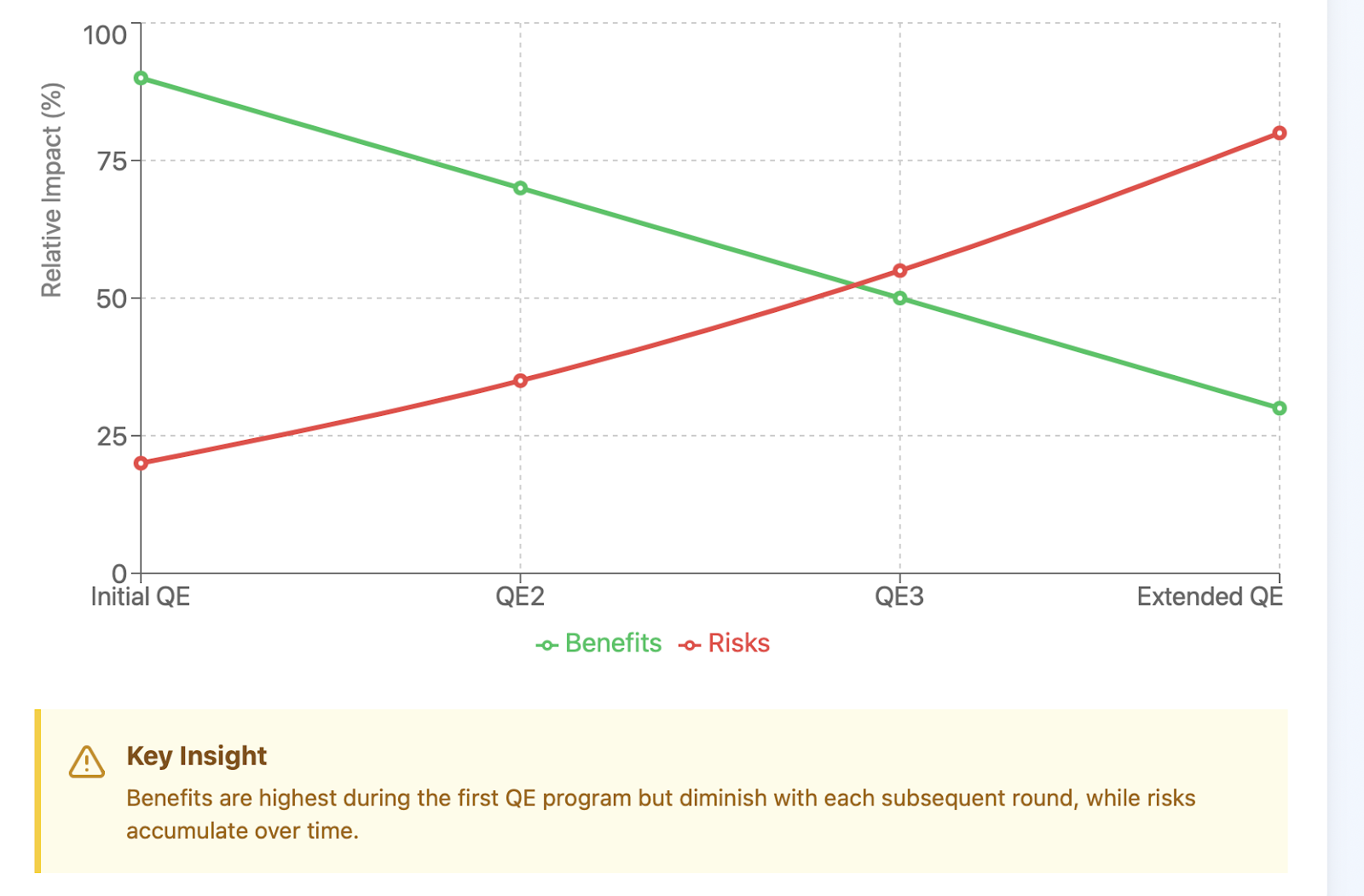
Think of a teacher granting bonus points with abandon. Eventually, students stop valuing the extra points because they become meaningless. The same thing can happen with QE. The first iteration can shock the system back to life, but then it tends to have less effect each subsequent round.
Emerging economies have an even greater risk. In countries without institutions and central banks with credibility, QE-type policies lead to hyperinflation. Venezuela and Zimbabwe both figured that out the hard way when the money printing was out of control.
A risk-benefit matrix would show a concentration of benefits at the front end (of course.) The first shock of liquidity and confidence will fade, and with it come the worries about inflation, debt levels, and manipulated price levels in assets.
QE works as an emergency short-term measure, not a permanent solution. Central banks need an exit strategy, and markets need to realise that stimulus does not last forever.
QE Versus Other Monetary Tools
So, why QE and not just a rate cut? The answer is that sometimes rates are zero. There’s no more room to cut rates, and that’s when central banks come in with QE. The traditional way monetary policy operates is by increasing and decreasing the interest rate.
For example, central banks increase rates to reduce inflation and decrease rates to encourage borrowing. This works perfectly until rates hit zero. Once you reach an effective zero lower bound, that’s when traditional policy becomes ineffective or entirely useless. QE is a way to continue engagement when cutting rates has reached its limit.
Most central banks manage liquidity on the balance sheet through open market operations, which are the buying and selling of short-term sovereign securities. QE takes open market operations and really uses it as a tool to purchase long-term bonds or other assets (like mortgage-backed securities). The size and duration of that process is drastically different.
You can see this perfectly in what the Fed did in 2008. The Federal Reserve took rates from over 5% to just below zero within a matter of months, but that wasn’t enough, so then they began QE. There’s a limit to what traditional policy can achieve, and that’s when you have to go to QE due to the limits of traditional policy.
Picture a school snack shop that consistently cuts prices as a way of wooing customers. At some point, the prices hit zero, and when the students still don’t buy, the teacher begins simply handing out free snacks. That transition represents the difference between an interest rate cut and quantitative easing (QE).
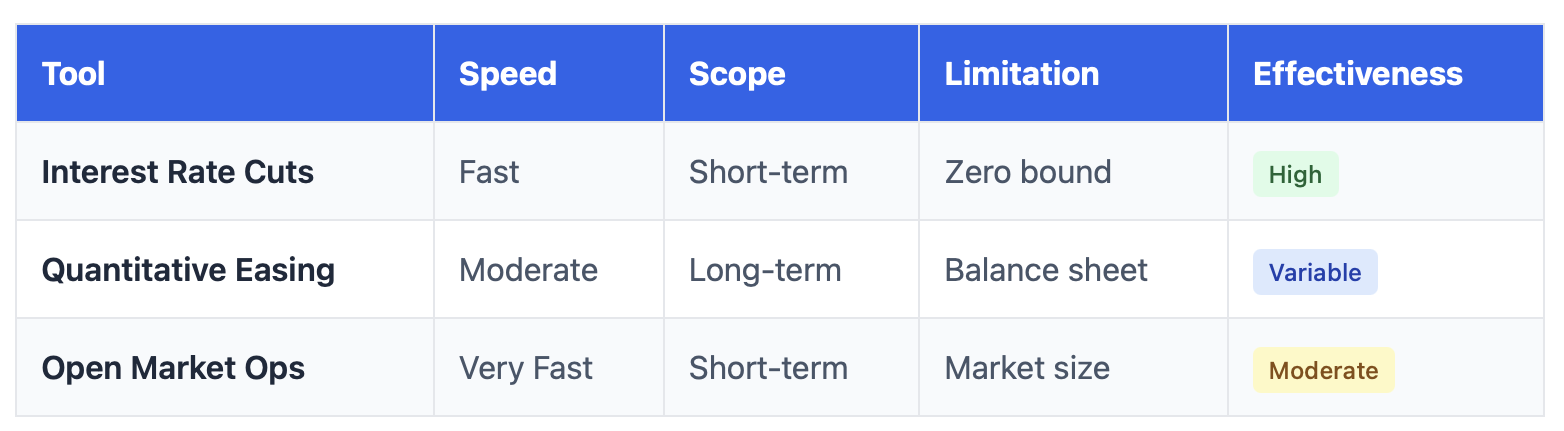
A comparison chart would show these differences:
-
Interest Rate Cuts: Effectiver for short-term borrowing costs, relatively fast acting, and limited by the zero bound;
-
QE: Longer-term rates and the mechanism of asset purchases, and limited by balance sheet size;
-
Open Market Operations: The short-term, small-scale, routine manner, of adjusting;
Central banks tend to see QE as a last resort since it's less common, and additional uncertainty of the long-term effects involved in the lack of price stability. You move to QE when there are no other options left.
Real World: The Instances of QE Programming That Impacted Markets.
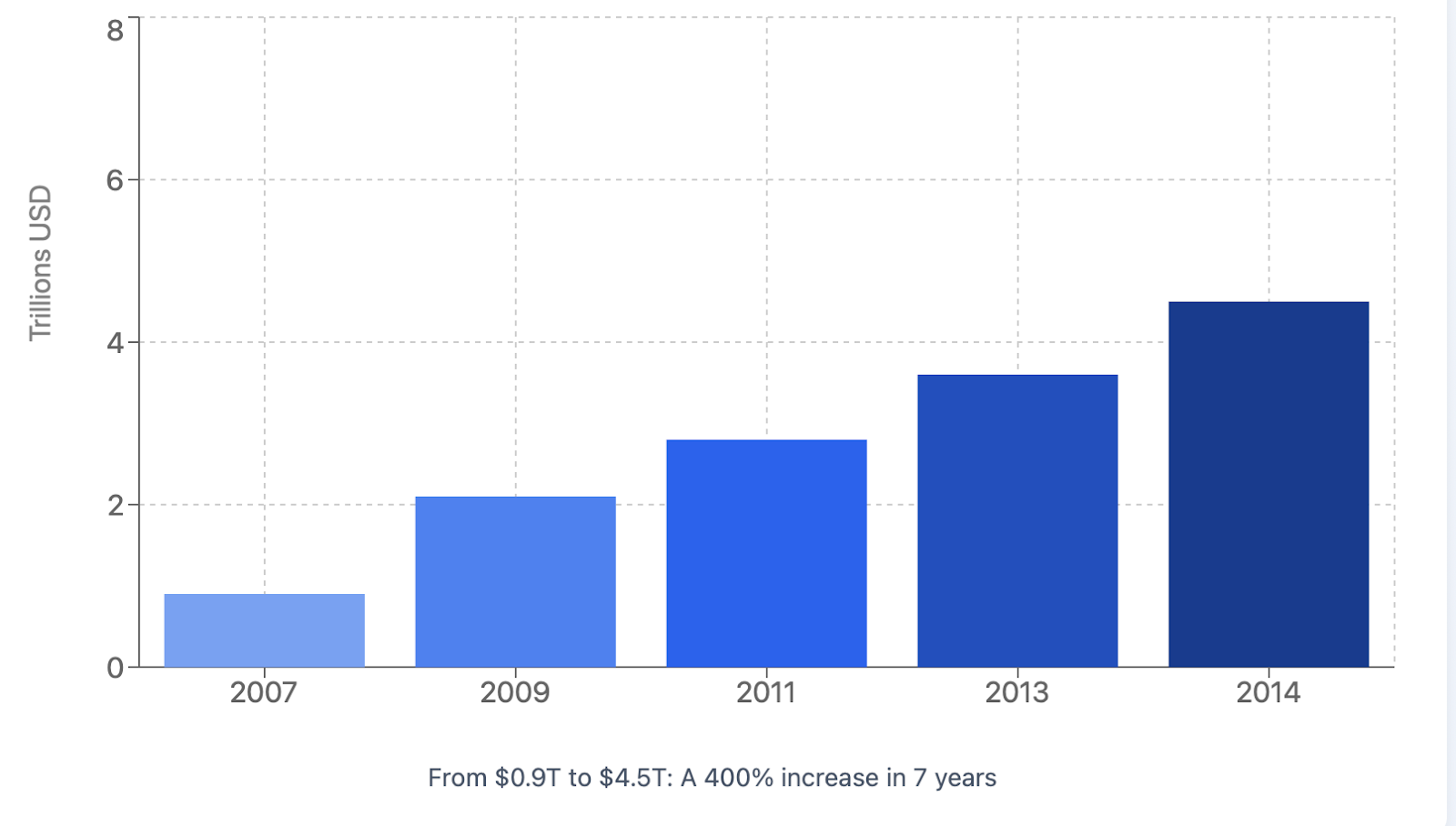
The Federal Reserve's permeability for QE began in late 2008 and ended in about 2014, starting with three rounds of promising early success. The first was focused entirely on the markets and stabilising the financial system following the crisis. The amount of discount and purchase was in mortgage-backed securities (MBS) and treasuries. In the first round of QE, the entire ledger increased from less than $900 b to approximately $2 t. The markets became very stable, the dollar weakened, and the stock markets began to recover from the lows.
The last round of QE2 arose in 2010, when the economic recovery had stalled. The Federal Reserve bought an additional $600 billion worth of Treasuries. QE3 started in 2012 and had no end date, lasting until late 2014. Despite ongoing debate and criticism, the equity markets soared. In fact, the S&P 500 index experienced a more than threefold increase between the lows of 2009 and 2014, though it should be noted that QE was not the sole contributor to this growth.
Japan's history paints a different picture. The Bank of Japan was the first to introduce QE monetary policy to help pull out of decades of deflation and stagnation back in the early 2000s. Despite years of extensive bond buying and numerous creative policy experiments, the results were mixed. Growth remained weak, inflation barely budged, and they became saddled with an over 250% debt-to-GDP ratio.
Finally, the European Central Bank (ECB) joined the QE game in 2015 and also introduced a program that ultimately approached €2.6 trillion in asset purchases. The aim was to prevent deflation and support a weak economy in the Eurozone. The euro fell like a brick, and Eurozone markets recovered, but critics asserted that QE supported asset owners more than the wider community.
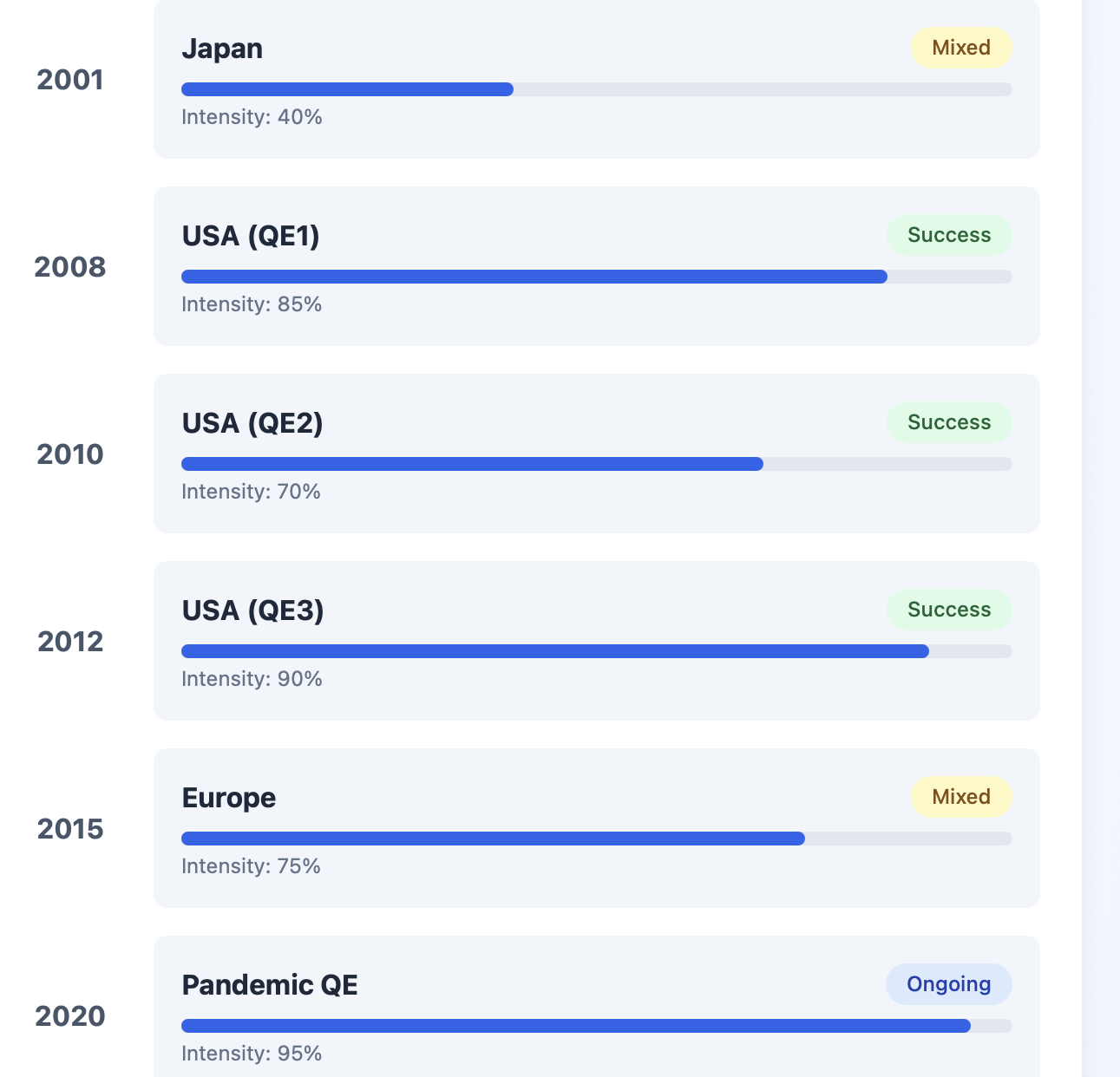
Consider a soccer team receiving additional water bottles mid-game as they are running around. The U.S. team (Fed) utilised them and surged back well. Japan's team consumed the water but could not score. Europe's team had mixed performances as some players benefited at different levels than others.
If one built a historical timeline of global QE, it would show periods of liquidity injections: U.S. QE from 2008 to 2014, Japan's expansionary QE program beginning in 2001 but expanding rapidly from 2013, and Europe instituting QE from 2015 to 2018, with a restart in 2020 during the pandemic.
In looking at the price charts of these currencies, correlation to their QE is apparent. The USD index dropped during the active Fed's QE. The EUR/USD dropped sharply after the ECB announced kicks off their QE policy. The USD/JPY increased during Japan's QE acceleration.
Again, these are not just abstract, awkward policy choices. These became real trading opportunities for months and years, not to mention the effects on global capital flows.
What This Means for Your Trading
Now let's pull this all together. QE is a monetary policy tool the central bank utilizes that adds liquidity by purchasing long-dated assets. It lowers the costs of borrowing, stimulates economic activity, and usually results in a weaker domestic currency. It creates effects in global markets from stocks to commodities to forex pairs.
The dangers are real. If QE progresses too far, inflation can take off. Asset bubbles can develop when the money looks for a return. The effectiveness diminishes, and unwinding can be messy. This has been evident in Japan's decades-long experiments and the Fed's careful approach to unwinding its balance sheet.
For forex traders, QE announcements are considered 'big' stock market-moving events. Any time a central bank flags brand new QE or hints at tapering some existing programs, the currencies can move quickly. The dollar tends to weaken when the Fed initiates QE. The euro will decline when the ECB purchases bonds. The yen will decline when the Bank of Japan increases stimulus.
Wise traders are watching the communication from the central bank officials. Assessing the minutes from policy meetings, evaluating the comments from press conferences, and reviewing economic projections will all provide information about when something is being considered. If you can position yourself ahead of the announcements, you can front-run significant moves.
This is like a day at school when you know it is free snack day. If you know the school is going to do a free snack for a class of kids tomorrow, you can plan the strategy today. Use the same thought approach to QE.
Historical examples demonstrate that these economic reactions persist. Fed QE announcements, espousing 'new' QE programs in many instances, created trading opportunities in USD pairs. The ECB's QE created a framework for EUR volatility. Knowing these economic pieces improves your ability to read and react to market effects.
What are we trying to convey? QE is not an unknown wizardry. It's a policy tool with predictable value effects and behavioural market responses. If you can recognise these patterns, you will have more confident trades when a central bank acts.
Are you ready to profit from central bank policy? Start paying attention to the QE announcements and fashion your forex strategy around the world's most powerful market influencers.
Disclaimer: The content of the blog does not represent any position of Trade W, does not serve as any trading-related decision advice, and does not endorse any third-party.