

 Trade W

Why Quantum Computing ETFs Matter in 2026
Investing in quantum computing is no longer just science fiction; it has become one of the largest emerging industries of our generation, and 2026 is shaping up to be an important year for investors considering the quantum computing industry.
Individual stocks in quantum computing that are publicly traded can be very unpredictable and high-risk investments; therefore, purchasing an ETF that invests in a basket of stocks in the quantum computing industry offers greater diversification opportunities than investing in only one specific company, like "putting all your eggs into one basket".
To illustrate this point, by purchasing an ETF focused on quantum computing, you are gaining exposure to many next-generation technology companies that are working in the quantum computing industry simultaneously. Because there are numerous applications for quantum computing across many different industries, it makes sense to invest in an ETF as opposed to individual public companies involved in developing quantum technology.
The three largest ETFs in this space are QTUM (the Defiance Quantum ETF), WQTM (the WisdomTree Quantum Computing ETF), and VanEck Quantum ETF; they invest in similar companies but utilise different strategies for gaining exposure to the rapidly growing quantum computing industry.
Investors in these ETFs should understand how each ETF operates and how each manager selects individual stocks to manage to gauge the potential for sustained growth compared to more significant fluctuations in value.
Investors are taking notice of how institutional investment is quickly moving into the quantum computing space, as nearly every large pension fund and hedge fund now has large allocations to quantum-computing-related ETFs. At the retail investor level, as evidenced by a dramatic increase in Google searches for "top quantum-computing ETFs", a hundred per cent increase in search activity occurred over the past six months.
Globally, investment into quantum computing has increased from approximately $2 billion in 2020 to over $15 billion in 2026; moreover, this trend does not appear to be slowing down. Additionally, the battle for the title of world leader in quantum computing development is being won by a plethora of newly established companies, along with several of the largest technology companies in the world, such as IBM, Microsoft, and Amazon, that are aggressively funding their respective quantum research and development initiatives.
Consequently, quantum computing ETFs represent one of the most highly attractive investment opportunities available to new investors who are trying to find ways to allocate their capital to technology, as well as to experienced investors who are already invested in ETFs.
Quantum ETF Portfolio Structure: QTUM vs. WQTM vs. VanEck
All 3 ETFs take different approaches to gaining exposure to quantum computing (QC), with QTUM being equal-weighted and consequently with less volatility than WQTM and VanEck's stricter revenue threshold methodology.
Equal-Weighted Methodology for QTUM
QTUM is constructed using an equal-weight methodology, which means that every holding has a relatively equal allocation of the overall portfolio, despite the difference in respective market capitalisations. In essence, this is equivalent to constructing a diversified basket of stocks where no single stock can harm your overall returns. Should one company suffer, it shouldn't negatively affect the performance of the overall ETF.
Unlike the WQTM ETF and the VanEck ETF, the holdings in the QTUM ETF will be heavily weighted towards semiconductor manufacturers that build the chips that are used in actual quantum computers, rather than only including pure-plays in the quantum computing sector (e.g. IonQ). The premise of this construction approach is simple: while quantum computers may take another decade to become fully developed, their parts, semiconductor chips and supporting infrastructure, are being sold and used in other types of computing today.
High-Growth Focus of WQTM
In contrast to QTUM, WQTM is constructed to target high-growth companies with strong momentum characteristics, which means that for this ET, F, there are also more volatile (high beta) names included. As a result, WQTM has larger allocations to companies such as IonQ and Rigetti Computing. WisdomTree's methodology to select companies favours those companies based on revenue growth and momentum; therefore, WQTM will tend to experience higher volatility than QTUM, which has more stable and evenly allocated holdings than WQTM or VanEck.
Concentrated Revenue-Threshold Approach for VanEck
Finally, the VanEck Quantum ETF (VQT) employs the most restrictive construction criteria of the three ETFs (QTUM, WQTM, and VQT). In order to be included in the portfolio of the VanEck ETF, companies must generate a meaningful portion of their total revenues from commercial quantum computing activities. This construction creates a more concentrated portfolio with more direct exposure to actual quantum computing stocks rather than semiconductor or cloud computing companies.
The benefit of the VanEck ETF is that it provides a more accurate representation of possible breakthroughs in quantum computing. The drawback is that it also has the highest concentration risk; therefore, in the event that the quantum computing sector underperforms, investors holding the VanEck ETF may experience a more severe decline in value than investors holding either QTUM or WQTM, both of which provide a more broadly diversified portfolio across the technology space.
Comparing the Top Holdings
Top 5 Holdings as of Q4 2025:
QTUM has the following top five holdings: NVIDIA (8.2%), IBM (7.9%), Intel (7.5%), Alphabet (7.3%), and Microsoft (7.1%). The top five holdings in WQTM are: IonQ (12.5%), Rigetti Computing (10.8%), NVIDIA (9.2%), D-Wave Quantum (8.6%), and Honeywell (7.3%). In terms of the top five holdings in VanEck, the following: IonQ (15.2%), Rigetti Computing (13.1%), D-Wave Quantum (11.4%), Quantum Computing Inc (9.7%), and Arqit Quantum (8.9%).
QTUM's holdings of major tech companies reveal more of a dominant tech company weightage pattern. WQTM has a mix of quantum companies in the semiconductor industry, and as such, their top five detailed diversification. VanEck's only focus is on companies that traditionally develop products and/or services leveraging quantum technologies.
The same pattern is evident when looking at the sector allocation across all three ETFs; QTUM has approximately 45% of its investment in semiconductor companies; 30% of its investment in software companies; and 25% of the rest invested in pure-play quantum companies; WQTM's sector allocation is approximately 35% semiconductor companies; 25% software companies; and 40% giving interest to investments in pure-play quantum companies.
In contrast, VanEck has established a model that is primarily invested in dedicated quantum computing companies,s approximately 15% semiconductor companies and 20% software companies.
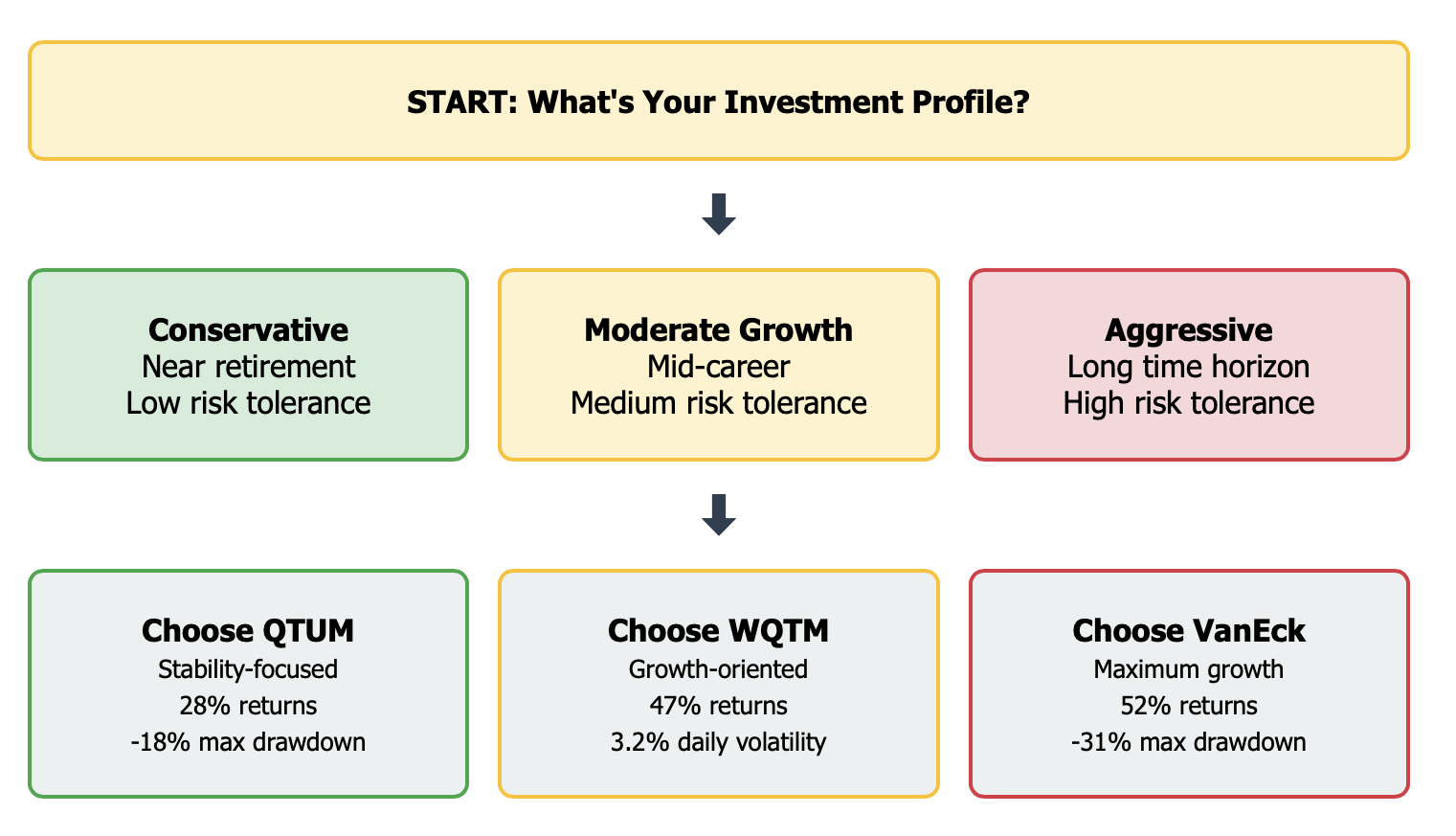
Your choice of ETF affects your risk profile depending on your investment strategy. QTUM offers stability through wide diversity. WQTM seeks to grow its returns with a moderate amount of risk. VanEck has made one concentrated investment; the ultimate success of quantum computing on the future. Therefore, your level of risk tolerance and time horizon must guide your selection.
Performance Metrics and Historical Returns
The reality of the investment landscape lies in the numbers. To illustrate this, we have charted the performance of Quantum Computing Exchange Traded Funds (ETFs) between January 2025 and January 2026. The number one performer is WQTM, which had a 47% return, followed by QTUM with 28% and VanEck with 52%. Although VanEck achieved superior performance in terms of returns, it also had a higher degree of volatility with the largest drawdown of -31% in the mid-2025 tech sell-off. In contrast, QTUM had half the maximum drawdown of only -18%.
Maximising your investment is important for all types of investors, especially professional investors who look at risk-adjusted performance versus straight performance. This is the reason behind the rationale of measuring performance with the Sharpe Ratio, which is like comparing savings account interest rates, but instead measures how much more return you get for a unit of risk you assume.
In general, the Sharpe Ratio threshold of what constitutes good is 1.0 or higher, with QTUM yielding a 1.35 Sharpe Ratio for the timeframe of 2025 through 2026. The Sharpe Ratio for WQTM is 1.18, which is decent for the volatility that it has,s and for VanEck is 1.22, which means that although there are large swings in performance,ce there are also large positive bloomed returns helping support the excessive volatility.
The differences in ETF performance come from what constitutes the underlying equities and each equity’s respective beta coefficient. The beta coefficient is the measurement of the movement of each stock relative to the market as a whole. WQTM and VanEck both represent equities, and their respective beta coefficients are in the [1.5 to 2.5 range], thus a larger swing in both directions when compared to QTUM, which holds semiconductors and has a more normalised beta of approximately 1.2.
When announcements are made for quantum computing advancements, such as when IBM announced its 1000-qubit computer in March 2026, VanEck soared 12% in one week versus QTUM’s increase of 6%, whereas in August 20,25 when tech sentiment went downriver, VanEck fell -15% in two weeks versus QTUM’s -8% decline.
The moral of this story is that if you believe quantum computing is going to be exploding and you can handle the sleepless nights due to the volatility, WQTM and VanEck would be good options for superior investment returns. If you are looking for quantum exposure without a lot of stomach ache,s you should look at QT, U, M, which has had a much smoother ride.
One final point should be made: the annualised tracking error of all ETFs is approximately 0.5%; therefore, it could be said that you will get the proper exposure you paid for, which may not be the case with alternative ETFs.
Investment Philosophy: Pure Play vs. Hybrid Exposure
When selecting from quantum computing exchange-traded funds (ETFs), demonstrating compatibility with an investment philosophy should be a consideration, as well as ultimately finding potential winners.
Pure-play quantum ETFs are focused primarily on those companies generating the majority of their revenues from developing products within the realm of quantum computing hardware, software, or service. For example, VanEck has created a pure-play ETF on the basis of this principle. When you're investing in VanEck, you are taking a direct position that IonQ, Rigetti, and D-Wave will emerge as leaders in the quantum computing space.
This analysis is similar to the discussion regarding chocolate. When you consume pure chocolate, there are very few outside elements competing for your attention; however, when you taste chocolate that has been mixed with several other elements, you still have chocolate as an element, but the flavour is diluted as a result of the other ingredients. If the technology matures, there is massive upside potential for the small quantum companies to be the next generation versions of Google or Amazon.
Purchasing a pure-play ETF can be risky, as the concentration of companies may be painful if commercialising quantum technology takes longer than projected or if one of the major players is unable to execute. A number of the companies will have minimal revenue or will barely be profitable and are therefore dependent on the enthusiasm of the investment community to support their continued operations, while building cash reserves with minimal revenue. In the event that there is a shift in market sentiment, the selloffs can be sizeable.
Hybrid ETFs, such as QTUM, provide a different approach to investing in quantum computing as they argue that quantum technology is not isolated from the semiconductor industry, cloud infrastructure, and software applications. The composition of hybrid ETFs typically includes not only pure-play quantum companies but also companies such as NVIDIA, Microsoft and IBM, thereby including all segments of the quantum ecosystem.
It could be considered in terms of mixing chocolate with other products (e.g., nuts, fruit, etc.) versus purchasing a package of pure chocolate to eat. As a result of that mixing process, you are having an experience that includes both the pure quartz and other products that were mixed with the quartz.
While this experience will not provide the same level of explosive upside potential if a small quantum company became the next Google or Amazon, it also would not have the same level of negative downside risk as when small quantum companies have minimal or no revenue.
Ultimately, ly the determination of which investment vehicle is appropriate for you will depend largely on your risk tolerance. An aggressive investor who has a long-term investment horizon, is comfortable with potentially experiencing a drawdown of 30-40% while waiting for quantum technology to mature, may prefer a pure-play ETF such as VanEck.
Alternatively, if you're a conservative investor or nearing retirement, you may find that hybrid ETFs are more appropriate based on the combination of quantum companies, semiconductor companies, and large established companies. The hybrid ETFs will have substantial growth potential, as well as reduced risk to the investor for unproven quantum companies.
There is another group of investors who I would place in the middle of the two extremes. For example, an investor might have a very small amount (e.g., 2-3% of total investment assets) in pure-play quantum ETFs to provide the possibility of substantial upside and will have an additional 3-5% invested in hybrid ETFs to provide a more stable return on his or her quantum investment.
The first question an investor should ask him/herself is whether he/she is investing in the potential for quantum computing or the reality of quantum computing. Pure-play ETFs are betting on the potential for quantum technology. Hybrid ETFs invest in the infrastructure to create quantum computing as we know it today.
The Quantum Threat to Encryption: Why Quantum ETFs Hedge Cybersecurity Risk
Many investors overlook this: Quantum computing exchange-traded funds (ETFs) serve as both a growth investment and a hedge against what will likely be one of the significant upcoming disruptions in technology.
For some time now, the cybersecurity industry has been preparing for what is now referred to as "Q-Day". Q-Day is when quantum computers will become powerful enough to break RSA encryption, which secures everything from bank transactions to classified government communications. Experts now believe that Q-Day could arrive as early as 2027-2028, although others believe it will occur in the middle of the 2030s.
The implications of Q-Day are enormous; most major banks, cloud service providers, and tech companies all rely on encryption that could be broken by quantum computers in a matter of minutes. Because of this urgency, there is an acceleration toward developing post-quantum encryption standards before Q-Day.
The relationship between quantum computing and the cybersecurity sector creates a unique investment environment. As quantum computing continues to progress, there will be an existential threat to the cybersecurity stocks of companies such as Palo Alto Networks, CrowdStrike, and Fortinet, all of which will need to retool their security models. While some of these companies will thrive in this new environment, others will struggle.
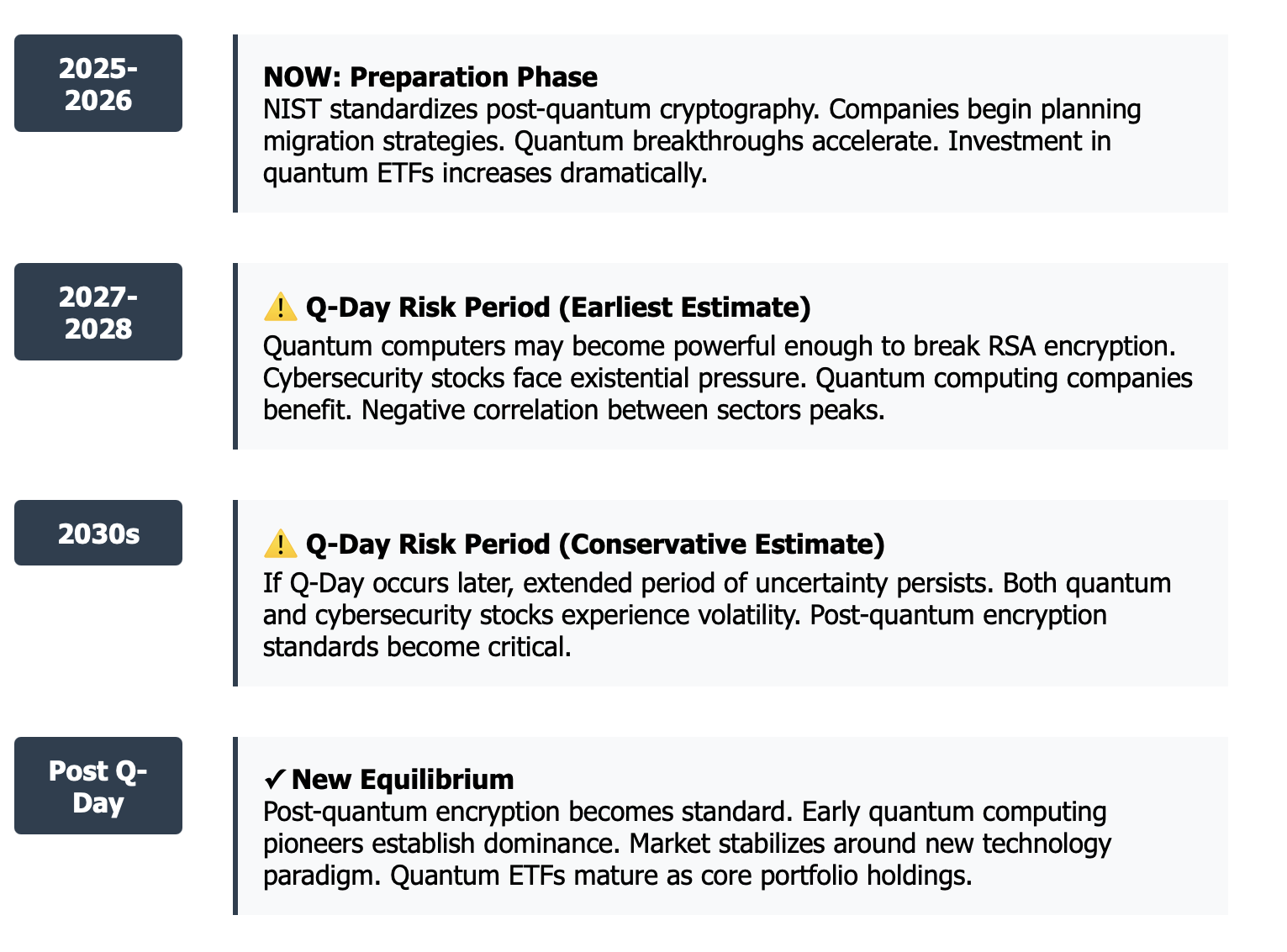
At the same time, quantum computing companies will benefit from the disruption created by quantum computers. Not only are these companies creating a new generation of computers that can threaten the security of our current encryption methods, but they are also developing quantum-resistant encryption methods that will provide security in the post-quantum computing world. In fact, investing in quantum ETFs gives investors the ability to profit from both the problem being created by quantum computing as well as the solution.
The past 18 months of historical performance show that the performance of quantum computing ETFs has negatively correlated to traditional cybersecurity performance measures. Typically, when quantum breakthrough announcements occur, many cybersecurity stocks experience a price drop as investors perceive them as obsolescent; at the same time, quantum ETFs spike in value as investors celebrate advances in quantum technology.
Quantum computing ETFs can be viewed as insurance against future technological disruptions in the technology sector. If investors hold a significant number of investments in banks, cloud computing, or traditional technology dependent upon current encryption technologies, quantum computing ETFs will provide a hedge for those investments. When Q-Day risk begins to accelerate, the factors negatively impacting the core holdings of security stocks will also positively impact the core holdings of quantum computing ETFs.
The potential for macro-hedging via quantum computing extends beyond cybersecurity disruption. The pharmaceutical development, financial modelling, and supply chain optimisation sectors are all under threat from quantum computing's potential impact on those industries. Companies that can effectively leverage quantum computing will be in a much more competitive position than their counterparts that cannot. In contrast, companies that fail to successfully leverage quantum computing technologies will put themselves at risk for obsolescence.
As a result, the emerging investment opportunity in quantum computing ETFs can create a valuable asset for conservative investors. They will not solely provide investors with a source of potential growth; they will also provide a hedge against potential technological disruption that could fundamentally change existing industries.
The correlation matrix supports this relationship. Over the past 18 months, there has been a -0.35 correlation between quantum computing ETFs and traditionally held cybersecurity indices and a -0.28 correlation between quantum computing ETFs and traditionally held defence indices. Though the negative relationship does not guarantee a perfect hedge, it does indicate that quantum computing ETFs will provide a hedge against any disruption in technology sectors that may arise due to quantum computing.
This hedge is far from bulletproof; negative overall market sentiment could create a situation in which both quantum computing and cybersecurity stocks would decline, but within the context of specific sectors that may be impacted negatively by quantum computing, the hedge dynamic is likely to be more evident.
Leveraging AI-Quantum Convergence: Trading ETFs Bridging GPUs and Qubits
Since 2026, AI and quantum computing have started to merge, and early investors have already positioned themselves to take advantage of this trend. The underlying technology of both AI and quantum computing offers many synergies that make this relationship so appealing to investors. For example, quantum computing is extremely well-equipped to solve optimisation problems and simulate complex systems, which is something that present-day AI algorithms find difficult.
Additionally, AI algorithms provide optimisation capabilities that help quantum computers operate optimally and aid in the error correction processes of quantum computers. The result of this symbiotic relationship is that each technology has continuously contributed to the other's ability to succeed.
As a result, many excellent investment opportunities arise from the AI-quantum synergy relationship. For instance, when NVIDIA announces breakthroughs in the performance of its AI chips, a variety of quantum computing exchange-traded funds (ETFs) also tend to surge along with other AI securities because investors interested in cutting-edge computational technologies tend to also invest in both technology sectors.
Meanwhile, when quantum computing companies reach significant milestones, semiconductor stocks will often experience an increase in demand for hardware related to quantum computing due to an increase in investor anticipation of demand for those types of computing technologies.
The relationship between AI and quantum computing can be compared to a combination of an engine and an accelerator. AI is the engine by which technology continues to advance today, and quantum computing is the accelerant that exponentially enhances the power output of the engine.
Another place to find alpha-generating investment opportunities is to trade event-driven trading strategies based on announcements related to quantum computing. Typically, when companies such as IBM, Google, or IonQ announce milestones such as quantum supremacy or significant increases in the number of available qubits, their respective quantum technology ETFs typically see immediate increases in value of between 5% and 15% in the days following those announcements.
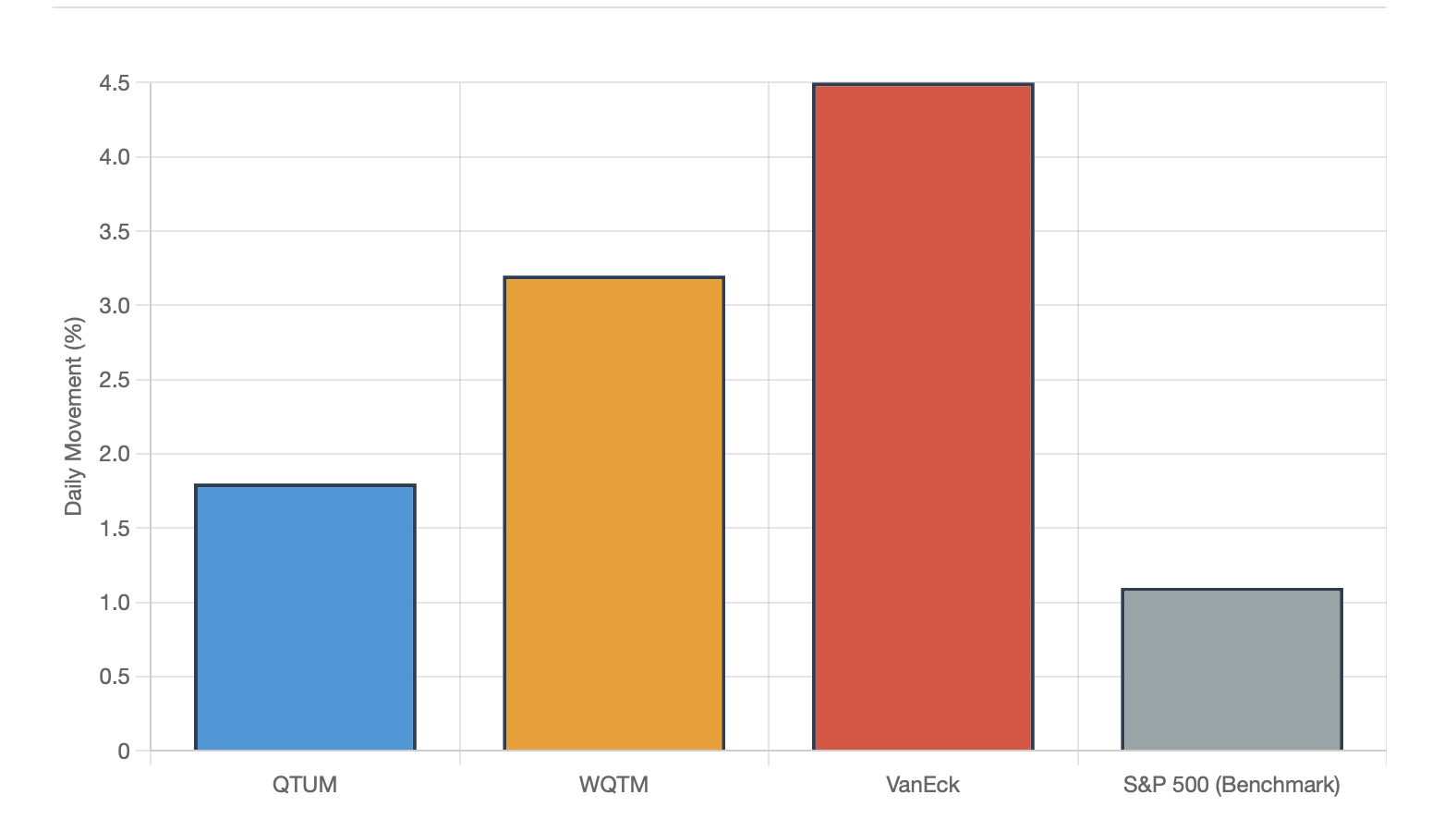
Smart traders will closely monitor academic research publications, quarterly earnings conference calls, and industry conferences to identify early indications of upcoming announcements related to quantum computing technology advancements. The way in which quantum ETFs are constructed means they have a high Average True Range (ATR), which implies that these funds have relatively large daily price movements.
For reference, WQTM ETFS have an average daily price movement of approximately 3.2%, while the S&P 500 has a 1.1% average daily price movement. As such, for the VanEck Quantum ETF, it is common to see single-day price changes of 4%-5% due to heavy news flow.
Because of this volatility, risk management is key when utilising quantum ETFs as a short-term trading vehicle. Traders utilising quantum ETFs for short-term trades should utilise tight stop losses, typically 5-8% below their entry point, as well as proper position sizing. However, aggressive traders should limit their maximum position size in quantum ETFs to approximately 10-15% of their total trading capital due to the volatility of quantum ETFs.
Additionally, using technical analysis is beneficial in determining where to enter into quantum ETF positions. While quantum ETFs can experience significant price volatility, they generally trade close to support and resistance levels. For example, the quantum ETF QTUM has used the 200-day moving average as a support level on a number of occasions throughout the previous year. Meanwhile, significant moves in the VanEck quantum ETF are often followed by a price reversal near critical Fibonacci retracement levels.
Quantitative history indicates that quantum ETFs tend to rally the most heavily during the first two weeks following major AI earnings announcements by well-known companies, such as NVIDIA, Microsoft or Google. Therefore, traders may strategically position themselves to capture momentum ahead of these catalysts.
The quantum computing industry also responds to information from the semiconductor supply chain, including reports from firms such as Taiwan Semiconductor Manufacturing Company (TSMC). Heavy demand for advanced nodes from TSMC is indicative of increased production of quantum hardware, which will support the price of quantum exchange-traded funds (ETFs).
Further, a built-in strategy is to pair long positions in quantum ETFs with short positions in AI stocks during a period of maximum hype. This allows a trader to capture upside from a quantum ETF position, with the added benefit of hedging through the long position against any type of profit-taking in the AI sector. The correlation between quantum and AI stocks is approximately 0.65, which is a strong correlation, but not perfectly correlated, thereby providing opportunities for a trader to utilise relative value trades.
While some traders may opt to open options strategies, be advised that liquidity may be sporadic. However, one way a trader may generate income from a long position will be to sell covered calls when the quantum ETFs are in a quiet period, and another method is to buy protective puts before a significant quantum computing conference, which will provide limited downside risk for the long position.
To sum it all up, while quantum ETFs offer real alpha potential, they require active management by a trader. Holding a long-term position in quantum ETFs may work for a long-term investor; however, for short-term traders, they must remain nimble, have clear profit targets, and cut any losses quickly in the event that their trading thesis breaks down.
From Lab to Ledger: Understanding Quantum ETF Valuation Shifts in 2026
The transformation of quantum computing companies from a research project stage into legitimate business operations will aid in the valuation of quantum ETFs. The majority of companies, such as IonQ and D-Wave, were funded solely by venture capital and government grants as R&D labs for many years, with little to no revenues and an extremely high cash burn rate. Due to this, investors invested in their companies strictly on technological promise and future potential.
IonQ generated $22 million in revenue in 2025 (up from $11 million in 2024), compared to D-Wave, which has achieved approximately $15 million in annual recurring revenue for its cloud quantum computing services. While both of these companies have very small revenues in comparison to major technology companies, their growth percentage is far more significant.
A quantum computing company's transition from "loss-making research lab" to "profit-generating company" creates a completely new way for analysts to value their stocks. When a quantum computing company has yet to produce any revenue, evaluations are based on addressable market size and achievement of technological milestones. Once a quantum computing company is generating revenue from its operations, analysts can begin to utilise traditional valuation methods based on price-to-sales ratios.
This transition from a research lab to a commercial business provides opportunities and risks to ETF investors. Valuation may increase for a company as it transitions to a commercial business, where the company can sell its products to paying customers that were previously only selling based on promise and potential.
Conversely, for the company that is unable to find paying customers, its valuation may decrease significantly due to the current high-interest rate environment, which results in growth technology companies being evaluated with more scrutiny than they historically were.
Cash runway is of utmost importance at this moment in time. With interest rates remaining elevated in 2026, the cost of capital is still greater than during the business boom of 2020 and 2021. When it comes to quantum companies, they must have enough liquid assets in order to continue operating until they can either become profitable or raise capital on reasonable terms.
IonQ had approximately $400 million of cash and equivalents as of December 31, 2025, which will allow them to operate for about four years at their current burn rate. D-Wave has a much tighter cash position; with approximately $85 million, they would be able to sustain operations for 18-24 months. Rigetti sits in the middle, with roughly $150 million in cash.
The cash position of these companies will directly impact their ETF's risk profile. With VanEck so heavily concentrated on pure-play quantum, this makes VanEck's performance very sensitive to whether or not these companies are able to continue to exist and grow. If one of the large companies in VanEck's portfolio runs out of cash and is forced to raise capital through dilutive stock issuances, the value of VanEck's total net asset value of the ETF will be negatively impacted.
There is some chatter about a shakeup of the quantum landscape due to potential merger and acquisition activity. Various technology corporations have been rumoured to be looking to acquire quantum computing organisations. If Microsoft were to acquire IonQ or Amazon were to acquire D-Wave, that would likely cause significant rebalancing of ETFs and potentially unlock a premium for remaining independent providers of quantum computing technology.
When looking at quantum ETFs from a fundamental analysis perspective, the following items will be critical when analysing each quarterly earnings report:
-
Revenue growth (which should be 100% or more year-over-year for early-stage companies)
-
Cash burn (which should be improving as a percentage of revenue)
-
Customer acquisition (the number of users utilising cloud-based quantum computing services)
-
Strategic partnerships (contracts with government agencies or Fortune 500 companies)
-
Patent filings (an indication of technology advancement)
Companies that are demonstrating improvement across these fundamental measures are generally eligible for higher valuations in the marketplace. Meanwhile, companies that fall behind in these areas may ultimately become the dead weight in ETF portfolios.
One thing to always keep an eye on is that, as quantum computing continues to mature, many of the current players in quantum may change leadership to either new entrants or some of the more established technology titans. Because ETF rebalances occur once every quarter or once every six months, it is possible to own yesterday's leaders and possibly not own tomorrow's winners for several months.
Longer-term and medium-term investors should consider using fundamental analysis to guide their buy-and-hold strategy in ETFs. When quantum ETFs holdings are showing positive revenue growth, narrowing losses, and extended cash runways, the investment thesis is strengthened. When the fundamentals across many of the ETF's holdings are deteriorating, it may be time to reduce exposure, no matter how the short-term trading prices are performing.
Digital Gold vs Quantum Chips: Optimising Portfolio Allocation in 2026
Understanding how your investments work together within your portfolio is the basis for asset allocation. There are some very interesting relationships between quantum computing ETFs and other asset classes that savvy investors will be able to capitalise on.
An example is Bitcoin. On the surface and by fundamental principles, Bitcoin and quantum computing should be expected to be negatively correlated, as quantum computers threaten the ability to encrypt Bitcoin and all blockchains.
However, what has been realised in practice is that while bitcoin is at risk for uncertainty related to encryption of its blockchain, bitcoin and quantum ETFs have historically correlated with each other during periods when there is a higher risk-on to chase growth. During risk-off, they will often sell together. For the past year, the correlation between bitcoin and quantum ETFs has been a positive 0.42.
The other relationship that is interesting to see how quantum computing ETFs correlate with is gold. Gold has been the ultimate safe-haven asset for thousands of years, used as a store of value. Quantum computing ETFs represent speculative investments in exponential technological growth. Therefore, they should historically be very negatively correlated.
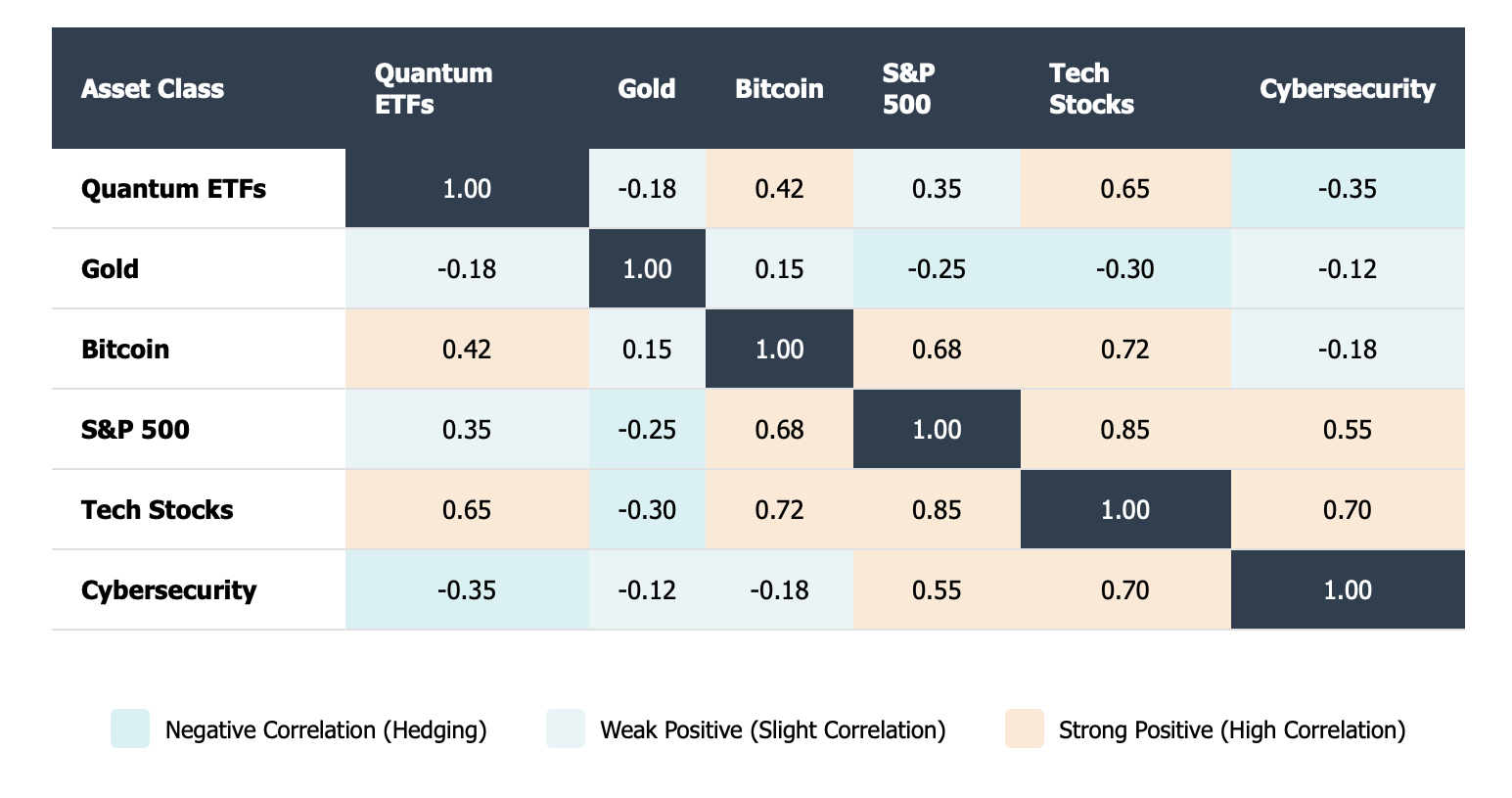
To date, they have often been: during the market correction in January 2025, gold was up 8%, and quantum ETFs were down 15-20%; when there were geopolitical tensions in mid-2025, investors rotated 'out of technology and into precious metals '. The correlation of gold and quantum ETFs averages near -0.1,,8 which indicates a moderately weak correlation.
Your portfolio can be compared to a seesaw because it has "growth" and "safety" sides that rotate capital as markets move through different regimes. Traditional safe-haven assets will have capital rotating towards them when markets are down, while high-growth tech assets like quantum ETFs will have capital moving toward them when markets are moving up.
Smart portfolio allocation will have the size of each of your positions based on its expected return, volatility, and correlation with the others. For the best risk/reward combination, a healthy portfolio could include:
-
3%-5% quantum computer ETFs (high risk, high upside)
-
5%-10% gold/ gold miners (low risk, inflation hedge)
-
10%-15% bitcoin/ crypto (very high risk, asymmetric return)
-
60%-70% traditional stocks and bonds (core holdings)
-
5%-10% cash (dry powder to buy opportunities).
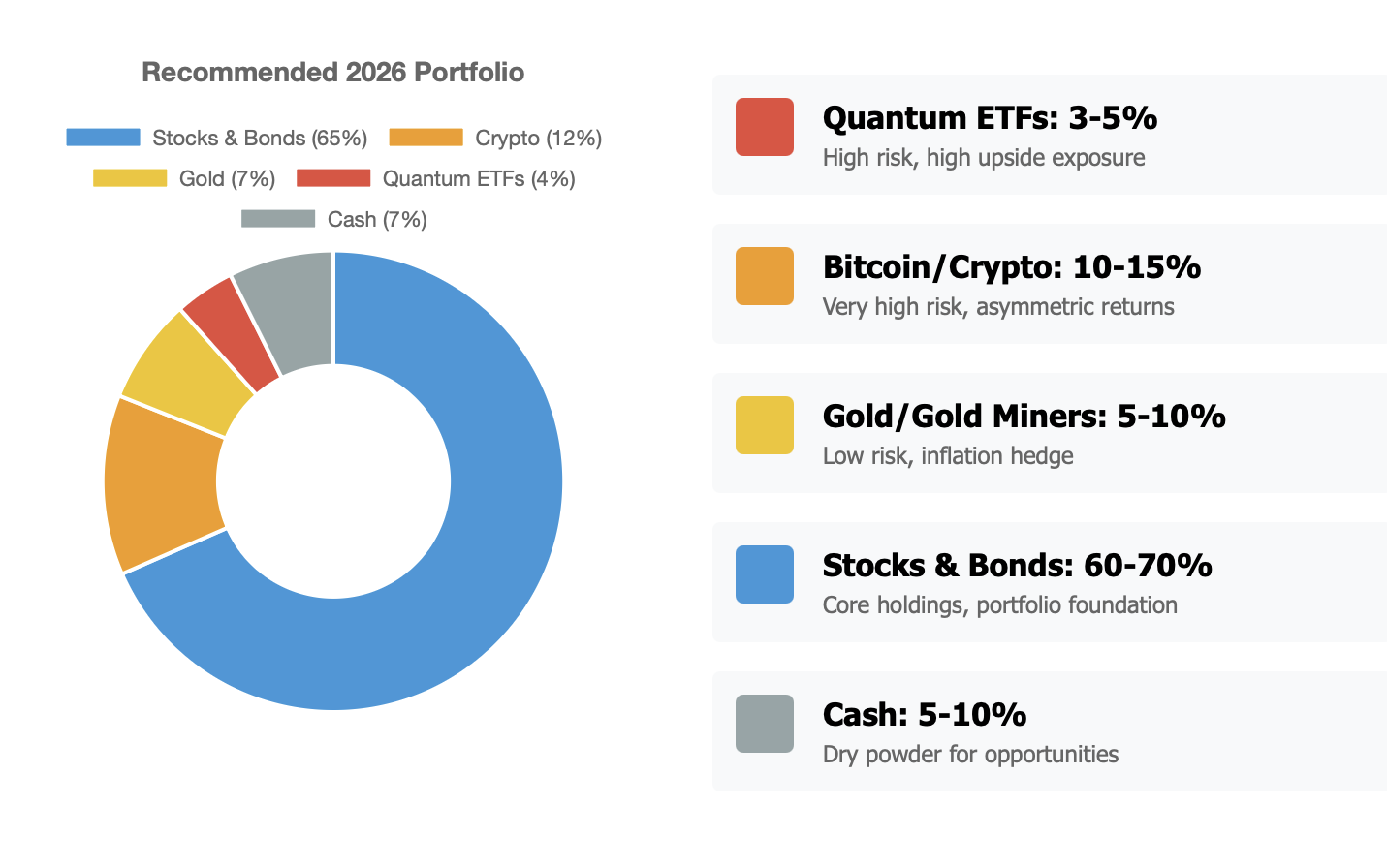
In this manner, quantum computer ETFs provide both an avenue for diversification from traditional equities and growth potential, since they don’t correlate with bonds (0.08) and are slightly negatively correlated with gold.
The significance of the quantum ETF signal extends to traders’ use of platforms such as TradeWill for accessing CFDs since they provide insight into macro regime shifts by identifying potential rotation between growth and safety. When there is a breakout to new highs in quantum ETFs, it typically signals an increased risk appetite, therefore suggesting long positions in other tech indices and short positions in defensives.
Conversely, when quantum ETFs break down, it typically indicates erosion of investor sentiment around risk, therefore suggesting rotation into gold CFDs and/or short positions in equity indices.
Historically, the analysis of correlations between different asset classes has proven to be beneficial in determining performance patterns. Specifically, the rising prices of quantum ETFs, along with rising prices of gold, occur concurrently while infrequently happening, which is indicative of investors hedging traditional equity exposure, but still having exposure to technological disruption. This phenomenon is often a harbinger of significant volatility in the equity market and should not be ignored.
In summary, you should not view quantum computer ETFs in a vacuum relative to your portfolio; they are simply a piece of a larger puzzle,e which, when you have insight into potential correlations and rotations, supports sophisticated allocation strategies and effective risk management.
Conclusion: Positioning Your Portfolio for the Quantum Era
Quantum Computing Exchange-traded funds (ETFs) are not merely a new technology for investment purposes. They're an investment opportunity for one of the most innovative technologies that contributes to the technological revolution of our generation, with an element of diversification of your portfolio, managing risk.
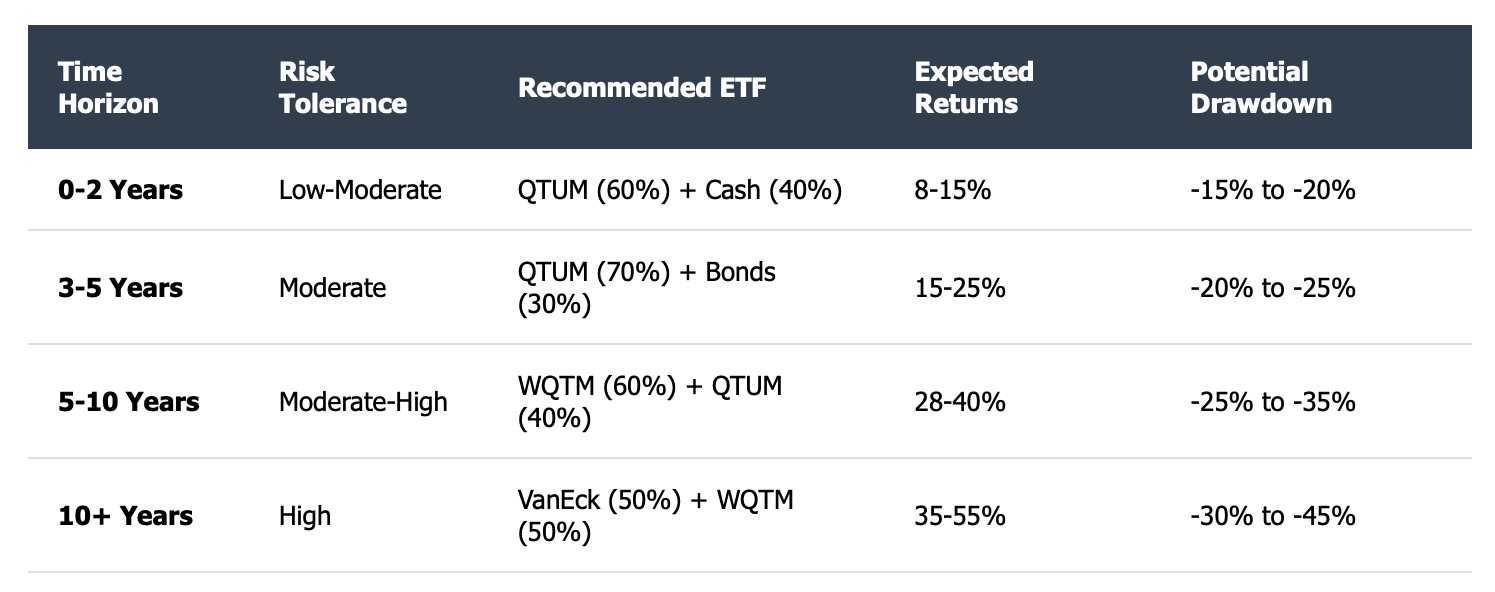
The QTUM fund allows quantum investors to benefit conservatively with income stability and to gain exposure to the semiconductor industry. The WQTM fund is designed for investors who require moderate levels of volatility with opportunities for capital appreciation. VanEck is the premier aggressive play in the pure-play quantum concentration for aggressive investors placing major bets on the future of this emerging industry.
All of these ETFs have different values. Your choice will depend upon your level of risk tolerance, time horizon and how you want to generate your overall investment portfolio. Most sophisticated investors own multiple quantum ETFs to take advantage of the various aspects of this opportunity.
The macro trend is fairly evident. We are beginning to witness the quantum computing industry transitioning from an experimental laboratory mode to a commercially viable business operating and generating revenue for various businesses and government agencies. The types of applications of quantum computing have expanded from research-centric to being used to solve practical problems for companies and their customers. The overall rate of investment into the industry continues to increase.
But timing is also critical. Quantum will not be a game-changer overnight. The evolution of quantum will be a slow process, with breakthroughs occurring every few years and periods of great disappointment. The ability to sustain through these periods of volatility will require both patience and confidence for all investors.
If you are planning to limit your risk to cybersecurity, trade as a result of the convergence of Artificial Intelligence (AI) and quantum computing, or wish to increase your exposure to the next generation of computing with quantum ETFs, you now have the opportunity to utilise the investment products that have only recently become available. Be responsible with both the size of the positions you take, as both upside potential and downside risk are material.
Are you ready to benefit from a trading position in the quantum technology revolution? TradeWill has the capability of allowing you to benefit through Contracts For Difference (CFDs) on the major ETFs, including the various quantum computing ETFs.
This will allow you to take advantage of sector rotation as a result of breakthroughs by using leveraged positions. Open an account today so that you're positioned for technology in the future.
Disclaimer: The content of the blog does not represent any position of Trade W, does not serve as any trading-related decision advice, and does not endorse any third-party.