

 Trade W

Introduction
In a fast-evolving market environment as that of today, investors find themselves with unique opportunities and opportunities to face complex challenges. A Perfect Storm of tech breakthroughs, geopolitical change and consumer shifts made 2025 the most interesting year I have ever covered for technology.
Scrums over free speech will become the biggest social issue, and President Trump is going to have to get a handle on it. Trolls and extremists have taken over the internet in a battalion of ugly words and threatening gestures, and it’s only going to get worse unless we figure out what to do. However, as many new trends vie for attention, it raises the question: which ones are worth allocating your portfolio space to?
The volatility that swept through world markets has only increased investors’ appetite for sectors that have the potential to produce more reliable growth. From the growth of the AI infrastructure boom to the nuclear power renaissance, and from the digitisation of financial services to the commercialisation of space, these are the industries that promise to shape the next economic cycle.
It primarily utilises Institutional Research, Market Data, Real Investment Talks & Discussions on Internet, Reddit, and other IM Forums to filter out the perfect opportunity to capitalise on. We won't invest in fad sectors, but in industries with strong fundamentals and competitive moats and a clear road to profitability.
The future is owned by people who prepare for it today. So let’s take a look at the five sectors that are changing the investing world and what that means for how you can invest in those trends for profit.
Top 5 Prospective Industries For The Next Five Years
The Infrastructure Gold Rush Driving the AI Revolution
So while the headlines all go to artificial intelligence, the real potential in terms of investment is in the infrastructure of change. The need for AI computing power has spawned a totally new category of infrastructure investments that goes way beyond what we’ve ever seen in the old data center era.
By 2025, around one third of all global data center space is predicted to be home to AI workloads, rising to 70% by 2030. This mass migration is one of the greatest infrastructure buildouts in modern history, akin to the railroad expansion of the 19th century or the automobile construction of the 20th century.
Key Investment Drivers:
-
GPU Demand Boom: At NVIDIA’s recent GTC 2025, the company unveiled ground-breaking chip designs and the new NVL576 rack system, highlighting the growing sophistication of AI compute power
-
Hyperscale Data Center Growth: Meta intends to spend $60 billion to $65 billion in 2025 to upgrade its artificial intelligence (AI) and other infrastructure, which is a large uptick from its projected $38 billion—$40 billion spending for 2024
-
Power Infrastructure: Nvidia is seeding a $1.4T data center market in a decade powered by AI that will require massive investment in power generation and cooling.
Investment Opportunities:
-
Direct Chip Exposure: Nvidia (NVDA), Advanced Micro Devices (AMD), Taiwan Semiconductor (TSM)
-
Data Center REITs: Digital Realty Trust (DLR), Equinix (EQIX)
-
Power Infrastructure: NextEra Energy (NEE), Brookfield Renewable (BEP)
-
ETFs Take Aim: Technology Select Sector SPDR (XLK), VanEck Semiconductor ETF (SMH)
Risks of Investing: Concentration of the market in NVIDIA, potential supply chain bottlenecks, and the potential for normalization of AI demand post initial buildout.
Nuclear Power & Next-Generation Energy
Nuclear is facing what many analysts are calling "the industry’s apparent renaissance" with an intersection of clean energy mandates, AI power load requests and technological advances in small modular reactors (SMRs).
Fundamental Transformation Drivers:
-
Clean Energy Expedient: Nuclear is base load clean energy that solar and wind cannot possibly match
-
AI Data Center Power Needs: With AI infrastructure's insatiable power needs, interest in nuclear as the only clean energy source that scales is growing.
-
Tech Disruption: The U.S. government has put its weight behind the fastest rebound of an industry in history, with new bills looking to expedite the rollout of next-generation small modular reactors and give an added boost to uranium production--and help to upgrade older reactors.
-
Demand Constraint: The intersection of surging energy needs with severely restricted supplies leaves uranium mining poised for major price gains
Investment Landscape:
Uranium Producers:
-
Cameco Corporation (CCJ) - The world's largest publicly traded uranium company
-
Energy Fuels (UUUU) - Producer of diversified uranium and rare earth.
-
Uranium Energy Corp (UEC) - Low-cost uranium development and production in the United States
Small Modular Reactor Technology:
-
NuScale Power (SMR) - First SMR ordered plethora of +ve: first SMR to receive design endorsement four reactors to be built in Idaho SMR novice Insight for SMR novice prototype built: due for completion 2026-7 obvious concerns: long-term concrete and steel safety.
-
Oklo (OKLO) – Advanced reactor technology
Nuclear ETFs:
-
Global X Uranium ETF (URA) - Broad uranium exposure
-
VanEck Uranium+Nuclear Energy ETF (NLR) - Focuses on nuclear infrastructure
Stretch Goals: Nuclear is going to absolutely kill it in 2025! Between the SMR is the hot spot, more investment, more countries (e.g. Türkiye or Indonesia) going nuclear, it promises to be transformational for the industry
Finance and FinTech Inclusion Through Digitisation
Reimagining Global Financial Infrastructure
The digitization of finance in one sense is not just about technology upgrading, but about a fundamental restructuring of how financial services engage with and serve the global population. This shift is particularly potent in the developing world, where there is limited penetration of traditional banking infrastructure.
Market Opportunity:
-
Populace without Bank Accounts: The World Bank reports that there are 1.7 billion people globally who are unbanked Contents [show]
-
Mobile-First Banking: Brazilians and Indians are jumping over traditional banking to use mobile-first banking platforms
-
B2B FinTech: Small and medium-sized business lending, payments and cash management
Leading Players and Models:
Latin America Leaders:
-
NuBank (NU): Over 80 million customers in Brazil and Mexico with a clear path to profitability
-
MercadoLibre (MELI): E-Commerce powerhouse growing FinTech sector quickly
Global Payment Innovation:
-
Block (SQ): CB6 business payments and consumer services you can get from CNAPP
-
PayPal (PYPL): Conventional digital payments with a side order of cryptocurrency
-
Adyen (ADYEY): European payment processing for big-company clients
Emerging Market Focus:
-
Sea Limited (SE): A Southeast Asian super-app with payments integration
-
Paymi (PAYM): African mobile payments
Investment Themes:
-
Financial inclusion in emerging markets
-
B2B payment infrastructure
-
Cryptocurrency and digital asset integration
-
Open banking and API-driven services
ETFs With Fin exposure: FinTech ETF (FINX), Global X FinTech ETF (FINQ)
Space & Defense Technology
The last frontier is now an economic frontier from govt exploration to vibrant commercial ecosystem Po + capitalist mainstreaming of the internet to igeocracy/twiDYI to ai They also explore the implications of low trust culture Wall-E on value leak from human culture to extrahuman agents (ai, govts, companies) 3/n Morgan Stanley along with ARK Invest forecast the space economy will be worth US$1.8 trillion by 2035, a 30x increase from the current size.
Commercial Space Revolution:
Launch Services:
-
SpaceX: The dominant player in commercial and government launches
-
Rocket Lab (RKLB): Launches small satellites with manufacturing capabilities
-
Virgin Galactic (SPCE): Space tourism and research flights.
Satellite Infrastructure:
-
Satellite Communications: Iridium (IRDM), Globalstar (GSAT)
-
Earth Observation: Planet Labs (PL), BlackSky (BKSY)
-
Manufacturing: Maxar Technologies (MAXR)
Defense Technology Integration:
-
Palantir (PLTR): Data analytics software for government defense and commercial use
-
Lockheed Martin (LMT), Defense (with old space capacities)
-
Northrop Grumman (NOC), defense and aerospace systems
Space ETFs:
-
SPDR S&P Kensho Final Frontiers ETF (KTEC)
-
Procure Space ETF (UFO)
-
ARK Space Exploration & Innovation ETF (ARKX)
Investment Thesis: Space is where the future is being pushed from multiple high growth technologies like AI, High-materials, robots, comms. The industry has advantages of both commercial demand and firm government contracts.
Healthcare System Disruption
Keynote Speaker: Dr. Patrick Soon-Shiong's Vision for $4 Trillion HealthCare in the United States
American healthcare, accounting for 17% of the economy but 37th in the world in terms of cost effectiveness, is ripe for technological disruption. The intersection of AI, telemedicine and novel care delivery models is offering investment opportunities throughout the health care value chain.
Disruption Catalysts:
Technology-Enabled Care Delivery:
-
Teladoc (TDOC): Virtual care platform, with specialty offerings
-
Dexcom (DXCM): Technology for continuous blood sugar monitoring
-
Veracyte (VCYT): Genomic diagnostics Personalized Medicine
Pharmacy and Drug Delivery:
-
Amazon Pharmacy: Big tech firm takes on traditional pharmacy
-
CVS Health (CVS): Retail and pharmacy and health-care services in combination
-
Ro (formerly Roman): Direct-to-consumer healthcare
Health Insurance Innovation:
-
Oscar Health (OSCR): Health insurance, technology-first
-
Clover Health (CLOV): Medicare Advantage focused on AI-driven care management
Medical Technology:
-
Intuitive Surgical (ISRG): Robot surgical systems
-
Abbott (ABT): A diversified devices and diagnostics maker
-
Moderna (MRNA): mRNA technology beyond COVID Source: Contrarian Outlook Want more from Contrarian Outlook? JADX Read and share these articles from Contrarian Outlook.
Healthcare ETFs:
-
Health Care Select Sector SPDR (XLV)
-
Vanguard Health Care ETF (VHT)
-
iShares U.S. Medical Devices ETF (IHI)
Investment Hurdles: Regulatory complexity, vested interest holders and the challenge of modifying existing healthcare delivery systems pose both risk and barriers to new entrants, in turn serving to protect the innovators that succeed.
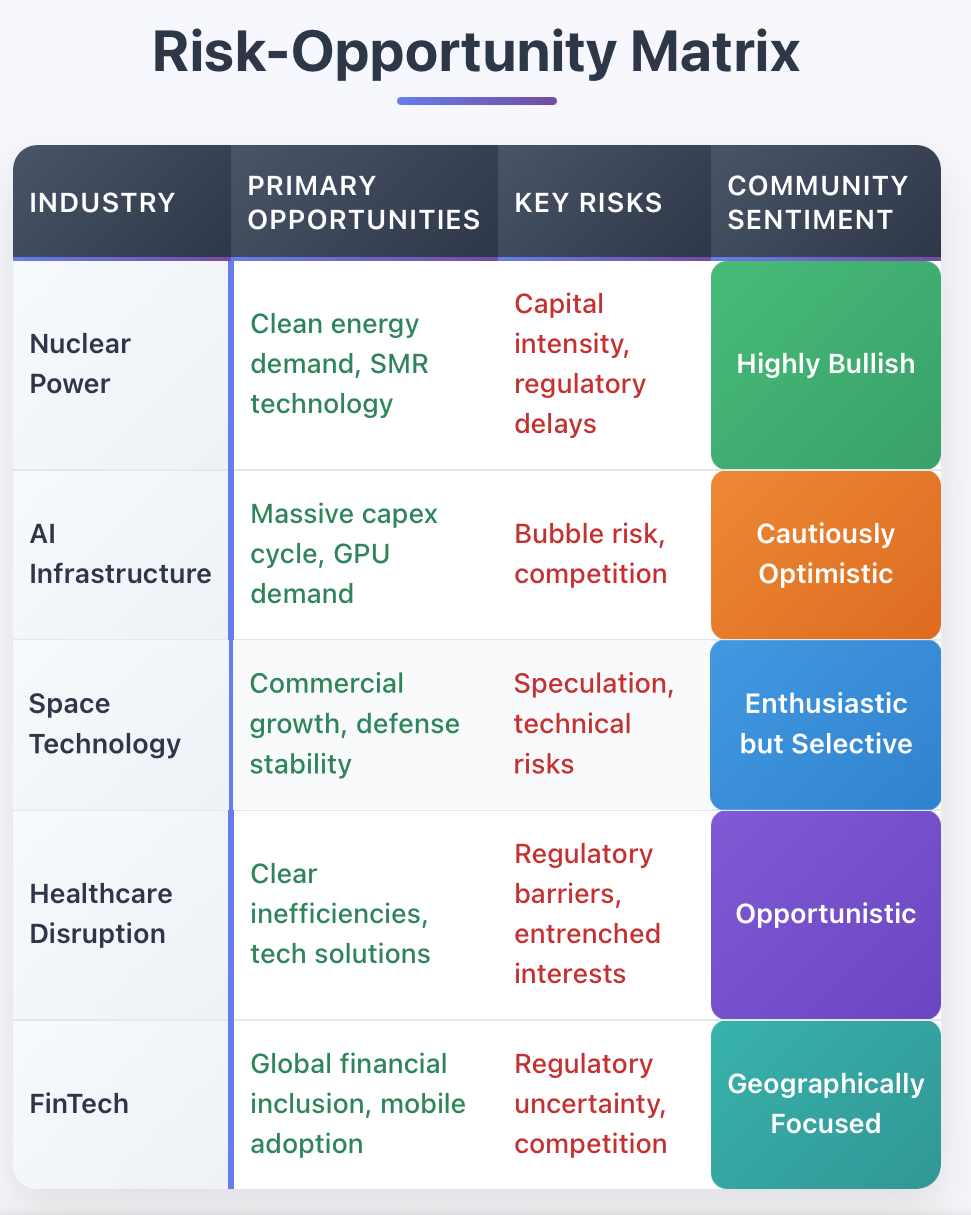
Market Insights: What Reddit Traders Are Saying
To test our hypothesis, we also looked for the discussion in r/investing and other investment communities to get a sense of where retail investors are placing their attention and their money. The insight of the community sheds light on both opportunities and potential pitfalls:
Community Consensus and Divergences
Power from Nuclear - "The Greatest Come Back in 50 Years":
Bullish Sentiment: Investors note nuclear as one of the industry’s best fundamental drivers Upgrade to Outperform.
Key Impediments: Significant capital needs and regulatory ambiguity
Popular Picks: CCJ, URA ETF, SMR stocks are the hot topics of discussions
AI Infrastructure - Momentum With Caution:
-
Opportunity: GPU demand (and data center growth) are strong narratives
-
Chatter: Increasing fear of bubble territory in AI stocks
-
Diversification: Lots of investors find they like ETF exposure to individual stock picking
Space Economy – Strong potential and high speculation:
-
Enthusiasm: There is a widespread community awareness of long-term potential
-
Caution: Keep in mind that many space stocks are speculative
-
Emphasis: Rocket Lab, which is often cited as a more plausible near-term prospect
Disruption in Healthcare - Clear Need, Difficult to Execute:
-
Consensus: Everyone agrees the system must be disrupted
-
Skepticism: Confidence that healthcare is notoriously resistant to change
-
Preferred: Specialize in areas such as telemedicine and medical devices
Digital Assets & FinTech - Divided Views:
-
Focus on innovation: curiosity about what blockchain applications there are outside of just cryptocurrency
-
Risk Management: Focus on quality players rather than tokens with no history of success
-
Geography: Passion for EM FinTech
Building A Portfolio: How To Prepare For These Trends
Investment Framework by Risk Profile
Defensive Style (Low Risk and Stability of Returns):
-
Core Holdings: Broad market ETFs with Sector Tilts (XLK, XLE, XLV)
-
Selective Exposure: Major players such as Microsoft (MSFT), Alphabet (GOOGL)
-
Timeline: 5 – 10 years under sector rotation over time
Moderate Approach (Balanced Risk-Return):
-
Sector ETFs: (semiconductors), (uranium), (healthcare)
-
Large Cap Losers: NVIDIA, Cameco, Microsoft, Amazon
-
Allocation: 60% established names, 40% growth areas
-
Timeline: 3-7 years with regular adjustments
The High Risk, High Reward, Aggressive Play:
-
Specific Stocks: RKLB, SMR, PLTR, emerging FinTech names
-
Thematic ETFs: ARKX (space), FINX (FinTech), BOTZ (robots)
-
30% allocation to established, 70% to inception opportunities
-
Timeline: 2-5 years, actively managed
Sector Allocation Strategy
Ideal Portfolio Weighting by Time Frame for the Investor:
Short-Term (1-2 years):
• AI Infrastructure: 35%
• Nuclear Energy: 25%
• Healthcare Tech: 20%
• FinTech: 15%
• Space: 5%
Medium-Term (3-5 years):
• AI Infrastructure: 30%
• Nuclear Energy: 25%
• Healthcare Disruption: 20%
• Space Economy: 15%
• FinTech: 10%
Long-Term (5+ years):
• Space Economy: 30%
• Nuclear Energy: 25%
• Healthcare Disruption: 20%
• AI Infrastructure: 15%
• FinTech: 10%
How to Play It Through ETFs and Individual Stocks
Core ETF Foundation:
-
Technology: QQQ, XLK to broadly invest in technology
-
Energy: XLE (Overlay URA as nuclear play)
-
Health care: XLV for defensive exposure to health care
-
Innovation: ARKK, ARKX for disruptive tech themes
Individual Stock Selection Criteria:
-
Market Leadership - Dominant positioning in a growing market
-
Financial Strength : Having strong financial strength can help withstand the market dynamics
-
Scalable Business Model M1: Possibility of growth without rising costs of production
-
Regulatory Moats: Regulatory-protection or Government supported benefits
Conclusion: The future is now, take action!
The next five years will belong to the industries we’ve been analyzing: AI structure transforming how we compute and communicate, nuclear power offering the world clean baseload power for an electrified economy, FinTech democratizing access to financial offerings worldwide, space technology opening new frontiers of commerce and communication, and healthcare innovation finally attacking the most wasteful sector in America.
These are not in the way out there future thinking exercises, these are actualities that have clear investment opportunities right now. The companies and ETFs highlighted in this analysis offer various ways to participate in these secular trends -- whether you fancy the safety of incumbents or the growth of disruptive upstarts.
Key Takeaways for Investors:
-
Diversify Across Themes: Never concentrate exposure to a single industry, preferably choose a number of themes as these themes often work in tandem
-
Timeline Match: Align your period of expectations (AI infrastructure in the short term, space time in the long term) with this stage of sector growth.
-
Risk Management: Utilize ETFs for broad exposure and stocks for more concentrated bets
-
Frequent Rebalancing: These lines will change fast. Daily or weekly tracking is required.
The alignment of technology, economic need and policy backing makes this a unique opportunity for strategic investors. Those who thoughtfully position themselves across these five sectors, today, will have the greatest opportunity to exploit this monster value generation over the next decade.
The future belongs to the prepared investment philosophy in action. The issue isn’t whether these industries are going to get bigger — it’s whether you’ll be in a position to capture that growth. The time for action is now.
This report is for information purposes only and is not investment advice. All investing is subject to risk, including the possible loss of the money you invest.
Disclaimer: The content of the blog does not represent any position of Trade W, does not serve as any trading-related decision advice, and does not endorse any third-party.