

 Trade W

Introduction: Why $100/oz Silver Is No Longer Unrealistic
Anyone who remembers triple-digit silver may recall that such a price was once considered a pipe dream. Such days have ended!
Silver's market has completely changed in the last 5 years. 2025 will mark five years in a row of global deficits in silver supply.
The amount of silver held in Exchange-Traded Funds (ETFs) continues to rise. At the same time, the amount of silver stored in COMEX warehouses is disappearing at an increasing pace enough to astonish even the most experienced traders.
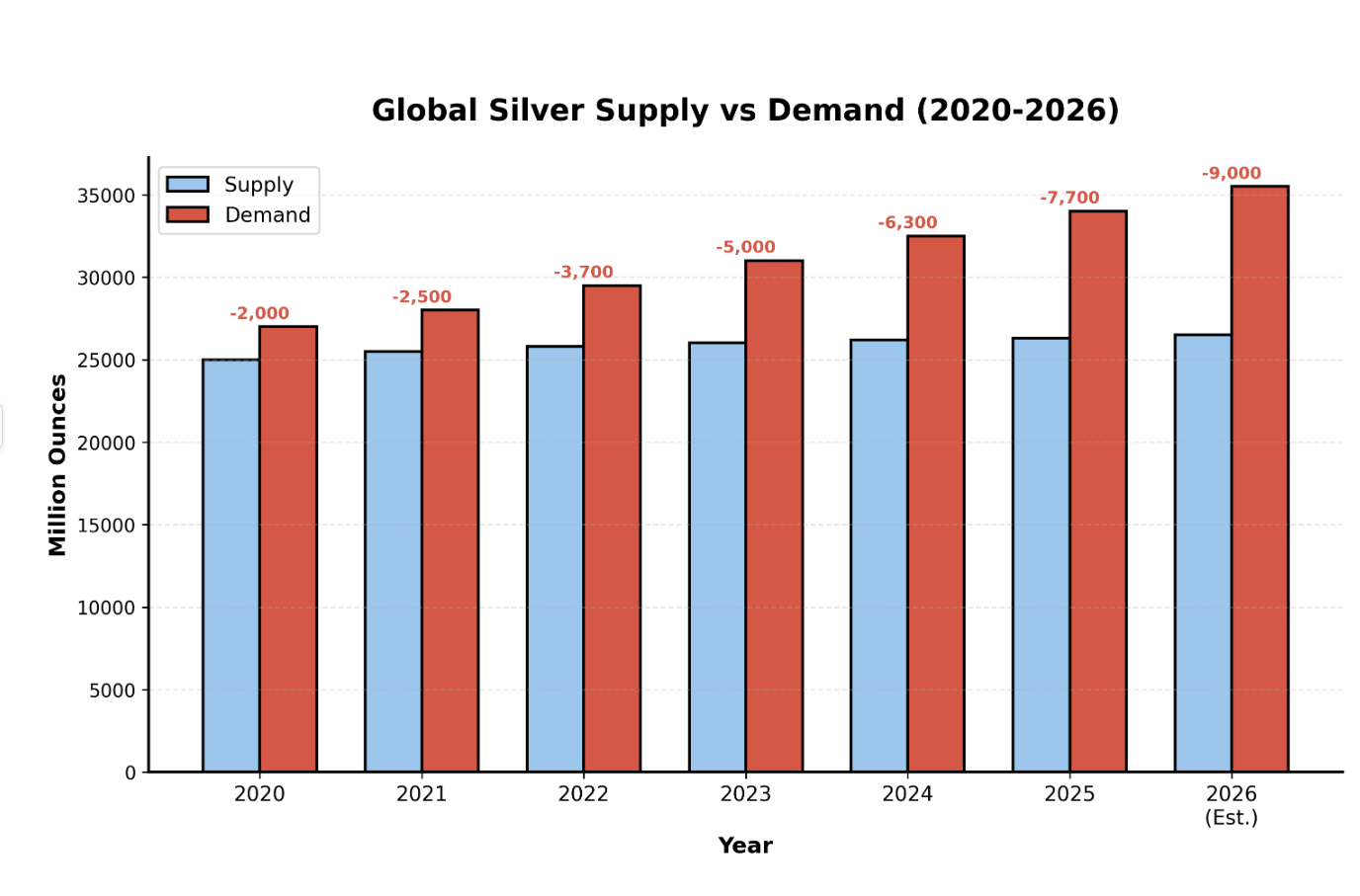
There is a clear basis for making a prediction of the $100/oz silver price. This price can be substantiated by the current state of the silver market and the reasons why it is characteristic of a "supply-side scarcity" a persistent shortage of silver created by a lack of mining activity as well as an overwhelming surge in industrial demand for silver and an level of inventory that would cause even the most seasoned commodity analysts to tremble at the thought of their investments.
Think about bottled water in a drought. There is very little available in bottles; there are millions of people still needing to quench their thirst, and the relative price for a bottle of water has gone up! Basic economics.
This blog covers my ideas about where silver could be priced in 2026, realistic price projections for silver and reasons why you should consider buying in either the near-term or as a first-time investor in the silver market. If you have been accumulating silver or are thinking about starting, these price projections will assist you in determining the best approach to accumulating silver when opportunity presents itself.
The question is not about whether silver will rise; it is how high before you take advantage of a price rise?
Industrial Demand Surge: How Photovoltaics Are Driving Silver Prices
Half of the world's silver that is produced is consumed by industrial applications.
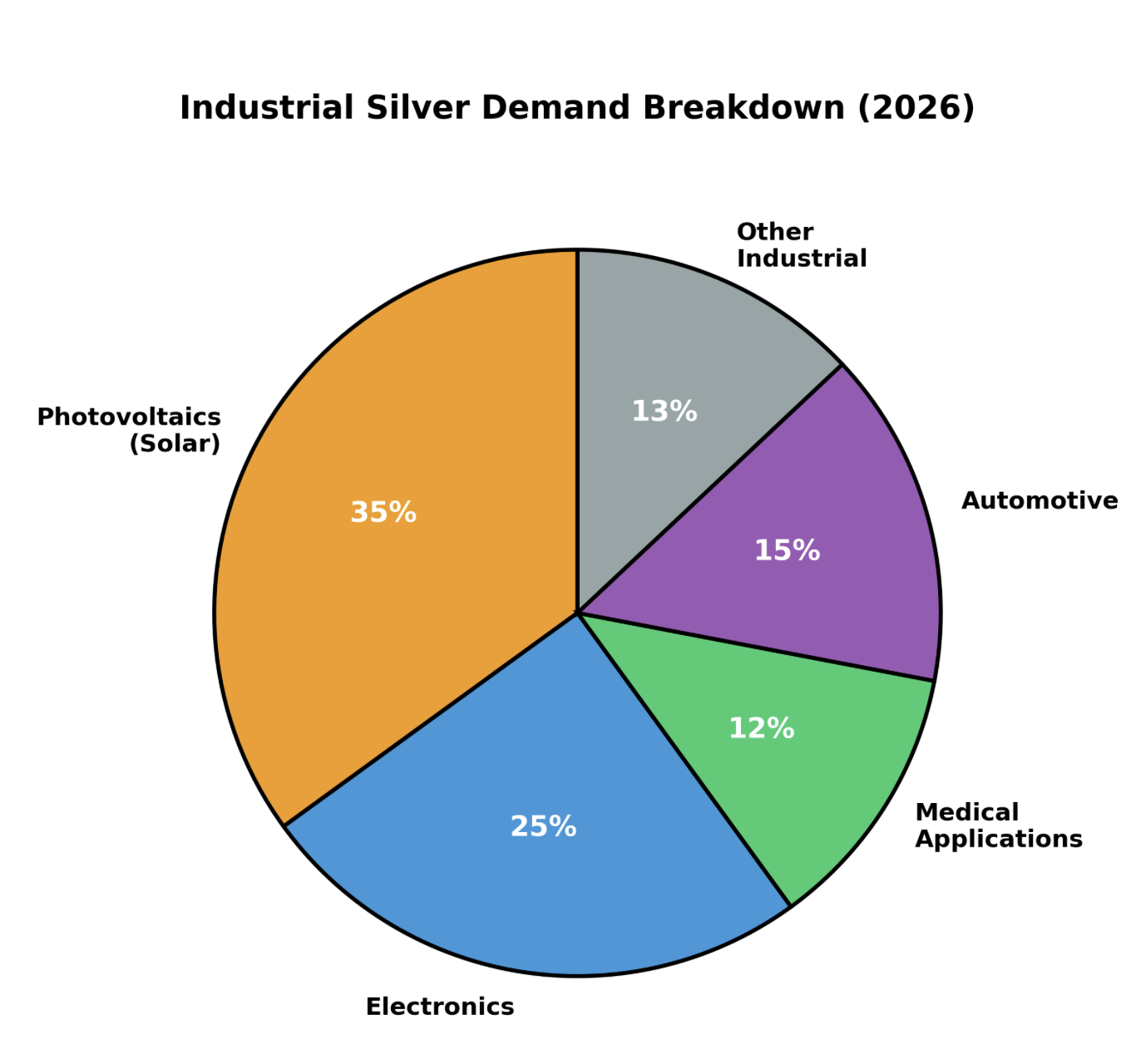
Currently, one industry is driving that demand through the roof: the photovoltaic industry.
The photovoltaic industry will consume a tremendous amount of silver. For example, in 2026, there will be an estimated 250 gigawatts of solar installed globally in the world. Each megawatt of solar generated will require silver for the conductive paste in the manufacture of solar cells. This will result in 4,000 additional tons of silver required simply for new solar installations in one year.
Yes, there are companies developing technologies to reduce the amount of silver used in producing solar cells, for example, by using thinner layers of silver and exploring alternative materials, but the explosive growth in solar panel production is far greater than any decrease in silver use per unit of solar plant output.
Therefore, many of the manufacturers/developers of solar panels will supply fewer pounds of silver based on these new technologies and, therefore, continue to add to their aggregate silver demand far in excess of what would be produced by the entire reduction in consumption of silver from that technology.
Silver demand from industrial users is also very strong for electronics and medical applications. Many billions of smartphones are manufactured each year, and there is a small amount of silver in each. Every time you multiply by billions, the amount of silver used becomes enormous. Additionally, every medical instrument, anti-bacterial coating, and water treatment system manufactured requires silver.
This industrial demand results in the very important creation of a structural supply gap that price could not resolve. Unlike the investment demand side of the market, when investment demand shrinks, industrial demand continues because obtaining silver is critical for the manufacture of and providing power through solar investment systems.
Therefore, a company that manufactures solar panels or makes electronic components cannot stop making these products just because the price of silver is increasing.
The explosive growth in photovoltaic technology and capacity will completely change how silver is priced. With the quantity of silver needed per factory flowing from the highest number of customers competing for a limited silver supply, the forces will only push the price of silver up.
That is because the demand from industrial users for silver is not speculative; it is extremely consistent, stable, and growing rapidly. This is one of the reasons the silver price expectations for 2026 are based primarily on industrial demand far outpacing any supply.
Silver Inventory Crisis: Why Physical Premiums Are Driving Prices Higher
If you take a look at the warehouses that hold the world's physical silver today, you'll see nearly empty shelves.
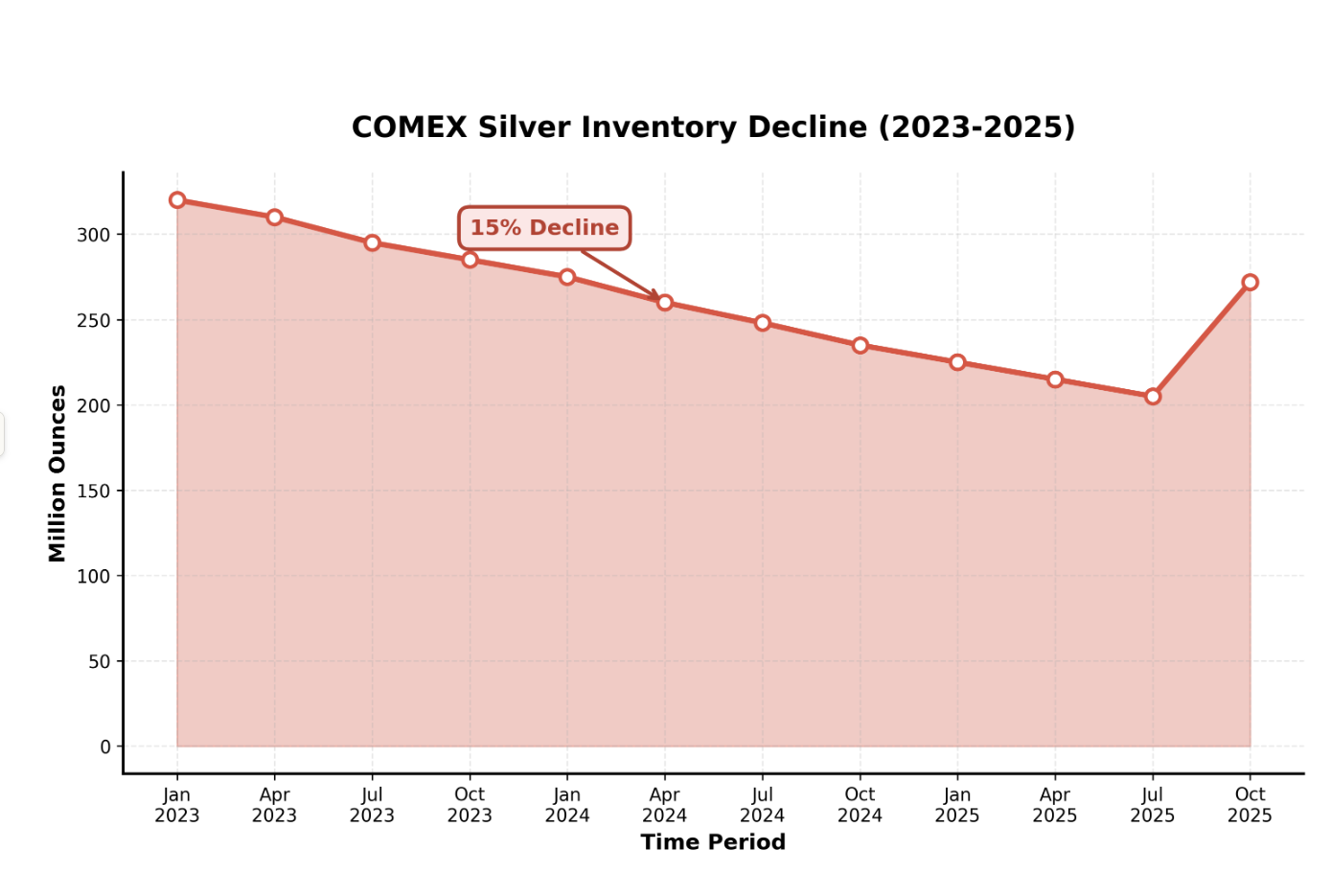
The amount of silver held in COMEX warehouses has dropped by 15% in 2025, and the total amount of silver available through the London Bullion Market Association has fallen below the long-term average. These declines aren't just temporary; they are the result of years of sustained depletion.
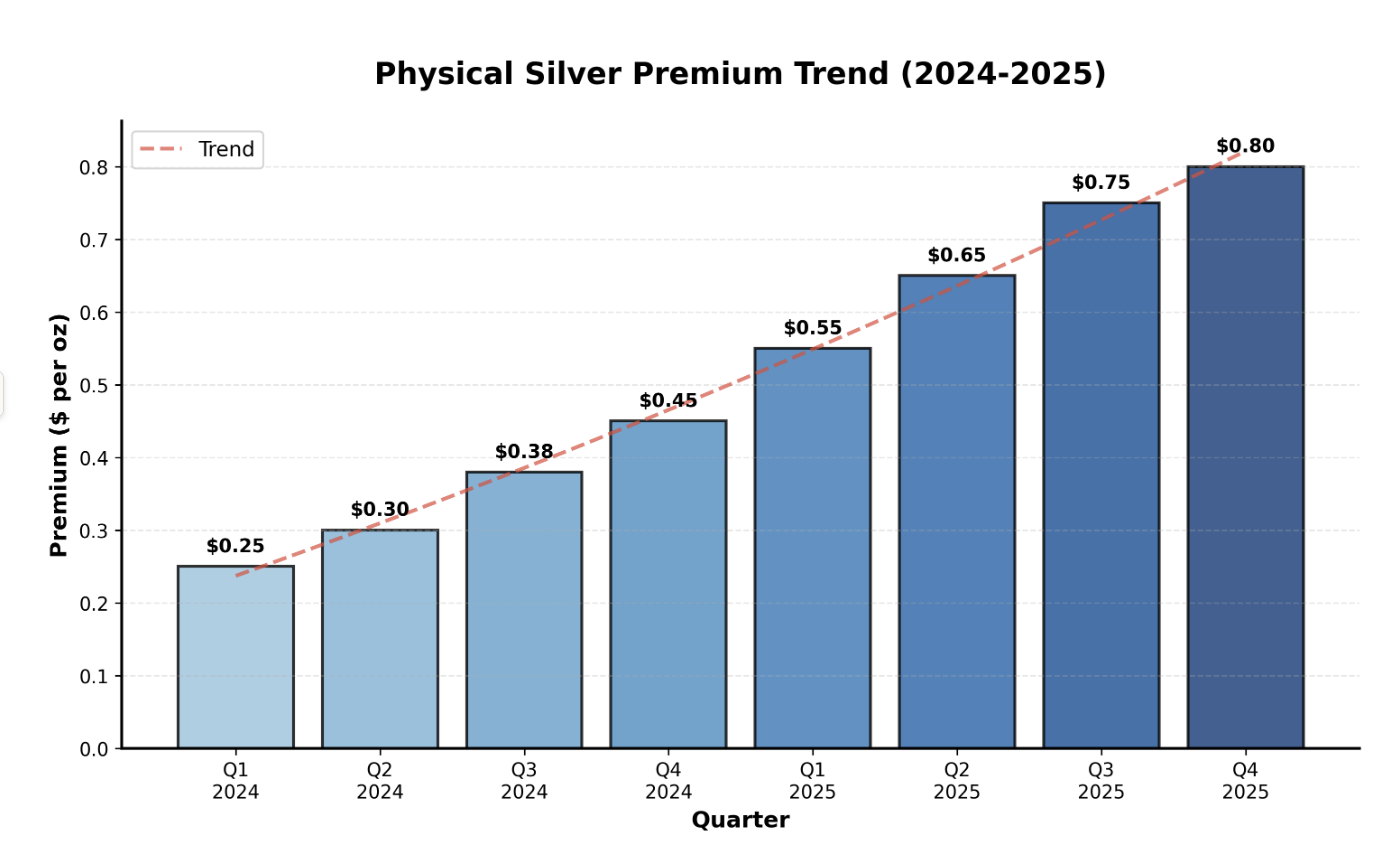
What makes these declines particularly interesting, however, is the price at which people can buy physical silver, known as "physical premiums". In 2024, the physical premium was approximately $0.25 per ounce; by the end of 2025, the premium had increased to approximately $0.80 per ounce and is continuing to rise.
Think of this situation like an empty grocery store. As long as there are empty shelves in the grocery store, prices will increase. The same principle applies to empty silver warehouses.
Physical premiums are crucial to identify because they demonstrate supply stress in the physical marketplace that cannot be completely identified using solely spot prices. When dealers who sell physical silver cannot find enough physical silver to sell, and there are many buyers for the little amount of physical metal available, the price of physical silver will increase. As physical silver rises in price, spot prices will also rise as the market reconciles the price of paper silver with the price of physical silver.
The situation on COMEX is exacerbated by the fact that Comex's warehouses are the location where futures contracts are delivered. Thus, if stocks in their warehouses are declining while open interest is high, then at some point in time, a delivery squeeze will occur. Traders who are betting on the value of paper silver suddenly learn that converting paper contracts into physical silver is not as simple as they thought it was.
From an investment perspective, the scarcity of available inventory places a price floor on silver. Regardless of whether speculators decide not to purchase silver anymore, prices will still be supported due to the limited availability of physical silver. Thus, as with all commodities, there is a correlation between supply and demand; however, in the case of silver, production cannot quickly ramp up to meet demand. Most of the silver that is produced will occur as a byproduct of mining operations over several years.
The inventory crisis that currently exists is not likely to be resolved anytime soon. Consequently, this will continue to be a key underpinning for positive bullish silver price predictions for 2026 and beyond.
Global Macro Factors: How Economic Trends Influence Silver Prices
For silver to be effective, it requires an audience beyond its parameters itself within a vacuum. Silver prices are largely affected by macroeconomic influences most of the time, with an ongoing connection between these factors and the price of silver. There appears to be a long-standing trend in America between the US dollar index and silver pricing in an opposing correlation relationship.
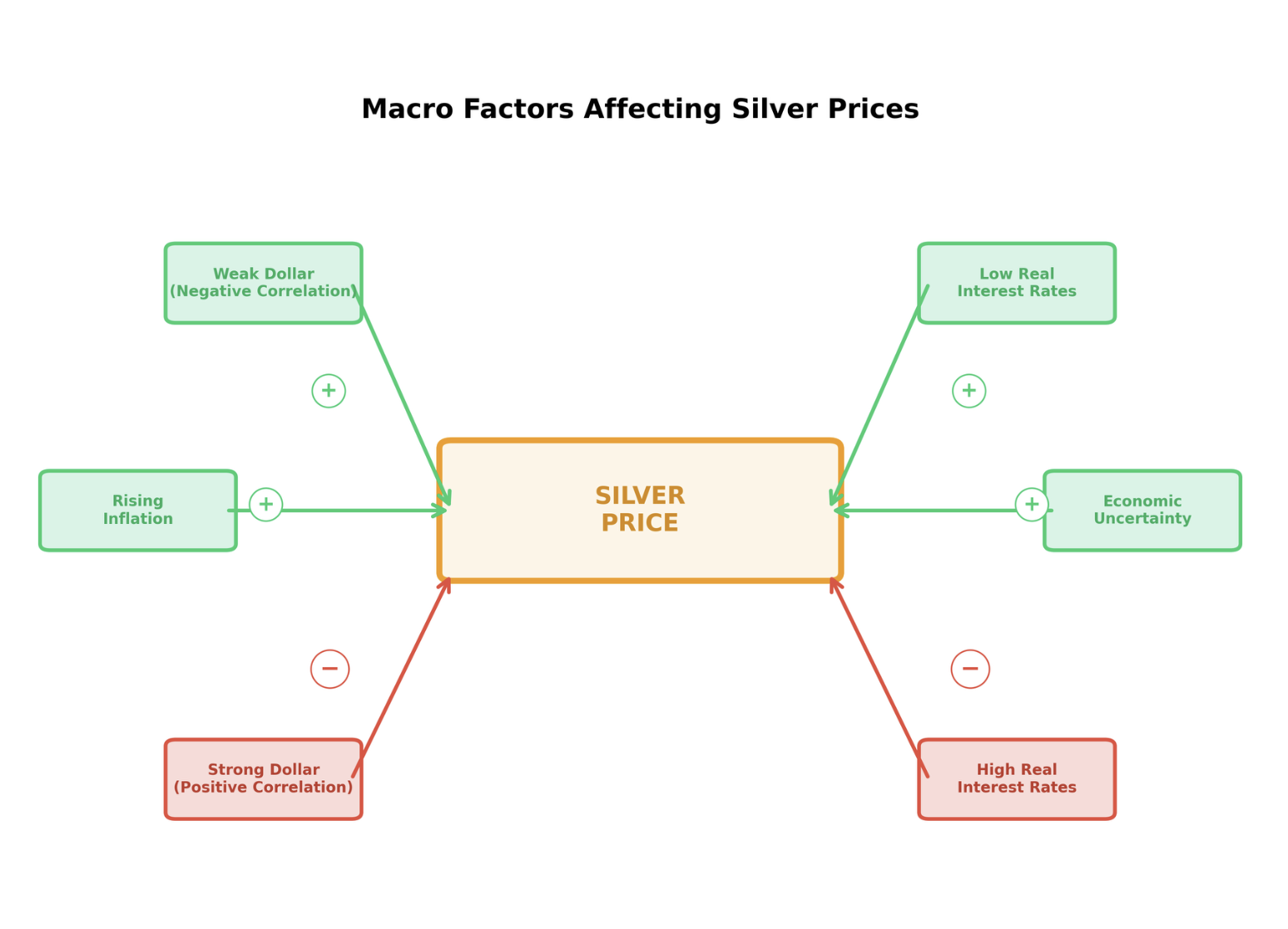
Simply put, the dollar will rally when it becomes weaker, and the dollar will face headwinds when the dollar increases in value by way of increases in the value of the dollar. Traders will closely follow the price movements of both silver and the dollar as they both can confirm price movement directionally for future expectations with near 95% accuracy.
The same is true for the relationship between interest rates and the price of silver. Lower or negative real interest rates, the difference between nominal rates and inflation creates an opportunity for investors to buy silver. With silver being a non-yielding asset, the spread between cash and 2% being less than inflation, 3% becomes an incentive to own silver, when both the Federal Reserve's expansion of its balance sheet and interest rate reductions caused gold and silver prices to soar.
The expectations of inflation are another macro factor that has created the narrative for endorsement of investing in silver. People buy tangible assets when there is uncertainty about the future value of a currency. Particularly as it relates to inflation in paper currencies, silver can be viewed as a store of value or hedge against the loss of purchasing power.
Currently, a unique macro environment exists globally with the economies of the Central Bank of the world continually walking a tightrope of controlling inflation & recession. Interest rate policies continue to shift and evolve as questions abound as to the future reserve status of the dollar and how the changes to international trade will affect that.
For the long-term invested holder of silver, the macro factors will serve as a form of guidance rather than distractions when the dollar weakens due to modest real interest rates. Those two macro environments simultaneously set up market conditions for silver prices to appreciate as both the dollar's value declines, as well as modestly positive real interest rates, would drive prices significantly higher as a result of the existence of favourable macro conditions without necessarily having any changes in supply or demand for silver.
The key, for the smart investor, to evaluating the overall health of investment in silver would include having a complete understanding of the following:
-
Federal Reserve policy & procedures
-
Inflationary data releases
-
Changes in the price trajectory of the dollar.
The combined understanding of the three indicators will provide the early warning signs of whether the macro environment will be supportive, or will adversely affect your investment in silver, and whether you may be able to accurately predict the future price of silver will, in fact, be in the year 2026.
Supply-Side Analysis: Mining, Production Costs & Silver Scarcity
Silver does not just spontaneously generate; it comes from underground mines, so the availability of silver to the market is constrained by the availability of mines.
The largest amount of new silver comes from a very small number of countries (Mexico and Peru) that together represent a large percentage of the total available silver. Any disruption to one of these regions from labour strikes, regulatory changes, or natural disasters will quickly have a major effect on the total amount of silver available to the world's markets.
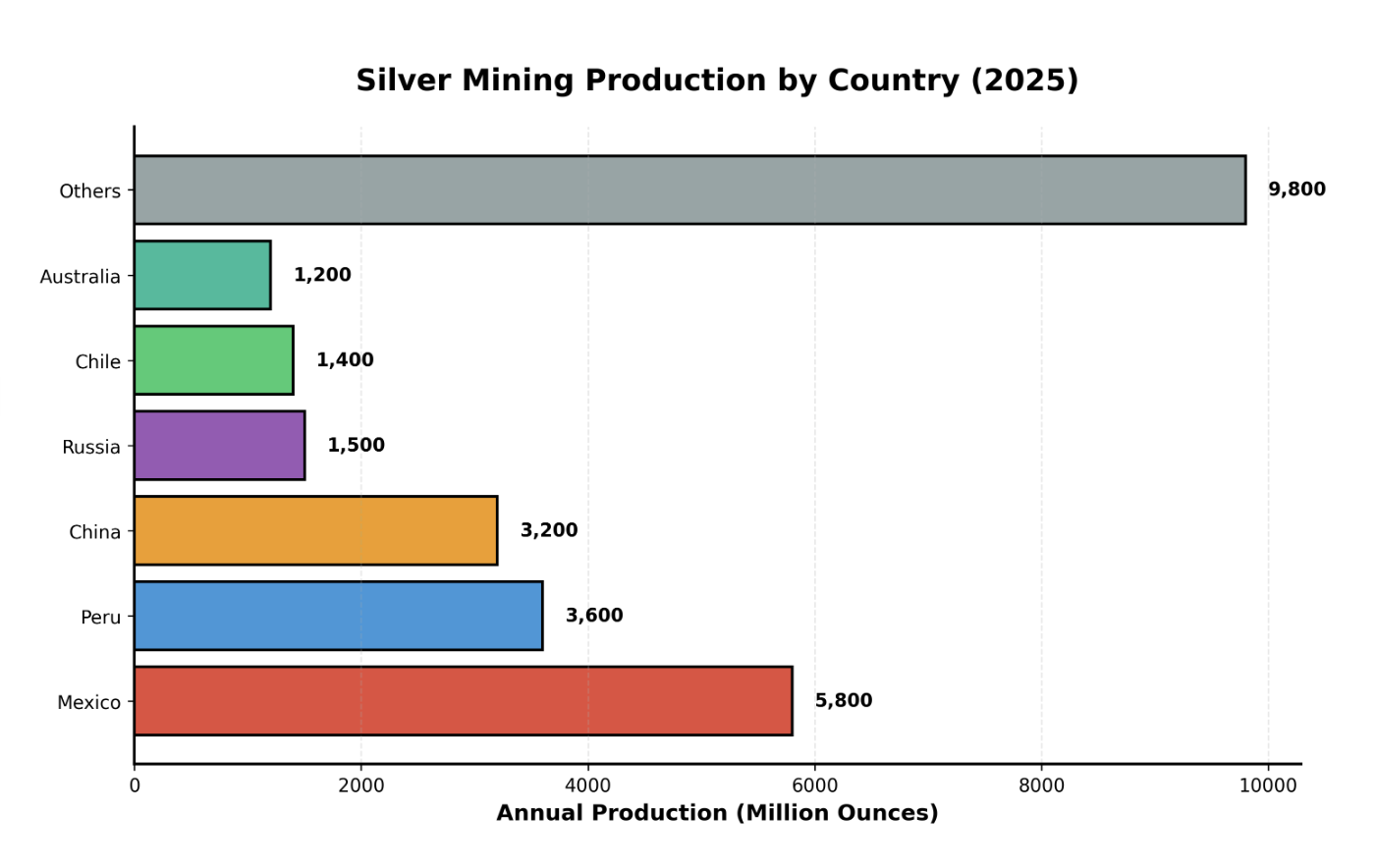
Another aspect to note is that 70% of silver is produced as a byproduct from the production of other metals (copper, lead, and zinc). There are not many primary silver mines in the world. As a result, the price of silver cannot be relied on to directly correlate with the cost of mining silver. When producing copper, they dig for copper, and silver is a lucky bonus that adds to the production value of the mine.
Another important factor introduces complexity into the cost of producing silver, which reflects a floor price for silver. All-in sustaining costs to mine silver are typically between $12-$18 per ounce for most silver mines, with individual operations falling somewhere in between this range. When the price of silver is lower than what it costs to mine silver, miners do not have an incentive to mine silver at a loss forever.
Therefore, if the price of silver falls below a certain level, marginal production sources shut down because it is not economical to continue producing. The closure of these operations leads to a supply decline, which will generate a natural price support.
Can the new supply make up the current deficit in silver? Not in the short term. The time it takes to bring new mines online is between 7 and 10 years from the date a new mine is discovered until it begins production. Although there is an opportunity to expand existing production, expansion takes time and substantial amounts of capital to complete. Therefore, the current deficit in silver supply cannot be resolved by fast-tracking new mines into production before 2026.
The environmental and regulatory constraints associated with producing silver in response to demand provide another level of complexity regarding silver mining production. Globally, mining faces increasing regulation and stricter regulations on mineral exploration and the permitting process; permits are taking longer and are more difficult to obtain due to opposition from surrounding communities; and the above-mentioned barriers are not temporary. They are the new normal for resource extraction.
The above supply-side picture of silver creates a bullish price prediction for silver. Demand for silver is outpacing supply, and supply will not be able to catch up to demand in the short term. The only way that the supply and demand imbalance will be resolved is with higher prices that provide incentives for new production and reduce marginal demand for silver.
It is expected that the inelasticity of industrial demand for silver will require pricing to do the majority of the work for this to occur. It is projected that due to the supply fundamentals alone, silver prices will be significantly higher than today by 2026.
Financial Market Demand: ETFs, Futures & Speculation Driving Silver
The silver markets have been amplified ever since financial markets began pouring money into both physical and financial types of silver. The financial markets have only added fuel to the fire of the increased physical demand for silver, thus driving up the prices of silver.
Silver ETFs, such as iShares Silver Trust (SLV), hold large amounts (more than 200 million ounces of silver) of physical silver on behalf of their investors. When these funds have inflows, they must purchase physical silver to back the additional shares created by the inflow, thus directly affecting spot prices. The trend of the holdings of the largest silver ETFs can be used as an indication of how much institutional and retail investors want to invest in silver.
If you look over the last year at the holdings of SLV, you can see that these holdings present a pattern of accumulation of physical silver followed by periods of consolidation. All of the major inflow phases of SLV corresponded with upward price movements, which is not coincidental but rather causal.
Various methods of investing in silver create even more demand for physical silver, including silver futures on COMEX. Traders can trade long and short positions on the COMEX silver futures market, creating volatility in the short term as a result of the price tug-of-war that occurs.
Financial speculation in the silver market can produce some interesting conclusions about silver's potential upside versus industrial uses for silver. Traders of silver do not need silver for industrial purposes; they are only looking to capture as much yield as they can.
Therefore, the financial demand for silver becomes relatively more volatile than industrial demand, but creates significantly stronger trends during the trend phases of silver. As more momentum builds in the silver market and traders are more aggressive in their buying, the potential for price spikes in the silver market becomes greater.
To put it into perspective, a company could release a limited-edition sneaker with only 500 pairs available to the public. Everybody who wants a pair of these sneakers lines up to buy one, which would cause the price of the pair of shoes to rise rapidly as the demand to buy exceeds the quantity available to buy. The investment process of buying and holding silver in the precious metals ETF and the futures market is similar in that they create a similar supply-demand imbalance in the financial markets.
A relationship exists between the financial and physical silver markets, and the effects of stress in one market transfer to both silver markets. In periods when ETF demand creates rapidly depleting physical inventories, premiums will rise. When the futures market becomes excessively one-sided in either the long or short direction, there could be short-squeeze or long-liquidation opportunities.
Financial market silver demand does not just react to silver prices; it will drive silver prices upwards. Understanding ETF flows and futures positioning will provide traders with insights into predicting movement in silver prices. In predicting future silver price levels, such as 2026 silver price predictions, attention must be paid to the financial indicators of ETF trends as well as physical supply trends, such as mine supply or solar panel production.
Geopolitical Risks: How Wars, Trade Conflicts & Disasters Affect Silver Prices
Uncertainty is the enemy of the stock market; however, it helps the price of silver increase due to both supply and demand. Any type of political instability, whether it be war or trade disputes, will create supply and demand disruptions, which will cause the price of silver to fluctuate widely.
For example, if there were to be military action taken in a country that has a major silver mining operation, the supply of silver could be cut off overnight. If there were to be trade disputes between two countries, it would have a large impact on which country is receiving silver and how much they are receiving.
Another great example of how uncertainty creates price swings in silver would be during the Libyan conflict in 2011. The price of silver increased during that time due to uncertainty in the Middle East. Even though the actual impact on silver supply was minimal from Libya, the fear of not having a supply created a fear premium, which increased the price of silver.
There are also other types of events, like natural disasters and mining accidents, that can create uncertainty in silver supplies. For example, if a large earthquake were to hit a large silver mining country like Peru, many of the country's mines may be shut down at the same time. If there were a tailings dam failure at a mining operation, then production would cease for potentially months or be shut down forever.
The analogy works in your local bakery when it shuts down. Since the bakery is out of business, the demand for bread will remain the same, but the supply of bread will decrease. Therefore, the price of bread will increase. The silver market also works this way when there is a major supply disruption.
Trade conflicts are also very important when it comes to silver. If a trade war occurs between two countries, it will disrupt the flow of silver, increase the cost of silver through tariffs, and create stockpiling events. Companies will rush to buy silver before tariffs take effect, causing temporary spikes in demand.
As an investor, you need to build hedges into your portfolio for geopolitical risk. Don't assume that you will never have any issues. Assume you will have issues and determine what type of volatility will occur because of an unexpected event. Most of the time, these types of events will help push the price of silver up as a result of future demand for safe-haven assets (silver) and future upside risk associated with supply.
Risk management is a must when investing in silver. Investors who make the most money are not those who can accurately predict each geopolitical event. Investors who make the most money have positioned their portfolios in a manner that allows them to handle volatility in a non-panic-selling way at the worst time for them.
Technical Analysis & Market Sentiment: Predicting Short-Term Silver Trends
Charts assist in interpreting the present phase of the market, but they can't provide forecasts. Price movements can be assessed using tools created through technical analysis, which enables traders to forecast near-term price action, for example, the various crossovers among moving averages, the 50-day moving average overlapping the 200-day moving average, demonstrating bullish momentum.
A "golden cross" occurs when the shorter-term moving average crosses above the longer-term moving average, which signifies an uptrend. Conversely, when the shorter-term moving average crosses beneath the longer-term moving average, it also signifies an indication of a downtrend.
The Relative Strength Index shows whether silver is currently overbought (RSI > 70) or oversold (RSI < 30). If silver has an RSI that indicates it is overbought, this does not mean that the trader should sell the asset immediately.
Rather, it means that the recent price action has moved beyond the fundamental value, and a retreat is to be expected better price point example, waiting to break above all-time high, indicates that there may be greater returns when buying once the consolidation phase is completed at the top of this move.
Likewise, if silver has an RSI that indicates it is currently in an oversold condition, this may provide a buying opportunity before the next increase in price action occurs.
Bollinger Bands are a measure of volatility. When prices near or track along the upper Bollinger Band, this typically would indicate that prices are trending up and momentum will likely continue; however, as there is extension risk, there would be a potential for prices to retract. Conversely, prices near the lower Bollinger Band suggest that prices have compressed and are likely to extend upward.
Overall, previous price action and figures produced by technical analysis can assist the trader in telling the overall mood of the market. Volume increase; Price increase, confirmed increase of value through increased buying activity and lower volume; no confirmation of a price increase. Fear index: positioning data shows whether the trader community has taken excessive long or short positions and created contrarian opportunities.
Use technical analysis as you would when driving a vehicle; traffic signals assist in determining when it is safe to start moving. Again, a red light means stop, and a green light indicates it is possible to resume driving. Technical analysis is used to provide the same clarity on when price movements and direction will occur.
Using both technical analysis and fundamental analysis will provide you with a clearer understanding of the price action of silver. Fundamental research will assist in completing your understanding by identifying price levels where the physical metal should be valued based on the current supply, demand, inflation, and macroeconomic conditions and how the physical metal is likely to arrive at those price levels based on historical trends and data derived from technical analysis.
Utilising these technical indicators can assist with entry and exit points for traders looking for over a long-term horizon in 2026. Additionally, by understanding when prices may be excessive based upon other historical price movements and value accumulation stages, long-term investors can utilise this information when determining an ideal buying opportunity.
Silver Price Forecast & Scenario Analysis: From Conservative to Aggressive
Let's identify real price targets for silver in 2026.
Conservative scenario: $45-$65 per ounce
This assumes that there is slow economic growth, that there won't be as many solar panels being installed as currently estimated, and that there will be some alleviation of the supply constraint. It also assumes that a few new mines will come online earlier than expected. As well, it assumes that investment demand would be fairly weak.
Even in the conservative target - $45 to $65 - silver is likely to trade far above this range, based upon industrial demand for silver and the structural shortages of silver. It is hard to picture silver crashing to the $45 to $65 range when you can see that very tight inventories of silver and that demand for silver in solar panels continue to go up.
Consensus scenario: $90-$100 per ounce
This is the price range supported by the fundamentals - a stable world economy, a continued explosion of solar-powered energy, persistent supply shortages of silver, and healthy demand for investment via ETFs and physical purchases of silver. It also holds that the overall macro options remain either neutral to bullish - that the dollar will not strengthen significantly and that real interest rates will remain at reasonable levels.
At $100 per ounce for silver, it will not be overvalued; rather, it will be the market demand price that has been developing for years. The forecasts from many large banks, implied volatility of futures contracts, and the position data from bullion dealers are all converging upon a $90 - $100 per ounce target.
Aggressive scenario: $150+ per ounce
For $150 to occur, it would take some major event - either a supply shock due to geopolitics, a disaster at one or more silver mines, a massive influx of institutional investment into ETFs all at once, or a sharp decline of the dollar, or a combination of one or more of these events to occur.
Is $150 a realistic target? It would be less likely to occur than the consensus or conservative targets, but it is not a pipe dream, i.e., from 2011 to the present, as of August 2021, silver was at $50, with nowhere near the industrial demand that exists currently. With the right combination of supply issues and strong investment buying, triple-digit returns are not beyond the realm of reality.
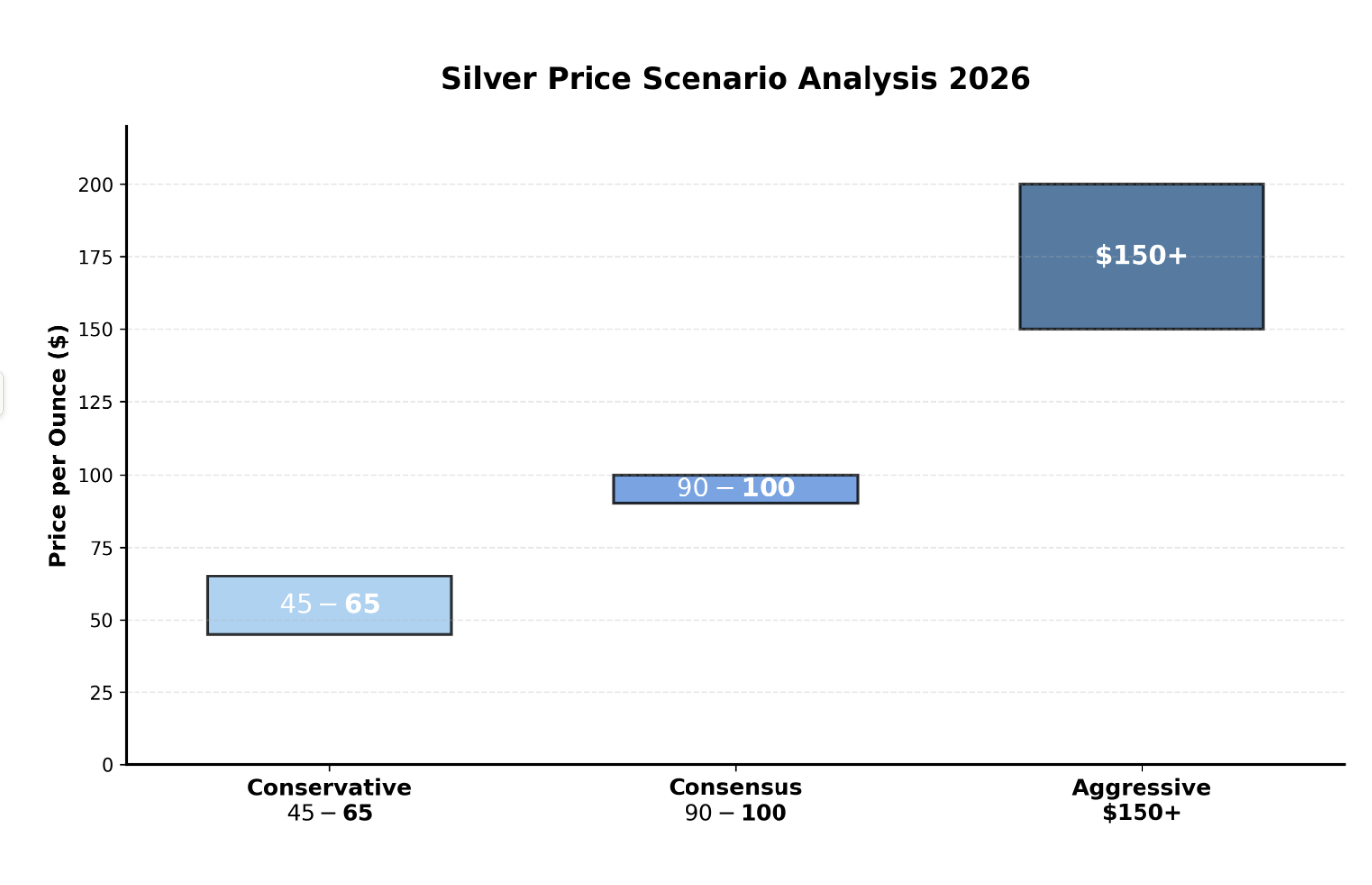
The silver price targets can be treated like weather forecasts; the consensus scenario is the most probable; the conservative and aggressive scenarios establish the outside boundaries of what could happen. Savvy investors will act on the consensus scenario while remaining with the flexibility to benefit from the aggressive scenario should that unfold.
The bottom line is that $100 per ounce has a logical basis in the markets. This is not a guess; this is the price point that will eventually become the market supply-demand equilibrium price, where the amount of silver that will be available will equal the amount of silver that will be used for industrial applications and that will be bought for investment purposes. It is unknown whether silver will reach this target in early 2026 or sometime before that point, depending on the rate of change of the above variables.
Silver Investment Strategies: Practical Tips for Mid-to-Long-Term Investors
You need to have both an actual investment strategy and an understanding of your investment style, along with a solid plan as to how you will utilise these price targets.
What is your style of investing?
Are you accumulating for the long term over a long period of time? Or do you want to trade and take advantage of price fluctuations? Depending on your style of investing, this will dictate everything else. Long-term accumulation investors focus on the overall quantity rather than timing; their only concern is acquiring the total number of ounces. In contrast, traders utilise tight risk management and short-term timeframes.
Utilising dollar-cost averaging (DCA)
By investing the same dollar amount each month or quarter, regardless of the price at which you are buying investments, you will average out volatility and eliminate the anxiety caused by trying to time your purchase.
If you think about how you save each week, it isn't done with waiting for the "best" week to do so; you are saving consistently, and this is the approach you must take when purchasing silver.
Holding physical silver means that you are holding established forms of it, i.e., coins, bars, or rounds. Although you own the metal directly, you will have to pay premium prices for it, and you may need to store and insure it. Holding physical silver is ideal for those accumulating over the long term, as you will have real ownership in the tangible assets.
ETFs provide ease of liquidity, i.e., how quickly you can sell your investment and lower overall transaction costs, but they are also tied to the fund in relation to the silver that they are claiming to own. ETFs generally serve well for traders and those who want to hold their investment for a short duration of time. However, for people who are going to hold their investment for multi-year terms and do not want counterparty exposure, physical silver is ideal.
These are ways to manage your risk:
-
Never put more than you can afford to lose into silver.
-
Diversify your silver with other asset classes. Do not just invest in silver.
-
Place stop losses on your trades.
Check for changes in the strength of the dollar and interest rates every so often, since they have a dramatic impact on silver's value.
Changes In Policy Can Affect Silver Prices
Check the Federal Reserve’s announcements for any policy changes or trade agreements that can have an immediate impact on silver prices, along with any changes in the regulations for mining companies.
Set Price Levels Where You Will Take Profits When Investing In Silver
Determine ahead of time what price level you want to take your profits on, e.g., if silver reaches $100 an ounce, do you want to sell all of your silver or only part of it? Having predetermined targets ensures you will not make decisions based on your emotions during large swings in price.
The investors who will make money investing in silver will not be the people who time the market perfectly. The successful investors will have a well-disciplined strategy, a realistic investment plan, and an effective risk management plan that enables them to stay in the market long enough for their investment thesis to become profitable. Although $100 per ounce is the stated target for silver's rise, you will need to be patient and follow an effective process to reach your target.
Key Takeaways for Silver Investors
In 2026, silver will not be determined by speculation but will have finally come to align purely on the fundamentals in the past several years.
The shortage of supply isn’t going away either, with industrial demand increasing for photovoltaics. Inventories at the COMEX and the LBMA are still quite low. These are not temporary issues and will not correct themselves very quickly, but rather, are structural issues that will take several years to correct.
The $100 an ounce silver price has gone from a “wishful thinking” price to one that we can use as a forecast that has real market dynamics behind it.
How we get there will depend on how macro factors, investment flow, and any shocks to supply develop throughout the year.
The investment opportunity is clear for investors but requires discipline. This is not a “get-rich-quick” trade, but rather a mid-to-long-term position in an asset with improving fundamentals while the majority of investors are currently ignoring them.
You must remain focused on the data. Monitor ETF holdings, the COMEX inventory, the amount of solar installations, and other macro indicators. Use the data to help you determine your decisions and not emotions or media headlines.
Silver is one of the clearest examples of an imbalance between demand and supply in today's commodity markets. The investors who identify that imbalance early and position themselves accordingly will greatly benefit from the price increases that will take place to reflect true value.
If you are ready to take advantage of the silver opportunity in 2026, TradeWill.com has the tools, research, and trading platform needed for you to implement your silver investment successfully.
Disclaimer: The content of the blog does not represent any position of Trade W, does not serve as any trading-related decision advice, and does not endorse any third-party.