

 Trade W
What Exactly Is Silver - and Why It Is NOT Just "Cheap Gold"
First things first: silver is not just "budget gold." If you think of silver as being one step down from gold based on price, you're not looking at the full picture.
What distinguishes silver from gold is its existence in two separate markets at the same time. First, silver acts as a "safe haven" investment when investors are seeking shelter during economically unstable times. Second, silver is used by factories to produce products and extend into technology with soldering to circuit boards, in addition to using silver to produce solar panels throughout the globe.
The duality of silver's identity creates the core reason why the silver price forecast is challenging. When attempting to project where silver prices are headed, one is forecasting two distinct yet seamlessly connected markets for the same metal.
When inflation increases or geopolitical tensions escalate, investors flock to both silver and gold as a store of value in times when fiat currencies lose their purchasing power. However, while those investors push up prices, factories are purchasing silver to create their products. This indicates factories are utilising silver for production, rather than consumer speculation with designs to flip silver for profit.
This results in price fluctuations for silver stocks that gold does not experience. The fact that the silver market is smaller and more centralised than gold and is more responsive to changes in capital movements provides for this inherent volatility. Therefore, rapid influxes of money can create rapid increases in the price of silver.
When the liquidation process is complete, the results can sometimes be extreme. Imagine that "gold" represents an international corporation owning numerous bank accounts full of gold, with a secure and stable way to manage their wealth, while "silver" is thought of as small, regional banks that are limited at best when it comes to their ability to accept large deposits or withdrawals.
Let us explore the investment aspect of silver when inflationary pressures increase or when traditional central banks engage in relatively aggressive financial policy, or when geopolitical events create uncertainty and instability between countries.
The similarities between silver and gold become even more prominent. Investors see silver in the same light as gold as a store of value or hedge against currency debasement, in other words, both silver and gold are viewed as tangible assets that can provide benefits in the digital world, and the key difference between gold and silver is that silver is significantly more volatile and can fluctuate more rapidly in both directions.
The issue of volatility is related directly to the overall size of the silver market. Globally, silver production is roughly 26,000 metric tons per year compared to approximately 3,000 metric tons per year for gold. Though the silver supply is greater than that of gold, when it comes to investing in silver, the actual amount of silver available for investment use is very small.
Therefore, when a "buying frenzy" occurs, the silver market does not have sufficient liquidity to handle it smoothly, causing silver prices to rise sharply. Conversely, should several silver sellers enter the marketplace at the same time, the silver price can fall sharply.
Silver's industrial identity fundamentally affects the nature of the silver market. Most people do not realise that modern technological innovations rely heavily upon silver for conducting electricity. For example, every factory producing photovoltaic panels has implemented the application of silver paste to create photovoltaic cells, simply because silver is the best electrical conductor available.
Additionally, electric vehicles use silver in their electric motors and battery systems, as well as in their charging systems, to maximise efficiency while minimising waste. The semiconductor industry uses silver for connecting circuits and sockets in virtually all electronic devices (e.g., cell phones, computers, server systems, etc.).

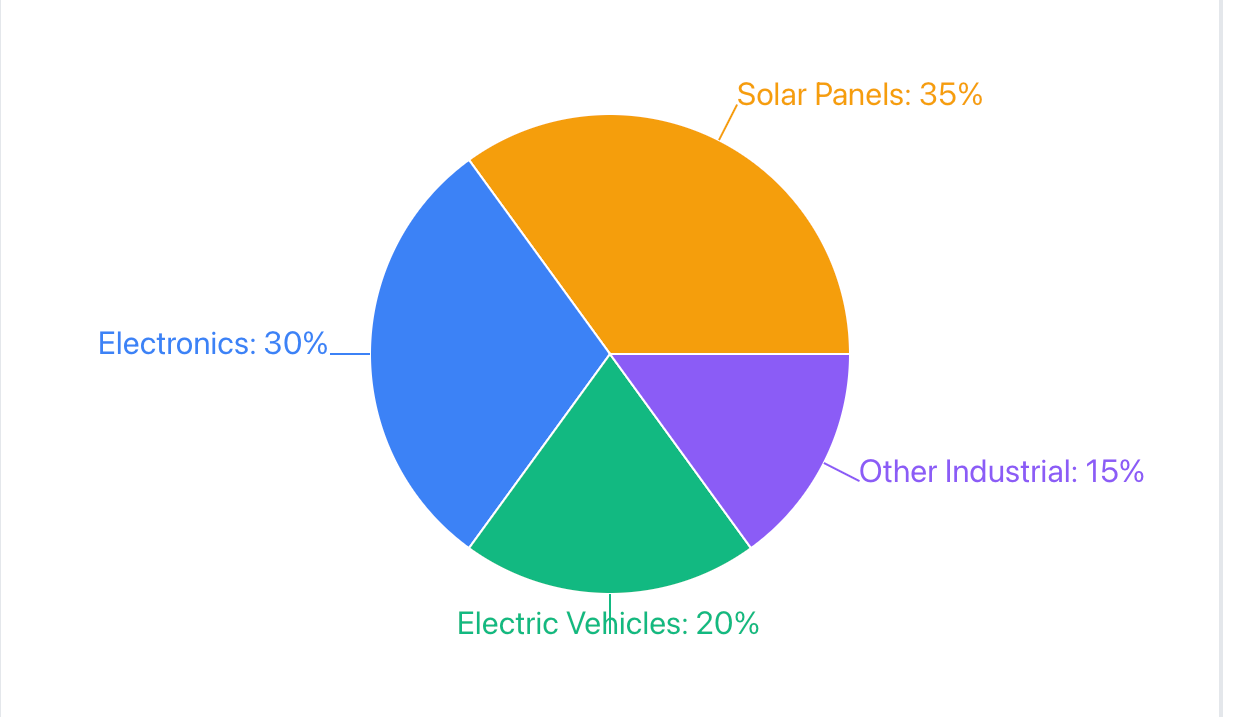
Therefore, investing in silver depends upon whether or not someone wants to invest in silver today, whereas the demand for silver from industrial users mandates that they continue to purchase silver for the ongoing production of their products. If a smartphone manufacturer stopped using silver, for whatever reason (e.g., silver price rises by 15%), it would not be possible for that company to simply revert to using copper and expect the same results or performance.
Similarly, if a manufacturer of solar panels switched to using copper as the conductive material in photovoltaic cells, those panels would not perform to the same standards as they would with silver as the conductive material. Once the use of silver in industrial applications is established, these purchasing patterns become more structured or long-lasting rather than cyclical.
The challenge arises when trying to forecast the price of silver. The pricing of silver is relatively volatile, and this volatility has the potential to confuse investors. Therefore, long-term technology advances will continue to drive the industrial use of silver upward over time.
Thus, at certain times, these forces will come together, as evidenced by rising inflation and, consequently, investor buying, and increasing green energy usage and, therefore, increasing industrial usage of silver, which allows for silver's price to spike upward.
However, on other occasions, these forces might not coincide; for example, the significant industrial demand for silver could maintain or even support a price of silver at the same time as the influx of investment funds dries up, therefore causing confusion, uncertainty, and stagnation within the silver marketplace amongst investors.
Because of the duality of silver's commodity nature, sudden price surges will create confusion for both investors and traders alike, who may be subject to sudden price corrections after experiencing extreme volatility. Not only does one have to consider investing in a precious metal or industrial commodity, but one is investing in these two categories at the same time, and they might not always agree with each other's trends.

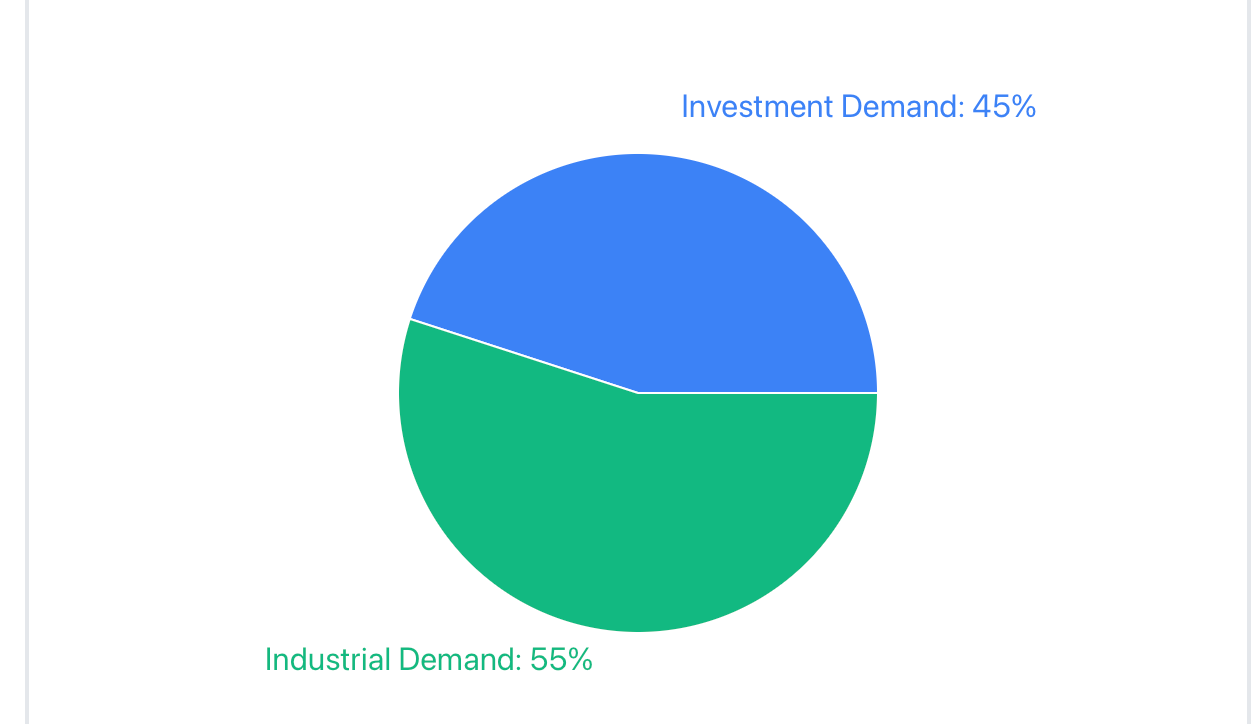
Understanding the duality of silver:
Understanding the dual nature of silver is critical to developing a reliable and accurate method for silver price forecast. Without understanding the dual nature of silver, analysts developing forecasts will always misinterpret the price movements of silver.
Silver Prices Forecast 2026: Bullish, Bearish, and Base Scenarios Explained

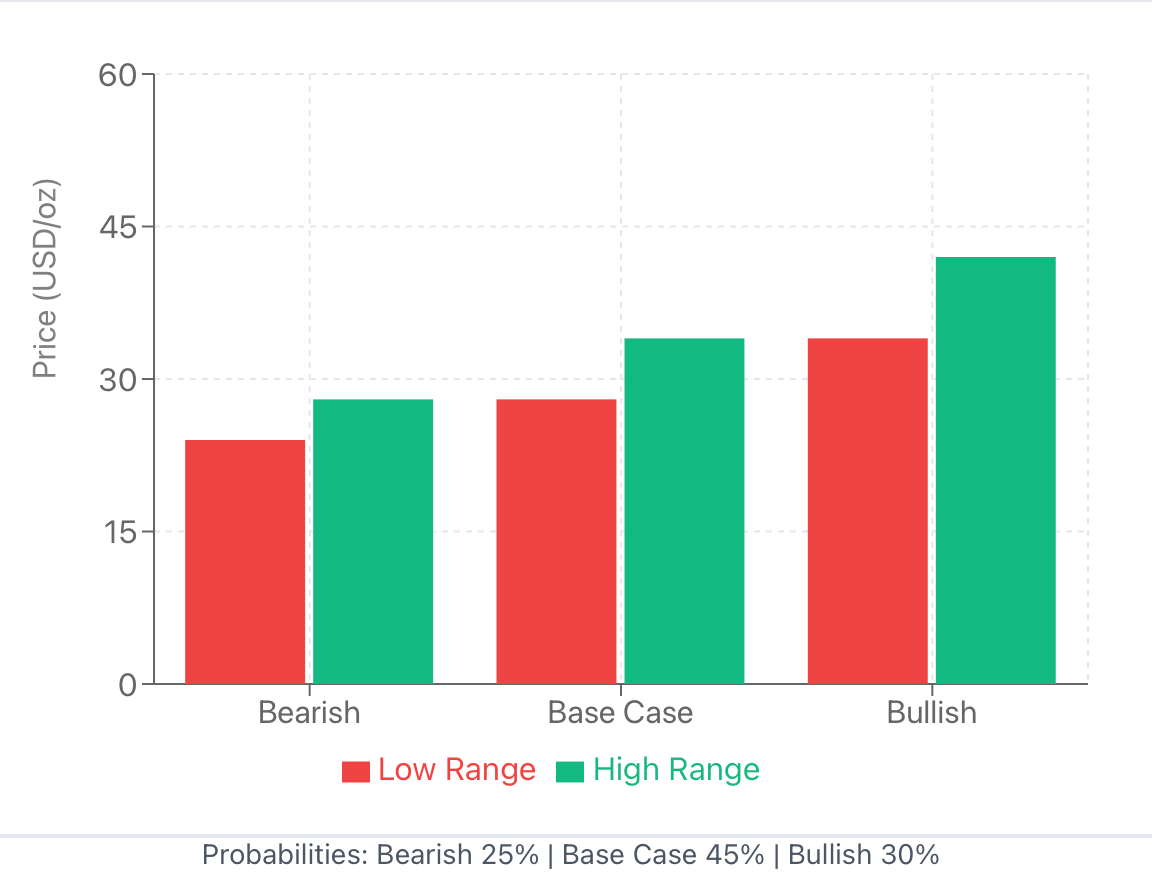
One of the most common mistakes that people make when looking at a silver price forecast for 2026 is that they want a single number. They ask, "Where will silver be by December 2026?" as if markets move linearly to predetermined targets.
Real forecasting does not work like this. If someone gives you a specific price prediction for an asset without giving you a clear explanation of what would need to occur for that price to be achieved, then that person is either oversimplifying the market or is someone who does not understand how silver's price is influenced. The proper way to forecast silver's price for 2026 is to use scenario analysis. You would develop several different scenarios based on how multiple factors could develop.
The Bullish Scenario: The Perfect Storm
If certain conditions align in conjunction with one another, it is conceivable to generate a forecast for silver prices using this scenario. In the bullish scenario, industrial demand continues to expand because of accelerated solar installations globally, and electric vehicle production increases faster than expected.
Additionally, central banks have altered their course of action and lowered their interest rates, so that their real interest rates are now in negative territory. The U.S. dollar will weaken while other currencies gain strength. As a result, investment capital will flow into precious metals.
Therefore, using this bullish scenario would be the combination of positive momentum times downhill momentum, times the accelerator effect of investment money. For instance, Lower real rates of return make the holding of non-yielding assets less appealing, and thus create higher demand. At the same time, a weaker U.S. dollar lowers costs for international buyers, which will create higher demand.
Finally, the increasing use of silver for industrial processes will continue to tighten physical supplies, driving up demand, which will consequently continue to drive prices higher. The potential for $10 billion in New Investment Capital into Silver could result in an increase of more than 15% due to a less inflated Silver Market than the other Precious Metals markets. There are many reasons why this type of demand will happen.
One of the first catalysts has been the renewed focus on Climate Change Considerations in developing and deploying solar panels quickly. The accelerated deployment of Electric Vehicles has also contributed to this anticipated growth due to accelerated declines in the costs of battery storage technologies.
In addition, the rising levels of Inflation resulting in Lower Real Rates, regardless of nominal interest rates, have also been a major catalyst for investor demand in Precious Metals. Finally, continued geopolitical instability has resulted in Demand for safe-haven assets such as Gold, Silver and other Precious Metals markets.
Typical Trading Range Scenarios: The Tug-of-War
Most of the time, Industry Demand provides a floor for price stability for Silver and other Precious Metals. By providing a floor, Industrial Demand helps prevent prices from crashing. Investor Demand is more unstable and less predictable than the Industrial Demand. Some of the money invested in Precious Metals is driven by Inflation concerns, while other money invested is driven by Demand for Attractive Real Yields, as well as Risk Appetite for investing in Equities.
Therefore, an Investor Demand result is typically characterised as a Trading Range or Price Volatility Scenario, in which Silver Prices fluctuate between $28 and $34 for an extended period of time.
Traders and Investors often experience frustration associated with the Lack of Price Movements over extended periods of time, although the price fluctuations allow for many trading opportunities. Typically, this scenario evolves from an Economic Environment where the inflation rate is decreasing but not eliminated, interest rates are at high levels but have not reached their peak, the strength of the U.S. Dollar is neutral (stable), and Industrial Demand is increasing incrementally versus exponential growth. There are no definitive developments that would drive the price upward or downward; therefore, silver's price is likely to oscillate.
Bearish Scenario: Investment Downward.
Picture the opposite scenario. The United States dollar rallies against weakening economies from around the world and experiences sudden and rapid growth. Inflation will fall much lower than the nominal rate increase, while both real and nominal interest rates will rise. Traditional growth stocks regain volatility from risk appetite, and speculative capital will flow away from commodities and back into traditional growth stocks, therefore removing investment demand.
For the silver bear, there are drawbacks because there is no immediate support for the industrial end, as there is an influx of investment, and when the influx of investment comes to an end. Yes, factories continue to require silver to produce finished goods, but that demand for silver is extremely insensitive to price and therefore has longer cycles of procurement. As such, factories are not actively purchasing that silver and pushing prices higher, but there is a level of consumption that creates a baseline consumption level.
However, under bearish scenarios, silver may fall dramatically because of the overwhelming influence of the investment side of silver price movements over the short term. The industrial side, however, acts as a floor that stops the decline at some point rather than as a mechanism to support pricing. One may expect to see silver drop from $32 to $24 over the next many months, with stabilisation occurring when the industrial end appears more attractive.
The catalysts for bearish scenarios would be the result of continued strong economic growth that keeps interest rates elevated, the central banks of the world are continuing to tighten expectations to fight inflation, a flight to quality will favour dollars at the expense of commodities, and changing technology has decreased the demand for silver within several of the markets which constitute the industrial component of silver, although these have been generally very rare occurrences and relatively low in number and taking time to manifest themselves.
The Importance of Scenario Planning
Each of the scenarios has different probability weights and as conditions change the weightings of each of the scenarios will also change, therefore, you may assign the probabilities of 30% chance for bullish, 45% for the base case, and 25% for the bearish case today, three months from now; you may find out that you assign 40% chance for bullish, 35% for the base case, and 25% for the bearish case.
In essence, when you revise your forecasts of silver prices, your revisions are based on new information and not on your assumption that you will always be flip-flopping. Additionally, this method aids in the management of your overall risk exposure. If you are established for a bullish scenario but conditions develop that lead to the base case, you will recognise this and should therefore begin to take partial profits or tighten your stops.
Conversely, if you await a bearish confirmation before taking a short position, you will avoid taking a position too early while conditions remain unclear.
Forecasts on single points of reference do not take into account this reality, and as such, markets do not care about your specific target; rather, they care about the balance of force in pushing prices higher or lower. Understanding the balance of forces acting on silver will allow you to comprehend the market direction.
What the Gold-Silver Ratio Is Really Telling Us
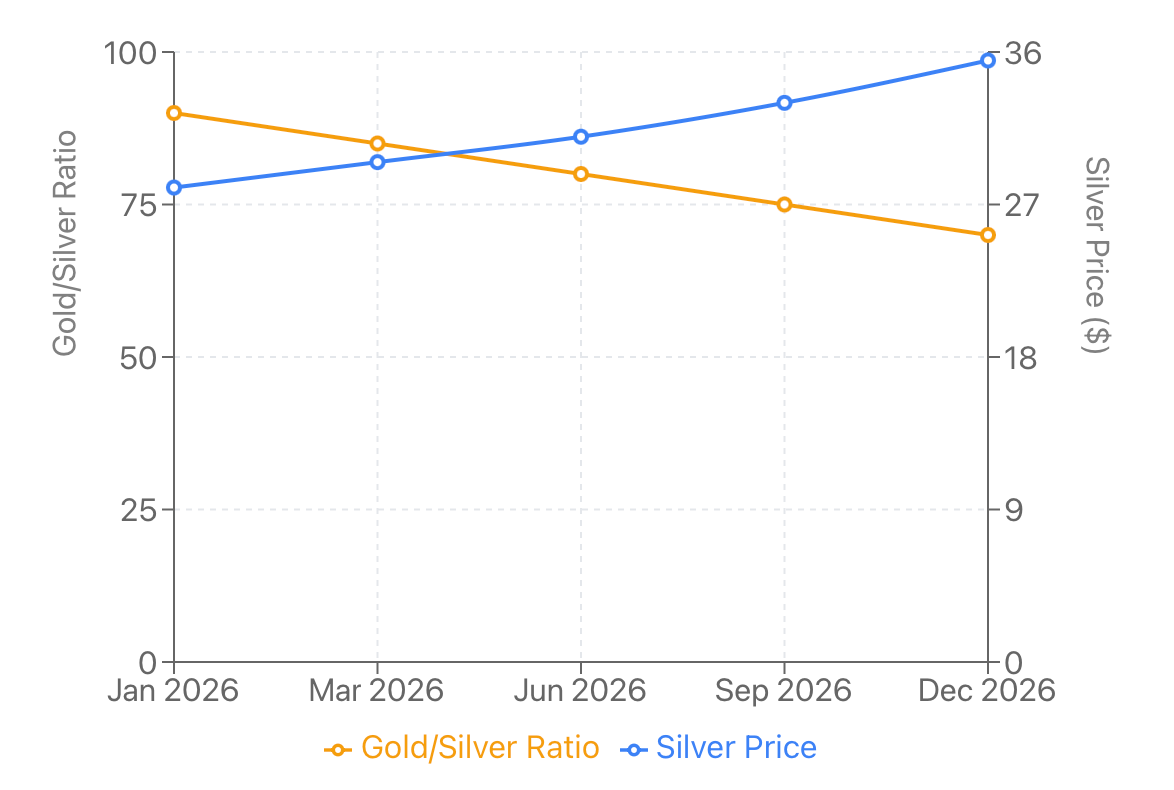
Although it sounds complicated, the gold-silver ratio is one of the simplestWhen the ratio of gold to silver rises to 90 or 100, it indicates potentially either that safe-haven demand for gold is surging in a way that is not reflected in silver prices forecast of 2026, or that silver has been hit with a large amount of "industrial demand" shock, resulting in disproportionate price declines.
Generally speaking, neither of these scenarios continues indefinitely - over time, capital will rotate into the less expensive of the two metals due to the potential of mean reversion outperformance.
High Ratios Favour Silver
The rationale behind this rotation is as follows: When the price of silver becomes extremely below its historical prices relative to gold, there are two primary types of buyers who will come to market. Precious metals investors who currently only own gold will begin purchasing silver for diversification and for potential value opportunity, not as an abandonment of gold, but as a means to capture relative value.
Additionally, new capital will be entering the market with a focus on silver specifically due to the better risk-reward profile. If both precious metals will be benefiting from the same macroeconomic environment (real interest rate decline, dollar weakening, inflationary pressures) but silver has depreciated below its historical relative valuation, then it makes sense for investors to favour the metal that has the most upside.
This creates the "catch-up rally" dynamic, where silver starts closing in on the depressed valuation of gold, resulting in a tightening of the ratio from 90 back toward 75 and then to a tighter 70 ratio. The dynamic momentum builds as silver begins performing better than gold, leading to additional buying pressure that further reduces the ratio. Thus, what may begin as a relative value trade ultimately develops into a momentum-driven trade.

To illustrate the catch-up dynamic, think of two students in the same class. When one student falls significantly behind in terms of their academic performance, the teachers will likely devote
much of their attention to ensuring that the student has every opportunity to improve academically.
As the gap narrows, it is not because the stronger performing student has suddenly "dropped out," but simply because the stronger performing student has far less "room to improve," thus receiving more of the resources devoted to the weaker student. Capital rotation happens in the markets in this manner.
Understanding Limitations
While the gold/silver ratio provides a picture of the relative valuation of both metals, and can help identify target purchase prices, the ratio is not a precise tool for timing purchases of either gold or silver simply because the ratio has decreased to a "lower" or closer ratio (e.g. 85) does not mean that the price of silver will appreciate the next day, as the price could increase to 90 or 95, hit an interim peak and then pull back down; as well as that macroeconomic challenges can lead to a prolonged period of elevated ratios when many of the same forces that create elevated ratios remain in place (e.g. strength of dollar, weakness of industrial demand for silver, rising risk sentiment).
Therefore, it is important not to make trades based solely on relative ratios - for example, as gold prices decrease, and silver prices are decreasing less, the ratio is compressing; however, in such a situation, you would not be generating returns by buying silver, simply generating losses at a slower rate than gold holders.
Therefore, in this scenario, while your ratio is improving, your losses in your portfolio relative to that scenario would still be appreciated. Always use ratio analysis in conjunction with directional analysis of both metals (i.e. the price of silver relative to that of gold).
Use the Gold/Silver Ratio as One Input
Always use the Gold/Silver Ratio, along with other factors, to analyse your investment decisions. When the Gold/Silver Ratio shows a low valuation of silver relative to gold, you should consider the ratio.
When the ratio shows that silver is historically favourable, you should overweight your analysis as compared to other bullish indicators and shouldn't "force" trades simply because other indicators are bullish. You should let the market indicate valuations for you, rather than forcing trades based upon relative valuations.
While the gold/silver ratio won't tell you when to enter or exit your trades, it should provide an indication of when silver has a better relative valuation than gold; thus, through capitalising on purchasing silver when it is at a better relative valuation than gold you should have a better opportunity to optimise your return on investment as compared to the current investment strategy surrounding bookends.
Macro Drivers Behind Silver Prices Forecast: Rates, USD, and Inflation
To determine where the price of silver is heading, an individual must know what affects the silver price forecast; therefore, it is necessary to understand what three primary macroeconomic indicators affect the price of silver: Real Interest Rates, U.S. Dollar Value, and Inflation Expectations.

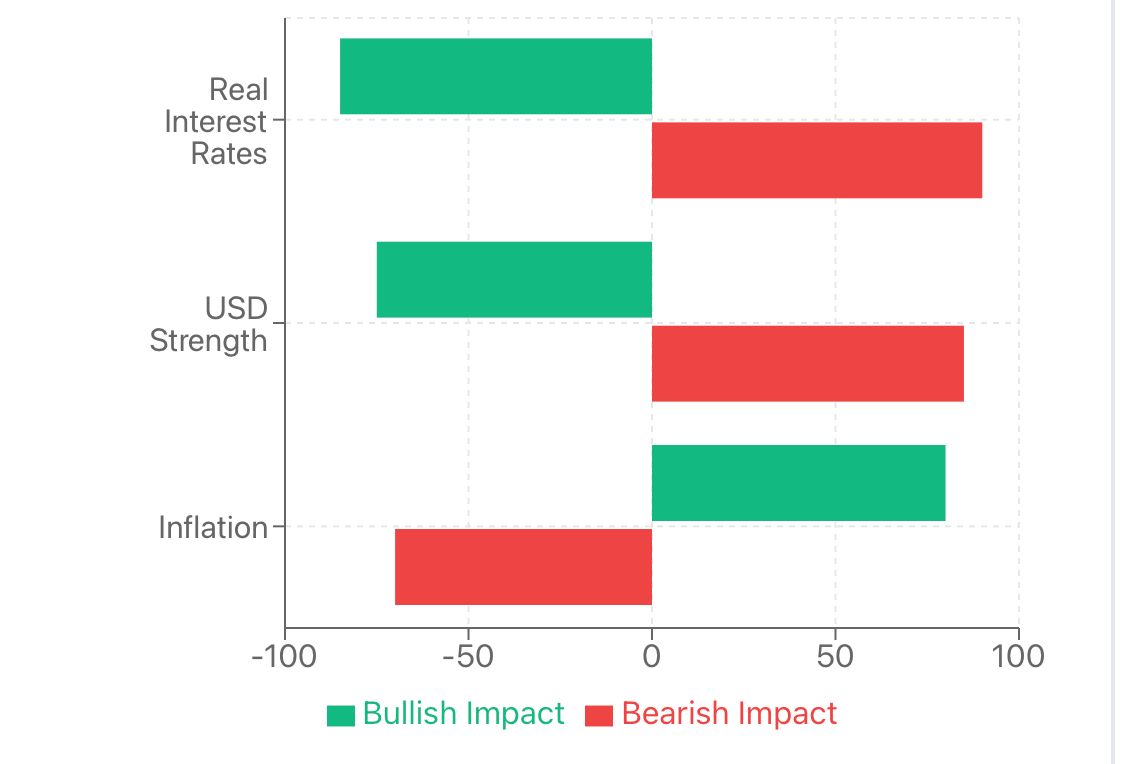
These three indicators are considered to be more critical indicators of future silver prices than all other macroeconomic factors together. Analysis of any kind that does not include consideration of these three variables will provide an incorrect forecast regarding the future trend in price for this product or commodity.
Real Interest Rates - The actual fear of silver:
Let's clarify a misunderstanding: Silver does not fear the increase in interest rates per se, but instead Silver fears increases in the Positive Real Interest Rates (RIR). There is a key difference here between Real Rates of Interest & Nominal Rates of Interest. Real Interest Rates (RIR) are calculated by taking the Nominal Interest Rate and subtracting the Inflation Rate.
An example would be when the Federal Reserve increases interest rates to 5% while the Inflation Rate is at 4%. Therefore, the Real Rate of Interest would be 1%. Conversely, if the interest rate was at 3% while the rate of inflation was 1%, the Real Rate of Interest would be 2%. Although the nominal interest rate is lower in comparison to 5%, the RIR of 2% in comparison to 1% is a greater negative scenario for Silver.
Why is it important to make this distinction? Because Silver pays out no yield whatsoever for an investor to hold onto, an investor is unable to earn any interest or utilise any funds to invest in Silver and have them paid back.
Therefore, as long as the RIR remains positive, the investor loses the opportunity to earn interest on any funds invested in Silver and therefore will typically invest in savings accounts, U.S. Treasury Bonds or some form of Fixed Income Security, which provides an interest return without the risk of retaining a Non-Yielding Asset like Silver.
When RIR goes negative, the opposite becomes attractive: If an investor has a savings account that earns 3% interest and the rate of inflation is 5%, the investor has effectively lost 2% of their purchasing power each year, even though they continue to receive an interest payment.
As such, instead of losing purchasing power due to inflation, the investor is now looking to hold Silver in their portfolio, as Silver will hold its value as an intrinsic asset and will not depreciate or lose any purchasing power due to inflation.
The US Dollar is a factor that affects every trade made with silver.
Silver can be priced globally in US Dollars. In other words, when you see "$32/oz.", you are viewing a dollar price. For that reason, there is an automatic inverse relationship associated with dollars and silver, although it is not mechanical.
When the dollar weakens relative to other currencies, the price of silver drops for buyers outside of the US. For example, a European using Euros or an Asian using Yen can buy more ounces of silver with the same local currency spend. This will create additional demand from international buyers that will support or increase the price of silver.
Conversely, when the dollar strengthens, it becomes more expensive for buyers located outside of the US. Buyers will need to exchange more of their local currency to buy the same amount of silver. Some buyers will stop purchasing because of the price increase. The resulting headwinds may, at times, overwhelm or dilute any other bullish factors on silver prices.
The dollar vs. silver pricing relationship is not a perfect linear correlation, however, as in some instances, both the dollar and silver can rise during risk-off phases for the market. Some investors may flee to cash during times of uncertainty and may, at the same time, also be looking for a "safe haven" with precious metals, in particular, gold and silver.
However, in the longer term, the inverse correlation will start to dominate. A sustained rally in the dollar will generally put downward pressure on silver pricing, while a sustained decline will put upward pressure on silver pricing.
The US Dollar Index (DXY) is one of the best ways to keep a pulse on the dollar's strength or weakness, and can be tracked along with silver prices. When the dollar is testing a level of technical support, silver is typically attempting a breakout.
Conversely, when the dollar breaks through a level of technical resistance, silver is often faced with selling pressure. You do not need to have sophisticated models to track the relationship between silver and the dollar; simply watch the historical formation of the dollar versus historical silver prices.
Inflation: Why Silver Moves Faster Than Gold
Inflation impacts both gold and silver, but those impacts occur on different timelines. During the first phase of rising inflation, investors will see movement in gold faster than silver. In this period of time, investors are becoming aware of inflation building and subsequently are rotating their investments to gold, as it is the traditional hedge against inflation. During this phase, silver will lag behind gold in price appreciation.
Why is there a lag in price appreciation for silver? Because in the first phase of rising inflation, the commercial demand for silver has not yet changed. Factories are still operated based on their existing contracts; supply chains have not yet changed. Thus, although the investment case for silver exists, companies that use silver as an industrial product have not started buying silver.
As inflation continues to build into the middle and later stages of inflation, sometimes called the hyperinflation phase, industrial demand will start to accelerate, as well. As prices rise across the economy and manufacturing costs rise, production continues at companies that have end-user demand for silver-based products.
Companies will still need to buy silver at higher prices because those products are still in demand, as well as because of investment demand. The two forms of demand for silver (investment and industrial) will create explosive price moves.
The dynamic described above was very clear in the period from 2010 to 2011, when inflation fears were on the rise. Gold prices increased from about $1,100 to $1,90,0, and silver increased from about $17 to $49, nearly tripling in value, while gold increased in value by less than 70%. At this point, the commercial demand for silver was in full force, resulting in the explosive price move of silver.

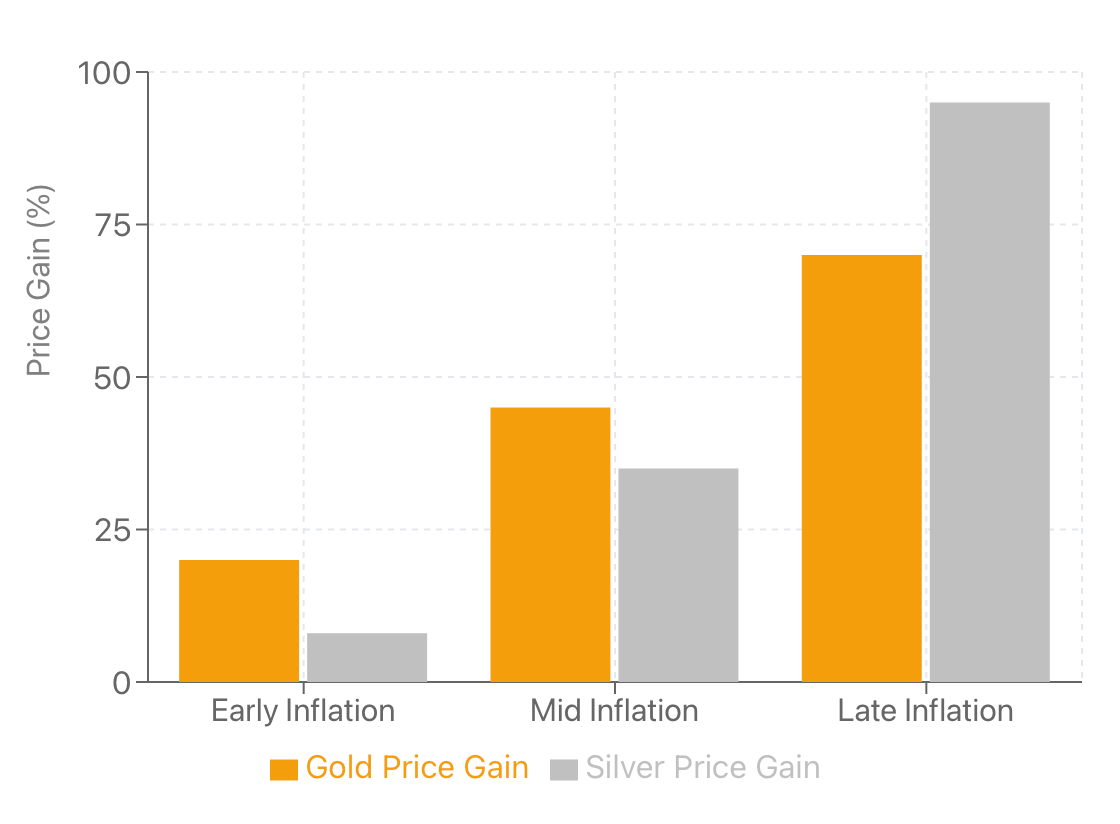
The bottom line: While you should be closely monitoring inflation trends, keep in mind that silver's response may be lagging at first, but will accelerate rapidly when industrial demand catches up to investment demand. The initial lag is not a weakness; it is often the setup for massive gains.
Putting It All Together
Falling real interest rates, a weakening dollar, and rising inflation create the most bullish environment for silver. When considered independently, each of these factors can potentially push silver prices higher. Together, these three factors create an ideal environment for explosive rallies in silver.

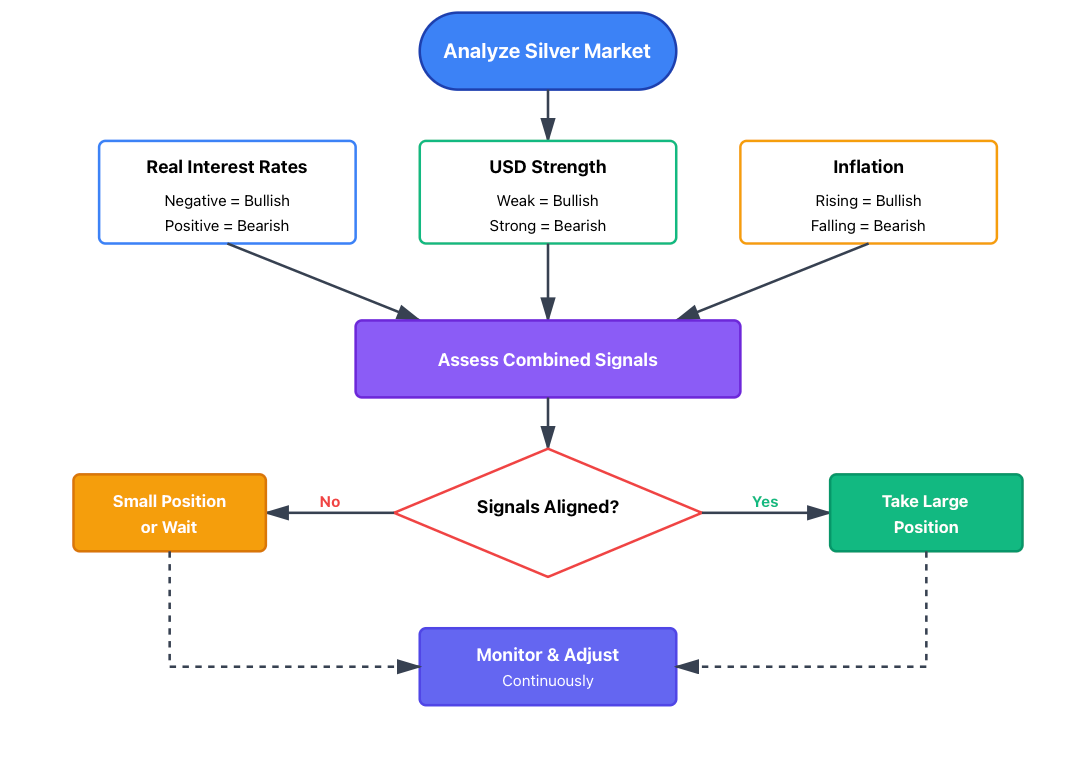
Alternatively, rising real interest rates, a strengthening dollar, and falling inflation create the most bearish environment for silver. Again, each of these factors independently exerts downward pressure on silver prices. Collectively, they generate the most significant sell-offs in silver.
On the average day, traders receive a combination of mixed signals. For example, real interest rates may decline while the dollar remains relatively constant compared to other currencies. Similarly, while inflation rates may increase, nominal interest rates may increase more rapidly. Mixed signals create a range of volatile, conflicting price movements and patterns with no defined trends in silver.
As a trader or investor, your task is not to estimate specific future silver price forcasts but instead to review each of the macroeconomic variables, understand their current relationship to the price of silver, and then establish your trading position based on that information.
Establish your exposure size based on the relationship of the macroeconomic variables to each other. When the relationships are clearly defined, they take significant positions. Conversely, if you receive mixed or distorted macroeconomic signals, take smaller positions or wait until the market offers better opportunities.
While macroeconomic indicators do not guarantee price movements, determining their current configuration increases the probability of successfully forecasting silver price movements compared to other trading opportunities.
Are you ready to act on your silver analysis? Tradewill offers a variety of silver cash contracts for difference with flexible leverage, live charts, and a wide array of tools required to trade both bullishly and bearishly, all from one convenient platform.
Disclaimer: The content of the blog does not represent any position of Trade W, does not serve as any trading-related decision advice, and does not endorse any third-party.