

 Trade W

Why SMCI Earnings Matter for Global Investors
Super Micro Computer (SMCI) is one of the most prominent names in the artificial intelligence infrastructure excitement. It is a company that creates and sells supercomputer hardware, including very high-quality computer systems and equipment for large organizations. When SMCI announces new earnings, many investors worldwide will watch closely.
SMCI is important in today’s digital world because they work directly with some of the biggest manufacturers of computer chips: Nvidia, AMD, and Broadcom. They take these chips and build them into computers that can run complex programs for artificial intelligence, as well as help train large computer networks and support super-large data centers. Because there is growing demand for AI, SMCI has been able to experience fast growth that many hardware companies cannot match.
Earnings reports can be likened to a report card for students in school. For professionals, they give a range of information, from company revenue, to company profits, to company profitability, to company future earnings predictions. For beginners, think of it as being a "student" who gets grades every three months. If your parents are investors, they will want to know whether your grades improve, stay the same or decline over the year. That is what earnings reports do for businesses.
In this analysis of SMCI's most recent earnings, we take a look at each revenue source, show what profit margins are like and give you an industry outlook. This report will be helpful to anyone that trades in stocks, indices or CFDs and will show how to interpret SMCI's numbers to better understand the overall AI Infrastructure Market, whether you are investing for the long-haul or trading on an active basis.
SMCI's stock price has seen significant levels of volatility following every earnings release from SMCI. When the earnings that SMCI reported either beat or miss the consensus expectation from Wall Street, the Stock Price can move up to 5-10% in one trading session. The level of volatility created by earnings releases creates opportunity; however, it is important for traders to thoroughly evaluate the fundamentals of the company before acting on the data provided in the Earnings Report.
SMCI Latest Earnings Breakdown: Key Numbers You Need to Know
Let's cut to the numbers that moved markets in SMCI's most recent earnings report.
The following are essential metrics to describe SMCI's performance in relation to the results discussed above:
-
Revenue: The growth of revenue YOY continued to show a strong upward trend for the deployment of AI servers. Additionally, when comparing quarter-over-quarter, the seasonal patterns typical of enterprise hardware sales were evident.
-
Net Income: Due to the shift of the product mix toward higher-margin AI products, SMCI was able to further enhance its profitability.
-
EPS: The amounts reported for earnings per share (EPS) exceeded analyst's estimates, demonstrating that for another quarter SMCI continues to exceed analyst expectations.
-
Gross Margin: With increased pricing pressure due to reduced component availability, SMCI maintained steady margins, demonstrating SMCI's ability to price effectively in a constrained environment.
-
Forward Guidance: SMCI's management team raised its estimate of total revenue for the year, reflecting confidence that the AI infrastructure spending trend will continue.
Realizing the difference between beat and miss is important for investors. When analysts anticipate that SMCI will earn $2.50 per share and instead the company reports $2.75, the company has "beaten" the consensus estimate. To further put this into context, consider the following analogy: your expectations of scoring an 80 on a test and instead you score a 90; the actual number becomes less significant than the surprise factor and what it will do to the market. Markets factor in expectations long before earnings day.
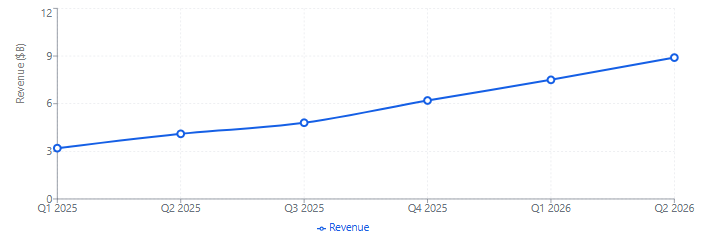
The significance of earnings expectations is the key takeaway for the investor because it immediately alters the investor's perception of SMCI's value. As the financial models change, the price targets change, and algorithms react to the beat by either moving more aggressively into SMCI's stock or moving away from it all within milliseconds of earnings being released. Such a "surprise" can have a cascading effect through all related segments, impacting semiconductor stocks, cloud computing indices, etc.
A company's financial results do not dictate which way the stock market reacts; rather, the overall reaction is more closely tied to how much better or worse than money the company made. SMCI has an excellent example of this by experiencing such strong year-over-year absolute growth, but at the same time, experiencing volatility due to how expectations shift based on the number of reports.
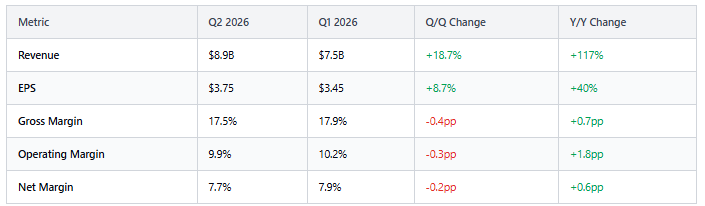
In addition, there are significant trends with SMCI in regards to gross margins and, therefore, it will be interesting to pay special attention to how they trend over time, particularly due to SMCI's ability to increase or maintain their gross margin while simultaneously increasing production levels. It shows that there are two prominent business modeling aspects that SMCI is focusing on - operational maturity and demand fundamentals.
When a company's gross margin begins to compress, typically it indicates that competitor pricing pressure is having an impact on profits, but also that costs associated with the company entering into new contracts (component pricing) are not yet established; therefore, this shows potential long-term growth.
Where SMCI's Revenue Really Comes From
Revenue generated by SMCI is not derived from one single source. The Company has developed business models for multiple different segments, each of which has a unique growth trajectory, including multiple margins.
SMCI's AI Server Segment is the company's flagship product segment. These Systems combine, via a wrapper and/or enclosure, the latest GPUs manufactured by Nvidia or AMD. AI Servers are designed specifically for Machine Learning workloads, training of Large Language Models, and also for Inference Execution. Companies need to build their own AI Capability, creating continued growth for this segment.
The Rack Scale and Data Center Solutions Segment is also a major product segment. SMCI no longer sells only individual Servers, but increasingly sells complete Rack-Scale Deployments, including Power Distribution Units and Cooling Systems for Data Center Deployment, Server Networking and Software for Data Center Management. The Rack Scale Deployment Strategy has proved successful with Hyperscalers, who require thousands of Servers deployed rapidly and in a cost-effective manner.
SMCI has established OEM / ODM relationships with many customers as a source of additional revenue. SMCI produces customized solutions tailored for Original Equipment Manufacturers (OEMs). In addition, SMCI engages in direct work with Cloud Service Providers on customized product design. SMCI has relied upon long-term contracts with OEMs and Cloud Service Providers to provide visibility into future revenues.
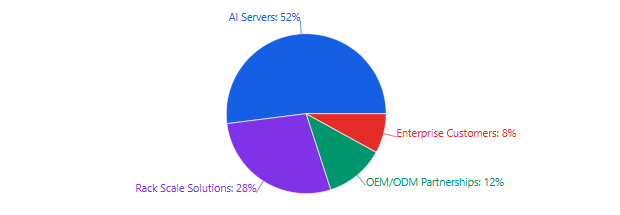
The Company has added a base of Global Enterprise Customers. Banks, Research Institutions, and Global Corporations all require High-Performance Computing Infrastructure. As a result, these Customers continue to generate strong demand for computing products and services that do not fall into the Hyperscaler Segment.
The Fastest-growing Segment without a doubt is Artificial Intelligence Servers. While Traditional Enterprise Servers generate solid revenue, their growth rates are measly compared with those of ai-oriented products. This shift is important because ai Servers have typically higher margins and represent the future direction of the market.
To use a restaurant analogy, SMCI checks which dishes draw the most customers into their establishment, as well as which dishes provide the best profit margins; If there is a sudden demand for more expensive steaks, as opposed to hamburgers, the restaurant will adjust accordingly and place more emphasis on providing premium meats. SMCI is doing exactly that, placing more emphasis on Ai Infrastructure as demand increases.
Hyperscale companies such as AWS, MS Azure, and Google Cloud Platforms have created an incredible opportunity. These companies are in competition with each other to develop infrastructures to support their AI capabilities, all of them have spent tens of Billions of dollars to build these capabilities, and when they increasingly purchase AI Servers then immediately have an impact on SMCI's financial performance.
The revenue structure of a business will drive long-term valuation, with companies that have multiple sources of revenue with exposure to high growth markets generally commanding higher valuation multiples. SMCI qualifies under each of those categories; however, there is the risk associated with concentration on a few large customer accounts.
Is SMCI's Profitability Sustainable?
While revenue growth appears to be the most important indicator of a company's ongoing growth, the profit margin on sales will determine where a company goes next.
If SMCI sells a server for $10,000 and the costs to build it are $6,000, the gross margin would be 40%.
To explain gross margin with another example: A hamburger might cost the store $2 to make and is purchased by a customer for $5, thus providing the hamburger seller $3 or 60% of the total purchase price as profit for selling the hamburger. The greater the gross margin, the greater the amount of money that flows to fund future growth, ongoing research and development, and shareholder returns.
The cost structure includes several components:
Direct Material Costs and the Major Cost Components: CPUs, GPUs, Memory Modules, Storage Drives, and Power Supplies. Increases in the cost of GPUs or a shortage of memory modules means higher costs to SMCI.
Manufacturing and Supply Chain Creates Operational Costs:SMCI operates in multiple countries worldwide and has a large global supply chain that requires complex logistics to ship raw materials from suppliers to factories and finished products to customers.
Inventory Management Becomes Important due to Unforeseen Market Changes: Having too much inventory ties up company capital and exposes the company to potential write-offs because of product obsolescence, while not having enough inventory creates missed sales opportunities.
Compared to traditional products, AI servers produce higher margins because the technology is still relatively young and competitive pressure is not as great. Customers are typically more interested in performance than price when purchasing AI servers, thus allowing SMCI to retain pricing power by way of GPU shortages; however, the supply chain will start to normalize in the near future and allow competitors to begin manufacturing similar products, thereby altering the dynamic of pricing power.
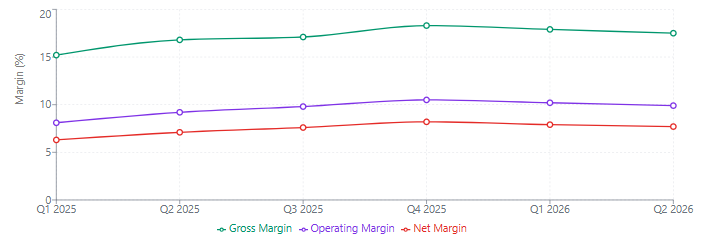
The two primary financial metrics that tell the story of the profitability profile for a company, operating margin and net margin, are finally starting to show consistency as the company reaches scale. Operating margin excludes all costs that are not part of the manufacturing process, including research and development and sales costs; however, net margin factors in everything, including taxes and interest expense. If one tracks these metrics over time, the efficiency gained by scaling a company can be evidenced by improvements in net margin and operating margin ratios.
The company's margin profile is most threatened by margin pressure, which is created by either an influx of similar product offerings from competitors or an increase in component costs resulting in a contraction in margin. Historically, the server industry has seen periods where supply has greatly exceeded demand, leading to extreme levels of margin compression. In order to avoid this fate, SMCI must continue to maintain its technological superiority and strong relationships with customers.
In conclusion, the industry has been experiencing short-term margin improvements due to the current shortage of chips and the limited availability of GPU components. The price that can be charged for a system with a limited number of GPUs has led to an increase in the margins of SMCI; however, as the industry normalizes, SMCI will begin to lose its pricing power which will put pressure on the company's margins unless the company experiences a corresponding increase in demand or introduces new products to the marketplace.
What SMCI's Past Earnings Reveal
The previous earnings report for the past 6 quarters has indicated that SMCI has gone through a dramatic change in the company, with rewards and challenges still being looked at as they were facing Hyper-Growth. The company continues to outperform analysts and has experienced a high amount of volatility as a result of executing on their growth strategy.
In many columns, companies will experience outstanding growth in certain quarters followed by a period of Consolidation, and the Revenue growth can typically vary widely from 50% in any given year on a q/q basis down to 30%. The volatility seen in the revenue figure is due to the large scale and hyperscale business in which the company operates, with the majority of the larger enterprise deals often being done in individual quarters.
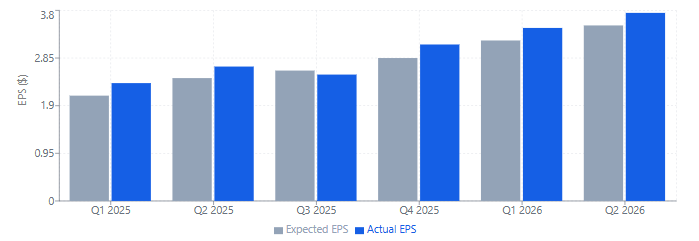
Other key observations from these metrics are:
-
SMCI's Gross Margins have continued to be considerably better than many of the analysts were expecting. SMCI’s Gross Margins continue to be in the Mid- to High-Teen range, on average, even during times of rapid Growth.
-
SMCI has continued to increase the amount of Operating Leverage over time.
-
SMCI is Generally Conservative in Providing Guidance to the Market. SMCI Management tends to be Preferable to Under-promise, and then over-deliver.
For long-term holders, SMCI is a high growth and high risk category. SMCI is currently operating in a fast growing and rapidly changing market environment and has an extremely large tailwind that will continue, however, the execution risk and timing is extremely important. As such, SMCI is not a dividend stock and requires Active Monitoring.
CFD traders are capitalizing on this volatility. Earnings reports trigger implied volatility spikes, which can generate large profits for traders anticipating the direction and/or magnitude of an earnings report (event).
For SMCI, it is common to move between 5% to 10% following their earnings reports; therefore, this could provide excellent opportunities for shorter-term trading strategies.
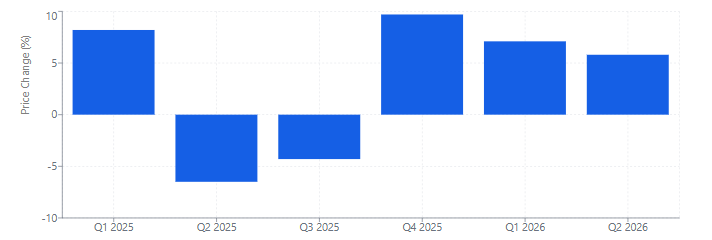
Think of SMCI as a "B" student : consistently producing great grades but sporadically falling to lower grades (C). This is a company with potential to improve based upon what is already known but also demonstrates that each quarter could be a "C" period due to unexpected challenges. The question for investors will be if it continues to improve and maintain an upward trajectory in the future, despite the volatility.
For example, in a quarter where SMCI beat their EPS expectations, the company's margins were down and the price dropped significantly due to concern over future profitability trends. This example illustrates how, when relying solely on one metric (EPS), it is easy to overlook other important factors that may be affecting the company.
What SMCI Earnings Tell Us About the AI & Server Industry
The earnings from SMCI not only indicate how the company did financially but also reflect the overall state of the Global Data Center and AI Infrastructure market.
Global Data Center CapX Capital Expenditures (CapX) are driving the industry. When Cloud Computing Companies, Enterprise Companies and Governments spend more dollars on building their infrastructure, companies like SMCI will directly benefit from that increased spending. However when spending on CapX slows, so does growth for SMCI and other companies in the Data Center and AI Infrastructure industry. Therefore SMCI is often viewed as a leading indicator of future trends before they become visible within the industry as a whole.
Signals from SMCI's earnings announcement/quarterly report demonstrate that:
-
Hyperscalers are accelerating their Capital Expenditures on AI, despite economic uncertainty. The race to develop Artificial Intelligence (AI) will not stop any time soon.
-
There is a continuing Growth of Rack Scale Hardware Deployments; as we are seeing many companies moving from purchasing individual servers towards purchasing complete Rack Scale Infrastructure Purchases
-
There is still demand for cutting edge GPU chips exceeds availability; however the situation has improved since we saw peak shortages of chips during the last quarter.
Here's an analogy for a better understanding; Imagine a school that suddenly receives 50% more students added to its roster. As a result, the school will need to increase the number of classrooms, desks, teachers, and equipment; therefore the Data Center will need to increase all of their physical resources to accommodate increased demand for computing resources due to increased workloads from Artificial Intelligence.
In order to put SMCI's performance into perspective, consider its biggest competitors: Dell, HPE, Nvidia, and AMD. When all five companies report high revenue generated by their AI-related products, it validates the evidence that AI has become an important revenue driver for many companies. Similarly, if one company reports lower than expected revenue growth, it may signal a difference in market share or other factors specific to that company's performance.
The primary risks facing the industry that will need to be monitored closely are:
-
AI-related capital expenditures could decrease significantly if the expected revenue generated by AI-related capital investments fall short of expectations. For example, companies are investing billions of dollars to build infrastructure now to be able to generate revenue from AI in the future. If this revenue does not materialize, it will likely lead to a dramatic reduction in investment in this area for many companies.
-
Supply chain issues have not been resolved for all manufacturers, and while the supply chain has improved relative to 2021 and 2022, production continues to be adversely impacted by chip and component shortages.
-
The delay of GPU shipments by either Nvidia or AMD has a direct impact on SMCI's ability to fulfill orders and recognize revenue.
For the first time in many years, data center capacity growth is being driven by AI demand, which signifies a dramatic change in the way companies are implementing their computing infrastructures from general purpose servers to a model where there is a greater emphasis placed on creating specialized hardware frameworks for machine learning. SMCI has an extremely strong position at the epicenter of this transformative change.
Key Risks Every SMCI Investor Should Watch
Every type of investment carries some risk. The risks that can slow down the growth of SMCI include:
Dependency on the chip suppliers (GPU Supply Chain): SMCI does not produce its processors but instead purchases them from Nvidia, AMD, and Intel. If one of these suppliers encounters production issues, gives higher priority to other customers, or has large price increases against an already short list of suppliers, this negatively impacts SMCI's business. This is similar to how a restaurant that relies on a single food supplier may have to close or raise its prices if that supplier is unable to deliver.
Customer Concentration Risk: The majority of SMCI's revenue comes from a limited number of large customers. The loss of any one of these major accounts or a significant decrease in purchasing by any one of these large customers would cause a substantial reduction in SMCI's revenue.
Competitive Pressure on AI Server Market: The AI server market is attracting new competitors with both Dell and HPE continuing to grow their relationships in large enterprises. Both companies are heavily investing in new AI Infrastructure Products. Companies in China are becoming major players in this space and are now introducing lower-cost options for customers in price-sensitive segments.
Artificial Intelligence capital expenditures have cycles and will not keep increasing infinitely. Technology spending typically goes through cycles of growth and recession. Although the current boom feels really good, historically, after every boom there have been periods of decreasing growth or worse, negative growth.
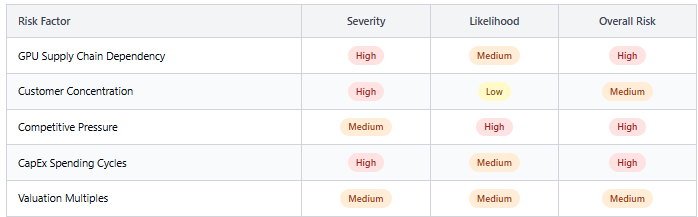
The company's higher valuation will mean greater volatility caused by a combination of increased valuation risk and expectations that growth will continue. Given that the company's stock is currently trading at elevated multiples based on high expectations of continued hypergrowth, if their growth is less than expected, investors will react negatively, and the more the investor pays, the more they will react.
The chip shortages that impacted the majority of the industry have shown just how reliant server manufacturers are on semiconductor supply chains. What most people don't realize is that one bottleneck in Taiwan or Korea or wherever creates a domino effect for the entire ecosystem of server manufacturers, delaying not only product launches but revenue recognition for as long as they are affected.
Risk management is critical for anyone purchasing volatile technology stocks. Whether the trader uses size or volatility stops, or any type of portfolio diversification to mitigate risk, they must maintain their exposure to the upside.
Final Takeaway: What Investors Should Focus On Next
SMCI has demonstrated through its earnings that it is benefiting from one of technology's biggest trends, AI infrastructure. With demand for AI infrastructure continuing to increase and accelerate, SMCI has positioned itself as a key supplier to leading firms within this sector.
Takeaways:
-
Revenue growth continues to be impressive, largely from AI server implementers and rack-level solutions.
-
Margins have actually held up better than expected, although margin pressure exists due, in part, to component pricing and competition.
-
Sector fundamentals continue to be strong as hyperscalers continue to invest in increasing their CapEx on AI.
-
Uncertainty and volatility will continue to create opportunities for both longer-term investors and shorter-term traders.
When investing over the long term, SMCI is a great way to gain exposure to the growth of AI infrastructure without the negative characteristics that many pure-play AI software businesses have (i.e. they generate revenue and profit). When trading CFDs, traders have the benefit of predictable volatility that occurs during earnings season, which can be exploited with appropriate risk management.
Understanding not just whether SMCI beat or missed results, but how they achieved their margins, provided their guidance and what other market participants said about their earnings is an important aspect to consider when trading.
At this point, artificial intelligence (AI) is just starting to gain momentum in its growth trajectory. Businesses are beginning the process of building out their support systems for their upcoming AI-based solutions. If SMCI can deliver on their potential and maintain their position as a leader in the technology space, this will allow them to capitalize on these continuing builds.
If you're ready to access the trading markets that make up your portfolio, then come on over to Tradewill! We offer global equities, indices, and contracts for difference (CFDs) to serious traders using the latest tools provided by our advanced trading platform.
Disclaimer: The content of the blog does not represent any position of Trade W, does not serve as any trading-related decision advice, and does not endorse any third-party.