

 Trade W

Why SMCI Earnings Matter to Tech Investors
Super Micro Computer (SMCI) is one of the hottest names in technology investing today; SMCI's revenues and successes in designing and manufacturing high-performance server systems, storage systems, and Artificial Intelligence infrastructure have led to tremendous advancements across Cloud Computing platforms and various Artificial Intelligence Applications. As such, when SMCI provides its quarterly earnings report, investors all over the world take note of their results, as they are a clear representation of where the AI Technology Hardware Industry is heading.
Company earnings are quite similar to a student's report card; just as school grades reflect how well a person performed in their classes, so too do earnings indicate how effectively a company executed its overall business strategies. When reviewing SMCI's financial data, investors should look at the company's revenue growth, gross profits, and whether or not SMCI was able to achieve Wall Street's expectations.
For professional investors, the actual numbers in the earnings report hold even greater significance. The most commonly analyzed metrics such as EPS, percentage of Revenue Growth YoY and gross margin percentages will be the defining factors regarding whether or not the SMCI stock price will increase or decrease. If earnings exceed Wall Street's expectations, the stock will likely experience strong growth, whereas should the earnings report fall short, the result will likely be a significant stock price drop.
SMCI's current standing in the AI Server Market represents the company's significant presence within this fast-growing industry when compared to larger competitors like Nvidia and Dell. Nvidia leads the way when it comes to artificial intelligence chip production, while Dell remains the leading provider of enterprise products. SMCI focuses more intensely on high-performance liquid-cooled AI Infrastructure.
While comparing these three companies is a case study of market dynamics, understanding SMCI's competition gives investors insight into where their investment dollars should be allocated. Investors must choose between betting on the chip manufacturer (Nvidia), the well-established enterprise provider (Dell), or a new player in the Server Specialist category (SMCI).
How Super Micro Makes Money
The growth of SMCI is supported by their diversified revenue streams, which decrease risk as compared to most firms relying on a single source of revenue. SMCI generates the majority of its revenue through sales of fully integrated server and storage infrastructure to cloud service providers, data centers, and organisations. These infrastructure solutions are not typical "retail" purchases but rather highly customized high-density computing solutions which are not easily replicated elsewhere in the marketplace.
The emergence of AI hardware will increase demand for servers capable of meeting the compute demands associated with training and running large language models (LLMs) and thus produce tremendous volumes of heat. As such, SMCI’s liquid cooling solutions have become especially attractive to clients developing AI solutions.
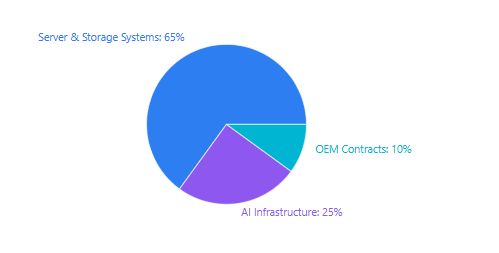
The other primary source of revenue for SMCI comes from OEM contracts. SMCI collaborates with leading cloud services such as AWS, Microsoft Azure and Google Cloud to provide infrastructure at scale. This provides stable and predictable recurring revenue that is attractive to many investors.
To illustrate the benefit of diversification of revenue streams consider a student who earns grades in multiple academic disciplines. If the student takes one academic course and fails, their overall GPA (Grade Point Average) will be severely impacted; however, if that same student is taking five classes and achieves high grades in four of them (but has one grade of a D), the single D will not have as significant an impact as it would in the previous scenario because the overall number of classes taken will mitigate the impact of the D to a degree.
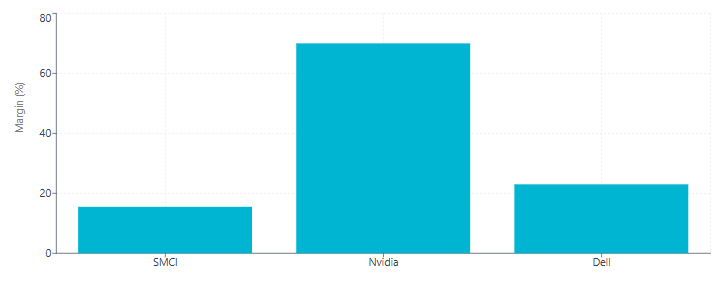
Gross Margin is a measure of how well SMCI will convert its sales into profits. Historically, SMCI had gross margins ranging from 12% to 17%. While this is a respectable margin for the server manufacturing industry, it pales in comparison to NvidiaGPU's margins. This discrepancy largely stems from the fact that physical server assembly contains many more components (physical/Material) and labor costs than chips which are closer to "virtual" (you can't assemble a chip until it's designed).
SMCI's real strength lies in growth; since 2020, SMCI has experienced tremendous revenue growth fueled by widespread adoption of artificial intelligence (AI) and expanded Cloud Infrastructure and Shift to Edge Computing.
All around the world, the data centres that operate as cloud infrastructure (via AI workload management) have begun upgrading all hardware, including servers; this has created an opportunity for SMCI.
SMCI's recent contracts with several very large hyperscalers (hyper-scale cloud providers) demonstrate how strong the company's position can be. When AWS or Google Cloud select SMCI for their internal Data Centres, it provides confirmation to the market of SMCI's technology capabilities and establishes recurring revenues with that customer for many years into the future.
SMCI's Competitive Landscape
To gain predictive insight on SMCI's potential for earnings, one must consider SMCI's competitive landscape, which is fragmented between two primary players, Nvidia and Dell, with drastically differing competitive threats.
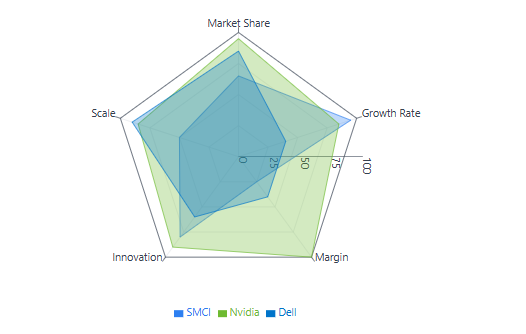
Nvidia is not a direct competitor of SMCI in the area of servers but does dominate the GPU market that drives AI computing. The sheer volume of revenue produced by Nvidia and the gross margins exceeding 70% for their products in comparison to the rest of the technology sector allows Nvidia's earnings to dominate the rest of the industry. Their revenue growth has been astronomical due to the rapid growth in AI-based demand. Therefore, when Nvidia announces record Q4 earnings, this will also produce a positive impact on all other companies within the AI infrastructure sector, including SMCI.
On the other hand, Dell's size and scale allow it to have a much lower per-unit selling price through its server offerings than does SMCI. The way in which Dell operates, through available financing options, service offerings, and long-standing corporate relationships, gives them the ability to provide an overall competitive advantage over SMCI. This is reflected by the trends in Dell's earnings as they are seeing growth that is consistent with the trends in overall enterprise IT spending.
To draw a comparison amongst the three companies mentioned above, Nvidia would be best described as a 'math wizard,' as they have consistently produced outstanding earnings results. Dell would be a 'well-rounded' student, as they produce strong earnings across all product categories while also having strong customer relationships. And lastly, SMCI would be a 'specialist' that has strong performance in one particular area (in this example, physics) and is quickly improving in that area.
Nvidia, Dell and SMCI are three very different companies with very different investment opportunities for investors. Nvidia gives investors a way to gain access to the AI Chip Opportunity that is dominating the market. Dell on the other hand, is an established technology company having provided stability and diversification in Enterprise Technology Services. Whereas SMCI (Super Micro Computer Inc), is a pure-play investment in AI Infrastructure Growth, investors will encounter higher risk associated with this high growth opportunity, but potential for great return on investment.
Investors want to know if SMCI Products will hold up against increasing competition. Investors will want to know if SMCI will be able to continue winning contracts from Hyperscalers and what the impact will be on their profit margins as they increase manufacturing. Through earnings reports, investors will have answers each quarter.
Breaking Down SMCI's Latest Earnings
SMCI's most current earnings reports outlines how quickly they are growing but the company has not executed quite as well as they would like. The data paints an interesting picture.
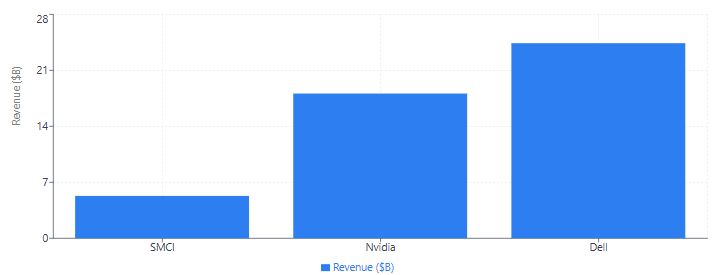
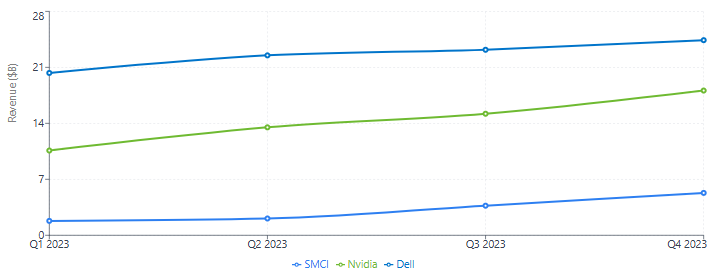
In revenues, SMCI reported revenue of $5.3 billion in the most recent quarter, a year over year increase of roughly 200%. Yes, that's correct, approximately 3x the amount of revenue earned in this same quarter a year ago. This significant increase is atypical of a business the size of SMCI and is indicative of the incredible demands for AI Infrastructure.
When net income and earnings per share were reported, there was positive growth; however, the numbers are not in-line with the revenue increase. This likely indicates SMCI invested heavily in order to scale the operational side in response to the rapid increase in demand for their products.
SMCI's gross margin for the quarter was approximately 15.5%. This is in-line with the historical averages for SMCI, however some analysts had hoped to see better than this number. SMCI explained that the increased production levels and large contracts put pressure on margins during ramp-up periods until the company becomes more efficient.
If you want to use a report card analogy, SMCI has an 'A+' for increasing revenues, but perhaps a 'B+' for profitability. SMCI is experiencing incredible growth, but can SMCI continue to grow with this level of operational efficiency?
Investors reacted to SMCI's Q4 earnings release with admiration for the company's sales growth but disappointment over less-than-expected gross margins. Immediately after the announcement, shares surged; however, once analysts began to analyze the quarterly results in detail, share prices fell sharply.
The most important thing for long-term investors is whether the growth that SMCI is experiencing will be sustainable. According to SMCI's management, there is a significant backlog in orders for SMCI products and there continues to be a significant demand for their products from hyperscaler companies. Therefore, the growth story is not just about a single quarter of strong performance; SMCI is in the early stages of a multi-year infrastructure buildout cycle.
Another point that came up in the earnings call was that liquid cooling technology has become increasingly significant as a differentiator in the computer chip market. AI computer chips produce ever-increasing amounts of power and excess heat, thus traditional air cooling systems no longer provide the necessary cooling requirements. SMCI has developed liquid cooling systems that can manage these extreme demands, which gives SMCI a significant competitive advantage over other manufacturers of AI computer chips.
SMCI vs Nvidia: The AI Hardware Showdown
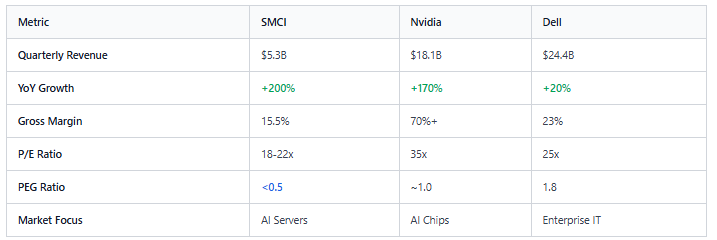
NVIDIA's current earnings for Q1 2023 were $18.1 billion. A significant portion of their earnings is derived from the data center segment, which contains their AI GPUs, with gross margins exceeding 70% in Q1 2023, solidifying NVIDIA's dominance in revenues from AI chips. All other manufacturers of AI chips are nowhere near achieving the financial performance of NVIDIA.
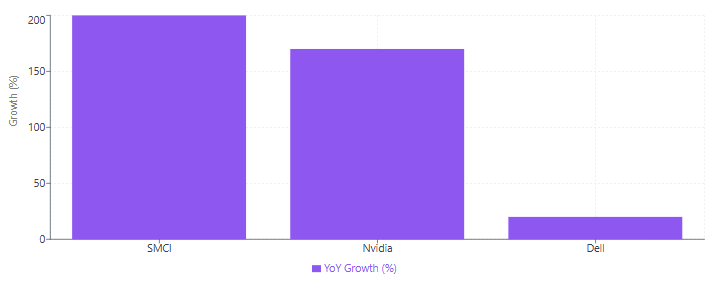
On the contrary, SMCI achieved revenue of $5.3 billion, which is dwarfed by NVIDIA; however, if you compare year-over-year revenue growth rates, the picture looks very different. NVIDIA grew year-over-year by approximately 170%, while SMCI grew year-over-year at approximately 200%. So, while they are deriving from the same AI growth opportunity, the manner in which they are doing so is different.
To clarify, you could use an analogy with two students. The first student, who began with a perfect GPA (all A's) and continues to earn A's while moving into higher-level classes. The second student, who started with a GPA of B and improved to a similar level as the first student after three years, has continued improving his GPA over the last 3 years. Although both students have experienced tremendous success, their paths to academic success have been very different.
The gross margin gap is the primary difference between the two. Nvidia has gross margins of over 70%, which is due to being a chip designer and having the ability to dictate its price. SMCI has gross margins of about 15%, which is indicative of hardware manufacturing and assembly. This doesn't imply SMCI is doing poorly, because by producing a greater volume of products and turning over inventories more quickly, SMCI compensates for lower margins.
The differences in market share dynamics between SMCI and Nvidia will benefit Nvidia in AI chips, but SMCI has an opportunity in server space. Nvidia essentially has no competition in the manufacturing of high-performance AI GPU's. SMCI competes against Dell, HP, Lenovo, and many other companies in the server market, which is large enough to allow for multiple winners.
Revenue growth drivers for SMCI and Nvidia are different. For Nvidia, selling more expensive chips as AI models become larger and more complex is one way to drive revenue growth. For SMCI, revenue growth comes from the fact that data centers will continue to deploy additional servers to support these AI models. These two facts are really two sides of the same coin.
In summary, for investors deciding between either of these stocks, both have pros and cons but the most significant for each company is that Nvidia is a market leader and trades at a premium valuation, whereas, SMCI has greater growth potential, however, with a higher degree of execution risk and competition.
SMCI vs Dell: Old Guard Meets New Challenger
As you can see from the comparison of SMCI and Dell, the business model directly impacts the financial results. Dell has had a long history and been in existence for decades while SMCI is considered the new kid on the block, an aggressive start-up. Both companies offer servers for sale, but that is where their similarities end.
In the most recent quarter for Dell, the company achieved $24.4 billion of revenues across all its business units. The server business (Infrastructure Solutions Group) generated approximately $11 billion of revenue for Dell, which is much larger than SMCI's total annual revenues.
However, when analysing the two companies in terms of growth rate, we see a different picture. Dell's revenue from its servers grew at approximately 20% compared to a year ago; while that is an impressive growth rate, it is not close to SMCI's incredible growth rate of 200%.
The two companies also have a difference in terms of gross margin. Dell's gross margin for all its business units is approximately 23%, whereas SMCI has a gross margin of approximately 15%. One of the reasons for the difference in Dell's gross margin is that it sells more higher-margin products such as storage arrays and software alongside its servers. In addition, Dell has a much larger services division that provides continual revenue streams.
In analogy, you might consider Dell as the senior in high school with good grades, who is a star athlete in three different sports, and has a part-time job, whereas SMCI is the junior who just joined one club in high school, but is dominating in that club. These two companies represent different strategies resulting in different outcomes.
Overview of Earnings Per Share (EPS) Viability: Dell's successful EPS maturity = SAPs higher absolute EPS relative to SAP's EPS growth rate, creating an unusual valuation dynamic, discussed further in the Valuation section.
There are significant contrasts in the business models of both companies. Dell serves enterprises through large sales force and channel partner networks, providing them with financing options, long-term service contracts and placing as much emphasis on the company/corporate relationships as the products that they sell to Dell. SMCI sells directly to hyperscalers and large enterprises requiring highest performance at reduced service costs.
Each company's competitive positioning has significant differences and similarities. Dell has the highest unit sales in the traditional (Non-cloud) Enterprise Server market, where Service and Support are key differentiators. SMCI has built a customer base primarily consisting of companies who require maximum performance and depend on Liquid Cooling, particularly those getting ready to deploy Artificial Intelligence (AI) work loads. While there are synergies between the companies, both have distinctive competitive advantages.
What's Driving SMCI's Growth
There are several macro-trends helping to fuel SMCI’s revenue growth which will help provide clues as to whether or not SMCI will continue to see revenue growth. The most obvious of these trends is the demand for AI servers. Major technology companies are spending thousands of millions of dollars on building AI infrastructure. Major technology companies like OpenAI, Google, Meta, Microsoft, Amazon, etc. are all in a race to build larger AI models which will require an increase in computing power which translates into an increase in the number of GPUs and CPUs. SMCI is the company that provides the infrastructure for where all of these GPUs and CPUs will be housed.
Cloud adoption continues to help drive demand for server technology. Even outside of AI, cloud adoption is still a work in progress. Companies are continuing to migrate workloads from their on-premise data centers to the cloud and hyperscale companies require the necessary server technology to support continued growth of the cloud as well.
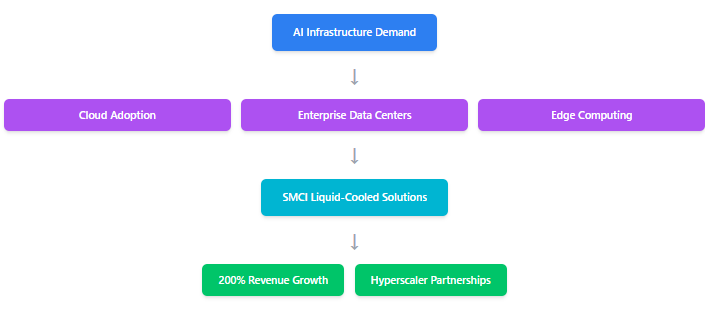
Enterprise Data Center Spending: A third macro-trend that will help to drive continued growth for SMCI is enterprise data center spending. Large corporations are currently building private clouds and they are upgrading the architecture of their data centers to support modern workloads. SMCI provides customizable solutions for enterprises that would like to have control of the infrastructure that they provide for their organizations to meet their growth needs.
Think of it as a School District deciding to Upgrade All of its Equipment: Historically when a School District has made a top-level decision to upgrade all of its equipment to a more modern version of the same equipment, the suppliers who have the ability to deliver large amounts of such equipment to School Districts have, historically, been the companies (suppliers) that have had the largest contracts awarded to them. That is happening now to the technology infrastructure market with similar implications for large corporations and cloud service providers.
Analysts expect AI spending worldwide to reach more than $200 billion each year by 2030, and while SMCI does not claim the entire amount, it will be able to participate in this vast market share, which provides SMCI with several years of potential growth.
The partnership established between SMCI and the largest cloud providers creates an effect, which means that as SMCI continues to deliver successful implementations to cloud service providers, more orders will come in as service providers expand their capabilities. This type of customer base provides SMCI with customers that have significant amounts of financial resources and urgent needs that align with SMCI's business model.
SMCI also benefits from an additional new growth opportunity in edge computing. As the AI inference moves closer to where the data is being produced (for example, self-driving cars, smart factories), there is an increase in demand for a distribution of infrastructure. SMCI's efficient and compact designs work well with edge deployments.
Risks Facing Super Micro
Every growth company faces its own set of problems, and SMCI has many issues that can slow down the company's growth in revenue.
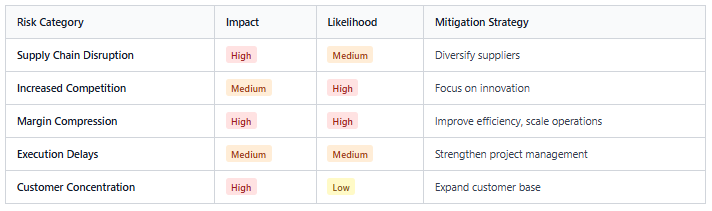
For example, many companies in SMCI's industry are experiencing supply chain disruptions; and even the smallest disruption to a supplier's supply chain will prevent SMCI from fulfilling its orders to its customers. As we have seen with the most recent shortage of chips, the entire technology industry is vulnerable to supply chain disruptions in this athletic arena.
The number of competitors for SMCI is increasing quickly; Dell has begun marketing its new offerings aggressively; HP has begun marketing its AI-based infrastructure solutions; and now we see companies like Nvidia leveraging their relationships with cloud providers to design and sell complete systems.
To stay competitive, SMCI must continue to innovate.
This is similar to an analogy about homework; when you have so many assignments due at once, even if you have the ability to get the work done, poor timing and/or lack of available resources may negatively impact your ability to complete the assignment.
Another risk that SMCI will face as it scales its business is margin compression; its customers who are "hyperscalers" will become tough negotiators and, as their orders grow, they will expect lower prices. In order for SMCI to not lose margin, it must find a way to rapidly improve operating efficiency to counteract that margin pressure.
As SMCI grows rapidly, it may also experience delays in receiving orders. Because of the rapid increase in the customer's demand for products, ramping production to meet that demand may be difficult. If SMCI makes any mistakes in execution, it could lead to disappointing its Wall Street investors and result in a sell-off of SMCI stock.
The availability of components specifically for AI servers is increasingly being squeezed. The demand for these high performance parts is high amongst many companies, and as such SMCI must compete with many larger organizations for allocation.
Financial Risks:
There will be significant amounts of working capital required for SMCI to build servers, as components must be purchased upfront, and with customers delaying payments or pushing out orders, cash flow can quickly become constrained.
Another area of concern is market concentration. If SMCI has too many customers that are large, there is a risk that if one customer stops ordering, revenue may drop dramatically.
How Earnings Move SMCI's Stock
SMCI stock price does not stay stable and shows a lot of variance around the earnings report days. Understanding this pattern will help investors navigate this volatility.
Earnings beats and misses will elicit immediate reactions to the stock price. For example, when a company reports revenues or EPS numbers above analyst expectations (known as an earnings beat), often the stock will see an immediate increase of 10%-20% in after-hours trading. Likewise, in the event of an earnings miss, the stock will often experience a similar decline in its after-hours trading. While this reaction is not limited to SMCI, the size of the price movement will generally be larger than for most tech stocks.
Think about it this way: You take a test, and when you get the results back, you are excited because you received a higher score than expected. If you had scored a lower grade than you thought, you would likely feel disappointed. The stock market reacts similarly to earnings results.
The initial reaction to an earnings report is frequently overzealous on either the positive or negative reaction. For instance, after an earnings report comes out, traders will often take a profit from the initial spike, or buyers will frequently step in to try to take advantage of the oversold condition. This creates the potential for making a quick gain by taking advantage of the volatility created following the earnings report.
As far as how dividends and earnings can be used to develop a trading strategy, it is entirely dependent on the investor's time-frame. For example, a long-term investor may use the dip from an earnings report as a chance to buy shares in a company whose fundamental story still holds true. A short-term trader may take advantage of the volatility created by the earnings report through the use of options or contracts for difference (CFDs).
By looking at past quarters, it is evident there is a trend developing. For instance, SMCI's stock price rose 15% after beating earnings estimates for Q4 2023, but within two weeks it had lost almost half of that increase. When SMCI provided its guidance for Q1 2024, although revenue beat expectations, the stock dropped 12% as a result. However, the stock has made a full recovery.
This trend presents many trading options, however, there are significant risks associated with trading around earnings announcements, so effective risk management is essential; therefore, traders should use stop-loss orders (stop-loss orders) and position size properly when trading around SMCI earnings.
The options activity surrounding SMCI's earnings dates indicates that traders expect to see some volatility, thus causing a spike in implied volatility prior to SMCI's earnings release; this spike in implied volatility results in higher costs for SMCI options, but could also lead to profits for the trader if the trader forecasts the correct direction.
Valuation: Is SMCI Cheap or Expensive?
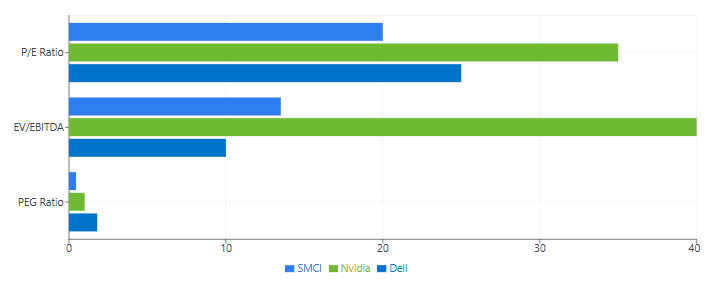
The P/E ratio is an important measure for investors to gauge the relative attractiveness of SMCI stock versus Nvidia and Dell. P/E is a ratio between the price of the stock and the amount of money the company makes per share (also known as earnings), or how much they will earn for every share. For SMCI, depending on the estimates of earnings being used, its forward P/E ratio currently ranges from approximately 18 to 22 times, which is considerably lower than NVDA (35 times) and Dell (25 times).
However, does this mean that SMCI stock is an attractive value? Not necessarily. When looking at P/E, one must consider the relative strength of each company. Nvidia has a larger market share and very high gross margins, or profit margins. Dell earnings are growing steadily, but are projected to grow slowly over the next few years.
To put it another way, if you were to consider academic performance in a class ranking situation, converting grades to rankings can give you an idea of how each student is performing in comparison to other students; however, you also must know how many points it takes to get an A. In that example, getting an A+ in an honors class would be ranked higher than getting a B- in a regular class.
Another perspective on valuation is needed by evaluating the EV/EBITDA metric (Enterprise Value/Earnings Before Interest, Taxes, Depreciation and Amortization). The range for SMCI is approximately 12 to 15 times and for Nvidia is 40+ times and for Dell is 10 times.
A PEG Ratio (the P/E ratio divided by the anticipated growth rate) is a more meaningful number and indicates that, in many calculations, the PEG ratio for SMCI indicates that it is undervalued relative to its future growth potential as a company - it is below 0.5. For Nvidia, its PEG is approximately one, which is viewed as a fair valuation; while Dell has a significantly higher ratio, suggesting slower growth potential.
The market is indicating that SMCI has huge growth potential going forward; in contrast, Nvidia has a very strong market position; while Dell is providing steady stability to investors. Clearly, the valuations of these three companies reflect the differing priorities within the investment community.
Historically, SMCI traded at a higher multiple than it is currently trading now, particularly during "peak AI" times. If growth continues, the current valuation of SMCI appears reasonable; however, if execution falters, the value of SMCI could decline quickly.
In comparison with past valuations of Nvidia and Dell, SMCI seems appealing when adjusted for growth; however, that historical performance does not indicate that future performance will mirror past performance, especially given SMCI's volatility as a stock.
What Analysts Expect
Wall Street analysts have dedicated their entire careers to analyzing companies like SMCI; therefore the estimates provide insight into what the market thinks will happen with the company going forward.
Currently there is a consensus among analysts that SMCI will earn $23-$25 billion in revenues over the entire fiscal year. This would represent approximately 80%-90% growth over the previous year and is based on an expectation of continued strong demand for software products and services provided by SMCI. As such these numbers are considered aggressive estimates.
The current EPS forecasts by analysts for SMCI are concentrated in a narrower band of $27-$30 for the year, indicating a substantial increase in profitability compared to last year. Furthermore, analysts anticipate that SMCI will see a modest increase in profit margins as it continues to develop scale and increase its efficiency.
To use an analogy, you can compare the way analysts predict earnings for a company to the way students predict grades for their next semester; they look at the past performance of the student as well as the course difficulty and the amount of time the student has available to study. Analysts do the same for companies.
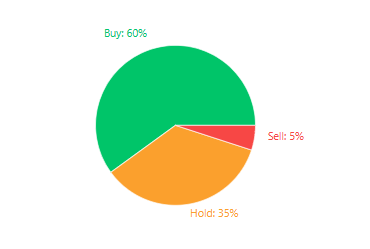
Analysts' ratings on SMCI are somewhat mixed. Of the analysts covering SMCI, approximately 60% have a buy rating, 35% have a hold rating, and 5% have sell recommendations. The distribution of the ratings is actually quite bullish in that it shows that the majority of analysts believe in the company's growth prospects, although they may have concerns about the valuation of the stock or the risks associated with execution.
Analysts provide target prices ranging from $35 on the low end to $75 on the high end, with a median target of around $50. This indicates that the stock currently has potential for upside, and that a wide range of opinions exists regarding what is the fair value for the stock.
Analyst target changes show how analysts' sentiments have changed. After earnings were better than expected, numerous companies increased price targets and revised ratings but because many companies stated that due to declining margins, they downgraded ratings from a buy recommendation to hold.
Analysts are forecasting that SMCI will continue to grow revenue for the current quarter, with increases estimated to be fairly strong, but they are monitoring SMCI's margins closely. If SMCI is able to outperform both on revenues and margin levels, then the stock will increase sharply. On the other hand, if SMCI increases revenue levels but marginally misses expectations, then the stock's performance will be essentially neutral.
Before earnings are released, there are often major movements in stock prices due to estimates being raised by analysts due to anticipation. Even if earnings end up being in line with those predictions made by analysts, the stock price may not change significantly after the release of earnings.
SMCI's Global Impact
Earnings of Super Micro (SMCI) have far-reaching implications beyond the company itself, as they are closely intertwined with the direction of global technology infrastructure. AI hardware supply chains and development are dependent on companies like SMCI to establish and scale production; when SMCI encounters obstacles or challenges, it retards the overall development and breadth of AI usage, just as successful execution by SMCI accelerates AI implementation across multiple sectors and industries.
The Cloud’s investing behaviours follow similar trends as those exhibited by periods of increases/decreases for SMCI; strong results from SMCI reflect the hype-cycle that Investors have experienced with ‘hyperscalers’ whereby they are investing on an aggressive basis, which should create bullish sentiment across the entire cloud-related ecosystem; poor results from SMCI would indicate that there may have now been some slowdown trend developing in Cloud-based Infrastructure spending.
It can be analogised that SMCI is akin to a top-performing School providing opportunity for increased numbers of tutors and educational resources to the local community; success in one aspect of the ecosystem/paradigm provides a ‘lift’ to adjoining aspects.
As such, the growth of SMCI will similarly impact the growth of technology indices, Exchange Traded Funds, etc. SMCI is part of the NASDAQ composite index and is an underlying component of several technology and /or AI-focused ETFs, so when SMCI’s stock rallies, it assists in increasing growth for the respective indices.
A pattern has developed over the years, where beating earnings concurrently produces similar increases in other related companies' respective stocks. Companies (that manufacture/produce) Server Component Suppliers, Data Centre Real Estate Investment Trusts (REITs), and other companies associated with AI Infrastructure typically will experience Movement in Sympathy with the performance of SMCI.
When SMCI does not meet expectations, it can negatively impact other AI infrastructure stocks as investors begin to question if they are inflating their investments across multiple companies in a single industry (AI Infrastructure). SMCI's component needs are reflective of worldwide demand for semiconductors. Strong Server Assembly allows for the assembly of servers that contain chips which allow for the use of various types of processors. Therefore, the growth of SMCI sales supports the pricing and volumes that Chip Manufacturers can sell.
AI Infrastructure is becoming an international trend, with the deployment of AI solutions in Asia and Europe demonstrating that the trend of deploying AI is growing beyond just North America.
Trading SMCI: Practical Strategies
To create profits from analyzing earnings, active traders must apply a strategy rather than simply applying information. The following provides insight to how active traders view SMCI in regards to earnings.
Earnings-induced trading generally tends to be speculative due to the immediate volatility and lack of certainty. Traders may purchase options prior to earnings with hopes of a large price movement in either direction, commonly found in straddle and strangle strategies. Other traders will examine the initial reaction and will look to fade any overextended reaction.
On a simplified basis, traders may use a similar approach of what they consider to be logical reasoning to develop their study strategies prior to exams. For example, if a trader believes that certain types of questions appear frequently on a particular type of exam, then they may develop a strategy to prepare in advance specifically for those types of questions.
In the case of SMCI, stock traders/CDF traders may purchase shares of stock in anticipation of a strong earnings report and/or place a stop-loss below the prior support levels, or they may want to wait until after earnings to buy shares if they consider the negative reaction to be excessive when comparing actual results.
With regards to stock/CFD position sizes, position size plays a significant role for highly volatile stocks like SMCI. Even when traders are extremely confident in their viewpoint and analysis of SMCI, they should keep their position size on any individual position restricted to 2%-3% of their total portfolio due to the possibility of stocks moving 15%-20% in a single day.
Technical analysis can assist in determining market direction on earnings due to trends that reflect a continued upward or downward trend. For example, if SMCI were to report earnings and subsequently beat expectations and continue to hit key resistance levels, then potentially there may be a short opportunity. Conversely, if SMCI were to report earnings and miss expectations yet hold near key levels of support, then it may indicate the bottom of the stock is likely being established.
Earnings cycles create trading opportunities. Some traders prefer to trade the run-up prior to earnings, while others prefer trading the post-earnings drift, where stocks typically continue moving in the direction of their earnings reaction for several days or weeks after the earnings announcement.
Risk management is very important when trading volatile stocks. Use stop losses; don't over-leverage; and don't risk what you can’t afford to lose are basic principles that should be followed when trading any stock, but are even more important with respect to trading volatile stocks.
Just because earnings have been announced doesn’t mean to blindly trade all earnings reports. Sometimes it is better to take no trade, especially if the results have been mixed and the market reaction is uncertain.
Ready to turn SMCI earnings insights into real trading opportunities? Tradewill.com gives you access to AI infrastructure stocks and tech CFDs with the tools to trade market-moving earnings. Open your account and start positioning for the next big move.
Disclaimer: The content of the blog does not represent any position of Trade W, does not serve as any trading-related decision advice, and does not endorse any third-party.