

 Trade W

Navigating the world of commodity trading may seem intimidating initially. There is much to learn about margins, contracts and the fundamentals of that market. One type of commodity that is relatively easy to start trading would be soybean futures contracts once you know some of the basics about commodity markets.
This guide will break down all the information you will need before placing your first trade.
What is a Soybean Futures Contract? Complete Beginner's Guide to Soybean Futures
Soybean futures contracts are standardised agreements in which you agree to buy or sell a set amount of soybeans at a specified future date and price. The actual purchase of soybeans doesn't happen except where someone carries the contract until expiration and takes delivery of it, which is not something most traders do.
Rather, traders are speculating on what the future price of this commodity might be. It can be compared to arranging an airline ticket several months ahead at a fixed price for a specific date. If the price of tickets goes up before the travel date, then you are happy as you have locked in a lower price than the current market conditions.
If the price of tickets goes down, then you might feel that you have paid too much. This is a simplified comparison of how a futures contract operates with respect to agricultural commodities versus airline tickets.
Who Trades Soybean Futures?
There are two major players in the current market:
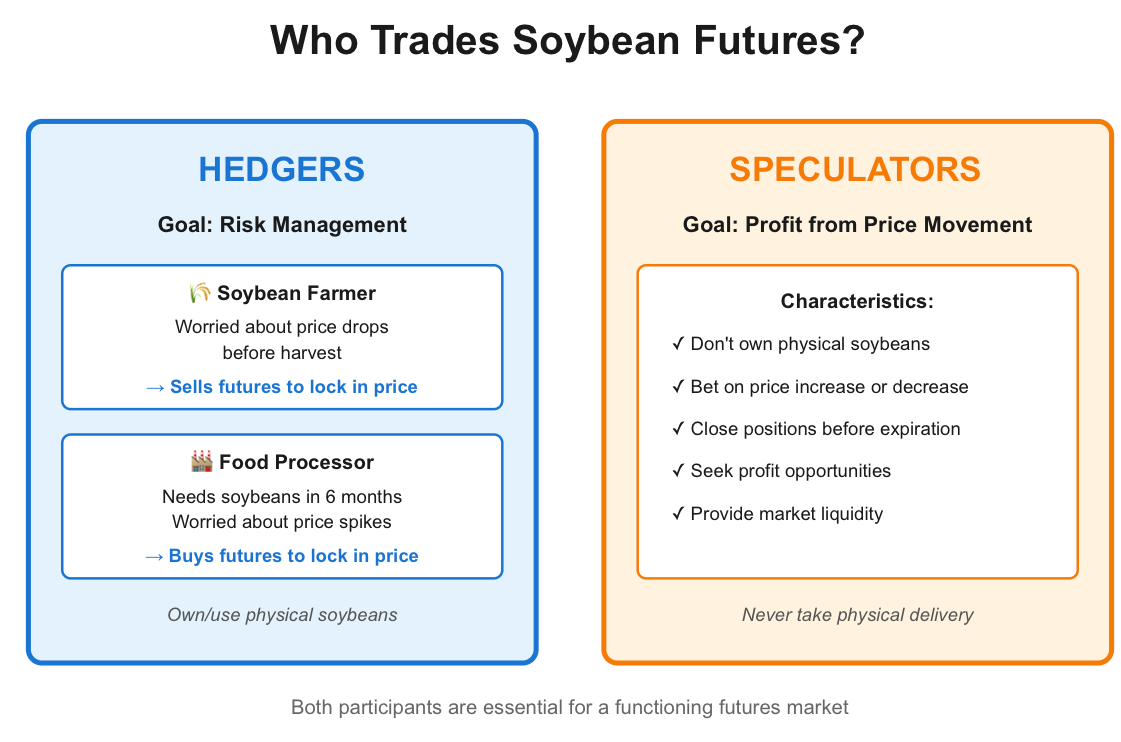
Hedgers who are using contracts to reduce their exposure to changing prices. An example of a hedger would be a soy bean farmer anxious about the downturn in price before harvest. So the farmer would contract out the future of the soybeans to hedge the price today. An example on the other side of the transaction would be a food processing company needing Soy beans in six months, so they would contract out the Soy beans now to protect from massive swings in price.
Speculators operate as a less conventional means of trading on the commodity market. Unlike hedgers, they are not involved in the actual purchase of the underlying commodity, but are betting that prices will increase or decrease over time. Speculators generally close out their contracts before the futures contract expires to realise a profit or potentially a loss.
Why Soybeans Matter Globally
The soybean is more than just an agronomical commodity; it is the basis of the modern global food supply. In addition to the production of animal meats as livestock feed and edible oils, there is also a growing demand from consumers who've opted to create their own soybean products made from plant proteins. Soybean products can also be converted into biodiesel.
There is a monthly increasing demand for soybeans from different industries (food, feed, fuel). For this reason, the soybean trading market experiences large price swings. A few of the causes for this volatility are: changes in climate, planting decisions made by farmers, and changing trade laws enacted by the world's governments.
The Soybean Futures contract on the Chicago Mercantile Exchange (CME) is the benchmark for prices of soybeans in the world. When companies enter into agreements or contracts for soybeans with each other, it is common for them to base their agreements on CME futures prices.
How Soybean Futures Contracts Work: Understanding Mechanics, Margin, and Settlement
Futures trading functions differently from buying stock. Particular contract specifications or margin calls may catch you unaware if you don’t understand the rules of the game.
Contract Specifications
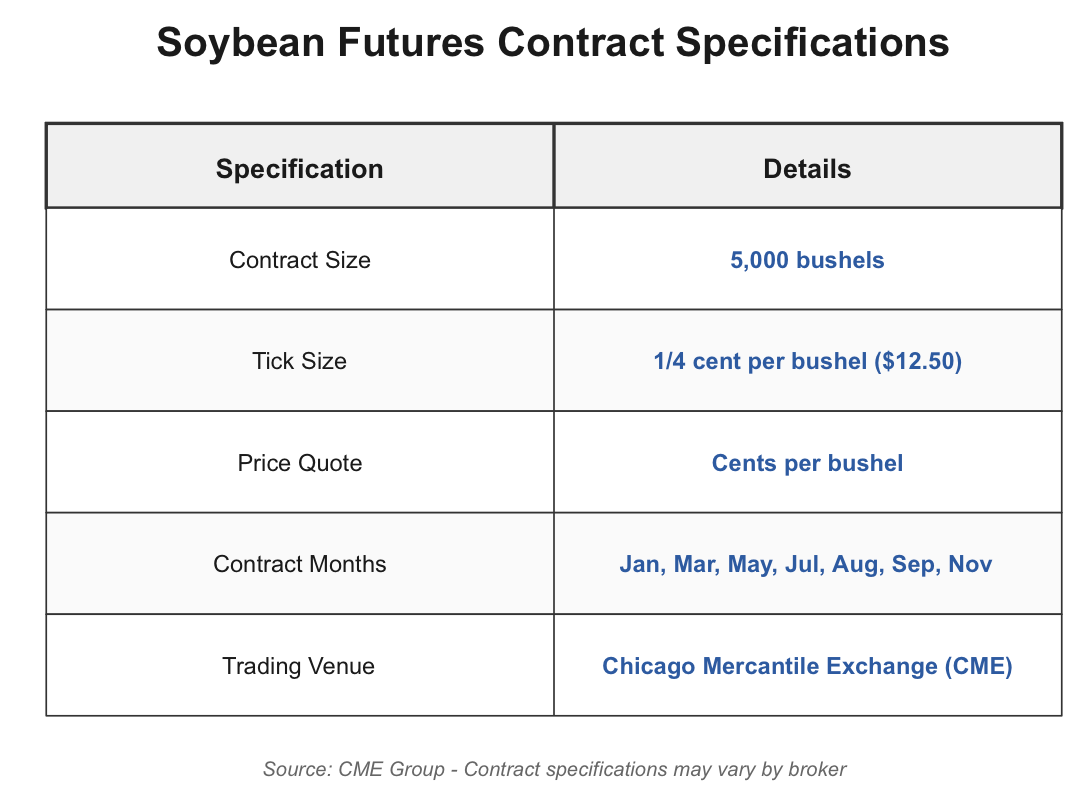
Soybean Futures Contracts are for 5,000 bushels. The tick size (minimum price movement) is 1/4 cent per bushel, which equals $12.50 per contract. Price quotes are for cents per bushel (e.g. 1050.25 means $10.5025 per bushel). Contracts are for specific months: January (F), March (H), May (K), July (N), August (Q), September (U) and November (X). Each contract has an expiration date. If an open position is not closed before the expiration date, you may have delivery obligations.
Margin and Leverage
Futures are powerful yet dangerous because you don’t need to have the full value of a contract to initiate trades. Instead of purchasing a full contract, you post a margin, which is like a performance bond.
For example, if you want to go long on one soybean futures contract at $10.50 per bushel, the value of that contract is $52,500 (5,000 bushels x $10.50); however, as an initial margin, you may only need to put up $3,000.
Thus, you are leveraging approximately 17:1. If soybeans move up 1%, your account will move 17%. In this example, if the price of soybeans increases to $10.60 (less than 1%), you will have made $500 on the original $3,000 margin, which equals a 16.7% return.
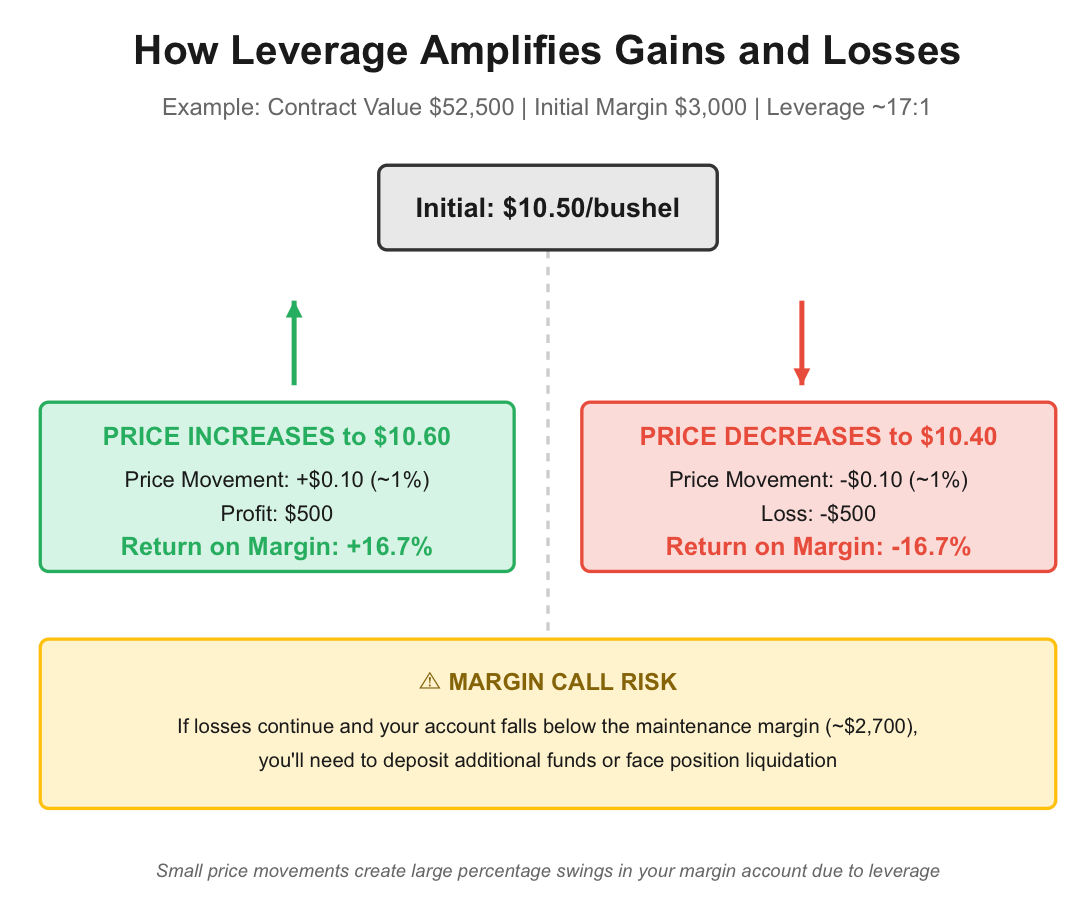
Leverage also works in the opposite direction. If soybeans decline to $10.40, you will lose $500 or 16.7% of the margin amount. If the price continues to decline and your account falls below the maintenance margin of approximately $2,700, you will receive a margin call to fund your account or be liquidated by your broker.
Mark-to-Market Settlement
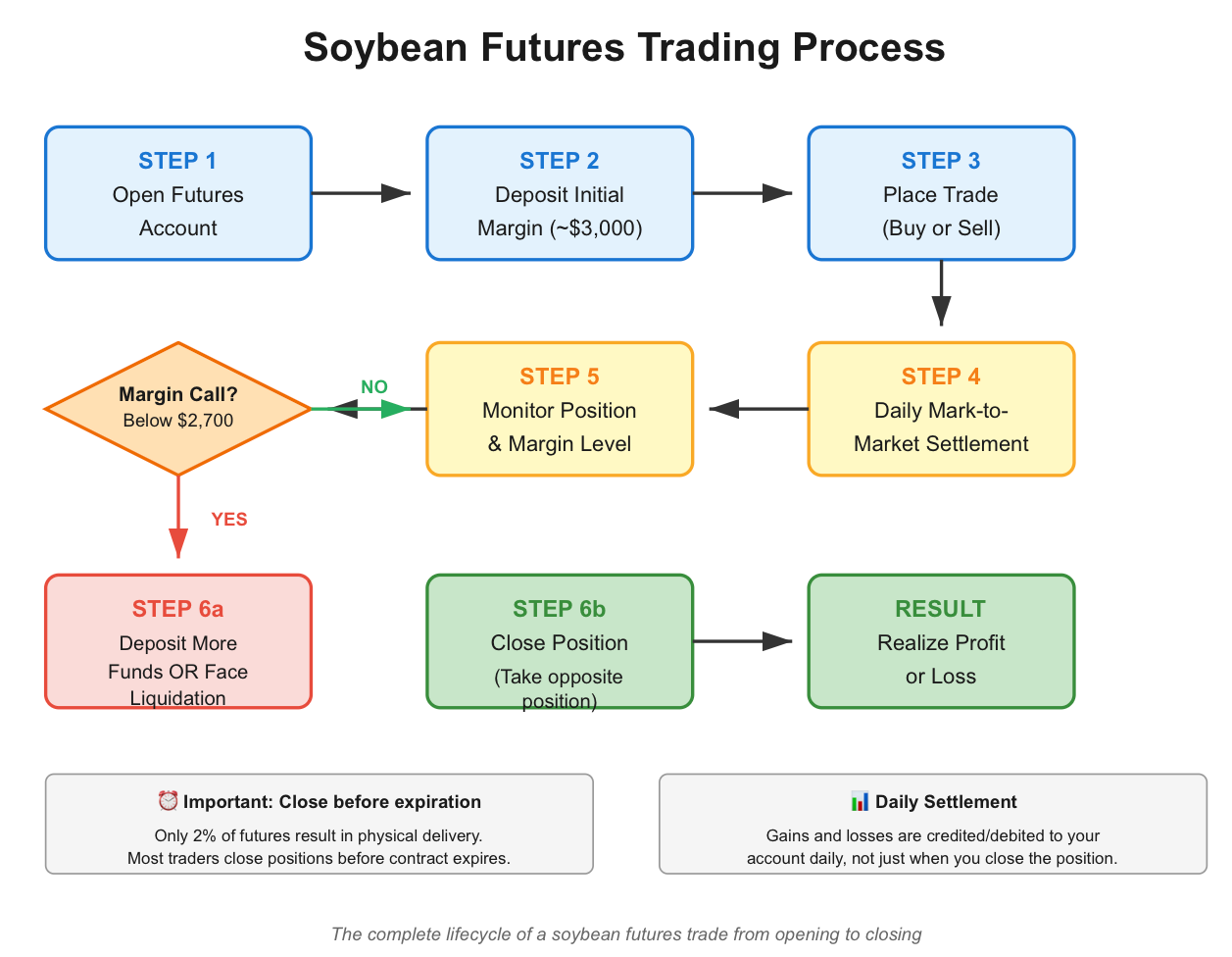
Futures accounts settle daily, which differs from stocks, where you do not recognise realised gains or losses until you sell your stock holdings. With futures, you will be credited or debited with cash amounts for the daily mark-to-market gains or losses. If you have $300 of equity based on your futures position today, you will have $300 cash credited to your account. If you lose $300 tomorrow from your futures position, $300 cash will be deducted from your account.
This form of settlement maintains integrity in the marketplace and reduces the opportunities for large losses to accumulate without being recognised.
Delivery vs. Closing Out a Position
Most traders will close out their positions before expiration of the contracts; most traders will take the opposite of their original position when they want to exit. For instance, if you buy a contract, you will sell a contract to close out the position. Only about 2% of futures contracts go to physical delivery.
Think of it as a hotel room. You reserve the room ahead of time, but if your plans change, you can cancel before taking delivery. Additionally, large institutional traders typically roll their positions from one contract month to another during the approach of an expiration.
Key Factors Driving Soybeans Futures Prices: From Supply, Demand to Market Expectations
Purchasing futures is an entirely different transaction from purchasing stock. Futures contracts are governed by specific attributes of each contract. Without having knowledge of how futures trading works, an inexperienced or uninformed trader could find themselves losing money in a trade without knowing why.
Contract Specifications
The soybean futures contracts represent 5000 bushels of soybeans. The tick size for its price movement is $0.0025 per bushel or $12.50 per contract. The price of soybean futures is quoted as dollars and cents per bushel (the price quoted at $1050.25 means $10.5025 per bushel). Each contract has an expiration date, so if you have open positions at expiration, you may end up taking delivery on these contracts.
Margins and Leverage
Because of the leverage involved in trading futures contracts, it is a powerful yet dangerous type of trading. When opening a position on a futures contract, you do not have to post the full amount of the contract, but rather a margin that is essentially an insurance policy for your money. For example, if you want to buy a long soybean futures contract at $10.50 a bushel, your contract would be worth $52,500 (which is calculated by multiplying 5,000 bushels x $10.50 a bushel).
You will probably only need to post an initial margin of $3,000 (which will vary based on exchange requirements and the volatility of the market). Therefore, if you post an initial margin of $3,000, you will have an approximate leveraged position of 17 to 1. This means that if the price of soybeans rises by $0.10 (or 1%), your account will rise approximately 17%.
For example, if soybeans rise to $10.60 (an approximate increase of 0.95% over the previous close), your account will rise $500 on an initial margin of $3,000, which would give you a return of approximately 16.67%.
Leverage can also work against you. If soybeans decrease to $10.40 (or $0.10), you would have lost approximately $500, or a 16.67% decrease in your margin. If the market continues to decline and your account falls below the maintenance margin of $2,700, you will receive a margin call to deposit additional cash, or your broker will liquidate your position.
Daily Mark-to-Market Settlement
Futures accounts are marked-to-market every day. Unlike stocks, daily marked-to-market settlements are where gains and losses are recognised daily, rather than at the close of the day. Daily mark-to-market settlements can be applied to your account as cash credits and cash debits. For example, if your account has $300 worth of equity today because of your futures position, you will have a cash credit of $300. However, if you lost $300 tomorrow, you will have $300 deducted from your account.
Daily mark-to-market settlements ensure that the futures marketplace maintains its integrity and prevents losses from accumulating without being recognised.
Physical Delivery vs Closing Out a Futures Position
Most futures traders close out their positions before the expiration date, or they take a position opposite to the contract they purchased to exit the market. For example, if you purchased a contract, you will sell another contract to close out your position. For that reason, only about 2% of all futures contracts actually result in delivery.
Think of a futures contract like reserving a room in a hotel. You can guarantee your room by reserving it early, but if your plans change, you may cancel your reservation before taking physical delivery of the room. To add to this example, large institutional traders also "roll" their positions forward into the next contract month before the current contract expires.
Beyond the Farm: How Global Macro Trends and the USD Impact Soybean Futures Prices
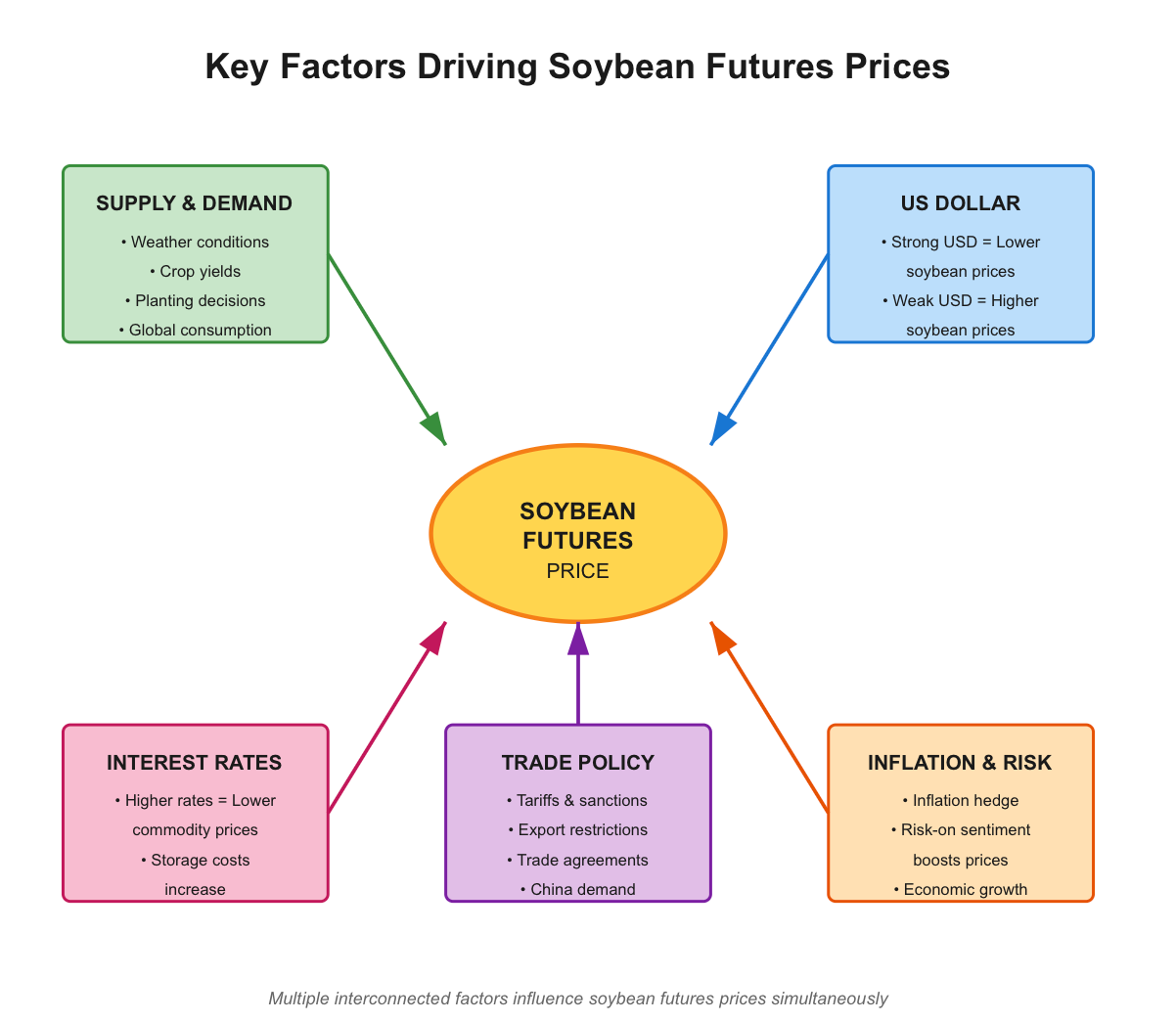
There is more to soybean futures contracts than just farming; they are also financial commodities traded all over the world. Soybean futures contracts are affected by macroeconomic trends and conditions, and therefore are influenced by factors that have nothing to do with weather or planting cycles.
The Effect of the US Dollar on Soybean Futures
Internationally, soybeans have a price set in US dollars. When the US dollar is strong relative to other currencies, it makes soybeans more expensive for international purchasers. Thus, a Brazilian purchaser who pays for soybeans in reals, or a Chinese buyer who pays for soybeans in yuan, must pay a higher price when the US dollar goes up in relation to their local currency. As a result, as buyers' costs increase, it exerts downward pressure on soybean prices.
Conversely, a weak US dollar will lower the cost of soybeans for foreign purchasers, which will increase their demand, thus supporting soybean prices. Many professional traders notice an inverse correlation between the price of soybean futures and the dollar index.
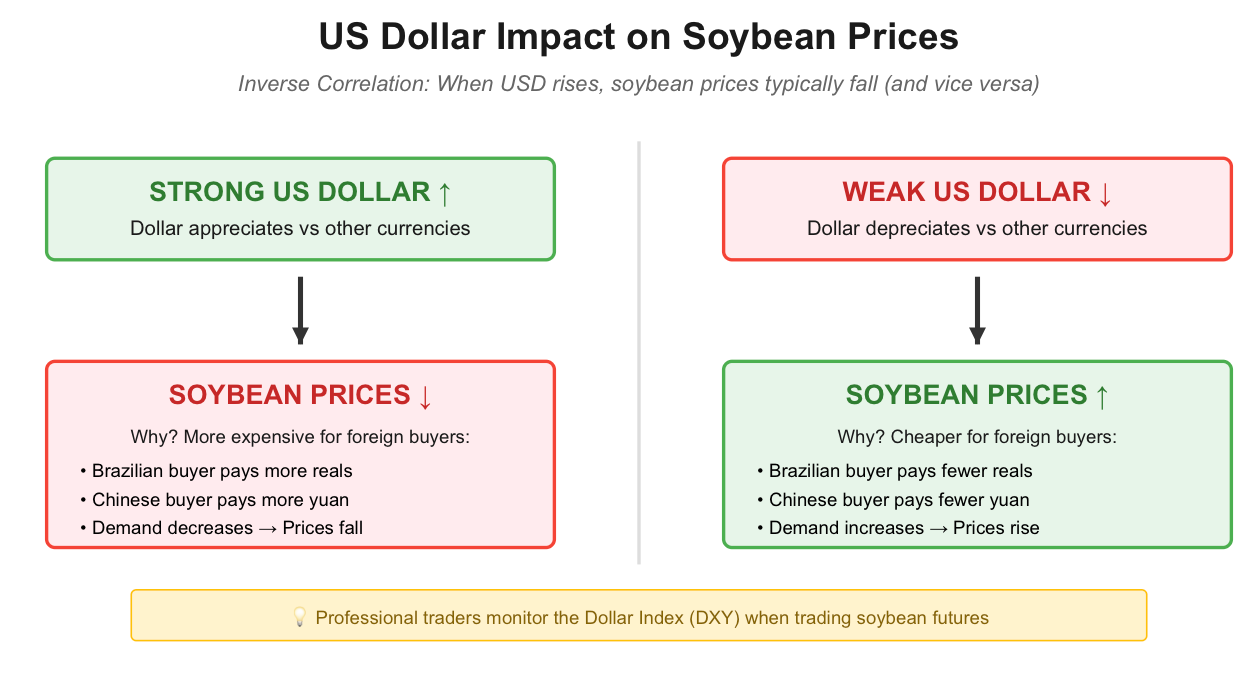
Consider international purchases in terms of your local currency's value. If your currency becomes weaker, the cost of the same item priced in your local currency will increase, even if the nominal price remains constant, which is what international purchasers are experiencing from currency depreciation; therefore, they must pay more to purchase soybeans.
The Impact of Rising Interest Rates on Soybean Futures
The rising interest rates increase the cost to carry inventory. Whether you are storing physical soybeans or holding futures positions, the costs associated with these activities increase with rising interest rates. Therefore, rising interest rates cause downward pressure to be put on commodity prices.
Conversely, decreasing interest rates have the opposite effect. Lower interest rates increase the attractiveness of owning physical commodities, such as soybeans, versus fixed-income investments; additionally, they lower the cost of carrying the commodities by making it less expensive to carry commodities during a period of low interest rates.
The Relationship Between Soybean Futures and Inflation Expectations
Soybeans relate to a broader trend of rising or declining inflation. Soybeans are a key input in food production, and when soybean prices rise, they contribute to an increase in food inflation. When investors expect increased inflation, commodities, including soybeans, are viewed as an attractive investment and therefore serve as an inflation hedge.
Risk Sentiment
When global market investors are "risk on," commodities tend to have higher performance due to the expectations of increased economic growth supporting demand. When global markets are "risk off," commodities tend to be sold off because traders expect that lower levels of economic activity will result in lower consumption levels for commodities.
In conclusion, the link between agriculture and the macroeconomic landscape makes soybean futures contracts a uniquely blended asset class, comprised of agricultural commodities, macro-sensitive financial assets and inflation hedges.
Common Risks and Mistakes in Soybeans Futures Trading: Avoiding Pitfalls Every Trader Should Know
There are many traders who make the same mistakes over and over again when it comes to futures trading. Most traders attempt to avoid making those same mistakes, but unfortunately, it's too easy for many of them to fall back into the trap of doing so.
Using Leverage to Trade Futures
Leverage amplifies everything. For example, if you make a 5% profit, your margin will be double what it was before. On the other hand, if you have a 5% loss, you will have lost everything. Even with small amounts of capital, your profit/loss (P&L) will swing which are far beyond what you can handle.
Extreme weather events have created situations where even professionally managed funds have had their margins called. If large institutions are catching a margin call, there is no question that individual traders will. Therefore, do not put all of your money at risk as a margin.
Emotional Trading
Emotions of greed and fear can ruin your trading account after hard work in analysis and getting to that point. You see that you missed an opportunity, and now prices are much higher than when you wanted to buy. You panic sell out of fear at the bottom of the market following your emotional trading.
Solutions: Place stop loss orders at your anticipated maximum loss before making the trade. Size your positions so that no single transaction can wipe out your account. Stick to your trading plan even though your emotions are telling you otherwise.
Not Paying Attention To Contract Expiration Dates
Each futures contract will expire, and if you have not closed your position before expiration, you may be subject to the risk of physical delivery on your long position. This means you may have to take possession of 5,000 bushels of soybeans, and then you are responsible for arranging to have those soybeans shipped to you and paying storage fees.
Generally speaking, your broker will automatically close out your positions before expiration, but you will incur costs and potential losses in price execution for those positions that expire when normally held.
Not Treating Futures Like Stocks
Buying futures is an active form of managing your portfolio, because the futures contract is marked to market each day and is subject to significantly greater volatility and leverage. Therefore, unlike with a long-term stock investment, you may not want to just buy and forget about your futures investments/reinvestments; you may want to actively manage them.
Not Paying Attention To Macro Economic Factors
Many traders believe they have sufficient information when it comes to supply and demand fundamental analysis, but they do not utilize other monetary actions in the market, such as currency fluctuations, interest rate changes, and overall risk sentiment. Consider other external factors that will impact your trade outcome, other than what you perceive to be the most important factor, i.e. supply and demand, before making a trade.
Why Soybean Futures Contracts Are Essential for Portfolio Diversification
While tallying a return is an obvious benefit of speculative trading, Soybean futures contracts help a broader number of investors build diversified portfolios than just traders seeking to take advantage of ranchers' mistakes or market fluctuation.
Asset Correlation
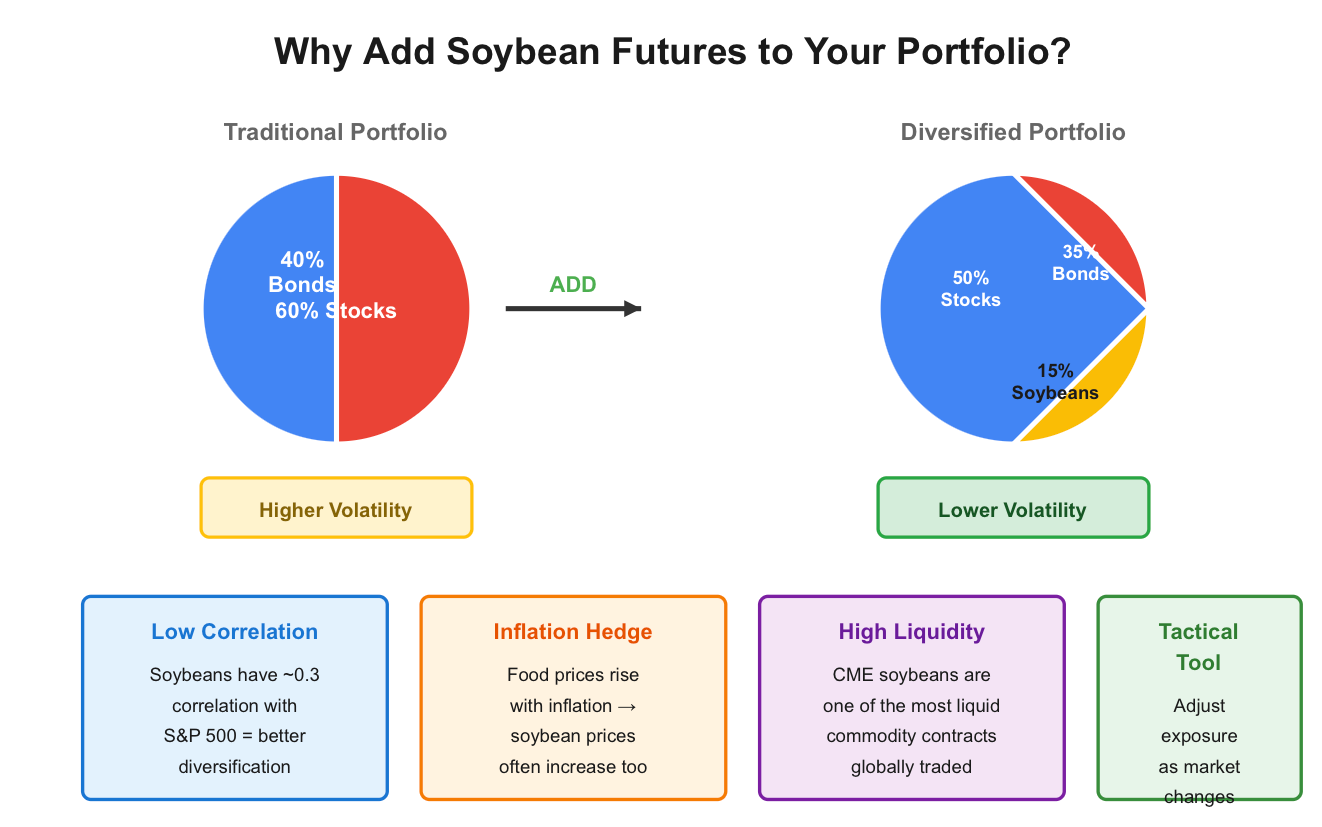
Soybeans typically have a low degree of correlation with other traditional assets such as Stocks and Bonds. For example, professional institutional portfolios have shown to have 0.3 or less with the S&P 500. This indicates that, while stock prices may be declining, soybean prices can be increasing, or vice versa.
Additionally, diversification is not merely about having a variety of products within one particular commodity sector. Adding to a portfolio an asset that is not correlated to both stock and bond holdings will allow for a relative decrease in a portfolio's overall volatility while continuing to produce positive returns.
Inflation Hedge
Due to the economic impact of food inflation, an increase in food prices typically creates upward pressure on soybean prices because soybeans are one of the largest agricultural inputs used in the production of food products. Adding soybeans to your portfolio will help offset the "real-world" price increases you will incur at the grocery store. Soybeans will act as a natural hedge against the loss of purchasing power due to inflation.
Macro Allocation Strategy
Sophisticated investors employ a macro allocation strategy to dynamically allocate their commodity exposure through changes in the macro environment. Greater allocations of commodities are placed during risk-on events when stronger growth expectations exist. Conversely, fewer allocations are placed during risk-off events.
This allocation process enables investors to take advantage of changing market opportunities through soybeans and other commodities as tactical tools.
Liquidity Advantage
CME Soybean Futures Contracts are considered to be one of the most liquid commodity contracts available globally. This high degree of liquidity results in tight bid/ask spreads, quick and easy entry/exit points, and the ability to trade larger volumes of contracts without creating a significant price movement within the commodity market.
One way to view this is to use a three-basket analogy. Stocks, Bonds, and Soybean Futures represent three distinct styles of investment, each utilising different types of financial instruments for generating returns while providing a way to create resilience in an overall investment portfolio by combining different types of assets with a low correlation between them.
Final Thoughts: Is Trading Soybeans Futures Right for You?
So far, we have learned that soybean futures contracts are standardised contracts used to purchase or sell soybeans at agreed-upon prices in the future. Soybean futures contracts utilize leverage and require margin deposits and mark-to-market accounting on a daily basis. The price of soybean futures contracts is affected by weather, supply and demand, macroeconomic factors such as the U.S. dollar and interest rates, and traders' expectations regarding future economic conditions.
Traders use different types of trading strategies to trade soybean futures, including weather breakout strategies, trend-following and range trading strategies. There are several risks associated with using leverage to trade soybean futures, including emotional trading decisions made under emotional stress, contract expiration risks, and being ignorant of macroeconomic factors when placing trades. That said, soybean futures contracts can provide diversification benefits to your overall investment portfolio.
Should you trade soybean futures? If you can manage your use of leverage appropriately, if you can control your emotions during trading, if you understand the fundamentals and technicals associated with soybean futures contracts, and if you are committed to continually educating yourself, then it is possible that soybean futures contracts could be a good trading vehicle for you.
For those who are brand new to trading derivatives or who do not feel comfortable trading in highly volatile markets, it would be wise to take advantage of the opportunity to practice with a demo account or paper trading until you feel comfortable trading with real capital.
Would you like to learn more about soybean futures trading? You can find the latest real-time market data along with strategic guides and risk management resources for both novice and experienced commodity investors at tradewill.com.
Disclaimer: The content of the blog does not represent any position of Trade W, does not serve as any trading-related decision advice, and does not endorse any third-party.