

 Trade W
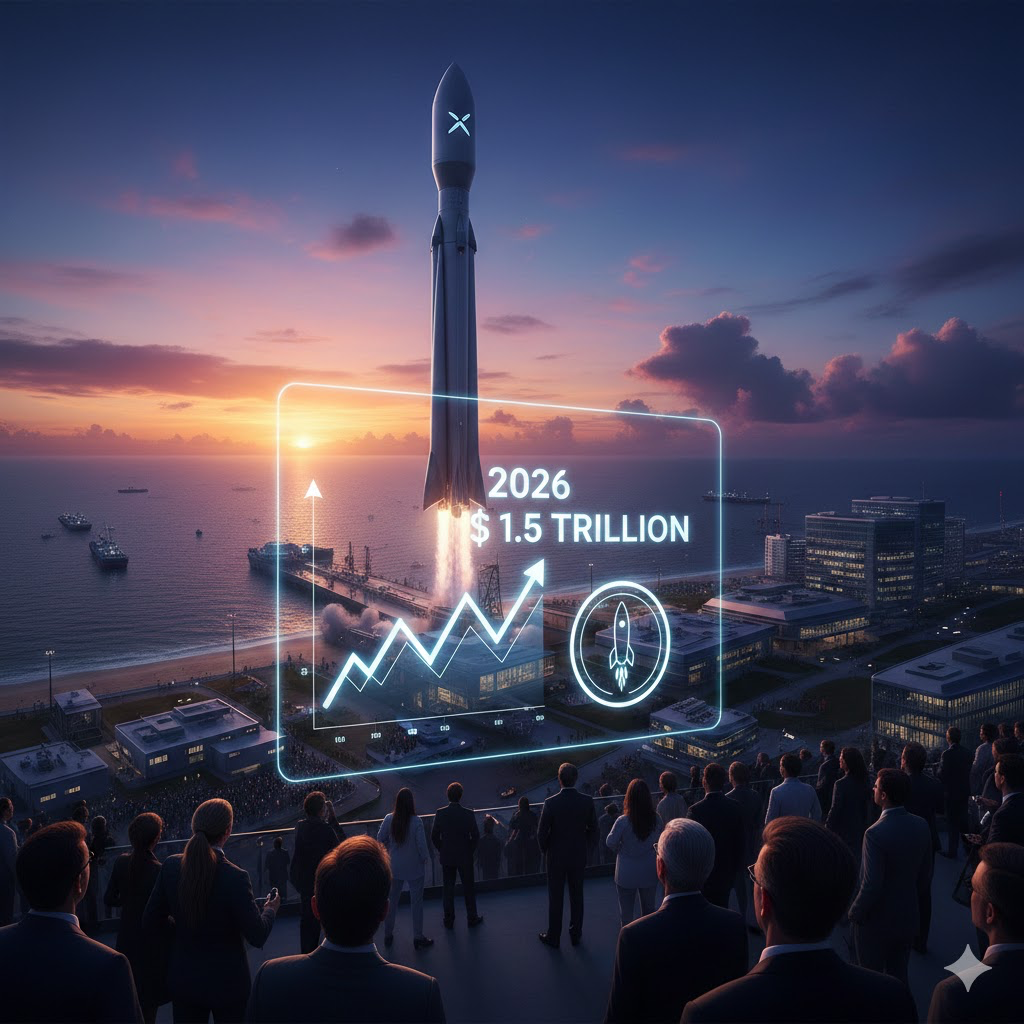
It is anticipated that this will be one of the largest public offerings in today's stock market. Once SpaceX does indeed go public, it will represent an enormous change in the way that capital is lent to companies from around the globe. The term "ipo spacex" has become synonymous with this transformative occasion and rightly so!
The reason for such importance is that SpaceX's IPO represents the chance to create a multi-trillion-dollar global infrastructure that will connect together rocket technology, satellite technology and Artificial Intelligence.
Why the SpaceX IPO Could Be the Biggest Structural Event of the Decade
Not all IPOs are the same - the great majority of companies that go public do so to raise capital from the public market, but a small handful of companies represent entire industries, and an even smaller number will fundamentally change the way money flows through the global financial system. SpaceX is one of these very rare companies, or "structural IPOs," as analysts call them.
The Saudi Aramco $29 billion IPO in 2019 attracted significant liquidity from the Middle East temporarily. Alibaba's $25 billion IPO in 2014 created considerable disruption with tech company valuations in the US and with capital flows from China into US companies. SpaceX's IPO has the potential to dwarf both of those IPOs.
Current estimates suggest SpaceX may be able to raise more than $100 billion, with the estimates potentially exceeding $150 billion depending upon the final valuation and float percentage. The Nasdaq's current trading volume averages between $300 - $400 billion per day. SpaceX's IPO would absorb approximately 25% - 40% of one day's worth of total market liquidity.
These are all immediate impacts; Technology exchange-traded funds (ETFs) would need to rebalance their portfolios to account for SpaceX's value in the major indices. Sovereign wealth funds from Norway to Singapore would review their allocations to aerospace stocks as well as to infrastructure stocks. Portfolio managers of institutional assets in excess of $500 billion will be faced with one simple question: Can I afford NOT to own a piece of humanity's first commercial off-planet infrastructure company?
In September 2020, Snowflake went public and raised $3.4 billion. The first-day volatility in Snowflake's stock affected cloud computing company stocks for weeks, creating a rotation of capital from established companies to the new entrant. Multiply that effect by 30 times.
The SpaceX IPO will be more than just an IPO. It will create a capital structure earthquake, forcing all of the leading institutional fund managers to rethink the way they allocate their capital for the next ten years.
xAI + SpaceX: How AI Could Transform SpaceX into a Trillion-Dollar Infrastructure Giant
Unlike most rocket companies, SpaceX is no longer viewed solely as a launch vehicle manufacturer. The company will be valued much differently due to its integration with xAI.
Historically, the average aerospace company trades at around 5x times its sales. They build rockets, sell rocket launches, and generate steady, albeit average, margins. SpaceX did this for many years; however, the addition of xAI changes the SpaceX business model from a manufacturing company to a platform company.
To illustrate this point, think about the many unique applications. AI can optimise launch windows; using AI, a rocket can calculate when it's best to launch based on thousands of weather data points, better orbital mechanics calculations, and calculations for fuel efficiency, all of which would take a human team thousands of times longer to compute.
Predictive maintenance for rocket boosters requires the use of AI algorithms that evaluate data from launch sensors; therefore, when the same sensors identify anomalies, they can alert engineering teams to potential problems before they arise, optimising maintenance of the fleet of reusable rockets. The network of Starlink satellites generates a daily volume of data from the allocation of bandwidth used across the Starlink network; using AI can optimise ground stations' allocation of network traffic in real time.
Many people fail to see that satellites also provide valuable intelligence in addition to launching rockets. The ability to measure and collect data on things like agricultural patterns, shipping routes, infrastructure improvements, etc., can be very beneficial to governments, logistics companies, and financial institutions as it relates to monitoring global economic conditions. By leveraging the value of that intelligence, SpaceX can dramatically increase its total addressable market (TAM) and grow as a result.
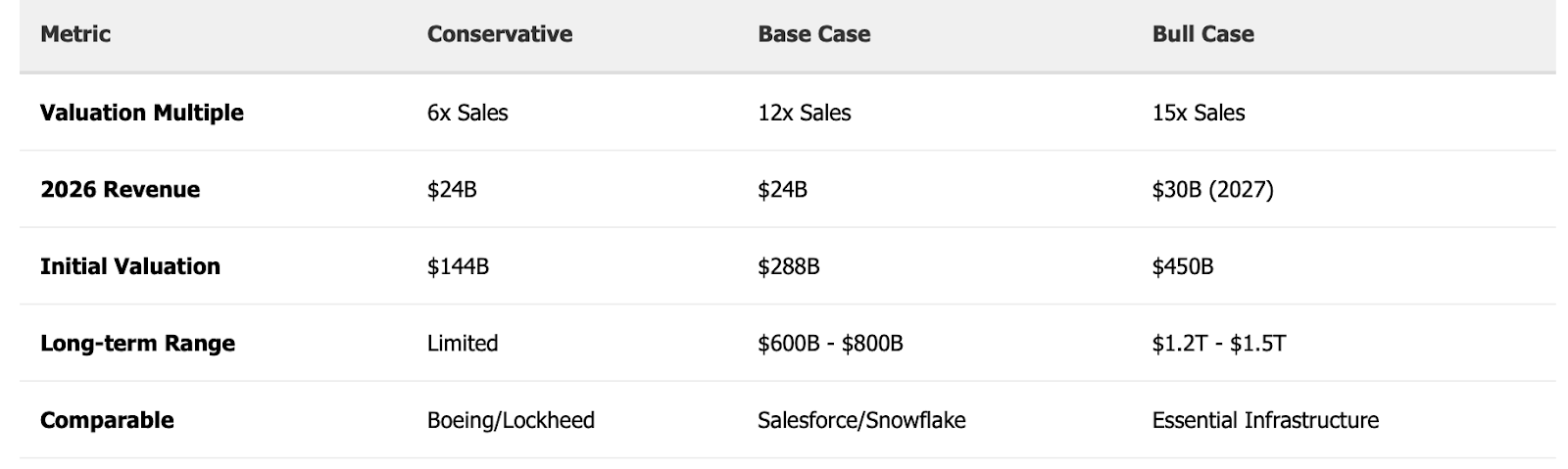
This is why SpaceX is likely going to trade on 10x-15x sales multiples once revenue hits $24 billion in 2026 (more on that later). If SpaceX shares are assigned a conservative multiple of 12x sales, the value of SpaceX shares would be at least $288 billion. In addition to the revenue and growth projections for SpaceX, there is also significant strategic value in SpaceX, which could put the valuation floor between $800 billion and $1.5 trillion.
Think of AI as the engine that allows SpaceX to create exponentially more value from its physical infrastructure. SpaceX is not just about launching more rockets; it is about launching rockets more intelligently, operating more efficiently, and taking full advantage of every satellite in orbit.
Inside the Numbers: SpaceX Revenue Growth, Cash Flow Breakthrough, and Financial Sustainability
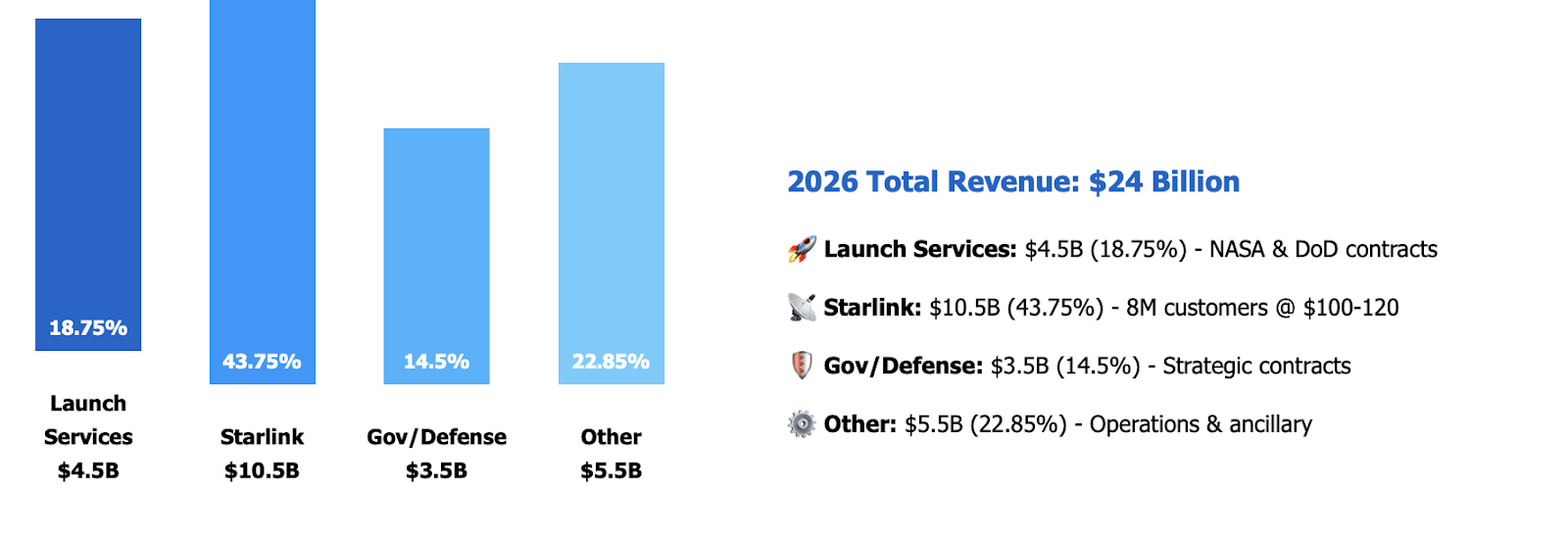
Initially similar to Amazon's early years, SpaceX was all about capital investment while investors and pundits questioned if it would ever generate profit. This is no longer a narrative anyone is questioning about SpaceX's success. According to the current 2025 revenue expectation, SpaceX's revenue will be $15 billion and as much as $24 billion by 2026. The breakdown:
Launch Services (4 billion - 5 billion) SpaceX still dominates Boeing launch services with billions in awarded contracts from both NASA and the Department of Defence through 2030.
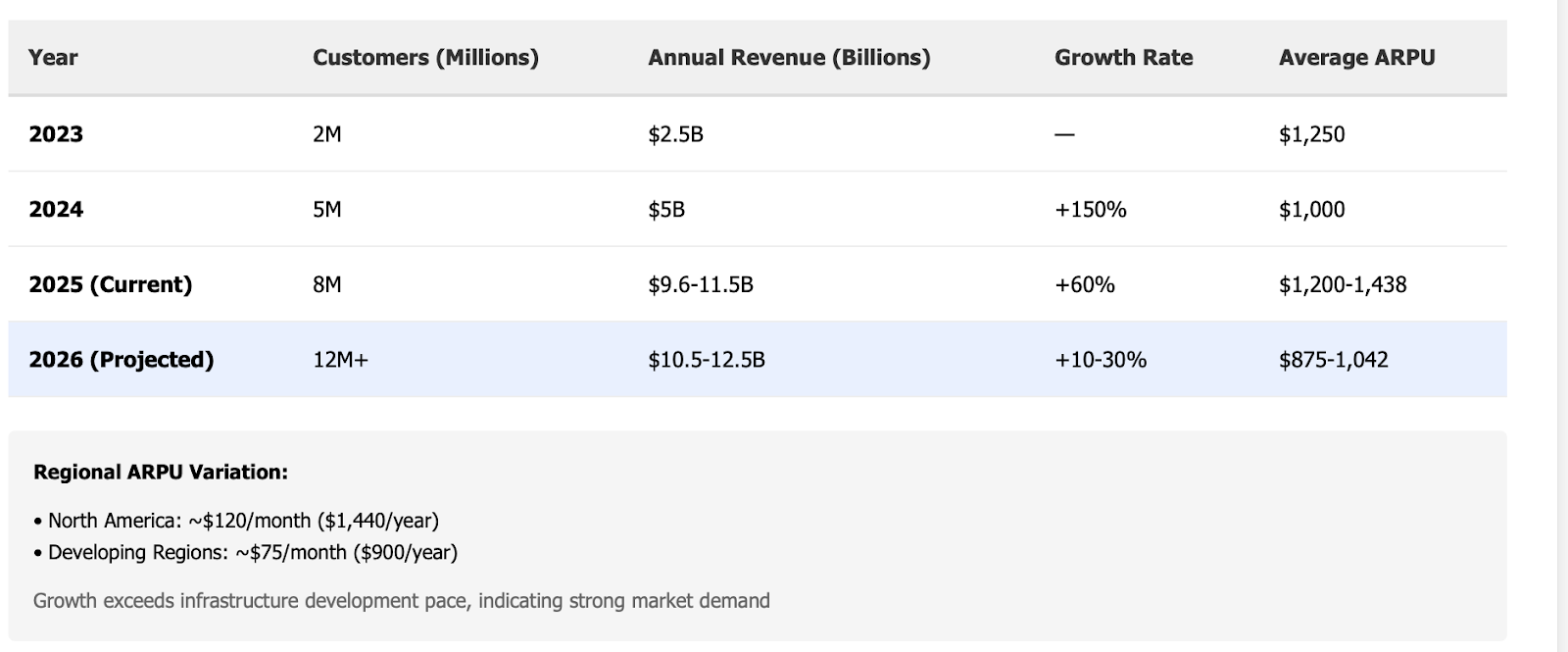
Starlink growth. With approximately 8 million customers purchasing subscriptions, and average customer charges of $100 to $120, this would yield $9.6 to $11.5 billion annually recurring revenue. Although the average revenue per user differs by region, North America averages $120 and between $75 in developing regions. User growth exceeds the speed of infrastructure development. $3 - 4 Billion more from Government and Defence Contracts. The U.S. Government and Department of Defence price competitively to deter against breaching contracts.
According to the company's cash flow statement, the inflexion investors are looking for is a positive free cash flow by late 2024 with enough cushion to fund capital expenditures. In late 2024, SpaceX had become negative free cash flow at the same time as they were incurring $8 to $10 billion in annual capital expenditures related to the Starship and Starlink projects, but were generating sufficient operating cash to satisfy their debt obligations.

This is very important because Wall Street and IPO valuation models calculate cash flow based on discounted future cash flows. When you are a loss-generating growth company, Wall Street uses an extremely high discount factor for the money you will produce in the future. Once cash flow becomes positive and is expected to continue increasing, investors will lower their discount factor.
Amazon's share price took off after it became profitable. Before profitability, the share price was less than doubled when it was based strictly on revenue growth. Once Wall Street realised Amazon could grow and produce cash at the same time, its share price increased dramatically.
$800 Billion to $1.5 Trillion? A Three-Scenario Valuation Model for the SpaceX IPO
Valuation is often seen as more of an art form than a scientific process, particularly for those companies that are redefining industries in their entirety. Below are three scenarios for how SpaceX might be valued based on a variety of different assumptions.
Scenario 1 (Conservative): SpaceX is valued using a multiple based on the aerospace industry, which is a 6x sales multiple on 2026 estimated revenue (which is estimated at $24 billion), resulting in a valuation of $144 billion. This very conservatively assumes that SpaceX is treated like Boeing or Lockheed Martin - two stable businesses that have a viable long-term government contract business model and will have minimal margin expansion. In contrast, this scenario ignores the other 50% of SpaceX's business.
Scenario 2 (Base Case): This scenario computes a valuation for SpaceX based on a blended revenue multiple (using a combination of aerospace and software/technology platform companies) resulting in 12x sales on $24 billion in estimated sales for 2026l, resulting in a projected valuation of $288 billion in 2026, and a potential valuation of $600-800 billion after adjusting for long-term growth.
This value incorporates the positive impact of the AI integration of SpaceX's Starlink product and recurring revenue business; similar to how companies such as Salesforce or Snowflake are priced, as they are both hybrid, long-term, infrastructure software/technology platforms with sticky customers and high switching costs.
Scenario 3 (Bull Case): This scenario assumes that SpaceX is valued as a new strategic infrastructure communication layer product that will have a 2027 revenue projection of $30 billion and yield a 15x sales multiple resulting in a base value of $450 billion and a growing premium multiple of approximately $1.2-1.5 trillion in a short time if governments and global institutions determine that Starlink is, in fact, an essential strategic asset for the future of sovereign global communications that is needed by governments as opposed to just being an optional purchase for end-users.
What's wild about this scenario is that while the traditional methodology for valuing companies would dictate that SpaceX would be valued using historical or expected financial performance; if SpaceX is ultimately viewed as a new form of essential global infrastructure as an alternative to current tools and technologies, SpaceX valuation multiples would take a different trajectory compared to traditional valuation multiples associated with publicly traded aerospace, accurate structures.
An example of the potential impact of a different form of future global infrastructure is reflected in Tesla's recent valuation history. As of 2018, Tesla's market cap was approximately $50 billion while operating at a loss, and by the end of 2020, Tesla's market cap exceeded $1.2 trillion as markets transitioned from valuing Tesla as a car company to valuing Tesla as a long-term energy and software platform company.
As a result of these considerable differences, I believe that SpaceX has the potential to follow a similar market valuation trajectory. However, it is reasonable to believe that SpaceX could attain that valuation trajectory much more quickly than Tesla has attained that valuation.
Can't Wait for the Official IPO? Three Smart Ways to Gain SpaceX Exposure Before It Goes Public
Institutional investors do not need to wait for an IPO, and neither should you if you're familiar with the associated risks.
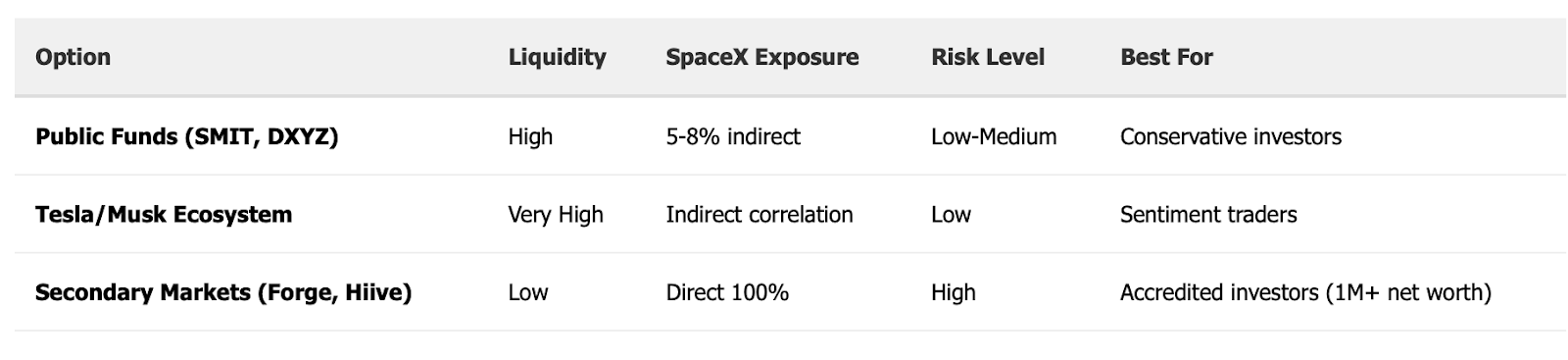
Option 1: Through Public Funds, You Can Obtain Indirect Exposure
The Scottish Mortgage Investment Trust, which is listed on the London Stock Exchange, owns SpaceX shares, and anyone can invest in this fund without the need to be an accredited investor. The downside is that when you purchase shares in this fund, you are purchasing a diversified pool of shares, and at most, SpaceX will make up only 5-8% of your investment. Also, funds can trade below net asset value (NAV), thereby reducing your investment returns.
Two examples of funds that have similar investment characteristics are ARK Venture Fund and Destiny Tech 100 (DXYZ). Unlike the Scottish Mortgage Investment Trust, these two funds offer different risk profiles and trade at varying discounts or premiums to NAV based upon investor sentiment towards private technology companies. For example, during the selloff in technology shares in 2022, DXYZ traded at a 30-40% discount to NAV, so there may be an opportunity depending on when you purchase and if the price changes.
Option 2: Play the Correlation of the Musk Ecosystem
Although Tesla does not hold SpaceX equity, there is a sentiment spillover effect between the two companies. Whenever a significant milestone is reached by SpaceX, i.e., a successful Starship test flight, or Starlink's announcement of being profitable, the stock price of Tesla usually moves up in relation to these developments. This relationship is not a perfect hedge, but there are many institutional algorithmic traders who utilise "Musk basket" trading strategies, creating a correlation between Tesla and SpaceX.
In addition, there is now a stronger connection with xAI, a company co-founded by Elon Musk. Tesla is utilising artificial intelligence ("AI") within its autonomous vehicle technology that overlaps with the AI technology being developed by xAI. Therefore, as SpaceX and xAI become more involved with one another, Tesla has become a proxy for the entire Elon Musk innovation ecosystem.
Option 3: Buy SpaceX Shares Through Pre-IPO Secondary Marketplaces
Platforms such as Forge Global and Hiive provide an alternative solution for buying private shares of SpaceX. Only accredited investors, who are typically either individuals with a net worth of over $1 million or individuals who earn over $200,000 annually for the last two years, can purchase SpaceX shares that current or former employees and/or early investors are looking to sell for liquidity reasons.
While this option does offer investors the opportunity to purchase shares of SpaceX, there are significant risks in doing so. First, pricing is very opaque. Second, you will have limited options for selling your shares. Third, the settlement process for these types of transactions can take weeks or months. Lastly, shares on the secondary market, on average, are priced at 10 - 20 % over the last formal round of financing, meaning you could pay a premium for the privilege of getting in early.
An example of how this has been accomplished in the past is through Tencent. Many investors who could not directly access shares of Tencent chose to invest in Napers, which owned a large interest in Tencent. While these funds are similar to the Naspers/Tencent relationship, in comparison to one another, the difference is one of greater complexity and overall illiquidity.
Before you allocate any money using the above-mentioned strategies, understand that you are potentially exchanging liquidity for upside. As such, if you are a long-term believer in SpaceX and are willing to lock your capital up for an extended period of time, you will benefit greatly. However, if you're an active trader who is looking for quick exits, then this is a recipe for disaster.
SpaceX vs Starlink: Will a 2026 Spin-Off Unlock Hidden Shareholder Value?
Analyst reports continue to raise the question of whether or not the Starlink division of SpaceX should be spun off into a separate public enterprise. When looking at the numbers, this makes sense. With 8 million paying customers at an annual average revenue per customer of $100-120, Starlink alone generates $9.6-11.5 billion annually. Applying telecom sector multiples of 5-7x revenue for subscription-based businesses with high retention rates, Starlink has a standalone value between $48-80 billion.
Now we can add SpaceX's core launch and manufacturing business, which is valued at 6-8x $12-14 billion in revenue, which would give us an additional standalone valuation range of $72-112 billion.
The total combined standalone valuation of Starlink and SpaceX would be $120-192 billion, not taking into consideration any future growth premiums and strategic value and/or AI integration.
When looking at the combined valuation of SpaceX and Starlink as a blended entity (where an analyst would apply only one multiple across the combined company), you would need to apply an aggressive multiple to generate the same value. Otherwise, there is a significant amount of value that would be left on the table.
The most famous example of this was PayPal and eBay's separation in 2015, where PayPal was being valued as an accessory to e-commerce when it was part of the eBay organisation. However, after eBay and PayPal separated, the stock market began to recognise PayPal as a standalone fintech company, and the combined market caps of both companies exceeded their pre-spin valuation by 40 per cent within two years of separation.
There are also significant operational synergies that would potentially come into play if the two businesses were to separate. Starlink is only viable due to SpaceX's ability to launch satellites at an extremely low cost; therefore, separating the two companies would eliminate the cost advantage of launching satellites for Starlink's operation. Also, there are "ecosystem premiums" that integrated companies command due to the aspects of their products/services that work together to create a greater product service than the value of each operating separately.
Elon Musk has provided some comments indicating he is open to the idea of Starlink becoming an independent company. However, he is not currently willing to commit to a specific time frame for this transition. If this were to happen, it would most likely occur after the stock offering for SpaceX and not before. Going public with SpaceX first would establish valuation benchmarks for investors, with the subsequent spin-off of Starlink occurring 12-18 months after the separation of SpaceX and Starlink, allowing the stock market to revisit the valuations of both entities with all applicable information.
As an investor, the result of a spin-off is likely to result in holding shares in two companies as opposed to one, and have an overall combined value greater than the original investment. Although this outcome is not definite, previous experience indicates that this scenario is likely.
The "SpaceX Effect": How the 2026 IPO Could Trigger Volatility Across Space and AI Stocks
An initial public offering (IPO) for a firm with a valuation of $100 billion or more does more than create price action; it changes everything around the stock.
Competing companies
Consider Rocket Lab (RKLB), which presently trades with a price to sales(P/S) multiple of ~20 with revenue of less than $500 million. The market is pricing that company for growth, not current operations. Now, consider that SpaceX will IPO at a PS multiple of ~12 with revenue of $5 billion and available launch capacity of ~100x RKLB. So how can RKLB justify its current multiple relative to SpaceX? Either SpaceX will receive an increased multiple (highly unlikely given its size) or RKLB will experience multiple compression.
Aerospace industry
Lockheed Martin (LMT) and Northrop Grumman (NOC) are currently priced at ~1.5-2 PS due to their responsibility for producing stable, credible and boring products. However, though SpaceX going public at a multiple of 10-15 will not directly threaten LMT or NOC's market valuations, it will create a new narrative. Why would an investor buy a slow-growth electrical aerospace company if they can own the fastest-growing alternative?
Infrastructure supply
If the market were to accept the xAI integration thesis, SpaceX would be comparable to Palantir (PLTR), C3.ai (AI), or even NVIDIA's (NVDA) infrastructure business. Thus, in the very short term, if investors begin allocating capital to "picks and shovels" businesses within the AI space, all such companies will benefit from the influx of new capital.
Liquidity environment
When going public, firms raise vast amounts of new capital, which often leads to declines in the share prices of incumbent firms as the new firm usurps capital from previous market participants who located their capital elsewhere after the IPO. For instance, when Meta went public in 2012, other social media firms (e.g., Zynga; GLUU) experienced severe downward pressure as funds moved capital into the new dominant player. A potential SpaceX IPO will create similar effects in smaller SPACs focused on the space market and in various speculative companies involved with AI.
Rebalancing activities of exchange-traded funds (ETFs) often create mechanical supply-demand pressure. For instance, if SpaceX IPOs and becomes a member of the Nasdaq-100, it will likely represent a weighting of 2 to 3%, or approximately $30-$50 billion in shares being purchased by index funds pursuing their investment strategy. That capital is sourced from somewhere else or by selling positions in existing holdings.
The potential effects experienced by previous IPOs, such as Facebook (FB), are highly informative of what may transpire in the future. Following the FB IPO, LinkedIn (LNKD), Twitter (TWTR) and Zynga (ZNGA) all experienced downward pressure due to investments being diverted to the new dominant player in the sector. However, over a subsequent six-month period, the downward share price pressure diminished as the market continued to absorb new supply.
Traders who focus on trading momentum or volatility should begin to monitor correlations among space and AI stocks approximately 60 days before the SpaceX IPO. Long-term investors should ignore any volatility, as volatility creates good opportunities if the investor has ample time and is not forced to sell during periods of extreme volatility.
SpaceX as a Macro Hedge: Why Rockets May Become the New Gold for Institutions
Gold acts as a hedge for macroeconomic risk due to its limited amount. Since it is a finite product, it tends to hold its value when there is inflation in fiat currencies.
SpaceX has two types of scarcity: technological uniqueness and geopolitical advantages. One can't suddenly create a fleet of reusable rockets. For the past two decades, Blue Origin has invested $10 billion and has failed to make a reusable rocket for the market.
The Chinese space program moves at a high speed, but it has no measure of how quickly it can build and continue to build in the coming years, with an integrated business model that has very different incentives than a company like SpaceX. SpaceX is a highly unique combination of low costs, success rate of launches, and access to private capital compared to its ability to build out all new technology.
Simply put, satellite Internet access will become a fundamental in the era of de-globalisation and issues regarding infrastructure warfare. Starlink provides a critical component of the digital revolution from both a military and economic perspective.
Traditionally, when institutions seek inflation hedges, they look to real estate, commodities, or inflation-indexed bonds. However, if technology underpins a significant portion of the world's economy, it may outperform traditional asset classes. In 2019, the stock price of NVIDIA was valued at $50, compared to a current value of $500+, representing a 10-fold increase in 5 years, while gold is up only 2x in the same period. The reason for this is not necessarily that gold has had a lesser impact on the economy; rather, it has had a lesser impact on the economy because it is an outdated asset class.
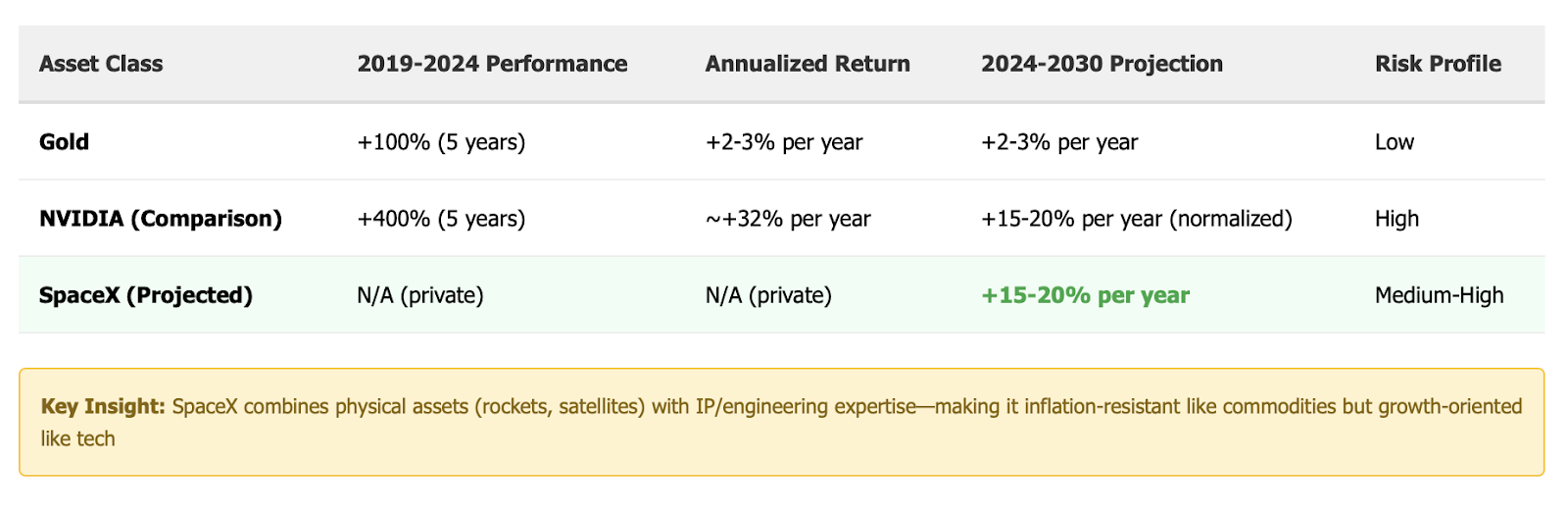
SpaceX fits this definition of a "real" inflation-proof investment. SpaceX has two fundamental types of assets: physical assets, rockets and satellites and IP engineering, programming, etc., which are fundamental to the long-term economic strength of all governments, regardless of present or future economic conditions.
Therefore, while it is not guaranteed that both of these classes of assets will necessarily be able to generate the required returns, it is guaranteed that both of these sectors will receive funding in both good and bad economic times: Space and Defence.
Compared to gold's annualised appreciation of about 2-3% over many decades, SpaceX, if it delivers on its value proposition, can provide annualised returns of 15-20%. SpaceX's volatility may be higher than gold's, but returns are also likely to be higher than gold's in a world dominated by competing nations for access to space.
Therefore, the aim of this document is not to propose a replacement for gold, but rather, it is to recognise that the value and performance of strategic technological assets will outpace that of historically traditional safe havens from today through 2030. Institutions appear to be moving toward the performance of these technological assets; therefore, retail investors should also focus on investing in these technological assets.
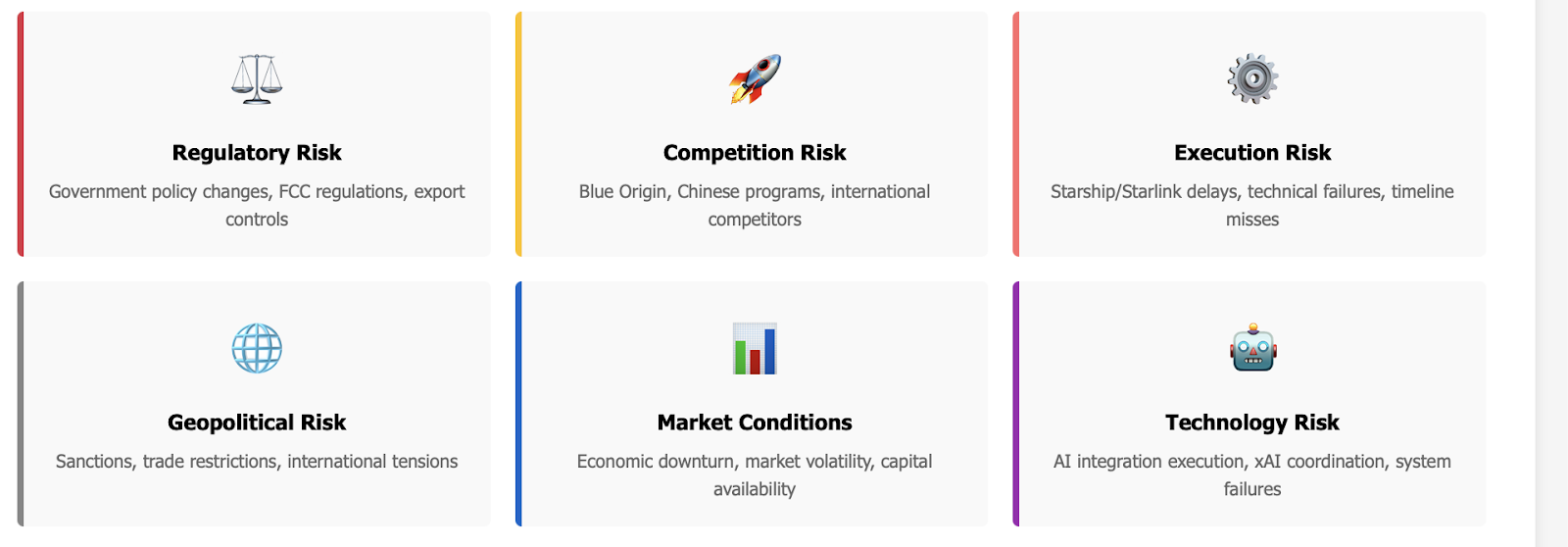
What Could Derail the SpaceX IPO? Key Risks Every Investor Must Consider
Gold acts as a hedge for macroeconomic risk due to its limited amount. Since it is a finite product, it tends to hold its value when there is inflation in fiat currencies.
SpaceX has two types of scarcity: technological uniqueness and geopolitical advantages. One can't suddenly create a fleet of reusable rockets. For the past two decades, Blue Origin has invested $10 billion and has failed to make a reusable rocket for the market.
The Chinese space program moves at a high speed, but it has no measurable goals for how quickly it can build and continue to build in the coming years, with an integrated business model that has very different incentives than a company like SpaceX. SpaceX is a highly unique combination of low costs, success rate of launches, and access to private capital compared to its ability to build out all new technology.
Simply put, satellite Internet access will become a fundamental in the era of de-globalisation and issues regarding infrastructure warfare. Starlink provides a critical component of the digital revolution from both a military and economic perspective.
Traditionally, when institutions seek inflation hedges, they look to real estate, commodities, or inflation-indexed bonds. However, if technology underpins a significant portion of the world's economy, it may outperform traditional asset classes. In 2019, the stock price of NVIDIA was valued at $50, compared to a current value of $500+, representing a 10-fold increase in 5 years, while gold is up only 2x in the same period. The reason for this is not necessarily that gold has had a lesser impact on the economy; rather, it has had a lesser impact on the economy because it is an outdated asset class.
SpaceX fits this definition of a "real" inflation-proof investment. SpaceX has two fundamental types of assets: physical assets, rockets and satellites and IP engineering, programming, etc., which are fundamental to the long-term economic strength of all governments, regardless of present or future economic conditions.
Therefore, while it is not guaranteed that both of these classes of assets will necessarily be able to generate the required returns, it is guaranteed that both of these sectors will receive funding in both good and bad economic times: Space and Defence.
Compared to gold's annualised appreciation of about 2-3% over many decades, SpaceX, if it delivers on its value proposition, can provide annualised returns of 15-20%. SpaceX's volatility may be higher than gold's, but returns are also likely to be higher than gold's in a world dominated by competing nations for access to space.
Therefore, the aim of this document is not to propose a replacement for gold, but rather, it is to recognise that the value and performance of strategic technological assets will outpace that of historically traditional safe havens, such as real estate, commodities, and inflation-indexed bonds, from today through 2030. Institutions appear to be moving toward the performance of these technological assets; therefore, retail investors should also focus on investing in these technological assets.
Final Outlook: Why the SpaceX IPO May Define the Next Decade of Global Investing
The initial public offering of SpaceX will present a new level of infrastructure that has never been available before for all governments, institutions, and retail investors. In other words, upon going public, there will be a change in capital structure that would not happen again until Aramco goes public.
Upon the SpaceX IPO, the technology exchange-traded funds will be reallocated, and as such, foreign sovereign wealth funds will increase their investments in aerospace companies. Consequently, retail investors will need to consider whether or not they want to hold an investment in rockets and satellites in their retirement portfolio.
Furthermore, the AI fusion of augmented reality will change SpaceX from a traditional manufacturing company into a provider of a platform. In addition to that, the change in cash flow created by SpaceX going public and therefore achieving positive cash flow creates a new marketplace for SpaceX that depends on both growth and new cash flow.
Likewise, the Starlink product will enable SpaceX to use its global internet access capability as a political tool and has been classified as strategic infrastructure, rather than just a technological tool.
The valuation of SpaceX today will be based on the following three elements: execution ability, market conditions, and the scarcity value attributed to the investment. However, the one constant between now and the IPO will be that SpaceX will have the ability to enhance the space infrastructure opportunity from government monopolies into the private sector.
The SpaceX IPO is not simply a speculative investment; it is a significant indication of how the next decade will change how humans build and invest in infrastructure off of Earth. Moreover, SpaceX will build out the infrastructure associated with creating satellite internet and creating a sustainable human colony on Mars.
Over the next ten years, all global investment will have an increasing focus on outer space; therefore, SpaceX will be the leader for identifying, developing, and unlocking this investment opportunity.
Ready to position yourself ahead of the biggest IPO of the decade? Join TradeWill.com for real-time analysis, valuation models, and actionable strategies as the SpaceX listing approaches—because preparation wins when markets move.
Disclaimer: The content of the blog does not represent any position of Trade W, does not serve as any trading-related decision advice, and does not endorse any third-party.