
 Trade W
What Is a Spinning Top Candlestick?
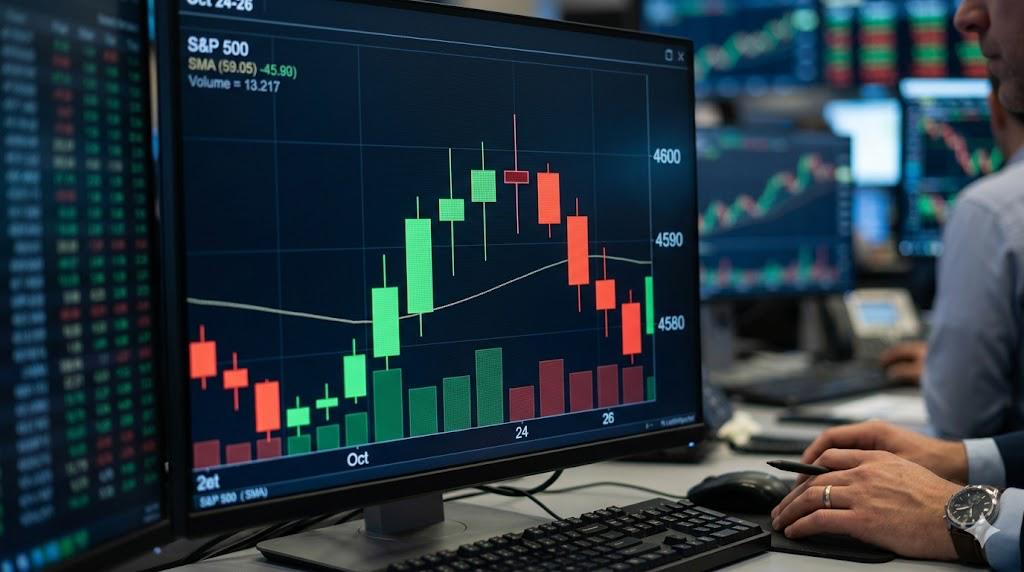
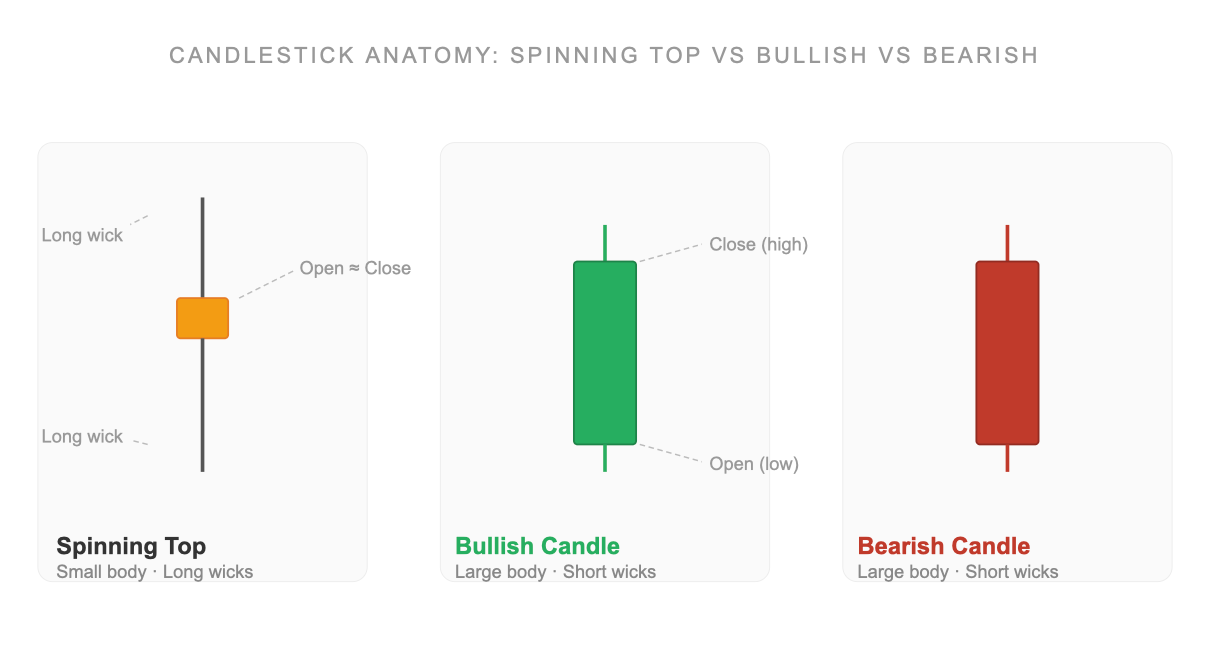
The spinning top candle is a single candlestick pattern that has a small body with long wicks above and below it. The formation of this candlestick indicates that neither buyers nor sellers dominated that trading session.
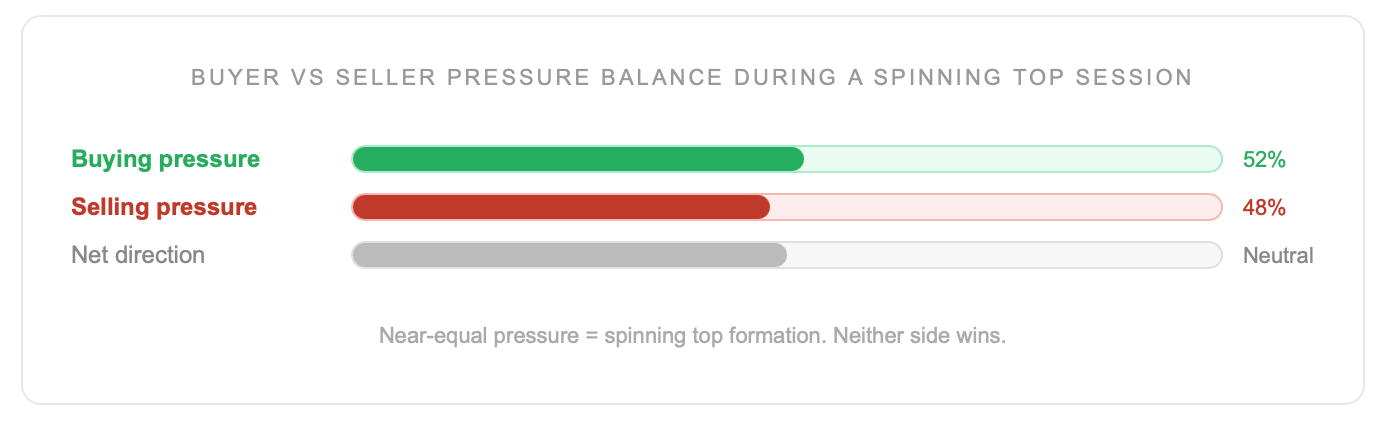
Envision the spinning top as a game of tug-of-war played equally on both sides, resulting in no movement by either side. The price of the asset opened, moved sharply upward to form a high, and then quickly fell back toward where it opened. This is what creates the spinning top pattern.
While spinning tops appear across all markets, they tend to appear frequently on both Bitcoin and Ethereum charts, as well as BTC trading pairs, close to areas of consolidation before turning points. A spinning top does not indicate the direction of a possible price movement or breakout; it simply suggests that neither buyers nor sellers have yet determined how to take control of the market, and that the market remains undecided.
As a result of this indecision, the spinning top should not be used in isolation to determine direction or initiate a trade. Instead, it can be interpreted as a period of stabilisation in the market before a subsequent breakout occurs.
How to Identify a Spinning Top Candlestick
There are three things that you must verify before determining whether a candle is a spinning top or not.
Check the body size of the candle; if it is small, then the open and close prices will be nearly alike. Verify that both wicks are long and see if the body is centred sideways within the total range of the candle.
If all three requirements are satisfied, you have a spinning top.
If one or more are not met, then you have a different candlestick pattern.
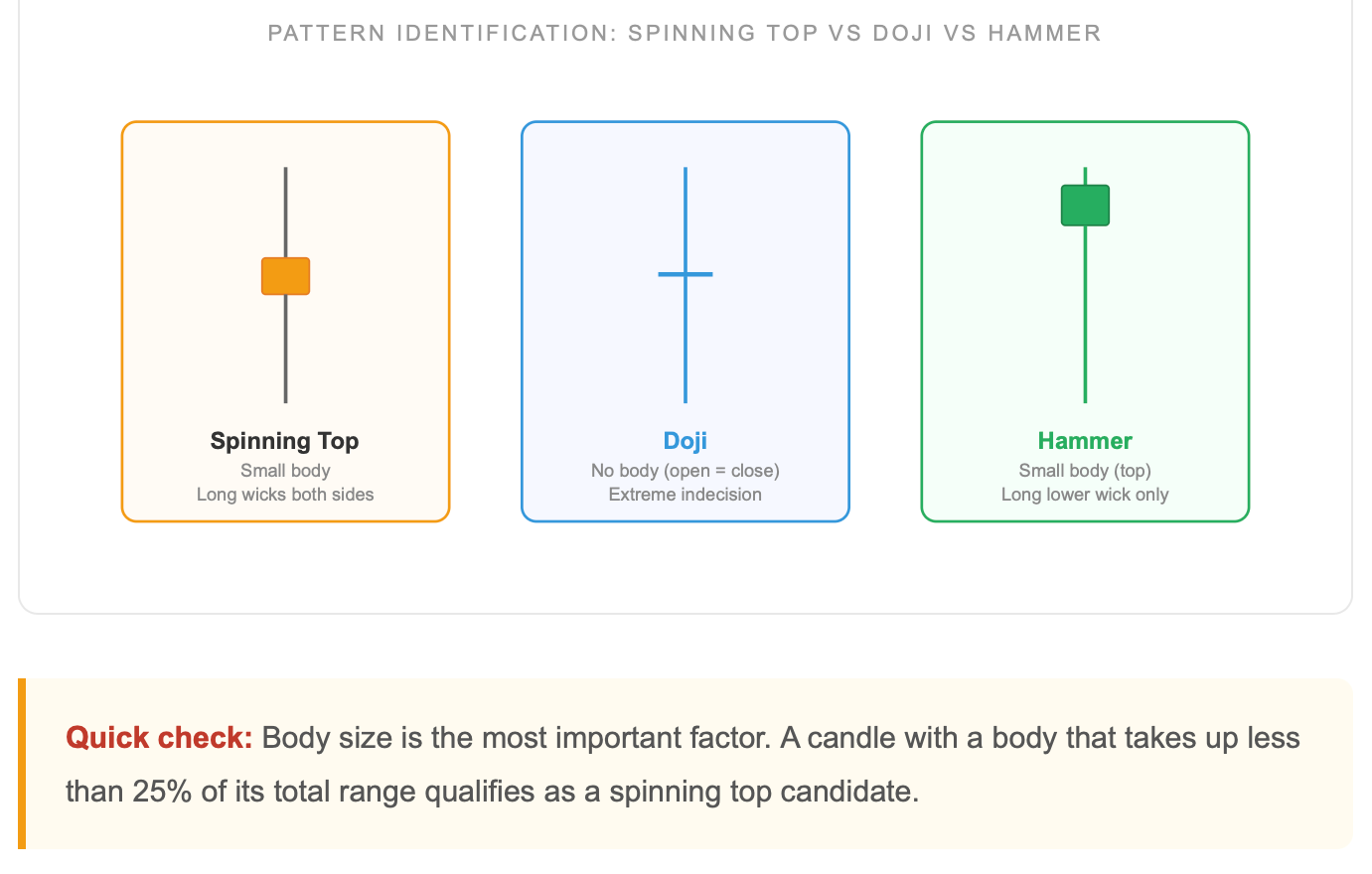
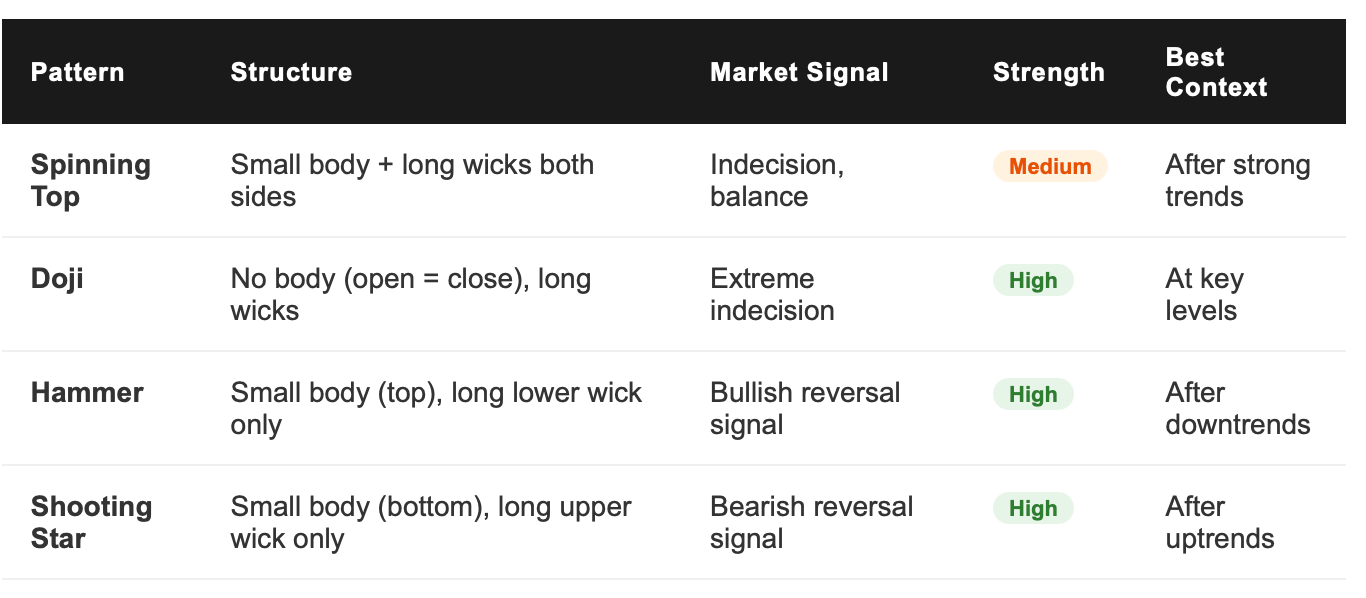
Traders often confuse spinning tops, dojis, and hammers, usually making the determination based solely on the size of the candle’s body. A doji has little to no body, while a hammer’s lower wick is substantially longer than its upper wick. A spinning top will have a small but identifiable body and wicks that are relatively similar in length.
What Does a Spinning Top Candlestick Mean in Trading?
Bulls strongly drove prices higher during that trading session before being equally countered by bears, resulting in a candle that shows both sides cancelling each other out, thus reflecting true balanced indecision regarding which side will ultimately control the trend.
This is frequently seen during profit-taking phases after a strong upward move, as larger sellers begin unloading Bitcoin while new buyers continue entering the market. Retail traders continue buying into the rallies, but the market recognises that neither side of the conflict can yet fully control the overall direction. Spinning tops are often created at the midpoint of this struggle.
Indecisive spinning tops are also frequently formed prior to uncertainty events, such as major Federal Reserve meetings, protocol upgrades, or large whale transactions. When uncertainty exists within a market, participants may become highly cautious, but the market itself has not yet determined a clear direction.
Remember, an indecisive spinning top does not represent weakness in a market; it merely reflects how seriously the market is weighing its next trading decision. The candle that follows a spinning top often reflects the market’s definitive decision, either upward or downward.
Spinning Top After an Uptrend vs a Downtrend
Context is important for many reasons. One is that context can provide different interpretations of the same pattern.
An example of this is how a spinning top candlestick can provide a very different interpretation depending on whether it occurs after an uptrend or a downtrend.
When it occurs after an uptrend, the price has been increasing consistently, and a spinning top candlestick has just formed. This indicates that buyers may be losing momentum while bears are beginning to gain strength, which could suggest that a reversal is approaching. If the next candlestick is a bearish engulfing candle after the spinning top, the bears will have confirmed their gain in momentum, helping traders conclude that a reversal is more likely in their crypto trading.
When it occurs after a downtrend, the price has been declining consistently for a period of time, and a spinning top candlestick has just formed. This indicates that selling pressure may be starting to weaken. Bears attempted to push the price lower while buyers attempted to push it higher, but neither side succeeded in taking control. This may prepare traders for a potential rebound or correction in price, or at the very least a period of consolidation before the next directional move occurs.
It is also important to remember that while spinning tops may suggest the possibility of a future trend reversal, they do not confirm one conclusively. A reversal is only confirmed once traders see what occurs with the next candlestick.
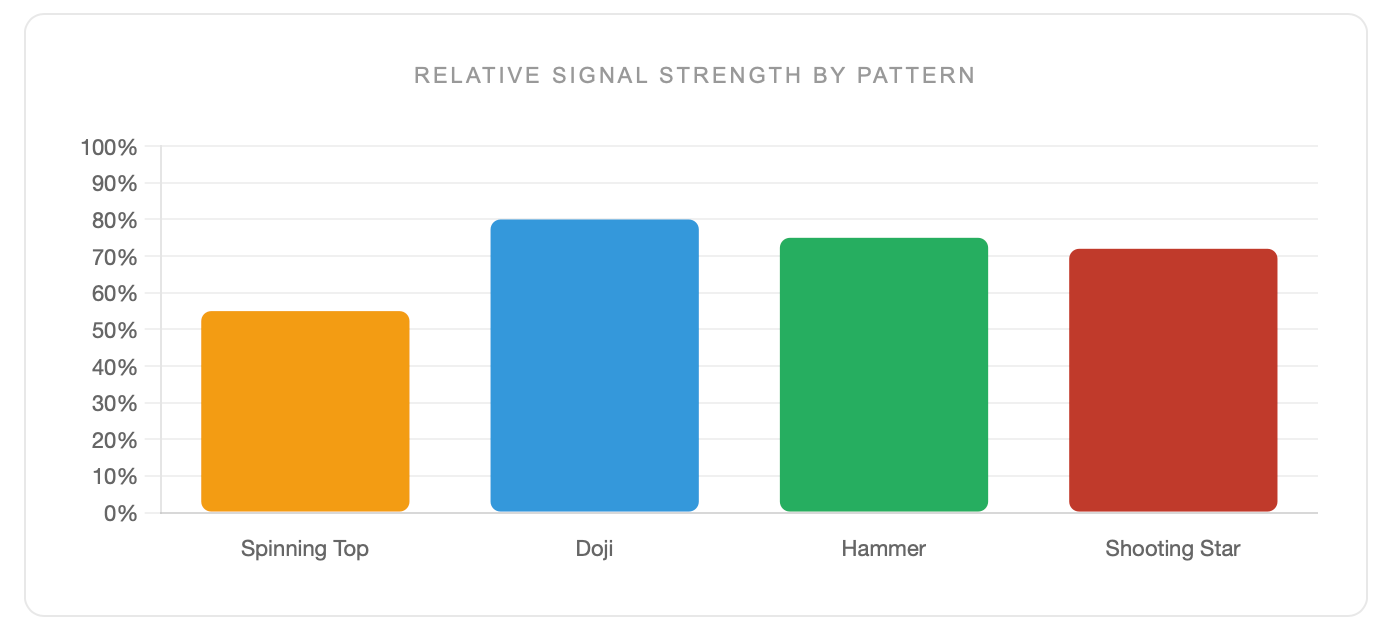
Spinning Top vs Doji vs Hammer: The Critical Differences
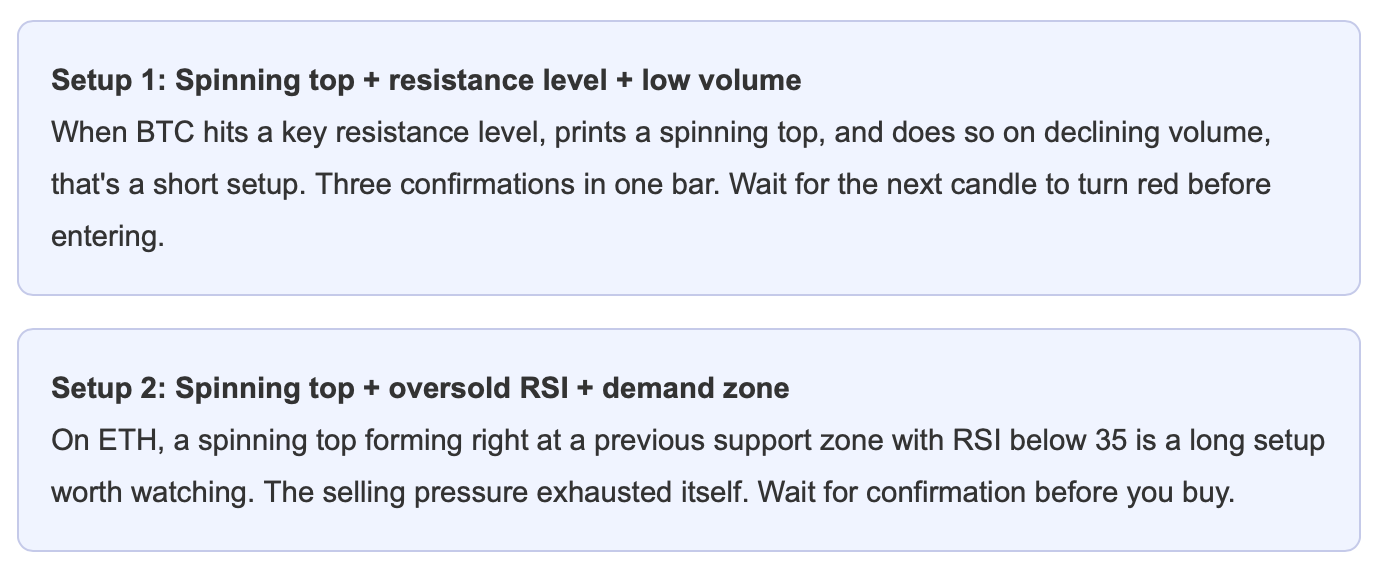
How Traders Actually Use the Spinning Top in Crypto and CFD Trading
Stop-Loss Placement
Your stop-loss should be placed above or below the full range of the spinning top’s high and low. If the spinning top’s high price is 45,000 and the low price is 43,000, the stop-loss should be placed above 45,000 or below 43,000, outside the spinning top’s range. In other words, if price moves beyond the high or low extreme of the spinning top, it would indicate that price did not continue respecting the indecision range, confirming that the setup is no longer in your favour.
Confirmation Candle Rule
This is the most important rule for spinning tops. Do not enter a trade until you wait for the close of the very next candle. For example, if you see a strong bearish candle following a spinning top during an uptrend, that becomes your entry signal. Likewise, if you see a strong bullish candle closing after a spinning top during a downtrend, then you may have identified a potential bounce setup.
Rule of Thumb: The spinning top is a door that can be opened; the confirmation candle tells you whether you should walk through that door.
Common Mistakes Traders Make With Spinning Tops
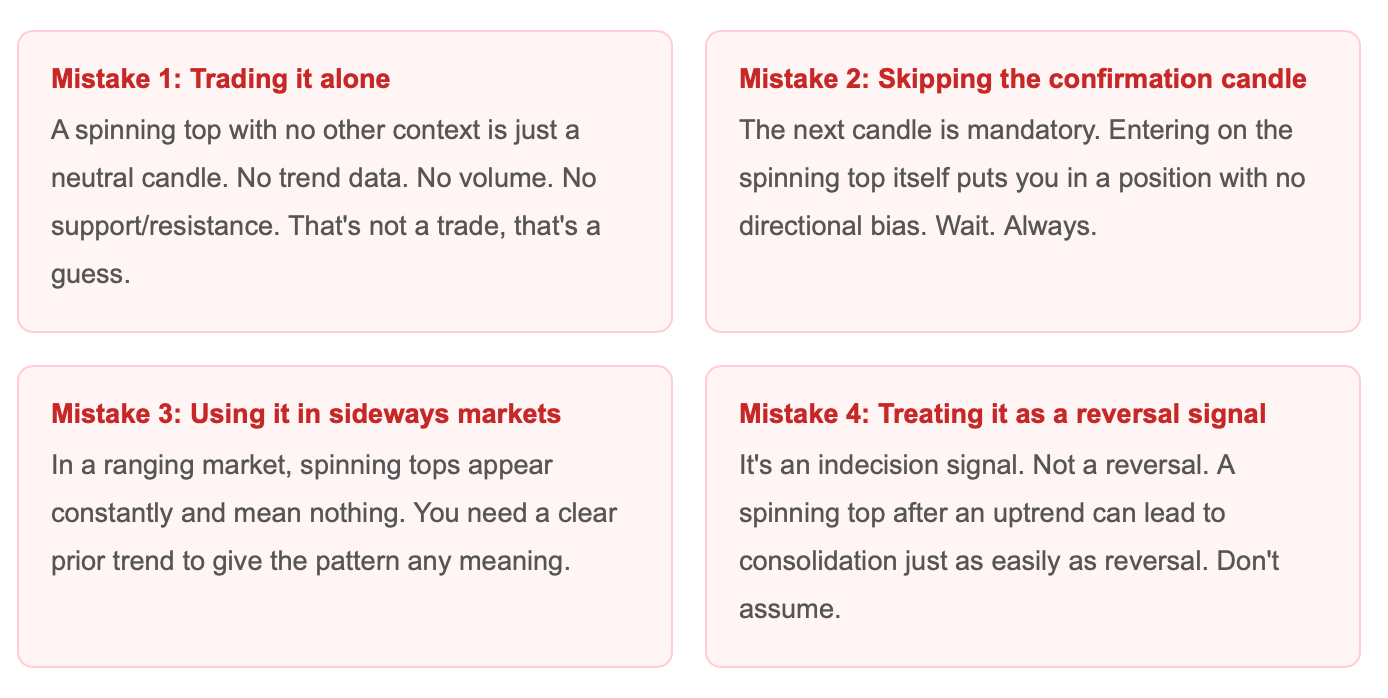
Bitcoin has been trending sideways for the past twelve days before entering an uptrend today. This movement has produced a large number of spinning tops, which resulted in traders getting caught in choppy price action as they attempted to use spinning tops as reversal signals. The spinning tops occurred during a period with no clear trend activity and therefore represented little more than market noise.
So, to answer the question of whether or not you can use spinning tops for making trading decisions, the answer is yes, but only if you combine spinning tops with other indicators.
Upon seeing a spinning top, slow down, check the existing trend, review the current volume, identify the nearest support or resistance level, and then wait for the next candle to help determine market direction.
Spinning tops can be viewed as the market pressing "pause" on the current trend. The trader who wins the battle during the following session will determine the next direction, and therefore, you want to follow that winning side rather than trying to predict it beforehand.
Spinning tops represent indecision in the market; always look for additional confirmation from subsequent candles; always check the trend before considering them for a trade; and spinning tops tend to pause trending activity rather than predict the next directional move.
Frequently Asked Questions
What does a spinning top candlestick mean?
It means the market couldn't decide on a direction during that session. Buyers and sellers both pushed hard, but neither gained control. The candle signals indecision, not a specific direction.
Is a spinning top bullish or bearish?
Neither, by itself. Context determines the bias. A spinning top after a downtrend leans slightly bullish. After an uptrend, it leans slightly bearish. But you need confirmation from the following candle before acting on either interpretation.
How reliable is the spinning top candlestick?
Alone, it's not particularly reliable, with roughly 50-55% accuracy depending on the market. Combined with trend context, volume, and a support or resistance level, reliability improves significantly. Always use it as part of a broader setup, not as a standalone signal.
Can a spinning top predict a reversal?
It can suggest one is coming, but it doesn't confirm it. A reversal requires a confirmation candle that closes decisively in the new direction. The spinning top opens the possibility. The following candle makes it real.
TradeWill gives you real-time pattern alerts, trend context, and volume signals, so you catch spinning tops at the exact moment they matter on live crypto and CFD charts.
Disclaimer: The content of the blog does not represent any position of Trade W, does not serve as any trading-related decision advice, and does not endorse any third-party.