

 Trade W
Stripe, the payments giant that has operated in the shadows of the private market for years, is now making headlines throughout the fintech world. Investors are rushing to determine what Stripe's potential IPO planned for 2025 means for their portfolios as word spreads.
If you are questioning whether Stripe will provide an investment opportunity of the decade with its public debut, or if it will simply be yet another overhyped technology IPO, then read on.
Stripe's Business Model: The Engine Behind a $100 Billion Valuation
Stripe is one of the top private companies worldwide due to its actions since 2010. Stripe has altered how businesses can accept payment methods via the internet. Stripe started with a basic way of processing credit cards, but has grown into a complete financial operating system that supports many small businesses, companies and charities throughout the world.
The core of Stripe's business model is based on transaction fees. Each time a user pays for a product or service through Stripe they charge a small fee (on average 2.9% + $0.30 per transaction in the United States). Although this might not seem like much, Stripe processes hundreds of billions of dollars In transactions each year across 47 countries, so those fees become very significant quickly.
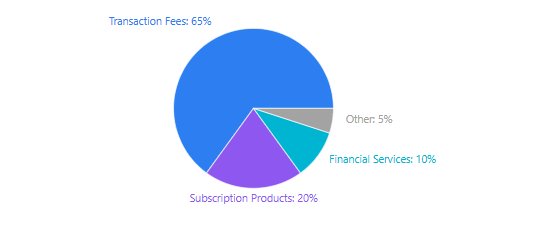
In addition to processing credit cards and providing financial transaction services, Stripe has expanded its product offerings to include things like point-of-sale equipment (Stripe Terminal), business incorporation assistance/jump-starts (Stripe Atlas), and revenue generation tools for recurring subscriptions for Software as a Service (SaaS) companies.
Stripe also has investment products (including lending) to help business owners access additional capital, fraud detection products to help keep businesses safe, and infrastructure that allows people to build custom software solutions to facilitate payment flows.
Stripe serves as a payment platform for companies such as Shopify, Amazon, and Salesforce. The Shopify/Stripe partnership exemplifies the strength of the relationship between the two companies. When merchants on the Shopify platform accept payments, they are actually using Stripe’s backend infrastructure to process those payments. Since this partnership has proven to be so successful, Stripe has become the primary way that merchants on Shopify process payments and has thus become the backbone for the vast majority of transactions taking place on the Shopify platform.
The reliance on Stripe by smaller businesses and independent contractors is similarly strong. A seller working on Fiverr that has clients in 15 different countries need not worry about foreign exchange rates or banking regulations when they receive payment from their clients because Stripe manages everything related to this process automatically and takes its fees out from the transaction prior to making a deposit of clean, foreign-exchanged money into the seller’s account.
What makes Stripe's business model so appealing is its API (Application Programming Interface) first focus. Many developers can implement Stripe as part of their app in just a few minutes rather than months. The simplicity of implementation has created a "network effect" whereby more developers that select to work with Stripe create better tools and thus attract even more developers to the Stripe platform. As a result, Stripe’s API documentation is considered the "gold standard" of the payments industry today.
Revenue Growth Drivers:
-
Expansion into emerging markets (Latin America, Southeast Asia)
-
Growing adoption of online commerce
-
Increasing cross-border transaction volume
-
New product launches (crypto payments, banking-as-a-service)
-
Enterprise client acquisitions
The payment industry is notoriously low-margin, but Stripe offsets this disadvantage through its massive transaction volume and offering higher-margin products (fraud detection, financial insight) as it climbs up the value chain.
The Story Behind Stripe’s Massive Valuation Growth: From Startup to $100 Billion+
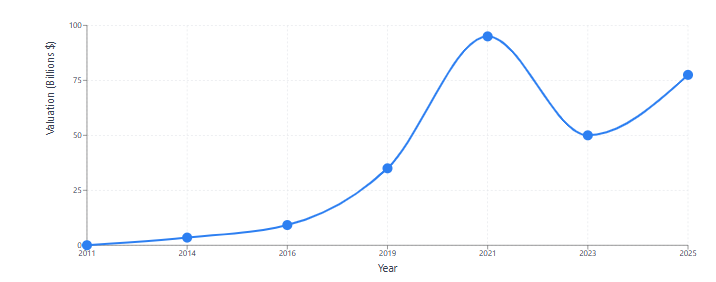
Stripe’s path to valuation success has been like that of a fairytale for fintech start-ups. In 2011, the company was able to raise its first funding rounds at a $20 million valuation, but by 2021, Stripe had achieved a peak valuation of $95 billion during a funding round led by some of the largest and most highly-regarded investors in Silicon Valley.
Sequoia Capital, Andreessen Horowitz, General Catalyst, and Thrive Capital are all leading names in venture capital, and their backing of the Collison brothers and their vision for Stripe confirms the confidence in Stripe from the VC community. Many traditional institutional investors, such as Fidelity and T. Rowe Price, participated in a funding round for Stripe in the later rounds, indicating the institutional investor community’s support of Stripe and the faith they have in the Collison brothers.
Stripe made an unusual decision to reduce its internal valuation down from $100 billion to $50 billion in 2023, a sign that it recognizes the downward trend in the overall technology market. However, this was not an indication of any weakness on Stripe’s part but simply recognised the realities of the changing marketplace. Based on private market transactions, Stripe’s valuation has rebounded to between $70 billion and $85 billion by early 2025.
The Pre-IPO stage of Stripe is fascinating because the company has found ways to allow liquidity for employees and early investors while being a privately held company. Stripe has provided opportunities for shareholders to sell portions of their stock to new investors through tender offers and Secondary Market Sales, which has helped to provide us with insights into what Public Market investors may be willing to pay.
To explain it simply, let's suppose you and your friends start a lemonade stand, and it becomes extremely successful, and eventually, you would like to take some of the money you've earned from the sale of lemonade; you do not want to shut down the Lemonade Stand. Stripe's method of operating Secondary Sales allows you to do this, only there are a lot more zeros in the transaction amounts.
Despite the general volatility in the Technology sector, Institutional investors continue to demonstrate interest in Stripe's stock within the Private Markets. Mutual funds and hedge funds have been paying premium prices for access to Stripe and continue to believe that upon entering the Public Markets, the value of Stripe will be much higher than it currently is.
Valuation Timeline:
-
2011: $20 million (Seed round)
-
2014: $3.5 billion (Series C)
-
2016: $9.2 billion (Series D)
-
2019: $35 billion (Series G)
-
2021: $95 billion (Series H, peak)
-
2023: $50 billion (Internal revaluation)
-
2025: $70-85 billion (Private market estimates)
Why Everyone's Talking About a Stripe IPO
The buzz surrounding the possible initial public offering (IPO) of Stripe is not merely financial speculation. If it does go public, this will be arguably one of the largest public market debuts since Airbnb and Coinbase went public in 2020 and 2021 respectively, but it is even more significant for the fintech space.
Stripe is a critical part of the "backend" of the digital economy. Rather than engaging directly with Stripe, many consumers see their transactions handled by leading online retailers such as Amazon or ride-sharing companies like Uber. If Stripe does, in fact, go public, this will be the first time public market investors can acquire equity interests in a global payment processing company.
The timing of a Stripe IPO is also critical. Both tech IPOs as well as tech-related investments have suffered significant losses during 2022 and 2023. However, as the stock market slowly rebounds, many companies including Stripe are dusting off their S-1 filings and seeing if there is a sufficient investor base interested in funding their continued growth.
From the perspective of institutional investors, Stripe would be an attractive investment opportunity. Many portfolio managers have watched Stripe's private valuation grow as they remained unable to invest. With an IPO, those institutional investors will be able to invest in Stripe, as well as invest alongside other pension funds, foundation endowments, and mutual funds.
The Coinbase IPO in 2021, for instance, would have been a great opportunity for most of you to get in early on. Coinbase was valued at approximately $86 billion when it went public through direct listing and received tremendous amounts of attention from investors. Even though Coinbase experienced extreme price fluctuations (from $40 - $368 per share depending on the day), it had a terrific time taking advantage of the public markets as cryptocurrency prices were surging.
Similarly, the Airbnb example also demonstrates how valuable a startup can become in a very short amount of time when it goes public. Airbnb was valued at $47 billion when it entered into a stock exchange program in December 2020. On the first day of trading, Airbnb's market capitalization rose nearly 100 percent. Investors viewed it as an investment in the future of travel and the working from home concept. Stripe represents a similar investment opportunity, only now investors are betting on how the commerce industry will evolve through digital transformation rather than travel and remote working.
Most retail investors have not had the chance to invest in a company that has been privately held for more than fifteen years. The initial public offering (IPO) of Stripe would create an opportunity for many retail investors to get involved in the growth of a company that has been unavailable to them during its largest growth phase because it has been privately held. Additionally, going public will help to narrow the divide between retail investors and private equity investors.
The symbolic implications are very significant as well. Stripe is thought of as being the definitive example of a successful startup; it’s known for its developer-first products and to be a company that builds thoughtfully. The Collison brothers are often mentioned when talking about responsible technology leadership. For Stripe to go public would be a strong statement that you can build a big and valuable company without sacrificing cultural values or committing large amounts of capital with no plan for return.
Decoding the IPO Timeline: What 2025 Could Look Like
If Stripe proceeds with its IPO in 2025, the company will be following a timeline similar to that of many other leading technology companies in the past. Understanding this timeline allows investors to keep track of key milestones throughout the process.
Step 1: Pre-filing Preparation (Q1-Q2 2025): Leading up to their S-1 filing with the SEC, Stripe will spend several months preparing. This includes completing financial statements, obtaining independent audits from a third party, and engaging in substantive discussions with one or more investment banks about the company's market valuation. Likely banks leading this offering will be Goldman Sachs, JPMorgan, or Morgan Stanley due to their extensive experience managing large tech IPOs.
Company executives will also begin considering how to sell their story during the IPO process. How do they want to present themselves to investors? How do they communicate their business model in a way that non-technical investors can grasp? This messaging has a huge impact on both first day trading activity and long-term stock price performance
Step 2: S-1 Filing (Q2-Q3 2025): The next significant event occurs once Stripe submits their S-1 registration statement to the SEC. As a publicly available filing, this document reveals all aspects of the company including revenues generated, profitability levels, compensation paid to key executives, potential risks the company may face, and competitive pressures faced. Investors are able to determine how successful (or unsuccessful) Stripe has been up until this point by looking at the information contained within its S-1 filing.
Tech and financial experts would dissect the S-1 document, searching for clues about how much Stripe makes per transaction, what percentage of revenue is generated from the company's largest ten customers, and how much the company spends on sales and marketing. These details, along with the analysis of the S-1, would help to create the IPO story.
Stage 3: Roadshow (Q3 2025)
After filing the S-1 and receiving feedback from the SEC, Patrick and John Collison, along with their CFO, would spend several weeks visiting institutional investors located in New York, Boston, San Francisco, and London for roadshow presentations , where they will give institutional investors the opportunity to ask all difficult questions and determine their level of investment.
At this point, the company is determining its true value. If institutional investors show concern over the company's valuation, the price range may need to be lowered. If the demand is overwhelming, the company, in conjunction with its bankers, may be able to offer more than initially anticipated.
Stage 4: Pricing and Launch (Q4 2025)
On the eve of the IPO, Stripe and its bankers will have chosen the price of the offering. In determining the price of the offering, several factors must be balanced, including: providing the maximum amount of capital to the company; providing sufficient "pop" on the first day in order to reward investors; and determining a price that is defensible in the long run.
The initial trading period for an IPO is unpredictable and volatile as supply and demand seek equilibrium. The first few hours often reflect this chaos. Some companies have very successful debuts, such as Airbnb’s 100% increase (opening day) and DoorDash's 86% increase in value. Meanwhile, others fall flat by opening below their previously set IPO price.
This timeline assumes a smooth progression of events; however, delays are very common for IPOs. Issues such as volatility, regulations, or indecision may delay an IPO for multiple quarters to years after its anticipated filing date. An example is Stripe, which is expected to file its registration statement in Q2 2025 but likely not become publicly traded until Q1 2026.
There are three major milestones to watch during an IPO: the filing of the S-1 registration statement (S-1) which will publicly disclose the company’s financials; announcements of when they will hold “roadshows” a presentation explaining why investors should invest; and the date on which the shares will begin trading on the open market.
Stock Outlook: What Could Stripe Shares Be Worth?
The process of determining the value of a pre-IPO firm is based on many different factors, such as experience, understanding of the market, and estimation.
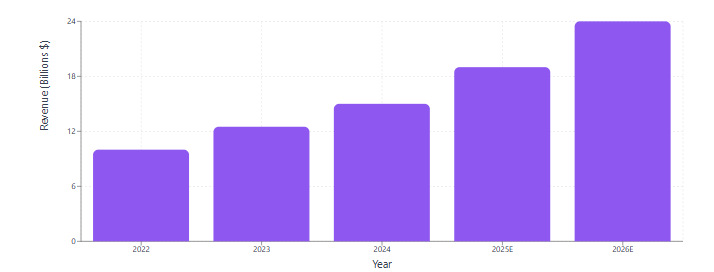
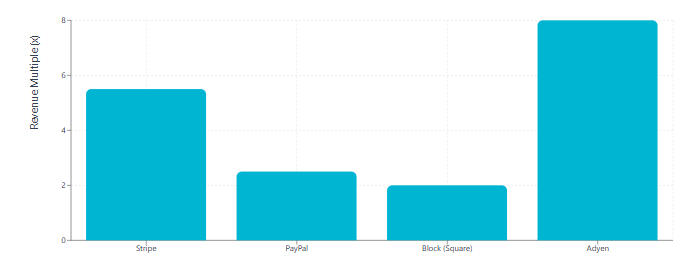
Currently, the most accurate estimate of Stripe's value is believed to be approximately $75 billion. In order for the firm to obtain that level of valuation, Stripe must continue its high growth in revenue and achieve a level of profitability that can be sustained over time. It is estimated that Stripe generated $14-16 billion in revenue during its fiscal year ending December 31, 2024, and will continue to increase revenue by 25-30% each year. If both of these estimates are correct, Stripe's revenue multiple of 5-6 multiplied by revenue will be fair compared to a rapidly growing fintech.
Stripe's premium valuation is the result of growth and the potential for continued growth. As a result of the significant increase in users and technical advances, the company competes at a much higher valuation than its competitors, including PayPal and Block (formerly Square), who are valued at a multiple of 2-3 and 2, respectively.
The future profitability of Stripe is critical for determining the valuation. To date, Stripe has invested heavily in new markets and product development while focusing on growth instead of profits. However, investors in 2025's public market will be more focused on the potential for profits than the investors who participated in the public market in 2021. If Stripe can provide a clear pathway to sustainable profitability and demonstrate that there will be operating leverage when margins increase with revenue, this will allow Stripe's stock to achieve a premium valuation.
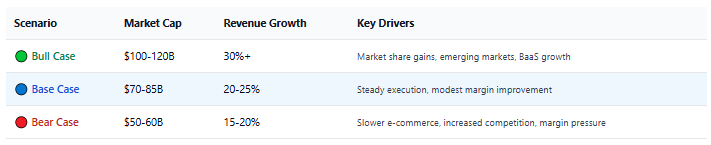
Analysts might model several scenarios:
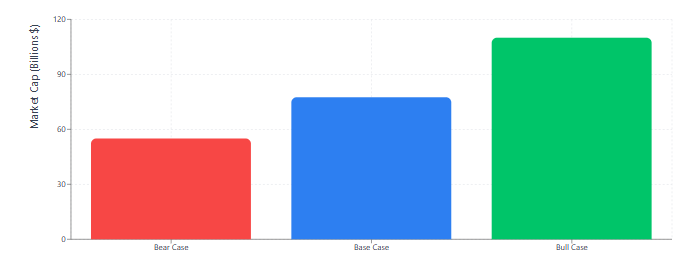
Bull Case: The Bull Case for Stripe is that the company gains more and more of the online payment market share, has a smooth entry into the emerging markets, and that the Banking-as-a-Service products grow considerably. Therefore, Stripe could have revenue growth of greater than 30%, which leads to increasing margins, and this could lead investors to value them at a market capitalization of $100-$120 billion by the end of year one.
Base Case: The Base Case for Stripe is that the company continues to execute steadily, has a 20-25% growth in revenue, and has a modest increase in margins over the next year. As a result, the stock would be priced flat to the IPO price at $70-$85 billion as investors digest their quarterly results going forward.
Bear Case: The Bear Case for Stripe is that there will be slower growth in e-commerce overall, and that there will be growing competition for Stripe from firms like Apple and other tech companies, which will put pressure on margins because of the cost of acquiring customers. As a result, if the company fails to meet expectations for growth, Stripe's stock could fall to a value of $50-$60 billion.
An example of this is Coinbase, which was initially projected by analysts to be worth between $200-$600 per share when it went public. The stock first opened its average trading price at about $381, reached as high as $368 (adjusted for splits), and now trades around $200-$300 depending on the current conditions of the cryptocurrency market. These fluctuations are typical for new public growth companies.
A significant advantage for Stripe is their diversification, unlike Coinbase. Stripe is not solely reliant on the volume of cryptocurrency trades; instead, they also benefit from being well positioned in e-commerce, Business-to-Business payments, and recurring revenue through subscription models. Thus, Stripe should have less volatility in its stock price as compared to Coinbase.
Many variables will influence the long-term growth potential of Stripe. Will competitors continue to invest heavily in developing their platforms, or will Stripe continue to hold the technological advantage? How successful could Stripe's current efforts in entering new areas such as lending, banking, and crypto? Finally, how effectively can they compete against the established players (e.g., PayPal) and the newly emerging players (e.g., Apple)?
Additionally, the market conditions at the time of the IPO (late 2025) will be critical for Stripe's success. If the Federal Reserve has successfully engineered a "soft landing" and tech stocks are trending upward, it is likely that Stripe will enjoy a favorable reception. On the other hand, if there are fears of a recession or if fintech stocks are currently out of favor, even a solid company may find it difficult to have a strong opening on day one of trading.
Ripple Effects: How Stripe's IPO Could Shake Up Payments
The public offering of a corporation the size and influence of Stripe will not only change Stripe, it will affect every part of the online payments ecosystem.
Stripe has been taking market share from PayPal since it was founded, and a successful initial public offering (IPO) for Stripe would further validate the market for API driven payment processing solutions targeted at developers, with Stripe being THE developer’s choice for payment solution, thereby forcing PayPal to move more quickly toward modernization.
As a result of Stripe’s IPO, expect increased competition between Stripe and PayPal, as PayPal has already made some aggressive moves into cryptocurrency and buy now pay later services.
Adyen went public in 2018 and is likely Stripe’s most direct competitor. Although they use different architectures to process payments, they both serve large enterprise clients, such as Spotify and Uber, so a successful IPO of Stripe could result in pressure for Adyen to reduce rates and enhance their product offerings in order to continue being competitive.
Block, operated by Jack Dorsey, is another company like Stripe, but it focuses more on small business payments (via Square) and Cash App payments. There is certainly some overlap between Block and Stripe, and institutional investors will compare both companies’ valuations and growth rates.
Smaller FinTechs may face difficult challenges if Stripe utilizes any proceeds from their IPO to aggressively expand into other finance areas - lending, banking, and blockchain - thereby pushing their emerging competition out of the market before they have a chance to gain enough momentum to compete effectively. On the flip side, if Stripe's IPO is a major success, this may remind potential investors why they are so fond of FinTechs and subsequently, there will be more investment money flowing through to all available FinTechs.
E-commerce platforms must also be aware and pay close attention to any potential developments resulting from a large and successful IPO from Stripe. There is certainly a mutualistic partnership between Stripe and Shopify, and both platforms have benefited from that, however, there may come a time when Shopify may decide that building out more of their own payment infrastructure would allow them to capture those economics for itself directly. In the same way as Shopify, Amazon will continue to leverage Stripe for some merchant services as well.
Banks are also making investments into digital payment systems. For example, JPMorgan Chase invested a billion dollars in building a digital payments system, while Wells Fargo and Bank of America are working to catch up. There are still many similarities to how traditional banking has historically operated, but many of those similarities are quickly fading, and a significant IPO from Stripe would highlight how much value has already been transferred away from traditional banking and toward the FinTech space, and could further accelerate banks' digital transformation initiatives.
The anticipated international impacts may not be limited to North America and Europe, as they may have greater impacts in other Regions, with MercadoLibre dominating the payment processing industry in Latin America, Grab and Gojek dominating in Southeast Asia, and Paytm and PhonePe competing in India. Stripe's slow entry into these markets may result in the influx of capital post-IPO which will allow for rapid growth and thus
The merchant perspective will also be a consideration. If you have an online business today, you likely have a choice of only Stripe, PayPal, Square, and perhaps a few local options, however; Market share competition will provide benefits for Merchants in the form of lower transaction fees, more attractive features, and better customer service. The public IPO of Stripe may catalyze an increased level of competition on pricing across certain market segments.
Another, often overlooked, impact on Stripe is talent. Historically Stripe has had access to some of the best engineering talent due to the option for Equity Ownership within a private company; once a public company, the compensation plan will no longer be aligned with Private Equity Compensation. Stripe may be more susceptible to competitor talent acquisition as competitors will be able to hire Stripe employees with access to liquid stock grants as opposed to illiquid option grants.
Investment Opportunities and Risks: A Reality Check
To put it simply, Stripe's IPO will be among the most talked about IPOs on the public markets in recent times; the hype offers both opportunity and risk.
Opportunity: If you believe that online commerce will continue to grow globally, Stripe is the best option for benefitting from this growth. Stripe provides a core technology component (the infrastructure layer) for the supported E-commerce, SaaS and digital marketplaces. As they grow so will their business, therefore allowing investors an exponential opportunity to invest in the digitization of commerce without having to select between every E-commerce company or marketplace that exists.
Another positive aspect of having multiple verticals is optionality. What this means is that Stripe has expanded into Embedded Financial Services, Crypto Infrastructure, and Global Banking. Thus, Stripe is in a position to pivot as needed, should one or more of their verticals become sluggish. This is because of Stripe's multiple verticals that create a more diversified company, thus reducing company-specific risk; as compared to Fintechs that are focused only in one vertical.
This IPO can help investors who did not participate in the Private Market, now get in at a time when they would have an advantage over those who did. In addition to that, you will be able to invest in a company with the benefit of 15 years of execution history and proven products; and the company has the largest scale of operations among all the Fintechs in the space.
The Risks: Stripe's $75 billion valuation is certainly on the high side, and it will have to execute perfectly to warrant that type of valuation. If the company's revenue growth, margin expansion, or product launches disappoint all at once, the share price could drop significantly. Tech companies that have had high valuations when they go public often perform poorly in the first year as investors come to terms with reality.
Stripe is facing increased competition from all angles. Apple pay is entering into deeper territories concerning online payments, Amazon may choose to pursue this strategy more aggressively, and even Facebook and Google have ambitions to get into the payments space. Stripe has competitors on multiple fronts and a number of these competitors have much greater resources available to them.
There are significant risks associated with regulation in the payments industry. Companies that provide payment processing services are currently being monitored and studied by governments around the world. In particular, data privacy, anti-money laundering laws, and laws regarding cross-border transactions are the most recent focus of governments. New regulations could increase compliance expenses for Stripe and potentially put restrictions on certain types of business.
The macroeconomic environment is critical. If we experience reduced e-commerce growth or enter into a recession, many businesses will reduce their spending, which includes sophisticated payment systems. At the same time, Stripe could see a decline in transaction volume at the same time investors are expecting the company to grow.
Over the last several years, growth stocks have experienced severe drops in valuations and multiples of revenue. Even companies that are regarded as being strong have seen their multiples cut in half or even more. Stripe may have an IPO at five times its revenue, but if the market starts valuing fintech companies at three times their revenue, the company’s shares will drop 40% even if it performs well.
Strategic Factors: If you have a long-term investing approach and believe in the future of digital commerce, you may want to purchase shares during the initial public offering (IPO) and hold them for many years regardless of price fluctuations. This has worked very well for many investors who purchased shares of both Amazon and Netflix at their respective IPOs and held through numerous market corrections.
However, waiting a few months after the IPO before purchasing shares may give you more favorable prices. When the lockup period ends and insiders begin selling their shares, market excitement usually decreases, which tends to clarify the direction of the company's operations. Most IPOs will be priced lower than their opening price six months later.
Most of the shares that will be allocated to IPOs will go to institutional investors. Therefore, if you are a small investor (retail) you will likely have trouble purchasing shares at the IPO offering price. If shares become readily available for purchase once trading begins, the price may have increased by a considerable amount (30–50 percent) immediately following the IPO.
Portfolio sizing is critical as well. If you like the investment thesis for Stripe, making it 20 percent your portfolio exposes you to excessive concentration risk. A more conservative position of 2 to 5 percent provides you with the potential benefit of participation in the upside of the investment while limiting downside risk if things do not go as expected.
Long-Term Impact on Fintech Innovation
Looking at Stripe's IPO from a broad perspective shows that Fintech's long-term success is largely a test of whether these companies can deliver "lasting, profitable" public companies. The Fintech industry experienced rapid growth between 2015 to 2020 with a mass of investment in the sector.
Each financial service category has been disrupted by new entrants (lending, banks, insurance, investment, and cryptocurrencies) and billions of dollars have been invested in these companies with the hope that they will have the same evolution as the media, retail, and transportation industries; and transition to completely digital models.
However, it soon became evident that some of the assumptions made by early-stage investors were incorrect; specifically their projections regarding how quickly these companies would generate profits. In addition to these issues, the amount of time and money required to achieve regulatory compliance is substantial; therefore it is understandable why some of these originally "unicorn" ranked companies saw their valuations drop drastically or even disappear altogether.
The outcome of Stripe's IPO will determine the fate of the surviving fintech companies. If Stripe does go public successfully, receives a high trading post-offer price and continues to grow, this would confirm the validity of all of the money that has been invested by venture capitalists through the years in Fintech companies which would allow Limited Partners of venture capital funds back the next wave of Fintech start-ups.
The psychological impact of Stripe's success could be just as significant for entrepreneurs as its financial impact. If Stripe succeeds, it will demonstrate that a massive, legal-compliant fintech company can be built without the need to cut corners, spend heavily to acquire customers or utilize regulatory schemes for monetary gain. Furthermore, Stripe's founders, the Collisions, will have set the benchmark for what can be accomplished through a methodical approach over time.
The availability of early stage capital is expected to change as well. Venture capitalists may prefer to focus their capital on providing infrastructure for businesses (such as Stripe) rather than having it directed towards businesses that serve the consumer. Historically, the picks and shovels companies during gold rushes often generate more profit than the actual gold miners.
On the flip side, a negative reaction to an IPO could negatively impact the fintech sector as a whole. If Stripe's stock is released to the public and immediately drops by 20-30% or if the company underperforms after the first few earnings calls, venture capitalists may have a more cautious outlook regarding fintech companies in general and redirect their investment into other trending sectors such as A.I., Biotech, and Climate Technology.
Competitive dynamics within the fintech space are going to change. Today, private fintech firms compete predominantly based on product offering and user experience, but once Stripe goes public, they will have to compete not only based on their products and services, but based on their stock performance. Highly skilled engineers and executives are going to factor stock prices, momentum, compensation structures, and career-path potential into their decision processes when evaluating prospective employment opportunities with Stripe as compared to any given private competitor.
The enormous potential of Banking-as-a-Service may be realized through the success of Stripe. Should investors find value in these types of services from Stripe, we may see a rush from every other fintech to produce Banking-as-a-Service products to meet the demand. The result would be an acceleration of the trend of unbundling because of the use of specialized companies to provide better service for different segments of consumer demand for financial services.
At the same time, there is likely to be a greater influence from outside of developed countries. A successful Stripe will likely serve as a model for founders in emerging markets who desire to create local payment systems as an alternative to relying on companies in developed economies (the West) for payment services. The size of the unbanked population in Brazil, India, Nigeria, and Indonesia combined is likely to create a demand for companies similar to Stripe but with a greater understanding of the local markets.
The nature of the regulatory conversation will change as well. With a successful IPO, Stripe's value will serve as an example (or a model) for regulatory agencies on the characteristics of a well-functioning, functioning, and responsible fintech company that has scaled its operations to meet the needs of its consumers. Many regulatory agencies are currently developing regulations that will support the emergence of new fintech companies, which will enable the entire fintech ecosystem to innovate and prosper.
Final Thoughts: Navigating the Stripe IPO as an Investor
Stripe is an amazing success story. The story began many years ago with a single API, and today it has grown into a $75 billion (USD) FinTech (Financial Technology) powerhouse. In addition to being an amazing success for one company, the potential Initial Public Offering (IPO) of Stripe, expected in 2025, will be significant for the entire FinTech industry. If Stripe is able to deliver meaningful returns to public market investors, it will be an important gauge of whether digital payment infrastructure will provide meaningful returns.
The opportunity is there, as Stripe has demonstrated its ability to execute with its dominant market position with developers and its various sources of revenue, as well as several potential avenues for growth beyond what it is currently doing.
There are significant risks associated with the potential of Stripe. The current valuation for Stripe is at or near the upper limit of its potential (whereas most startups have room for growth over time) due to the fierce competition in the market. Furthermore, Stripe must deal with regulatory uncertainty, and the potential for macroeconomic headwinds to affect even the best businesses. The excitement surrounding Stripe's IPO will likely be enormous, but excitement also tends to lead to inflated valuations.
Investors should take the time to perform their due diligence. They should read the S-1 when it is filed. They should be familiar with Stripe's business model. They should compare Stripe's valuation with its competitors. Finally, they should be cautious of the fear of missing out (FOMO) that can result in poor investment decisions.
Think carefully about the strategy you want to implement. Are you a long-term investor with the ability to accept volatility or a short-term investor seeking immediate gains? The answer to this question will indicate if you should purchase on day one, wait for a pullback, or skip the IPO altogether.
Remember that no single stock should make up a large percentage of your portfolio, regardless of how good it seems. Diversifying your investments is a critical component of any good investment strategy. Even if Stripe does eventually become the next Amazon, you don’t want to overexpose yourself if anything unexpected happens.
We are still in the early stages of the fintech revolution. Stripe's IPO may be a landmark event for this space, but there will be other opportunities. Stay up to date, remain disciplined, and make investment decisions based on fundamentals, rather than hype.
Ready to make informed decisions about fintech investments like Stripe's IPO? TradeWill.com gives you the tools, research, and real-time market insights you need to navigate high-stakes opportunities with confidence. Don't just follow the hype-trade with intelligence.
Disclaimer: The content of the blog does not represent any position of Trade W, does not serve as any trading-related decision advice, and does not endorse any third-party.