
 Trade W
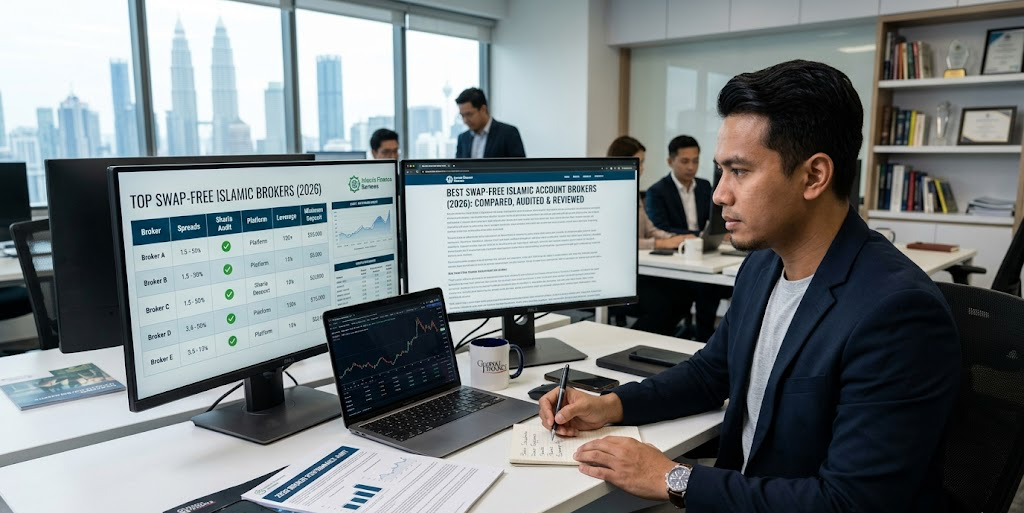
It will1 take less than 30 seconds to find a forex broker that offers an Islamic account option on Google. However, finding a broker with a truly riba-free account that does not receive or charge interest, and where any fees replacing the overnight swap are not simply interest under a different name, will require considerably more effort. This is why you need this guide.
If you have recently read mixed opinions regarding whether forex trading is halal, or if you are uncertain whether the Islamic account label used by forex brokers in their marketing has any real substance or validity, these are legitimate concerns. The purpose of this guide is to help you conduct your own audit of broker fee structures, present current scholarly opinions regarding the permissibility of forex trading without providing a definitive ruling, and identify which brokers meet the criteria outlined in this guide under meaningful scrutiny. In addition, when evaluating a trading account, it is important to understanding how leverage and financial instruments work, as your analysis cannot be meaningful without that foundation.
What Is a Swap-Free Islamic Account?
Additionally, no overnight swap (rollover interest, or riba) is charged to your trading account for positions held after the daily rollover. Swap-free accounts are used by Muslim traders who wish to trade in accordance with Sharia law and avoid paying or receiving interest on positions held overnight. Instead of charging or paying interest on overnight positions, compliant brokers typically apply either a fixed service fee or a wider spread, the difference between the bid and ask prices of an asset, rather than an interest-based fee that accumulates over time.
To understand why this is important, you must first understand what a swap is. When you keep a forex trade open beyond 5:00 p.m. New York time, your broker will either credit or debit your account based on the interest rate differential between the two currencies in the pair. For example, when trading USD/JPY, the overnight adjustment reflects the difference between the prevailing interest rates associated with the U.S. dollar and the Japanese yen.
By holding a long USD/JPY position overnight, you are effectively holding U.S. dollars against Japanese yen exposure, and the rollover adjustment reflects the financing cost or interest earned on that position. Because this mechanism is based on the passage of time and interest rate differentials, it is commonly regarded as riba al-nasiah, or interest arising from deferred settlement, which is one of the primary reasons traders seek swap-free accounts.
You can think of a swap-free account as turning off the meter that would otherwise accumulate interest charges or credits overnight. The position you hold remains exactly the same, but your rollover or swap line will show $0.00 rather than a debit or credit based on overnight financing.
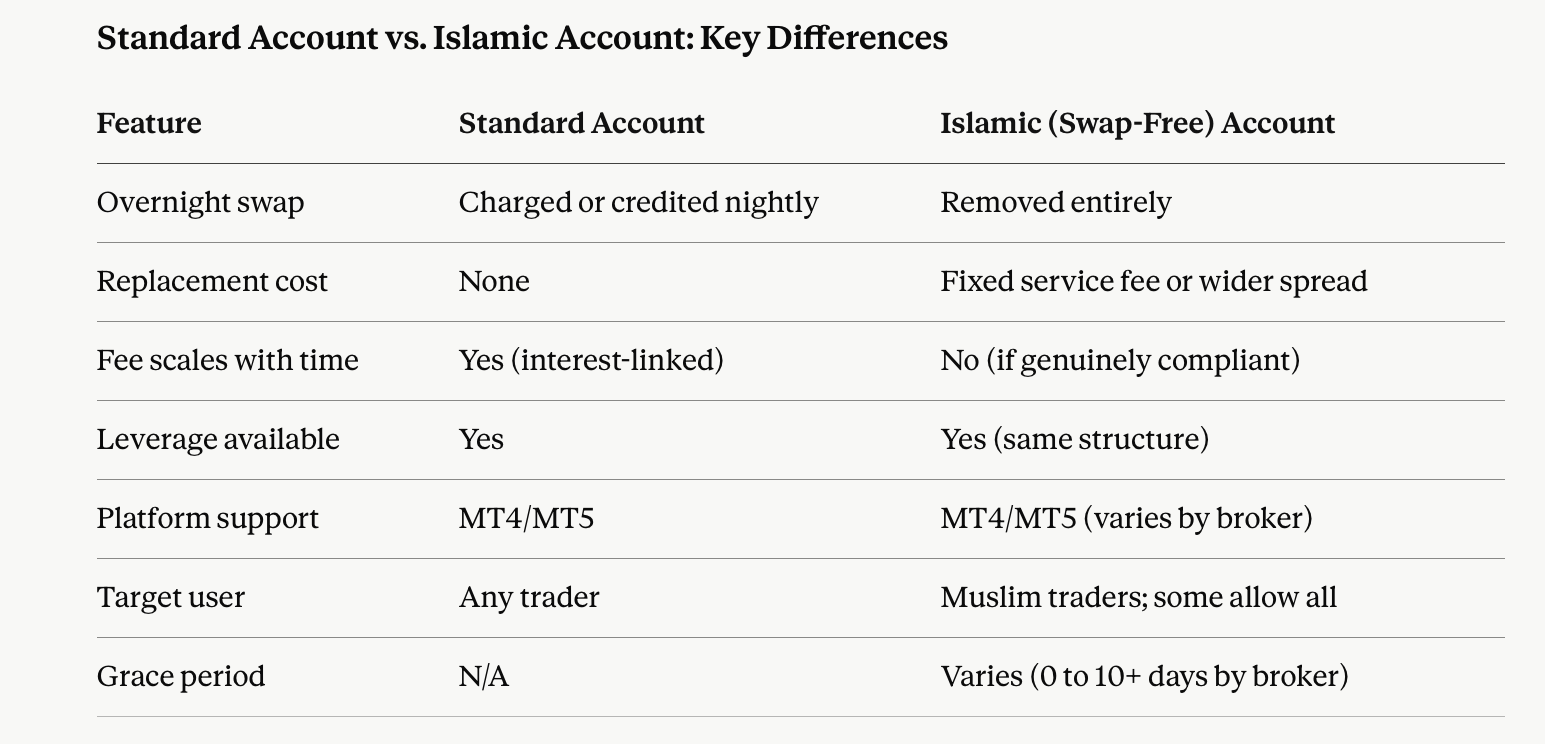
The greatest differences, and those often overlooked in broker reviews and comparison articles, become apparent when examining how positions are structured and charged at a swap-free, Sharia-compliant broker compared with a standard forex broker. The tables below compare the structural differences between a typical forex trading account and an Islamic (swap-free) account.
Best Swap-Free Islamic Account Brokers: At a Glance
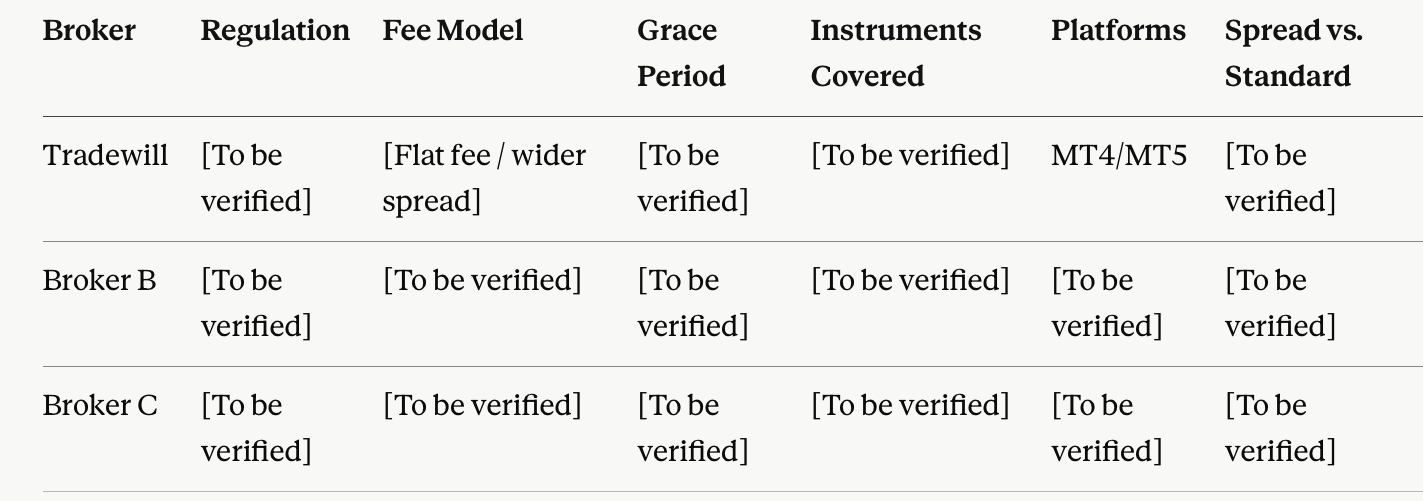
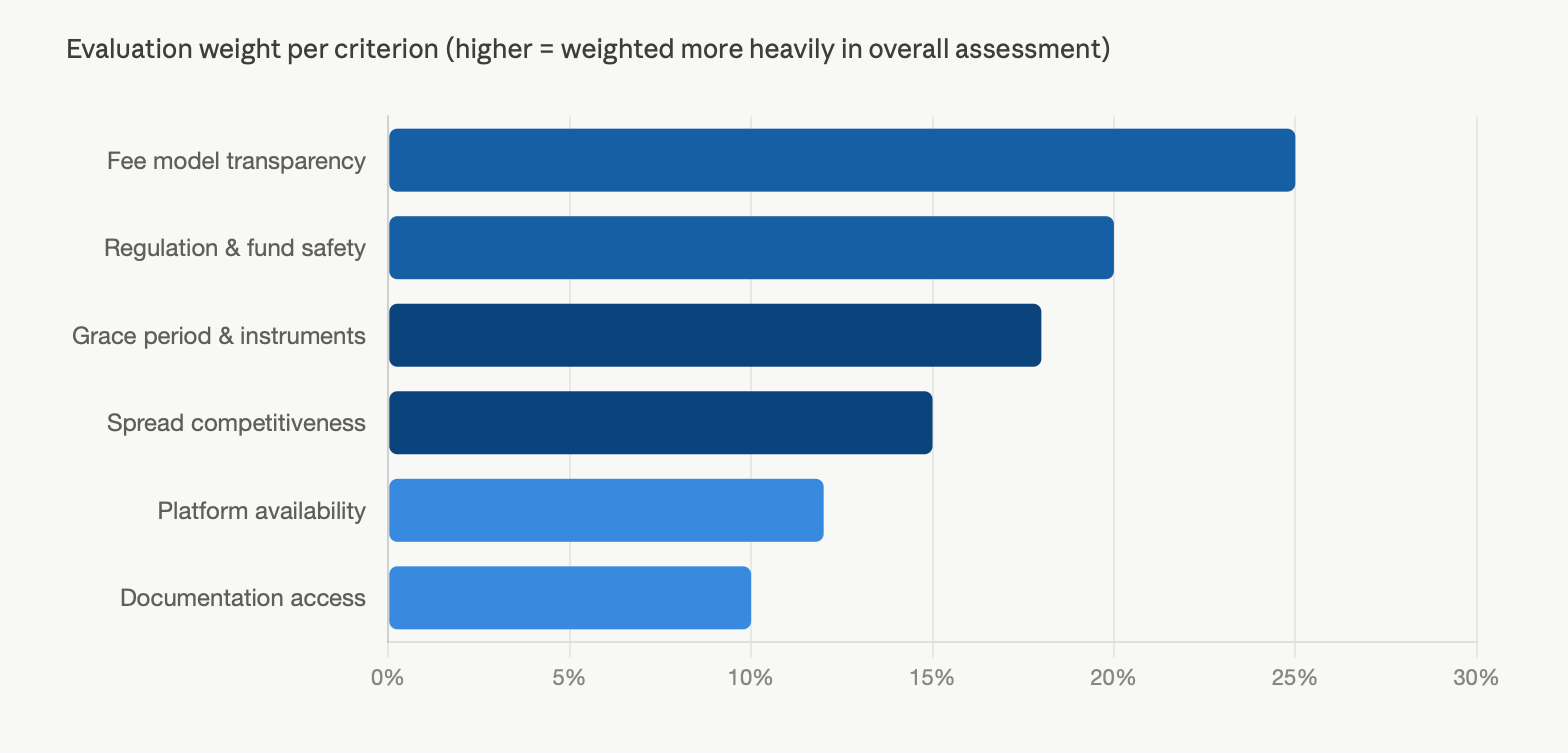
Islamic broker comparison criteria should be based on how each broker's Islamic Account Terms align with key considerations, including fee structure (flat versus variable fees replacing swaps), grace period duration, instrument coverage, platform availability, and regulatory standing. Therefore, all information should be verified against each broker's official Islamic Account Terms before opening an account.
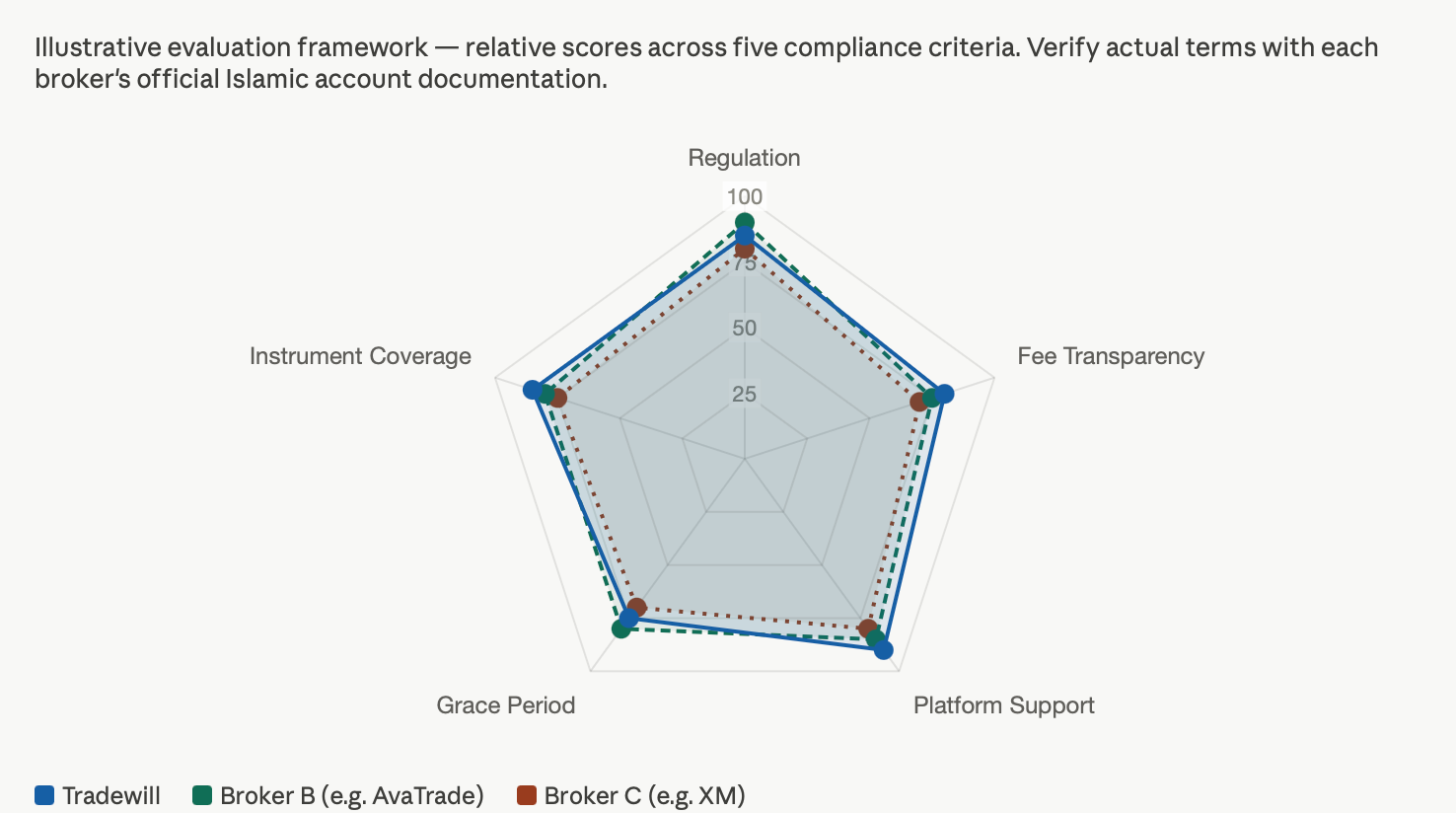
Best Overall = Tradewill (pending compliance verification). Regulated, flat-fee structure, MT4/MT5 support, and a wide range of available instruments.
Best for Beginners = Brokers that provide swap-free trial accounts, clear fee terms, and user-friendly documentation for opening and managing an account.
Best for Long-Term Holding = Brokers that offer extended grace periods and genuinely flat fees after the grace period expires, making them more suitable for holding positions over longer periods.
Best for Tight Spreads = Some brokers offer wider spreads on Islamic accounts than on standard accounts to offset revenue lost from swaps. Therefore, you should compare each broker's spread tables to determine which providers offer the most competitive Islamic account spreads before committing to a broker.
All brokers have been reviewed and dated by Tradewill for compliance using the official Islamic Account Terms documentation provided by the broker. The overall structure of this comparison table has been designed to align with the requirements outlined in each broker's compliance framework.
Is Forex Trading Halal?
Broker-owned articles usually begin by either avoiding the question entirely or confidently stating, "Yes, forex is halal, and here is why." Neither type of article provides meaningful value to Muslim traders seeking an objective assessment.
The reality is that there has been a legitimate difference of scholarly opinion on this matter for decades.
Contemporary Islamic finance scholarship, which often relies on AAOIFI (Accounting and Auditing Organization for Islamic Financial Institutions) frameworks, generally holds that currency exchange (sarf) is permissible under Islam if certain conditions are met. Specifically, settlement must occur immediately or on a spot basis, no riba may be involved, and the transaction must represent a genuine exchange of value rather than mere speculation or gambling (maysir). Under this interpretation, retail forex trading may be considered halal if it is conducted through a properly structured swap-free account and accompanied by prudent controls on leverage and position sizing.
Other scholars, particularly those who adopt a stricter interpretation, argue that the leveraged nature of retail forex trading, where a relatively small deposit controls a much larger notional position, and the speculative characteristics of many trading activities make it too similar to gambling. Under this view, retail forex trading may be considered impermissible regardless of how the issue of riba is addressed.
Neither position is a fringe view, and neither should be dismissed. There is no universal consensus among the established madhahib (schools of Islamic jurisprudence), and qualified scholars across those schools have reached differing conclusions. This article does not issue a halal ruling on your behalf, nor can a broker provide such a ruling.
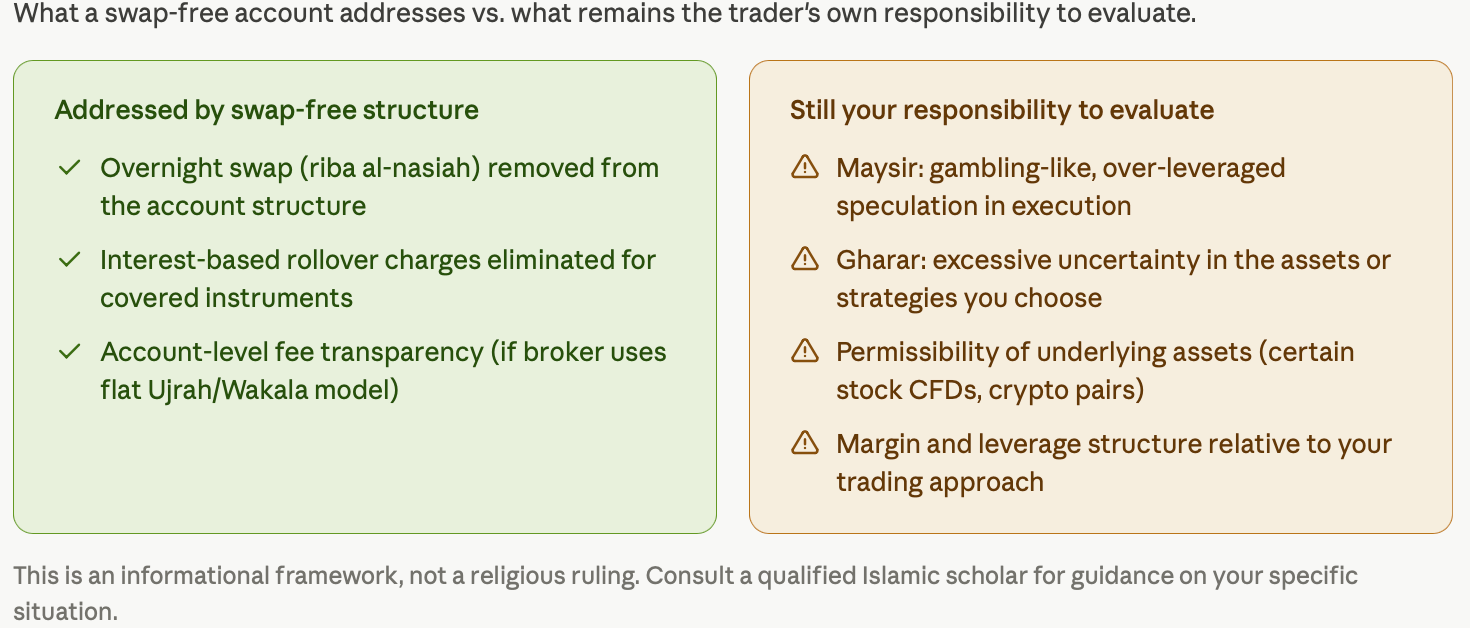
With regard to the swap (riba al-nasiah) issue, eliminating swap charges may address one area of concern, but additional questions remain regarding maysir (gambling), gharar (excessive uncertainty in a transaction), and whether the underlying assets being traded are themselves halal. These matters should be discussed with a qualified Islamic scholar who understands both Islamic jurisprudence and your personal circumstances, rather than relying solely on information provided in a broker's FAQ section.
Are Islamic Accounts Really Swap-Free? The Hidden-Fee Audit
There is also a question that almost all broker comparison articles fail to address: If a broker eliminates overnight swap charges to avoid charging interest, how does the broker replace the revenue that would otherwise have been generated?
There are three principal methods brokers may use to create a new revenue stream to offset the loss of income from overnight swaps: a flat service fee, which may sometimes be structured under an Ujrah or Wakala arrangement; a wider spread on Islamic account instruments; or a holding fee that begins to accrue after a defined grace period. The first two approaches are generally regarded by many contemporary scholars as more compatible with Islamic finance principles because they are transparent, fixed, and not directly linked to prevailing interest rates. The third approach requires closer scrutiny.
In some cases, a broker may structure its post-grace-period fee so that it increases over time based on how long a client holds a position. The cumulative effect can make the charge resemble a financing cost that moves in line with broader interest rate conditions. As a result, some scholars and practitioners in Islamic finance argue that such fees may function as a form of riba under a different label.
Ujrah represents a genuine service fee and is not dependent on how long a trade remains open. A fixed service charge applied when opening a position, for example on a per-lot basis, does not increase simply because the position is held for a longer period. However, if a broker charges a fee that accumulates or compounds based on the length of time a trade remains open, it becomes difficult to distinguish that charge from interest regardless of the terminology used by the broker.
The following audit checklist can be used to assess any Islamic trading account before funding the account.
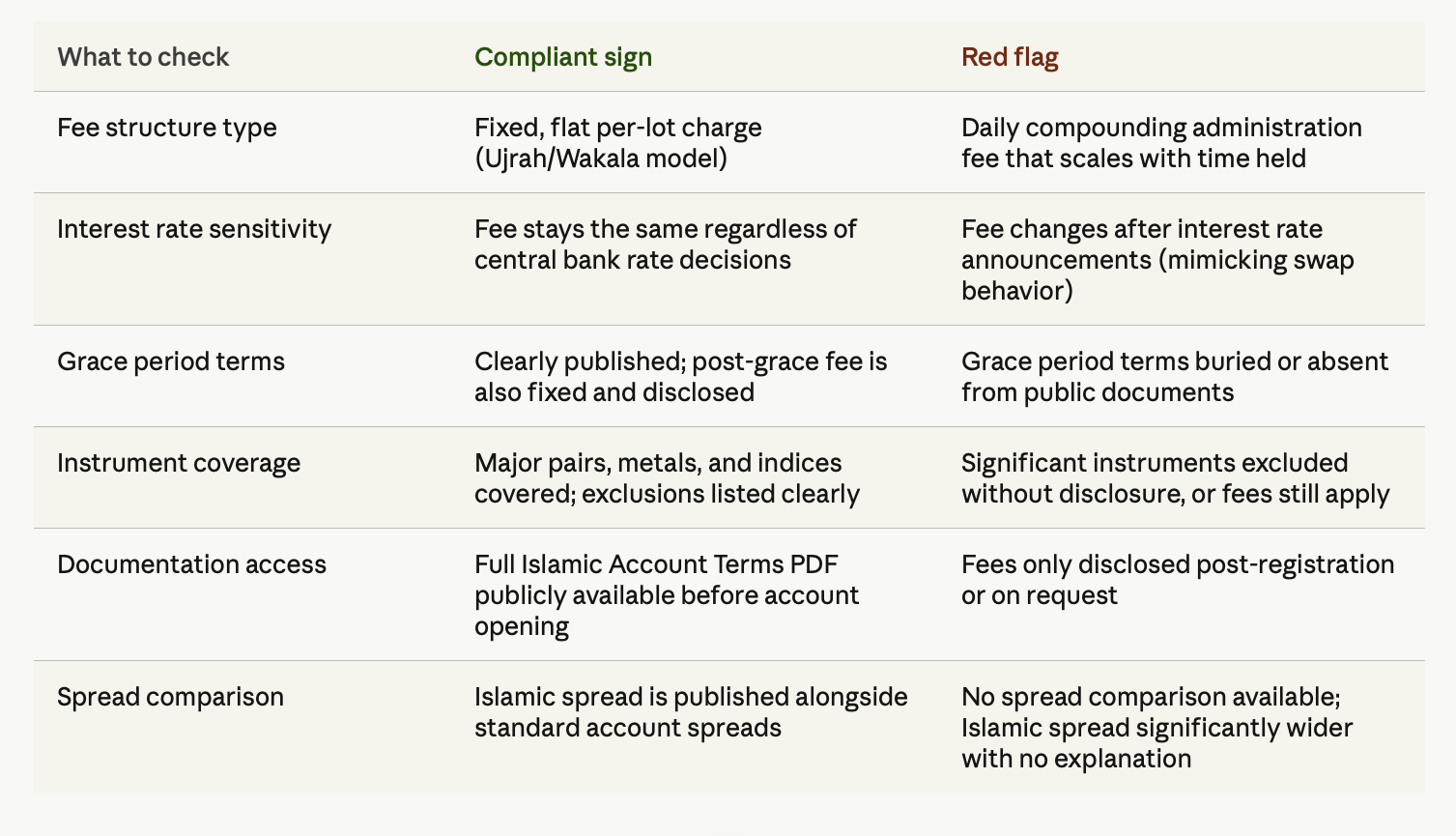
As a general guideline, if a commission or fee increases the longer a trade remains open, it may function in a manner similar to an interest charge. In contrast, a standard service fee remains the same regardless of whether a position is held for two days or ten days.
In addition, scalpers and day traders will generally only incur rollover charges if they keep positions open beyond the daily rollover time. Therefore, traders using a standard account who consistently close their positions before the end of the trading day are effectively operating in a swap-free environment.
When evaluating intraday trading strategies, the need for an Islamic account typically becomes relevant only when positions are held overnight. Traders who employ carry trade or swing trading strategies often hold positions for longer periods, making overnight financing charges more likely to apply. In such cases, the Islamic account structure becomes an important consideration.
How We Evaluated These Brokers
Since this article is published on a broker-owned platform, the methodology for ranking and reviewing competitors needs to be explicit, not buried or implied.
The evaluation criteria are weighted in this order, and the weighting reflects the actual concerns a Muslim trader brings to this decision:
As a general guideline, if a commission or fee increases the longer a trade remains open, it may function in a manner similar to an interest charge. In contrast, a standard service fee remains the same regardless of whether a position is held for two days or ten days.
In addition, scalpers and day traders will generally only incur rollover charges if they keep positions open beyond the daily rollover time. Therefore, traders using a standard account who consistently close their positions before the end of the trading day are effectively operating in a swap-free environment.
When evaluating intraday trading strategies, the need for an Islamic account typically becomes relevant only when positions are held overnight. Traders who employ carry trade or swing trading strategies often hold positions for longer periods, making overnight financing charges more likely to apply. In such cases, the Islamic account structure becomes an important consideration.
Detailed Broker Reviews
Tradewill offers a regulated Islamic account for Muslim investors who wish to trade in a manner that aligns with their faith without paying or receiving interest on their positions.
Strengths: Subject to compliance verification. Transparent account structure. Strong support for both MetaTrader 4 and MetaTrader 5.
Disadvantages: Subject to compliance verification. Product availability, excluding any products with significant interest-related components, and minimum deposit requirements remain to be confirmed.
Suitability for swing trading will depend on the final terms approved by compliance. If demo accounts are available, they may provide a useful starting point for investors who wish to test strategies and familiarize themselves with the platform before committing real capital.
All figures and account details must be validated by Trellatin's compliance department before being made available to the public.
Broker B (Example: AvaTrade)
For both its Standard Account and MT4/MT5 platforms, AvaTrade offers an Islamic account that is not subject to swap fees. Details regarding the fee structure can be found in AvaTrade's Islamic Account documentation.
Strengths: Highly regulated through multiple regulatory authorities, offers a large selection of tradable instruments, and has a substantial number of independent reviews.
Disadvantages: Different categories of instruments are subject to different grace periods and fee structures. In addition, not all cryptocurrency products may be available for trading through an Islamic account.
Target User Profile: Traders who prefer a well-established broker with strong regulatory oversight and access to a broad range of financial instruments.
Broker C (Example: XM)
XM offers an Islamic account upon request, provided that you complete the standard KYC verification process. For many major currency pairs, the account does not apply swap or rollover fees.
Strengths: Low minimum deposit requirements, availability on both MT4 and MT5 platforms, and a large selection of tradable instruments.
Disadvantages: The swap-free period is limited in duration and may be followed by administrative fees. Traders should review XM's current fee schedule and Islamic Account Terms before opening an account.
Ideal for: First-time traders seeking low entry requirements and access to a wide variety of financial instruments.
Islamic Account vs. Standard Account
The difference between standard and Islamic account pricing is primarily based on how positions are charged when held overnight and whether those charges affect your trading strategy. If you hold positions for minutes or hours and close all trades before the New York rollover, the swap mechanism will never be activated. In that case, you are already operating in a swap-neutral environment while trading from a standard account. The distinction of an Islamic account becomes most significant for traders who use trend-following, price-channel, or carry-trade strategies that involve holding positions for multiple days or weeks.
The cost comparison also depends on how your broker compensates for the removal of swap charges, whether through wider spreads or a flat service fee. A wider spread affects every trade executed during trend following strategies, price channel approaches, or carry trade structures, whereas a flat service fee generally affects only positions held beyond the rollover period. For high-frequency traders who execute numerous intraday trades, an Islamic account with wider spreads may potentially cost more than a standard account with swap charges that are never incurred because positions are closed before rollover.
This consideration forms part of a broader evaluation of trading costs and commission structures that applies to all types of trading accounts.
How to Open a Swap-Free Islamic Account
It is easier to obtain an Islamic account than many traders assume. However, eligibility requirements can vary significantly from one broker to another.
First Step: Choose a broker that is regulated by a top-tier regulatory authority, such as the FCA, ASIC, CySEC, or DFSA, and that publishes its Islamic Account Terms before you register.
Second Step: Complete the standard registration and KYC (Know Your Customer) process. This typically involves submitting a government-issued photo ID and proof of address.
Third Step: Request or activate the Islamic (swap-free) account designation. Some brokers automatically provide this option during registration, while others require you to contact customer support or complete an additional application form. Certain brokers may require proof of religious affiliation, whereas others make swap-free accounts available to all clients.
Fourth Step: Review the Islamic Account Terms document before funding your account with real money. Confirm the fee structure, grace period, and the availability of the instruments you intend to trade.
Fifth Step: Open a demo account configured with the swap-free account settings, rather than a standard demo account, and test the trading environment over several sessions before committing real capital.
Sixth Step: Fund your live account and begin trading. Start conservatively, particularly if you are new to forex day trading mechanics or reading price action.
Regarding eligibility, many brokers now offer swap-free accounts to non-Muslim clients as well. In these cases, the account is treated as a standalone product rather than one limited solely to religious considerations. Because eligibility requirements differ among brokers, it is important to review each broker's specific policies. Once approved, however, the account structure generally functions the same regardless of how eligibility was established.
Risks and Responsible Trading
A swap-free account is an account that uses a different fee structure from a traditional account, but it does not change how the market itself operates.
There is a high risk of losing money when trading leveraged forex and CFDs. Therefore, it is important to understand and manage this risk regardless of the type of account you use, including an Islamic account. A swap-free account may address the issue of overnight interest charges; however, it does not eliminate the risk of the market moving against your position.
A responsible forex trader should understand how quantitative easing and central bank decisions move currency markets, as well as how to read financial statements when trading stock Contracts for Difference (CFDs).
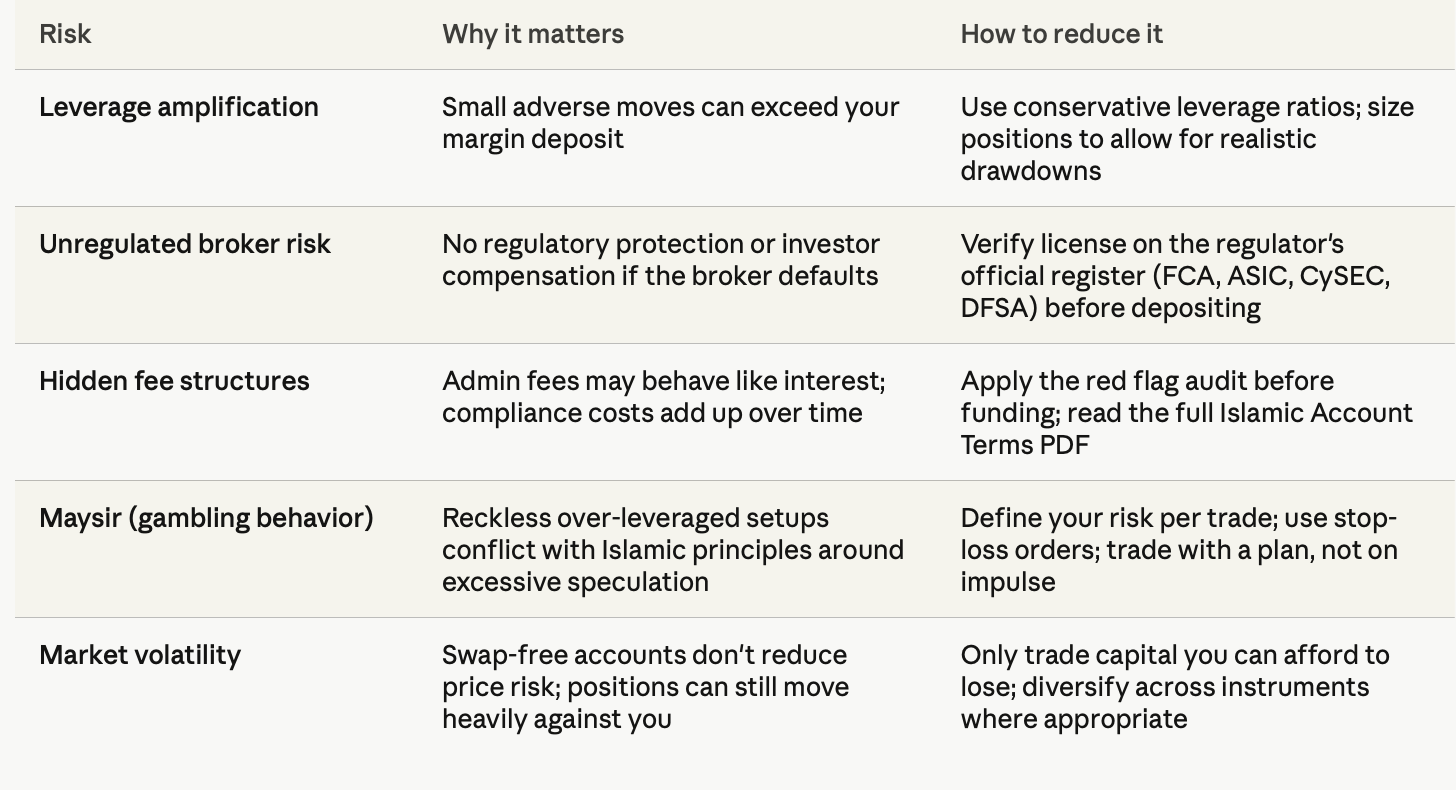
There is also an Islamic principle of avoiding excessive speculation (maysir), which may influence your trading activity. Taking position sizes that can wipe out an entire account with a single large loss can not only result in significant financial damage but may also be inconsistent with the principles of deliberate and measured trading as defined by Islamic finance scholars. All traders, especially Muslim traders, are expected to use risk management tools like stop-loss orders and understanding volatility patterns, as these form an integral part of the broader compliance framework.
Risk Disclaimer: Trading foreign exchange (FX) and/or Contracts for Difference (CFDs) carries the potential for significant rewards, but also significant risks. You may lose some or all of your investment. A no-swap Islamic account changes the fees charged to you, but does not change the market risks associated with trading activity.
Frequently Asked Questions
What is a swap-free Islamic account?
A swap-free Islamic account is a trading account that removes the overnight swap (rollover interest, or riba) on positions held past the daily rollover, designed for Muslim traders following Sharia law. Instead of interest, compliant brokers apply a fixed service fee or a wider spread, not a time-based or interest-linked charge.
Is forex trading halal in Islam?
Views differ among scholars. Many contemporary Islamic finance scholars consider forex permissible under specific conditions — immediate (spot) settlement, no interest (riba), and no gambling-like excessive speculation. Others hold more restrictive views. This is not a ruling; consult a qualified scholar for guidance on your specific situation.
How does a swap-free account work?
When you hold a position overnight on a standard account, the broker charges or credits swap interest based on the two currencies' rate differential. A swap-free account freezes that interest at zero. To cover the cost, the broker may apply a fixed service fee or a slightly wider spread instead.
Are Islamic forex accounts really interest-free?
Not always. The overnight swap is removed, but some brokers replace it with an administration fee that scales with time or interest rates, which critics consider interest in disguise. A genuinely compliant account uses a fixed service fee or wider spread, not a daily interest-linked charge. Read the terms first.
Which broker offers the best Islamic account?
The best broker depends on your needs, but strong candidates are top-tier regulated, use a transparent fixed-fee or wider-spread model (not disguised interest), publish their Islamic terms publicly, cover a wide range of instruments, and support MT4/MT5. Always verify the fee model before opening an account.
Can non-Muslims open an Islamic account?
It depends on the broker. Some offer swap-free accounts to all clients, while others restrict them to Muslim traders and may request proof of faith during onboarding. Check the broker's eligibility rules and Islamic account terms before applying.
Do Islamic accounts have hidden fees?
They can. Some brokers replace the swap with administration fees, wider spreads, or charges that begin after a grace period. The key question is whether any holding fee is a fixed service charge or scales like interest. Always read the Islamic account terms before funding.
What is the difference between an Islamic and standard account?
A standard account charges or credits overnight swap interest; an Islamic account removes it. To compensate, Islamic accounts may carry a fixed service fee or slightly wider spreads. Trading features like platforms and instruments are usually the same, though some instruments may be excluded.
Are Islamic accounts available on MT5?
Yes. Many brokers offer swap-free Islamic accounts on both MT4 and MT5. Confirm that the Islamic option is available for your chosen account type and platform, and check which instruments are covered before opening.
How can I open a swap-free trading account?
Choose a top-tier regulated broker with a transparent fee model, register and complete verification, then request or enable the Islamic (swap-free) status. Some brokers require proof of faith. Read the Islamic account terms, practice on a demo, then fund your account.
What is riba in forex trading?
Riba refers to interest, which is prohibited under Sharia law. In forex, the overnight swap (rollover) is interest derived from the two currencies' rate differential. Because it's interest-based, observant Muslim traders avoid it by using a swap-free Islamic account that removes the charge.
Does a swap-free account make forex fully halal?
Not on its own. A swap-free account addresses the riba from overnight interest, but full compliance also involves avoiding gambling-like speculation (maysir), excessive uncertainty (gharar), and choosing permissible instruments and leverage. Whether your overall trading approach is permissible is best confirmed with a qualified scholar.
What is an administration fee on an Islamic account?
It's a charge some brokers apply in place of the swap to cover the cost of overnight positions. To be considered compliant by many scholars, it should be a fixed service fee, not a charge that scales with time or interest rates. Check how your broker calculates it before opening an account.
Do day traders and scalpers need a swap-free account?
Usually not. Swap is only charged on positions held past the daily rollover. If you close all trades intraday, you never incur swap, so a standard account is effectively swap-free for you. Swap-free accounts matter most for traders who hold positions overnight or longer, such as those using double bottom reversal patterns or trend line strategies across multiple sessions.
Are all instruments available on Islamic accounts?
Not always. Major forex pairs, metals, and indices are commonly covered, but some brokers exclude exotic pairs, cryptocurrencies, or certain stock CFDs, or still apply fees to them. Check the broker's instrument list and Islamic terms before trading those markets.
Is a grace period good or bad on an Islamic account?
A grace period lets you hold positions for a set number of days before any holding fee applies, which benefits swing traders. Longer grace periods are generally better for multi-day strategies. Confirm the length and what happens after it ends, specifically whether the post-grace fee is flat or compounding.
Are regulated Islamic brokers safer?
Yes. Brokers regulated by top-tier authorities like the FCA, ASIC, CySEC, or DFSA must follow rules on client fund segregation and conduct, reducing risk meaningfully. Unregulated brokers offer no such protection. Always verify a broker's license on the regulator's official register before depositing any capital.
Why do Islamic accounts sometimes have wider spreads?
Because brokers earn swap revenue on standard accounts, some recover that lost income on Islamic accounts through a slightly wider spread instead of interest. This is one of the more transparent compensation methods, since you can see the cost per trade. Compare spreads on the specific instruments you trade before choosing.
Do I need proof of faith to open an Islamic account?
Some brokers require a declaration or proof of faith, especially if your ID doesn't state your religion; others offer swap-free accounts to everyone. Requirements vary, so check the broker's onboarding rules directly. The broker is not a religious authority — verify your personal compliance with a qualified scholar.
Is an Islamic account more expensive than a standard one?
It depends. If the broker compensates with a wider spread or a fixed service fee, costs may be slightly higher for overnight positions. For day traders who don't hold overnight, costs can be comparable. Compare the total cost on the specific instruments and timeframes you actually trade, not just the headline numbers.
Conclusion
Three factors ultimately determine whether you'll take advantage of a swap-free Islamic account: the broker needs to be regulated appropriately, the fee charged to replace the swap must truly be a flat amount (not disguised as interest), and finally, the products being traded must fall within the scope of the Islamic account terms.
Broader questions regarding your trading practices and the potential impact or removal of haram (prohibited) behaviours will need to be discussed with an experienced Islamic scholar. The fee structure audit and validation of the broker’s regulatory compliance outlined above are only steps in helping to shorten the list of brokers being considered for a swap-free Islamic trading account.
Prior to opening a swap-free Islamic account, always read and understand any broker's Terms of Employment, practise on their demo account for an extended period of time, use small trading positions to identify potential issues, and utilize this red flag checklist before funding any of your accounts.
Want to test conditions without risk first? Open a free demo on Tradewill and trade swap-free before your first deposit.
Disclaimer: The content of the blog does not represent any position of Trade W, does not serve as any trading-related decision advice, and does not endorse any third-party.