

 Trade W

How TikTok's Rise Reshaped the Global Tech Stock Landscape
The rapid growth of TikTok over the last five years has had a dramatic effect on the social media space. TikTok has an average of over 200 billion daily views as of mid-2025, which has had a significant impact on the tech stock market. What makes this so interesting is that TikTok is not a publicly traded company, so the company's success has created a large shift in the market value of its listed competitors.
There are three major companies that are currently competing against TikTok directly: Meta (through Instagram Reels), Snap (through Snapchat Spotlight), and YouTube (through Shorts). All three have been fighting for a piece of the short-video pie that TikTok has created. This fight has changed the way these companies run their businesses and how their stock are valued.
So the core question is: Who is going to be the ultimate winner of the TikTok phenomenon in the stock market? The answer might surprise you. While one would assume that TikTok's success would hurt its competitors, some of the competitors have turned that threat into a huge opportunity.
To illustrate this point, consider a new super-popular restaurant opening in the area. While it's possible that nearby restaurants will suffer because of the success of the new restaurant, it's also possible that nearby restaurants will gain customers from people who would have otherwise gone to the new restaurant but now travel to the area specifically for the new restaurant. That's exactly what's happened in the short-video economy.
TikTok's Business Model and Competitive Pressure
TikTok's business model relies on three main pillars: an artificial intelligence-generated recommendation algorithm that mimics a teacher who has an infinite amount of knowledge about what each of his or her students might want to learn, and continues to evolve based on the individual preferences of each user over time; a highly engaging, quickly consumable video that keeps the user's attention for hours; and an extremely young demographic that other social platforms have trouble reaching.
TikTok has a very simple yet highly successful revenue structure: the majority of revenue comes from ads, while TikTok Shop sales continue to rise significantly in places such as the US and UK; with the addition of TikTok creators, TikTok has garnered billions in ad revenue.
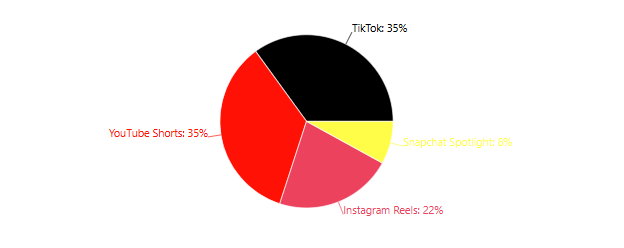
TikTok's competition is more than just competing for users because TikTok is stealing their time. Research indicates that nearly two-thirds of the time spent on Instagram is spent viewing video content and that this change occurred after TikTok successfully demonstrated that audiences wanted short-form video content. When user attention shifts, so does ad budget allocation. Brands that historically spent their advertising budgets across platforms like Facebook, Instagram, and Snapchat now allocate a large percentage of their budget to TikTok.
A massive disruption to the industry resulted from this. Reels were created by Instagram in response and the youtube shorts product was developed very quickly. Snapchat launched their spotlight platform and set up a $1b creator incentive program. The platforms knew that to not innovate meant they would go the way of the dinosaur. The pressure to innovate was not speculation; it had a real impact on quarterly earnings and user engagement metrics.
We still see the continuing Ripple effects of this phenomenon today. Every time tiktok develops a new feature or shopping capability, competitors frantically race to develop an analogous feature. The result of this continual innovation has produced a tremendous amount of volatility in the stock price of small players who don't have the resources to develop their innovation.
Meta: The Unexpected Winner of TikTok Competition
Meta's business move to counter TikTok may be one of the most significant shifts in tech competition in the past few years since the rise of TikTok with the launch of their own Reels feature. With Facebook, Instagram, and WhatsApp being Meta's three main social media platforms, Meta's move into short-form video content was a critical point where their competitors posed an extreme challenge.
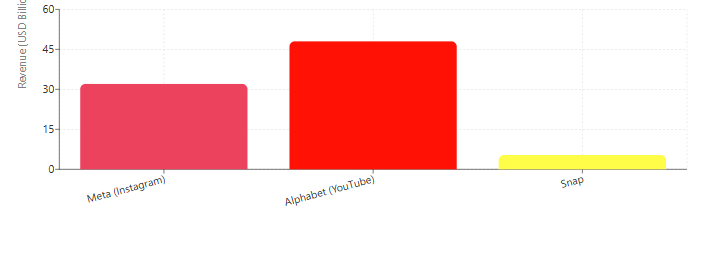
It has worked well for Meta so far, evidenced by the fact that Q4 2024 was an all-time high for the amount of ad impressions on Instagram accounted for by Reels (19%). Instagram is projected to have more ad revenue in the U.S. in 2025 than any year previous ($32.03 billion), and for the first time in its history, Instagram will account for over half of Meta's U.S. ad revenue.
The interesting twist in the story of Meta's strong position is that TikTok's growth has actually benefited Meta significantly, as Instagram has provided advertisers a much more established user base with a robust ad ecosystem. With advertisers concerned about putting their budgets into TikTok due to potential regulatory concerns, they shifted their spending back to Meta as a safer bet due to the size and age of Instagram users compared to TikTok users, who are mostly Gen Z.
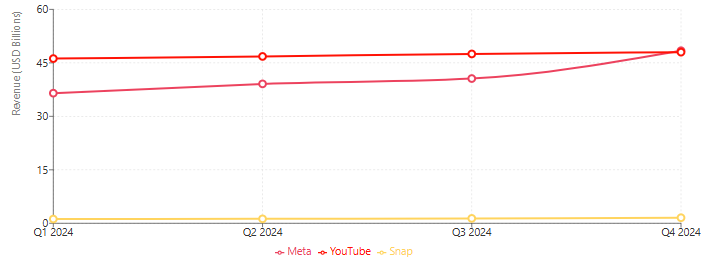
Meta generated quarterly revenues of $48.4 billion, achieving a year-over-year revenue increase of 21% in the fourth quarter of 2024. CEO Mark Zuckerberg has stated he thinks that the Reels feature on both Instagram and Facebook will continue to experience increased growth regardless of the fate of TikTok, and the stock market concurs. Meta's stock price has performed exceptionally well due to the combination of Wall Street's high expectations for Reels and the efficiencies created by its application of artificial intelligence to advertising.
One of the most compelling aspects of Meta's corporate strategy is the growing level of sophistication of its artificial intelligence systems. These systems enable the company to identify and reach customers as potential advertisers with tremendous precision, resulting in markedly improved return on advertising investment (ROAI) for those companies using Meta's advertising platform. Together, these two factors have enabled Meta to create an unprecedented level of competitive advantage that competitors are having a difficult time recreating.
Though the future is still uncertain for Meta, there are also likely going to be risks associated with Meta's success. Specifically, advertising budgets tend to be one of the first places that companies cut back on their spending during a downturn in the economy. In addition, there will be many regulatory issues that may affect Meta's ability to do business (even though they are not necessarily China-related as was the case with TikTok)
Nevertheless, as of now, it appears that Meta may be the largest surprising beneficiary of the competition generated by TikTok, which should be a valuable piece of information for anyone doing research on technology stocks.
Snap: The Most Damaged Competitor with Explosive Rebound Potential
Meta represents a success journey; Snap serves as an example of a cautionary tale with redemption potential. Snap and TikTok both primarily appeal to teens as their core audiences, creating a direct audience conflict between them. Due to this direct audience conflict, Snap has become the most exposed competitor for TikTok.
However, the revenue numbers are telling a very different story. Snap's total revenue for 2024 is $5.361 billion, resulting in a growth rate of 16% over its revenues in 2023. Although this growth indicates a viable growth trajectory, the growth rate is significantly lower than those of competing short-form video platforms. Additionally, it is alarming that Snap recorded a net loss of $698 million in 2024; this number is an improvement over Snap's net loss of $1.322 billion in 2023.
Snap used the $1 billion it invested in incentives for content creators to develop Spotlight; their answer to TikTok's and Instagram Reels' short-form video platforms. Both companies are competing for the same user base despite having each other's competitors in-house. Given that advertising budgets are limited, advertisers target only one media platform, and that has caused many giant advertisers to divert ad dollars away from Snap because of its comparatively smaller user audience and smaller ad spend compared to TikTok and Meta.
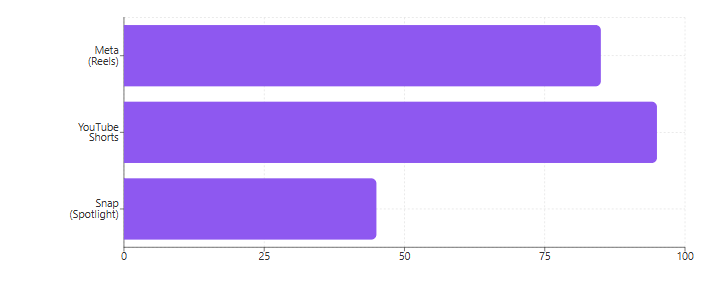
Snap's user growth is continuing its deceleration compared to TikTok, Instagram Reels, and YouTube Shorts. Snap had 453 million DAUs as of Q4 2024, which represents an increase of 39 million DAUs, or 9%, over its DAUs from Q4 2023. Although this increase is respectable, it significantly trails the year-over-year growth of Reels and Shorts.
The ad revenue, which is the lifeblood of Snap, has continued to experience intense pressure due to concerns by advertisers over whether Snapchat's reach justifies their ad spending.
The opportunity for high-risk investors is even more compelling, as we find that Snap has developed state-of-the-art augmented reality (AR) lens technology that has been utilized by many brands, such as Gucci & Nike, through AR try-on features on Snapchat, thus providing them with an immersive shopping experience that their competition cannot compete with; therefore, partnerships with ecommerce companies at earlier stages.
Snapchat+ subscription revenue increased 131% year over year in 2024 and the company ended the year with an annualized revenue run rate of greater than $500 million. The fact that the company has been able to diversify its revenue sources so far from pure advertising reliance indicates that the company's management has to be strategic in their thinking. In addition to this amplified subscriber revenue, Snap has been able to produce some success with new ad formats, specifically, Sponsored Snaps & Promoted Places.
Currently, Snap's stock price has not yet recovered to the heights observed previously, and as such, the company is positioned as one of the most beaten down respective competitors in this latest short video war phase but has the technology and user base to be in explosive comeback mode.
If you are willing to take on the more considerable risk that comes with investing in Snap at current prices; it would be an intriguing opportunity because it will probably be considered to be a classic value play, as it is not entirely out of the contest, just beaten down from the events that have transpired.
YouTube: Shorts as Google's Next Growth Engine
In terms of entering the short-video segment, YouTube has several built-in advantages. Specifically, as the largest video platform worldwide with billions of users, it didn’t have to create an audience out of nothing. By launching Shorts, YouTube offered its current creators an additional format and provided current users with an alternative method to consume content.
As of mid-2025, YouTube Shorts has a daily average of 200 billion views, which is a growth rate of approximately 186% from the previous year. Such a surge in growth provides the opportunity for YouTube to decrease the amount of time that users spend on TikTok. Users previously going to TikTok for short-form content can now find the same type of content without leaving the YouTube platform.
In addition to protecting advertising dollars for Alphabet (the parent company of YouTube) by allowing brands to continue to spend their ad budgets on YouTube rather than diverting them to TikTok, YouTube also benefits from its well-developed creator system, allowing for established influencers to incorporate Shorts along with their traditional video content. Finally, due to the ecosystem and the synergy created between YouTube, YouTube Music, Google Search, and traditional videos, YouTube has created an ecosystem that will keep users engaged across those services.
Alphabet has an equally compelling monetization story, as they have drastically improved short-form ad efficiency with the creation of Shorts, which has helped to turn an initial defence against TikTok into a revenue-generating feature. Advertisers on YouTube now have a unique opportunity to create campaigns that reach both short-form and long-form videos to a massive audience on one platform, similar to using both TikTok and Netflix capabilities.
Alphabet's diversification from a stock perspective is helping investors. Alphabet does not rely solely on advertising revenue like Snap and is not nearly as reliant on advertising as Meta. A substantial portion of Alphabet's revenue comes from Search, Cloud, Hardware, and other revenue-generating lines of business. The impact of TikTok on Alphabet costs is less than for other companies; therefore, Alphabet provides long-term investors looking for exposure to short-video growth and low-risk growth options.
There are still risks. The pending regulatory proceedings regarding antitrust and data privacy in the United States and the European Union remain a significant threat to Google. More concerning for some analysts are the developing AI-powered search alternatives that may someday diminish the dominance of Google Search and result in decreased ad revenue for the overall Alphabet company. However, the success of Shorts adds strength to Alphabet's position within the video space, which continues to dominate global internet usage.
Among its three main competitors, YouTube has the greatest potential for generating risk-free returns. By launching Shorts, they are enhancing their long-term value proposition while not taking the risk of investing all of their resources in one are. For those investors who've sought positive returns, Alphabet provides a well-balanced chance of achieving consistent returns with upside potential.
Comparing Meta, Snap & YouTube Stocks: Who Benefits Most?
Let's compare the four key metrics between these platforms: User Growth, Revenue and Advertising Performance, Market Share, and Stock Characteristics.
In terms of the User Growth of IG and FB, there are billions of users; however, the Reels feature is generating substantial growth in engagement rates. The rapid growth of YouTube Shorts has reached more than 200 billion views per day. The Snap app is experiencing year-on-year growth of 9% with daily users reaching 453 million, however, in comparison to its competitors, the app is struggling with the scale and speed of its growth.
In the comparison of Revenue and Advertising Performance, Meta is the clear leader with Instagram generating an estimated $32 billion in revenue from US advertisers in 2025, making up greater than half of Meta's revenue from US advertisers. While Alphabet does not break down the revenue generated from its YouTube Shorts, it does generate over $48 billion in revenue from advertisements in Q4 2020 and Shorts contribute to that total. Snap generated an estimated $5.36 billion in revenue in 2020, with 16% growth compared to the previous year.
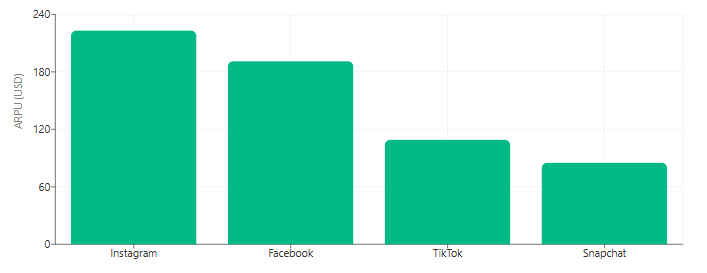
The following is a further comparison of revenue and advertising performance across all four of the platforms:
Market Share, Instagram leads with the highest average revenue per user at $223, compared to $191 for Facebook and $109 for TikTok. This average revenue per user illustrates the pricing power and advertiser appeal of Instagram's platform. Although YouTube's Shorts are scaled considerably larger than the rest of its competitors, its revenue per user is comparatively lower than other formats. Snapchat has managed to achieve considerable scale with its platform; however, it has been less successful in achieving sufficient monetization per user in comparison to the larger platforms.
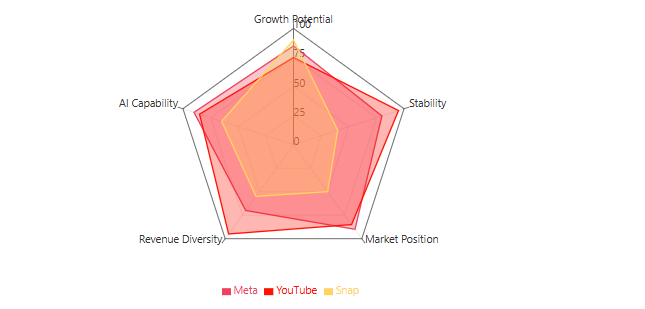
Shareholder Profile and Share Price Volatility: 2023-2024 Meta's stock performance, particularly the large increase from 2023-2024, is indicative of the market rewarding Meta for the successful implementation of Reels and its ability to leverage artificial intelligence. On the other hand, Alphabet is much more stable as it has multiple revenue sources in addition to video. Snap's share price volatility has been very high during the previous quarters due to quarterly earnings reports and how the market viewed Snap's viability.
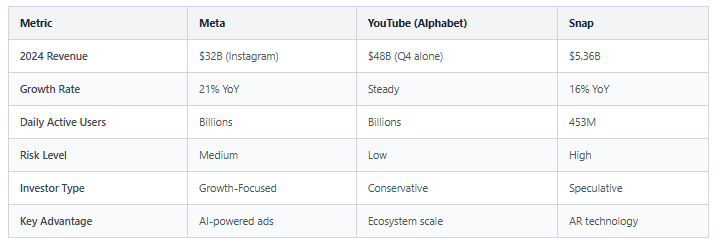
If we were to use simple analogies to illustrate these stock performances, then Meta is the top student who is consistently doing well in their other subjects while learning a new skill (short video). Alphabet is a well-off student with good family support, who is able to learn a new skill (video) with little effort, while Snap is the student under the most pressure due to the nature of their current situation, who has talent in other areas (augmented reality) that may eventually lead to gains.
The professional investor community tends to see things as follows:
-
Meta - short and/or midterm value, the Reels narrative is actively unfolding, and we have observable evidence that Meta has completed "an interim goal."
-
Snap - very volatile, risky - Will return high rewards for portfolios with a tolerance for volatility and a belief in its comeback story (market timing only).
-
YouTube - safest long-term investment: Alphabet has diversified; additionally, the success of Shorts within the ecosystem creates stable and reliable growth.
In summary, investors should take note of the following:
-
Meta is currently the largest benefactor of the short-form video revolution.
-
YouTube is the best positioned for sustained/resilience growth in the long-term.
-
Snap has the most potential for rebound growth. It has taken a beating over the past few years, but it has a very strong AR technology and an extremely devoted user base.
Comparatively speaking, it is evident where to focus on growth right now - Meta is the best current choice, Alphabet is the safest long-term investment with consistent returns, while Snap is the best choice for speculation in search of the "lottery ticket" comeback story.
Investment Strategy: How Should Investors Position Themselves?
Now, how can we leverage this research to help form trading decisions? Different investor types will evaluate these stocks differently and CFD traders will be looking at additional important factors.
Conservative Investors: Alphabet If capital preservation with modest growth are your two priorities, then Alphabet is the way to go. Because Alphabet has so many different sources of income, if Shorts doesn’t perform well, Search, Cloud, and other divisions will still generate income. You can think of Alphabet as having a solid defense that rarely takes such a big hit.
For Growth-Focused Investors: Meta If you're looking for large capital gains in the next couple of years, Meta is the best return for your risks. Reels is now showing consistent growth, Instagram's still the leader in users, and AI-enhanced advertising is helping to improve profits. Meta provides balanced offence and defence; it’s positioned for rapid growth without the risk of smaller competitors.
For High-Risk Investors: Snap For investors willing to take on a lot of volatility in exchange for the potential for large returns, Snap should be on your radar. The price of the stock is at a low compared to the rest of the market; this means that any positive news (successful monetisation of AR, an increase in the number of users, or even a ban of TikTok) will likely create a significant increase in stock price. However, be warned that Snap has a highly aggressive offense, which leads to big potential losses should things not improve.
Placing a contract for difference is just one of the opportunities that can be created by earnings announcements (such as for Meta & Snap). The price of Meta's stock reached over $700 per share when it exceeded the Q4 '24 revenue expectations, and through that event, traders had an opportunity to capitalize on large post-earnings volatility.
Regulatory News, like all other market moving events, becomes another opportunity for traders. The potential for restrictions on TikTok has begun to impact all three of these stocks (Meta, Snap, TikTok) immediately. Generally, Meta receives the largest benefit of all three
Moving averages and RSI (Relative Strength Index) can be helpful in your technical analysis tools to identify trends and determine overbought or oversold conditions, respectively.
As with all stocks, it is important to continue being reminded of the risks associated with tech stocks. In the case of tech stocks, this is more pronounced due to regulatory changes that affect user engagement, algorithm updates that affect advertising spending, and other global macroeconomic conditions that affect the overall economy.
Investors should never invest more than they are willing to lose and should always use stop-losses when trading in a volatile environment (for example, a CFD or stock).\
The key is to align your risk tolerance with the type of opportunity you have. Conservative investors should invest in stocks of Alphabet, while growth investors should overweight Meta, and speculative investors should consider chasing Snap's turnaround story. Finally, active traders can trade on the volatility of the three, using technical indicators and news catalysts to time their trades.
Final Verdict: Which Social Media Stock Gains Most in a Post-TikTok World?
Let's summarize everything. First, we can note that Meta has the most immediate wins, successfully transitioning to shorter-form video while maintaining their core competencies. Instagram Reels did not only counter TikTok, but it has also provided a new opportunity for growth.
YouTube will be the most stable long-term winner, able to leverage existing scale and diversification (in revenue) to capture short-video market share without risking everything on it. Although Snap is the most uncertain long-term investment, Snap also offers the greatest potential reward (exponential upside) if management can successfully monetize augmented reality technology and stabilize user growth.
On a larger scale, even if TikTok never goes public, it will have irrevocably changed the competitive environment of stock markets at the macro level due to its short-form video revolution. All tech titans are now under pressure to innovate faster, invest in AI, and rethink their content strategies. The innovation of short-form video has created both winners and losers, opportunities and risks.
Finally, while TikTok has changed the market, the winners have actually been their competitors. The strongest adaptation to the challenge posed by TikTok was Meta, which turned TikTok from a threat into an opportunity. YouTube's massive scale and ecosystem advantages also indicate how important each factor can be for success in short-form video. Despite being the most harmed, Snap learned the importance of differentiation and technology like AR (Augmented Reality) for making an impact in their industry.
It's quite evident for investors that the short-video economy is here to stay. Users have changed their habits permanently and now seek partly through algorithms consumption of short, bite-sized pieces of content. Therefore it seems that those companies who have figured out how to master this format will really flourish while those companies who do not, will ultimately disappear and become irrelevant in the near term. Meta platform, YouTube, and Snap have all provided various options for investors to participate in this growing trend as it relates to varying risk appetite and investment timeline.
If you're interested in trading stocks based on industry trends, you can find real-time information and trade using the Tradewill, where you can turn insights gained from studying market patterns into profit-generating trades. You can also keep track of upcoming technology stocks by conducting additional stock analysis.
Disclaimer: The content of the blog does not represent any position of Trade W, does not serve as any trading-related decision advice, and does not endorse any third-party.