

 Trade W

Understanding Options: Your Gateway to Smarter Trading
To protect against losses that result from a market downturn, consider using options. As a safety precaution, if they were going to insure their vehicles, traders should protect themselves with options; in the same way that an individual cannot drive without auto insurance, traders cannot invest without utilising options.
Here is a brief overview of what options are: Options are an "option" or "right" to buy or sell stock at a predetermined strike price before a specified expiration date. There are two different options for trading: call options (to buy) and put options (to sell). The buyer of an option pays a premium when purchasing the option, and this is the maximum amount that they can lose.
A person trading stocks typically has both their money and the stock itself. In contrast, using options allows individuals to leverage their money to control a greater number of shares using the same amount of capital. For example, if an individual has $1,000 and is buying shares of a $100 stock, they will purchase 10 shares of that stock. However, if that same person has $1,000 and is trading options, they can control 100 shares of that company.
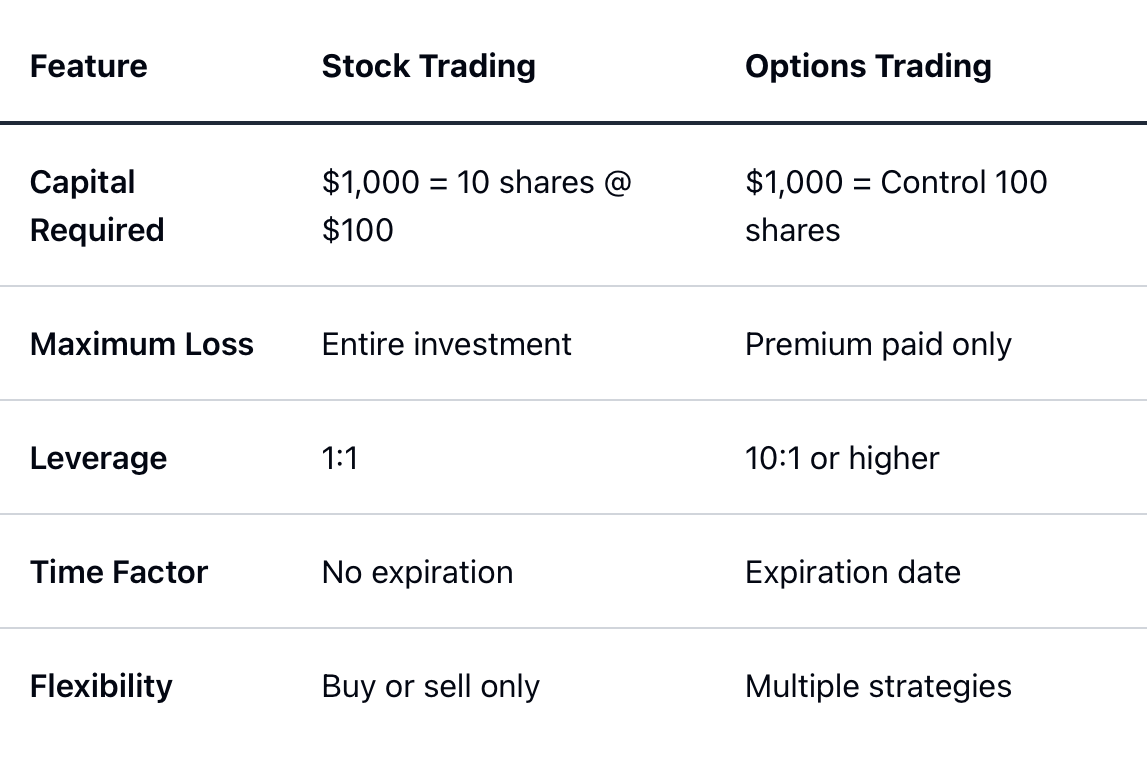
Options also provide traders with timing advantages over stock purchases because they expire. Therefore, traders have to be aware of when an option's expiration date is so that they can time their trades accordingly.
Professional traders typically use options to either hedge current positions or protect themselves from declines in value. or speculate (make a bet that the price of a security will go up or down with less money invested than they would when purchasing stock). Hedge funds often purchase put options in order to protect their multi-million dollar portfolios, and many retail traders will buy call options to profit from the price increase of a stock without requiring as much capital to invest.
Three important terms to know when beginning to trade options:
-
Strike Price: This is the price at which an individual has the ability to purchase/sell stock.
-
Expiration Date: The date that the option contract expires.
-
Premium: The amount of money you pay for the option.
Let's take an example: Suppose that Apple is currently trading at $180. You decide to purchase a call option on Apple with a strike price of $185, which expires in 30 days, for a premium of $3/share (total cost of $300 for 1 contract, covering 100 shares). If at the time of expiration, the price of Apple has gone up to $195, your option will then be worth at least $10/share. Thus, the $300 you spent could now be worth $1,000.
Core Strategies Every Trader Needs
Many of the most successful options traders rely on a small, select group of strategies that have proven to work over time. You do not need to learn all 50 different strategies available; instead, learn the basics and focus on mastering those.
If you already own stocks, selling Covered Calls may be the best place to begin as a new trader. You sell the right to someone else to purchase your shares at a price higher than what you currently own them for, while you keep the premium collected when you made the sale, regardless of what happens afterwards. If the stock remains flat or drops slightly on the day of the sale, then you will receive additional income. If the stock moves up significantly, you will have sold the stock at your price, therefore making a profit.
For example, you currently own 100 shares of Microsoft at $380 each. You sell the right to another trader with a $400 strike price from your shares, and you receive a premium of $5 per share or $500 total. If the stock price stays below $400, you keep both your shares and the $500 premium. If it goes over $400 and reaches $410, you sell your shares at $400, earning $2,000 on the stock and $500 in options.
The Protective Put is a good analogy for Homeowners' Insurance. With a Protective Put, you will have to purchase a Put Option for the stock you currently own to protect yourself against a short-term drop in price. You pay a premium, but you will cap your possible loss on the trade.
Vertical Spreads also allow you to maximise the profit and minimise the loss before entering a trade. The Bull Call Spread involves buying one Call Option with a specific strike price, while selling a second Call Option with a higher strike price. This reduces the total amount spent on the trade, but it also reduces your maximum potential profit. The Bear Put Spread is the opposite of the Bull Call Spread, it allows you to profit from a drop in the underlying stock.
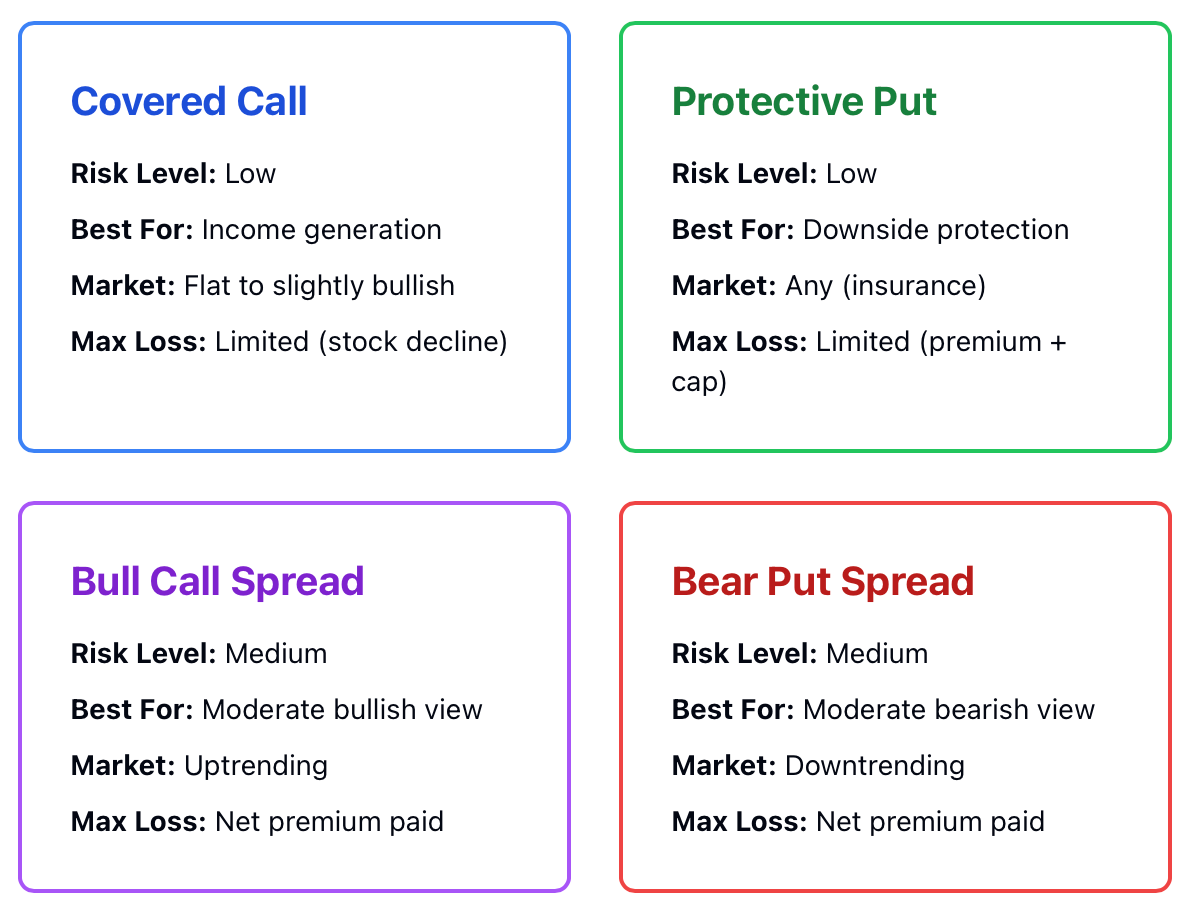
These four option strategies share a common benefit- that being, limited risk. You already know what your potential maximum loss or gain will be before clicking the buy button, which is extremely important considering how fast and dramatically prices can change when the markets are volatile, and buyers and sellers are making their trades based upon emotion.
Ten Strategy Combinations for Today's Markets
Markets are not always predictable. There are periods of trend when the market moves in one direction. and periods of sideways price movement. A much more volatile market will have wild price fluctuations and moving average trendlines that provide the price level of the instrument(s) of trade during that period.
Iron condors are primarily considered bearish and work well in a stagnant sideways market, as you will be able to profit from a rapid increase or decrease in the price of the stock. Condition traders have been known to maintain a portfolio of an iron condor during low volatility.
Strangles and straddles are primarily bullish trades in nature and work well in a volatile environment. Strangles require you to buy a long call and put as well as short (out-of-the-money) options on the same stock (strangles). A significant price move in either direction will usually allow you to profit from one of the trajectories in the strangle.
In calendar spreads, you sell near-term options and purchase further out-of-the-money options (same strike) that will also benefit from time decay (if the stock price is consistent). If you can hold some of your long positions while maintaining a stable short position, you can profit when the price of the stock declines.
Butterfly spreads work primarily to produce a small profit in stable range-bound markets. The system allows you to construct butterflies around a price, which creates a range of profit opportunities from a single option (vertical spread).
Diagonal spreads are a hybrid of calendar spreads and vertical spreads with different strike prices. Diagonal spreads allow for more versatility and opportunities to adapt to market movement.
Ratio spreads involve buying one option while simultaneously selling multiple options at varying strike prices. Ratio spreads can produce substantial profits but also have unlimited downside risk, so be cautious in your use of these products.
Jade Lizards, while they sound exotic, are simply the combination of the short put and short call spread you utilize to generate the bulk of your premium. In addition, with the short legs, there is no upside risk with the downside risk of your stock prices.
Double diagonal spreads are the double options in the same emergency market racing to both call and put strikes combined into a larger (3343) price profitability range. They are best in moderately volatile price ranges.
Synthetic positions are a combination of the synthetic stock position created by a long call and a short put at the same strike prices, but with a lower cost to establish your synthetic position.
Collar strategies are a way to protect stocks by establishing puts and calls. While they create built-in protection, there is often little (if any) cost associated with the collar.
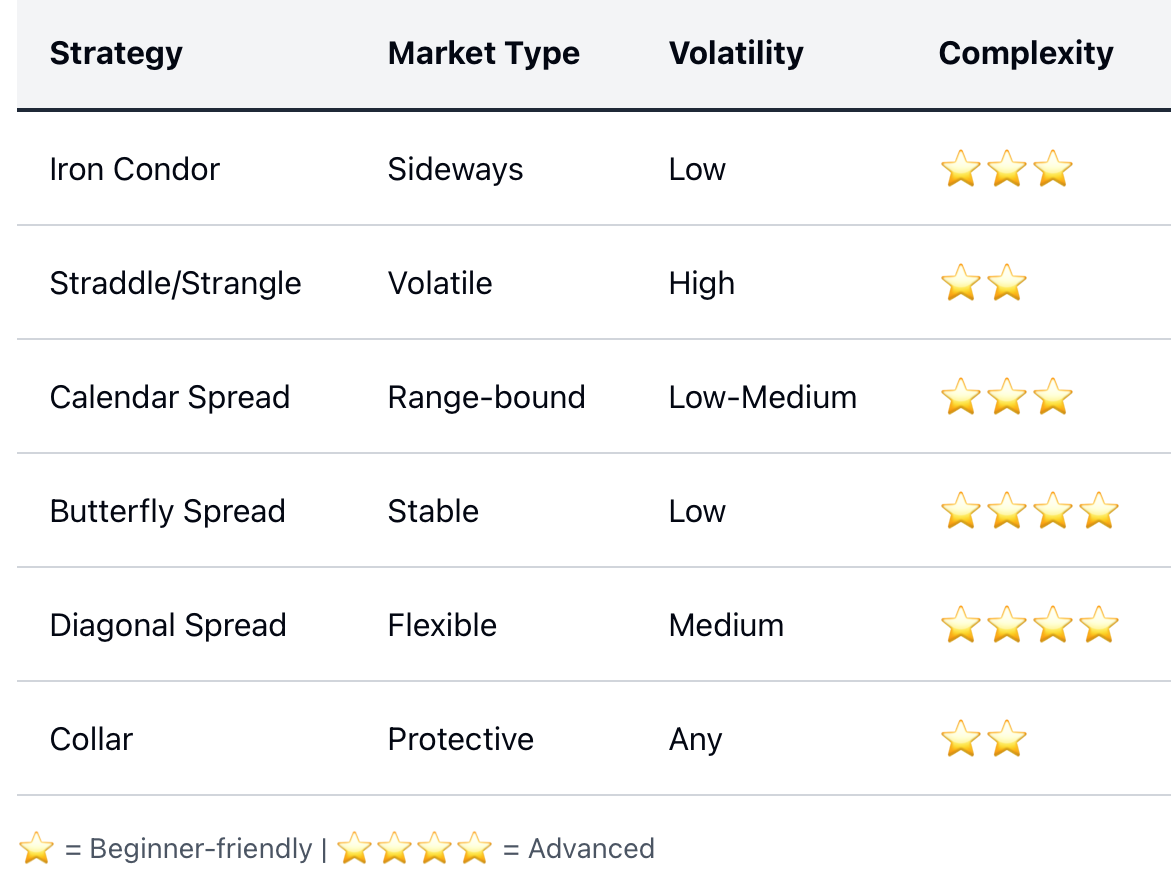
The primary reason to keep in mind all of these strategies is so you can determine which are going to be the best fit for your trade style, whether they produce the potential for profit as well as loss, and which markets are best suited for your trading style based on the common nature of where markets are trading (trending versus range-bound).
The Power of Keeping It Simple
Most successful traders utilize very simple trading methods to achieve positive cash flow. These traders do not use multiple-leg strategies, nor do they employ complicated mathematical equations that require several years to learn.
The reason behind these simple strategies is that they have fewer variables or factors that could lead to a mistake in placing your trade; as a result, a trader has more time to find new trade opportunities versus managing their trades. An additional benefit of using a simpler trading strategy is that their commission fees are lower due to the reduction in trading volume, and more importantly, a trader does not have to worry about every aspect of the trade as part of their decision-making process.
For example, I once met a trader who made $50,000 last year only by utilising a long call option on an established uptrend and cash-secured puts on the stock she wanted to acquire. She had no idea what a combination was or how to use it; she simply maintained a level of discipline when executing the components of a long call and cash-secured put strategy.
On the flip side, those traders who try to leverage the marginal return of 2% from adding seven legs to an option structure will most likely have trouble executing their trades properly. The complexity of utilising multiple legs and components tends to lead to missed exits and higher commission costs due to the increase in buying and selling activity. Additionally, mistakes associated with placing orders due to having too many active parts of a trade will lead to additional commission fees.
Think about it in terms of cooking: preparing a steak perfectly, seasoned with salt and pepper, will yield a superior meal when compared to a poorly executed beef Wellington. The best way to become successful at trading is to establish a strong knowledge base on the basics prior to advancing to a more complex level.
Here are five trading strategies that are simple yet effective:
-
Long calls on confirmed uptrends
-
Long puts on confirmed downtrends
-
Bull call spreads provide a way to lower expenses in bullish scenarios
-
Bear put spreads offer a way to capitalise on the fallout of bearish markets while controlling risk
-
Covered calls on the stock you currently own
By learning how to recognise and correctly implement these five types of trades, a trader can potentially outperform most other traders, including those who pursue exotic strategies.
Reading the Market: Volatility and Timing
Options are influenced by factors aside from just the price of the underlying stock. Specifically, volatility tends to have a larger impact on option pricing than the underlying stock price's movements.
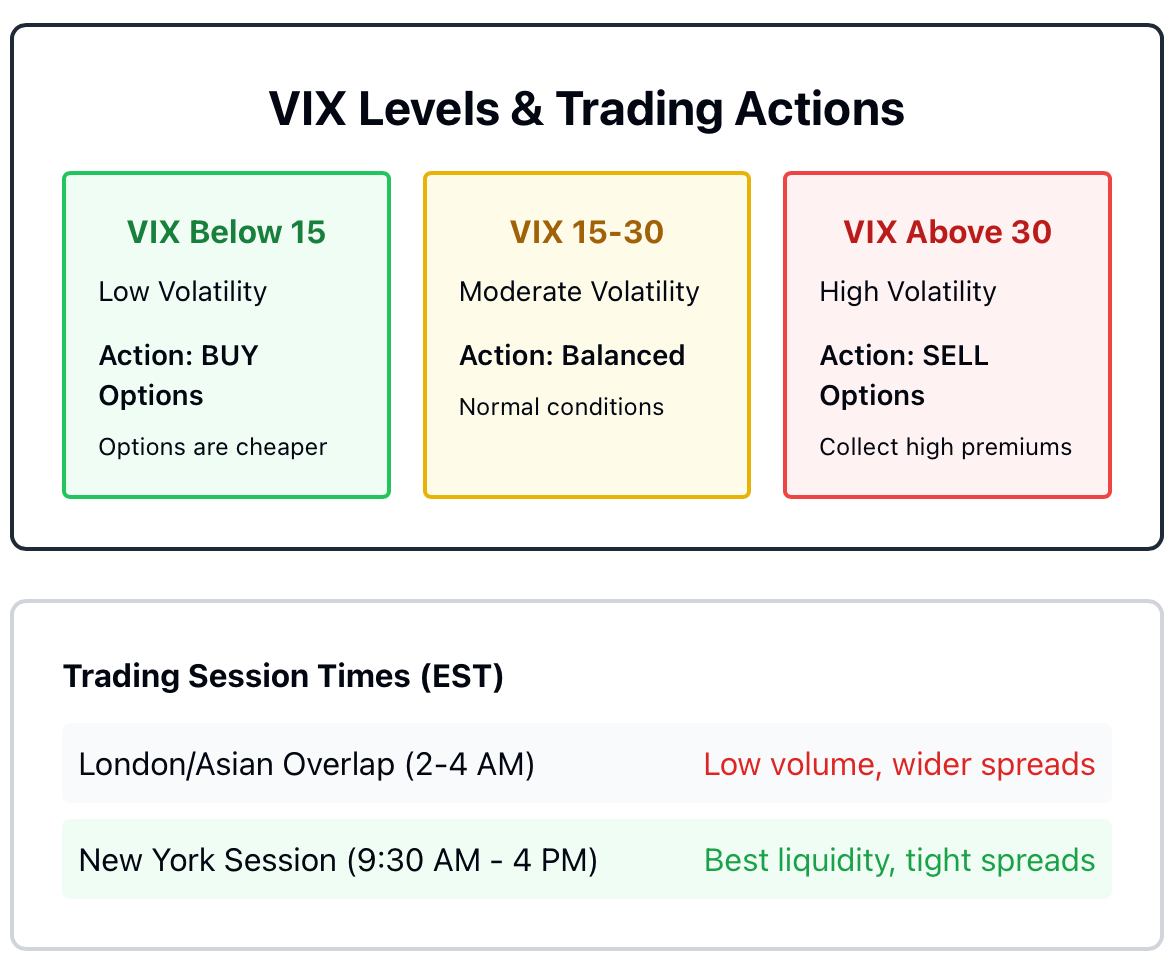
Volatility Index (VIX): When VIX is low (below 15), options generally cost less. When VIX spikes above 30, the options' prices increase dramatically. Therefore, purchasing options while there is high volatility means you will pay a higher price. Selling options (cash inflow) will tend to provide a better profit potential in times of high volatility.
Implied Volatility (IV): Implied Volatility (IV) represents what the market anticipates for a stock's expected movement in the future. Thus, high IV represents the marketplace anticipating a stock will have volatility. Therefore, low IV means options are less expensive due to not being expected to experience much price movement.
Traders who are aware of this information typically will buy options at IV levels below their average and sell options at IV levels above their average. During the COVID market crash, IV spiked to record levels. As a result, traders who were selling credit spreads and iron condors collected extremely high premium amounts when volatility returned to normal after the crash.
Trading sessions also matter. The London/Asian Overlap (2-4 AM EST) will generally have lower volumes of trades but greater spreads between the bid/ask pricing, while the New York session (9:30 AM-4 PM EST) will experience the highest level of liquidity and the tightest spreads on the chart. As a trader, always trade options during the periods of the most volume unless there is a valid reason not to.
When there are major events that occur (earnings reports, Federal Reserve announcements, and elections), the implied volatility will inflate. This means that there is potential to profit from selling implied volatility before the event and to profit when the implied volatility "crashes" following the event, even if the underlying stock does not move much. Alternatively, you may decide to purchase options at a low value long before an event takes place, before the implied volatility begins to rise.
To help you understand volatility, think of it as ocean waves. The smaller the waves (low volatility) will provide the safer the swimming experience, but will provide less excitement for surfers; whereas larger waves (high volatility) will provide some risks but will also provide the opportunity to the experienced surfer. Choose the type of volatility that will fit into your trading plan.
How Professionals Actually Trade Options
We can see an example of how a trader will analyse and trade through all stages of a trade.
For example, a professional trader sees that Tesla consolidated after a rally, but for the previous three months had been trending higher before it began some sideways movement, so for now, it is fluctuating between $240-$260. The Implied Volatility (IV) Rank is 40% (Moderate Volatility).
The trader feels comfortable selling an Iron Condor because it's likely that Tesla will remain within this range for the next 30 days, so selling premium will provide some return on this trade.
Here's the trade:
-
Sell $270 call
-
Buy $280 call
-
Sell $230 put
-
Buy $220 put
-
Net credit: $2.00 per share ($200 per contract)
-
Max risk: $8.00 per share ($800 per contract)
Traders risk 2% of their total capital when sizing an account, meaning a trader has a $50,000 account can risk $1,000 per contract (2% of $50,000) and with 1 contract in the position of a trade, the trader has correctly sized the position for that risk.
The risk/reward ratio of the trade is 1 to 4, and at first glance, it looks very poor (risk of $800 to make $200 profit); however, because the trader sees that the implied probability of making money is about 65%, the perception of the trade is much more positive for the trader, so he/she can justify taking the smaller profit while having a much larger chance of being successful.
After 3 weeks, the price of Tesla stock is priced at $248. The iron condor is priced for about $1.20 in credit, and the trader exited the trade early with approximately 60% of the maximum potential profit. Why did the trader exit the trade early? Because a trader has rules for managing risk to take profits from high-probability trades, and allows profits to run on trades that require direction.
The differences between textbook examples and actual trading examples include:
-
Professional traders adjust their trade positions according to changes in market conditions.
-
Professional traders will usually exit prior to expiry for positions that are profitable.
-
Professional traders will consider both the probability of success and the expected value of a position when determining a position's merit.
-
Professional traders will maintain a book on every trade they take for future review of previous trades.
-
Professional traders practice strict discipline with the proper position size so that they do not suffer devastating losses.
The delta-neutral trading technique encompasses an expanded view of trading over traditional methods of trading. As such, by managing the delta of multiple positions, professional traders create time premium income from time decay and volatility while safely remaining hedged against minor price fluctuations. Though this is viewed as advanced and/or complex, it is merely an example of how to develop a trading strategy that includes changes beyond simple directionality in trading over time.
Risk Management: The Only Way to Survive
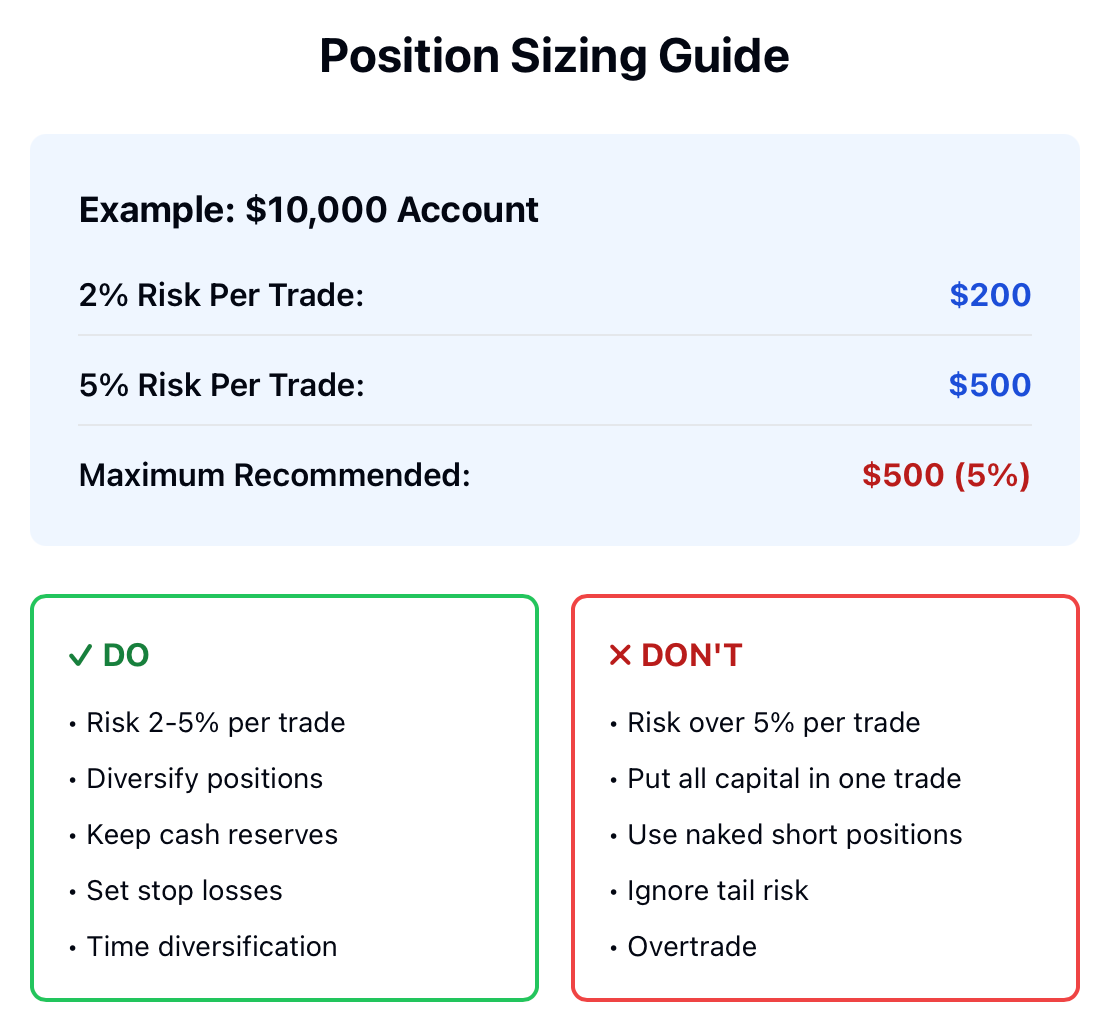
Around 90% of individuals who participate in options trading indeed lose money due to poor risk management rather than the selection of a bad strategy. The first rule of successful risk management when trading options is to follow proper position sizing. Position sizing refers to the total amount of capital that you are willing to risk in any one trade. Position sizing is typically accepted as a good guideline to never risk more than 2% - 5% of your Capital Account on a single trade.
For example, if you have a trading account balance of $10,000, then you should only undertake trades that have a maximum risk amount of between $200 - $500. Additionally, if you are going to purchase options that are trading for $3 per share, then the maximum number of contracts you should be able to purchase is a maximum of 1 or 2. If the maximum amount of risk that you can take is only $200 or $500, then you will need to build up your Trading Capital Account through continued Trading before being able to take more significant Positions.
Before entering a trade, determine your projected probability of profit. Most online trading platforms offer an estimated probability of profit. If the probability of profit is only 30%, you will need to make at least 3x your initial investment to break even over time. This strategy works best for "lottery-style" call option trades, and if you enter into those types of trades with only a 30% probability of profit, they need to win significantly to provide a sufficient return.
Risk-reward ratios must be in accordance with probability; trades that carry a higher likelihood of being profitable (such as iron condors and credit spreads) will generally always have a risk-reward ratio of 1:3 or 1:4, respectively. On the other hand, low-probability option trades (i.e., far out-of-the-money) may result in a 5:1 or 10:1 risk-reward ratio. Neither scenario is better than the other; however, this ultimately depends on how accurate the Traders are, and what trading strategy they use.
All traders are subject to "tail risk," which is when an unlikely event occurs, such as the COVID-related crash in 2020 or the financial crisis in 2008 and results in one trade that destroys months of profits. Every professional trader has an additional layer of protection from "tail risk" as demonstrated by the following steps they implement each day:
-
Diversifying by owning multiple positions and our many different types of underlying stocks.
-
Never having an account fully invested (always holding cash).
-
Setting up Stop Loss Orders or predetermined Exit Points.
-
Not using Naked Short Positions that are subject to unlimited loss.
If you had a trader who had opened 20 iron condors during February of 2020, the trader might have had a successful month until the market collapsed in March. All of those 20 positions would have been annihilated at the same time. This is why the benefit of Time Diversification can be realised with different Options Expiration Dates and by owning multiple underlying stocks.
Making trades on the basis of solid risk management, supported by proven trading strategies, allows your Trading Edge to be maximised. Therefore, you will not find the "perfect trade."
The Psychology Problem Nobody Talks About
Even the best trading strategy can lose a trader money. Why? Because there is a lot of emotional chaos going on in the trader's mind. In fact, there are two primary reasons why overtrading has killed more accounts than poor strategies; the first one being overtrading itself.
When a trader sees something they want to invest in, they enter the trade; then five minutes later, they see something else that may be profitable, so they enter that trade; and by the end of the week, that trader will have opened up 15 positions and have no clue which position is in line with their original trading style.
To combat this, a trader should limit themselves to how many trades they can open in a given week and, once they hit that limit, stop trading for the week. They should instead go for a walk, read a book, or do anything other than place additional trades.
Secondly, confirmation bias distorts a trader's view of the current market. If a trader is bullish on tech stocks, then, regardless of the current news headline, that trader will interpret that news headline as a positive development for the tech sector. Eventually, the trader begins ignoring warning signs about the market until the losses begin to accumulate.
How do they combat this? In order to avoid this situation, a trader should actively seek out and read information that contradicts their thesis. If a trader is long on something, they should read bearish analysts; conversely, if a trader is short, they should read bullish reports on the same security. A trader needs to make the best case possible against their position even before they enter it.
The third type of emotional trading is known as "revenge." This occurs after a trader takes a loss; they get emotionally charged and decide to go and get that money back as quickly as possible, so they enter bigger positions with less analysis. Most of the time this creates even larger losses.
To combat this, after a loss, traders should take a break of at least 24 hours before making their next trade. This gives the trader time to cool down and analyse what they did wrong before deciding whether they want to trade again.
The final emotional aspect of trading is called "the herd mentality." This is when traders follow the crowd regardless of whether or not what the crowd is doing aligns with a trader's plan. For example, when the crowd is buying calls on GameStop, a trader who follows the herd mentality buys calls, or conversely, when everyone is panic selling over inflation, that same trader is panic buying puts. Generally speaking, the crowd tends to be late to follow trends and early to panic.
To combat this, every trader should create and adhere to a written trading plan; if a trader is going to be tempted to follow the crowd, then the trader should refer to their written trading plan to determine if following the crowd is in alignment with the written plan, and if it isn’t, then that trader should steer clear of making any trades.
Professional traders keep very detailed journals documenting all of their trades, including their emotional state, their reasoning for entering/ exiting trades, and what they learned. This provides accountability and allows traders to see patterns in their trading psychology that might sabotage their trading results.
The way a trader thinks is just as important, if not more so, than the way they have set up a trading strategy.
Matching Strategy to Market Conditions
Different market environments have wildly different outcomes for the same strategy. In sideways markets, Iron Condors make money; however, in trending markets, Iron Condors will 'blow up'. Long Calls do well in a rising stock price trend; however, in a consolidating trend, Long Calls lose their value rapidly (decay).
Most trending markets demonstrate either clear upward (higher highs and higher lows) or downward (lower highs and lower lows) movement.
These markets reward directional strategies:
-
Long calls in uptrends
-
Long puts in downtrends
-
Bull call spreads to reduce cost in bullish environments
-
Bear put spreads for bearish setups
An options trader who purchased call options on NVIDIA during the entire Artificial Intelligence (AI) boom of 2023 experienced enormous profitability due to a clearly defined and persistently trending market.
A ranging market is characterised by recurring price movement between established levels of support and resistance, creating a price channel or a rectangular shape on a price chart. In this case, the market structure will lend itself to strategies for selling premium options.
-
Iron condors
-
Butterflies
-
Short strangles (with caution)
-
Covered calls
A large number of high-value stocks (e.g., Coca-Cola, Procter & Gamble) will typically hover in one price range for many months, allowing the investor to collect a premium time and time again.
The VIX will frequently fluctuate wildly up and down in the short term. The media will make it look as if a crash, or a new high (or moonshot), is imminent and that now is the time to buy, or sell! Volatile markets will be the most profitable for a volatility trader.
-
Long straddles
-
Long strangles
-
Calendar spreads (if you expect volatility to persist)
-
Protective collars for existing stock positions
Massive spikes in implied volatility typically occur around the time of earnings reports for individual stocks. When Amazon reports earnings, traders can profit from either direction (up or down) with a straddle as long as the stock's price movement is greater than the cost of the trade.
The biggest blunders that traders make are choosing an inappropriate strategy for prevailing market conditions. For instance, in a market that is ranging, a trader who buys calls will only fight time decay and won't experience any price appreciation; conversely, a trader who sells iron condors will likely get crushed by the directional moves occurring in a trending market.
Make it a habit to check the VIX (Volatility Index) every day, become familiar with the recent price movements of your selected stocks, determine whether those stocks are trending, range-bound, or experiencing high levels of volatility, and then devise your trading strategies based on that analysis.
Successful traders are flexible; they adjust their trading strategies based on the current market conditions rather than attempting to apply their preferred trading strategy to every market condition.
Hedging and Generating Income with Options
Most assume options are used only as speculation, which is partially true but also not the whole story. Options also provide long-term investors with ways to mitigate portfolio risk and generate consistent cash flow.
A covered call position can turn a relatively boring stock into a source of income for the investor. For example, if you own 500 shares of Apple, you can sell five covered call contracts each month against your shares. If Apple does nothing, you generate an option premium. If Apple moves up a little, you earn both the premium as well as the uptrend in Apple’s price. The downside of the covered call strategy is that if Apple goes up significantly in value, your profit potential is limited to the strike price of the call contracts.
For example, a pensioner with a $500,000 portfolio of dividend-paying stocks has sold covered calls on half of the investment portfolio, generating additional cash flow of $3,000-$5,000/month in premium from selling the calls. Over the course of one year, that would total between $36,000-$60,000, in addition to the dividends she receives. While the pensioner sometimes needs to sell a stock that has significantly appreciated because of the covered call position, she maintains that the ongoing income from the covered call option more than compensates for the few occasions when she sells stock that has appreciated.
Protective puts are a great way to establish “insurance” on the portfolio or stocks you’re concerned about. Whenever the market scrambles around, as it often does, you can purchase protective put options on stocks you are worried about or exchange-traded funds (ETFs) that track major indices. If the market declines significantly, the protective puts you purchase will have appreciated compared to the loss you have experienced in the value of your stock. However, if the market continues to appreciate, you would lose the premium you have paid for the puts, but your stocks will have appreciated much more than you have paid for them.
Portfolio managers typically hedge 10% to 20% of the value of the portfolio in anticipation of market-moving events or when they believe the market is at a saturation point. Hedging allows you to rest easy knowing you have some protection if the market were to experience a sudden downturn.
Because credit spreads allow you to earn a premium while taking a limited amount of risk. By selling an option that is closer in value to the stock and then buying an option that is further away (and therefore has a lesser premium), you retain the difference between the two premiums. Credit spreads work best when the market is moving slightly upward or when the market is trading laterally.
There are two advantages to writing cash-secured puts. First, you have a method to write a put option on the stock you’d like to buy if prices were at a lower price when you wrote the option. Second, if the stock decreases in value, you can buy that stock at the price you set for the put. If the stock price remains stable or goes up, you still retain the premium you received when selling the put.
Cash-secured puts work similarly to a limit order. Instead of placing an order to buy Tesla at $200 and waiting, you would sell a put at $200 and wait to see if you get executed while earning a premium.
The earning potential from selling covered calls exponentially increases. While selling covered calls typically provides a 1%-2% monthly profit, at the end of a one-year time frame, the compounded 12%-24% return (plus the potential gains in the stock and dividends) significantly enhances the overall return of your investment.
In addition to being a tool for speculation, options provide long-term investors with opportunities to earn risk-adjusted returns using multiple strategies.
Building a Repeatable Trading System
Successful options trading doesn't come down to picking "the" "best" trade. Successful options traders implement a methodical approach that produces positive returns (expectancy) over a period of time, regardless of the frequency of trades, or whether the option was traded in a trending or sideways market.
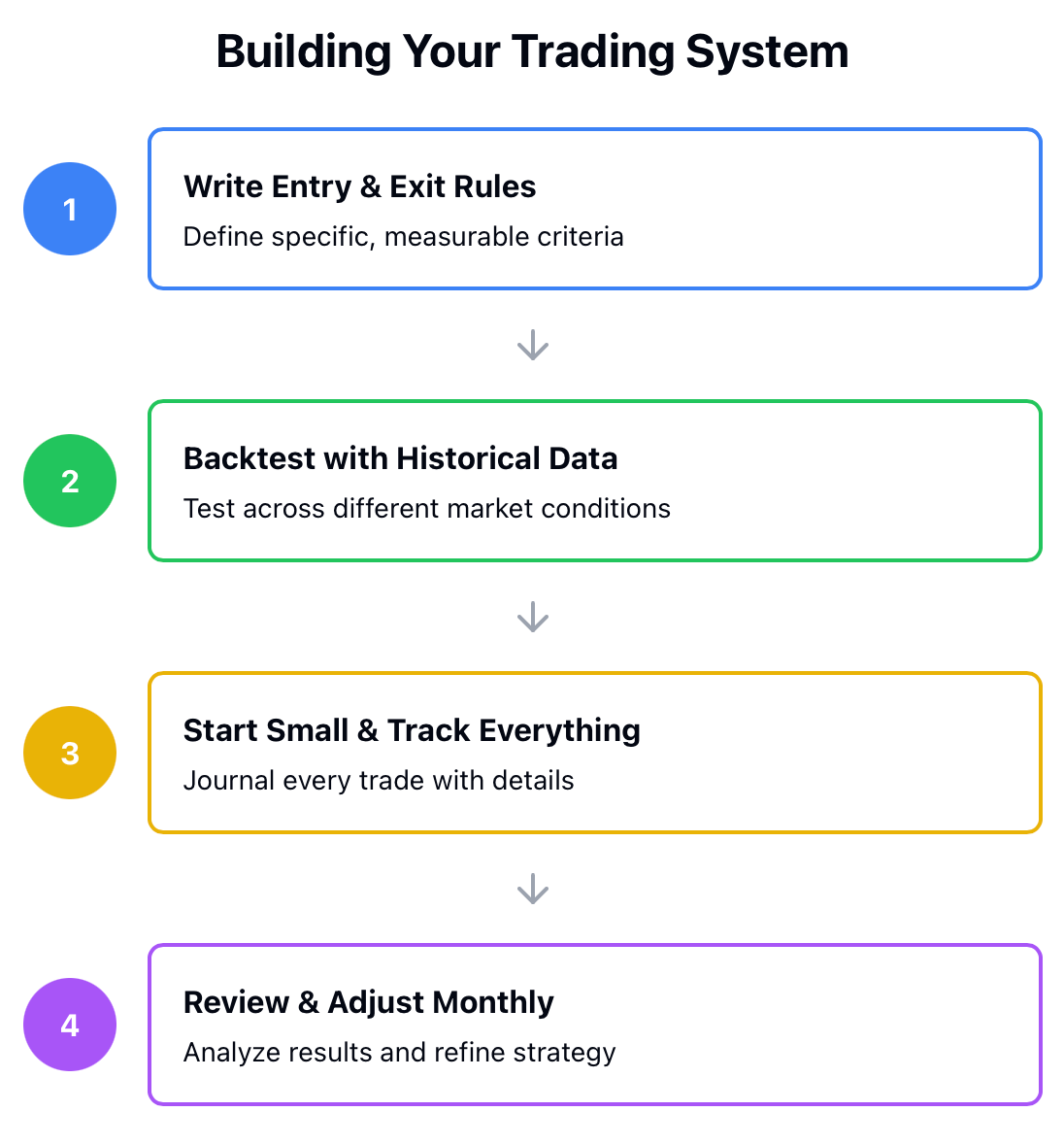
Step 1: Write Out Your Entry & Exit Rules. Determine when you will enter and exit trades. You should not list entry and exit rules in general terms, as they may be too vague, but rather create specific rules for yourself. For instance: “I will purchase bull call spreads on stocks that have broken out above their 20-day high, have an RSI of 50-70, and increasing volume.” The more specific you are, the better.
Step 2: Backtest Your Strategy Using Historical Data. Before risking actual money, you should test your strategy using past data. Paper trading and backtesting is offered by most online trading platforms. Backtest your rules using different market scenarios, as well as during volatile (e.g., crash) periods. Does your strategy remain valid in different types of trading scenarios? (e.g., trending, ranging, and volatile crashes)
Step 3: Begin Trading Small, Track Everything, And Monitor Everything. Start with the smallest positions available to you. For every trade made, record the entry price, exit price, rationale, the conditions of the market, your emotional state, and whether the trade was profitable or not. Track these records on either a trading journal app or a spreadsheet.
Step 4: Review Your Trading Results Each Month And Make Modifications Where Applicable. At the end of each month, analyse what worked, what didn't, and which conditions favoured your trading strategy. Also, note any problems you noticed and write down what mistakes you repeatedly made. Change your trading rules based on facts and not emotions.
The goal is to develop a non-cognitive way of executing your strategy. Professional algorithmic traders go even further in this regard and fully automate their trading strategies. You don't have to go to that extent, but you do need to have a repetitive method.
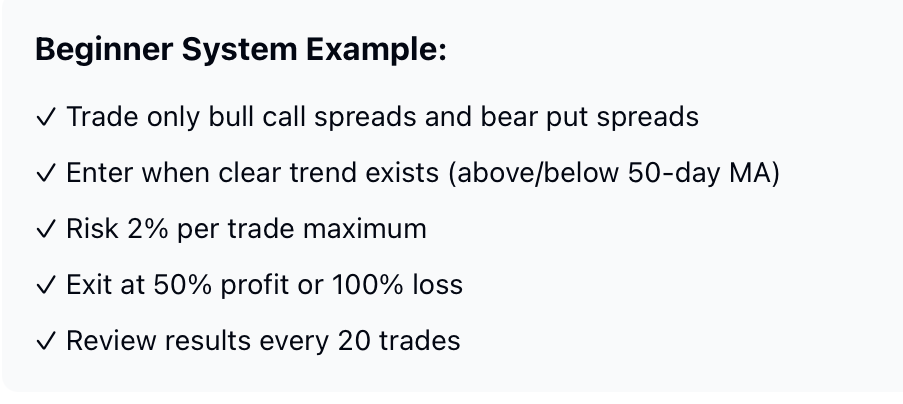
Example system for beginners:
-
Trade only bull call spreads and bear put spreads
-
Enter when a clear trend exists (price above/below 50-day moving average)
-
Risk 2% per trade maximum
-
Exit at 50% profit or 100% loss
-
Review results every 20 trades
This straightforward system eliminates the majority of guesswork and uncertainty from trade execution; you follow a method, not intuition or chance. A great example of this is a trader friend of mine who utilises a slightly modified version of the iron condor strategy.
He places trades on the SPY (S&P 500 ETF) every Monday, following strict delta guidelines and with 45 days until expiration. Any trades that have not been closed after reaching either 50% profit or have 21 days remaining will not be closed until they reach either one of those criteria - there are no exceptions.
This automated methodology has produced 18% average annual returns over the past five years, resulting in low maintenance requirements. Consistency will provide you with the same results.
Ready to put these strategies into action? Tradewill offers the tools and real-time data you need to execute options trades with confidence. Start trading smarter today at tradewill.com.
Disclaimer: The content of the blog does not represent any position of Trade W, does not serve as any trading-related decision advice, and does not endorse any third-party.