

 Trade W
Many were caught off guard when Chime's Initial Public Offering didn’t follow the predicted “fintechs-to-the-moon” trajectory and instead crashed under heavy macro headwinds, compressed valuations, and the realities of being a public company.
So if you missed the initial offering or watched your investment in Chime evaporate since its IPO, there are a lot of people just like you.
But, here’s why that is a good thing - volatility equals opportunity. The price swings you’re seeing in CHYM are not pure randomness; they follow a well-established pattern that can be traced to the following: earnings seasons, ETF rebalances, lock-up expiration and option positioning.
This document is not a “buy and hold forever” pitch; it is intended to be a tactical trading framework for anyone looking to profit from CHYM through its natural instability while continuing to manage downside risk.
1. Chime IPO Valuation Reset: Why Did the Market Reprice CHYM So Aggressively?
Let’s address the most fundamental question – how can a company that has increased its customer base & revenues see its valuation decrease by 50%?
Chime went from going public at a $25B valuation to being valued at approximately $11B within a few months. Yet the actual business itself has not gone to zero; in fact, according to their Annual Report for 2025, Chime had 9.1 million active members as of year-end Seattle, WA on December 31, 202,2 which is up from the previous quarter; in addition, revenues from interchange fees & MyPay Services continue to rise.
What then could have changed? – The marketplace.
The rising interest rates changed how investors evaluate GROWTH companies. When the 10-Year Treasury Yield was at 1.5%, for example, a fintech projected to grow 30% annually would be very attractive to an investor. When the Treasury Yield increases to 4.5%, however, the future cash flows received from that same fintech company are worth less today due solely to how discount rates compress present valuations.
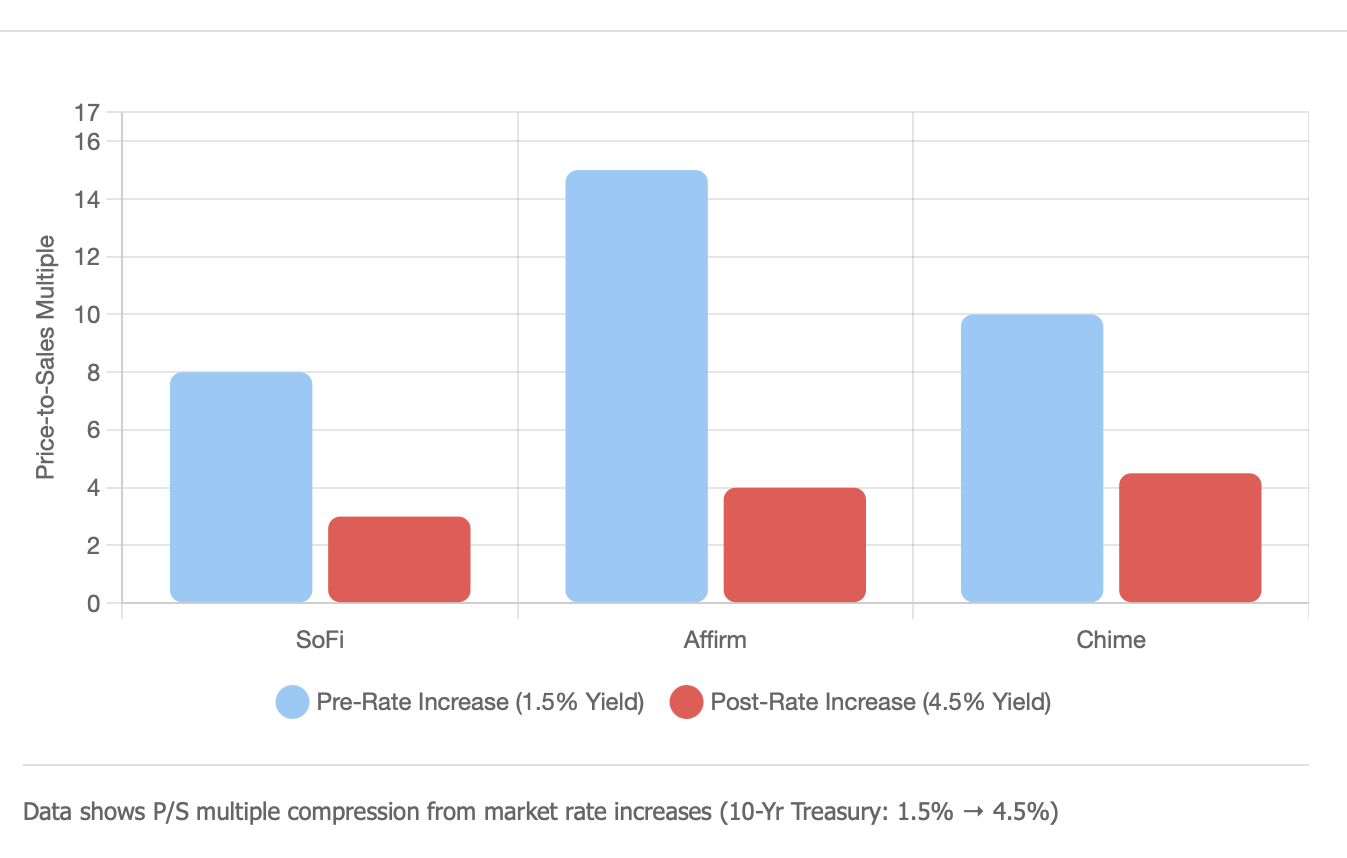
That is not limited to Chime alone; Fintech as a whole re-priced, as evidenced by the following companies:
-
SoFi’s Price-to-Sales multiple fell from 8x down to 3x;
-
Affirm's PTT multiple went from 15x down to 4x.
-
Chime decreased/revalued from approximately 10x revenue down to approximately 4.5x.
-
This pattern of contraction can be seen across all of the high-growth and low-margin digital banks.
Next, if we look at changes in risk appetite during periods where the Federal Reserve has been Fiscally Stimulating, interest rate increases coupled with rising real estate prices have caused a movement away from Speculative Growth Stocks toward Stable Cash Flow Stocks. Obviously, FinTech IPO's are one casualty resulting from this transition away from Speculative Growth Stocks toward Stable Cash Flow Stocks.
Thus, volatility traders should be aware that the decrease in valuation does not signal operational deterioration of the business, but rather that it is still an existing operation, and thus does generate revenue per customer; however, valuation reflects an entirely different set of market expectations now than prior, thus many aspects of operations have simply changed.
For those traders engaged in volatility-based trading strategies, this difference will be extremely important as CHYM’s valuation swings are not attributable to operational deterioration, but instead rre a result of macro execution, thereby CHYM has been subject to excessive over-reaction like many other high growth-low revenue companies in either direction.
2. Chime Earnings as a Leading Indicator: The "Second Derivative" of U.S. Consumer Health
Many investors think of earnings as simply reports detailing how a company has performed historically; however, smarter traders consider them indicators of future performance.
Because Chime serves a lower-income customer base, the behaviour of its users tends to change rapidly with changes in the economy. For example, when inflation creates a strain on household budgets, customers of Chime tend to withdraw from overdraft protection sooner than other consumers.
Similarly, when people feel their job security is declining, they tend to cut back on discretionary spending more quickly than the general population. As a result of these rapid changes in behaviour, Chime's metrics are able to provide leading indicators of what will be reported in GDP and unemployment reports for many months into the future.
Think about it this way - if students suddenly start borrowing money for food more frequently, you can safely assume that something is wrong in their household. The same holds for the actions of Chime's customer base.
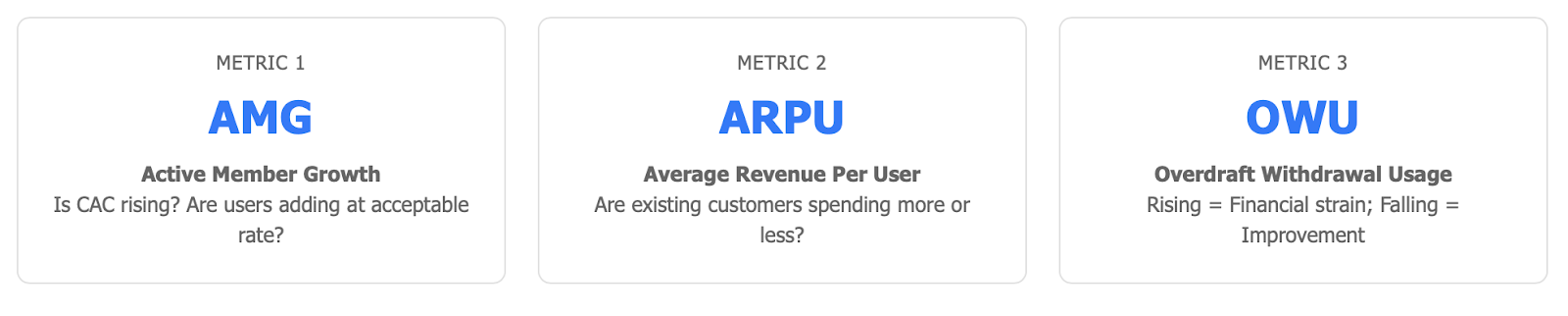
Professional traders should focus on three key performance metrics reported during an earnings call:
1. Active member growth - Is Chime continuing to add users at an acceptable rate, or is its cost of acquiring new customers rising?
2. Average Revenue Per User (ARPU) trend - indicates whether existing customers are spending more or less than they did in the past.
3. Overdraft usage - if the number of times customers withdraw from an overdraft account is on the rise, that could indicate financial strain; if usage drops, it may indicate financial improvement.
When an increase in overdraft withdrawals coincides with a decrease in ARPU, that is a leading indicator of potential credit problems. In fact, that pattern typically will occur six to nine months prior to any data being reported on credit problems in bank earnings and/or related to consumer credit.
Professional-level traders do not wait for the GDP number to be reported; rather, they place their orders based on changes in the operating metrics of their trading partners and adjust accordingly.
3. Chime vs Nubank vs SoFi: Who Wins the Global Digital Banking Battle?
Chime is not a business that works in total isolation. The company has competitors like Nubank in Brazil and SoFi in the United States, but they operate under completely different business models.
Chime is largely dependent on interchange revenue. This is money that comes from merchants upon credit/debit card transactions. The more people who are using the Chime application, the greater the volume of transactions and ultimately the revenue generated for Chime. Because the cost to acquire customers is relatively low in relation to the number of small transactions, this model has proven successful for Chime.
In contrast to Chime, Nubank initially focused on creating credit cards and then grew into a lending platform thereafter. Most of Nubank's revenue comes from the interest charged on loans, which allows Nubank to be more exposed to credit losses, but also exposes Nubank to greater scalability during times of rapid growth, like in Brazil. Nubank's annualised return on equity averages greater than 20%, making it one of the fastest-growing digital banks in the world.
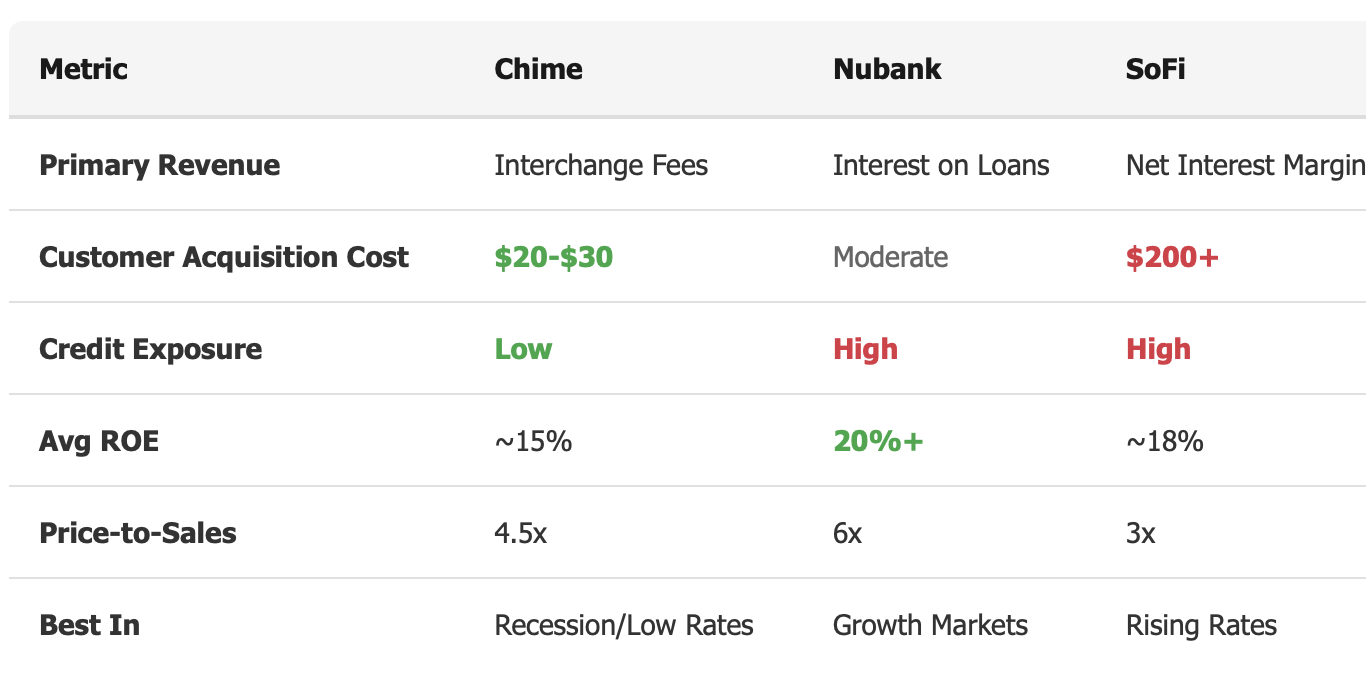
SoFi took a more traditional approach to its business model by acquiring a banking charter that grants SoFi the ability to accept deposits as well as originate loans directly. Thus, SoFi has significantly better margins on lending than it would be able to if it did not have a banking charter. However, because SoFi operates via the borrowing and lending stream, changes in interest rates can significantly squeeze SoFi's net interest margin.
Comparing the companies based on capital efficiency, Chime ranks best based on customer acquisition costs, as its estimated CAC is $20 to $30, while SoFi's average CAC can exceed $200 for various lending products. However, SoFi will receive a greater average lifetime value per customer with its diverse suite of financial services.
When looking at the valuation of these three companies, Chime's price-to-sales ratio is approximately 4.5x, SoFi's price-to-sales is approximately 3x, and Nubank's price-to-sales ratio is approximately 6x because investors believe Nubank has better growth prospects on an international basis than either Chime or SoFi.
Ultimately, the most relevant question is not which of the three companies is a "better" company, but rather which of the three companies' business models will perform best in different macro conditions, i.e. in an recessionary environment, Chime has lower credit exposure than both Nubank and SoFi and thus is considered a safer investment while in an growthier macro environment than SoFi utilises its additional leverage on an ongoing basis to produce the greatest returns.
4. How Chime Benefits in a Rate-Cut Cycle: The MyPay Revenue Advantage
In traditional banking, the money that banks make comes from net interest margin, or the difference between the interest they charge on loans and the interest they pay on deposits. Banks generally borrow money at low short-term rates and lend that money at higher long-term rates.
When the Federal Reserve lowers short-term interest rates, the difference between short-term and long-term rates decreases. Thus, banks would earn less on each loan made and subsequently would see their profitability decline.
Chime's business model, on the other hand, is not based on lending money to customers. Chime generates revenue primarily through interchange fees when customers use their debit cards to make purchases and through MyPay, which is a product that provides customers with access to their paychecks via direct deposit before they are actually paid.
Since MyPay provides a service for customers before receiving their paycheck and does not require a loan from the bank, Chime is not impacted by the Federal Reserve lowering short-term interest rates, and therefore, the revenue that Chime generates through MyPay remains stable.
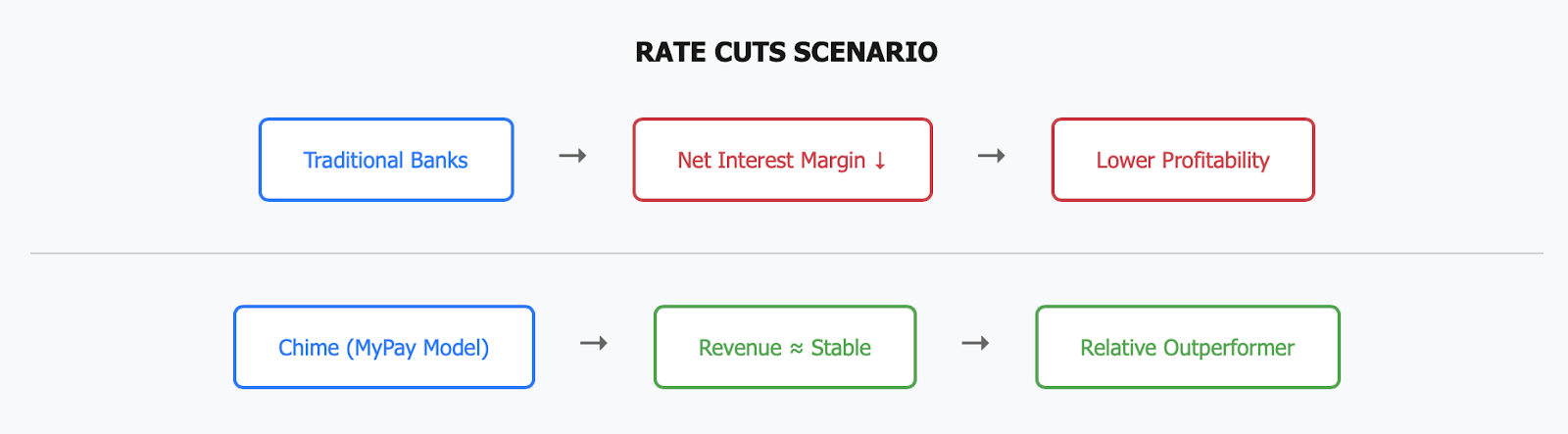
When the Federal Reserve reduces rates, traditional banks see their interest rate spread compress, meaning the difference between what they can pay on deposits and what they can charge on loans diminishes, and banks earn less on every loan. As a result, the stock price of banks is under pressure as well.
Additionally, Chime recently announced that it will repurchase $200 million of its stock, which will increase the earnings per share of all remaining shares since there will be fewer total shares outstanding. In an environment where interest rates are decreasing, Chime's stock will be able to increase each existing stockholder's interest in Chime's stable sources of revenue through the lower total number of shares outstanding.
Therefore, as the Federal Reserve begins to reduce short-term interest rates, the traders will be able to take advantage of the relative difference between CHYM and the banking stocks through this dynamic. When the reduced interest rates begin to be priced into the market, traders can take advantage of potential opportunities as they exist in the underlying fundamentals of related institutions.
5. How to Trade CHYM Earnings Volatility on TradeWill (CFD Strategy Guide)
CHYM becomes “volatile” when earnings season rolls around. Because of this “volatility,” traders will raise their implied volatility before the earnings announcement, and then after the announcement, there will be a massive drop in implied volatility.
Therefore, if a trader understands this phenomenon, he/she can profit from that volatility rather than just from direction. Here is what usually happens:
As earnings approach, uncertainty increases. Traders are uncertain if CHYM will beat or miss estimates, and so they adjust their option pricing accordingly. This causes option prices to increase as well. Implied Volatility can go from almost 40% to 65% as the earnings deadline nears.
Once the earnings numbers are announced, uncertainty has disappeared. The stock will often move very sharply up or down, but will return to an implied volatility of 35% to 40% almost immediately after the announcement. Even though the trader may have guessed wrong on the direction of the move, he still has the potential of realising a profit as a result of the volatility contraction, assuming he has positioned himself properly.
CFD traders can take advantage of this phenomenon in a variety of ways:
Directional Positioning: If you believe you know how the earnings will turn out, then take out a leveraged long or short CFD position. Be sure to set your stop loss based on the average true range (ATR) of the underlying stock to avoid getting taken out by the noise prior to the earnings being released.
Beta Hedging: CHYM has a beta to the Nasdaq of around 1.3. If you are long CHYM into earnings, you can hedge that position with a short Nasdaq Index CFD so that you only have to deal with the risk associated with CHYM.
Breakout Trading: After the earnings announcement, wait for an initial breakout before entering into a CFD position. If CHYM gapped up 8% due to the strong earnings, your initial entry should be with a target of 12%-15%.
Don't forget to consider the ATR when placing your stop. For example, if CHYM has a 14-day average true range of $1.50, you would want to place your stop 1.5 times the ATR. This will provide the trade with enough room to operate while still being within the limits of risk.
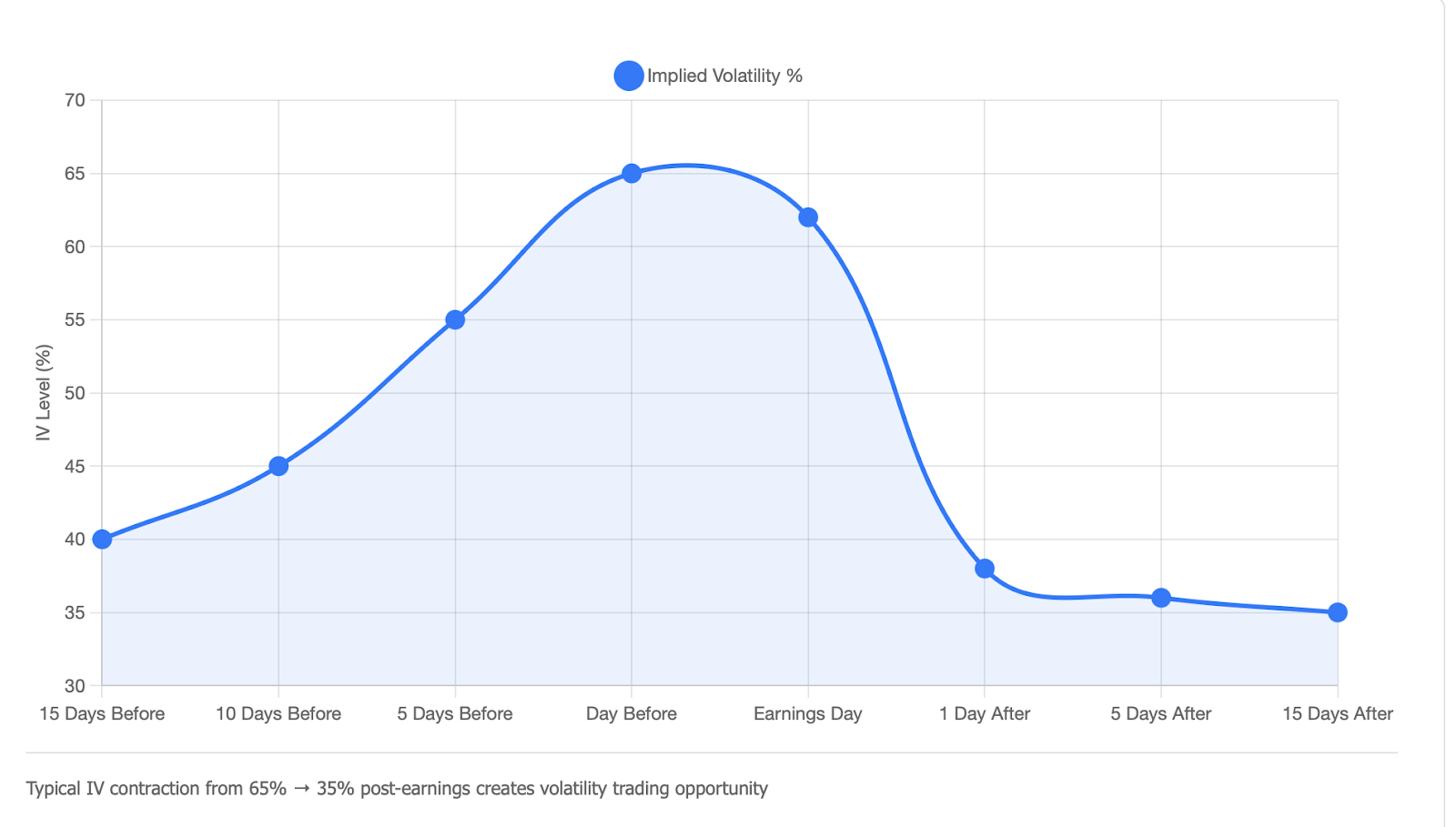
The key point here is to recognise that volatility itself is an asset class. You don't have to predict the earnings release perfectly, but you do have to understand how volatility behaves around binary events.
6. ETF Inclusion & Passive Flows: The Hidden Force Behind CHYM Stock Moves
Most retail traders overlook ETF flow data, a mistake that has huge implications for retail traders. Buying by passive funds can cause short-term price fluctuations due entirely to the features of Capital Flows into ETFs.
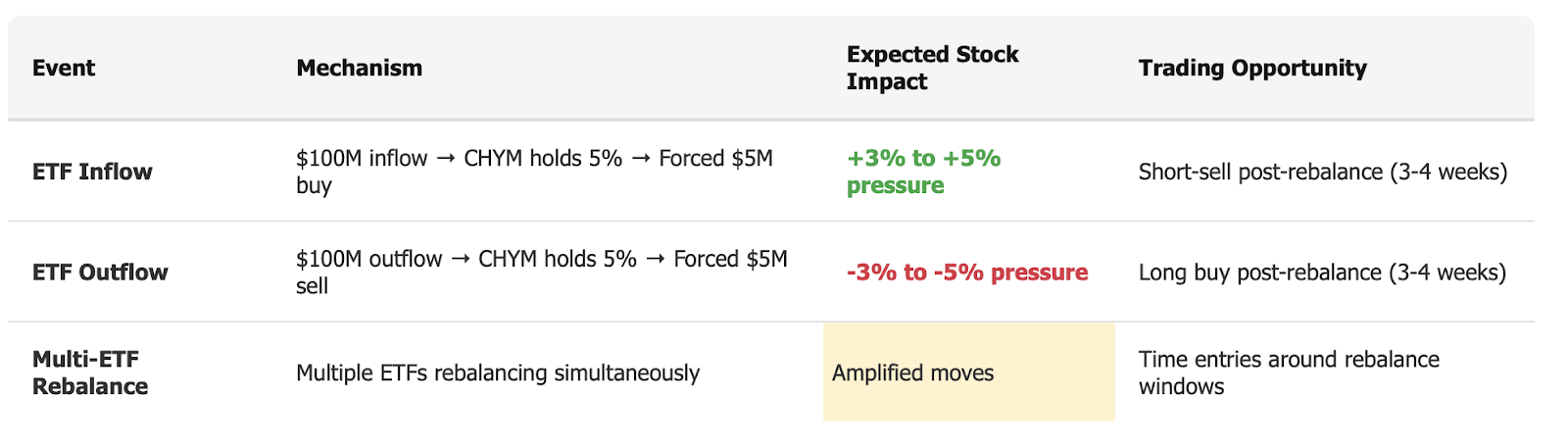
When CHYM is added to an ETF like FINX or IPAY, fund managers are forced to buy shares of those underlying stocks in order to rebalance the index weightings. If CHYM makes up 5% of the ETF holdings and the ETFs receive $100 million worth of inflows, then there is $5 million worth of forced buying into CHYM.
The buying results in predictable upward price pressure. At times when the ETFs are rebalancing (typically around three times per year), one can be assured that there will be increased buying regardless of CHYM’s performance because the fund does not care whether its earnings are good or bad; it simply must purchase enough stocks to maintain index exposure.
Small-cap stocks (like CHYM) are particularly influenced by capital flows into ETFs. A $500 million market cap fintech company like CHYM can expect to move approximately 3-5% due only to ETF rebalancing flows, particularly when multiple ETFs are rebalancing their assets at the same time.
As a trader, it is essential to pay attention to ETF flow data. When there is significant inflow into fintech-focused ETFs, there will most likely be a benefit to CHYM stocks through forced buying. Conversely, when there is significant outflow from these ETFs, the passive selling of CHYM stocks will exert downward pressure on the price of these stocks, regardless of the performance of the business itself.
The distortion created by ETF flows into small-cap, next-generation fintech stocks remains for only a limited time, yet the opportunity to profit exists during these periods. If the share price of CHYM rises 4% as a direct result of ETF buying, then there exists a prime opportunity to short-sell CHYM post-rebalancing within the next three to four weeks.
7. Lock-Up Expiry After the Chime IPO: Short-Term Risk or Second Buying Opportunity?
After Chime's IPO, all of the employees and investors are eligible to sell their shares because the six-month lock-up period has passed; therefore, there will be a predictable supply shock in the market.
As a result of the value of the shares of the venture capitalists who invested at $5 billion more than they are multiplied by a multiple for the same stock, they have an opportunity to cash out some of their investment and return the money to their limited partners. Employees who hold stock options will also feel pressure to sell their shares and generate liquidity.
Statistically speaking, when the lock-up expiration for IPO stocks occurs, they drop by an average of 7-12% during the next month. Therefore, there will be a real supply of stock available. There will be real pressure on the market because everybody is selling.
The tactical opportunity comes from the fact that the market anticipates lock-up selling; as a result, you typically see a decline in CHYM prices 2-3 weeks before the actual lock-up expiration as traders front-run the expected supply shock. After all, CHYM can find a bottom and reverse direction after lock-up expiry.
The following technical indicators help assess the state of the CHYM price and the likelihood of CHYM finding its bottom:
Volume spike: When you see an abnormal amount of volume, it is a good indication that the supply shock is being absorbed.
RSI divergence: If you see CHYM making new lows, while its RSI continues to make new highs, you have a bullish divergence that signals selling exhaustion.
Double bottom formation: If the stock price tests the same price level twice, that is usually an indication of a capitulation low.
Lock-up expiry is not simply a risk for traders; it is a volatility event that creates clearly established entry points for those traders willing to enter into a trade during the exit of most of the other stakeholders.
8. CHYM Options Chain, Gamma Exposure & Max Pain: What Traders Must Watch
The act of buying options can influence what direction the price of an underlying stock (such as CHYM) will move for a short period of time, regardless of the company’s fundamentals. If you are trading CHYM and you are not aware of what the options market looks like, you are going to be lost while trading this stock.
According to the Black-Scholes model, a stock will move to the strike price where most of the options expire worthless when the options begin to expire. The act of market makers hedging their exposure by buying or selling shares puts pressure on the underlying stock as expiration draws closer.
For example, if CHYM has a significant amount of open interest at the $15 strike price and is currently trading at $17, the market makers will hedge their position by selling shares to get CHYM back to the $15 strike, which is not manipulation; it is the mechanical act of hedging.
Delta hedging is an additional category of mechanics that occurs when a trader buys call options,s and the market makers have to then buy shares of the underlying stock to maintain their delta-neutral position. When the price of the underlying stock rises, the market makers will buy even more shares, which creates a feedback loop known as a gamma squeeze.
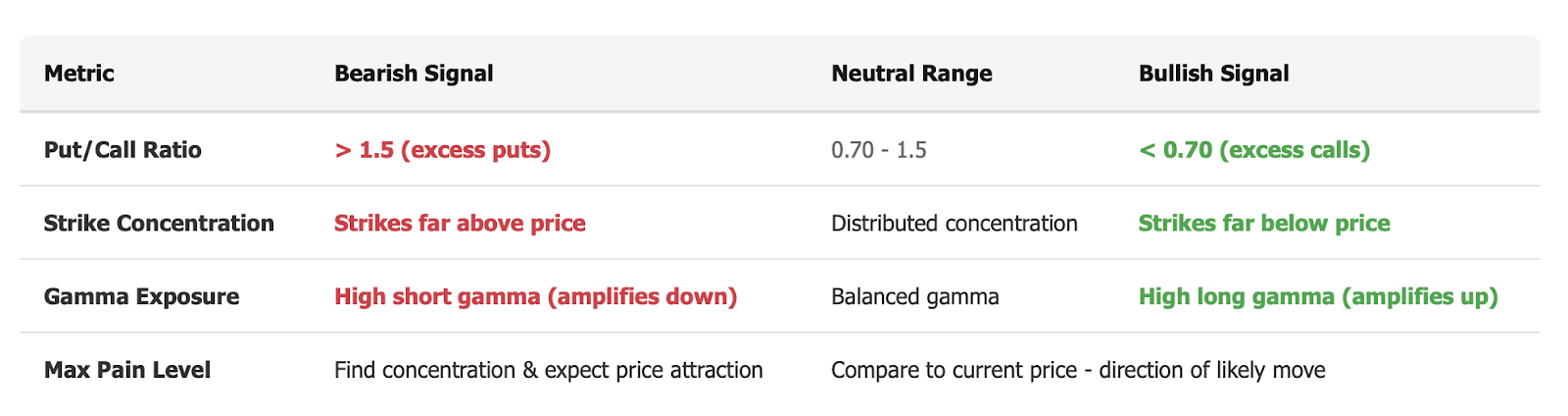
When the market makers sell shares to hedge the delta positions of traders that are heavily shorting call options and long in put options, this has the opposite effect, as it will create pressure to move the stock lower.
When you decide to trade CHYM directionally, you should check the following:
Put/call ratio: If the ratio is above 1.5, there is a bearish sentiment. If the ratio is less than 0.70, there is a bullish sentiment.
Strike concentration: Which strike has the highest concentration of open interest? This will help you find the max pain price.
Gamma exposure: Is the options market positioned to amplify moves or to mitigate the volatility?
Understanding the dynamics of the options market will allow you to avoid getting caught on the wrong side of price action that is driven by mechanical activity associated with option trading.
9. Scenario Analysis: How CHYM Performs in Soft Landing vs Recession
The stock price of CHYM will reflect macroeconomic results more than business performance. By performing scenario analyses, we can forecast prudent estimates of CHYM's share prices.
Scenario 1 - Soft Landing: The Federal Reserve achieves disinflation without a recession. Unemployment remains under 4.5%, consumer spending continues to remain strong, and CHYM will maintain a 15-20% annual growth in users. Under this scenario, CHYMs are expected to trade at 6-7 times sales, ranging from $20 to $24 per share.
Scenario 2 - Mild Recession: Unemployment rises to 5.5%, consumer spending slows, and CHYM's user growth declines to 8-10%. Increased credit losses occur from increased overdraft use. Under this scenario, CHYMs are expected to trade at 3.5 to 4 times sales, resulting in a share price of $12-$15.
Scenario 3 - Deep Recession: Unemployment reaches over 7%, additional consumer credit stress, and increasing delinquencies for CHYM. User growth comes to a halt, and CHYM's stock is repriced to 2.5 to 3 times sales, resulting in a share price of $8-$10.
Both probabilities and scenarios need to be factored into your analysis of the future value of CHYM shares. Assuming you applied 60% chance of a soft landing; 30% for mild recession, and 10% for deep recession, the resulting expected value would be positive. If we now increase the mild recession to a 50% chance, the risk/reward shift dramatically.
CHYM reflects stress in the lower-income consumer; when macroeconomic conditions worsen, CHYM shares will lead the market down.
10. Missed the Chime IPO? How to Build a Position in CHYM in 2026
Missing IPO's not necessarily a bad thing. Often, waiting for a better entry point gives you a better price than you would have gotten from the IPO price.
Using DCA to invest in stocks that are very volatile,e like CHYM, is a smart way to invest. Instead of making your investment of $10K all at once, if you were to invest $1K over 10 weeks, you would reduce your timing risk and the chances of having to buy at the top.
When looking at past performance, the use of DCA has outperformed one-time investments in very volatile stocks 60% of the time. Although you may lose out on potential upside when stocks are doing very well, you would eliminate a massive loss during very bad years.
Additionally, if you don't want to purchase shares of CHYM directly, you can invest in an ETF that focuses on fintech, one of which CHYM is a part. For example, both FINX and IPAY have positions in CHYM, giving you exposure to the entire sector without having risk associated with only one stock.
If CHYM accounts for 8% of the ETF and you invest $10K in the ETF, $800 of your investment will be in CHYM, plus you will have shares in approximately 20 or 30 other fintech companies.
Active day traders can also start building a position in CHYM using TradeWill by creating micro positions using CFDs. You can start with 0.5% of your trading account for your first trade and then gradually add to your position as you become more comfortable in your conviction and your ability to trade with margin.
Just because you missed the IPO of a company, it does not mean you are late to the game. Many companies that go public perform poorly during their first year as a public company, so patience can help you find better risk-adjusted entry prices and ultimately provide you with a higher ROI.
11. Risk Management Blueprint: Position Sizing & Volatility Control for CHYM Traders
As volatility increases, risk management has to get tighter; CHYM is capable of moving 5%-8% within one day. Therefore, if your position sizing is off, you'll blow up your account.
Position sizing for a CHYM trade should not exceed 2% of your total account equity. If your account is valued at $50,000, your total risk on a CHYM trade should not exceed $1,000. Position size should be determined by the distance of your stop loss, rather than an arbitrary number of shares.
For example, if CHYM trades at $15 and your stop is at $13.50, your risk per share is $1.50 (15 - 13.50 = 1.5); therefore, if you want to have a total risk of $1,000 on this trade, you would buy 666 shares (1,000 ÷ $1.50 = ≈ 666).
Additionally, the use of volatility filters can help avoid trading in extreme volatility, which will reduce both the probability and amounts of premature stop-outs when the volatility of CHYM exceeds 80% based on its 30-day historical average; in this case, reduce your position size by 50%.
Establish maximum drawdown limits; if your total CHYM position drops 10% from its peak, cease trading CHYM until you've analysed the reasons for your losses. Avoid averaging down in trades that are "falling knives."
As a rule of thumb, favour asymmetric risk-reward ratios; avoid making trades that offer less than a 2:1 risk-to-reward ratio; therefore, if you are going to risk $1,000, your target profit must be at least $2,000.
Make use of "braking" when trading CHYM, as the higher the car's speed, the more caution you must take when applying brakes; trading CHYM is very exciting due to its volatility; however, properly managing your risks will help ensure you stay in the game long enough to receive an ultimate payoff.
Ready to trade CHYM's next earnings cycle or lock-up event? TradeWill's CFD platform gives you the leverage, real-time data, and execution speed you need to capitalise on fintech volatility while keeping risk under control.
Disclaimer: The content of the blog does not represent any position of Trade W, does not serve as any trading-related decision advice, and does not endorse any third-party.