

 Trade W

In the Forex market, trades can generally be handled 24 hours per day, but that does not mean all of those 24 hours would have the same level of market activity. As a trader, you should know what time of day the major session periods occur and how those times influence the levels of activity regarding the major trades. Being aware of the session periods, what other traders are doing, and where you can limit risk allows you to develop a strategy that incorporates these factors.
The goal of this guide is to summarise each major trading session and show you the hours they overlap with each other so that you can properly align your trading strategy with the active trading conditions of the market. This guide is for those just getting started, wanting to spend less time on their trading, and those already in the forex market wanting to trade smarter rather than longer.
What Are Trading Sessions in Forex and Crypto Markets?
A financial market has trading sessions during which traders are able to buy and sell securities. A general schedule for trading exists across all financial markets; however, four major trading hours of operation align with the four main financial centres, Sydney, Tokyo, London, and New York, providing a consistent trading pattern on a 24-hour basis within the forex market.
Each of the four trading sessions has its own distinctive personality and behaviour. The Sydney session commonly begins by establishing a calmer environment for traders throughout the entire trading day.
As liquidity increases through the Asian session, the London session generally has the greatest amount of volume, with New York having the second most, especially during the overlap period when both London and New York sessions’ markets are open.
The most critical periods for trading in forex are referred to as ‘overlap’ periods where two of the four sessions are open for trading during the same time frame; most of the volume and activity in forex trading typically occurs during these overlap periods due to the large number of market participants e.g., banks, institutional investors, hedge funds that are active in the market, which leads to very liquid conditions characterised by tighter spreads as well as more volatile price movements.
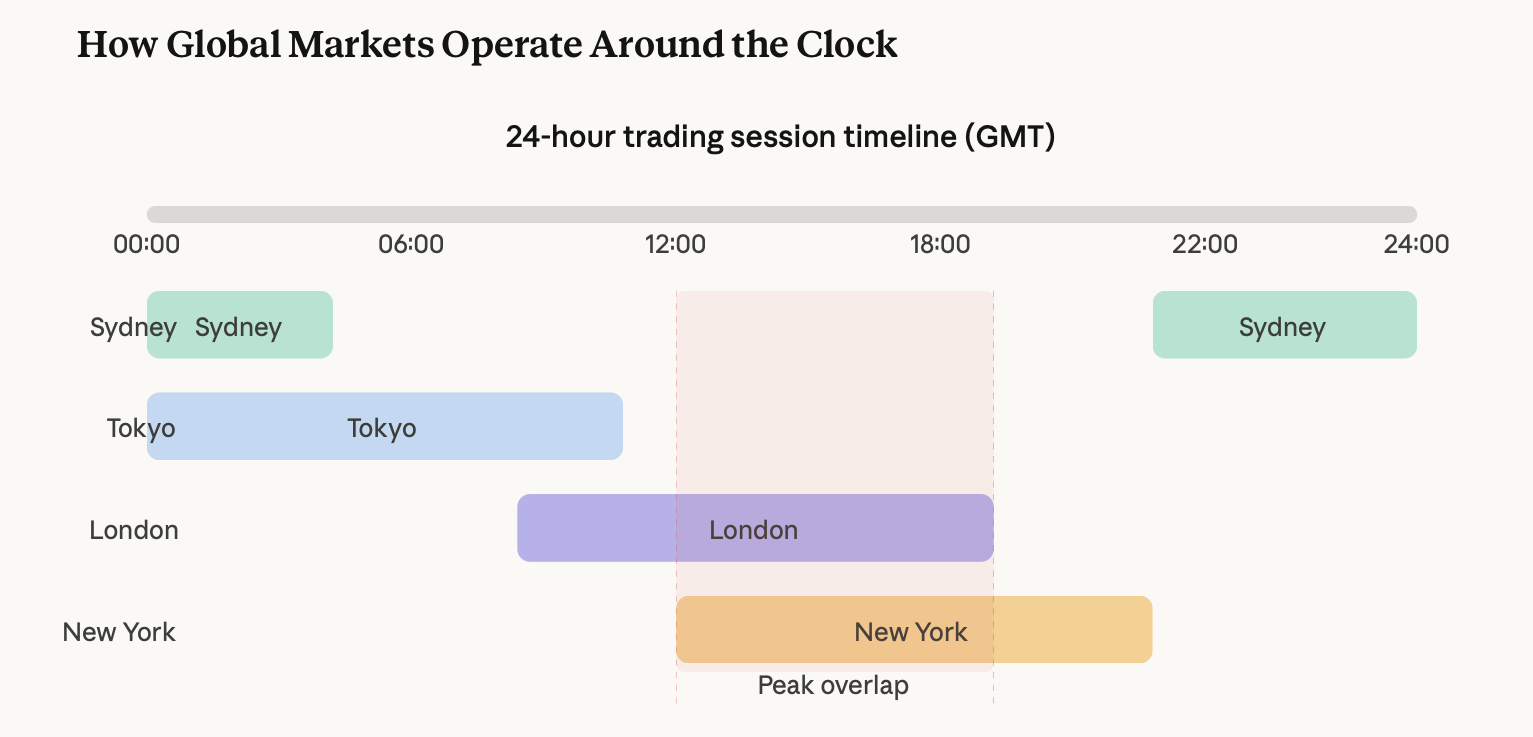
More specifically, the overlap period of 13:00 GMT to 17:00 GMT between the London and New York trading sessions is regarded as the most active time frame in which to trade forex throughout the week.
Although crypto assets trade 24 hours a day, 7 days a week, the activity volume and volatility of crypto assets show the greatest correlation with those of the forex market, primarily during the London and New York trading sessions. Accordingly, there is generally a significant increase in the volume of crypto assets traded during these two hours of overlap between trading sessions in the forex market.
Understanding Global Trading Sessions
When looking at the worldwide market as a relay, it has three legs. First, Sydney takes off with the baton and passes it to Tokyo, which then hands it over to London. When New York crosses the finish line, the Sydney leg has already begun the race back over to New York.
The individual legs of that relay have different properties. When the Sydney and early Tokyo legs are running, there is less liquidity in the market and movement response to price changes generally tends to be less than 1%.
Since the major banks and the North American funds are not yet active, Australian and Japanese data releases can cause the markets to move, but it will be the European and North American economic data that will create large price changes. Once the markets open in London, the dynamics change. A dramatic amount of money comes from Europe into the global foreign exchange markets. The main currency pairs will see an acceleration in their price movements.
In the US, the combination of Europe and the US starting to trade at the same time, and the announcement of economic data over the first few hours of the day creates the most volatile period of the trading day.
The Four Major Trading Sessions
Sydney Session (22:00–07:00 GMT)
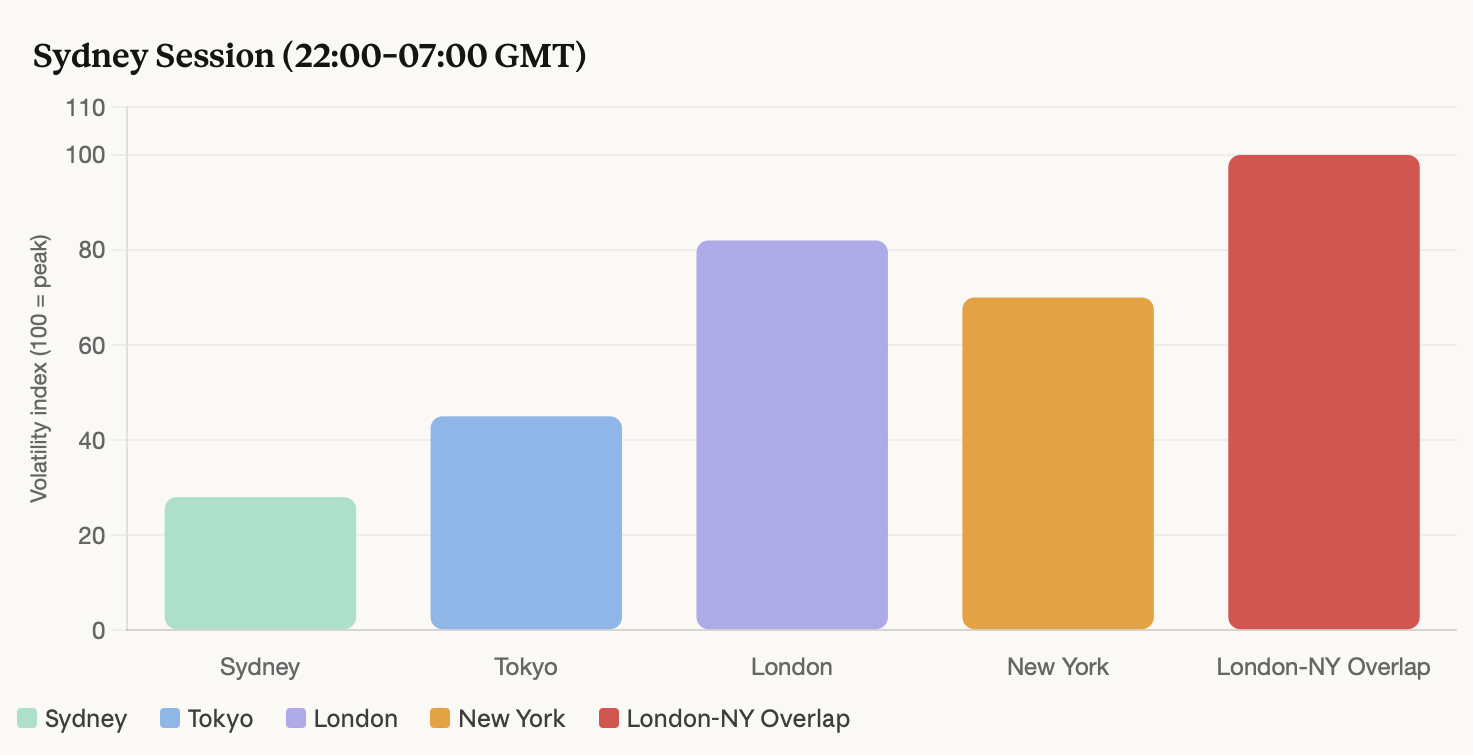
The Sydney market is the first in the Forex weekly cycle; it is typically the sleeper of the four given sessions (London, New York, and Tokyo). Volatility is low, both in terms of total price movement and in percentage terms. Spreads can be wider than normal, and average price moves for the primary currencies (AUD, NZD) will be relatively modest. Commodity-related news (i.e., iron ore, gold, oil) can create larger-than-expected price moves in AUD/USD during this time period.
For beginners: The market is just waking up, don't expect too much. For professional traders: This is a good opportunity to establish a position ahead of the Asian liquidity and respond to news from Australia/New Zealand.
Tokyo (00:00 – 09:00 GMT):
The Tokyo session typically produces moderate volatility and is the primary trading session for JPY pairs. USD/JPY, EUR/JPY, and GBP/JPY will often have substantial price action during this period. Additionally, announcements made by the Bank of Japan will often be able to drive large, fast moves in JPY pairs. Be sure to check the economic calendar before entering into a position on JPY pairs during Tokyo hours.
The actual performance of equity markets in Asia will also affect JPY pairs, as JPY is viewed as a safe-haven currency. Therefore, when Asian equity markets sell off, JPY will often strengthen.
London (07:00 – 16:00 GMT):
The London session is when the marketplace gets completely awake. Nearly 35% to 40% of the daily Forex volume occurs during London, and it is typically the session that produces the largest daily price moves. Major currency pairs, including EUR/USD, GBP/USD, EUR/GBP, and USD/CHF, will have significant price action during this trading session.
Between 07:00 & 09:00 GMT, the London open institutional desks will begin to execute the accumulated order volume from the overnight sessions, which often leads to large directional price moves. Breakout strategies also tend to perform particularly well during the first two hours of the London session, so if you are looking for clean technical setups, you should focus your attention during the first two hours of the London session.
New York (12:00 – 21:00 GMT):
The US Economic Data releases, including but not limited to Non-Farm Payroll Releases, CPI Releases, Federal Reserve Statements, and FOMC decisions, primarily drive the New York session. There will be high volumes of activity in USD pairs, with typically high volatility around major releases. Given that the New York session typically overlaps the London trading session, the New York session generally produces the largest amount of liquidity throughout the entire week.
For example, following a Fed rate decision in New York hours, EUR/USD would typically be able to move by more than 100 pips in less than an hour. If you plan to trade the news during the New York session, you need to use strict risk management and have clearly outlined entry & exit levels before trading news.
Session Overlaps: Where the Real Opportunity Lives
When two markets are open at the same time, liquidity is doubled due to more buyers and sellers, which results in tighter spreads, better fills and larger moves in one direction. There are two important overlaps you need to be aware of:
The Tokyo to London Overlap (07:00 - 09:00 GMT): Though this is a short overlap, it is important because the European financial institutions react to price action that has already occurred in Asia, which makes it an ideal time for buying and selling the GBP/JPY and EUR/JPY.
The London to New York Overlap (13:00 - 17:00 GMT): This is the golden hour, as these are the hours with the largest volume of trading for EUR/USD and GBP/USD and most pairs relative to USD. Scalpers are attracted to very tight spreads during this timeframe, while breakout traders look for momentum. Swing traders look to this timeframe to confirm their directional bias.
Think of it as two very busy markets next to each other; when both are open, there is twice the foot traffic, the price moves much faster, and there are many more opportunities to participate in the market.
One thing to keep an eye on in 2026 is that when the clocks change for daylight saving time (DST) in the US and Europe, it temporarily changes the time of the session overlaps by 1 hour. The US will have their time changes in March and November, while Europe will have its own schedule. This can result in a temporary change of the overlap window, so just confirm the current GMT times before trading in those weeks.
How Sessions Affect Your Trading Performance
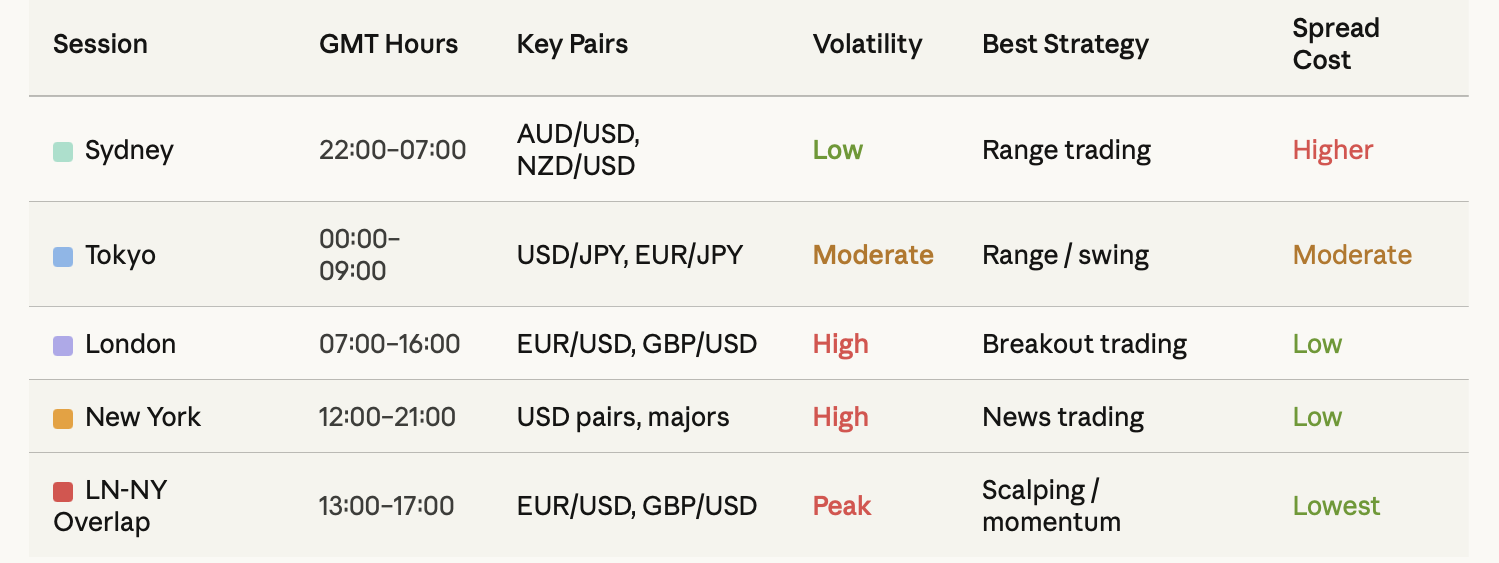
Four Ways That Your Trading Session Affects Performance
1. Liquidity – The liquidity of the session affects how well your orders get filled at your desired price. The lower the liquidity of the session, the more likely your broker is to fill you at an inferior price, particularly if you are trading large sizes. Conversely, the high liquidity of the London and New York Sessions provides execution quality that is not available during the more tranquil hours of the day.
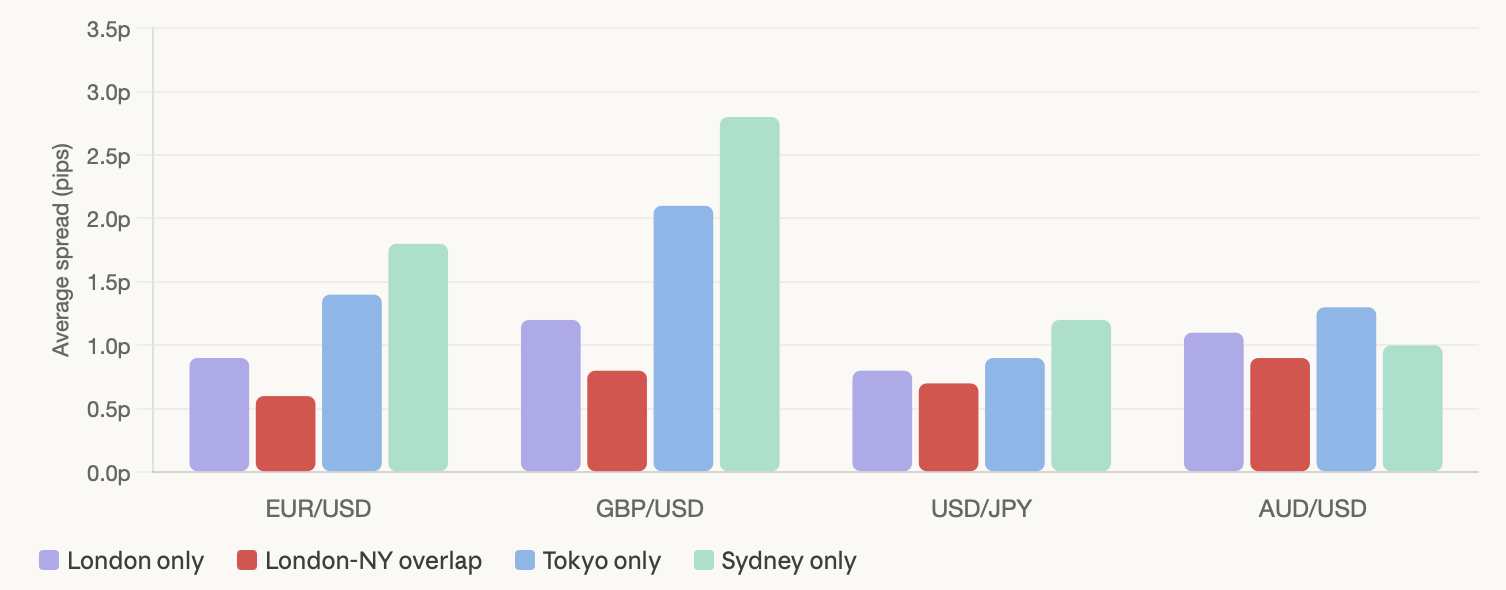
2. Spread Cost – Spread costs will take away from your profit on every trade. The unweighted average spread on EUR/USD during the Sydney session is 1.8 pips, while that spread is only 0.6 pips during the overlap of the London and New York sessions. This creates a huge difference in your overall results if you are an active trader. For the month that you are in active trading, the difference in session timing can result in a strategy that gives you profit one month and loss another due only to the cost of doing business.
3. Volatility – More volatility equates to more opportunity, yet also more risk. For example, within the New York session at the time of a Federal Reserve meeting, if you have a poorly managed position, your stop-loss may be hit before the market goes back to where you expect it to. Be sure to manage your stop distance to account for the volatility of the trading session you're in, not just the technical levels.
4. Execution Quality – The execution quality that you will receive when placing your market orders will depend on the liquidity of the current trading session. You will have a greater chance of slippage occurring in a low liquidity environment. If you are using a strategy that relies on the accuracy of the price at which you enter a trade, be sure to only trade at the peak hours of the trading session.
Practical Strategies by Session
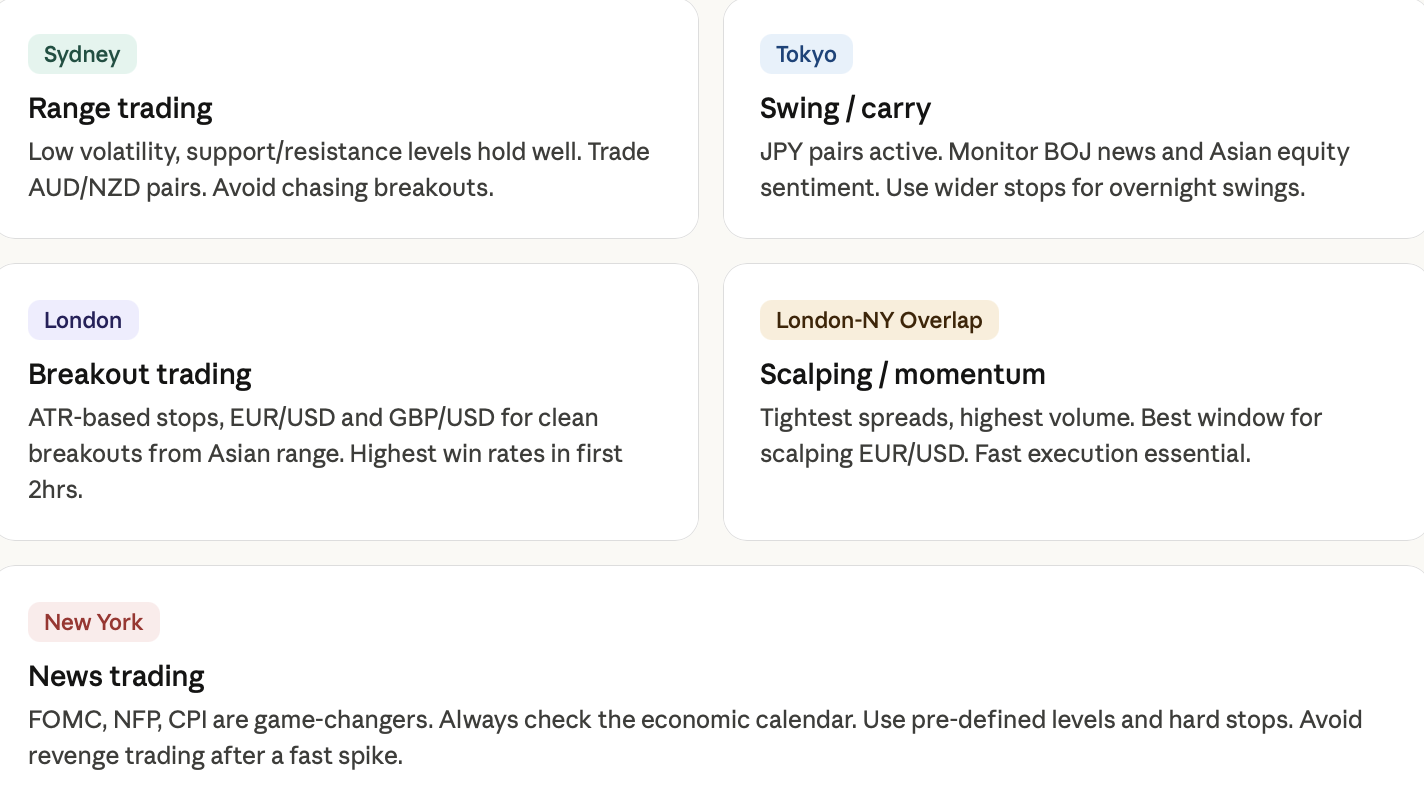
Your trading strategy needs to suit the trading session, not vice versa. A good breakout strategy for the Sydney session will fail repeatedly, as it does not have enough participants to sustain it. In contrast, the same breakout strategy employed during the London session will perform quite differently due to high activity from institutional desks and increased overall volume.
To give beginners a starting point, trade the overlap of the London and New York sessions from 1300 to 1700 GMT. Trading at this time provides the best spreads, the most consistent price action and the highest liquidity. Once comfortable with trading the London-New York overlap, start looking at understanding how to trade the London and New York sessions independently.
Risk Management and Trading Sessions
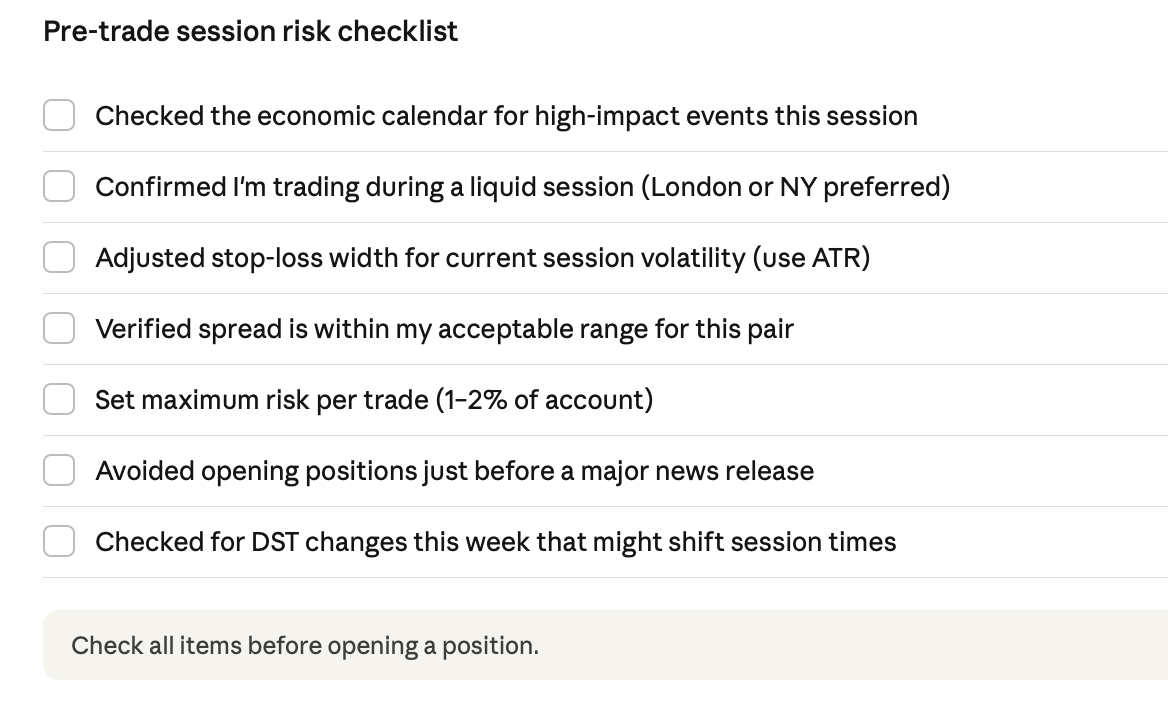
Each trader has their own set of challenges, and the position size and stop placement will vary greatly based on the level of risk you are comfortable assuming within each session. A 15-pip stop during the calm Tokyo session could get taken out in just a few minutes after the London market opens on a volatile day.
One of the most effective ways to gauge the risk associated with a session is by using an Average True Range (ATR) indicator. Using a 14-period ATR on your hourly chart shows you how much a currency pair typically moves in an hour during the session being analysed. Your stop placement should be based on actual price movements and not just on a round number that you feel comfortable losing.
Slippage risk increases significantly during periods where there is low liquidity and when high-impact news is released. If you employ a market order, do not trade during the five minutes leading up to or following the release of major news; the spread will often widen substantially during this time, even for major brokers.
Another thing to consider with respect to session considerations is leverage. When using higher leverage during low-liquidity periods, slippage and gap risks will be greatly magnified. If you plan on carrying a position into the new week on Sunday evening's weekly opening, you should adjust your leverage down to reduce your risk when entering into that new week's session.
2026 Market Considerations
Algorithmic trading has rapidly increased its participation in the market since 2016. As an example, the time between the London Close and New York Open is seeing new algorithmic trading activity at high-frequency levels. The same can be seen with specific price levels having increased activity based on the number of transactions (i.e., round price levels & previous day's high/low price levels).
Crypto assets trade continuously 24/7 within their own "session" concept, yet they do experience similar influences from traditional session activity. The majority of the trading volume during the London/North America timeframe is the same as that of the stock and FX markets. The least active timeframe for crypto asset trading is late night on Sunday and early morning on Monday GMT.
Changes in Daylight Saving Time (DST) are the single most disruptive factor for sessions. For example, in the United States, DST begins in March and ends in November, and in Europe, these changes occur at different times within those same months. The result of the time differences during these transition weeks means a change of 1 hour between London and New York during the overlap of the two sessions. Traders should remind themselves of this.
FAQ
What are trading sessions? There are time windows when major financial centres are actively operating. Each session brings different liquidity, volatility, and currency pair focus.
Which session is best for beginners? The London-New York overlap (13:00–17:00 GMT) is the safest starting point. Tight spreads, strong liquidity, and cleaner price action.
When is the London-New York overlap? Typically 13:00–17:00 GMT, though DST changes can shift this by an hour in certain weeks.
Are trading sessions relevant for crypto? Yes. Even though crypto is 24/7, volume and volatility follow traditional session patterns, peaking during London and NY hours.
Can I trade all day? You can, but it's not productive. Quiet session hours tend to produce choppy, unreliable price action. Selective session focus usually outperforms all-day screen time.
What's the most volatile session? The London-NY overlap, followed by the London open. New York during major data releases can produce brief, extreme spikes.
How do sessions affect spreads? Spreads tighten during high-liquidity sessions and widen during low-liquidity periods. The difference can be 2–3x on the same currency pair at different hours.
What time should I trade in 2026? Focus on 07:00–17:00 GMT. That covers the London session and the NY overlap. Adjust for your time zone and check the economic calendar daily.
Trading sessions are not just an aspect of trading; they are the basis for trading. The same trading setup, the same currency pair, and the same technical setup can have a different experience because of the time frame you are executing the trade in. The London breakout has a momentum that the Sydney hour setups rarely have. Scalping is possible during the London and New York overlaps, but is of little merit at 03:00 GMT.
Those traders who grasp the mental aspect of trading aren't wasting their time staring at the slow, choppy markets. They are focusing their efforts where it is productive. Less screen time means better execution with a clearer picture of what is happening in the market.
Ready to put session knowledge to work? Explore professional-grade trading tools and real-time market data on Tradewill.com, built for traders who know that timing is the edge most people overlook.
Disclaimer: The content of the blog does not represent any position of Trade W, does not serve as any trading-related decision advice, and does not endorse any third-party.