

 Trade W
Introduction: Why Most Traders Lose Money on Exits, Not Entries
The majority of traders do not want to admit it, but more than 90% of their time is spent focusing on perfecting the entry signal and a small percentage on exits; therefore, they often wonder why they keep having their winning trade turn to losing trades.
The majority of traders have had this same experience; you place an order on a trade at the absolute perfect time, things are going your way, the market moves in your favour, and you now have a 5% profit, then a 10% profit, and as you calculate how to spend your profits, the market turns around, the profits that you once thought were in your hands can no longer be accessed, and now you see a loss instead of a profit. It can be very frustrating.
On the flip side of the coin, you may be one of those traders who take profits at the first sign of the trade showing a profit and then watch from the sidelines as the trend moves on without you, leaving behind many more profits.
Most traders are unsuccessful not because they do not have the ability to see certain opportunities, but because they don't know when to get out of the trade.
Using fixed stop losses does not solve this problem; they do help protect against losses, but they do absolutely nothing for securing profits. Using take-profit orders sets you up to have to guess at where you believe the trend will end; therefore, you can never truly know where to set a take-profit order! You need a system that is dynamic and reacts to price movements, to maximise the number of winners, protect profits, and allow winners to continue running.
This is precisely what a trailing stop loss order offers you.
Although trailing stop loss orders sound like a standard stop-loss tool, they are actually a total exit strategy to help you eliminate emotions from one of trading's most difficult decisions—when to close a winning trade! Trailing stops give you a set profit amount and allow you to leave the winning trade open. In this guide, we will outline what trailing stop-and-stop orders are, the advantages of using trailing stop orders in various types of markets, and why professional traders use trailing stop orders to maximise their trend capture without constantly watching charts.
What Is a Trailing Stop Loss? A Beginner-to-Pro Guide
A trailing stop loss is a dynamic stop order, which means it will automatically adjust as the price moves in your favour. Unlike a fixed stop loss that remains at one price, the trailing stop loss "trails" along behind the market price at a fixed distance and locks in profits as trends continue.
Think of a trailing stop loss as having a ratchet mechanism. The trailing stop loss will only move in one direction; therefore, there is no chance of increasing your risk.
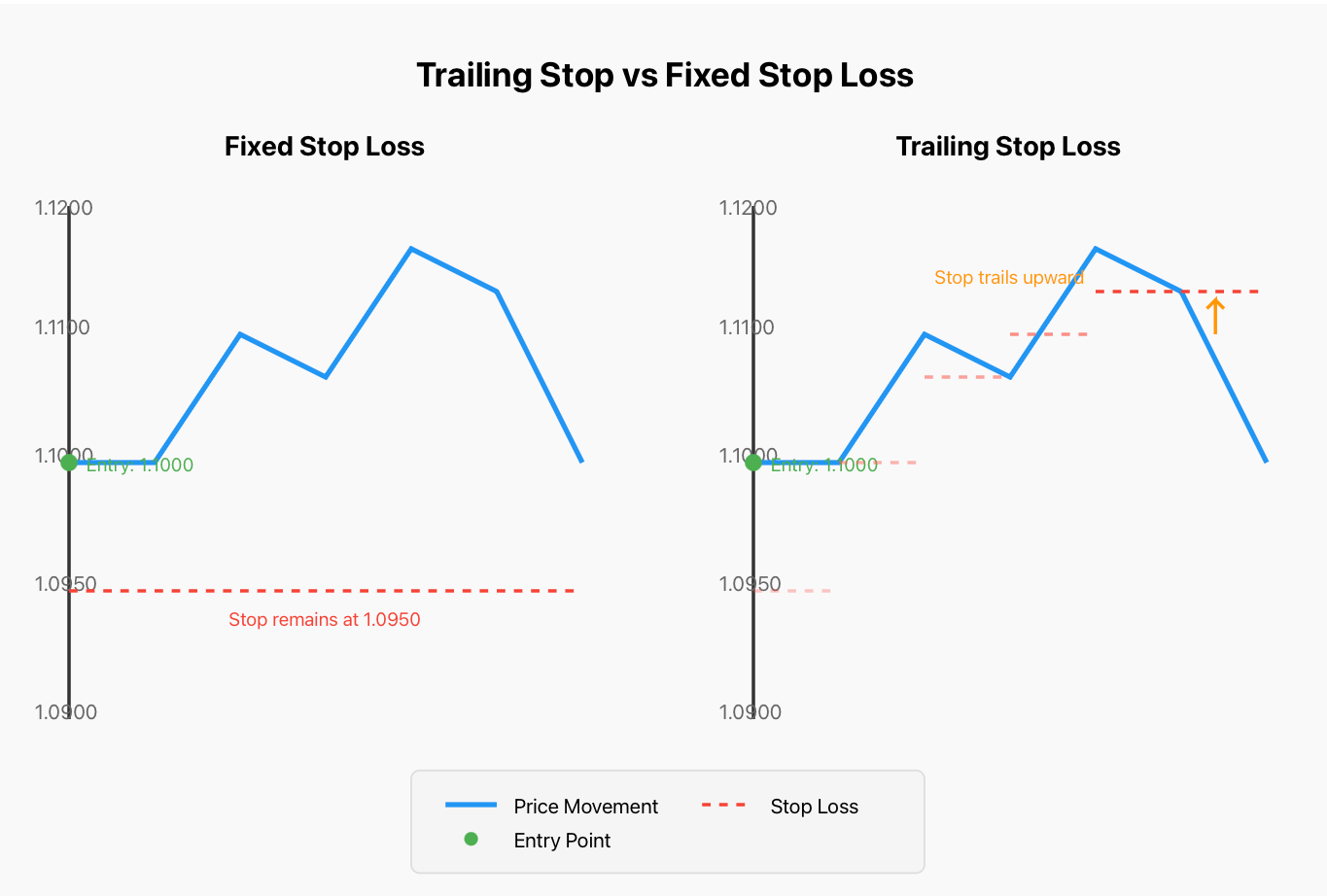
For instance, if you were to buy EUR/USD at 1.1000 and set a trailing stop loss for 50 pips below your entry point, when the price rises to 1.1100, your trailing stop loss will automatically follow you to 1.1050. If it continues to rise, your trailing stop loss will continue moving up until the price drops back down to your trailing stop loss at 1.1150 and locks in 150 pips of profit.
This is a completely different scenario from a fixed stop loss, where you would have maintained your risk at 1.0950 no matter how much profit you earned during the trade.
There are two fundamental rules that every trader must know.
The first rule is that the stop only moves profitably. If you have an open long position, the stop will move up in unison with any increase in the price of the underlying asset; conversely, if you have an open short position, the stop will move down in conjunction with any decrease in the price of the underlying asset. In other words, your stop will never move back against you.
The second rule is that a trailing stop loss will never increase your maximum possible loss when trading in the market because it can only decrease what you potentially could lose, or provide you with the ability to take your profits. In other words, a trailing stop loss on a bad trade will never worsen that bad trade.
In the case of a short position, the concept is reversed. For instance, if you sell short the EUR/USD at 1.1000 with a 50-pip trailing stop loss, the trailing stop would begin at 1.1050. If the price subsequently dropped to 1.0900, your trailing stop would have dropped to 1.0950. If the price subsequently rallied back to the 1.0950 area, you would exit the trade with a trailing stop loss of 50 pips from where you initially entered the trade.
The advantage of this system is that you establish your risk at the time you enter your trade. The trailing stop will inform you of when the trend has reached an end, and there will be no ambiguity or guesswork. The stop does all of the work for you with respect to managing your risk.
How Does a Trailing Stop Work? Step-by-Step Execution Explained
This article outlines the process of executing a trailing stop from start to finish.
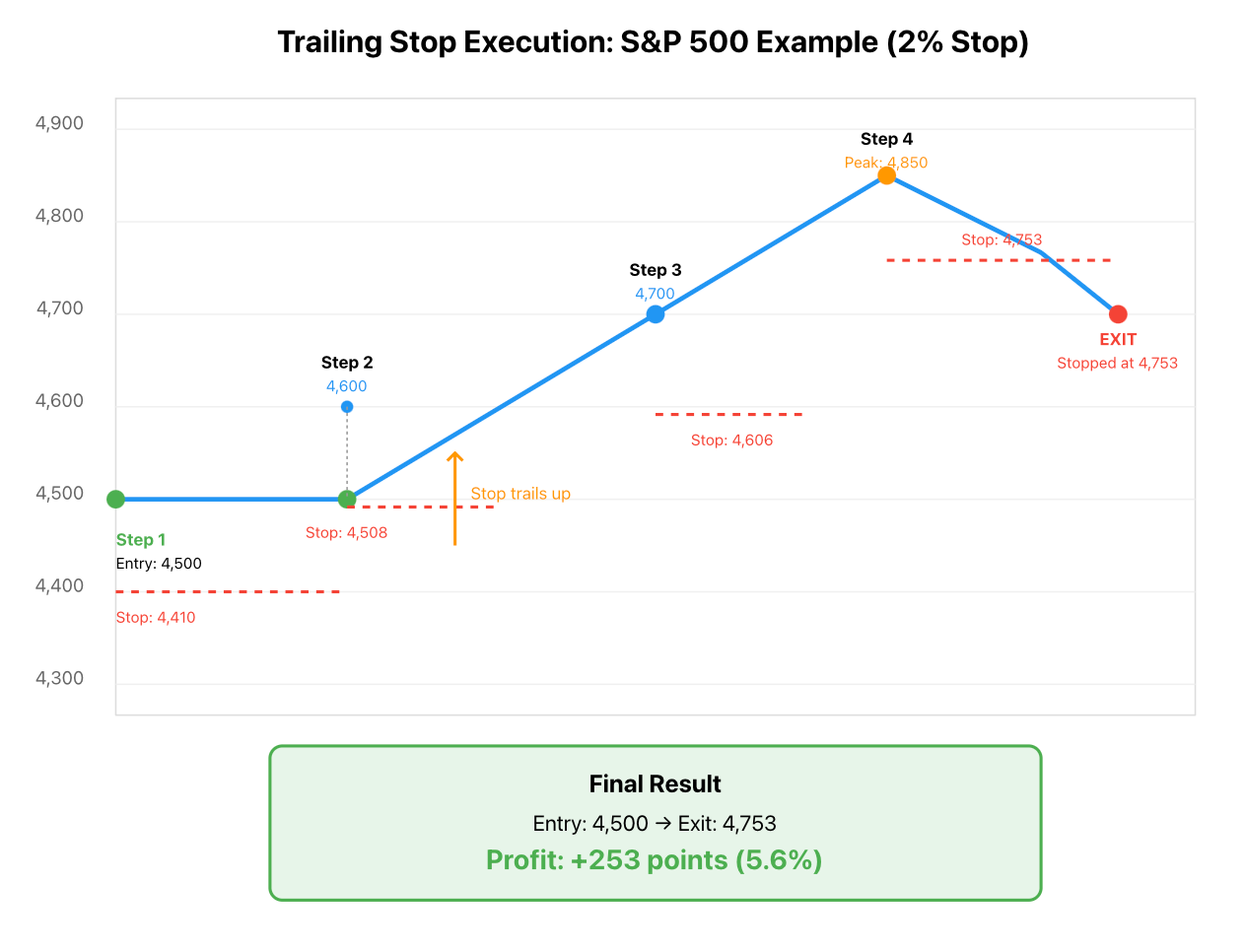
Step 1: You buy into the S&P 500 at 4,500 and place a 2% trailing stop loss. That's a risk of 90 points below, or 4,410.
Step 2: The price moves up to 4,600, so the stop changes to 4,508. You are now locked in for at least 8 points of profit with 92 points of security.
Step 3: The price continues to move up to 4,700, so the stop will further follow the price of 4,606, and will continue to move higher as the price continues to make new highs, with the price hitting 4,800.
Step 4: The market peaked out at 4,850, moving your stop to 4,753. However, a sharp reversal starts. When it reverses back down towards your stop at 4,753, your stop was set as a market order when the price hit 4,753 and thus closed out your position with a 253-point profit.
Trailing stops can be either fixed-point or percentage-based.
Fixed-point trailing stops are set with a particular price point distance from the price of the aggressive trade, while percentage-based trailing stops maintain a percentage ratio of the price of the aggressive trade with a percentage of ascending price points.
For example, a 50-pip fixed-point trailing stop would remain at a price distance of 50 pips below the price of the EUR/USD, irrespective of how much the market moved, and would generally work well for short-term trades/markets where there is an average pip movement based upon a specific price point level.
Percentage-based trailing stops can cover a greater proportion of price points based on the original price point at the time the stop was set, thus making them more scalable. For instance, if you were to buy a stock with a 2% trailing stop from a $100 entry point, your stop would be at $98 at the beginning. However, once it increased to $150, your stop would be at $147.
Two important misconceptions about trailing stops are commonly believed.
There is the misconception that trailing stops protect profits. In reality, trailing stops do not protect profits. Trailing stops ensure you get out of the position when there is a price reversal of a predetermined amount. Hence, if you are trading in choppy or sideways markets where volatility may cause prices to change rapidly before establishing a firm trend, you may either be stopped out of a position with a small profit or even a loss.
Trailing stops work well in every market condition. This is not true. When a market is trending up or down, trailing stops can really add significant value to your trading activity. However, if you trade in a market that is moving sideways, ranging, and choppy, trailing stops can wipe out your account.
For instance, if you buy a currency pair that may move between 100 pips up or down from its previous close, and you have a 30-pip trailing stop, and the price moves from the top of that range to the bottom of that range, you are going to be stopped out multiple times simply from the noise associated with the markets.
Furthermore, you should remember that once your trailing stop has been triggered, it becomes a market order and therefore the price at which you will be executed is not guaranteed to be at the same level as your stop loss. In fast-moving markets or gap-up or gap-down pricing, the price at which you are executed may be significantly different from your stop loss level.
The 3 Most Common Types of Trailing Stop Loss Strategies
There is more than one way to set a trailing stop, but they all have something in common: The way you decide which type is the right option for you will come down to how you trade, when you trade, and what kind of environment you are trading into.
Fixed-Point Trailing Stop
It’s as simple as a fixed distance from the last price you placed on an order. So when the price starts to fall, the distance does not change; it stays at this same price distance until you exit the trade or close out your position. If you set up a fixed-point stop at "50" and the price goes up to the highest price for the day, then continues going back down, you will exit your trade at the same price distance away from your last entry point of 50.
Pros: Very easy to understand and use; works at all price levels.
Cons: Does not account for changing volatility from one moment to another; tends to be too tight and/or loose at times.
Best uses: Day traders and scalpers who typically trade at high intraday levels of volatility.
Percentage-Based Trailing Stop
A trailing stop uses a percentage of the maximum level you achieve in a market. The percentage used below the highest price is fixed; for example, if you have reached a high of "50" and you want your stop at 25%, you would continue to move the trailing stop each time you reach a new low, creating an average of the worst price of 50 pips per hour. This method works on all types of instruments (equities, currencies, etc.) without having to modify it.
Pros: This method provides for even scaling of position sizing. You can easily scale with other asset classes as well.
Cons: Percentage moves do not confirm volatility at the time you take a trade; percentage moves in one security are entirely different from moves in another class of security.
Best uses: Swing and position traders and those trading across asset classes, where the average price movement will be based on an average or consistent risk.
Indicator-Based Trailing Stop - (ATR Method)
A trailing stop is based on the volatility of market movement and can be identified through the ATR indicator. The distance below the highest price at which you set your stop will depend on the ATR value daily. If the ATR value is currently $15, you can set a stop of 2 times the value of the ATR ($30). When the ATR is above its level, it will continue to be based on its volatility; when it dips below its level, it will be set according to that new value.
Pros: By utilising the ATR to determine your stop, you can set your stop based on the level of the ATR, which is very similar to the method based on fixed points or scaled percentages. For those who have a good understanding of the ATR, this method provides the widest range of stops.
Best Uses: Systematic traders, trend followers, and other traders who utilise different types of market movement based upon varying levels of volatility.
To sum this up: all three trailing stop methods have their place, and the correct way to choose the best method for you is to combine your timeframe, risk tolerance, and the volatility of the security you are trading into your decision-making process.
Why Professional Traders Rely on Trailing Stop Losses
Professional traders do not utilise trailing stops due to laziness or an inability to continuously monitor charts - they utilise trailing stops to mitigate the psychological aspect of maintaining a consistently profitable trading career.
The vast majority of traders are left in a constant state of emotional turmoil regarding their winning trades until they reach a point of decision-making regarding whether to exit the trade, add to the position, or remain in the position until the price reverses itself and hits their trailing stop loss.
When traders are not using a trailing stop loss on their winning trades, two negative outcomes occur:
1. Fear will cause traders to exit their winning trade too early. For example, a trader has a position that is at an all-time high of 5%. The trader feels proud or disciplined for exiting the trade; however, a few hours later, the price rises another 20%, causing the trader to feel sick to his stomach for not having taken the profit when he had it. After a while, the little 5% of profits the trader accumulated will not keep up with the average losses of 8-10%. The math just does not add up.
2. Greed will cause traders to hold onto their winning trades for too long. A trader may be sitting on a winning trade that is at 15% and begin to convince himself that the price is going to 20%, and it will eventually go to 25%.
Unfortunately, the price peak occurs, followed by a reversal, which causes the trader to lose 5% of the profits they had accumulated. As a result, the trader has no choice but to panic-sell and take a loss, along with the sick feeling they will have after missing out on the additional profits.
Professional traders understand that, rather than attempting to exit a trade at the absolute peak of a trend, a trader should accept the fact that the act of trying to time their exits will lead to emotional paralysis, indecision, and ultimately, a lower probability of success.
By accepting the reality that no trader will ever exit at the absolute high of the trend and no one will ever enter the absolute low of the trend, professional traders' goal becomes ultimately capturing the lion's share of every major trend/price movement, instead of trying to time their entries or exits.
Concerning psychology, by utilising trailing stops within their trading methodology or strategy, professional traders can eliminate the stress and emotional burden of constantly having to evaluate whether to exit their trade, add to a position, or hold the position indefinitely and hope for a good outcome.
In addition, professional traders understand that it is impossible to determine where a trend will end, and therefore cannot accurately assess where their final exit point will be. Rather, the best traders will respond to the change in momentum, and the subsequent change in price movement and thus can develop a consistent, follow-through system.
Trailing Stop vs Fixed Stop Loss: Which Performs Better in Volatile Markets?
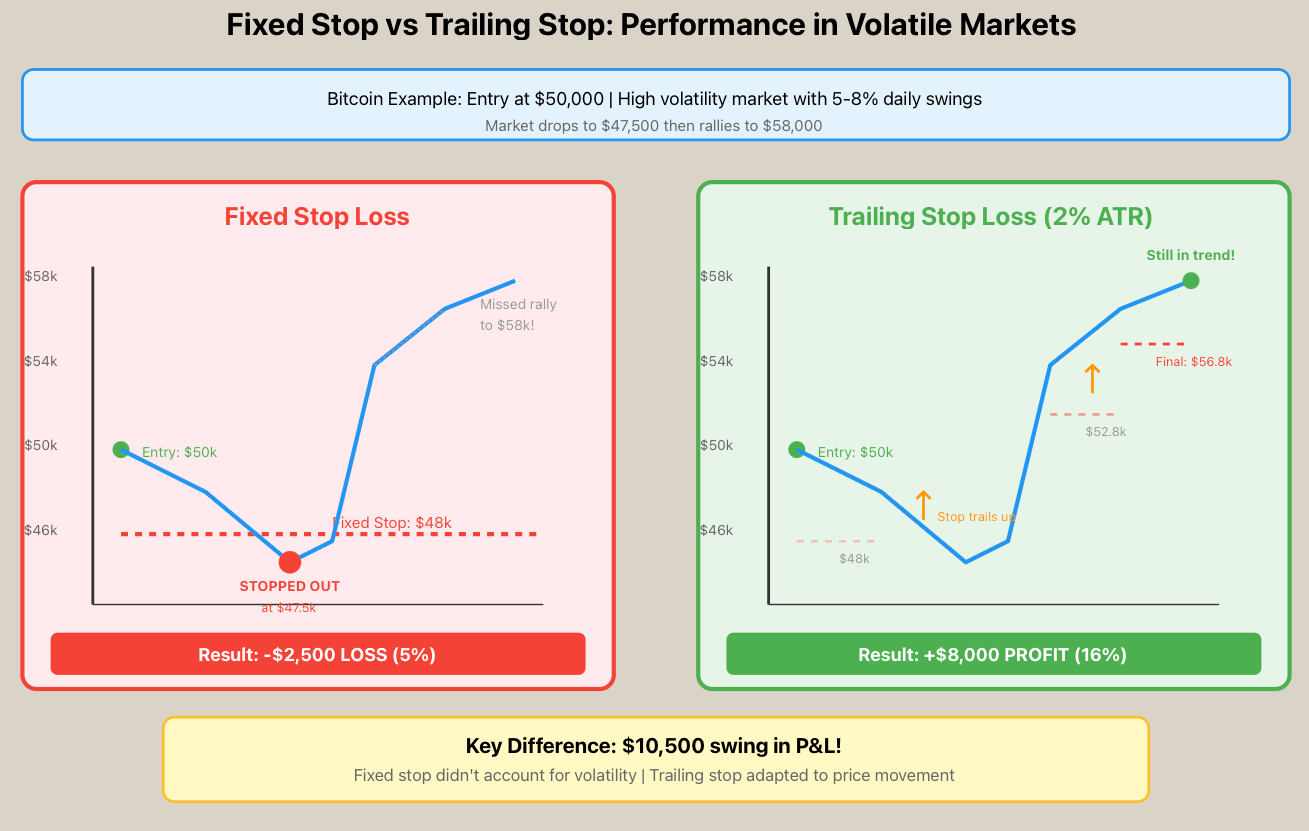
Highly volatile markets demonstrate just how brutally ineffective fixed stop losses truly are. Take this scenario, for example: A trader goes long on Bitcoin when it is trading around $50,000. The trader has done their research and analysis and set a fixed stop loss at $48,000, risk 4%. In a normal world where markets operate at a relative pace, this would have been an acceptable risk assessment based on the market price.
However, we live in the world of Cryptocurrency where intraday price fluctuations of 5%-8% are commonplace, so when the price of Bitcoin dropped to $47,500, only to rally back up to over $58,000 without the trader still being able to participate in that price increase, they quickly learned that while their original stop loss was technically correct, it did not actually correspond to the volatility associated with that asset.
Scenarios like this happen constantly within the cryptocurrency markets. Fixed stop losses only work when a trader can predict the correct amount of "breathing room" the trade will require; volatility is not consistent. A calm market might fluctuate $100 within 24 hours, yet during certain periods that experience elevated volatility, the same market could easily fluctuate $500 within that same timeframe.
In high volatility environments, static fixed stops have some important limitations:
Fixed stops treat all market conditions equally. For instance, a 50 pip stop on EUR/USD may be reasonable during the London open, but could be way too tight due to the news release by a central bank.
Fixed stops do not save profits you’ve accumulated during your trade; instead, your initial risk on a trade is your risk until you change it manually after you have made enough money.
Fixed stops require continuous monitoring of the market and for you to adjust your position; ultimately negating one of the reasons to have stops in the first place.
Trailing stops do not have the same limitations as fixed stops with regard to volatility. As trailing stops adjust as prices move, they allow a trend to develop naturally as well as provide protection against violent reversals.
During the COVID-19 market crash in March 2020, traders who used fixed stops on stock indices were unable to trail their fixed stops downwards with the movement of the market and would’ve had to wait until the next day for a retracement back to their planned trade to make money. Contrarily, traders who used trailing stops on their trades would have been able to stay in their short trades much longer and therefore take much more profit.
However, trailing stops also have limitations; specifically, they do not work well in choppy and sideways-moving markets. For example, if a stock price bounces between $95 and $105 every day with a trailing stop set 3% behind it, the trader will be taken out of that stock at or near the low price and then will have to wait for the stock to recover back to the high price. When a trader gets taken out of a stock due to a trailing stop in a choppy market, they will keep losing money.
Here's a comparison:
Fixed Stop Loss:
-
Benefits - Only provides predictable risk with fixed amounts of control; Better in a range-bound market format; The ability to easily calculate your position size with a fixed stop loss.
-
Disadvantages- A fixed stop loss does not change based on market volatility or provide any profit protection; A trader must adjust the stop distance manually based on current market conditions.
Trailing Stop Loss:
-
Benefits - Depends upon trend movement; Trailing stop locks in profit automatically; Helps reduce emotional trading decisions.
-
Disadvantages - It does not perform well during choppy markets; can create premature exits while taking advantage of normal pullbacks; and requires knowledge of optimal trailing distances.
The big answer isn't to select one over the other. Both methods are used by professional traders, depending on the structure of the current market. Trailing stops typically result in more profit potential when used during uptrending markets; however, during a choppy or range-bound market, fixed stops provide a trader with a better level of control and protection.
An effective risk management strategy needs to be based on the structure of the current market conditions. If you continue using the same form of stop strategy across all market conditions, you are limiting your success to 50%.
ATR-Based Trailing Stops: How to Set Stops Scientifically
Many traders set their trailing stops based on what they feel or numbers they pick without any analysis. For instance, they may say something like "50 pips sounds good" or "I will do 2% on everything". In this method of setting a trailing stop loss, the most important component is left out - Actual Market Volatility, and because the trader has set a trailing stop without taking actual market volatility into consideration, this could result in a loss of profit.
The Average True Range (ATR) is a tool that solves this problem. The ATR shows the average price movement over a given time frame, which can be expressed objectively. Based on a daily chart, Gold’s 14-period average true range is $20.
Therefore, Gold typically moves $20 per day, so if a trader sets a trailing stop at 1x ATR ($20), it will be extremely tight; in fact, it’s likely to be executed throughout a typical day’s fluctuations of market prices.
In contrast, a trailing stop placed at 3x ATR will allow for a greater amount of fluctuation, allowing the trader to stay in the trade a little longer before being taken out if the trend actually does reverse.
The concept behind using ATR when determining your risk management plan can be simple and serves to reinforce the premise that volatile markets should have wider stops and more stable, calm markets should have tighter stops; therefore, your risk management method adapts to what the market is experiencing. In this way, your stop loss is being placed based on the actual price behaviour of the underlying asset.
How to Use Common ATR and PiX multipliers: In general, the ATR is used to measure the level of volatility in the market.
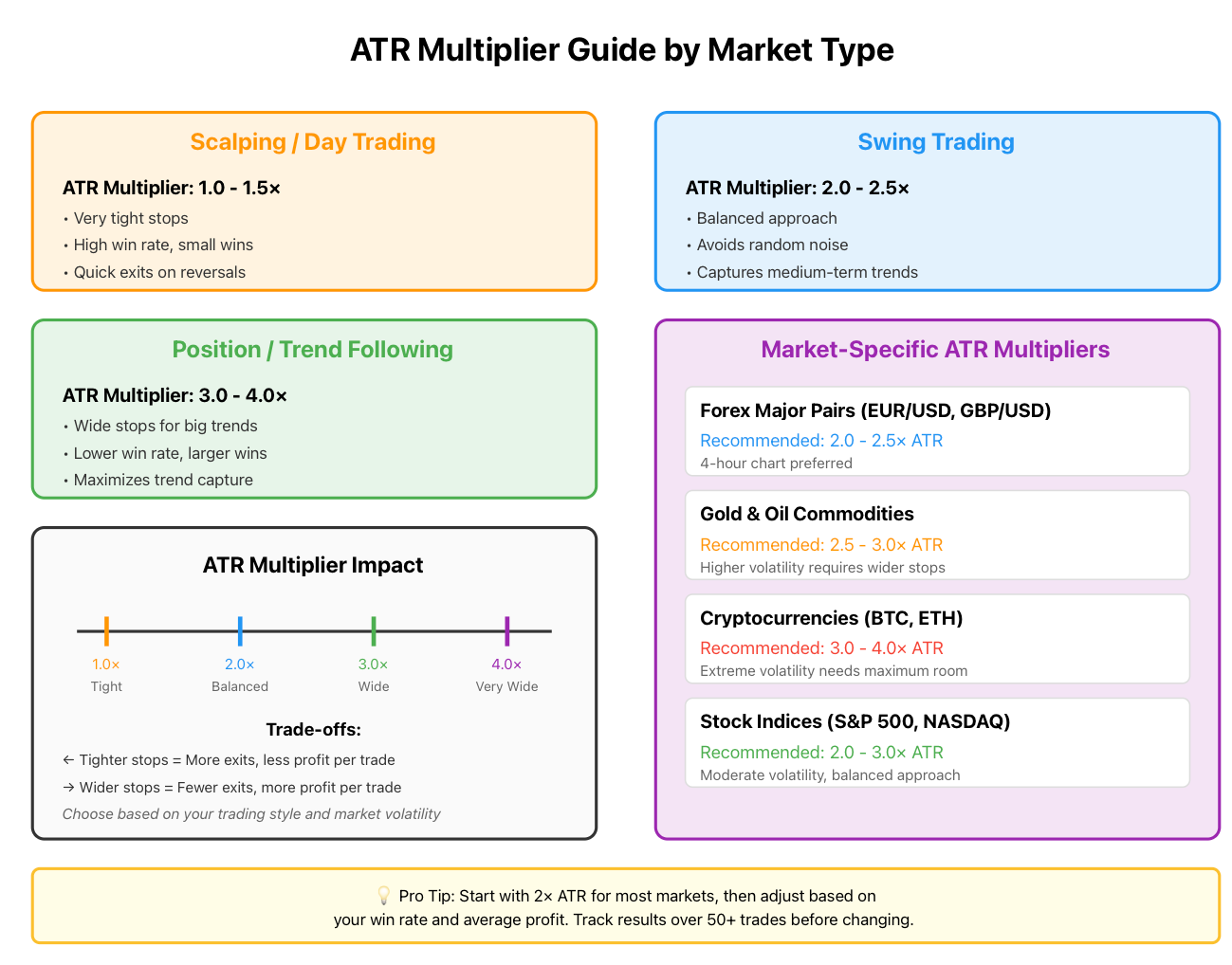
1. ATR at 1-1.5 times the ATR - very tight stop. Primarily used for scalping or as an initial stop for a reversal. High percentage win rate; however, low average win size.
2. ATR at 2-2.5 times the ATR - balanced approach to swing trading. Avoids most of the random noise from the candle patterns while allowing the trader to exit on reversal cautiously.
3. ATR at 3-4 times the ATR - allows for wider stops suitable for the beginner as well as longer-term trend followers. A lower percentage win rate, however, the magnitude of the occurrence during decisive trends.
Now let’s discuss how to execute this in real life. You decide to trade EUR/USD on a 4-hour time frame. The AUD has a 14-period ATR of 60 pips. You plan to use a trailing stop of 120 pips (2 x ATR) on your long position. You place your entry at 1.1000. Your initial stop loss is placed at 1.0880 (120 pips below your entry point).
As the market moves higher towards your 1200 (the target you set before entering your position), you will also begin lowering the amount between your entry and the highest price you reached; therefore, in this scenario, your new position is at 1.1080 (120 pips below).
But what happens next? As time goes on, market volatility will increase and decrease. For instance, the ATR of 40 pips would indicate that very little volatility exists during the Asian session. When the Federal Reserve releases its Fiscal Policy Announcement ATR level will boost and increase from approximately 40 pips to 100 pips. Thus, by using a trailing stop based on the ATR level, your trailing stop distance will increase/decrease according to current volatility and remain “in synch”.
Different types of Forex Trading require different ATR Multipliers. Major Pairs are usually trading between 2 to 2.5 times the ATR (4-hour chart). Gold and Oil are typically traded with 2.5 to 3 times the ATR due to the volatility in comparison. Cryptocurrencies currently trade between 3.0 and 4.0 times the ATR because of the extreme volatility they are experiencing, whereas Stock indices are typically between 2.0 and 3.0 times the ATR.
Mistakes are often made when using ATR-based trailing stops. Here are some common mistakes traders make.
Mistake 1: Applying a single ATR multiplier across all markets. For example, if you use two times the ATR for your stop loss on EUR/USD, that same multiplier may be too tight on Bitcoin or too loose on a stock with low average volatility.
Mistake 2: Believing ATR is a leading indicator of future volatility. Traders often use ATR to determine stops; however, the ATR only reflects the volatility of an asset in the past and therefore does not provide a future expectation of volatility. As a result, during periods of excessive volatility expansion, the ATR may be a poor indicator of the future volatility of that instrument.
Mistake 3: Setting stops based on ATR and then later cancelling them because they "feel like" they are too wide. It is common for traders to set their stops based on ATR rather than their own emotions, leading to incorrect stop levels.
The level of volatility will determine how far away from your entry point you should place a stop. The use of emotions will only lead to loss and is the primary reason why some traders are able to consistently capture trends, while others are unable to do so because they cancel out of positions a moment before their technical analysis is confirmed.
Trailing Stop Loss as a Complete Exit Strategy
Trade stops are incorrectly referred to as "security blankets" by most trading education companies when, in actuality, they should be referred to as a component of a trader's trading system.
The application of a trailing stop loss allows for an exit strategy as well as a mode of protection. No exit strategy means a trader does not have a trading system; they only have a selection of predictions and assumptions.
A trader's trading system should include three components that will generate profits for them: Win Rate, Average Winning Size, and Average Losing Size. The equation that connects these three components is:
Expectancy = (Win Rate × Average Win) - (Loss Rate × Average Loss)
It is apparent from the previous examples that all three of these exits relate to the average winning size and the average losing size.
Most traders fall into the trap of becoming too entangled in finding ways to increase their win rates through enhanced entry points and fail to see that even if they achieve a high win rate (e.g., 70% of trades) but have a smaller average winning size than their average losing size, they will lose money overall.
Professional traders using trend following trading systems report win percentages from 40%-45% on average, but also report having much larger average winning sizes (e.g., 3-5x larger) than average losing sizes. This is accomplished through the implementation of a trailing stop loss to take advantage of larger moves. Therefore, professional traders can consistently lose more trades than they win but still generate a healthy net profit as a result of the mathematical calculations of their systems.
Using this information, traders may use a trailing stop loss to achieve an ideally greater risk-to-reward ratio than by utilising fixed take profit orders. Trailing stop loss will provide room for winning trades to run while limiting the potential loss on losing trades to a predetermined amount, whereas take profit orders will restrict the potential reward for winning trades to pre-determined amounts while allowing the loss on losing trades to exceed the predetermined amount.
Consider two traders:
A trader who employs fixed profit limits on their trades is known as Trader A. Trader A has a 60% success rate with an average profit of +50 pips on their winning trades and an average loss of -50 pips on their losing trades. In the case of 100 trades, Trader A's total pips would be: (60 x 50) - (40 x 50) = +1,000 pips.
Trader B, on the other hand, employs trailing stops when executing trades. Therefore, although Trader B has a 40% success rate, he makes significantly larger profits than Trader A due to his larger average profit on winning trades (+150 pips) and the same amount of average loss per losing trade (-50 pips). In the case of 100 trades, Trader B would produce: (40 x 150) - (60 x 50) = +3,000 pips.
This means Trader B has made three times more profit than Trader A, despite the lower win-rate. Trader B's trading system and exit strategies, or trailing stops, are what create the difference.
Professional traders utilise systematic thinking and design their trading systems to work together, including when to enter, how much to invest in each trade, and how to exit the trade. The exit strategies that are developed through the use of trailing stops are the basis for determining whether a trading system will be successful over the long term.
A trader without exit rules does not have a real trading system but is instead simply gambling based on emotions and therefore has no control over their profits/losses.
Conclusion: Master Trailing Stop Loss and Turn Volatility Into Consistent Profits
You have now gained a clear understanding of how to identify to find traders that can be profitable over time, as opposed to those that constantly see them diminish.
The most important takeaway from this information is simple – Trailing stop loss orders are much more than just a risk management device; they are a complete exit strategy that removes the emotional aspect of one of the largest hurdles of trading - your exit!
Trailing stops allow traders to take advantage of trending markets without having to worry about predicting the high of a market. Trailing stops allow traders to protect profit and provide an exit strategy, without the necessity of constantly monitoring a position. Trailing stops also allow for the alignment of stops with actual market volatility instead of utilising guesswork to set stops.
In summary, key thoughts to keep in mind are:
1. A trailing stop only moves in a profitable direction (i.e. a trailing stop that remains "in the money" may not move to a point where it becomes a risk).
2. Different types of markets (i.e. forex, indices, cryptocurrency) require the use of different approaches. Each of these markets should be approached based on the specific volatility of that market.
3. Utilisation of ATR-based trailing stops should be accomplished in a manner that is scientifically designed to match market conditions.
4. Finally, the trader's edge comes from their execution abilities and not their ability to predict market trends.
It should be noted as a painful but honest truth that it is essentially impossible to always catch the high of a trend. Imagine the following: the price will almost always extend past your trailing stop exit. Get used to that feeling of "leaving money on the table"; it is the cost of trading consistently.
Professional traders do not focus on perfecting exits. Instead, professional traders focus on developing a systematic and repeatable method for capturing large amounts of almost every trend. Over hundreds of trades, a systematic, repeatable process far exceeds that of emotional "gut feeling" methods.
The first step is to practice all types of trailing stop strategies with a demo trading account. Use all forms of stops, i.e. fixed point trailing, percentage trailing stops, and ATR-based trailing stops across all trading instruments and time frames.
You must find the method that works well with your trading personality and opportunity cost. When you feel confident that you have found a system that is going to be successful, use that system for live trading - and be assured you will continue to use your plan even when you are uncomfortable.
Are you now ready to begin using trailing stops? Then visit Tradewill.com and open an account today to begin trading using a full-featured suite of professional-grade risk management tools designed to advance your individual trading strategy.
Discipline is the key to creating long-term profit in the markets, not guessing where the markets will go. Become proficient at managing your exits, and you will become proficient at achieving your trading results!
Disclaimer: The content of the blog does not represent any position of Trade W, does not serve as any trading-related decision advice, and does not endorse any third-party.