

 Trade W
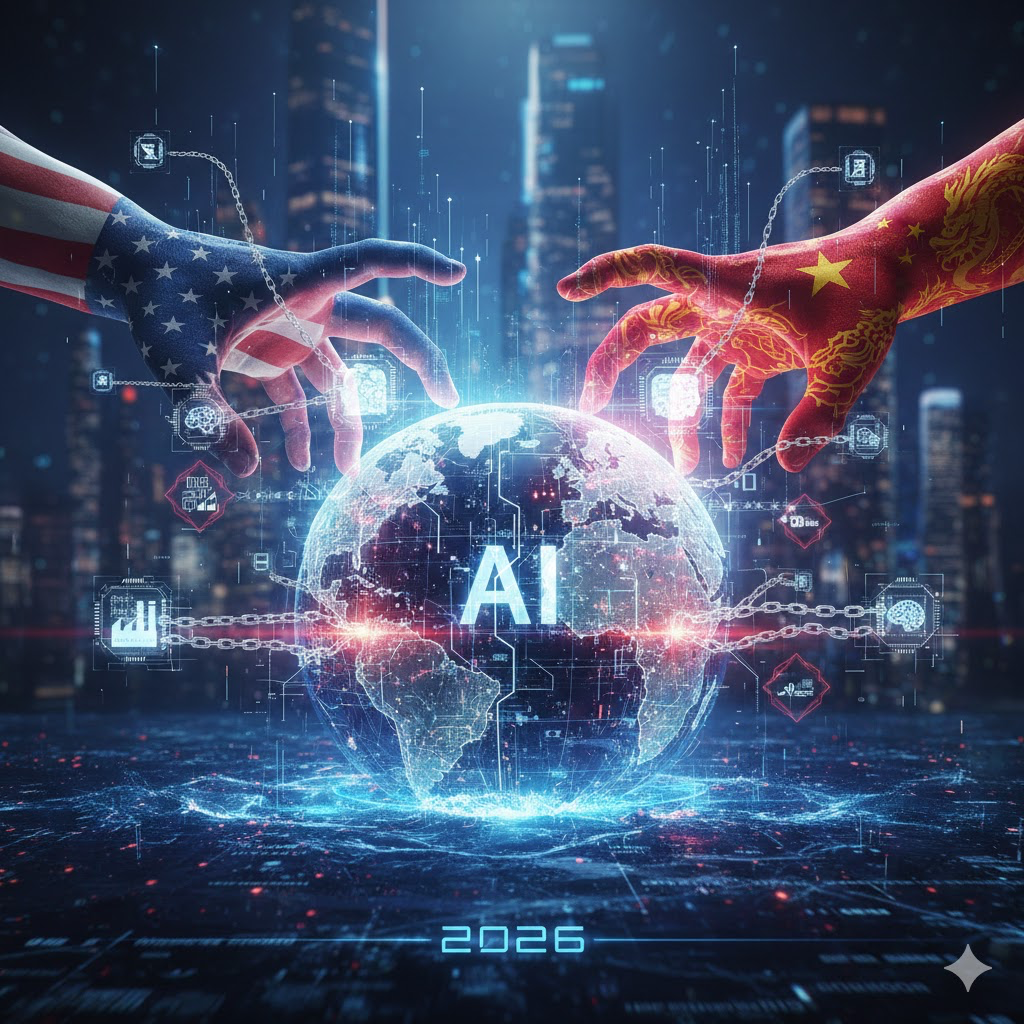
The trade war between the United States and China is no longer the same as it was in 2018. In addition to imposing tariffs, retaliatory measures, and balancing trade relations, there has been a fundamental shift in power between the United States and China, which will be able to dictate global economic growth through its control of emerging technologies over the next 10 years.
For investors who follow these forms of news, you should pay close attention to this distinction; it will have broad implications for your investments in both equity markets and currency valuation, as well as your overall investment strategy - much more so than the tariff and retaliatory measures alone were.
What's Actually Happening in the Trade Dispute Between the US and China News Right Now
The policy decisions that are being made in Q1 2026 are going to create a cascade of change within the U.S and China relationship as it relates to economics. The latest policy restrictions that are being made are specific to advanced semiconductor packaging technology, the export of AI chips, and will be used to produce the next generation of processors. These changes are significant, and they are an example of how the U.S. is trying to control access to the type of technology that will be essential for competitive advantage for the next decade.
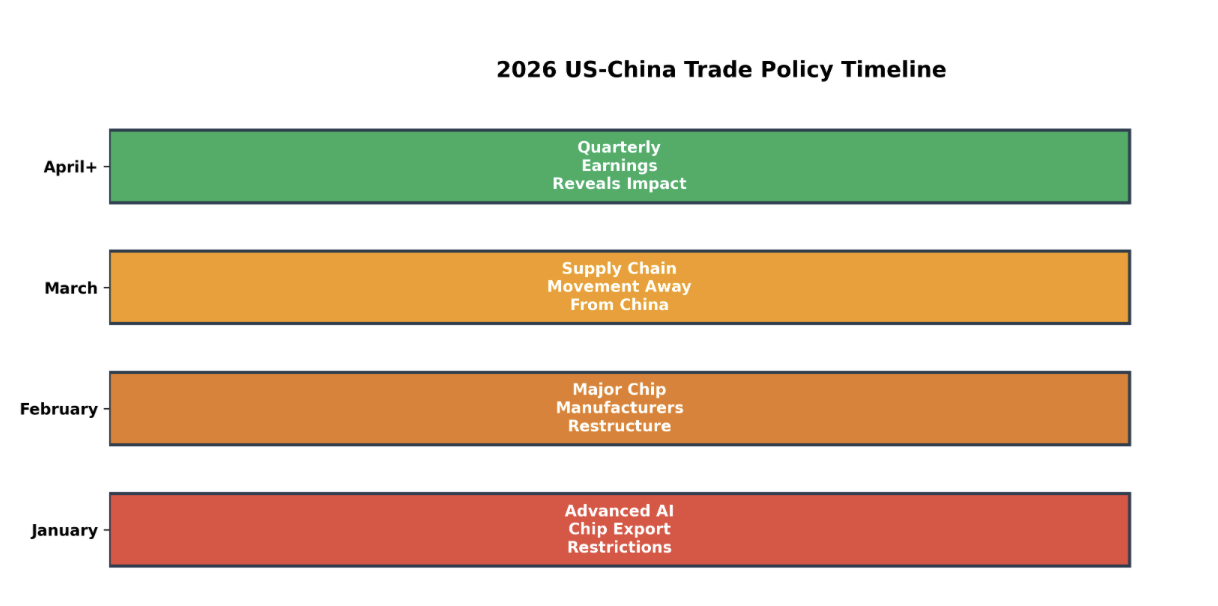
In January, new restrictions were put into effect, which restricted the export of chipmaking equipment geared specifically towards advanced AI training. By February, we began to see major chip manufacturers filing documents with the government stating that they were in the process of restructuring their production to conform to the restrictions.
At the same time as the manufacturers were reacting to the restrictions, many of the major suppliers of the equipment were moving their supply chains away from their Chinese customers. The stock market also reacted immediately because the indices for semiconductor and AI were moved 2 to 4 per cent up or down for each new regulation that became public.
The immediate impact was clearly on the technology market, but the ripples go far beyond this. Any company that had a dependence on the Chinese supply chain now has to create uncertainty around the timing and ability to procure goods. The logistics networks that have been built around the need for efficiency over the last twenty years must now be built around the needs of resiliency and multiple geographic areas.
Investors need to take away this critical change; this is far more than a disagreement over trade balances, it is a structural disagreement on who will lead in technology. The U.S. is saying that "you can no longer have access to these chips", and China is now investing billions to develop alternatives. Other countries are rapidly trying to identify which side they will be on or how to protect against both sides.
From Tariffs to Technology: Why This Matters for Global Economics
In order to analyse the United States and China trade dispute, one must step back and evaluate what each government enjoys nowadays. The measurement of sales of vehicles and cotton is no longer of concern. The greater issues at stake pulling nations apart have now become the supply chain resilience and the ability to control strategic industries across the globe.
Supply chain resilience became an everyday term inside the government since COVID demonstrated to each nation how quickly production could be shut down worldwide because of fragile production networks throughout the world.
Countries now realise that when you have such a heavy dependency on a singular nation for large amounts of critical component pieces, and that nation doesn't sell those components due to their own internal reasons, it stops the production of all items produced by that component. Therefore, policymakers understand and recognise that a concentrated production of critical technology items in one area creates a vulnerability and not an efficiency gain.
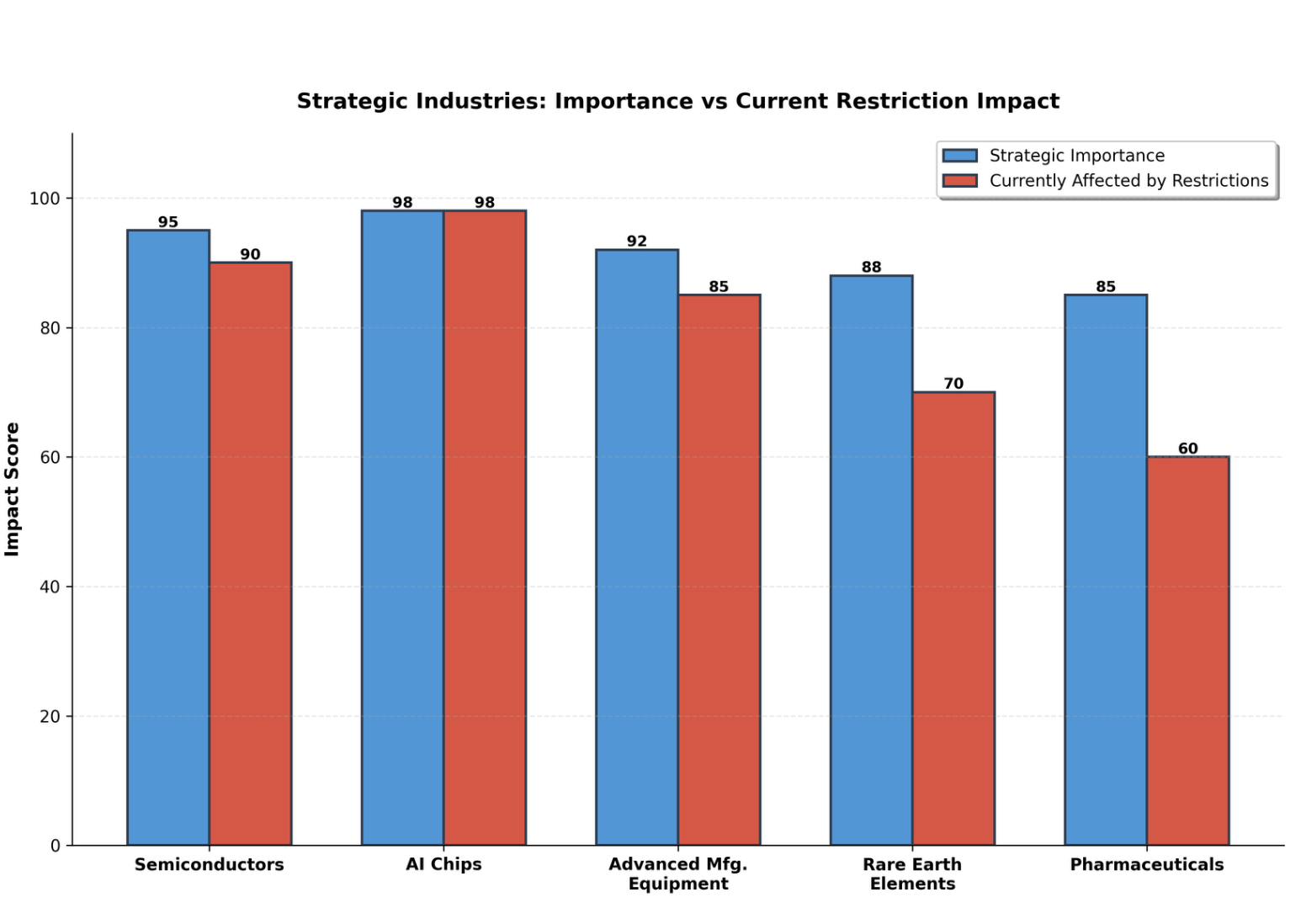
The current obsession with “Strategic Industries” has now been recognised by all governments. Semiconductors, advanced manufacturing equipment, AI chips, rare earth elements and pharmaceuticals are now at the top of every government’s list. These strategic items are not a luxury, but rather, are the basis of everyday life as military-based items, communication items and economic-based items.
As a result, it is important to understand how to classify one as either a “decoupled or a 'de-risking' direction to target economic rewards, real interest rates.
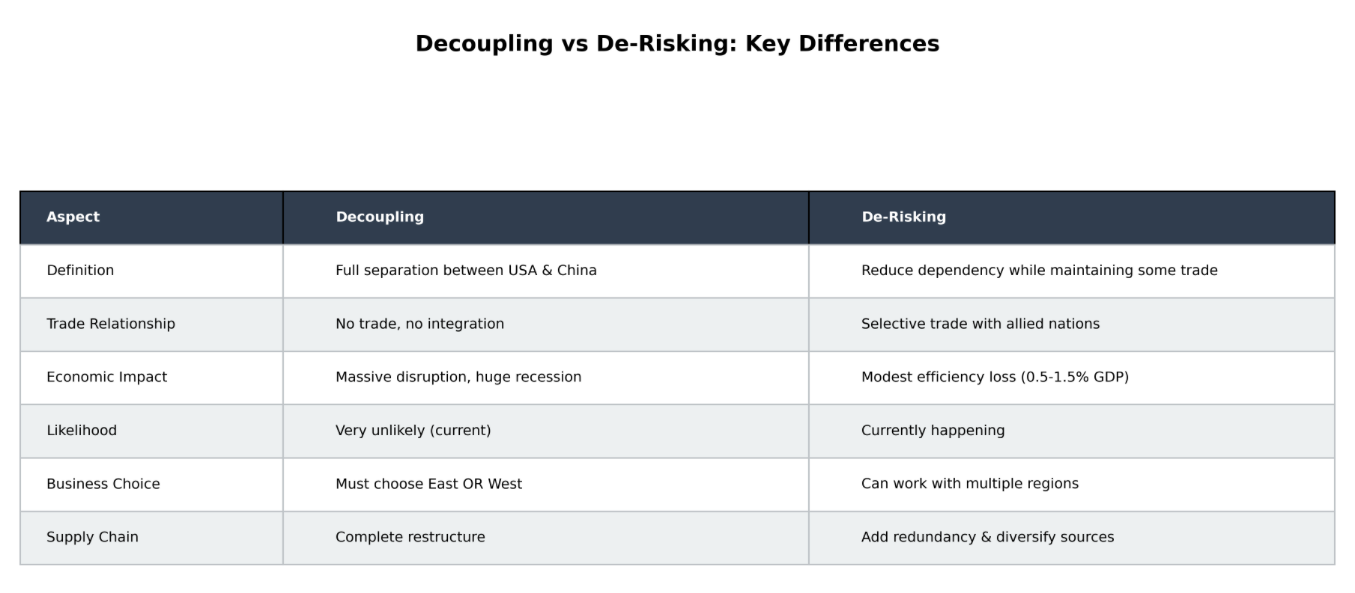
“Decoupled” describes a full separation between the USA and China (i.e. no trade, no supply chain, no integration); a full resumption of a Cold War economic style. Decoupling will create huge disruptions to both nations' GDP, lead to an enormous global recession, and each company will have to choose whether to be with the East or with the West, resulting in economic havoc; however, this scenario is very unlikely based on today's political environment.
De-risking is what is occurring inside today’s economy. De-risking occurs when one can reduce or eliminate their dependency on China’s manufacturing by sourcing components, creating redundancy and sourcing goods from other allied nations such as Vietnam, Taiwan, South Korea, and India. One must still maintain some trade, but structure the trade in a manner that they are less vulnerable.
These scenarios have several market implications that are all different; those companies that successfully de-risk their operations will create a big competitive advantage for their opponents, but those companies that continue to be so dependent will continue to have margin pressure while scrambling to restructure, and the countries de-risking (USA, Europe, Japan) will have investment capital returned to their manufacturing and technology sectors.
As such, the above parallels will lead to allocating capital, over the long-term, from supply chains above to companies that can manufacture or purchase goods other than from China. The result will be an increase in cost for the final goods and a slowing of efficiency.
How the Market Actually Reacts to Trade Dispute Headlines
If you are following your portfolio closely, you see how immediate volatility due to US / China trade issue headlines results in shorting or exceeding target prices.
You can gain a better understanding of how this volatility fits into your investment strategy by recognising the difference between noise and true market repricing.
For example, if new AI chip export restrictions have been implemented, technology stocks lose 1-3% within a few hours. Currency markets react, and bond yields shift. It seems chaotic, but most of the volatility is noise. This volatility does not reflect fundamental developments in the respective marketplaces. It is automated selling through trading algorithms triggered by geopolitical keywords in its software.
This noise will dissipate in about one to two weeks, and the true repricing will begin to occur over the next several months as the corporation files new 10-K forms, reports earnings using their new constraints, and releases new guidance using their new operational environment.
Intelligent investors look for the distinction between noise and true technological change. After the announcement meets the market, look to see if this announcement is a permanent structural event or a temporary announcement that is being negotiated.
If this announcement has a long-term impact, there may be a new buying or selling opportunity based on what your investment thesis states. If this announcement is only a temporary aosturing event by one of the involved geopolitical economies, ignore the intra-day changes and focus on the quarterly earnings announcements instead.
The long-term repricing is mostly based on the sectors directly affected by the announcement. Semiconductor equipment manufacturers are unable to ship to their pre-announcement Chinese customer base; thus, they need to find new markets. This impacts their gross margins in the future; thus, it will impact their earnings in the future. Chip manufacturers that have sold chips to the long-term Chinese customer base face uncertainty about the policy of the new administration, making valuation questions difficult until there is greater clarity on the new regulations.
All investors are affected by the currency market consequences of the US/ China trade issue. During times of U.S./China trade tensions, the U.S. dollar will typically always perform better against other currencies as traders perceive the dollar and assume dollar-denominated investments as safe from geopolitical risks. As emerging market currencies are generally dependent on large amounts of global trade, they will typically weaken during times of U.S./China trade tension.
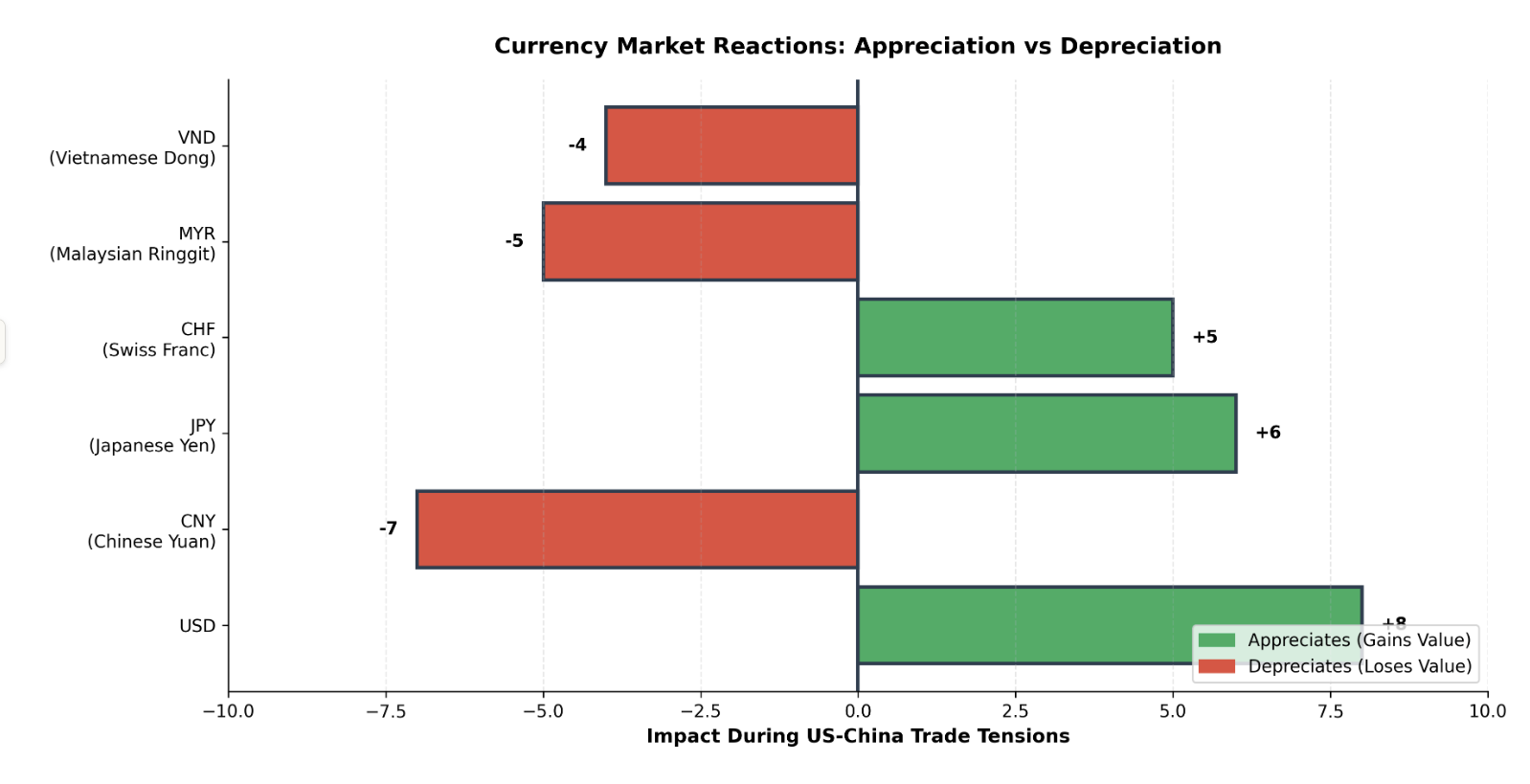
For foreign exchange and currency traders, there is a definitive trading playbook to use regarding trades between the U.S. dollar and the Chinese yuan (USD/CNY) as the spread between the two currencies usually increases during times of U.S./China trade tension. The Japanese yen and the Swiss franc have also consistently gained in value as succeeding trends. Emergent market currencies that rely heavily on China for their growth (e.g. Malaysia and/or Vietnam) typically decline in value.
The Long-Term Repricing: Supply Chain Costs and Global GDP Growth
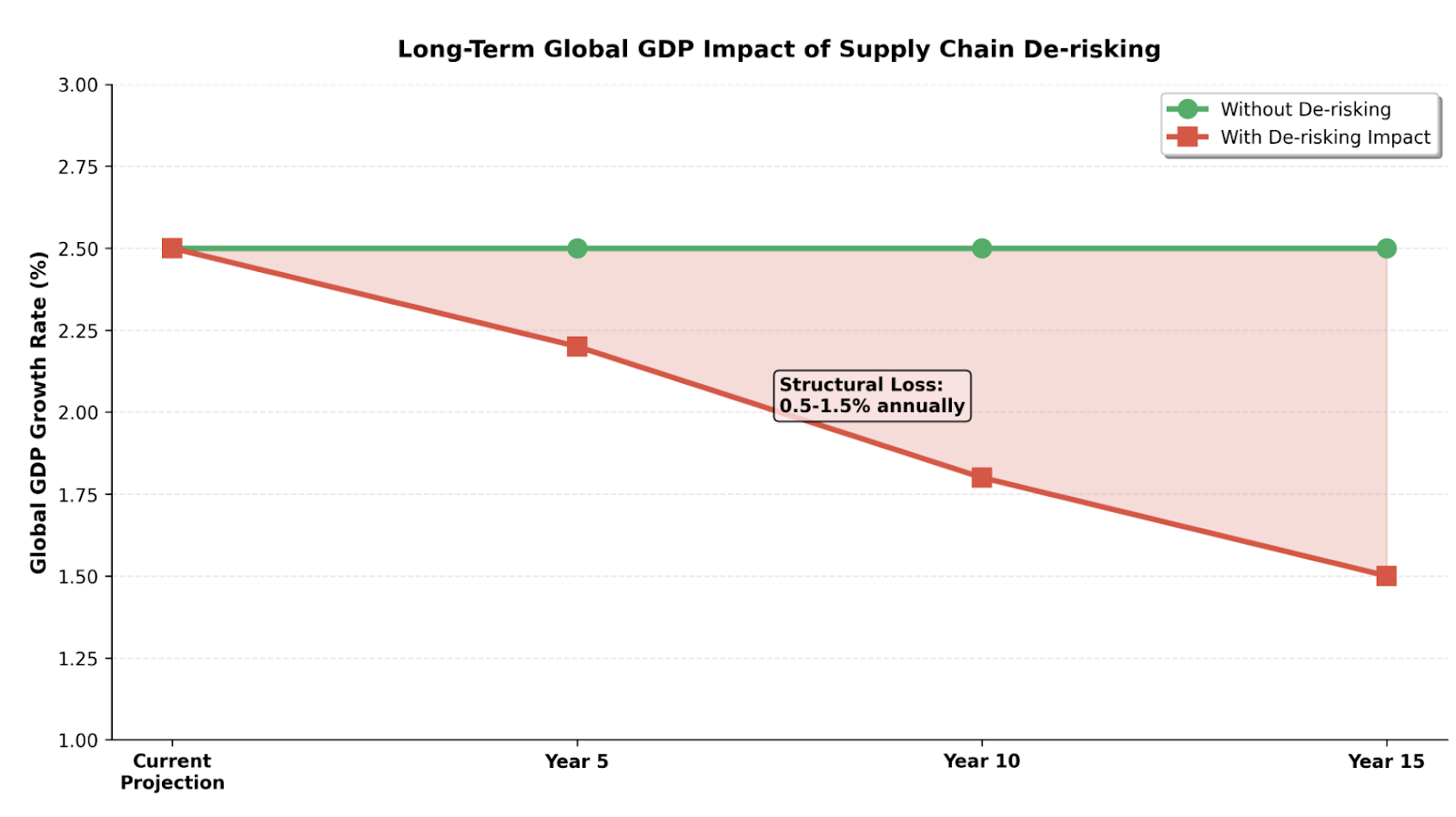
Macro strategists are concerned about the long-term structural impact of de-risking, which impacts the growth trajectory of global GDP for decades to come.
Building redundant supply chains sacrifices efficiency. For example, a company that sources its chips from Taiwan instead of relying on one Chinese foundry pays higher costs, carries higher inventory levels and has more complex logistics associated with that sourcing. None of this will create headline GDP growth, but all of this will create higher costs for companies and marginally reduced margins for consumers.
Economists believe that the de-risking of global supply chains will reduce the growth of global GDP by 0.5 to 1.5% within 5-10 years as a structural, permanent loss. This is not a collapse; it is a slow deterioration of productivity that compounds over time.
This is important because it alters long-term inflation expectations and real interest rates. If long-term global growth is 1% lower than it was previously projected, then central banks will not be able to support rate increases indefinitely. This means that bond yields will eventually be under pressure, and equities will benefit, but long-term earnings growth will decline across the board, resulting in limited expansion of valuation levels.
Long-term investors should continue to see diversification as an essential component of their portfolio. In a de-risking environment, those trying to succeed will be corporations and countries that can endure the de-risking efficiency costs, while still maintaining some degree of pricing power. This typically results in:
-
Powerful technology firms with pricing power across many geographic areas.
-
Energy companies (the rise of de-risking has driven up energy costs and will favour suppliers that are both domestic and geostrategically allied).
-
Military contractors (the current geopolitical fragmentation is driving military spending).
-
Companies in countries that are members of friendly trade groups (the United States, European Union, Japan, South Korea, India, Nepal).
How to Read Trade Dispute Headlines Like Someone Who Actually Knows What's Going On
Investors respond primarily based on their emotions when there is news about the US-China trade war; they panic when new restrictions are imposed, cheer for settlement talks, and then devote all their energy to trading the numbers that come out in between. All three responses are ultimately ineffective.
Creating a framework for sorting signals out of noise is a more productive approach.
Short-term noise can take the form of dramatic-sounding policy announcements that are still in the comment phase, flexible regulatory filings, or diplomatic pronouncements that are vague about upcoming negotiations. Typically, short-term noises will cause 1 to 2 per cent changes in the market, only to disappear within a few days.
Structural signals include final regulatory rules, major corporations announcing they will restructure their supply chains, and unambiguous statements from senior government leaders. These are the types of signals that create price changes that persist.
Timing is essential. You can monitor the issuance of quarterly earnings announcements from companies to determine when a trade policy is effective. For instance, if a trade policy was issued in January, you probably won’t know its true impact on earnings guidance until the end of the first quarter, which is typically in April or May, at which point you will know if the trade policy is actually binding and whether or not there are loopholes.
Another thing you can do is monitor supply chain disclosures from large manufacturers. Major manufacturers submit detailed information on their supply chains; so when a new trade restriction is enacted, you can look at those two companies' disclosures to determine who is really exposed and who is insulated from the new policy.
Here’s the playbook for macro investors:
1. Acknowledge the headline: There is a new export restriction. Write down the date of the announcement and how it will affect the industry.
2. Note the immediate market reaction and wait for volatility to settle down. Most of the volatility in the first week after an announcement will be due to automated trading algorithms.
3. Pay attention to company-specific disclosures and guidance changes; this is where the bulk of the price changes occur.
4. Evaluate the permanence of the restriction. Will it remain permanent, be modified, or be settled through negotiations? This is a geopolitical call, but you can gain insight into the outcome by observing diplomatic signals and listening for references to the new restriction during earnings calls.
5. Once you have clarity on the structural implications of the new restriction, adjust your portfolio positioning accordingly.
This is more involved than being a reactive trader, but it’s the only way to be successful when there is heightened geopolitical risk. Reactive traders become very fatigued and typically exit the market at precisely the wrong time.
Decoupling vs De-Risking: What It Means for Your Actual Investments
We will get down to the details on how your portfolio is impacted by de-risking. This is not just a theory and affects real investments.
By owning a diversified technology exchange-traded fund (ETF), you have exposure to companies that have incurred costly de-risking expenses, and there are some with significant sales in China, so there is a potential loss of those revenues. You will also have companies in your ETF that are being supported by companies that do de-risking for them. The overall effect of this on your ETF will vary by how it is constructed, but you will see shares with high volatility and very different performance amongst your holdings.
You have a complicated situation if you own semiconductor shares. Semiconductor manufacturers have lost Chinese customers because of government restrictions affecting their revenues.
Equipment manufacturers servicing semiconductor manufacturers will have bigger losses, as well, since the foundries in China make up 20-30% of the machinery manufacturing companies’ customers, and all of them can no longer operate in China. The share prices of semiconductor manufacturers and machinery companies have changed dramatically since early 2025.
If you own manufacturing stocks or companies with global supply chains, you will need to evaluate their ability to de-risk efficiently. Companies that have already announced restructuring of their supply chains and whose sourcing is now more diverse than it was when they relied on Chinese sources to manufacture their products or provide inputs into the manufacturing process will be better positioned than companies that still have to be dependent on Chinese supply sources.
From a currency or forex trading perspective, de-risking is leading to dollar appreciation in the intermediate term because of the following reasons:
-
Capital flows go to US manufacturing and tech firms.
-
The US is at the centre of the “alliance” trading bloc that includes Europe, Japan, South Korea, and Taiwan.
-
US dollar-based investments are considered safer from a geopolitical diversification standpoint.
-
The value of the Chinese yuan (CNY) is decreasing; China will not sell as much to the world due to their continued loss of export opportunities.
However, this will not last forever. A continuously strong dollar value will negatively impact US exporters and ultimately will create problems for the US economy. Keep an eye on the central bank and any changes in their monetary policy that will prevent or limit the appreciation of the US dollar.
The best prospects for the sophisticated investor in the current environment are distinguishing the companies that manage their de-risking efficiently from those that will have a difficult time in the process.
The companies that have invested in restructuring supply chains are past the lowest share prices for their companies and will likely outperform those companies that are just beginning the restructuring process, as they will face additional headwinds to their future share price appreciation. Therefore, the need for using fundamental analysis is now more important than macro sentiment.
Key Takeaway: Geopolitics Isn't a Trading Fad Anymore
There is no way that a change in administration or re-establishing negotiations will put an end to the US-China Trade Wars; there is a permanent transformation due to actual reasons of national security, economic strength, and technology dominance in place. Because of this shifting policy environment, they represent years of uncertainty and contention with regard to investment strategies by investors.
This uncertainty opens opportunities for investors who have the ability to see them clearly; however, it also creates risk for those caught on the wrong side of changing supply chains or foreign currency fluctuations.
To effectively navigate this environment, the best approach for investors is to develop a macro framework that separates permanent structural changes from temporary disturbances, and in this framework, track the securities and companies of specific segments and companies and establish positions with discipline, not emotion.
Begin with an audit of your investments to identify which have exposure to the Chinese supply chain; what companies are assisting their clients with de-risking; and how overexposed your investments are in foreign currencies and geographic regions. You can establish a basic monitoring system by monitoring for the announcement of any significant government policies on a certain date and waiting for the market reaction to stabilise before reviewing the quarterly disclosures given by the companies 90 days after the announcement.
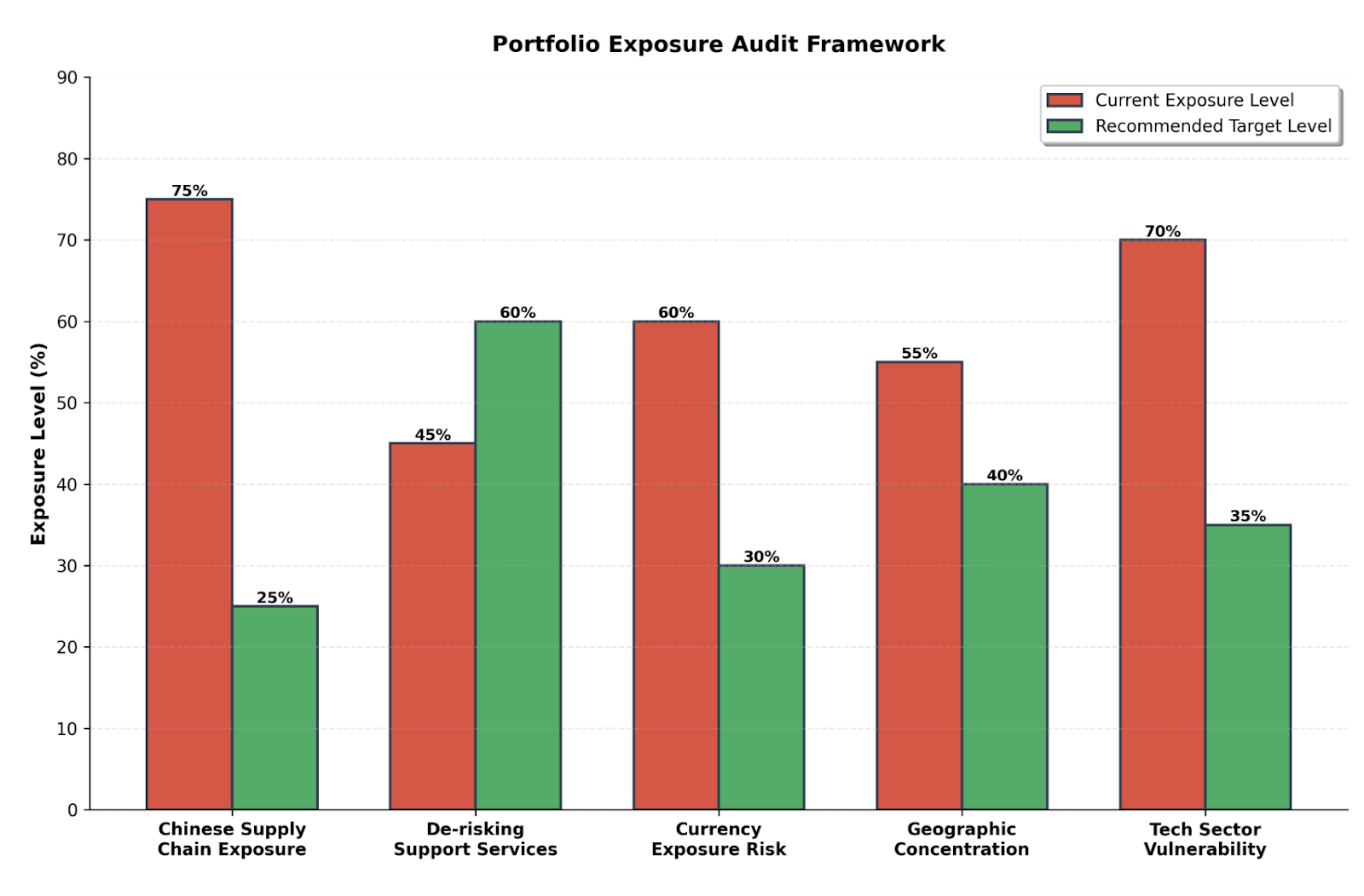
Although being disciplined will not make you wealthy, it will protect you from significant losses when the next headline of international trade conflict appears. Additionally, having a proactive approach with your investments will be to your benefit in the current investment landscape, characterised by substantial volatility due to international disputes of this nature.
Ready to trade smarter through geopolitical volatility? Join Tradewill's community of macro investors who decode policy headlines before the market overreacts. Start tracking your exposure to US-China trade risk with our customizable portfolio risk tools, and get clarity on which holdings matter most.
Disclaimer: The content of the blog does not represent any position of Trade W, does not serve as any trading-related decision advice, and does not endorse any third-party.