

 Trade W
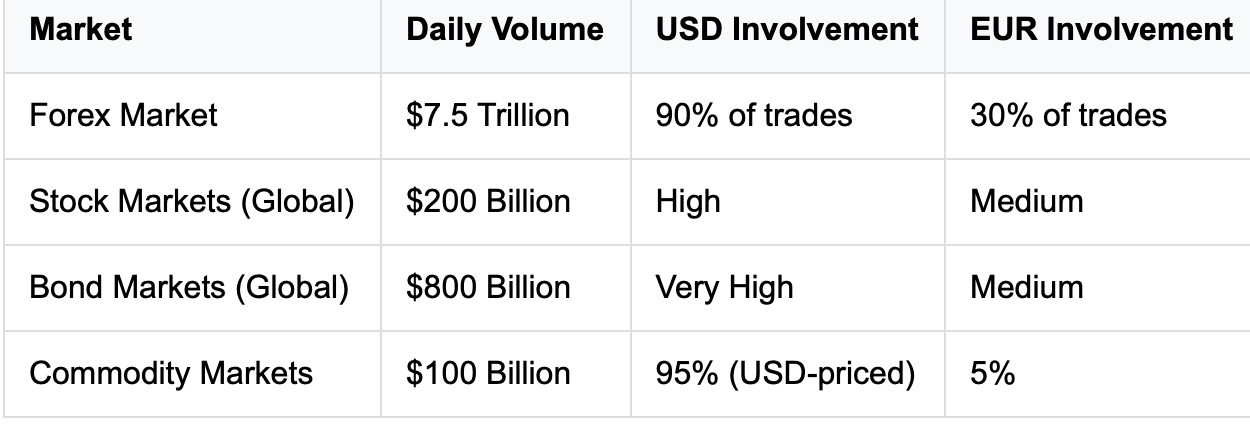
The foreign exchange (Forex) market is the largest financial market in the world, with a daily average turnover of over $7.5 trillion, according to the Bank for International Settlements (BIS, 2022). This tremendous volume exceeds the combined activity in the global stock and bond markets and underscores how critical currency trading is to the modern financial system.
Two currencies stand at the center of this gigantic universe: the U.S. dollar (USD) and euro (EUR). Together, they dominate trading activitythey appear in over 80% of all Forex transactions across the globe. For both professional traders and casual consumers, their impact is inescapable. A strong or weak dollar can shift oil prices, change the cost of traveling abroad, or change tuition fees for international students. Fluctuations in value of the euro influence the Eurozone and beyond, impacting global trade, corporate profit, and household spending.
As a new Forex trader, it can be valuable to think of the USD and EUR as the "anchors" of the currency world. Most international commodities, from oil to gold, are priced in dollars, while the euro represents a very important economic power, a regional alliance that collectively equals the United States in size. Together, they can be seen as value, liquidity, and stability benchmarks against which other currencies compare.
When you're finished reading this article, you can appreciate that the USD and EUR are not just just symbols you see on your trading screen. They are the dual core of the global finance system that underpins your investment options and your daily life.
II. The Global Dominance of USD
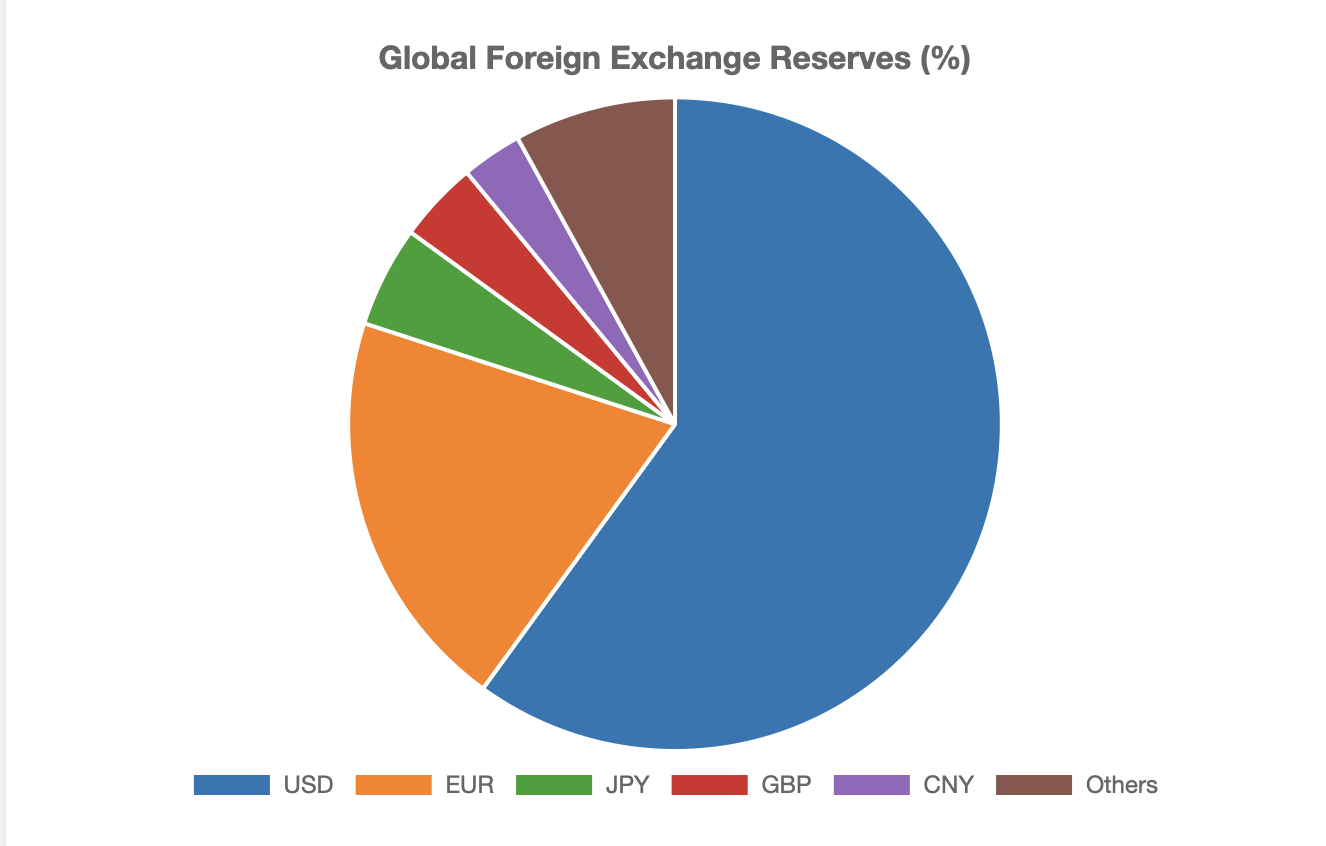
The U.S. dollar (USD) is not just a national currency, it is the cornerstone of the global financial system. The International Monetary Fund’s COFER database shows that the dollar is more than 60% of global foreign exchange reserves, making it the most widely held reserve currency in the world.
It enjoys an abundance of significance for accessing the most powerful asset, giving it incredible power over foreign trade, finance, and the flow of capital.
USD and the reserve currency
For decades, central banks, corporations, and investors have used USD as a safe repository of value. As a reserve currency, countries from many parts of the globe must hold USDdenominated assets, such as U.S. Treasury bonds, to cement their economy and to facilitate transactions between countries. This demand helps keep U.S. rates low, while expanding the reach of USD.
Petrodollar System
A key component of dollar dominance is the petrodollar system: the practice of pricing oil and other commodities in U.S. dollars. For 50 years most of the world's energy transactions have been settled in dollars, creating ongoing demand for the currency. The relationship between oil and the dollar requires energy purchasing nations to hold large reserves of U.S. dollars, thus linking global energy security to dollar liquidity.
The U.S. Dollar Index (DXY) as a Benchmark
Of the hundreds of publicly traded currencies in the world, the U.S. Dollar Index (DXY) is perhaps the most scrutinized in international markets. When the index rises, this usually translates as dollar strength that has secondary effects on commodities, emerging market currencies and the global trading environment.
The Effects of Strong vs. Weak Dollar
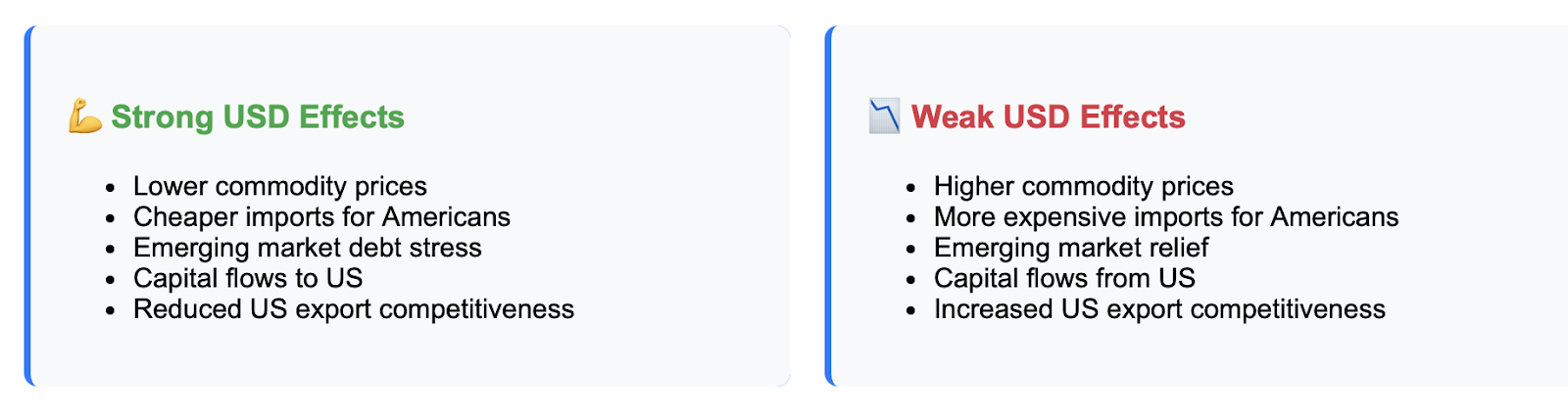
Strong dollar: Emerging market nations do not fare well as dollardenominated debt becomes harder to pay off. The prices of commodities, like gold and oil, usually decrease because these commodities are devalued when measured in local currency terms (because commodity prices are denominated in dollars).
Weak dollar: The weakening dollar typically increases levels of global trade and commodity prices, all while helping to increase the competitiveness of U.S. exports.
Beginner analogy: Think of the dollar as the measuring stick of the world. When the stick stretches (strong USD), everything priced in it looks smaller and more expensive. When it shrinks (weak USD), the opposite occurs.
III. The Strategic Nature of EUR
The dollar has monopoly power in global finance. The euro (EUR) occupies a vital supporting role as the second most important reserve currency in the world. IMF COFER data reveals that the euro accounts for over 20% of global foreign exchange reserves, confirming its position as a pillar of international trade and investment.
Eurozone Economic Size
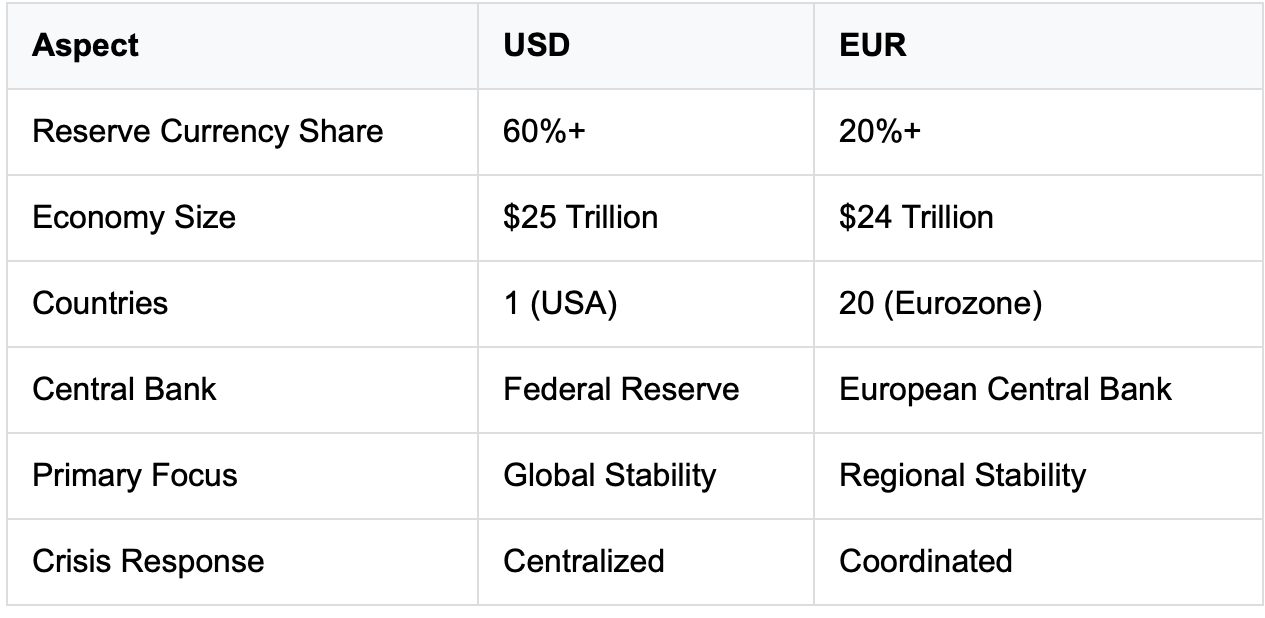
The strength of the euro resides in the sheer size of the Eurozone economy, which is approximately equal in size to the U.S. economy. The euro is unprecedented experiment of monetary union of which 20 countries shares a single currency. The Eurozone economic size creates an opportunity for EUR to serve as an alternative to the USD for both international reserves and crossborder transactions.
EUR/USD: The World's Most Traded Pair
The EUR/USD currency pair is the most traded pair in the world. EUR/USD accounts for a significant percentage of dayoverday turnover of the Forex market. Due to the sheer liquidity and volatility, there may be no other currency pair available with as much intrigue for traders, from the largest central banks to retail investors of minimal account sizes. For these reasons, the EUR/USD often serves as a market barometer of global Forex sentiment; a "heartbeat" of the Forex market.
The ECB and Its Impact on the Monetary Policy and EUR/USD Markets
The European Central Bank (ECB), and its monetary policy, is a driver of the euro’s value. The U.S. Federal Reserve has a very impactful role globally, the ECB is far more regionally focused and concerns itself with regional stability and regional inflation and growth, and problems of reconciling a diverse range of economy under a common currency. The results of a change in monetary policy on EUR/USD from the ECB are immediate and even enhanced by expectations in the market.
The Euro in Crisis and Stability
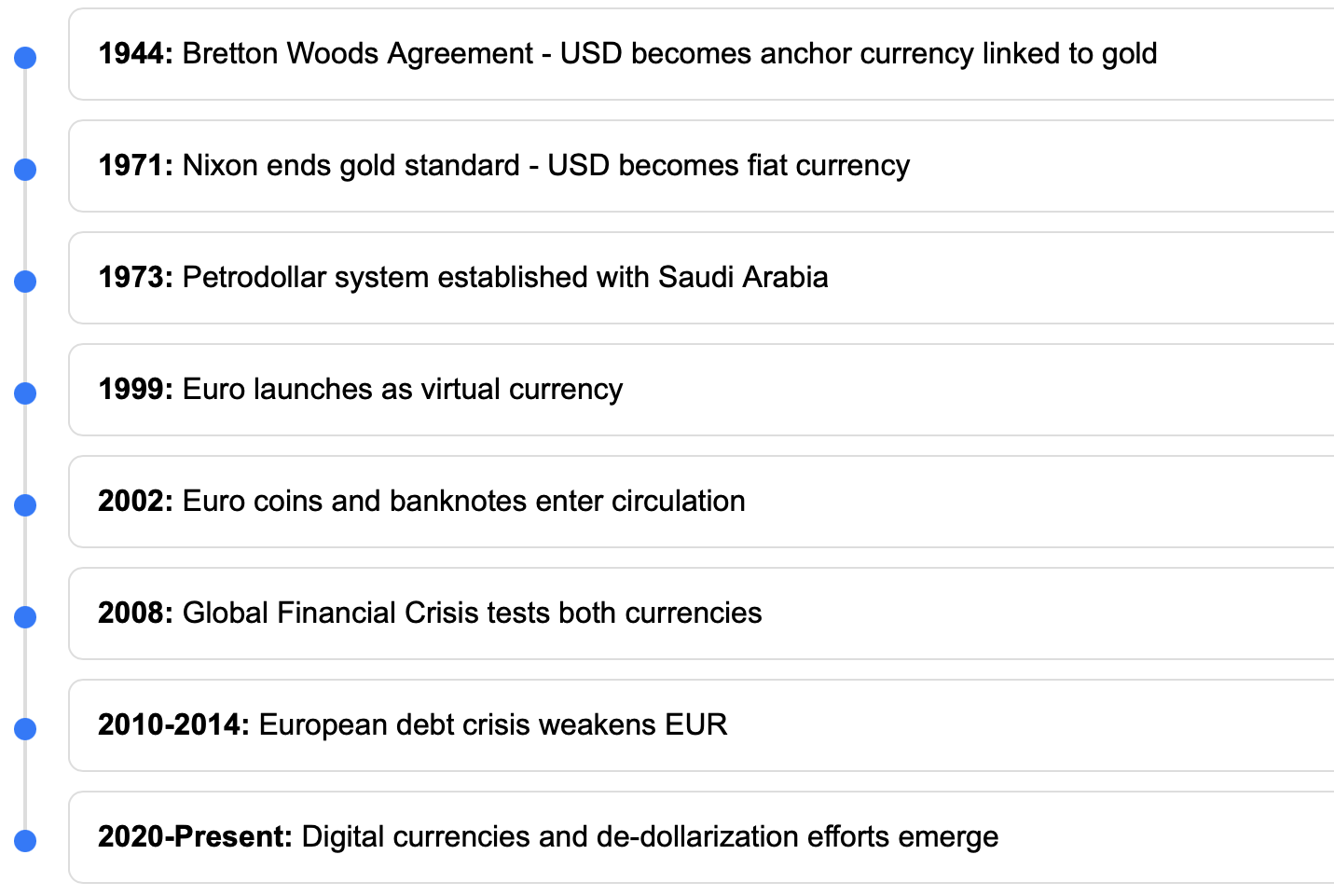
Global Financial Crisis (2008) The euro experienced a significant amount of volatility because investors began to wonder whether Eurozone economies would remain viable for the future.
Debt Crisis (2010 – 2014) Concerns surrounding sovereign debt in Greece, Italy and Spain caused the euro to depreciate significantly, illustrating to markets the structural complexities behind the common currency that would leave it vulnerable to deviations away from the original intent of creating a stable currency.
Beginner analogy: Think of the “superpower nation” being the USD, while the EUR from a "regional perspective" serves learnings relationship among nations that may work together, but are also subject to national selfinterest when needed, which can fracture observed, stability.
IV. USD vs. EUR Dynamics
The relationship between the U.S. dollar (USD) and euro (EUR) lies at the core of the global foreign exchange market. While each of these currencies has its own power, the relationship itself expressed most readily in the currency pair EUR/USD is where global capital flows, central bank policies, and market sentiment combine.
The Seesaw Effect
The USD and EUR are often complements for one another in the sense that a movement that favors one say toward the "safe" haven of the USD will mean a movement to the detriment of the EUR (and visa versa). This interrelation is what has allowed EUR/USD to become the most liquid and traded currency pair in the world, now comprising more than 20% of total daily FX turnover (see BIS 2022).
Arbitrage and Hedging Dynamics
For professional traders, the USD EUR dynamic provides excellent context for seeking two common strategies:
1. Arbitrage: Any slightly differing prices for EUR/USD are arbitraged across exchanges and profits accrue almost instantly.
2. Hedging: Multinational enterprises model EUR/USD hedges to curtail revenues that would otherwise be impacted by negative exchange rate movements (e.g., a U.S. exporter selling in Europe wants to hedge the euro weakening currency risk).
Policy Divergence and Market Influence
Diverging monetary policies between the Federal Reserve (Fed) and the European Central Bank (ECB) often lead to EUR/USD volatility. For example:
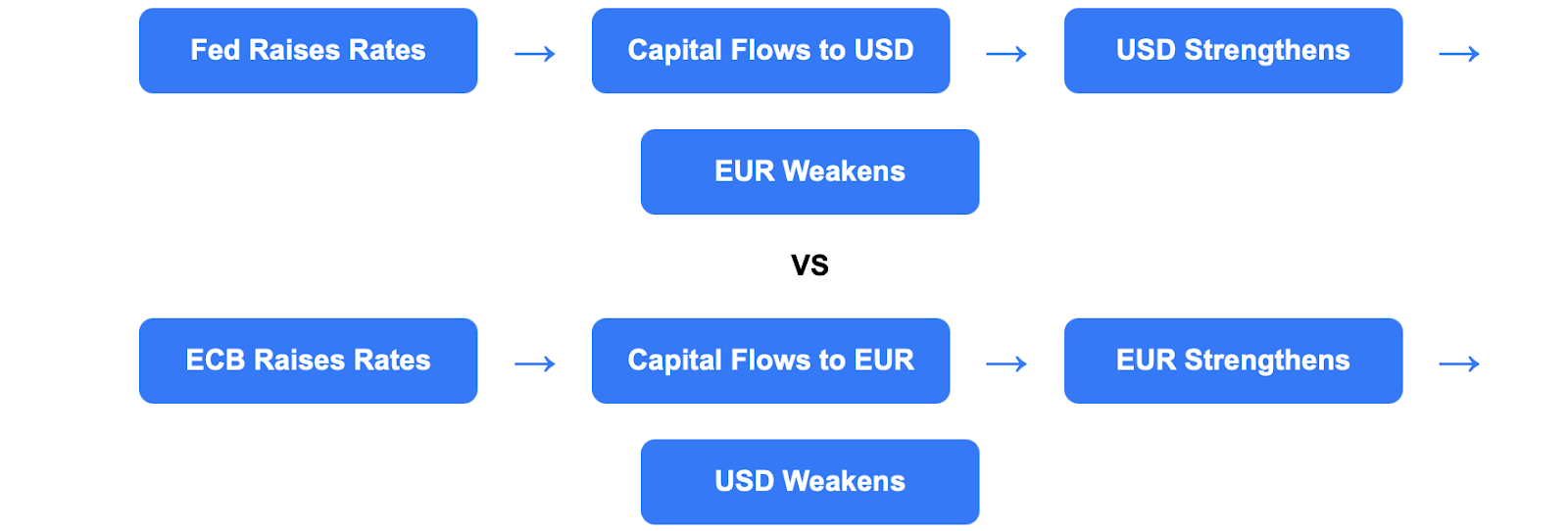
If the Fed increases interest rates and the ECB maintains its current policy stance, capital flows into the U.S. will increase demand for the dollar (increase its value), and decrease demand for the euro (decrease its value).
If the ECB tightens policy faster than the Fed, the euro will strengthen.
Beginner Example
You can think of USD and EUR as two large weights on a balance beam. When one side becomes heavier (increases in value), the other side has to naturally lift (decreases in value). Traders theorize that this balancing act indicates not just currency trends (and potential trades), but also the overall health of the financial markets.
Examples:
Professional: In 2014 during the Eurozone debt crisis, the euro sharply depreciated against the dollar, as investors were uncertain regarding the stability of southern European economies.
Beginner: A U.S. tourist who is visiting Paris notices that their hotel bill in euros is getting cheaper in dollars as the euro weakens.
V. History & Evolution
To arrive at understanding the dominance of the USD and rise of the EUR, we need to find their historical origins. The narrative accounts the typical tale of fluctuations in power coupled with global crises as well as aggressive monetary policy experimentation, which laid the foundations for today’s Forex marketplace.
The Rise of USD: Bretton Woods and Beyond
The USD became the fulcrum of global finance, following the 1944 Bretton Woods Agreement in which the USD was irrevocably linked to gold, and other major economies pegged their currencies to the USD. The system created an anchor currency, which was secured by the world’s gold reserves.
When President Richard Nixon unshackled the USD from gold in 1971, it was a defining event in the collapse of the gold standard. Rather than the collapse twisting the dollar into depreciation, it transitioned into an era of fiat money hegemony, with the USD at its epicenter.
Shortly thereafter, the petrodollar system arose when oil and a majority of commodities became price indexed to USD. This established a permanent demand for USD and provided the foundations for global leverage from the financialisation of everything.
The Birth of the Euro
In comparison, the euro may be regarded as a newer project. Initially launched in 1999 as a virtual currency solely used for accounting and transacting and it became a tangible object in 2002, when euro banknotes and coins were circulated replacing national currencies such as the Deutsche Mark, French Franc and Italian Lira.
The euro was meant to counterweight the dollar an opportunity to put Europe together under the banner of one monetary regime. The euro did succeed at increasing the integration of region, however it did not only challenge, the euro did not displace the USD as the dominant reserve currency.
Why The Euro Did Not Replace the Dollar
There are significant structural limitations to the euro's ability to fully compete with the USD:
-
Disjointed Fiscal Policy: Unlike the U.S. the Eurozone does not have a single fiscal authority. Legally each member states' integrates is budget independently leading to relied to be disjoint and often lack coordinated responses to challenge be resolved.
-
Debt Crises: The only period of prolonged crisis, most notably Greece (20102012), exposed vulnerabilities and gave barriers to doubt.
-
Political Fragmentation: Divergence of priority among the Eurozone member states introduces an uncertainty compared to a centralized U.S.
Introduction Analogy
Imagine the USD as a seasoned champion boxer, battletested through a lifetime of fights, and still standing. The euro as the new challenger talented and ambitious but occasionally slowed down by disagreements within the training camp.
VI. Policy Dynamics: Fed vs. ECB
If currencies are the veins of the global economy, central banks are the heart. The U.S. Federal Reserve (Fed) and the European Central Bank (ECB) are at the center of USD and EUR policy, constructing the values through monetary policies that set the tone globally.
The Federal Reserve: Global Impact
The Fed is not only America’s central bank, it is the world’s central bank. As the USD represents the world’s primary reserve currency, Fed decisions resonate with global implications.
Rate Hikes – As U.S. interest rates rise, global capital is drawn to the higher returns in the U.S., making USD more attractive and putting emerging market currencies under strain.
Quantitative Easing (QE) – During times of crisis, when the Fed engages in liquidity injections, it can serve to lessen the strength of the USD, but it also fuels peoples’ tendency to take risk in global markets.
Example – In 2022–2023, when the Fed raised rates aggressively (from a near zero rate interest rate to an above 5% interest rate), the massive appreciation of the USD across the globe forced emerging markets, especially countries like Turkey and Brazil, to intervene to defend their currencies.
The European Central Bank: Protecting Regional Stability First
The ECB shows more concern for stability in the eurozone rather than global dominance. Rather, it has to juggle two challenges:
Maintaining inflation under control
Meeting the needs of 20 unique economies, from developed Germany to debtladen Greece
As a result, we often see that the ECB is more cautious than the fed. Its policies are more focused on preventing fractures within the monetary union than in achieving global dominance.
Interest Rate Differentials Impact EUR/USD
-
The most direct influences on EUR/USD are the differential in interest rates between the Fed and ECB.
-
If the Fed hikes first and faster than the ECB → USD appreciates, EUR depreciates
-
If the ECB surprises with a big hike while the Fed grows complacent and holds → EUR appreciates
Beginner's Lens
Think of the Fed as a strict father, taking action and making the big moves while regulating the household. The ECB is like a nice teacher who must keep the peace in the classroom of students with various needs.
VII. Indirect Effects on Global Markets
The strength or weakness of the USD and EUR does not stop at the currency charts it cascades to commodities, emerging markets, and global trade. Their volatility often sets the tone for the financial world, as a master switch to many interconnected things.

Commodities: The Dollar Connection
As most commodities are priced in USD, including oil, gold, and agricultural items, fluctuations in the dollar will have a direct impact:
Strong USD → Falling commodity prices: When the dollar is strong, commodities are more expensive in local currencies which leads to less demand globally.
Weak USD → Rising commodity prices: When the dollar is weak, it effectively makes commodities cheaper globally, resulting in higher demand and eventual price increases.
Example: In 2015, crude oil prices fell below $40/barrel because of a strong USD, creating pain for energy exporters.
Emerging Market Disruptions
Emerging markets are often at the most exposure to fluctuations in the USD:
-
When the USD is strong, capital flows out as investors flee to U.S. assets for the yield.
-
Local currencies weaken which make it more expensive to service dollar denominated debt.
-
This cycle can create crises, as highlighted by the Turkish lira (2018) and Argentina's currency crises.
As an example, Fed rate hikes in 2022 drove significant depreciation in the Brazilian real (BRL) and the Turkish lira (TRY), which put central banks into a position where they were forced to burn through reserves.
Global Trade: Settlement & Stability
Since most international trade contracts are denominated in USD, any shift in its values are transmitted throughout supply chains around the world in the following way:
With a strong USD, imports are cheaper for Americans (and expensive for everyone else).
The EUR has its place to affect a region, as a secondary currency to trade on, particularly throughout Europe, Africa, and parts of Asia.
VIII. Future Outlook & Challenges
Currently, the USD and EUR are leading the way in the Forex market; but they can't stay on top forever. The factors for some changes in structural finance, technology and geopolitics provide potential challengers. Key trends are critical for traders, investors and policymakers to understand.
1. RMB Internationalisation
-
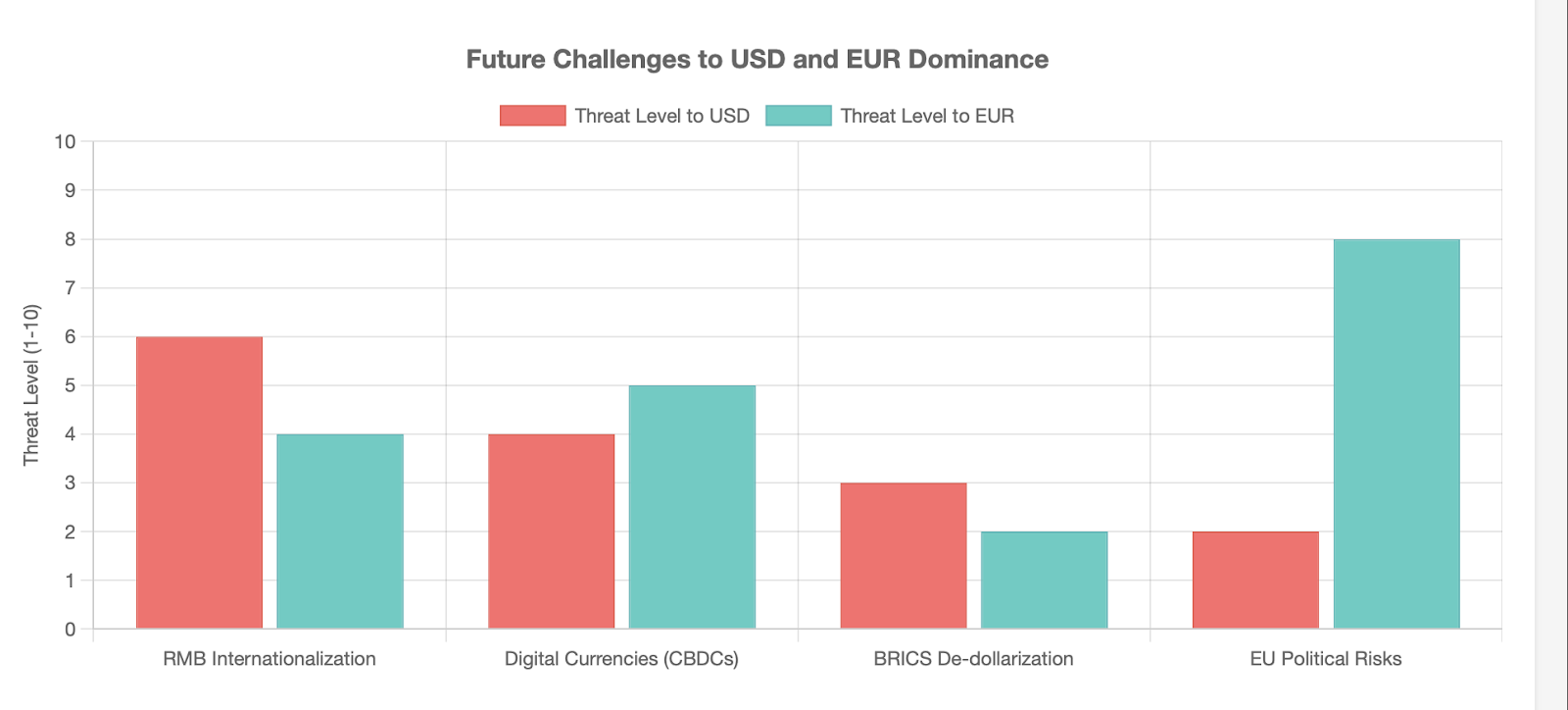
China has been consistently encouraging wider acceptance of the renminbi (RMB) as,
-
Increasing use in crossborder trade settlement, mostly within Asia and Africa.
-
Increasing use in SWIFT payments, though this is only approximately 5% of all payments, compared to the USD 40%+ share.
-
Increasing use in energy trade for example, in 2023, Saudi Arabia gave a tacit signal they would accept RMB for oil sales.
-
This is all real progress, but significant capital controls within China will continue to restrict RMB adoption.
2. Digital Currency (CBDCs)
-
Central banks are starting to experiment with central bank digital currencies (CBDCs).
-
A digital USD could reinforce the dollar's hold on dominance in global finance by increasing the speed and security of transactions.
-
A digital Euro could reinforce the EU's stature in all digital payments too, including crossborder transfers in Europe.
-
While these digital currencies will change the underlying mechanics of Forex markets, they will likely not disrupt established reserve currency rankings anytime soon.
3. DeDollarization and BRICS Initiatives
A coalition of emerging economies BRICS (Brazil, Russia, India, China, and South Africa) is actively exploring the possibility of dedollarization.
-
Uses of local currencies in bilateral exchange continue to rise,
-
Potential ideas for a BRICS reserve currency have been discussed.
Still, options for alternatives to the dollar are more symbolic than systematic without a unified governance structure or deep enough financial markets.
4. Challenges Facing the Euro
The strength of the future euro will depend on the EU's ability to deal with the following internal divisions:
-
Fiscal policies of member states continue to diverge,
-
Political risks exist (Euroscepticism persisted in a few countries),
-
Structural issues exist (energy dependency; demographic headwinds).
Examples:
Professional: 2023 discussions of RMB oil settlement show slow but incremental change in trade currencies.
Just like Netflix disrupted TV but didn't take its place overnight, it is highly possible that while new digital currencies will segment into the niche of payment alternatives along side USD/EUR vs. the "extinct" currency, it is unlikely that they will take their "place".
IX. Implications for Traders & Everyday Life
The movements of the USD and EUR do not exist only in chartsthey matter to both traders and laypeople alike in everyday life. Whether it is from a trading desk in London or a student simply studying abroad in Paris, currency take on all types of financial significance.
For Traders: A Market of Opportunity
Central Bank Watching: For professional traders, every Fed and ECB announcement is an opportunity to profit from market volatility. A 25 basispoint (0.025%) move can directly move EUR/USD by 100s of pips.
CFDs and Forex Trading: Many retail investors in USD/EUR pairs will use contracts for difference (CFDs) which provide the potential to profit from both up and down price movements.
Risk Management: Currency can move violently and so hedging strategies are key especially for companies/concerns who have international revenues.
Example: For example, in 2022, an aggressiverisked trader who knew those hikes were inthe market ahead of the Fed's decision could go long USD and short EUR and potentially capture 'the move' as EUR/USD underwent a race to parity.
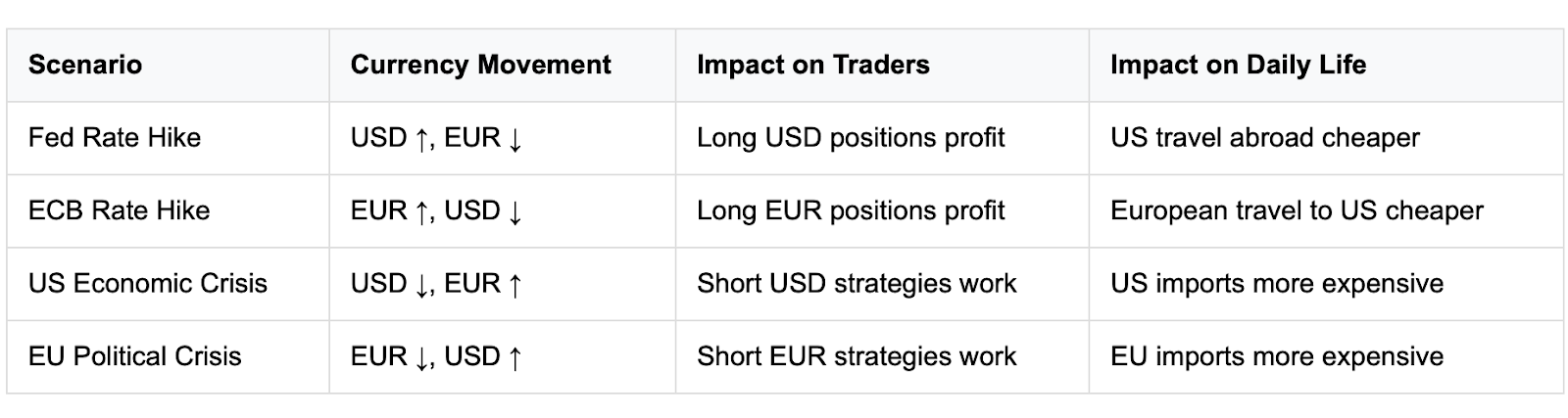
For Everyday Situations: Effects on Daily Living
Currency fluctuations affects much more than just trading:
Travel: Stronger dollar = More value for the American tourist abroad, but higher costs for the European tourists visiting the United States.
Education: International students studying in the United States, or Europe, will see tuition bills fluctuate in home currency.
Ecommerce: The price of online retailing varies through price increases or decreases by the USD/EUR currency pairing.
Example: A student from India paying their tuition fees in USD experienced a 10% rise in tuition costs due to the depreciation of the Indian rupee in 2022. However, the university in the United States did not change the cost of tuition in USD.
Practical Tip for Beginners
The best way to get used to how currency movements will affect their value is to actually trade! Most trading platforms will offer demo accounts.
Places like Tradewill.com offer free demo environments where beginner traders can learn how EUR/USD works around a particular news event without risking any of their own capital.
Conclusion
The dual monetary anchors of the Forex market are the USD and the EUR as they affect the way we trade currencies, commodities, conduct global trade, and even our daily lives. The two currencies together account for over 80% of daily turnover in the Forex market and are the touchstone for all other currencies in the world.
For traders, understanding the policies and the direction of monetary policies from both the Federal Reserve (Fed) and European Central Bank (ECB) is paramount. For most people, the impact is less evident, but reflects in travel costs, tuition fees, or online prices.
In the near future, there are challenges ahead, i.e. internationalizing the RMB, establishing digital currencies, and the efforts to move away from the USDbased system. Nevertheless, for the immediate future, the USD and EUR remain the champion and cochampion of the global monetary system.
In closing, the message is clear:
For investors → Analyzing the movements in the USD and EUR along a time line can give potential trading opportunities on the most liquid markets in the world.
For everyone else → Being aware of trends in offshore currency values/rates will lead to better financial decision making. In addition to being a global financial citizen, it can inform students planning to study abroad, and for people that buy imports and stuff.
If you would like to have more indepth knowledge and trade currency without risk, go to Tradewill.com. Explore expert information and use a demo account to practice currency trading on EUR/USD and many other majors.
Disclaimer: The content of the blog does not represent any position of Trade W, does not serve as any trading-related decision advice, and does not endorse any third-party.