

 Trade W
Introduction: Why USD/MXN Matters in 2026
It has been an eventful year in the dollar/peso exchange rate universe; as of one year ago, the peso gained strength, while the dollar received a boost from Fed interest rate increases. You may be wondering if this is an opportune time to purchase dollars or if you should continue using pesos; that is the key question.
As you prepare for the upcoming year (2026), you should anticipate that it will be a year of decentralised decision-making by both Central Banks (the Federal Reserve and Banxico). Adding to this uncertainty is the potential for a dramatic increase or decrease in commodity prices . Altogether, it is as though all participants are playing high-stakes poker, and they are all revealing their cards.
This article will provide you with insight into the macroeconomic components that affect the dollar/peso exchange rate. We will evaluate realistic scenarios of the exchange rate and show how traders are positioning themselves. The information we present will be beneficial to both novice investors attempting to understand currency markets, as well as experienced traders seeking an advantage.
The "Super Peso" phenomenon that occurred in 2023 was unexpected by most. It is essential that we do not permit a similar situation to develop in 2026.
2026 USD/MXN Outlook: Will the Dollar or Peso Lead the Trend?
Exchange Rate Forecasting Will Not Rely on Crystal Balls, Rather an Understanding of Possible Future Scenarios Under Different Conditions.
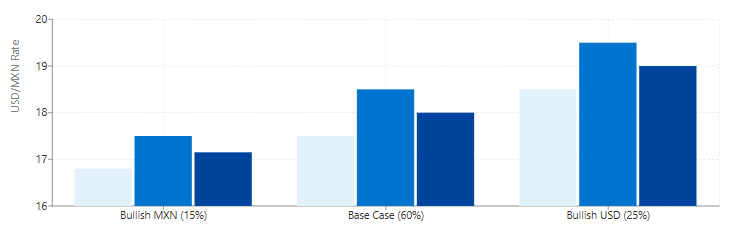
We have created three different future scenarios for the USD/MXN exchange rate.
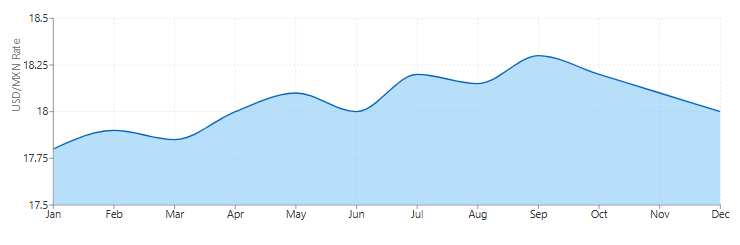
The Base Case Scenario: USD/MXN Between 17.5- 18.5
The base case is the most likely outcome if everything remains at a steady state. The Fed will reduce interest rates at a gradual pace, and the Banxico will be on a similar path but will still have at least somewhat attractive interest rates in Mexico. Therefore the peso will be stable and not depreciate or appreciate significantly.
Bullish Scenario: USD/MXN Between 18.5-19.5
If the US economy is still doing well based on US economic data and the Fed must hold higher interest rates for an extended period of time, the dollar will do better. Additionally, there are some global uncertainties such as geopolitical and financial stresses, so money will flow back into dollars. The dollar acts as a safe haven for investors when they become anxious; therefore they will go into dollar investments despite not offering the highest yield available.
Bullish MXN Scenario: 16.8–17.5 Range
If Banxico (Bank of Mexico) takes a hawkish position on monetary policy while the U.S. Federal Reserve cuts interest rates very quickly, this will lead to a stronger peso. The weight of high oil prices will also contribute to strengthening the Peso since it would make Mexico more financially secure. The continued trend of companies moving their manufacturing closer to the U.S. (Nearshoring) may lead to an influx of foreign investment in Mexico which may be enough to add more fuel to the fire that will create upside surprise on the peso.
Because there are many different factors (interest rate differentials between the U.S. Federal Reserve and Banxico; outlook of global investors/risk appetite; U.S. economic activity; and Mexico's political climate and fiscal situation) that are interdependent, a continued strong U.S. economy may protect against further cuts by the Fed and could therefore create a greater difference in interest rates between the two countries and thus, fuel the peso's appreciation via the increasing peso carry trade flows, while at the same time the continued growth of the U.S. economy may lead to increased risk appetite causing the dollar to lose value.
The use of "if-then" logic instead of making dire predictions is the most prudent way to approach the current volatile market. In March 2020 following the COVID crisis, the USD/MXN exchange rate spiked to 25, and the price quickly fell to 19 as the market settled. Markets operate very quickly. Therefore, by creating possible scenarios, the investor has a better understanding of potential positive/negative outcomes as opposed to taking very large risks in a market on one possible outcome.
Federal Reserve vs Banxico: Interest Rate Differentials Driving USD/MXN
Understanding and tracking how USD/MXN works requires an understanding of liquidity and investment interest based on risk.
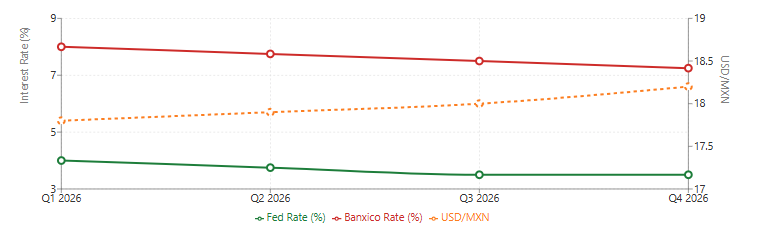
The value of USD/MXN is determined by the interest rate differential between the US Federal Reserve and Mexico's Central Bank (Banxico), as illustrated, when Banxico has an 8% interest rate and the Fed has 4%, investors will want to invest in pesos due to interest rate differentials resulting in demand for pesos and, therefore, a lowering of USD/MXN prices.
Using the analogy of Bank Interest Rate Comparisons ; If I had two different banks that offered savings accounts; Bank A at 1% and Bank B at 8%,where would I place my money? The same principle applies when determining the value of currency on the Forex market.
As we begin the Year 2024, the Federal Reserve has maintained their record interest rates for decades, during the course of 2024, rates are predicted to cut as inflation drops in the United States. The most current belief is that the Federal Reserve will cut rates two to three times during 2024 & end up with a Fed Funds Rate between 3.5% & 4.0% by the end of 2024.
Besides the Federal Reserve, Banxico is also dealing with inflation within their country and is therefore taking care to not rapidly drop their interest rates. If Banxico were to rapidly reduce their interest rates, it would weaken the Peso, thus increasing the price of goods imported to Mexico & creating imported inflation within Mexico
Rate differentials between Mexican pesos and US dollars should encourage carry returns to Mexico; as long as the Fed is cutting rates more aggressively than Banxico, those differentials will give a larger profit margin for investors. This was the case from 2016 until March of this year, as the Peso remained strong despite the ongoing political turmoil in Mexico because of this carry trade inflow related to Mexican interest rates being higher than those offered by other countries.
However, once the outlook for the global economy changes, or in the case of the COVID-19 pandemic, that same carry trade or dynamic will come to an end. When there is a crisis, such as the panic surrounding COVID-19, investors will stop investing in Emerging Market currencies, and sell all of their Emerging Market investments, always converting back to US dollars, regardless of the interest rate spread. Therefore, the correlation between rate differentials (USD/MXN) and the Mexican peso will diminish because of all of the negative factors occurring in the economy.
What will happen in 2026 is determined by the Fed dot plots, as well as Banxico's Quarterly Inflation Reports. If there is a larger interest rate spread, then there will be increased support for the Mexican peso as long as global markets are stable.
Five Unpredictable Factors: From Mexico's Election to US Inflation
The currency market is always looking for surprises, and 2026 is set to produce lots of them! In addition to economic data and interest rates, there will be many surprises to play with when it comes to the USD/MXN pair.
The Political Direction of Mexico
The impact of the Mexican election on fiscal policy is more important than the actual election results. If the incoming government takes an aggressive approach to spending, without having established revenue sources, Mexico will see an increase in its deficit. The market views a widening deficit as a negative "report card," requiring the market to provide a higher level of return to hold a peso asset. As a result, the risk premium on holding pesos increases and the value of pesos decreases.
Resurgence of US Inflation
Many people expect that inflation has been conquered. However, if inflation returns again in the United States, the Fed will have no alternative but to reverse its course and begin increasing interest rates again. This scenario will provide strength to the U.S. dollar, resulting in increased value for the USD/MXN and an increase in the U.S. dollar to Mexican peso exchange rate. The 2023-2024 interest rate hiking cycle demonstrated that an increased level of strength of the U.S. dollar will occur very rapidly if the Fed becomes aggressive.
Uncertainty in US Policy
Election seasons produce changes in policy in the United States. Trade policy, immigration policy, and fiscal spending are all key factors that affect cross-border flows with Mexico. The USMCA trade treaty is set to come up for review in 2026. Any indication of renegotiation or implementation of new tariffs will present a risk of increased volatility for the peso.
Changes in Global Risk Appetite
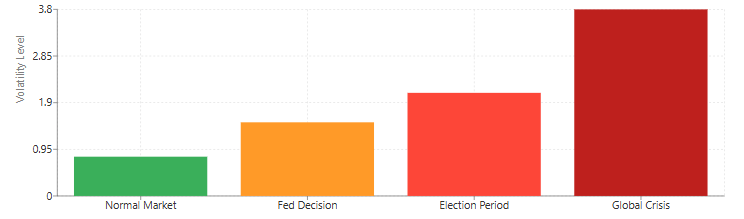
There is a lot of variability in the Mexican peso since it is a currency of an emerging market and therefore sensitive to fluctuations in global investor risk appetite. As an example, when there are periods of financial stability, capital will flow into assets with higher yields in emerging markets. Conversely, during periods of market "panic," that same capital will leave those assets quickly. This was evident during the early stages of the coronavirus pandemic, where the usd/mxn exchange rate moved from 19 to 25 as a direct result of investors' reaction to COVID-19; this rapid change reversed itself as central banks began "stimulating" the economy to combat the effects of COVID-19.
Changes to Supply Chains
There has been a growing trend of foreign direct investment (FDI) to Mexico as a result of companies relocating production from Asia to Mexico (nearshoring). FDI is one factor that generates a greater need for Mexican pesos, since it is necessary to build factories and pay employees. Nearshoring is a longer-term trend, but it has the potential to create sustainable demand for Mex. pesos over time.
Takeaways
The above-mentioned factors create increased volatility in the currency market; therefore, they cannot be predicted with any level of accuracy but must be closely monitored for timely trading opportunities. Professional traders do not attempt to estimate all potential outcomes, but rather take positions that allow for multiple possible outcomes and adjust those positions as more data becomes available.
Oil Prices and the Peso: The Hidden Correlation Traders Overlook
Mexico's oil production creates its government some tax revenue. An increase in the price of oil increases Mexico's government tax revenue. Better fiscal health means lower risk premiums and higher demand for the Peso. This connection is very simple, but many traders do not consider it when looking to buy or sell the Peso.
The Peso is a commodity currency; like the Canadian Dollar (which is related to the price of oil) and the Australian Dollar (which are related to the Price for Iron Ore and Coal). For instance, if a family business sells oranges and the price for oranges doubles, the family will have more income-Banxico has created more room to fight inflation without collapsing their economy by using higher oil revenues to increase fiscal strength.
In 2022, Oil prices rose dramatically as a result of Russia's invasion of Ukraine. As a result, the Peso performed better than many other emerging market currencies, such as the Turkish Lira. The increased oil revenues provided Banxico with fiscal strength to combat inflation without negatively affecting the economy.
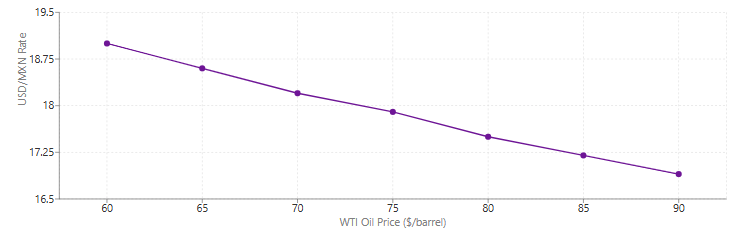
However, this is a correlation and not a straightforward one. Oil prices can increase due to Supply disruptions, which will support the MXN as well as slow down the falling demand and will decrease the MXN's strength against most currencies. Additionally, a sudden increase in oil demand can lead to the devaluation of the Peso and generally cause an economic recession for many emerging markets and their currencies.
Analysts are projecting WTI crude oil prices between $65 and $85 a barrel for 2026 based on economic growth forecasts globally and on OPEC production expectations. On the upside, if oil stays within that range, it should mildly support MXN; as a result, falling below $65 would eliminate one source of support for the peso, but rising above $85 could enhance the value of the peso beyond what current interest rate differential levels would indicate.
In comparison, the Canadian dollar relates more closely to oil prices because energy exports make up a larger percentage of total Canadian exports than for Mexico. Therefore, while peso exposure to changes in oil prices is significant, it is not nearly as pronounced as that of the Canadian dollar.
2026 USD/MXN Scenario Modeling & Forecast Ranges
To develop a potential outlook for the USD/MXN exchange rate by the end of the year 2026, we'll use scenario analysis. Professional forecasts utilize scenario analysis because forecast errors occur too often due to the complexity of market interactions among variables and the increased frequency of low probability opportunities than predicted by models.
In this analysis we will utilize three main variables: interest rate differentials, oil price and political/election risk factor. For each variable, we will provide three assumptions: Base Case (most likely) Scenario, Optimistic Scenario (for MXN) and Pessimistic Scenario (for MXN).
Base Case Scenario (60% Probability): 17.5-18.5
-
The Fed will be reducing rates two to three times and Banxico reducing rates once to twice, leaving an interest rate differential between approximately four percent.
-
Oil prices throughout this time period are expected to average approximately seventy to seventy-five dollars per barrel.
-
Political transitions will occur without any issues - no significant political surprises or policies will occur that could alter the direction of the economy.
-
Expectations of global risk remain neutral.
This Base Case Scenario assumes that there are no shocks and the gradual return to a normalized policy environment for both countries and, as such, the peso will generally continue to trade within its existing trading range, with no extreme increases or decreases.
Bullish USD Scenario (25% probability): 18.5-19.5
-
Fed holds rates higher due to sticky inflation, or cuts less than expected
-
Oil prices drop to $60-65/barrel on weak global demand
-
Election outcomes trigger fiscal concerns or policy uncertainty
-
Global risk-off episode (geopolitical shock, financial stress) drives safe-haven flows
Here multiple negatives stack up for the peso. Narrower rate differentials reduce carry appeal, lower oil hurts Mexico's fiscal position, and risk-off sentiment amplifies the move.
Bullish MXN Scenario (15% probability): 16.8-17.5
-
Fed cuts aggressively (4+ times), Banxico stays hawkish, rate differential widens to 5-6%
-
Oil prices rally to $80-90/barrel on supply constraints
-
Nearshoring momentum accelerates, FDI flows surge
-
Global markets stay risk-on, emerging market currencies broadly strengthen
The following is an example of what ideally would happen for the Mexican Peso (MXN). All the factors working together are attractive interest rates, high commodity prices, structural improvements for long term economic growth as well as a supportive global environment.
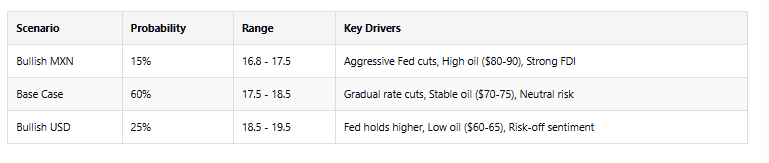
If the Fed makes an unexpected rate change, if there is an unexpected announcement from the Mexican fiscal authority or a geopolitical event occurs, the value of the Peso will change quickly. If we expect the Peso to have a particular number based on trends, we'll know that is incorrect and use ranges as a guide to determine probability.
You should think of probabilities instead of certainties. If you estimate 60% as the base case and 40% for others, the 40% probability of something occurring where you need to implement a risk management strategy.
How Traders Should Position for 2026 (Strategies + Risk Management)
Here’s where the Market goes before the U.S. Dollar/Mexican Peso (USD/MXN) can be traded for profit. Know that it's a different matter altogether to find a Trading Strategy.
Speculating Internationally on Market Events (short-term)
When news events occur in the market, they create volatility; and volatility presents a trading opportunity. Events such as Monetary Policy Decisions from the Federal Reserve and Banco de México, U.S. Inflation Reports, and Mexican Election Results create fast-moving markets for the USD/MXN. Event Traders, therefore, place trades prior to the release of these major news events and utilize tight stop-loss orders to protect their positions in case a move occurs opposite of what they anticipated.
For Example, typically, the day before Federal Reserve Monetary Policy Meetings a spike in Implied Volatility occurs. The Trader may purchase a straddle (which is a bet on moving in both directions) or position themselves in a directional manner - this would only apply if the Trader believes in a particular outcome strongly enough. It’s important to keep in mind that the markets tend to already price in the expected movement of asset prices- therefore; for the Trader to realize a profit from this strategy, a surprise must occur.
Speculating Internationally on Market Trends (medium-term)
Provided that the base case works out as expected; it is safe to assume that the U.S. Dollar versus Mexican Peso (USD/MXN) will remain in a defined Range for the majority of the year (17.50 - 18.50). Range Traders use a Buy Low/Sell High approach, taking profits once reaching the opposite extreme end of the range. There is nothing wrong with using this method; in fact, it works until it doesn’t - therefore; it is always advisable to use Stop Loss Orders when implementing a Range Trading strategy.
On the other hand, if there is a clear uptrend (for example, the peso rallying to 17 and below), trend traders may simply utilize trailing stops to profit from said uptrend. The recent rally that took place in 2023 with the Mexican Peso falling from 18.5 to below 17 validated this methodology of trading.
For Those That Enjoy Extend the Rate of Return on The Carry Trade
As long as Banxico maintains higher interest rates relative to the Fed, the Carry Trade for the Mexican Peso will remain profitable. This means you would borrow money in U.S. Dollars at lower interest rates, convert it to Pesos, and have the ability to earn interest on that difference. However, the risk of this type of trade is that if the value of the Peso depreciates, you would lose your entire yield advantage and perhaps more.
Carry Trades normally work best in terms of the Carry Trade when the interest rate differentials are wide and the risk tolerance of the global markets is stable. However, they will not perform well in more volatile markets or environments. Therefore, if you intend to engage in Carry Trades, you should not only size them conservatively but also be ready to exit if volatility increases significantly.
Risk Management Rules
Always set your stop-loss on every trade. You should determine your absolute maximum loss before entering a trade, not after you have already lost money due to market fluctuations against your position. The standard is always to have your stop-loss within 1-2% of the position size.
Be mindful of how much leverage you utilize in trading the currency markets. Currency trading allows for a high degree of leverage for margin funding purposes; therefore, the leverage provided to you by your broker will increase both your profits and your losses. Just because your broker offers you a 50:1 leverage ratio does not mean you necessarily should use that amount of leverage. Most experienced traders utilize less leverage than the typical retail trader does.
It is advisable to stay clear of large positions before major events. Other than using event trading as your strategy, it’s best to minimize risk leading up to things such as Fed meetings, elections, and the release of major data releases. Many traders who have avoided taking large positions leading up to these events have saved their accounts from suffering large losses caused by one bad trade.
Some of the common errors traders commit include:
-
Relying on only headlines, without taking time to research and understand the underlying data;
-
Not paying attention to what has been happening with the rate differential between the USD/EURO or any currency when a major event is occurring;
-
Over-trading simply because the FX market is open 24/5 and because you feel you need to be in the market at all times.
Think of it as if you were purchasing an airline ticket for your next vacation. You look at peak-season travel times, compare prices, and you don't just wait until the last minute to decide on which airline you want to travel with, or even if you will fly that evening before your vacation starts. The same idea applies when it comes to trading. Conduct thorough research, wait for a solid trade setup, and don’t make trades merely to “stay active”.
Conclusion:
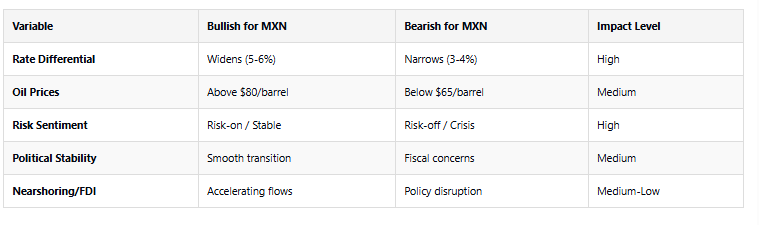
Looking to the future of the MXN/USD exchange rate, three key factors will determine the value of the currency pair over time in 2026: 1) The ongoing changes related to interest rates between the two central banks (Banxico and the Federal Reserve); 2) The effect on fiscal policy, and 3) The trend of commodities (especially oil), which will have significant ramifications on currency values.
If you can identify the anticipated direction of these three factors, you should be able to forecast the movement of the MXN/USD pair.
To track the Federal Reserve's Dot Plot and Meeting Minutes, pay attention to the Banxico's Inflation Reports, and Policy Statements. Also, monitor the prices of Crude Oil and the Global Risk Sentiment of Investors. Although news related to elections will continue to take center stage, Interest Rate Differentials will be the biggest factor impacting the exchange rate by December.
Despite having experienced some major upward movement in value over the last several years, the MXN/USD currency pair may not necessarily continue on the same upward trend indefinitely. Position yourself for multiple potential scenarios by managing your risks and remember that forecasting is not the primary goal; the goal is to be able to survive and profit from all scenarios.
Create a Tradewill Account for yourself, and access everything that an institution would!
Disclaimer: The content of the blog does not represent any position of Trade W, does not serve as any trading-related decision advice, and does not endorse any third-party.