

 Trade W

What is Wall Street Silver? From Reddit Rebellion to Market Force
In February 2021, a large number of retail investors on Reddit associated with GameStop's short squeeze determined that silver had a price discrepancy, where if enough participants made moves to call out the price, it would change. Silver was viewed by this group as the ultimate form of this movement.
More than a pure investment thesis, Wall Street Silver started as a social movement with a principal idea: The paper silver market is extremely over-leveraged compared to actual physical inventory. To execute this plan, the group agreed upon using a simple yet concrete approach; that is, purchase, hold, and remove from availability all physical silver bars and coins, holding them out of the trading system, creating a breakdown of the basic paper contracts and the actual physical, real metal.
The combined efforts of the retail investors popularised what is referred to as the "vault drain strategy." The premise is a simple one; if enough people were demanding to receive delivery of the actual physical silver commodity vs. using cash settlements, the COMEX warehouses backing the paper futures contracts and ETFs will run out of inventory. Once that occurs, the price of silver will surge as traders scramble to cover positions that they cannot deliver upon.
Was the vault drain strategy successful? Not necessarily; however, it did have positive results. The futures price of silver increased approximately 15% within the first two days of the silver movement.
The iShares Silver Trust was able to show significant inflows of new retail investors, along with physical silver dealers reporting shortages with premiums on coins increasing significantly greater than their spot price. Additionally, the COMEX inventory report area was being monitored more closely by industry participants than it has been in the past.
To better illustrate this analogy, consider a scenario where the total number of tickets sold or issued by an arena is 30,000, and there are only 100 actual physical seats. In the majority of instances, the ticket holders do not come to the arena to claim their seats and therefore, either trade tickets, resell tickets, or hold tickets for their financial value.
As a result, if all 30,000 ticket holders were to walk directly into the arena at the same time, there would be significant problems related to occupancy and access.
The movements of Wall Street Silver have created additional exposure and awareness to a unique structural defect or an imbalance of supply and demand, which many professional market participants have known for decades, but have not thought about.
The mechanics of the paper silver market operate on leverage ratios that most people would find appalling when compared to the actual physical supply or inventory that exists in the marketplace.
Regardless of whether you believe the narrative supports the movement, it has greatly changed the discourse around silver. Inventory reports have become commonplace in the media, versus being considered bargain shopping, and premiums or spreads have become evident in trading analysis, as well as forced CFD traders to reassess how they view and interpret silver volatility.
Paper Silver vs Physical Silver: Two Markets, One Price (Sort Of)
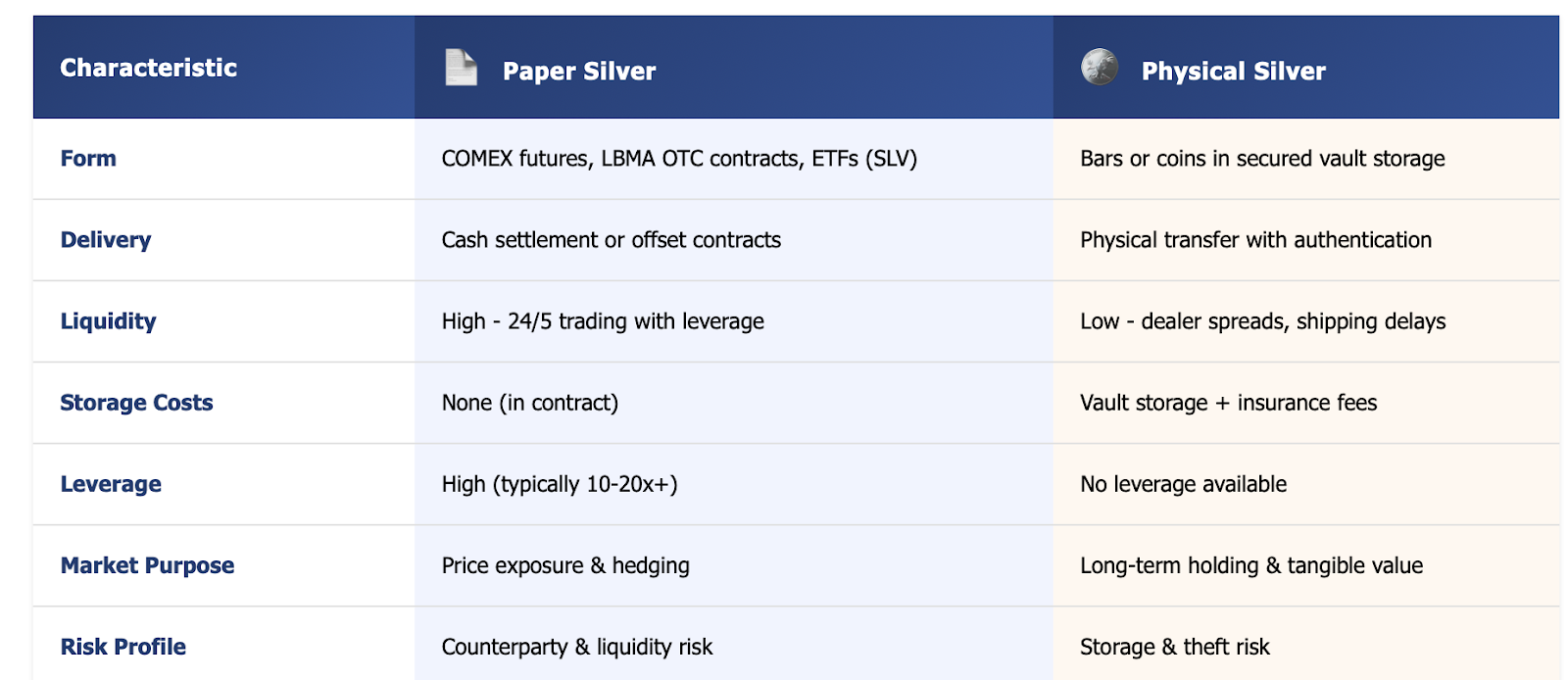
Things are heating up! Trading in physical silver is different from trading beyond physical silver. You will find 2 kinds of silver, the first, paper silver, consists of COMEX futures, LBMA over-the-counter contracts and ETFs like SLV. These financial products are all backed by physical silver.
No participant in the above will see any actual silver bullion. These contracts roll over at expiration, settle in cash or offset with matching opposite-position contracts. The market is designed to provide liquidity and leverage to traders of silver without concern for storage or logistical issues.
Physical silver, on the other hand, represents a bar or coin that exists physically in secured vault storage, that you own, that you store, that you pay dealer premiums for, and if you choose to sell, will need to ship to the purchaser and have the purchaser verify its authenticity. The world of physical silver trading has been clunky, costly to move and less liquid than futures.
The true structural divide that Wall Street Silver is focused on is commonly referred to as the paper-to-physical ratio. Estimates on this range from 200:1 to 300:1, meaning that, for every registered ounce of silver held in the world for which ownership can be claimed, there are 200 or more contractual claims against every ounce that will never be delivered.
As an example, let's say that a bank holds 1,000 digital silver coins in an account for customers. However, the bank also possesses 10 actual physical coins in its vault. As long as the digital coins continue to be traded and customers remain happy with that, there shall be no problems for the bank. Once a percentage of customers decide to claim the actual silver, the vault will be emptied very quickly.
It should be noted that the issue with the silver market is prevalent through all fractional reserve banks; however, the difference between the banking system and the silver market is that historically, traders of futures in the silver market have operated at much higher leverage ratios than traditional banks and that because there isn't a central bank that serves as a lender of last resort to those banks, they operate without a safety net.
When watching open interest in COMEX, which is the total active number of contracts, you typically see open interest at a number that is significantly more than the registered amount. In the average month, the registered silver held at COMEX would be approximately 50-80 million. However, the average open interest would be 800 million or more. That would represent a tremendous amount of contracts for which silver has never been at the same time in the world.
The volatility in the silver market can be significantly impacted by the activities of professional traders, whether they are watching for breakdowns to exit their existing futures positions, or to see them cash in to delivery, ensuring that silver prices increase rapidly.
Today, the vast majority of transactions completed in the silver market will not involve physical delivery of actual silver. Futures traders exit their futures positions through cash, ETF shareholders sell their share position to other investors, and OTC contracts will settle in cash. All market participants that settle and trade in silver assume that 95% of all silver trades will close without anyone requesting MLM delivery of actual silver that has been traded.
The difference in the thesis put forth by Wall Street Silver is that they intend to take action to force everyone to understand that this assumption is absolutely incorrect.
Is 300:1 a Financial Time Bomb? The Mechanics Behind the Squeeze
What happens when this assumption breaks down?
Let's do some math - if the existing ratio of paper to physical silver is 300:1, and only 5% of contractual holders ask for physical delivery, you're introducing 15 times more demand than already available on registered silver inventories. Obviously, not all of the holders can receive their metal. Some will be forced to accept cash settlement, or potentially pay a massive premium to source silver from other means.
Therefore, Wall Street Silver has described this situation as being "the biggest short squeeze to ever occur in the history of financial markets." The argument for Wall Street Silver is that the leverage ratio is evidence that a large portion of the silver market is structurally short on the actual metal, and the basis of that assumption has been that most people will not actually request physical delivery of their contracts.
Typically, for a short squeeze to occur, there is a catalyst to initiate one: heavy short interest, a limited number of shares available, and increased buying pressure forcing shorts to cover at higher prices. The same concept applies to the Wall Street Silver theory of a short squeeze due to physical delivery. If a large number of people request metal instead of cash, the shorts would be squeezed.
To illustrate this in a real-life example, imagine 30 people walk into a bank to withdraw cash, but the bank is prepared to supply only one customer with cash. The first several customers would be able to withdraw money; however, the remaining 27 customers could be forced to wait while the bank scrambles to obtain other funds from other branches, potentially pay urgently needed fees, or even close the branch entirely. In this example of a silver squeeze, that translates into higher spot prices, higher premiums to purchase silver, and the potential for failing to obtain delivery.
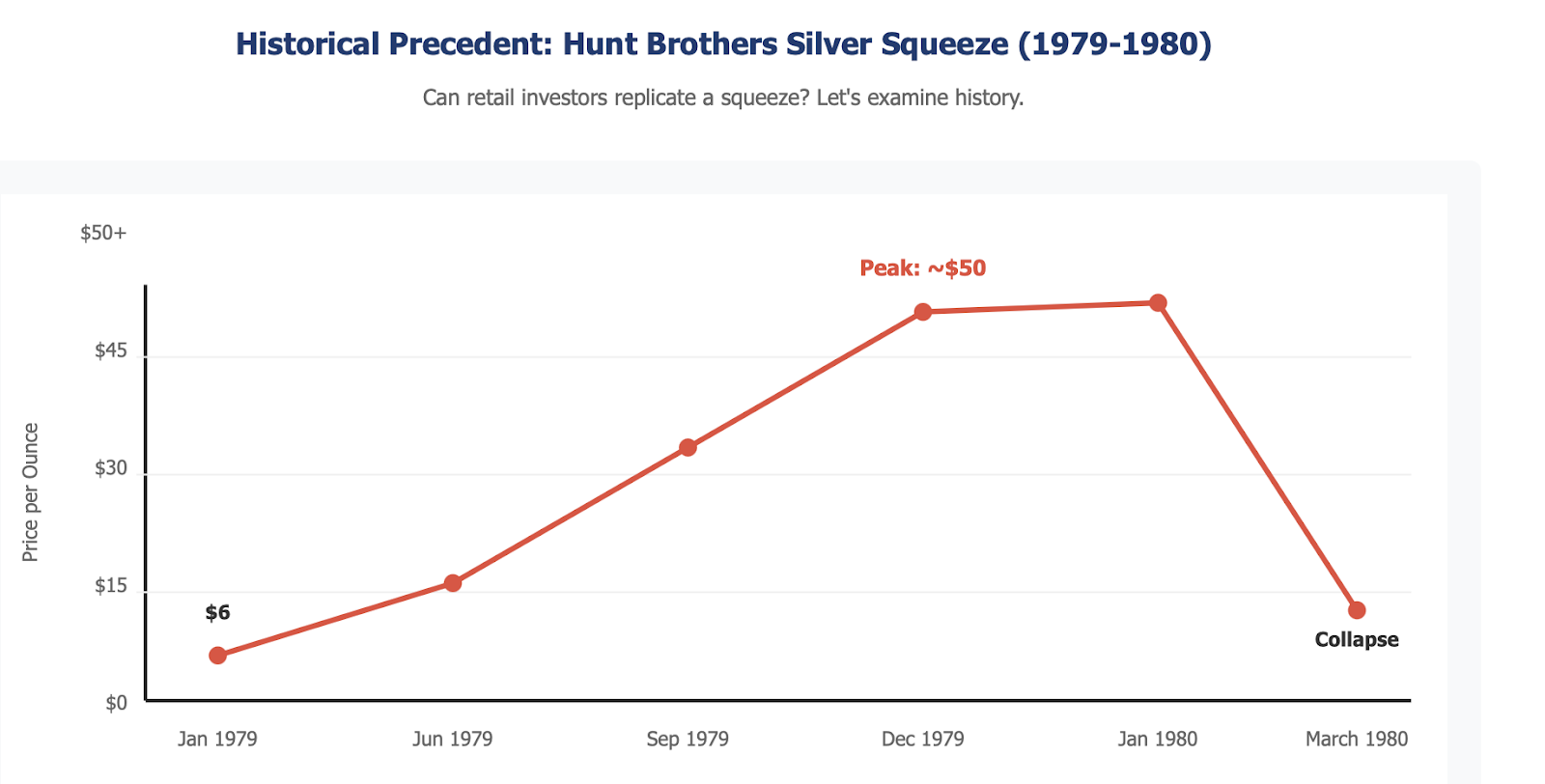
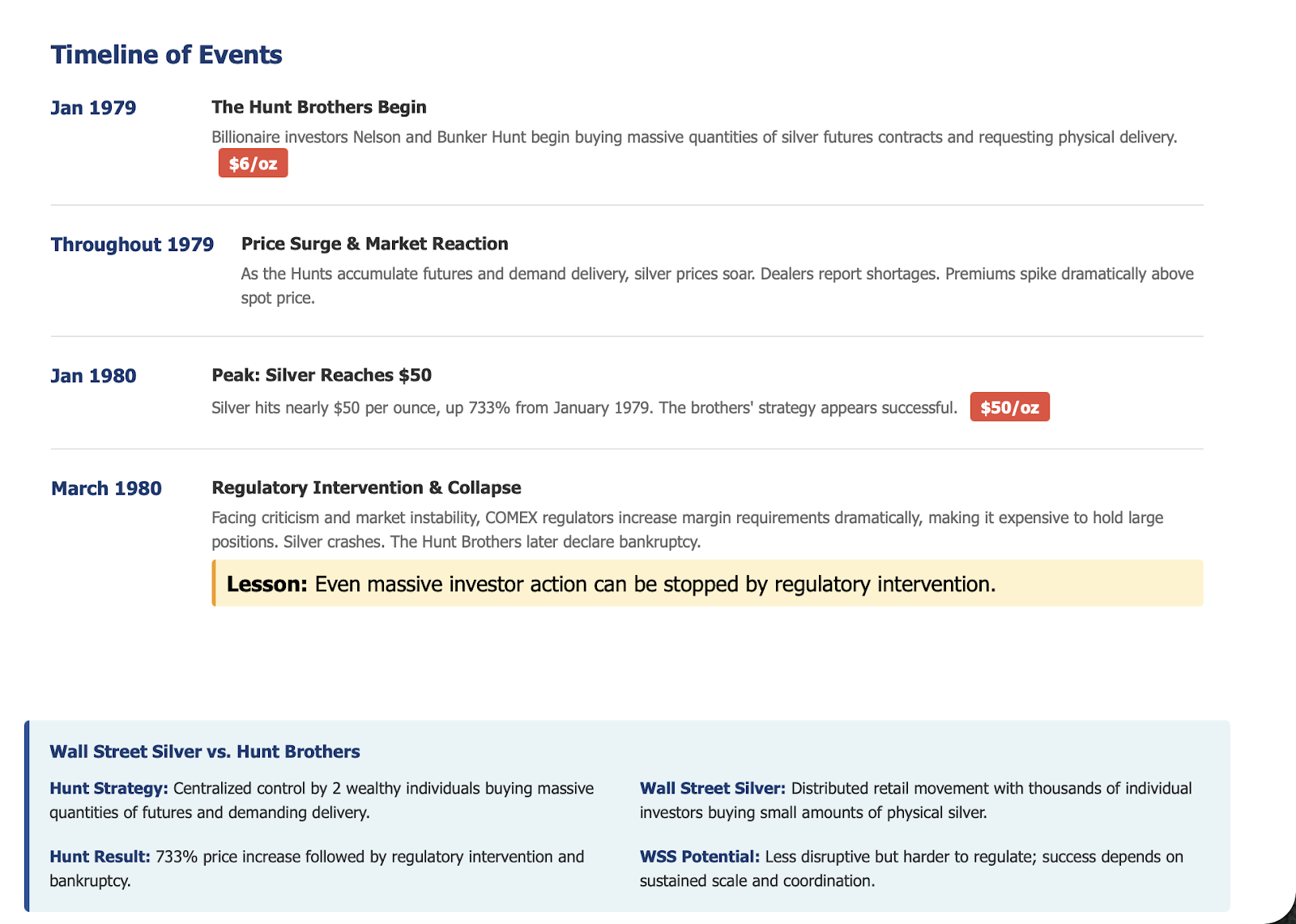
We can look at the Hunt Brothers from 1980 as an example of a historical short squeeze in silver. The Hunt brothers attempted to create an artificial shortage of silver by buying large volumes of silver futures and, at the same time, requesting the delivery of their futures. In January 1979, the price of silver was approximately $6 per ounce, and by January 1980, the price increased to nearly $50 per ounce.
After regulators intervened and changed margin requirements in buying contracts, the price collapsed, and the Hunts subsequently declared bankruptcy. Nonetheless, the Hunt brothers demonstrated that there is a capability of violently moving the price of silver through delivery pressure.
While the Wall Street Silver group is not trying to create a cornering of the market like the Hunts attempted with their method of operation, they are trying to create a distributed version, which is derived from a grassroots movement made up of thousands of retail investors each buying a small quantity of available metal.
Will this work? The success of the movement solely hinges upon the level of scale. If retail investors purchase a few hundred thousand ounces of physical silver, it would barely register in a market that trades hundreds of millions of ounces of paper silver each day. However, if there is sustained demand and coincides with the purchase of metals by large industrial users or institutional buyers, then this could produce a liquidity crisis.
The big picture is not that we know for sure when the squeeze will occur. There is a risk posed by the current structure, and that risk produces volatility, which creates trading opportunities.
LBMA & COMEX Inventory Crisis: What the Data Actually Shows
Let's take a look at what's actually going on with silver inventories, without falling into the hype.
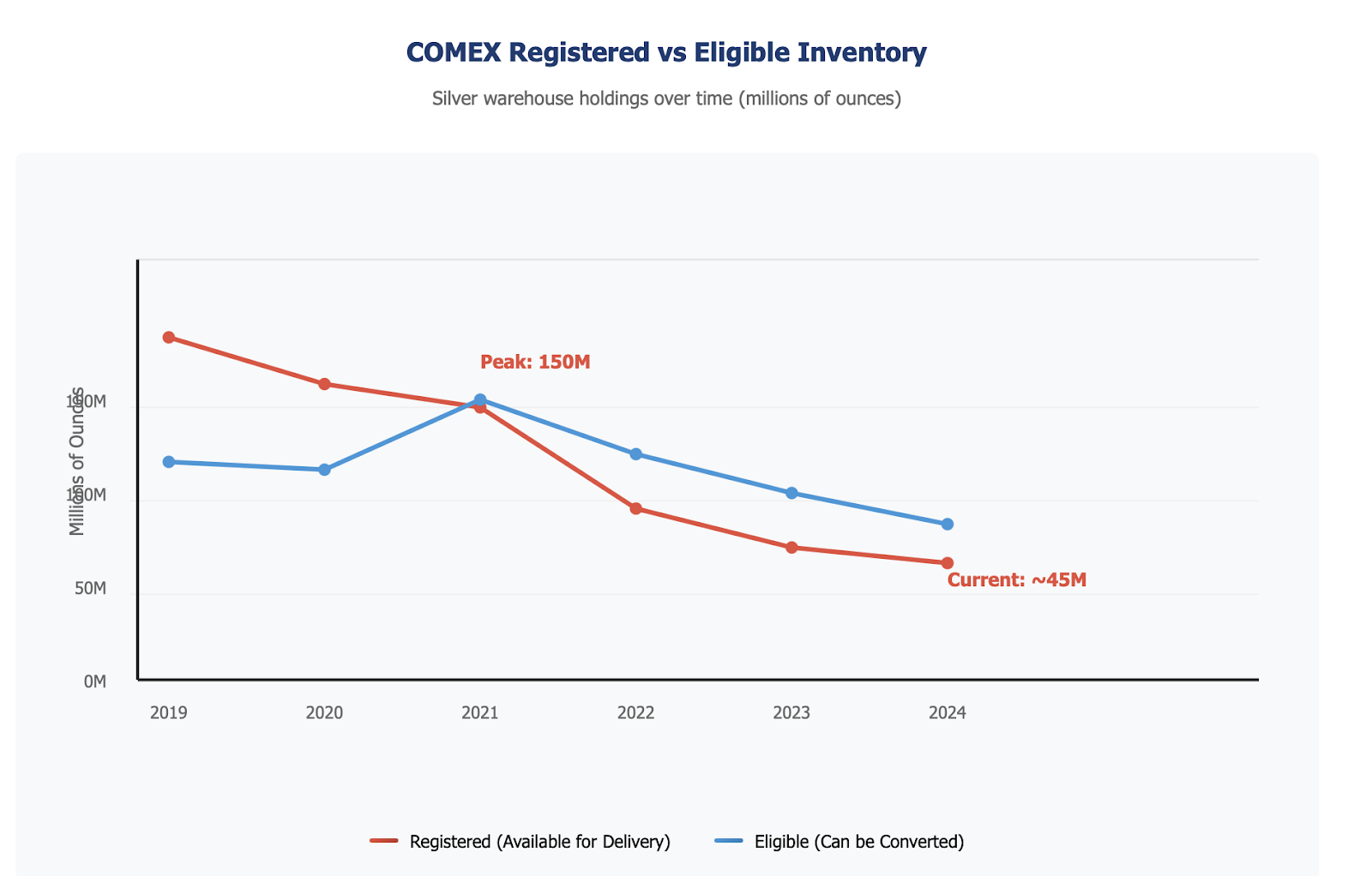
The COMEX reports silver holdings in two areas: "registered" and "eligible." Registered inventory is silver that has been approved for delivery against futures contracts. Eligible inventory is silver stored in COMEX warehouses but has not yet been designated for delivery. Delivery of contract obligations is dependent on the amount of registered inventories.
Registered inventories have seen a decrease from highs of 150M ounces to levels below 50M ounces. Those supporting Wall Street Silver point to the decline as proof of vault drainage, while critics argue that, because eligible inventories can be converted to registered with relative ease, the decline is not as substantial as it appears.
Both sides of the argument have valid points. Conversion from eligible to registered occurs; however, it is not instantaneous and is dependent upon the incentive of the warehouses. Furthermore, during stress periods, it will not always occur as quickly as traders expect.
The London Bullion Market Association (LBMA) publishes monthly inventory reports for vaults located in London, the historical hub for physical silver. These reports show total inventory and monthly changes, providing a broader look at the global inventory trends.
The LBMA inventory has experienced similar fluctuations, which are frequently driven by transfer flows from the West to Asia, where demand for industrial silver is located (the largest buyers of physical silver in the world are China and India, for both manufacturing and investment). Often, once this physical silver is moved East, it does not return to Western markets quickly, tightening the supply in Western markets.

The holdings of the ETF – particularly SLV – provide another data point. When silver inventories rise in SLV silver inventories, it indicates that investors are purchasing more shares than redeeming them, therefore pulling the metal into the ETF; and conversely, when silver inventories are low, it shows that investors are redeeming more shares than they are purchasing. Following the February 2021 squeeze, SLV daily inventories rose dramatically as retail investors rushed to buy shares and subsequently reduced as the hype wore off.
The reality is that inventory decline does not automatically equate to an immediate shortage of inventory. The market will provide adaptations through producing additional silver output, recycling silver from scrap, and increasing the price of silver to bring supply back in balance. However, reduced inventories provide a smaller buffer to absorb sudden shocks to demand, and often can amplify the volatility of the price of silver in reaction to unexpected shocks to the demand for silver.
Consider a warehouse that consists of two sections: one section holds silver ready to be shipped immediately, and the other section holds silver but does not yet have product. When the amount of silver stored in the "ready to be shipped" section is low, the warehouse can then pull product from the "not yet" section; however, it takes time and is dependent on the owner's intent to convert silver to registered inventories. If everyone rushes towards the entrance at the same time, there will quickly be no buffer left.
It is critical for institutional traders not to react to inventory levels as a binary signal for a crisis. Instead, institutional traders look for trends, measure month-to-month comparisons and cross-reference inventory data with open interest, speculative spreads and industrial demand reports. The aim of institutional traders is not to predict catastrophe, but instead to determine the early warning signs of stress in the commodity that could trigger a price movement in the short-term.
Premium vs Spot: Reading Market Sentiment Through Physical Silver
Whereas spot silver price reports to the Financial Times, Wall Street Journal, TradingView, and most financial news and trading platforms represent futures contract prices that reflect theoretical market prices based upon the immediate delivery of large volumes.
Premiums in terms of physical supplies include the cost of producing the actual coins used to make our everyday purchases. Additionally, physical premiums can rise or fall based on supply and demand for physical product.
Therefore, there will be times when premium prices will rise above normal, indicating to dealers that physical demand continues to exceed supply (i.e. it is not uncommon for the dealer’s inventory to quickly sell out, causing the need for the dealer to continue purchasing products). Premium prices usually track with physical product demand through either an inflationary environment of buying, or via huge surges in retail buyer interest that materialise suddenly.
An excellent example of this would be, in late February 2021, the average price of spot silver on the COMEX (1,000-ounce silver bar futures) was approximately $28, while retail prices for one-ounce silver coins available at local dealers averaged more than $35.
As you can see, a retailer selling you silver would have to charge 25 per cent higher than the spot price to reflect the difference in the averages between physical dealer to retail outlet and retail outlet to end consumer.
When dealers have too much product in stock, it is common for physical premiums to decrease the price from that original price, or when many other buyers are not buying their product supply, the premium price returns to or is close to cost. Premium price will also contract back toward cost, but would be significantly impacted due to supply/demand imbalances in the market.
This divergence relates to CFD traders, because premium prices are important for checking the influence on price fluctuations of XAG/USD vs. the premium prices. For example, if the silver price on XAG/USD is rising substantially, with premium prices remaining most stable, then silver future speculators may have an underlying supply reason for using futures, as opposed to a true reason based on the size of real-world supply. Conversely, if the silver price on XAG/USD is declining, and premium prices are increasing, then many of the real-world buyers will likely perceive an increase in apparent value.
The example I like to use is bottled water. Typically, Walmart will always have to sell bottled water at a lower price than a convenience store because people usually pay the higher price for immediate access when they are thirsty.
Therefore, if bottled water at the convenience store is selling for three times its typical cost at the convenience store, something has adversely affected the total supply of bottled water, whether it be panic buying due to some news or some sort of disruption in the bottled water supply chain.
Regardless of the reason for this water supply chain disruption, the disparity in price between the typical cost of bottled water and the higher, more arbitrary cost of bottled water provides insight into the supply side of the water industry that the actual price of bottled water cannot.
Therefore, to help provide insight into their prices, professional traders overlay premium prices with the prices for XAG/USD. If you illustrated a breakout chart for XAG/USD exceeding the actual previous price and if that breakout is accompanied by an increased demand for silver, then you would have solid evidence supporting your trade.
Alternatively, if a breakout occurs with a decrease in premium price, then you have no solid basis for establishing a trade. You would need substantial risk to validate establishing a long position versus pursuing short trades, especially if premium prices are likely to be much higher than normal.
While this is a good indication of the overall supply/demand of the silver market, premium prices are not the only factor reflecting the flow of silver between the physical market and the trading market. Premium prices provide confirming sentiment indicators, as well as tangible confirmation of price movement that could validate or provide insight for establishing selling or buying positions within the silver market and provide an overall “sense” for true market conditions in the silver market.
Trading the Paper-to-Physical Decoupling: Using XAG/USD CFDs
This is where the practical part of theory meets reality! How do you actually trade it?
CFDs on XAG/USD (silver/USD) give traders who would like to profit from volatility in the price of silver, based on Wall Street Silver dynamics or on general inventory issues, many possibilities.
1. You have leverage with CFDs, meaning that you can trade silver CFDs long, if you expect the squeeze narrative to take prices higher or short if you think the hype has extended too long, without receiving physical delivery of the metal.
2. CFDs also trade liquidly, 24 hours a day, 5 days per week, compared with physical silver, which has dealer spreads, shipping times and storage costs; therefore, you can get in and out of your positions, adjust your size as the market moves based on volatility, and have more precise stop losses to manage risk.
3. Silver (XAG/USD) tends to trade in waves surrounding inventory reports, social media trends and overall shifts in risk sentiment, and these types of wave patterns provide opportunities for trades if you know which ones to look for.
High-volatility breakout trading strategies work well before LBMA and COMEX inventory releases; when registered inventory drops significantly or when eligible to register converted to registered stalls, it is common for traders to push up the price of XAG/USD in anticipation of supply shortages. Breakouts above recent resistance levels that are confirmed with volume and increasing premiums are typically ideal entry points with defined risk.
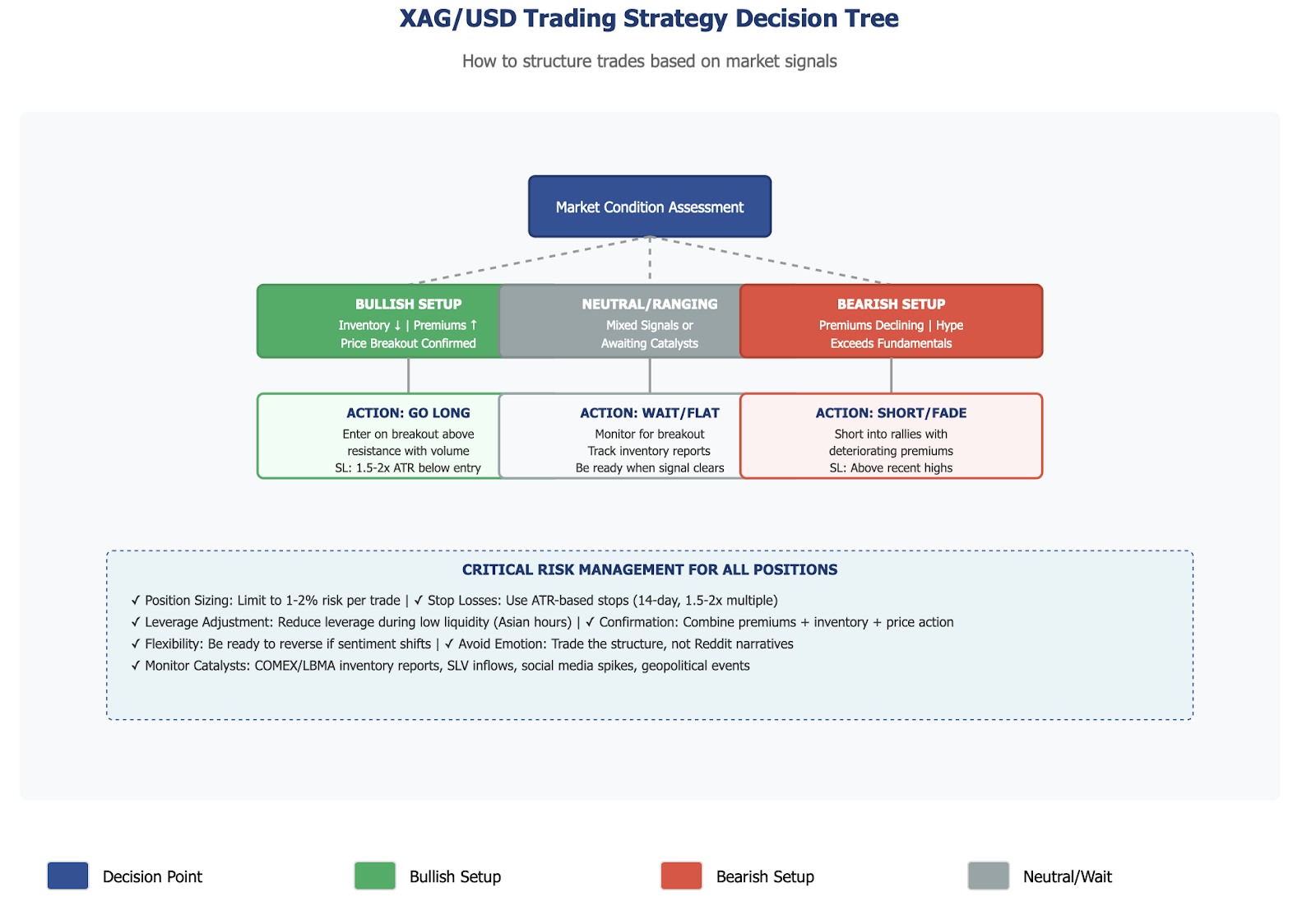
Event-driven trading directly correlates to Wall Street Silver activity & related catalysts; monitor spikes in social media sentiment, watch for viral posts regarding vault drains and track SLV inflows, as these events often lead to short-term volatility surges. Use confirmed signals instead of speculative actions, and consider breaking through key areas before committing your money.
Physical Silver Premium Data as a Filter for Premium Supported Trades:
When spot silver is ranging while premiums are expanding, it indicates accumulation as the funds have quietly accumulated physical silver. If you take a long position with a stop loss below the most recent low, you will be able to participate in price catching up to the demand for physical silver.
ATR-Based Stop Losses for Risk Management Around Volatile Moves in Silver:
Since there are so many violent price moves in silver, it is a good idea to establish stop losses based on the average true range. Using the average true range (14-day) to set 1.5-2x ATR stop losses below your entry price for a long position or above your entry price for a short position will allow you to use stops while also allowing for some breathing room due to wild price swings that can happen quickly in the silver market.
Beyond the average true range (14-day), position sizing is even more critical in leveraged silver trades. A 5% move in XAG/USD with 10x leverage is equal to a 50% swing in your account. Limit your risk per trade to 1-2% of your account, adjust leverage relative to volatility, and do not overleverage during periods of low liquidity (i.e., Asian hours).
Weather forecast for severe weather before you have an event that takes place outdoors. If the weather forecast indicates heavy rain, you will prepare ahead of time with an umbrella. Similarly, use the inventory chart to prepare for silver price increases before the "storm" occurs (i.e., whether or not the silver inventory is rising; and whether or not premiums are rising) and then adjust accordingly after the "storm" has already passed.
Flexibility is Key to Trading CFDs Around the Wall Street Silver Dynamics: The volatility generated from the Wall Street Silver movements will create spikes and drops in price that may not correlate with the fundamentals behind them. Therefore, you should trade price action and rely on inventory trend data and physical silver premium data as confirmation of your convictions, and be willing to reverse your direction & trade if the market sentiment changes.
Myth or Mechanism? Separating Emotion from Structural Risk
To clarify again, this is how the proponents of Wall Street Silver believe it to be a valid trading thesis and emotional story that needs to be distinguished from what's real and what's just hype if you're going to put money at risk.
The arguments made by pro-Wall Street Silver supporters claim that there is an inherent imbalance in the market due to decades of paper market leverage. They cite three factors as evidence that physical silver is fundamentally scarce relative to the paper claims: the decrease in registered inventories at the COMEX, the increase in industrial silver demand for solar panels, electronics, and EVs, and the stagnant mine production of silver.
They also believe that historically, the central bank's expansion of the money supply and continued inflation concerns are catalysts for a large portion of investment capital to flow into hard assets, such as physical silver. This large influx of new buying interest will ultimately create a more significant supply shortage of physical silver, thereby creating an even larger squeeze on the paper side.
The opposing views of sceptics say that the silver market has been operating at high paper-to-physical ratios for decades, giving them the confidence that they have not experienced any significant delivery failures.
They also cite the many cash settlement and emergency inventory conversion provisions that are part of the COMEX system to support their opinion. Sceptics contend that the Wall Street Silver supporters vastly overestimate the ability of retail buyers to affect the market compared to what the institutional buying will do, and that if prices do move higher, the mining sector will rapidly increase their output to accommodate prices at new levels.
The reality of how the silver market is structured lies between both viewpoints. The leverage ratios are high; the physical silver inventories are declining. However, the markets will continue to change as they adapt because they reflect what is happening in the economy. When there is stress, market prices adjust, market incentives are reassessed, and supply will adjust to meet demand, not always in the same manner as the drama-filled narratives currently permeating the Reddit community.
Professional traders are thinking about whether or not a squeeze will happen, written from the perspective of present positioning, inventory trend comparisons, and sentiment, creating favourable downside risks. If inventories drop another 20%, and move premiums are 30% above the spot price of silver, the risk profile is drastically different from if inventories stay flat with relatively flat premiums.
Long-term inventory trend cycles do not have a linear decline, with registered inventory recently dropping due to high buyer demand or speculative positioning, then subsequently increasing as futures have rolled and the incentives exist for eligible inventories to be converted into registered inventories. This usually cyclical pattern creates opportunities for those trading its trends; however, it does not validate the dramatic, apocalyptic "running out of silver" narrative.
The difference between emotion and mechanism exists in how one views or frames a trade. The emotional view says that the system is rigged and will collapse in the near future, or that the trades can be sold at a profit once there is further conviction in the integrity of the system. However, from a mechanistic perspective, the structural leverage provides volatility risk that can be traded.
The latter will become the foundation of one's trading decision; however, those who utilise a systematic methodology tend to utilize data to support or refute their pre-conceived positions.
Think about it this way: at times, one may be fearful for justifiable reasons, like when one does not want to walk in a dark alley in an unsafe neighbourhood because of a legitimate threat; at other times, one's fear will only be based on unfounded rumours, like not going to eat at a restaurant because of an unfounded bad review.
Evidence would be the distinguishing factor between the two forms of fear. In the case of the silver market, evidence could be derived by way of physical inventory data, premium spreads, or actual price behaviour, rather than the social media platforms providing positive opinions about "buying silver," and thereby deriving no substance behind their hype.
The safest way to approach your investments in Wall Street Silver is to treat those investments as a source of volatility rather than a certain trade outcome. Use momentum from the social movement to create long positions when there are technical setups established, while shorting the movement when premiums compromise deliverability and/or inventory stabilises. Rather than being influenced by the emotion behind the social movement, focus on what the actual market behaviour indicates.
From Social Movement to Arbitrage Opportunity
Retail investors have changed their perspective about commodity markets thanks to Wall Street Silver. The vault drain strategy has resulted in structural dynamics that can create true trading opportunities regardless of whether it results in a historic short squeeze.
The decoupling of paper from physical is not a myth; it is how modern commodity markets function. Mainly, modern commodity markets rely on leverage and liquidity, assuming that most participants are interested in price exposure rather than actually taking delivery of the physical commodity itself; therefore, if that assumption is tested, then the levels of volatility increase.
Traders' key indicators are the trends in inventory and the premium spreads. Watch for sudden drops in stock inventory in both COMEX monthly registered silver and LBMA, and monitor physical silver premiums to determine actual demand compared to speculation in paper. If inventory and premiums are in the same direction, there is more conviction. If they are in opposite directions, there is more caution to be exercised.
XAG/USD CFDs allow traders to utilise these indicators without the hassle of storing metal and dealing with dealer spreads. Long when supply decreases and demand increases, short when the hype is greater than the reality of the situation, and flat when the data does not provide enough conviction either way.
Risk Management is always an important aspect of trading. Silver can move rapidly. If a trader uses leverage, they will have the potential for both gains and losses, and retail sentiment can shift on a dime overnight. Thus, traders need to control the size of their positions, have stop losses in place, and not allow excessive emotional attachment to narratives in order to be able to stay in the game long enough to catch the real moves.
Having a thorough understanding of how the paper market operates gives you a significant advantage over someone who only utilises charts or follows social media. You can understand the underlying mechanics that create volatility rather than just the price action created from it. You will not be gambling based on Reddit narratives; you will be trading based on informed opportunities.
Ready to trade silver volatility with precision? TradeWill's XAG/USD CFDs give you the leverage, liquidity, and tools to ccapitalise on paper-physical decoupling opportunities. Stop watching from the sidelines, start trading the structure.
Disclaimer: The content of the blog does not represent any position of Trade W, does not serve as any trading-related decision advice, and does not endorse any third-party.