

 Trade W
What Is a Put Agreement?

The purpose of a put is to allow investors to establish a price they are willing to receive for their investment before its value declines. Put options are considered an "insurance policy" against the drop of their asset's value.
A put option agreement is a type of derivative and will generally involve two parties. The buyer of a put option holds the right to sell the underlying asset for a predetermined price for a specific period of time, as determined within the put option agreement. To obtain this right, the buyer pays a premium to the seller.
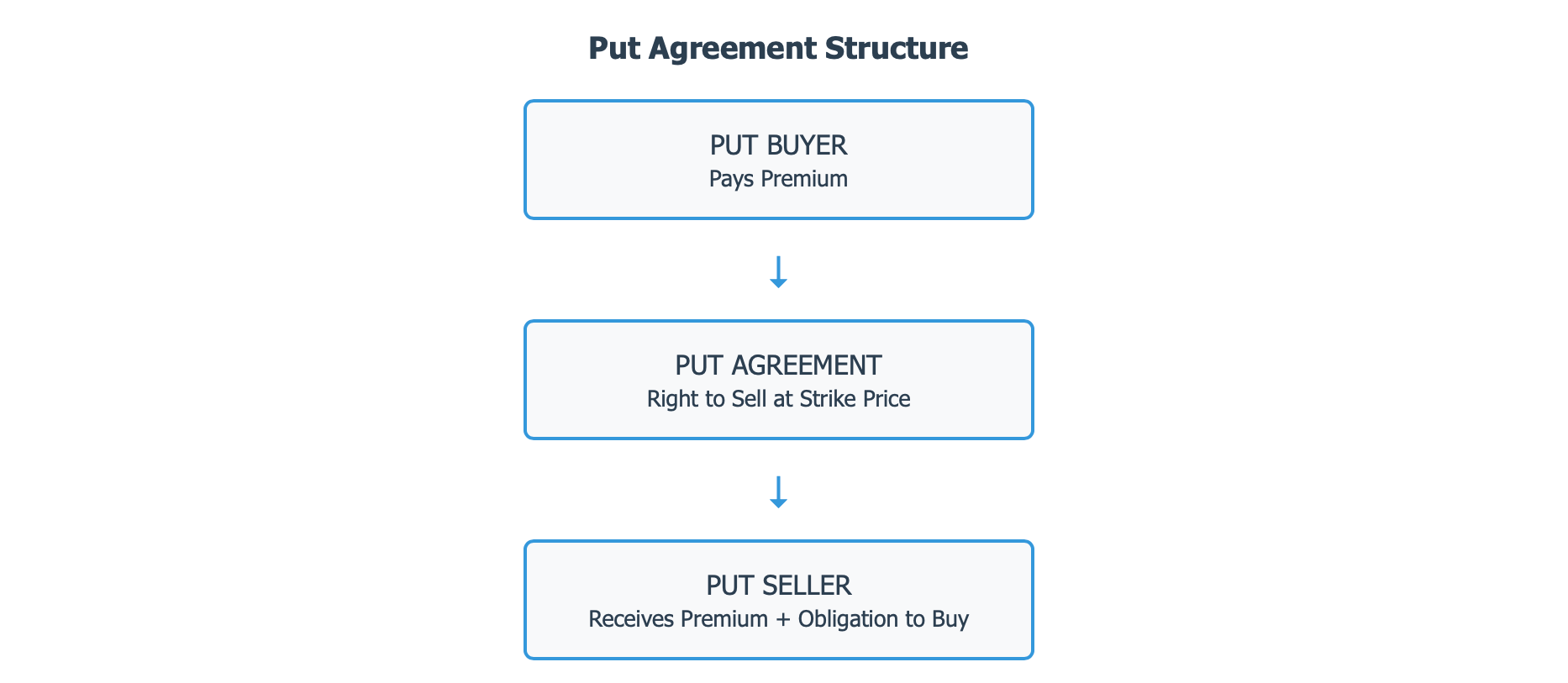
The primary participants involved in the transaction of a put option are put buyers and put sellers. The put buyer pays an initial premium to eliminate the risk created by a decrease in the market price of the underlying asset. In return, the put seller receives the premium and bears the risk associated with their obligation to purchase the underlying asset at the exercise price if the buyer elects to exercise the put option.
There is a discrepancy between the rights of the put buyer and the obligation of the put seller to fulfil their respective duties as outlined in the put option agreement. The buyer derives their rights, and the seller is obligated, based on the terms of the put option agreement.
The underlying asset for a put option can be any financial instrument that is transferable. Examples of underlying assets would be stocks, bonds, commodities, currencies, indices and contracts for difference. New investors often don't realise that they are not actually acquiring the underlying asset; rather, they enter into an agreement that grants them the right to exercise the option after the value of the underlying asset has decreased. This is what renders put options to be "derivative instruments" since the value of the instrument is based upon the performance of another instrument.
The reality in the financial markets is that there are always periods in time where the market will either increase in value or decline in value. Therefore, not all instruments are going to be able to be bought or sold for a profit.
Since not all investors will want to wait for the market to rebound from a price decrease, institutional portfolio managers will utilise put options as a means to lock in their profit level and hedge their portfolio against a potential market downturn. In addition, speculators will often employ the use of put options when they believe that the value of the instrument will decline.
Likewise, individual investors will use put options to hedge their portfolio against the volatility of the market. If no put options existed and investors wanted to liquidate their portfolio, the investors would have to sell their investments, incur taxes, and lose the opportunity to gain further profit from the appreciation of their investment value.
For example, you own 100 shares of a technology company at $50 per share. You would like to maintain your investment in the technology company but fear that the company may experience a market decline. To establish a put option, you would purchase a put option for a specific strike price, let's assume $45, with an expiration date of 90 days in the future from the date of the purchase.
If the stock declines to $30 per share, you would have the option to sell the stock for $45 if you were to exercise the put option. Conversely, if the stock increases to $60 per share, you will allow the put option to expire and maintain your investment in the technology company. The only cost to holding a put option in this example would be the premium paid to establish the put option.
Purchasing a put option is similar to obtaining automobile insurance. You pay an insurance premium to protect yourself against the risk of an automobile accident. An automobile accident is something that you would not expect to happen; however, if you were to have an accident and sustain a loss, you would expect to receive indemnification for your loss.
The primary purpose of a put option is to grant you the right to protect your asset against loss without having to exercise the right immediately. Therefore, you have the option to decide when and/or whether to exercise the put option. Flexibility with respect to the timing and the execution of the option is the primary reason that put options have become a popular tool in modern financial and trading systems and risk management systems.
How Does a Put Agreement Work?
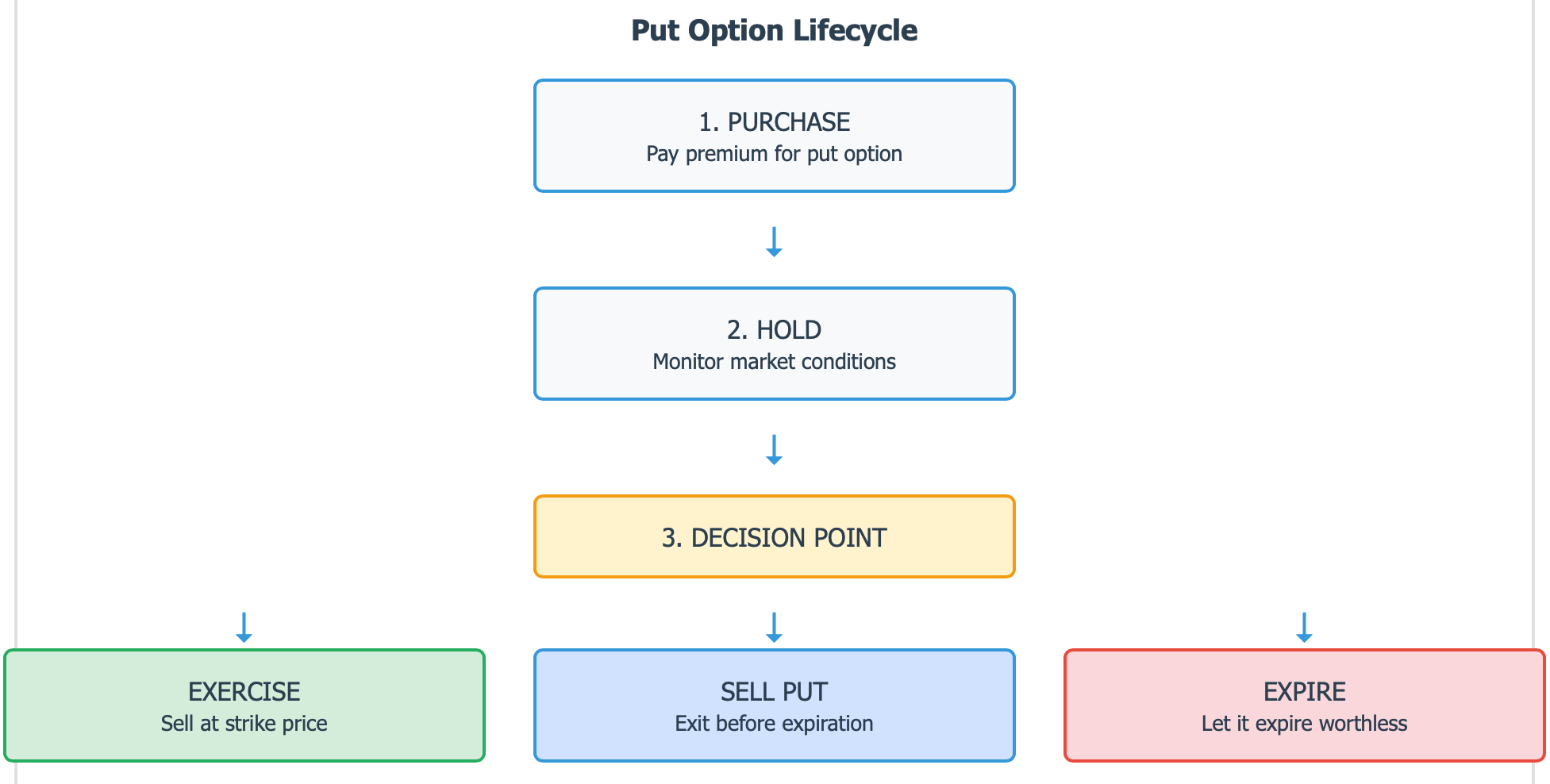
To fully grasp how a put contract functions, we will take you through its entire lifecycle from purchase to expiration.
When you buy a put option, you are initiating a contract that gives you the right but not the obligation to sell an underlying asset at the strike price until expiration. When you purchase it, you pay a premium to the seller, which is not refundable and represents your entry fee for either protection or an opportunity to profit from the put.
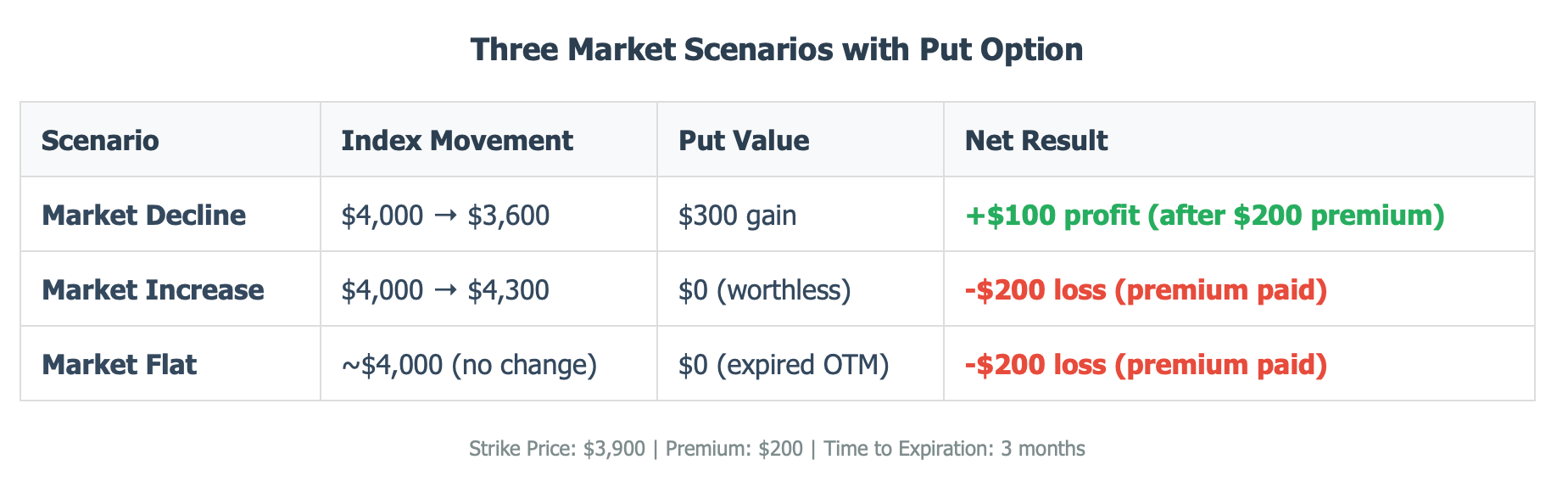
To understand how put options perform in various market conditions, let’s examine a specific index put that has a strike price of $3,900, is currently at a market price of $4,000 and has three months to maturity. The premium cost for this put option is $200.
Market Decline: Two months from now, the same index is at $3,600, making your option worth $3,900 and giving you the ability to “sell” for $3,900 when the market is only $3,600. Thus, by exercising your put, you would make a gain of $300 per contract. After subtracting your $200 premium from the $300 gain, you are left with a net profit of $100 per contract.
Market Increase: On the other hand, perhaps the index starts at $4,000 and two months later the same index is $4,300; your put option is now worthless because you can sell your position in the open market for $4,300.If the put expires without value, there is a total loss of $200 tied to the put. However, if you had owned the index itself, you would have gained $300 for every unit held, so there would be a net gain of $300 of index – $200 paid for the put of $100 for every unit owned. Thus, the hedge does work.
Market Flat: The market was flat, and the index fluctuated around 4,000 through expiration. The put expired slightly out of the money, and you would have lost your premium. The cost of the hedge was the $200 premium you paid for it, which you did not need to utilise as there was no loss in value of the index.
Put options do not have to wait until expiration. Most put trading agreements can be sold before their expiration date. Thus, if you have entered into a put option and the market has dropped below your strike price and the put option has gained in value or increased in value, you can sell the put to someone else for a profit without having to exercise the put option. This is the method that the majority of casual traders use to derive profit from put options and to obtain a return on their capital.
Cash settlement puts, when settled in cash, give you the cash difference between the strike price and the market price at the time the put is settled. When a physically settled put is settled, the actual delivery of the underlying asset occurs. In most applications, for index puts or CFD-based puts, cash settlement occurs because you are unable to provide physical delivery of the index.
Also, if you are trading puts on margin, which is common for CFD trades, and the value of the underlying index moves adversely to your overall position when calculating the margin requirement, margin calls will apply. In that case, you will have full downside risk on the premium but will still need to maintain the margin requirements associated with your leveraged positions.
The beauty of puts is their asymmetric risk. The maximum risk when you buy a put is the premium paid upfront. However, the potential return when you buy a put is theoretically unlimited because there is no lower limit on the value of an asset, and in theory, an asset could fall below $0. Conversely, the seller of a put earns the premium received and faces a potential unlimited loss from selling the put option should the underlying asset fall below $0.
How Are Put Agreements Priced?
The amount of premium you will pay for a put option is not something that just happens at random, but rather, it is calculated based on an intricate relationship of risk, time, and probability. Let’s take a look at how you get to the price of your premium.
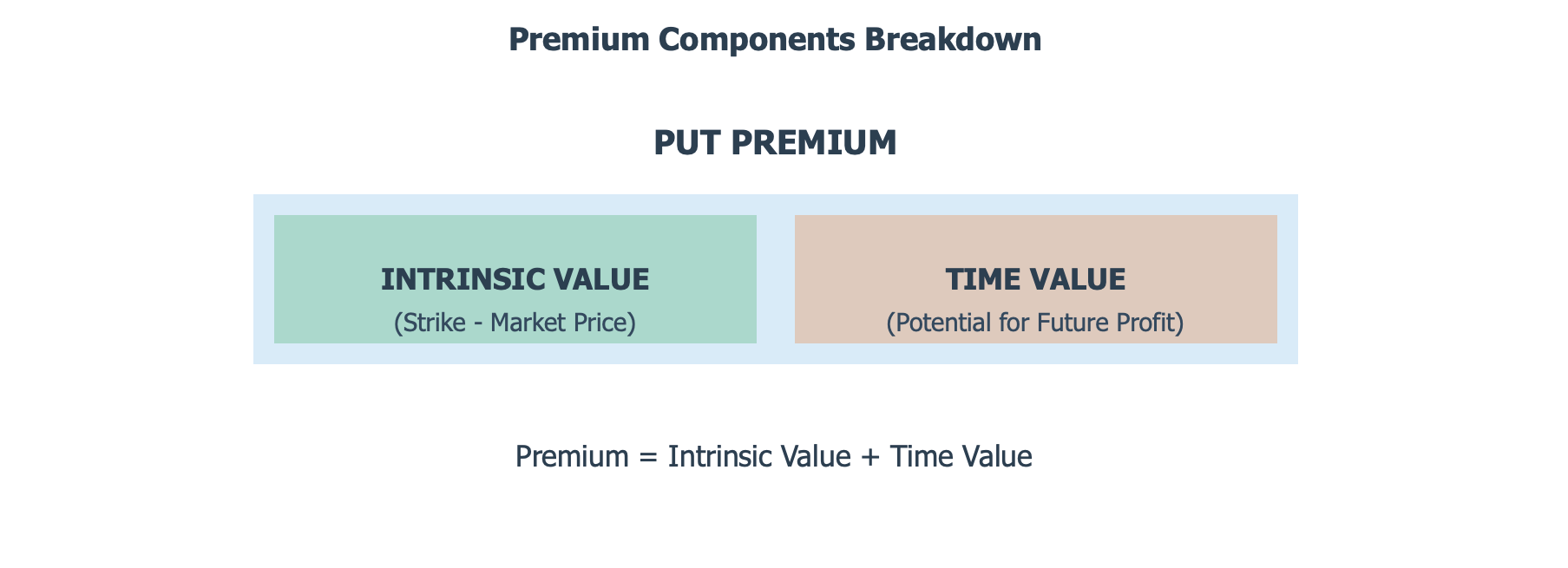
To put it simply, the premium you pay for your put option is simply the cost for receiving the right to sell your stock. The premium has two components, intrinsic value and time value. Intrinsic value is the value of your put option if you exercised your put right this minute. While time value is the additional amount of money that traders are willing to pay to have the potential of making their put option worth more before it expires.
Let’s look at what is considered to be intrinsic value. For example, if the stock is at $45, and you have a put option that has a strike price of $50, the intrinsic value of your put option is $5. This means you could, if you wanted, exercise your put option and sell your underlying asset at $50 each.
Alternatively, if the underlying asset is at $52, the intrinsic value of your put option is $0. The reason you lose money by exercising your put option in that example is that you would sell your asset for $50, and it would be worth $52 in the market.
Time value can be a little more difficult to determine. An amazing fact about time is that even if you own a put option that is “out of the money”, it still has a value. Why? The answer is that the market fluctuates. With an example, if the stock is at $52 today, it could eventually fall to $48 over the course of the next week.
Therefore, the longer you have until your put option expires, the greater the potential of having a favourable price move of the underlying asset. Consequently, more traders will pay for the additional optionality that an out-of-the-money put option provides.
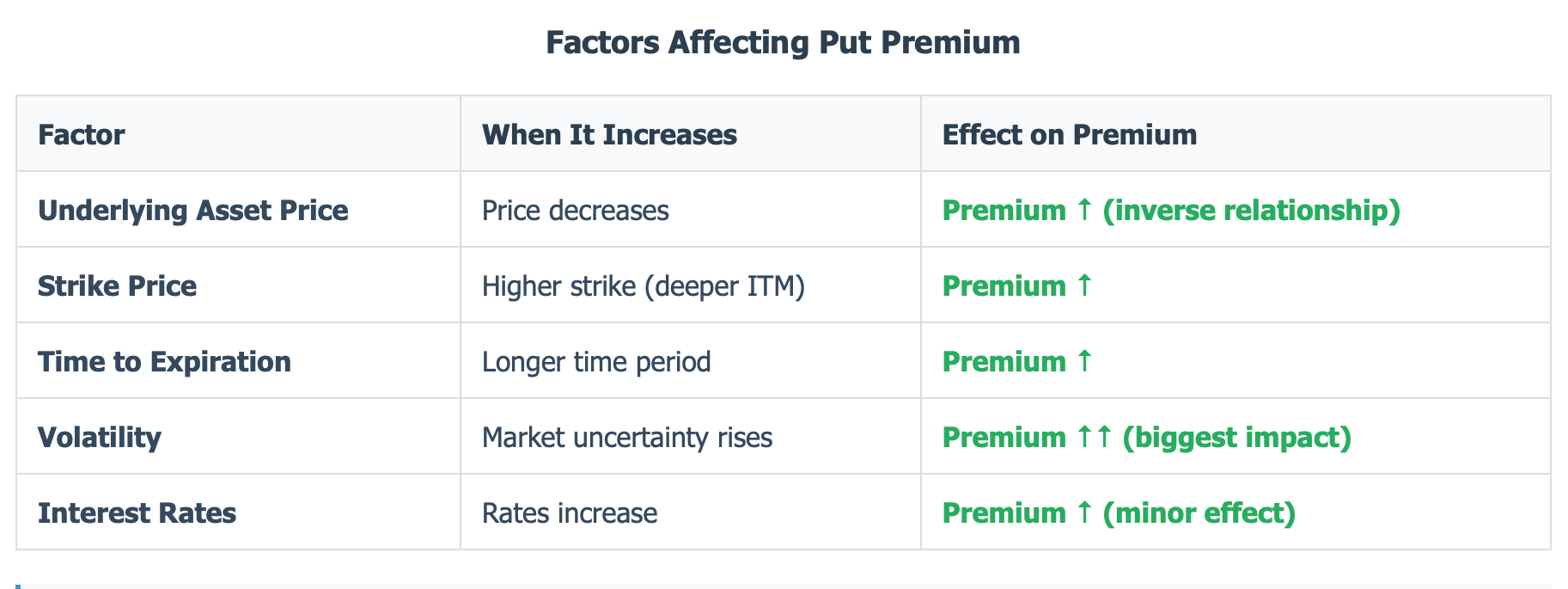
The following are some of the components that will be taken into consideration when calculating the premium:
Price of underlying asset: As the price of the underlying asset decreases, the price of the put options will begin to increase. The price of the underlying asset and the price of the put option are inversely proportional. A put option increases in value if the stock drops in price.
Strike Price: The premium of a put option is determined by the amount of protection or profit you will receive at that price. This means the higher your strike price (deeper in-the-money), the more it will be worth.
Time To Expiration: The longer the time until your put option expires, the more you will pay to purchase. A 6-month put on the same stock with the same strike price will always cost more than a 1-month put because there's more opportunity for the stock to move before the option expires.
Volatility: This factor is huge. Puts will be much cheaper when the markets are calm; however, during periods of uncertainty, e.g., after an earnings announcement, before an election, or amid an economic crisis, puts become very expensive. Volatility measures the probability of large price moves and therefore makes puts more attractive to own during periods of significant price change.
Interest Rates: Higher interest rates cause the premium of puts to be slightly higher due to the cost to carry the put; however, this fact is usually insignificant compared to the effects of volatility and the time until expiration.
Professionals use the "Greeks" to help them measure and gauge how these factors will affect the value of the put option. Delta indicates how much the price of the put will change as the underlying asset moves $1. Theta allows a trader to determine how much value an out-of-the-money put loses every day it gets closer to expiration.
Vega is the amount of change in the price of a put as a result of changes in volatility. You should not worry about mastering these concepts as a novice trader, but having a basic understanding will help to show you that put premium pricing is not done by mere chance.
Here's an example to illustrate how that principle works. If you have a stock valued at $100 and moderate volatility, the premium of a 3-month put with a $95 strike is about $3. If that same company were to announce poor earnings, causing volatility to double, that same put would increase to about $6, even though the underlying stock price has not changed. The reason this would happen is that the market believes there will be larger price swings than anticipated with the underlying stock and that a put will be more likely to have value.
To use an analogy, if you live in Florida during hurricane season, the cost of your storm insurance will increase significantly due to the increased risk of a hurricane, even if you haven't flooded your house yet. A put premium will increase with the risk perception of the underlying stock.
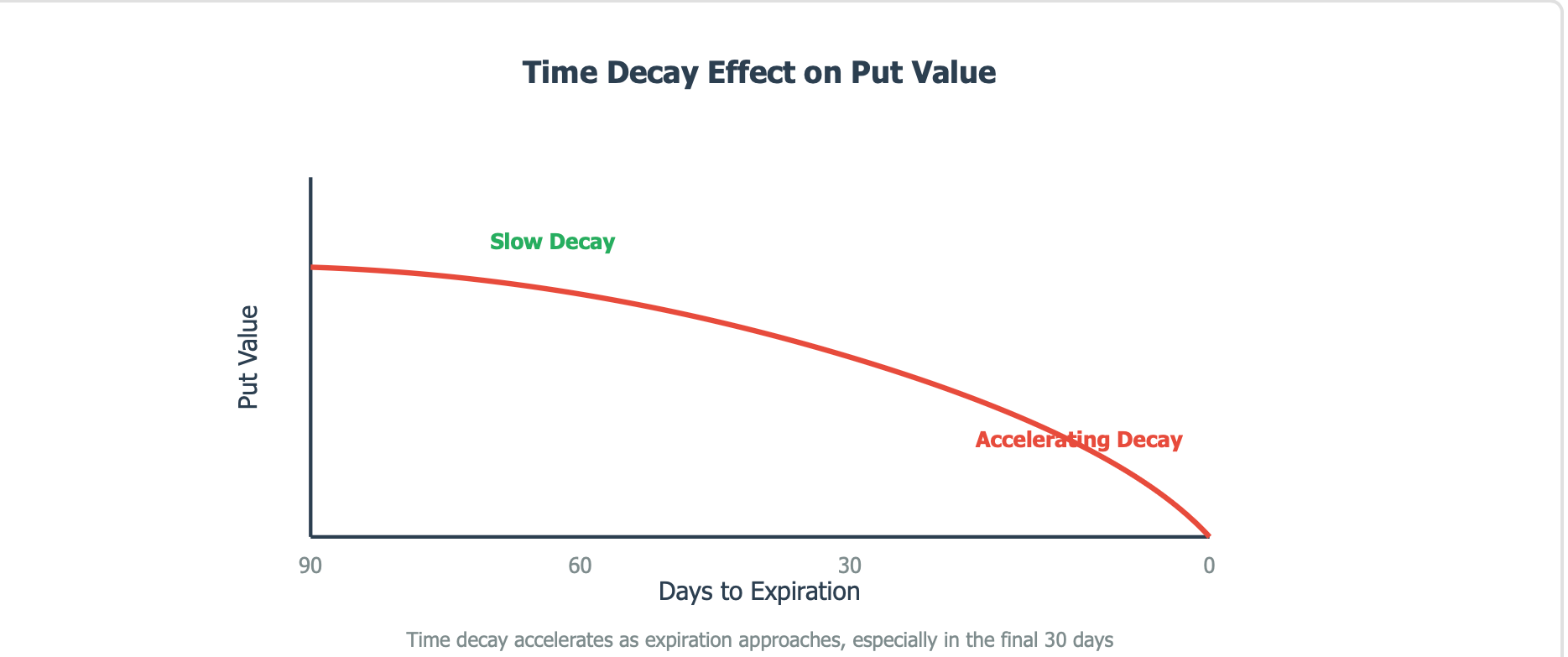
As an option buyer, time decay will work against you. Therefore, even though you may own an out-of-the-money put option, its value will decline each day until expiration regardless of what happens to the underlying stock. That’s why traders frequently sell options well in advance of expiration to capture their profit before time decay reduces it.
In-the-Money, At-the-Money, and Out-of-the-Money Explained
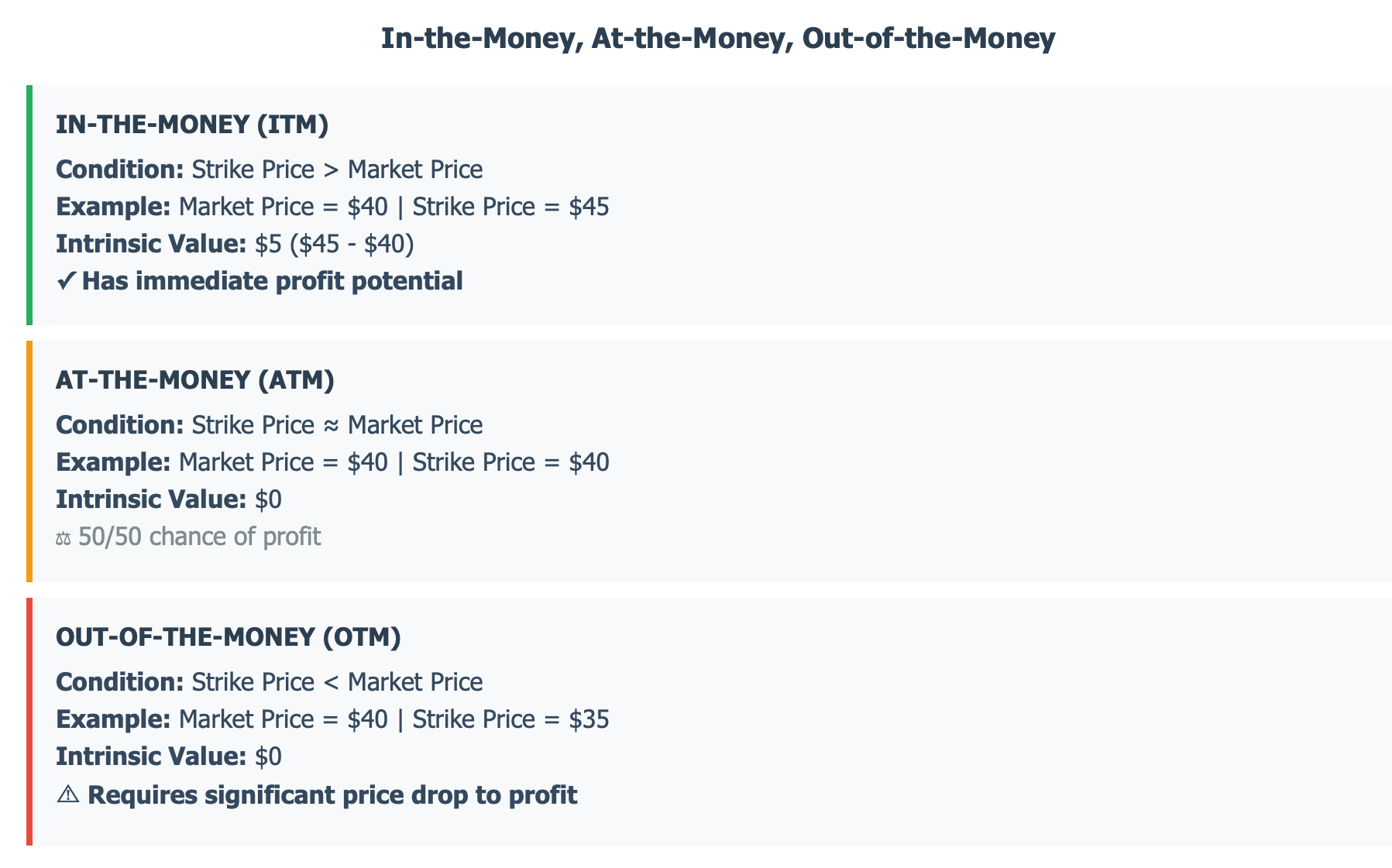
position of the agreement relative to the current underlying price and the strike price of the option. Specifically, the terms in-the-money (ITM), at-the-money (ATM), and out-of-the-money (OTM) are indicative of how the potential of a put differs from its real-time dollar value due to current market prices. Evaluating an option's moneyness, or degree of being in-the-money (ITM), at-the-money (ATM), or out-of-the-money (OTM), provides traders with an understanding of the risk-reward potential of each put option via the presence or absence of intrinsic value.
In-the-money Put Options (ITM): A put option is considered ITM when the strike price is greater than the market price (i.e., there is a positive difference between the strike price of the option and the price of the underlying asset in the market).
For example, if the market price of the underlying is $40.00 and the strike price of the put option you own is $45.00, then you have $5.00 of profit that you can realise by exercising your option today. Since ITM puts possess intrinsic value, they naturally have a higher price than OTM puts. Furthermore, since they possess intrinsic value, ITM puts have the highest probability of providing a profit at expiration.
At-the-money Put Options (ATM): When the strike price is equal to or very close to the market price (i.e., there is minimal or no difference between the strike price of the option and the market price of the underlying asset), the put option is considered ATM. All ATM puts are composed entirely of time value and are considered a 50/50 chance of being a winner or loser if exercised on the expiration date. Due to the lack of intrinsic value, they tend to be highly speculative and are therefore capable of providing high rates of return on relatively little initial investment.
Out-of-the-money Put Options (OTM): When the market price of the underlying asset is greater than the strike price of the put option (i.e., the difference between the strike price and the market price of the underlying asset is negative), the put option is considered OTM.
For example, if the market price of the underlying goes down from $40.00 to $36.00, you have an OTM put option to sell for $35.00, then you wouldn't have any intrinsic value at this time, but would have time value. Given that markets can move with some velocity, a sudden 10% drop could cause your OTM put option to become ITM.
Understanding options moneyness is useful to traders in evaluating the potential risk and reward of their options. Traders tend to perceive ITM puts to be "more expensive" than OTM puts because ITM puts possess intrinsic value; however, the additional cost typically reduces the overall risks of the trade as well as the likelihood of making money from the trade.
Conversely, OTM puts present a speculative trade that has the potential to provide very high profits relative to the low costs associated with OTM puts; therefore, OTM puts are often compared to "lottery tickets" (i.e., highly risky with a very low initial investment that could yield very high returns if successful). ATM puts trade at lower prices than ITM puts and also possess a lower probability of making a profit than OTM puts.
As an example, consider the scenario where you have an agreement to sell your used mobile phone to a potential purchaser for $600.00, but the market value of your mobile phone is $500.00. In this case, you would have an ITM agreement with the potential purchaser. If the market value were $600.00, the agreement between you and the potential purchaser would be ATM.
If, however, the current market value were $700.00, the potential purchaser would have no reason to exercise the agreement with you because they could purchase the mobile phone from another seller for $700.00; therefore, you would be considered to have an OTM agreement with the potential purchaser.
Overall, since OTM puts typically require less capital exposure to the market than ITM puts and provide more leverage than ITM puts, most traders prefer to buy OTM puts. For example, a trader can purchase an OTM put for $100.00 to protect a downside (i.e., a negative price movement) of $500.00 and have less capital at risk than they would be required to have for an ITM put that costs $500.00 for the same protection. However, for the OTM put to produce the desired profit at expiration, the price of the underlying asset must have decreased significantly.
Generally, to hedge their portfolios, portfolio managers buy puts that are slightly OTM; thereby allowing the portfolio manager an unspecified level of exposure while managing their risk at a minimal dollar amount. As such, portfolio managers can control their dollar outlays while protecting themselves against catastrophic loss.
New traders will often fail to recognise that OTM puts are not worthless; rather, they tend to have a lower probability of making a profit than puts that are ITM or ATM. However, despite this misconception about the profitability of OTM puts and the volatility of the market, OTM put options can provide very high returns due to the large price movements of the underlying asset during the life of the OTM put.
Who Uses Put Agreements?
Not every trader on Wall Street is a professional trader; there are many other traders as well, from day traders to pension funds and more, each with different levels and interests in trading.
Retail traders utilise put options as a form of short-term protection or for speculation. If you believe that a stock is overvalued or believe that there will be a correction in the overall market, you could purchase a put option and profit from any downside movement in price without having to go through the complexities of short-selling the stock. Furthermore, buying put options is typically cleaner to execute, has defined risk exposure, and does not require you to have margin.
CFD (Contract for Difference) and Forex traders utilise put options as a form of hedging from leveraged positions. When you're long on a currency pair with a 50:1 leverage and experience a small adverse move in price, that could completely wipe out your account balance.
However, if you purchase a put option on the same underlying asset or a correlated underlying asset when you're long on a currency pair, you can limit your downside exposure even though you continue to stay long on a leveraged position.
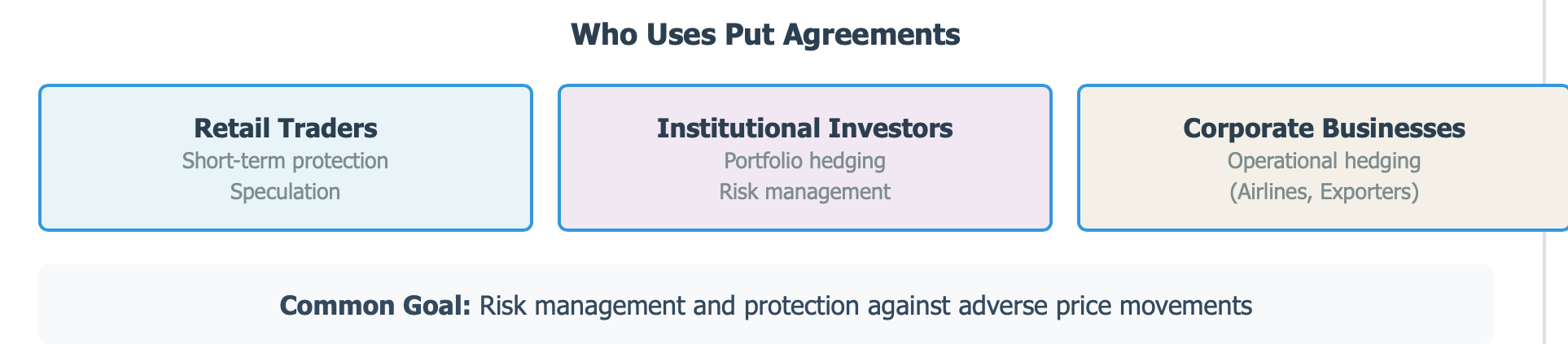
The biggest users of put options in the market are typically institutional investors and portfolio managers. Pension funds, mutual funds, and endowments can't simply sell their holdings in a turbulent market even if they want to; they have to maintain their long-term mandates from their clients. Therefore, instead of selling, they will purchase put options on the S&P 500 index as a hedge against their entire portfolio. If the S&P 500 index goes down by 20%, the gain from their put option protects all of their stock losses.
Another large group of users of put options is the risk manager and corporate businesses. Airlines may purchase put options on oil futures to place a cap on future fuel costs. Exporters may purchase put options on currency pairs to lock in future exchange rates. These types of trades are not speculative in nature; they are business necessities.
The main difference between a hedger and a speculator is that the hedger uses put options for protection, while a speculator uses put options to make money on their anticipated movement in price; neither of these types of traders is either better or worse, they both have different strategies and different risk profiles.
Put options provide a level playing field between traders of different levels. For example, a retail trader can buy a protective strategy for $500 that a hedge fund may utilise for $100 million; both utilise the same strategy to help protect against market downswings, but differ greatly in dollar amounts. This allows traders to access the same protection as hedge funds do; therefore, puts have become a very popular instrument within modern markets.
The Ultimate Hedge: How to Use a Put Agreement to Protect Your Portfolio
If you have seen your portfolio drop 15% in a week, you would know how helpless you feel at that time. That is why puts are known as "investment insurance." Puts are the most straightforward way to protect gains without selling your existing position.
The put protection strategy is quite straightforward: Purchase a put on the asset you already own or on an index that represents your portfolio. If the market declines, your put has value that offsets the decline. Conversely, if the market increases, a put expires with no cash value; however, your portfolio will have grown in value.
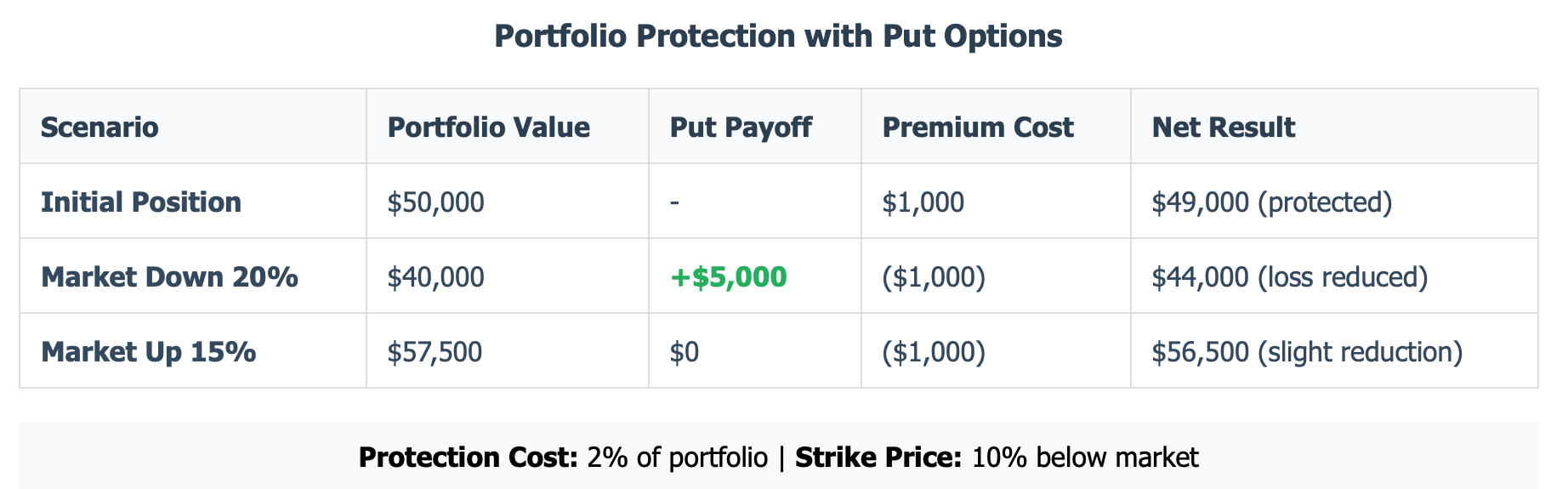
Now, let us walk through the example above. Your equity portfolio is worth $50,000 and is correlated to the S&P 500 index. You are now concerned that the market could decline 20% in 6 months. You purchase a put on the S&P 500 Index ETF with a $45 (10%) strike price below the current value of the index, which will cost you 2% of your portfolio ($1,000).
Scenario 1: The Market Declines by 20% - Your portfolio would be worth $40,000, and you would suffer a loss of $10,000. You purchased a put that allows you to sell at a $45 (10%) strike price; therefore, that put is exercised and pays you approximately $5,000 (the value dropped by 10% from the strike price). Your total loss is $10,000 - $5,000 = $5,000, plus the $1,000 premium, total = $6,000 instead of the actual loss of $10,000. You have significantly reduced your risk.
Scenario 2: The Market increases by 15% - Your equity portfolio value is $57,500. The put contract that you purchased expires worthless; therefore, you lost the $1,000 premium. You have $56,500 net, resulting in a 13% gain instead of a 15% gain. You paid for the protection (2% of the value of your portfolio) that you did not need.
The tradeoffs of using puts include the money you will spend on puts. Every dollar spent on puts is a dollar that is not providing you with a return. However, while it is sometimes costly to provide for this insurance, it becomes worth it to have comfort in knowing you are protecting the value of your portfolio.
Professional managers have put protection in place regularly by using long puts in place of selling and buying short puts each time they roll over the old put session. The cost of consistently rolling over puts is high over time, but it protects them from potentially losing their entire career by not having put protection in place at the time of a crash.
Newer managers can purchase one or two puts and, depending on how much appreciation is realised, will allow particular appreciation to be locked into place while allowing the manager the opportunity to realise additional appreciation over time. It acts as a compromise between selling and having all of your money at risk.
There is one considerable mistake to avoid with put contracts – not purchasing puts until significant volatility spikes in the stock market, and you find out that puts are expensive. The timing of protection with puts is to have protection before you need it, while it is inexpensive.
Put vs Call Agreements: Key Differences Explained
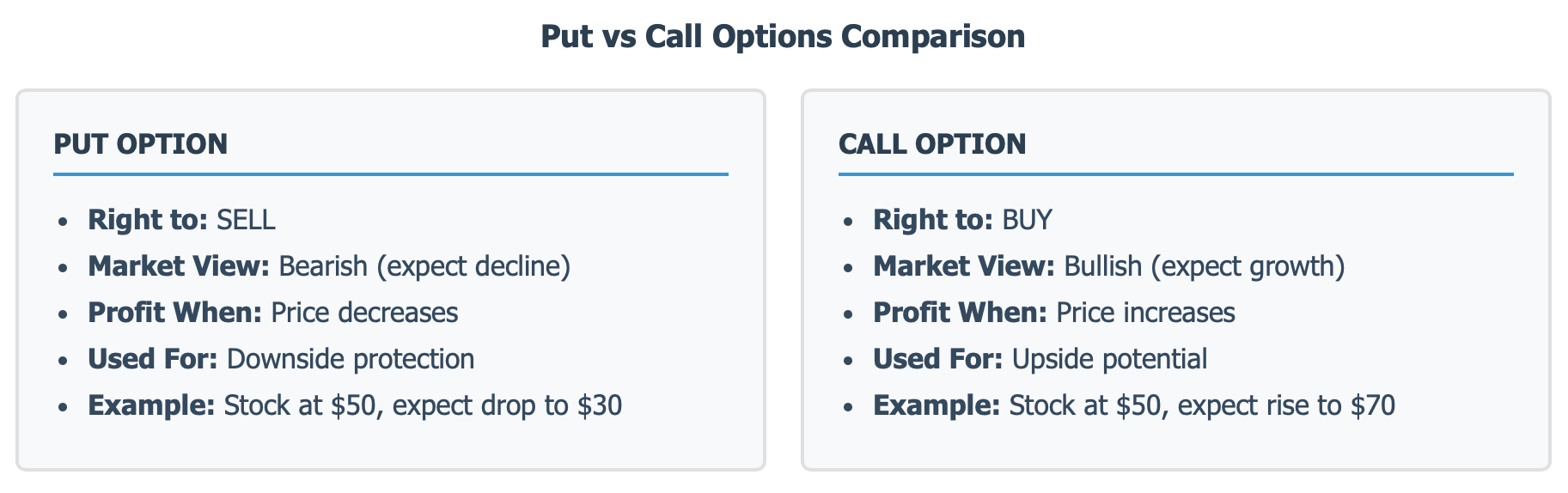
Puts and calls are two different types of option contracts. They both include numbers called strike prices, which identify where the trading of an asset will take place,e and also include expiration dates for their validity.
Puts give a trader the right to sell, while calls give the right to purchase an asset. As such, when you buy a call, you desire to profit from price increases, whereas with a put,t you will profit from price decreases. Described simply, a call is bullish, sh and a put is bearish. If you believe a stock priced at $50 will rise to $70, you would buy a call option; if you believe that stock's price will decline to $30, you would buy a put option.
Risks: As a buyer, you will have limited risk on both put and call options, but unlimited profit potential. Conversely, if you are a seller of puts and/or calls,s you will receive premium payments but will also have the potential for large losses.
Hedging: Investors who own an asset will buy a put option to provide them with downside protection from any adverse movements in price. Conversely, an investor who has an existing position that is short or sold calls may buy call options to protect themselves from upside risk. The logic is the same for both types of hedging: to hedge exposure through alternative contracts.
Market Trend Indicators: The put and call ratio compares the volume of put option contracts traded against the volume of call option contracts traded during a set time period. As a result, when the put/call ratio is above 1.0, usually that means that there is more sentiment to be bearish, and a put/call ratio of less than 1.0 means there is sentiment to be bullish.
In the 2020 market correction, there was a high volume of put options traded by investors in an effort to hedge their downside risk due to their belief that the market was going to continue to decline. The put/call ratio reached 1.5, indicating a high level of fear and uncertainty among traders. Therefore, savvy traders were able to capitalise on that fear by purchasing equities at a lower price based on the historical data that the excessive pessimistic sentiment would lead to a sharp reversal higher in price.
Here is a practical example of puts and calls. In an upwards-trending market, buying calls to generate a profit from rapidly increasing asset prices is a no-brainer; however, differences in the two methods can produce profits in bear markets as well. For example, many experienced traders sell put options for premiums without the risk that the money generated will translate into a profit due to the price not reaching the out-of-the-money strike price.
Neither method is inherently worse than the other. The right one will depend on your risk tolerance and/or market view and whether or not you are speculating or hedging. Most professional traders employ both methods simultaneously to execute a strategy, such as straddles, strangles, and collars.
At the end of the day, the primary distinction is: a call is indicative of optimism on the part of the trader, and a put is indicative of pessimism and/or caution before the trade. This information cannot be good or bad; they are merely tools,s and each plays a different role within the trading environment.
Risks and Misconceptions About Put Agreements
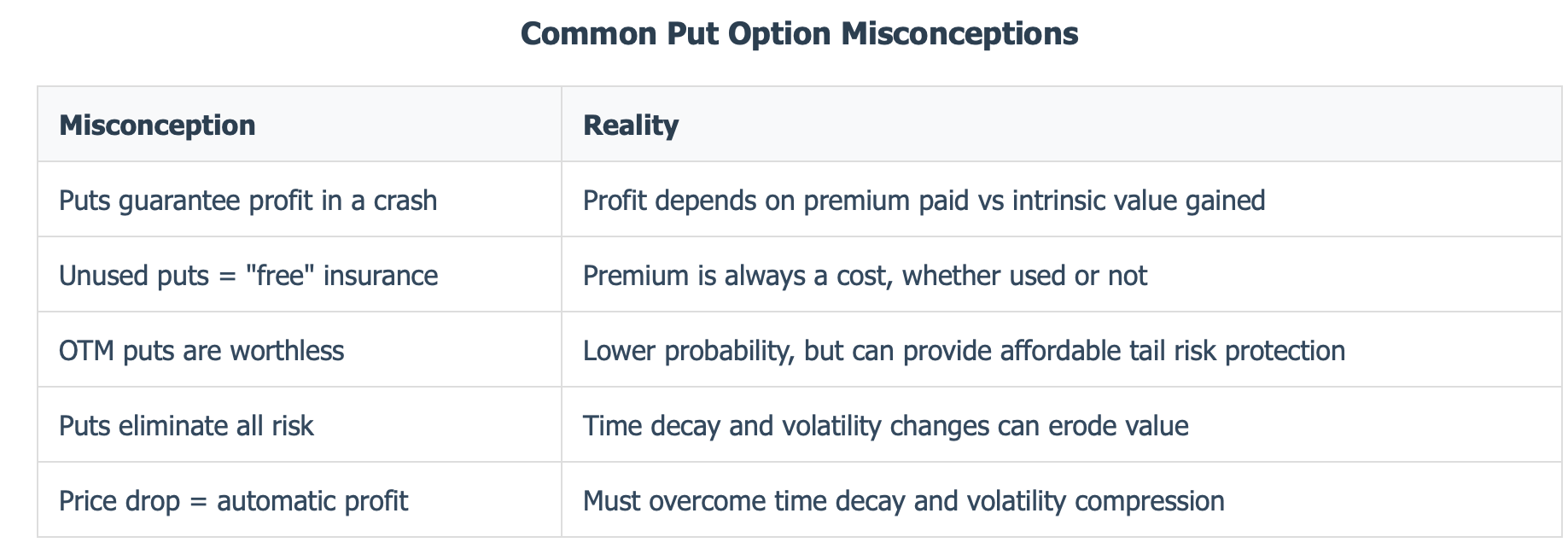
Put options can provide a safety net, but they won’t give you guaranteed income in a market crash. Many new investors have misconceptions about how the put option works, ks resulting in frustration and loss.
Here are some of the biggest misconceptions about putting options:
Misconception 1: Putting options guarantees you income in a market crash. False. Put options only give you the option to sell your shares at a pre-stated price. Whether or not you will have a profit is dependent on the premium that you paid for your put option. If you bought a $5 put, and the stock gains a total of $4 in intrinsic value, you will still have lost $1.
Misconception 2: If you do not use the policy you have, you have ‘free’ insurance.Totally wrong. You paid the put premium. Whether you used it or not, you lost your money. If there is no volatility in the market and your put expires worthless, you have already paid the cost of the premium. You will actually lose more if you over-hedge your portfolio than if you incur an occasional loss.
Misconception 3: Out of the money (OTM) puts are a scam. This is false. They are actually low probability bets and, therefore, speculations. Speculative bets are speculative; however, cheap OTM puts can provide affordable protection against both tail risks and excessive volatility.
The Time Decay Trap: Each day you put in losses, the value decreases. This is called ‘theta decay’. If you purchase a put and the market slowly declines, the ‘theta’ decay can consume all the gains that you would have realised. Many new traders will buy puts and watch the market decline, and when they get to a point of profitability, they will be very disappointed to learn their puts remain either unprofitable or at very low profits.
The Volatility Trap: Volatility will affect the pricing of your puts in both upward and downward directions. When you purchase a put, and there is a sizable volatility, you are going to be paying for the expected volatility. If there is little or no volatility, and the value of the shares goes down due to a lack of volatility in the market, your put will decrease in value. This is often where traders think that since the market has gone down, the price of their profits will also have increased.
Over-Hedging: A trader can become addicted to hedging and will therefore hedge much more than they need, even if the cost is between 5%-10% of the total value of their portfolio, on a real dollar basis. If you find yourself hedging on a reflexive basis, you can be at a severe disadvantage concerning your long-term performance.
The False Sense of Security: Although you own a put option, it does not mean that you can ignore portfolio sizing or diversification. A put option is one tool in the overall risk management approach. Do not use your hedge to justify an unreasonably large position in anything, and do not put yourself at a previously large, unsecured position elsewhere.
Traders who treat their put purchases as exactly that typically purchase puts that are priced far OTM and have not done any due diligence supporting their purchase, and the only reason they are purchasing the put is that they are trying to protect against a crash. When the crash does not happen or does not happen quickly enough, the trader has lost all of the premium and repeats the same mistakes.
The best use of your puts is to purchase them as hedges for the specific risk you are worried about, and utilise puts that you have appropriately priced. Find out what you are worried about, earnings miss, geopolitical events, sector movement, and buy put options as a hedge against the risk associated with that concern.
FAQ: Common Questions About Put Agreements Answered
On what criteria does the price of a put option depend?
The price of a put option depends on the strike price, time until expiration, and volatility of the market. A put option priced near the current price of the underlying security will cost 2 to 5% of the underlying security price when purchased for three months. Conversely, a put option priced substantially below the current price of the underlying security may cost as little as a few cents per contract, while put options priced significantly above the current price of the underlying security can cost as much as 15%.
What is the result of holding a put option that expires below a specified strike price (out-of-the-money)?
A put option that expires below the specified strike price (out-of-the-money) will be worthless when it expires, so you would lose the premium you paid to acquire it. There is no obligation for you to perform additional actions, and there would be no margin call if you were simply a purchaser of a put option.
Is there a specific asset type that I can use to create put options?
Most exchange-listed, liquid assets, such as major stocks and indices, commodity exchange-traded funds, commodities, and some currency exchanges would have exchange-listed put options. Exchange-listed puts would likely not be available on less liquid assets; those assets may, however, have an over-the-counter put available from a brokerage or counterpart. In some cases, brokers also offer synthetic put products and/or options markets that are similar to put options for CFDs.
How do I know if I am behaving like a speculator by buying put options?
You are more likely to act like a speculator by purchasing put options without conducting analysis or due diligence on the potential for the security price to decline. On the other hand, by purchasing put options to hedge against other investments, you would be practising risk management rather than speculation. Puts are systematically used by professional investors within their portfolios in order to provide security; therefore, buying OTM puts in anticipation of a price decline would be more representative of speculation than risk management.
What should I not be involved with when considering the use of put options?
You should not trade put options if you do not have enough capital to cover your losses on the premium. You should not trade put options if you do not understand the security that the option relates to.
You should not trade options with the expectation that you will receive a significant amount of money as a result; options trading does require a capital investment, an understanding of the applicable market conditions, and reasonable expectations regarding how the market will behave. Absolute beginners who have not become familiar with pricing basic assets would not be considered suitable users of put options.
Are you prepared to use your understanding of the market? At TradeWill, you will receive all the tools, live information and assistance required to have complete confidence in your trading, whether you are hedging your portfolio or taking advantage of your next chance. Start looking into better strategies today.
Disclaimer: The content of the blog does not represent any position of Trade W, does not serve as any trading-related decision advice, and does not endorse any third-party.